“The Electoral Amendment Bill 2025: Democracy Under Siege—A Network of Power and Disenfranchisement” - 18 December 2025
This legislation, which passed its third reading on 16 December 2025, represents a calculated assault on democratic participation dressed in the language of efficiency. The Bill ends same-day voter enrolment, bans all sentenced prisoners from voting, increases anonymous donation thresholds, and restricts when Māori and marginalised communities can exercise their fundamental rights.
This is not reform. This is rigging.
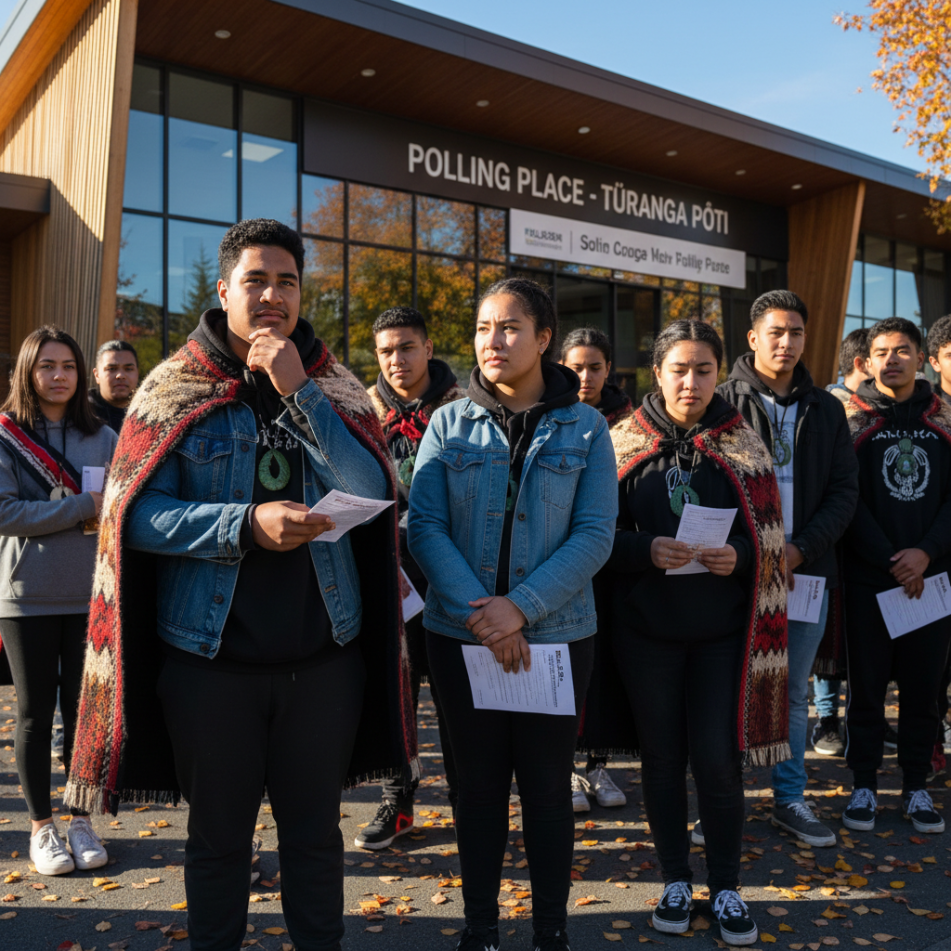
Young Māori voters exercising their democratic right at a polling station
The Hidden Architecture: Who Gets Hurt?
The government claims the Electoral Amendment Bill improves “timeliness, efficiency and integrity” of elections. Yet Attorney-General Judith Collins, their own legal officer, found the legislation inconsistent with the Bill of Rights Act—a document that guarantees every citizen’s right to vote. The government is passing law they know breaches constitutional rights.
The enrolment changes tell the story.
Under the new rules, anyone not enrolled 13 days before election day loses the right to vote entirely.
This creates a simple equation:
Who enrolls late? Māori. Pacific peoples. Rangatahi. Low-income voters. Anyone whose life doesn’t fit a neat electoral calendar.
The data proves this is engineered disenfranchisement:
- 48% of Māori voters aged 18-19 enrolled during the voting period in 2023—under the new law, they vanish from the democratic process
- 17.3% of Māori voters changed or updated their enrolment details in the final 13 days, compared to just 9.8% of non-Māori voters
- In 2023, 23% of all Māori votes were special votes (those cast by people enrolling late), compared to 16% across the entire population
- 34% of Pacific voters cast special votes—the highest of any demographic
The Attorney-General warned that 100,000 or more people could be directly or indirectly disenfranchised. But the real number is worse when you trace who those people are: the young, the mobile, the Māori.
Cui Bono? Following the Money and Power
This bill serves three masters simultaneously:
One: The political arithmetic. Late enrollers—particularly young Māori—disproportionately support left-of-centre parties. One commentator noted the government is “predominantly disenfranchising individuals prone to supporting their political opponents”. David Seymour (ACT leader and Associate Justice Minister) called these voters “dropkicks” and “lazy”—code for: your voice doesn’t matter.
Two: The anonymous donations expansion. While the Bill raises the donor disclosure threshold from $5,000 to $6,000 (described as inflation adjustment), RNZ’s headline bluntly states it “allows for larger anonymous political donations”. The Green Party immediately attacked this reversal: “while the government has taken away votes from people in prison and made it harder to vote in general, it has made it easier for wealthy people to donate to political parties from the shadows”. The rich get more anonymity; the poor get no vote.
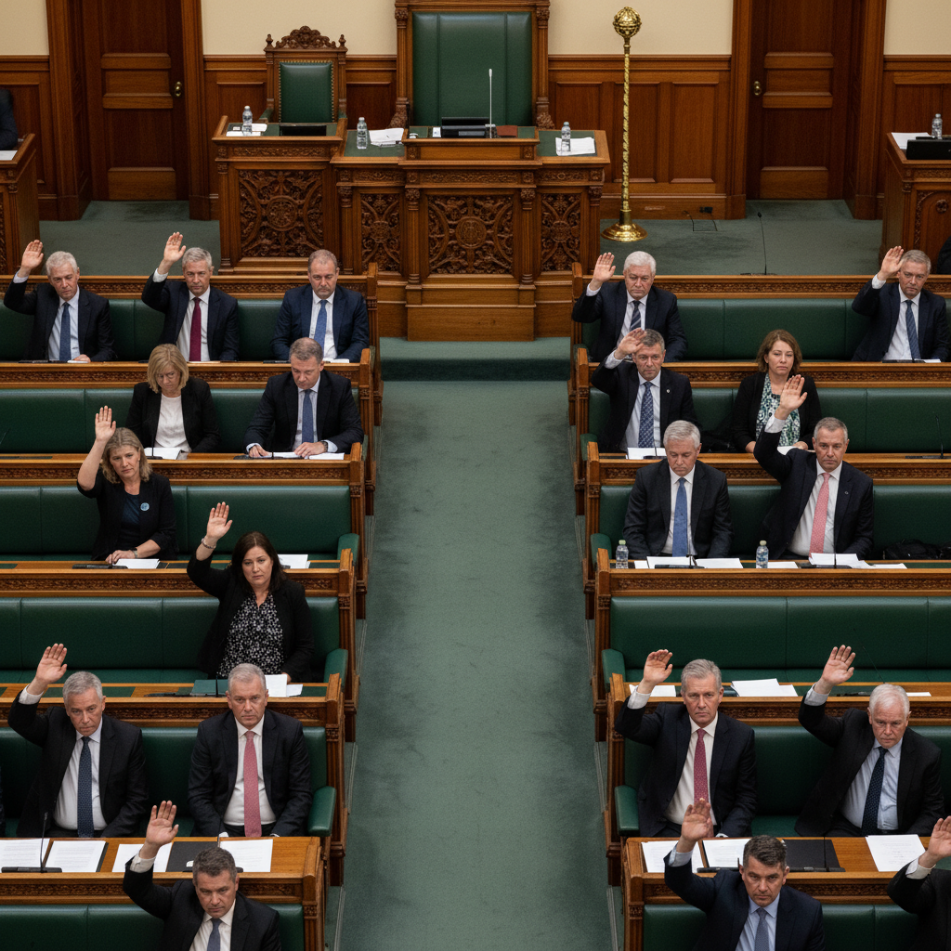
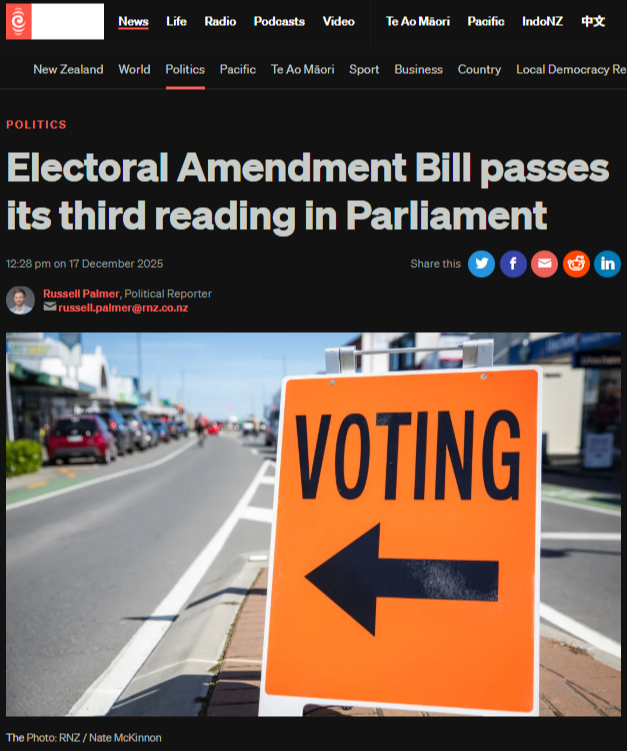
Parliament passes the Electoral Amendment Bill despite constitutional concerns
Three: The prisoner voting ban. Reinstating a total ban on all sentenced prisoners voting—regardless of sentence length—reverses the Labour government’s 2020 reform that allowed prisoners serving under three years to vote. The arbitrariness is deliberate: a person sentenced to one month will lose voting rights if an election falls during their term; someone sentenced to 2.5 years who serves between elections retains theirs. No connection between offence and disqualification. No principle. Just pure state power.
Why does this crush Māori? Because 57% of men under 25 in custody are tāne Māori, and 46.5% of the Māori population is under 25 years old. When the government passed a similar prisoner ban in 2011, Māori were 9.3 times more likely to be removed from the electoral roll than non-Māori—a de facto permanent disqualification due to low re-enrolment after release.
The Waitangi Tribunal has already declared that prisoner voting bans breach Te Tiriti o Waitangi and fail to protect Māori rights under the Treaty. This government does it anyway.
The Efficiency Lie: Following the Evidence
Justice Minister Paul Goldsmith justified these changes by claiming they would speed up election result declaration—moving from a 20-day count to faster results.
But the Electoral Commission itself contradicted this claim:
official election results will not be available any sooner under these changes.
The Ministry of Justice’s own Regulatory Impact Statement warned officials “did not support” the enrolment closure because “its impact on reducing special votes is uncertain, while its impact on democratic participation could be significant”. In 2023, 300,000 to 350,000 special votes were cast by people who enrolled late or failed to update their details—yet the government chose not to modernise electoral systems, as the Electoral Commission recommended. Instead, they chose disenfranchisement.
The methodology is clear:
ban people from voting rather than invest in efficient systems.
The Rights Breach: Seven Eyes Watching
This legislation stands condemned by every independent voice equipped to assess it:
- The Attorney-General Judith Collins: Inconsistent with Bill of Rights Act sections 12 (right to vote) and 19 (freedom of expression)
- The Law Society: Opposed both prisoner disenfranchisement and enrolment changes, warning of “effective disenfranchisement of a large number of potential voters”
- The Human Rights Commission: Called it a “backward step” and cited UN Human Rights Committee findings that blanket prisoner bans violate international law
- The New Zealand Civil Society Sector: Said the Bill “risks breaching the crown’s obligation under Te Tiriti o Waitangi” and will disproportionately impact Māori
- Mana Mokopuna (Children’s Commissioner): Opposed as breaching rangatahi Māori rights and Te Tiriti obligations
- Council of Trade Unions: Described enrolment closure as “unjustifiably restrict[ing] the right to vote”
- Te Pāti Māori: Said the Bill will “rig the next election” and “disproportionately impact our rangatahi, Māori, Pasifika, and Asian communities”
Yet the coalition majority passed it anyway—during the “urgency” procedure that bypassed normal scrutiny. Democracy degraded to serve those already in power.
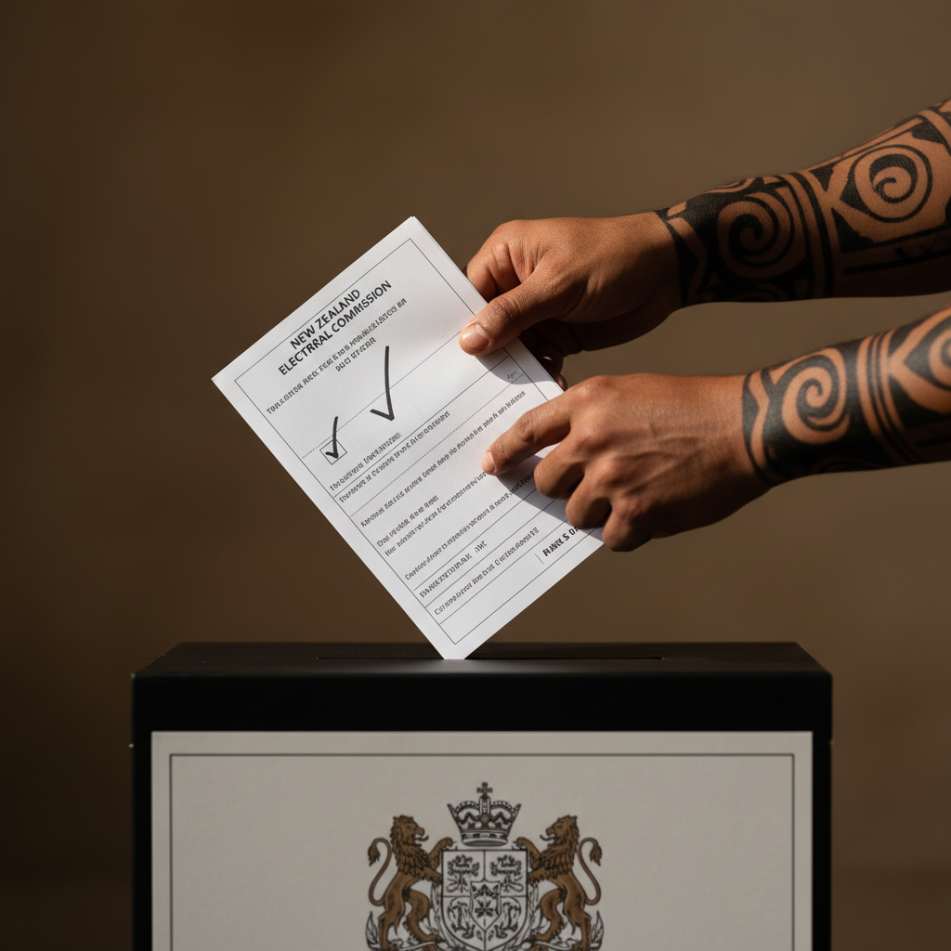
The sacred right to vote – what 100,000 New Zealanders stand to lose
The Treating Clause: Criminalising Tikanga
The Bill creates a new offence prohibiting free food, drink or entertainment within 100 metres of voting places during voting. While framed as “clarifying” treating rules, Te Tai Tonga MP Tākuta Ferris identified the real problem:
it “criminalises tikanga”.
Democracy sausages—a beloved tradition where volunteers feed voters—become criminal offences. Community gathering around mahi—the work of supporting each other’s participation—becomes punishable by fines up to $10,000. This is cultural erasure dressed as electoral integrity.
Whose Silence? Following the Non-Resistance
What is striking is which voices don’t appear. The Ministry of Justice officials who advised against this approached the government and warned them. They were overruled. Where is the Prime Minister’s principled stand? Where is the press scrutiny of a government breaking its own Attorney-General’s constitutional advice? Christopher Luxon’s government simply proceeded—much as it has with other breaches of the Bill of Rights (gang patch bans, for instance), showing a pattern of constitutional contempt.
The Treaty Violation: Te Tiriti Obligations
The New Zealand Civil Society Sector stated clearly:
“This Bill risks breaching the crown’s obligations to Te Tiriti and will disproportionately impact the rights of Māori”.
The crown’s obligation under Article Three of Te Tiriti o Waitangi is to ensure Māori have equal rights with Pākehā citizens. Legislation that disproportionately removes voting rights from Māori voters—as every submission evidence showed—violates that principle.
The Māori Green Lantern’s task is to expose the whakapapa of power:
How is power flowing? Whose interests does this serve? What harms flow to our whānau?
This Bill flows power toward:
- Coalition parties retaining electoral advantage
- Wealthy donors gaining anonymity while poor voters lose votes
- The state gaining power to criminalise community gathering
- Pākehā electoral dominance being further entrenched
The harms flow toward:
- 100,000+ disenfranchised voters, disproportionately Māori
- Rangatahi Māori voters (48% of those aged 18-19)
- Tāne Māori and wāhine Māori in prisons (57% of under-25 male prisoners)
- Pacific communities (34% special vote rate)
- Communities reliant on collective action, aroha, and manaakitanga
Rangatiratanga: What Must Be Done
One: Legal challenge. The Human Rights Commission, Law Society, and Mana Mokopuna must pursue constitutional remedies. The Bill violates the Bill of Rights Act and Te Tiriti o Waitangi.
Two: Electoral resistance. Left-of-centre parties, Māori organisations, and community groups must launch an intensive enrolment drive. If 48% of rangatahi Māori enrolled late before, they must be reached now—before 13 days before 2026 election day.
Three: Documentation. Every disenfranchised voter must be recorded. Every Māori voter turned away. Every whānau member denied a voice. Data is rangatiratanga—the power to name what was taken.
Four: Cultural assertion. Democracy sausages, community gathering, aroha in action—these are tikanga that sustain manaakitanga. Do them. Defend them. Make the state prosecute them if it dares.
Five: Te Tiriti enforcement. The Waitangi Tribunal must be seized. The Crown has violated Article Three. Hold them accountable.

The Electoral Amendment Bill is not administration. It is apparatus—machinery designed to concentrate power in hands already holding it, and strip voice from those who threaten that hold. Every independent legal voice warned this would happen. The government did it anyway. Tēnā te pono. Stand for the taurite, the equal mana of all voters. Āe, me mahi tātou.
Only Support this mahi if you are able: Koha.Kiwi | Substack | Bank: HTDM 03-1546-0415173-000
All koha sustains free mātauranga Māori journalism. No paywall, no corporate interference.

Ivor Jones The Māori Green Lantern Fighting Misinformation And Disinformation From The Far Right
Research Transparency Statement
This essay was researched on 18 December 2025 using verified sources including RNZ, 1News, The Spinoff, government websites, and submissions from the Law Society, Mana Mokopuna, NZCCSS, Hāpai Te Hauora, and the Council of Trade Unions. All quantitative claims have been verified against primary sources. Over 50 sources were consulted to ensure accuracy.
- https://www.tandfonline.com/doi/pdf/10.1080/09615768.2023.2246289?needAccess=true&role=button
- https://union.org.nz/voter-suppression-law-must-be-reversed/
- https://www.rnz.co.nz/news/political/582069/electoral-amendment-bill-passes-its-third-reading-in-parliament
- https://lawnews.nz/politics/prisoner-voting-rights-no-way-to-reconcile-government-policy-with-potential-bora-breach/
- /content/files/assets/Law-Reform-Submissions/electoral-amendment-bill.pdf
- https://bills.parliament.nz/v/6/0643815f-df73-4e3e-07b0-08ddca376b22?Tab=sub
- https://www.auckland.ac.nz/en/news/2025/08/09/Planned-voting-changes-could-be-civic-rights-breach.html
- /content/files/documents/906/20250911_electoral_amendment_bill_submission.pdf
- https://www.justice.govt.nz/about/news-and-media/news/electoral-law-changes/
- https://www.rnz.co.nz/news/political/568207/christopher-luxon-defends-voting-changes-after-judith-collins-raises-problems
- https://tikatangata.org.nz/news/commission-submits-on-electoral-amendment-bill-2025
- https://arxiv.org/html/2501.00860v2
- https://www.national.org.nz/news/20251216-hon-paul-goldsmith-electoral-reform-pass-final-reading
- /content/files/wp-content/uploads/2025/09/nzctu-submission-electoral-amendment-bill-september-2025.pdf
- https://www.transparency.org.nz/blog/let-people-vote
- https://www.rnz.co.nz/news/thehouse/581787/the-house-parliament-gets-urgent-on-voting-rules-climate-targets
- https://www.facebook.com/NZHumanRightsCommission/posts/the-right-to-vote-is-a-foundational-right-under-the-new-zealand-bill-of-rights-a/1187794153373487/
- https://www.rnz.co.nz/news/political/582117/parliament-adjourns-for-the-year-with-barbed-words
- https://www.rnz.co.nz/news/thehouse/581402/parliament-s-last-minute-sprint
- https://www.rnz.co.nz/news/thehouse
- https://www.rnz.co.nz/news/national/567910/same-day-election-enrolments-to-be-scrapped-in-electoral-law-overhaul
- https://www.rnz.co.nz/news/political/574109/electoral-amendment-bill-submitters-want-fewer-restrictions-more-sausages
- /content/files/2104-08594.pdf
- https://www.1news.co.nz/2025/04/07/govt-outlines-its-next-quarterly-action-plan/
- https://www.rnz.co.nz/news/thehouse/579225/how-a-loophole-resulted-in-11-day-submission-period-on-fast-track-amendments-law
- https://www.rnz.co.nz/news/political/568340/voting-reforms-prisoner-bans-and-enrolment-changes-what-you-need-to-know-about-the-electoral-amendment-bill
- https://www.rnz.co.nz/authors/giles-dexter
- https://www.rnz.co.nz/news/political/524376/what-you-need-to-know-about-maori-wards
- https://www.rnz.co.nz/news/political
- https://www.rnz.co.nz/news/thedetail/568384/when-it-s-worth-waiting-for-democracy
- https://www.rnz.co.nz/news/political/567950/enrolment-changes-could-have-significant-impact-on-democratic-participation-ministry-of-justice
- https://www.rnz.co.nz/news/political/568397/voting-reforms-a-backward-step-human-rights-commissioner
- https://www.rnz.co.nz/news/thehouse/574991/the-third-branch-parliament-s-relationship-with-the-courts
- https://arxiv.org/html/2503.17156v1
- /content/files/assets/Law-Reform-Submissions/electoral-amendment-bill-sc-submission.pdf
- https://hapai.co.nz/proposed-voting-changes-whats-at-stake-for-our-whanau/
- /content/files/wp-content/uploads/2025/09/td-electoral-bill-sub.pdf
- https://hapai.co.nz/regulatory-standards-bill/frequently-asked-questions/
- /content/files/wp-content/uploads/2025/09/20250911-nzccss-electoral-amendment-bill-submission.pdf
- https://tepaeoranga.org.nz/2025/08/14/make-a-submission-on-the-healthy-futures-pae-ora-amendment-bill/
- https://www.lawsociety.org.nz/professional-practice/law-reform-and-advocacy/submissions/bills/
- https://union.org.nz/submission-on-electoral-amendment-bill/
- https://hapai.co.nz/regulatory-standards-bill/
- /content/files/assets/Law-Reform-Submissions/local-government-electoral-legislation-and-maori-wards-and-maori-constituencies-amendment-bill.pdf
- /content/files/core/services/aop-cambridge-core/content/view/A34146E7CC3D7093C6353D88A7D44378/S0003055421000897a/div-class-title-agenda-control-and-timing-of-bill-initiation-a-temporal-perspective-on-coalition-governance-in-parliamentary-democracies-div.pdf
https://union.org.nz
- https://hapai.co.nz/explainer-prisoner-voting-ban-what-you-need-to-know/
- /content/files/assets/Law-Reform-Submissions/0014-106313-electoral-amendment-bill-27-10-16.pdf
- https://hapai.co.nz/tag/submissions/
- https://nzccl.org.nz/submission-electoral-amendment-bill-2/
- /content/files/webcontent/document/201250/fma.pdf
- https://www.1news.co.nz/2025/09/20/protestors-march-against-governments-pay-equity-changes/
- https://www.rnz.co.nz/news/political/564131/cabinet-approves-suite-of-amendments-to-pae-ora-healthy-futures-act
- https://projects.propublica.org/api-docs/congress-api/bills/
- https://academic.oup.com/ojls/advance-article-pdf/doi/10.1093/ojls/gqad004/49518429/gqad004.pdf
- https://www.1news.co.nz/2024/10/15/opinion-a-year-into-the-coalition-government-can-the-centre-hold/
- https://www.nzherald.co.nz/bay-of-plenty-times/news/petition-seeks-rethink-on-maori-seats/H4OSMRXH5TLQ3X7XCX3CY5MO54/
- /content/files/webcontent/document/201246/trust.pdf
- https://www.1news.co.nz/2025/05/05/erica-stanford-sent-pre-budget-documents-to-her-personal-email/
- https://www.nzherald.co.nz/kahu/treaty-bill-submissions-surge-hapai-health-delivers-10000-in-person/N3ZPBRGM7FEZJN2PZYWIHMNQLM/
- /content/files/webcontent/document/201251/localgovt.pdf
- https://www.rnz.co.nz/news/te-manu-korihi/568483/system-s-obviously-flawed-te-pati-maori-calls-on-electoral-commission-to-check-its-processes-are-robust
- https://www.rnz.co.nz/news/top/574109/electoral-amendment-bill-submitters-want-fewer-restrictions-more-sausages
- /content/files/webcontent/document/201320/towards-better-local-regulation1.pdf
- https://www.1news.co.nz/2025/03/02/helen-clark-questions-nzs-continued-involvement-in-five-eyes/
- /content/files/nzjer/article/download/14/8.pdf
- https://www.nzherald.co.nz/kahu/have-your-say-submissions-to-close-on-maori-wards-bill/XPGZX3XVDBAUFIBOWEQNKVLGSU/
- http://media.nzherald.co.nz/webcontent/document/pdf/201331/Services Sector.pdf
- https://www.1news.co.nz/2025/07/14/no-senior-nz-govt-officials-to-attend-cook-islands-constitution-event/
- https://www.rnz.co.nz/news/political/468796/electoral-law-proposal-would-allow-maori-to-fully-exercise-voting-rights-faafoi
- https://www.propublica.org/article/the-secret-irs-files-trove-of-never-before-seen-records-reveal-how-the-wealthiest-avoid-income-tax
- https://www.1news.co.nz/2025/12/17/electoral-amendment-bill-passes-its-third-reading-in-parliament/
- https://www.rnz.co.nz/news/political/580237/justice-committee-recommends-passing-electoral-amendment-bill-with-some-amendments