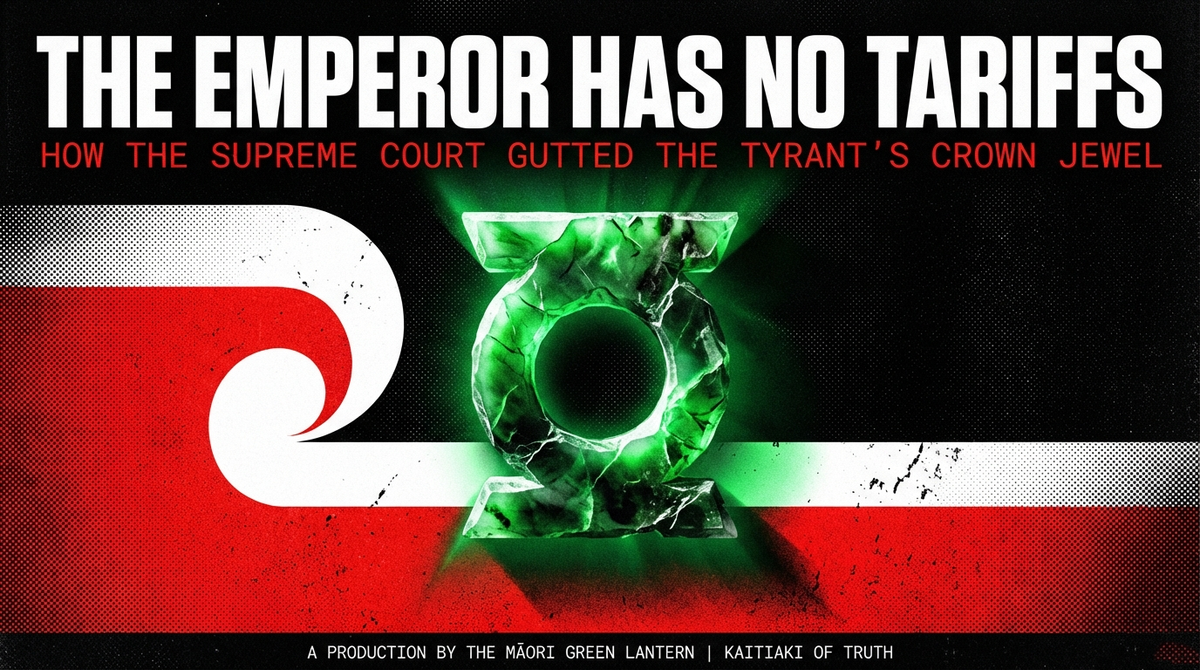
"THE EMPEROR HAS NO TARIFFS: How His Own Court Gutted the Tyrant's Crown Jewel and Exposed the Fraud of "Liberation Day"" - 21 February 2026
They built him a throne of emergency powers. His own judges kicked the legs out. Now $142 billion in stolen revenue sits in a constitutional ditch, and the man who promised to make America rich stands naked before the world

Mōrena Aotearoa,
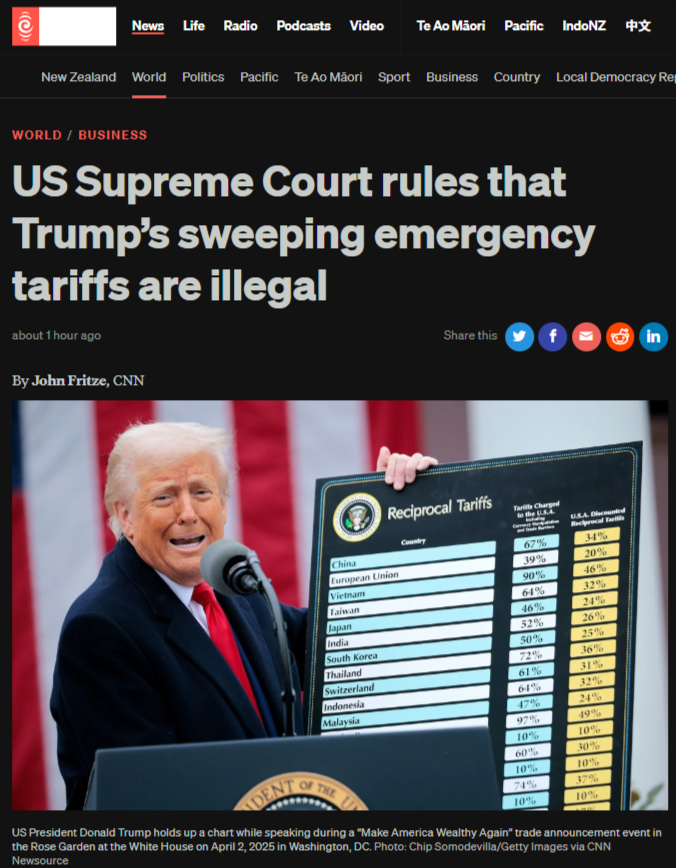
Get ready for things to pop off around the globe as Koro Trump creates an emergency in response to this.
Karakia: The Taiaha That Turned in His Hands
Unuhia te rito o te harakeke — kei whea te kōmako e kō?
Ki mai ki ahau, he aha te mea nui o te ao?
Māku e kī atu — he tangata, he tangata, he tangata.
Pull out the heart of the flax bush — where will the bellbird sing?
Ask me what is the greatest thing in the world?
I will reply — it is people, it is people, it is people.
Donald Trump pulled out the heart of the American constitutional flax bush and expected the bellbird to keep singing his name. On 20 February 2026, the Supreme Court of the United States told him: the bellbird is dead, and you killed it.
The Kill Shot: What Happened
On Friday 20 February 2026, the United States Supreme Court drove the taiaha straight through the rotting heart of Donald Trump's economic agenda. In a 6-3 ruling in Learning Resources, Inc. v. Trump, Chief Justice John Roberts declared what the Constitution has said since 1787: Congress, not any one man, controls the power to tax the American people.
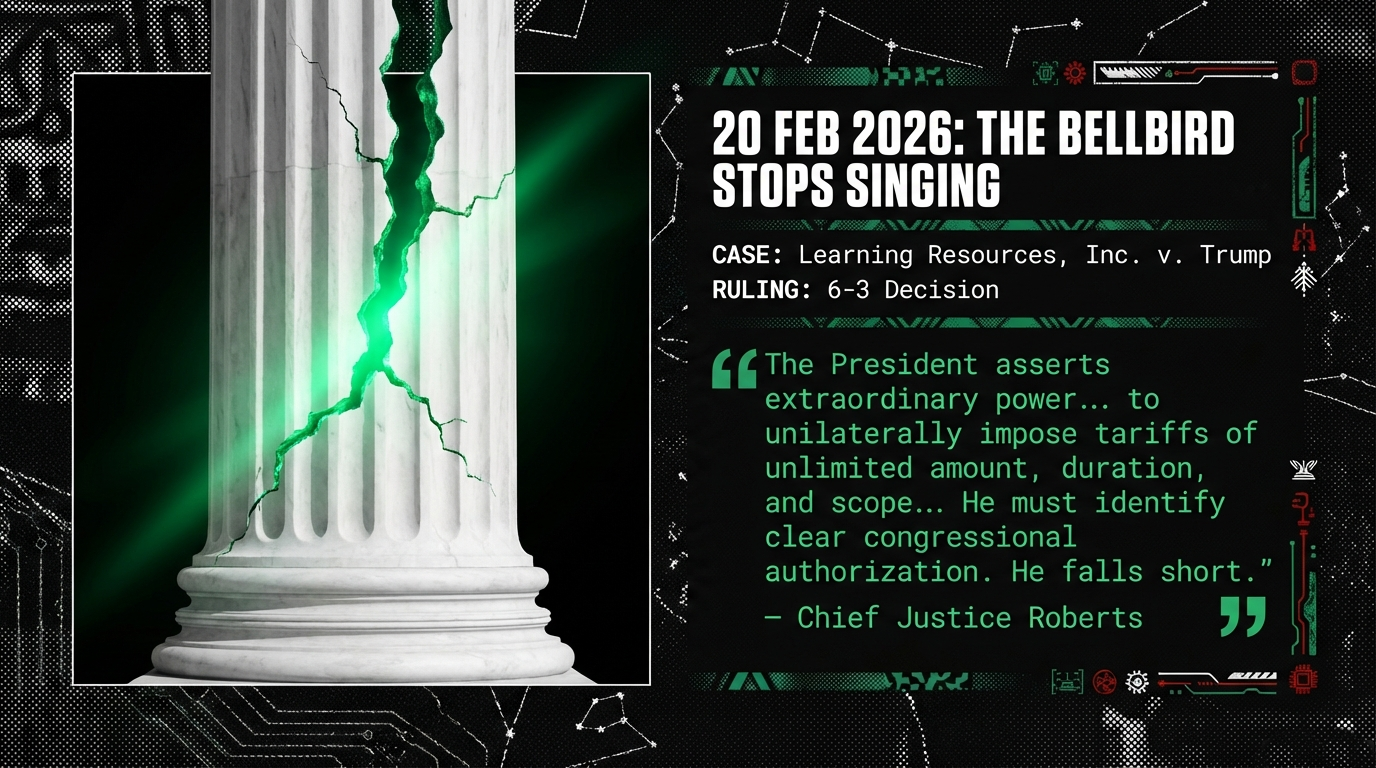
"The President asserts the extraordinary power to unilaterally impose tariffs of unlimited amount, duration, and scope," Roberts wrote. "In light of the breadth, history, and constitutional context of that asserted authority, he must identify clear congressional authorization to exercise it. IEEPA's grant of authority to 'regulate … importation' falls short."
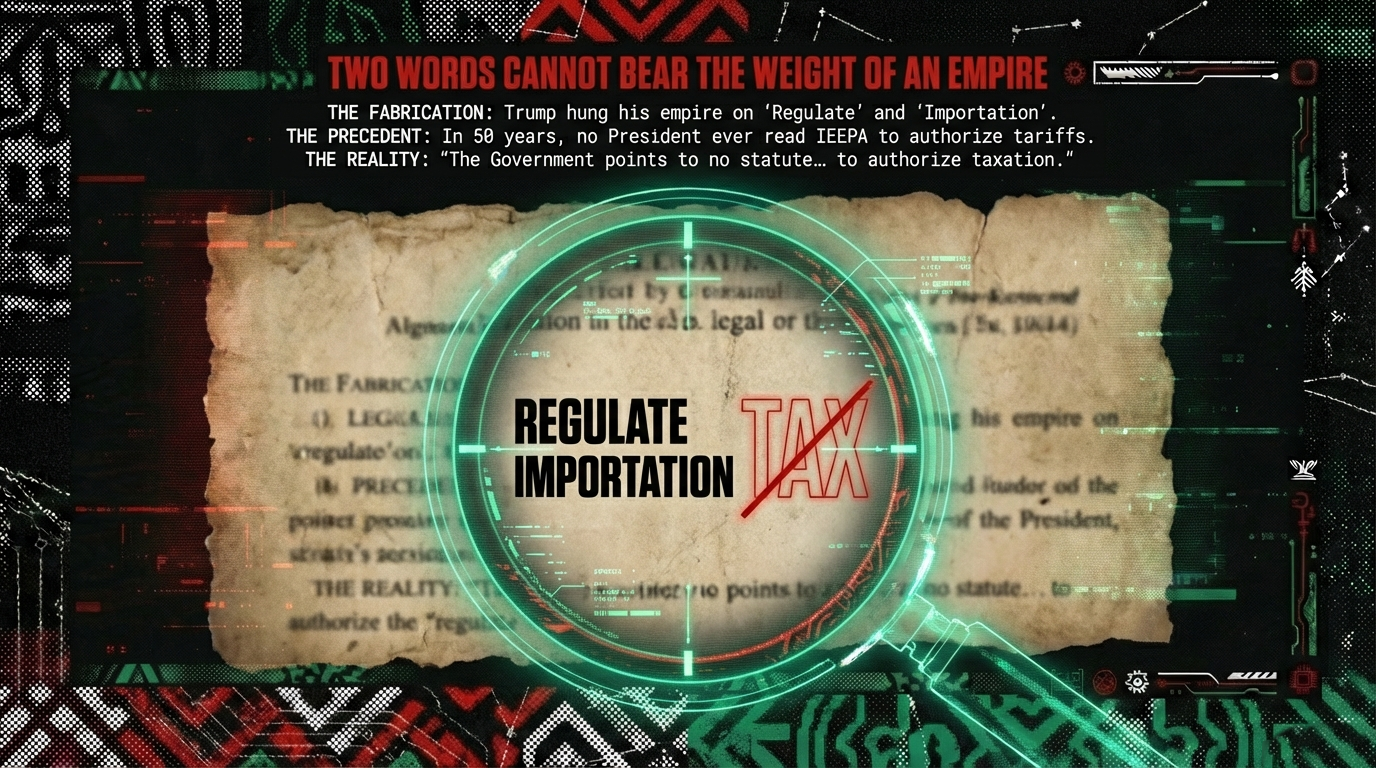
Two words. That is all Trump hung his entire economic empire upon — "regulate" and "importation," separated by 16 other words in the International Emergency Economic Powers Act. The Supreme Court ruled those two pathetic syllables cannot bear the weight of a global tariff regime that extracted over $142 billion from American importers in a single year.
The man who promised to make America rich instead made it an unconstitutional toll booth — and the highest court in the land just padlocked the gate, changed the locks, and threw the key into the Potomac.
Koha: Fund the Taiaha That Holds Power to Account
This essay exists because whānau fund it. Not the Crown. Not corporate media. Not the very power structures whose failures fill these pages.
Every koha signals that rangatiratanga includes the power to fund our own truth-tellers — even when emperors scream "disgrace" and sycophants howl about "betrayal." Your koha says what the Supreme Court just confirmed: one man does not get to decide what the people pay. The people decide.
Kia kaha, whānau. Stay vigilant. Stay connected. And if you are able, consider a koha to ensure this voice continues to wield the taiaha — because the wounded beast is not finished, and neither are we.
If you are unable to koha, no worries! Subscribe, follow, kōrero and share with your whānau and friends — that is koha in itself.
Three pathways exist:
For those who wish to support this mahi directly with a koha (voluntary contribution), please visit the Koha platform:
Koha — Support: https://app.koha.kiwi/events/the-maori-green-lantern-fighting-misinformation-and-disinformation-ivor-jones
For those who wish to receive essays directly and support through subscription:
Subscribe to the Māori Green Lantern: https://www.themaorigreenlantern.maori.nz/#/portal/support
For those who prefer direct bank transfer, account details are:
HTDM, account number 03-1546-0415173-000.
Timeline: The Hour the Empire Crumbled
For the Western mind accustomed to linear time, here is the chronological autopsy of Trump's worst day since he discovered Eric was supposed to be running the business:
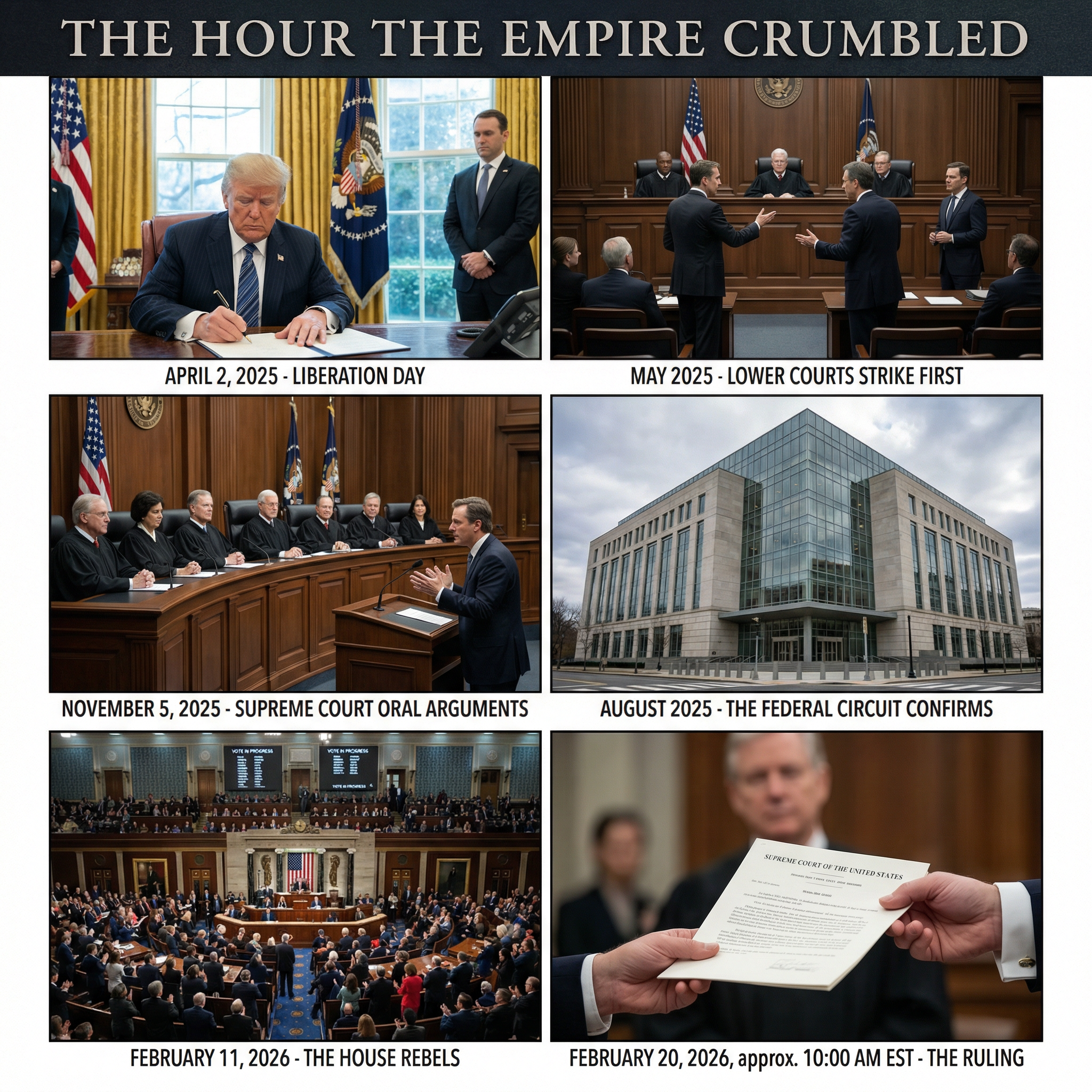
April 2, 2025 — "Liberation Day"
Trump imposes sweeping "reciprocal" tariffs on over 100 countries, with rates as high as 145% on China and 50% on India and Brazil, invoking the 1977 International Emergency Economic Powers Act. He calls it the most important day in American economic history. It was, in fact, the day he signed his own constitutional death warrant.
May 2025 — Lower Courts Strike First
The U.S. Court of International Trade rules Trump's tariffs unlawful. A separate federal district court in Washington reaches the same conclusion. Two courts. Same answer. Trump screams "judicial overreach." The courts stay their rulings, allowing tariff collection to continue.
August 2025 — The Federal Circuit Confirms
The Court of Appeals for the Federal Circuit rules 7-4 that Trump exceeded his powers. Trump posts: "If allowed to stand, this Decision would literally destroy the United States of America." Spoiler: America survived.
November 5, 2025 — Supreme Court Oral Arguments
Justices Barrett and Gorsuch — Trump's own appointees — ask devastating questions of the administration. Barrett demands: "Is it your assertion that every nation required tariffs?" The Solicitor General flounders. The writing is on the wall. Trump cannot read it.
February 11, 2026 — The House Rebels
Nine days before the ruling, the House votes 219-211 to rescind tariffs on Canada — a bipartisan rebuke of a sitting president's signature policy. The smell of blood is in the water.
February 20, 2026, approximately 10:00 AM EST — The Ruling
The Supreme Court issues its decision. 6-3. Trump loses. His own appointees Barrett and Gorsuch join the majority. Roberts writes: "IEEPA does not authorize the President to impose tariffs."
February 20, 2026, approximately 10:05 AM EST — The Meltdown
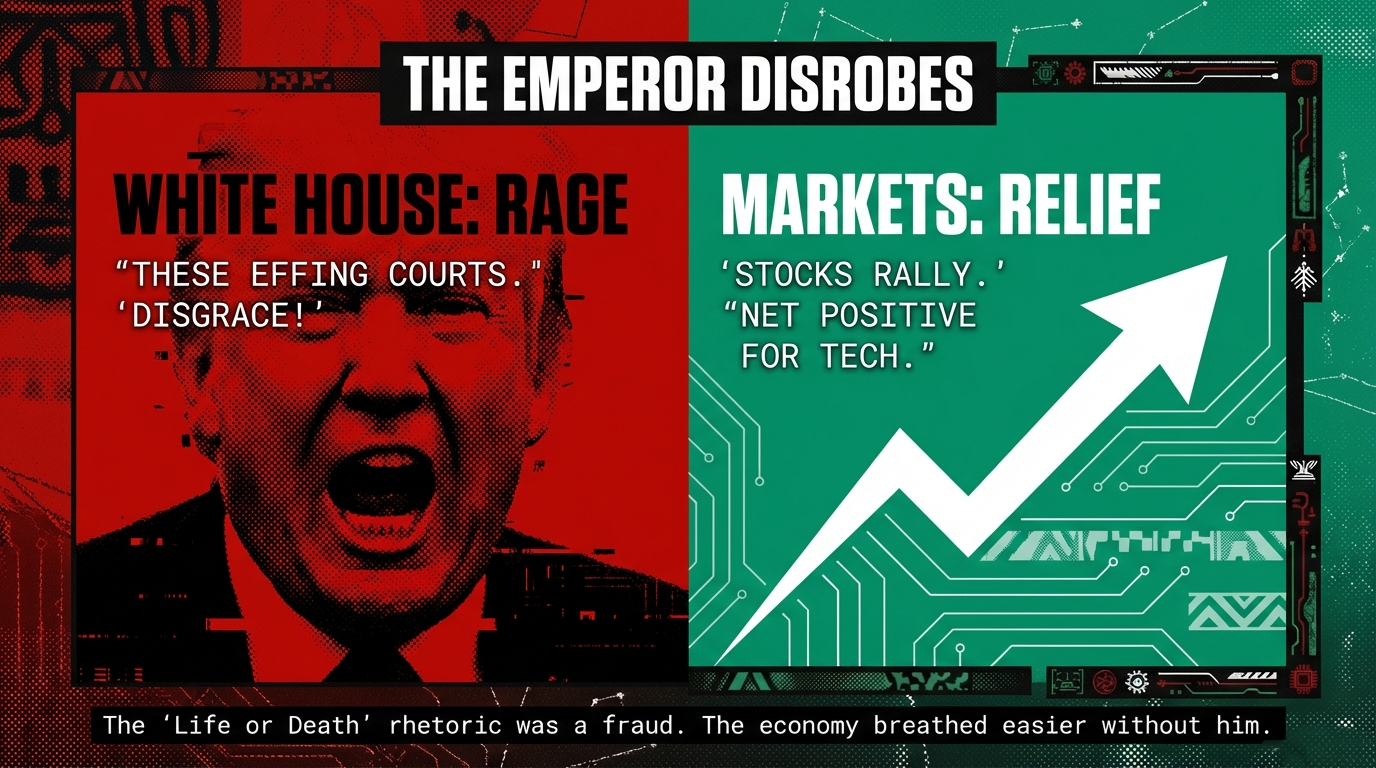
An aide enters the White House State Dining Room where Trump is hosting governors for breakfast. A note is passed. According to CNN's Kristen Holmes: "President Trump became enraged. He started ranting about the decision, not only calling it a disgrace, but started attacking the courts, at one point saying 'these effing courts' — but using the actual language there." Trump personally orders the press to leave the room. The emperor does not wish witnesses to his disrobing.
February 20, 2026, approximately 10:15 AM EST onward — MAGA Implosion
Alex Bruesewitz: "This is a total disgrace!" Rep. Bernie Moreno: "This betrayal must be reversed!" Laura Loomer: "This is the real-world consequence of Leonard Leo's betrayal." Jack Posobiec: "Trump can, will, and should reimpose the tariffs by other means." Gunther Eagleman calls Mike Pence a "traitor" for praising the ruling. The far right calls Barrett and Gorsuch "the usual suspects who betrayed us".
February 20, 2026 — Markets React
Stocks rally modestly. European markets surge. The Morningstar Europe Index rises 0.83%. Dan Ives of Wedbush calls it "a net positive for the tech sector". The market's verdict is clear: Trump's tariffs were a drag on the economy, not a gift to it.
February 20, 2026 — Republican Fracture
Senator Rand Paul: "In defense of our Republic, the Supreme Court struck down using emergency powers to enact taxes." Rep. Don Bacon: "I feel vindicated. The checks and balances our Constitution puts in place works." House Speaker Mike Johnson offers tepid damage control about finding the "best path forward."
Neal Katyal, who argued the case for the challengers: "It is a reaffirmation of our deepest constitutional values and the idea that Congress, not any one man, controls the power to tax the American people." Complete and total victory.
The Split: His Own Taiaha Turned Against Him
This is where the ruling becomes not merely a legal defeat but a spiritual evisceration — a muru, a stripping of mana so complete that no amount of MAGA rallies can restore what was taken.
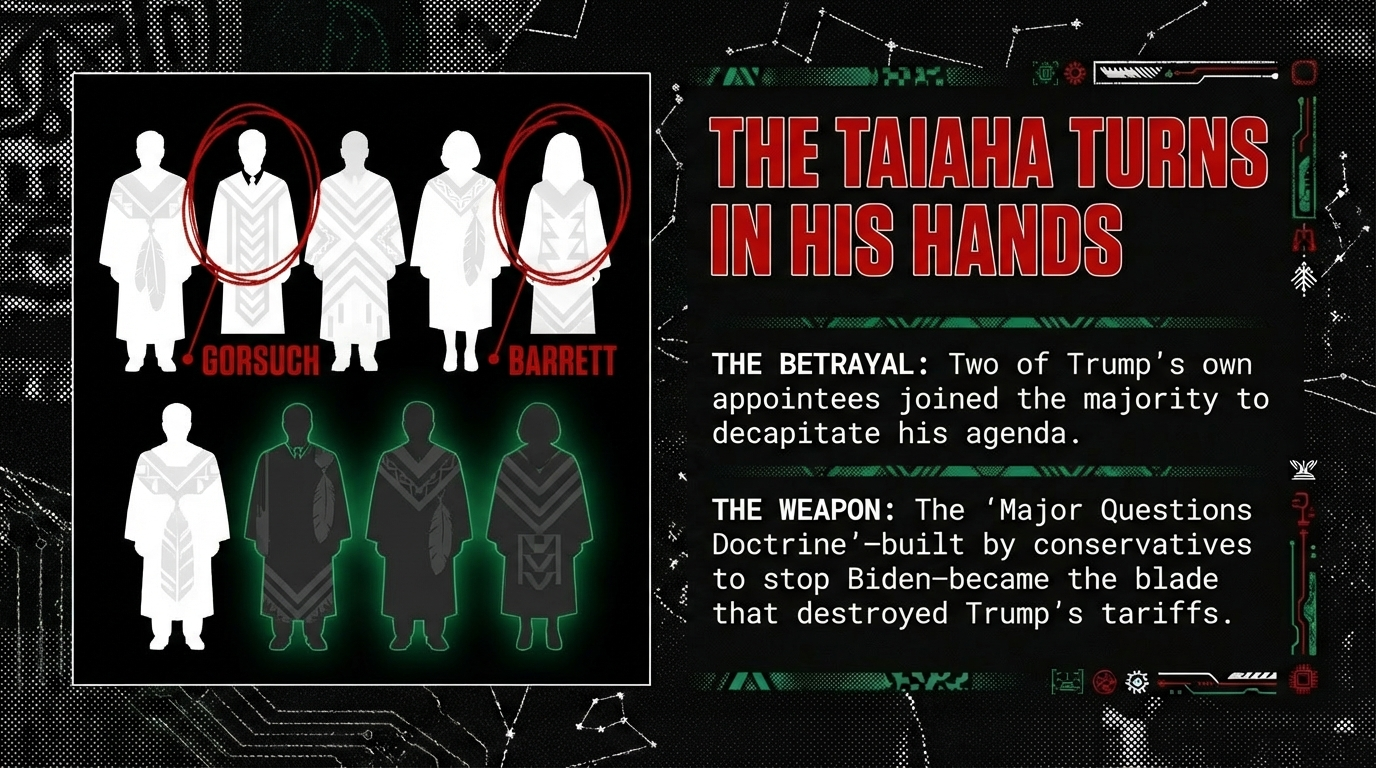
The Majority: The Wharenui Stands Against the Rangatira Who Lost His Way
The 6-3 majority was not some liberal ambush. It was led by Chief Justice John Roberts, a George W. Bush appointee, and joined by:
- Justice Neil Gorsuch — Trump's first Supreme Court appointee (2017)
- Justice Amy Coney Barrett — Trump's third Supreme Court appointee (2020)
- Justice Sonia Sotomayor — Obama appointee
- Justice Elena Kagan — Obama appointee
- Justice Ketanji Brown Jackson — Biden appointee
Two of the three justices Donald Trump personally placed on the Supreme Court voted to destroy his signature economic policy. Barrett and Gorsuch did not merely join the majority; they wrote separate concurrences elaborating why Trump was wrong. Gorsuch authored a 46-page concurrence — the second-longest writing in the entire case — defending the very doctrinal framework that decapitated Trump's agenda.
In te ao Māori, this is the equivalent of a rangatira's own toa — warriors he personally selected and armed — turning the taiaha back upon him in the whare. The weapon he forged became the instrument of his humiliation.
The Dissent: The Rump of Authoritarian Loyalty
Only three justices voted to save Trump: Clarence Thomas, Samuel Alito, and Brett Kavanaugh — the court's authoritarian rump, the judicial equivalent of the last three sycophants clinging to a sinking waka.
Kavanaugh authored a 63-page dissent — the longest writing in the entire case — arguing that "tariffs are a traditional and common tool to regulate importation." This dissent was not independent judicial reasoning. The Legalytics empirical analysis revealed it was a near-complete adoption of the Trump administration's own legal brief — "the textual argument, the Algonquin a fortiori framing, the Yoshida historical-practice argument, and the foreign-affairs MQD carveout in both sequence and emphasis."
The citation overlap between the Roberts majority and the Kavanaugh dissent? Approximately 9.3 percent. They were not having a legal debate. They were speaking different languages about different constitutions. The majority was reading the document the Framers wrote. Kavanaugh was reading the one Trump wished existed.
The Fracture Within the Majority
Even the victorious coalition fractured along methodological lines — a data point that exposes the depth of the constitutional crisis Trump created:
- Parts I, II-A-1, and II-B — the core ruling that IEEPA does not authorise tariffs — commanded all six justices.
- Parts II-A-2 and III — applying the major questions doctrine — were joined only by Roberts, Gorsuch, and Barrett. This is a three-justice plurality, not a majority holding.
- Justice Kagan, joined by Sotomayor and Jackson, explicitly rejected the major questions framing, stating that "ordinary tools of statutory interpretation are sufficient."
- Justice Jackson wrote separately to rely on legislative history — a method Gorsuch explicitly cautioned against.
They agree Trump was wrong. They disagree on why. This is what happens when a president is so catastrophically wrong about the law that six justices from opposing judicial philosophies can all see it, even if they cannot agree on which lens makes the wrongness most visible.
The Credibility Annihilation: A Mana Stripped Bare
The Doctrine That Ate Its Creator
The supreme irony — and it is exquisite in its cruelty — is that the legal weapon that destroyed Trump's tariffs was built by conservatives to destroy Biden.
The major questions doctrine holds that if Congress wants to delegate the power to make decisions of vast economic or political significance, it must do so clearly. Conservative justices wielded it to block Biden's student loan forgiveness in 2023 and his vaccine mandate in 2022.
Now Roberts and the plurality applied it directly to Trump. "There is no exception to the major questions doctrine for emergency statutes", Roberts wrote. The foreign-affairs implications do not change the principle.
Trump's own judicial philosophy — the interpretive architecture his Federalist Society allies spent decades building — became the weapon that dismembered his presidency's centrepiece policy. The taiaha turned in his hands and struck him between the eyes.
Fifty Years of Silence Scream
Roberts drove the blade deeper. In IEEPA's fifty-year existence, no president had ever invoked it to impose tariffs. Not Carter. Not Reagan. Not Clinton. Not Obama. Not even Trump himself in his first term.
"The Government points to no statute in which Congress used the word 'regulate' to authorize taxation," Roberts wrote. "And until now no President has read IEEPA to confer such power."
Every lower court that reviewed Trump's tariffs — the U.S. Court of International Trade, the Federal Circuit at 7-4, and a federal district court in Washington — had already ruled against him. The Supreme Court merely confirmed what was already a judicial consensus: Trump fabricated a power that did not exist, wielded it for a year, extracted $142 billion, and got caught.
The "Life or Death" Lie
Trump told the American people this case was "literally, life or death for our country". He screamed "WE'RE SCREWED!" on social media if the court ruled against him. He warned of "economic disaster".
The ruling came. The markets rallied. Europe cheered. Small businesses celebrated. Ann Robinson of Scottish Gourmet in North Carolina said she was "doing a happy dance" — her business had been haemorrhaging $30,000 per season under Trump's tariffs.
The "life or death" turned out to be this: life for the American economy once Trump's unconstitutional chokehold was removed, and death for the credibility of a president who told the nation the sky would fall without him. The sky held. The emperor fell.
The First Real Defeat
As ING's analysis noted with surgical precision: "This is the very first time the Supreme Court has effectively limited Trump's powers, which — at least in my view — is a strong statement that goes beyond trade."
Every previous Trump "win" at the Supreme Court came through the shadow docket — emergency orders without full briefing or oral argument. When the lights came on, when the full constitutional machinery engaged, when the justices had time to read, think, and reason — Trump lost. And lost decisively.
This is the credibility collapse that cannot be papered over: Trump's power rested not on legal authority but on the absence of scrutiny. The moment scrutiny arrived, the power evaporated. He was the Wizard of Oz, and the Supreme Court pulled back the curtain.
The Damage: Quantified and Devastating
The Yale Budget Lab calculated the carnage:
| Metric | With IEEPA Tariffs | After SCOTUS Ruling |
|---|---|---|
| Average effective tariff rate | 16.9% | 9.1% |
| Short-run consumer price increase | 1.2% | 0.6% |
| Average household cost (annual) | ~$1,600 | ~$800 |
| Lowest-income decile burden (% of income) | ~2.2% | ~1.1% |
| 10-year revenue projection | $2.4 trillion+ | $1.2 trillion |
| Long-run GDP reduction | 0.3% | 0.1% |
| Unemployment rate increase (end 2026) | ~0.6pp | ~0.3pp |
The Tax Policy Center estimated a reduction of $1.4 trillion in taxes on households over the next decade. Time magazine reported the average effective U.S. tariff rate fell from about 17% to roughly 9% following the ruling.
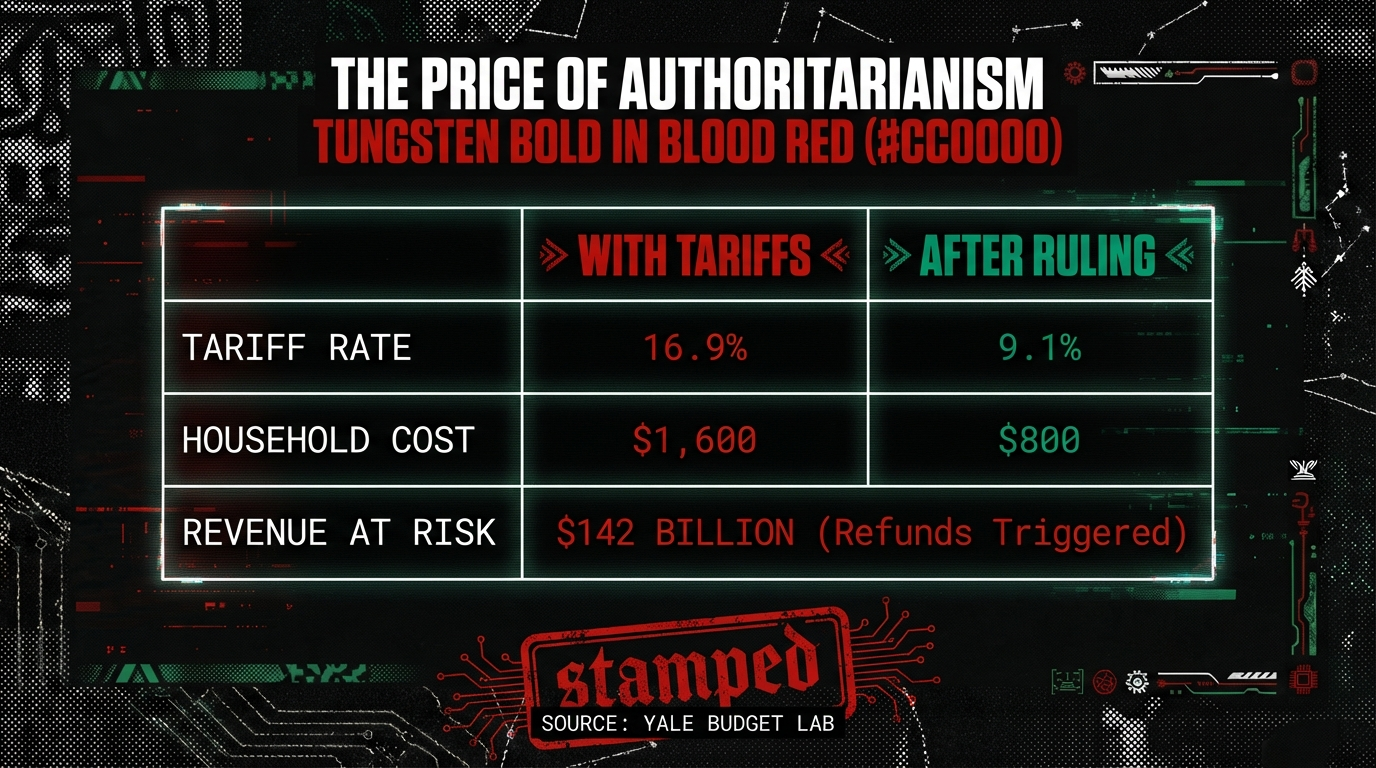
And the refund bomb: over $142 billion in IEEPA tariffs collected in 2025 is now potentially subject to refund claims. Companies including Costco have already filed in lower courts. As Kavanaugh admitted in his own dissent, the refund process will be a "mess".
Three Examples for the Western Mind: The Harm Made Visible Through Tikanga
For those raised in the Western tradition, the concepts of mauri (life force), mana (authority and prestige), and tikanga (the right way of doing things) may seem abstract. They are not. They are as real and measurable as a tariff rate, a bankruptcy filing, or a child going hungry because their parents' import business just collapsed. Here are three real-world examples that quantify the harm and translate the tikanga violation for those who need the numbers to feel the wound.
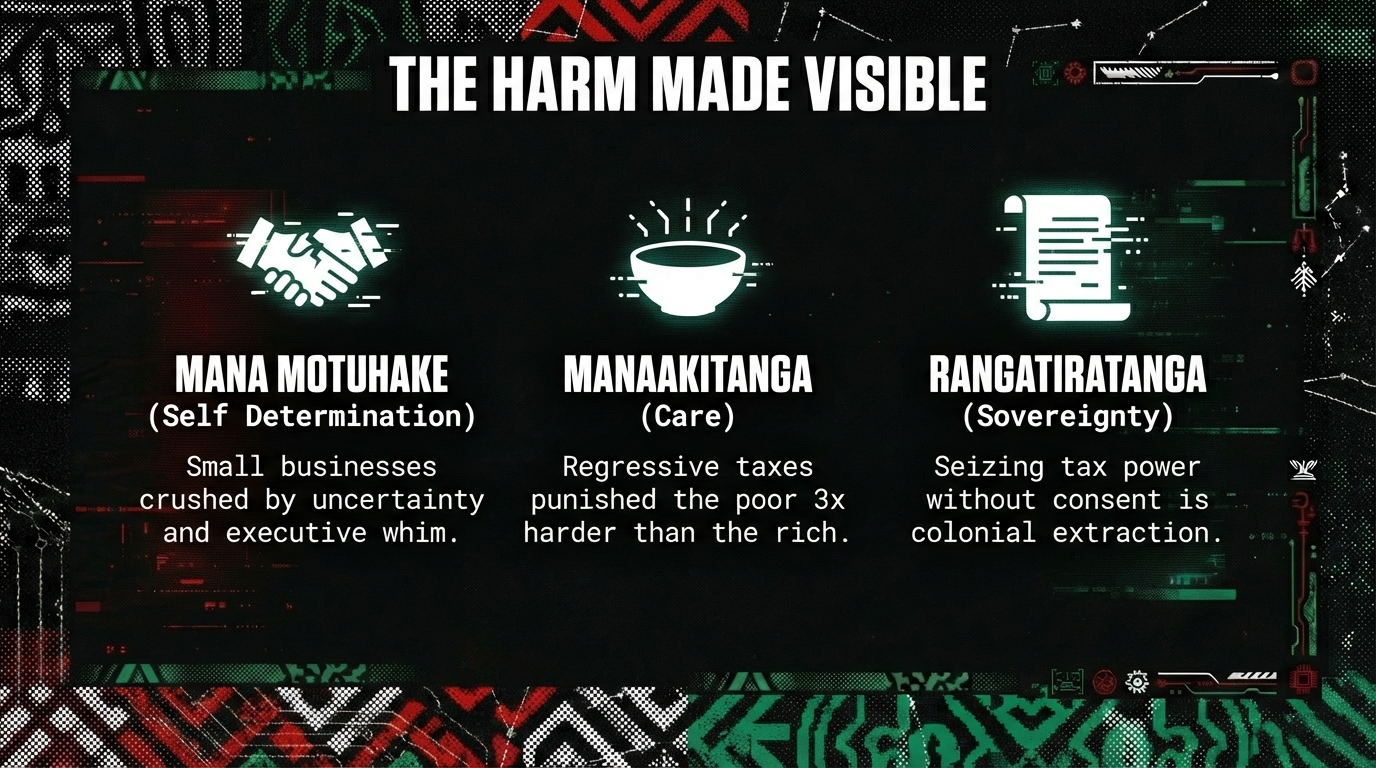
Example 1: The Small Business Slaughter — An Assault on Mana Motuhake
The harm: Learning Resources, Inc. — the Chicago-based educational toy company that brought the case — represents thousands of small businesses crushed under Trump's unconstitutional tariffs. These are not corporations. They are whānau enterprises. VOS Selections, a New York wine importer. Small plumbing suppliers. Women's cycling apparel makers. Every lower court recognised their devastation.
Ann Robinson of Scottish Gourmet in North Carolina lost $30,000 in a single season from the 10% baseline tariff on UK goods.
The tikanga violation: In te ao Māori, mana motuhake is the inherent right of a community or individual to determine their own affairs — to exercise authority over their own economic destiny. When a single man imposes a tax of unlimited amount, duration, and scope without the consent of the people's representatives, he does not merely break a law. He destroys mana motuhake. He says to every small business owner: your livelihood exists at my whim. Your planning is irrelevant. Your survival depends on my mood.
This is the same act, in different clothing, as the Crown's imposition of land taxes on Māori under the Native Land Court — taxes designed not to raise revenue but to force alienation. Trump's tariffs were not trade policy. They were a mechanism of control disguised as economics.
The solution: Congressional reassertion of tariff authority with transparent, predictable frameworks. Mandatory economic impact assessments for any proposed tariffs above 10%. Small business compensation funds for future trade disruptions. Independent review of all tariff exemptions, which ProPublica revealed were being distributed to politically connected firms.
As The Māori Green Lantern documented in "The Mirage of Prosperity: How Flawed Economic Indicators Perpetuate Inequality in the United States and New Zealand", the neoliberal trick is always the same: aggregate numbers that hide distributional devastation. Trump's $142 billion in tariff revenue was extracted disproportionately from the smallest businesses and the poorest consumers.
Example 2: The Regressive Tax Bomb — Whakamā Upon the Vulnerable
The harm: The Yale Budget Lab's distributional analysis confirms that tariffs are a brutally regressive tax. The burden, expressed as a share of post-tax-and-transfer income, falls three times harder on the lowest income decile (1.1%) than on the top decile (0.4%). The average annual cost to bottom-decile households: $400. To top-decile households: $1,800 — but they can absorb it.
With IEEPA tariffs in place, these numbers were twice as large. Trump was extracting income from families who could not afford groceries and handing it to a government that was simultaneously cutting social services.
The tikanga violation: In tikanga Māori, manaakitanga — the ethic of care, generosity, and hospitality — is not optional. It is the foundational obligation of any leader. A rangatira who taxes the poorest to fund their own prestige projects is not exercising leadership. They are committing whakamā — shame — upon the most vulnerable. They are depleting the mauri of the collective.
The Western economic term is "regressive taxation." The tikanga term is he mahi kino ki te hunga rawakore — a harmful act against the poor. The difference is that tikanga demands accountability. Economics merely describes the harm and moves on.
The solution: Any future tariff regime must include progressive offset mechanisms — direct payments to low-income households equivalent to their tariff burden. Tax refund mechanisms must be automatic, not dependent on filing claims. Consumer pass-through of refunds must be monitored and enforced.
As The Māori Green Lantern explored in "The Beehive's Hunger Games: How Libertarian Vultures Feed on the Poor While Preaching Freedom", the neoliberal pattern is global and consistent: extract from the bottom, accumulate at the top, call it "growth."
Example 3: The Constitutional Breach — The Destruction of Rangatiratanga Itself
The harm: Trump's tariffs were imposed without congressional authorisation, without time limits, without industry-specific constraints, and without investigation requirements. As the Supreme Court noted, other tariff statutes include all of these safeguards: Section 122 limits tariffs to 15% for 150 days. Section 232 requires a Commerce Department investigation. IEEPA had none of these constraints because it was never designed to authorise tariffs.
The "emergency" Trump declared — trade deficits that had persisted for nearly 50 years — was not an emergency. It was a structural feature of the American economy weaponised to seize a power the Framers explicitly denied the executive.
The tikanga violation: In te ao Māori, the concept of rangatiratanga — the inherent right of a people to self-determination and sovereignty — is the bedrock of all legitimate governance. When Trump imposed tariffs without congressional consent, he committed the constitutional equivalent of what the Crown did to Māori in 1840: he asserted kāwanatanga (governance) without the consent of the people, and then used it to extract economic resources. As Te Ara records, the Māori version of Te Tiriti preserved to Māori their rangatiratanga, while the Crown asserted sovereignty without their informed agreement. Trump asserted taxing power without the people's representatives' agreement.
The Framers of the U.S. Constitution — like the rangatira who signed Te Tiriti — understood that the power to tax is the power to destroy. That is precisely why they vested it in the collective body, not the individual. Trump's violation was not a technicality. It was an assault on the foundational tikanga of democratic governance.
The solution: Codify constraints on emergency economic powers. Require congressional ratification of any tariffs above 10% within 90 days. Create an independent trade review tribunal modelled on the separation of powers, not the concentration of them. As Bloomberg Law warned before the ruling, the very legitimacy of the court was at stake — and by extension, the legitimacy of the constitutional order.
As The Māori Green Lantern documented in "Back to Basics, Back to Brutality: How a 'Hodgepodge' of Bills Became the Most Coordinated Assault on Māori Rights, Workers, and Democracy in a Generation", the pattern of executive overreach is not uniquely American. In Aotearoa, the Luxon-Seymour-Peters coalition operates the same playbook: manufacture urgency, cite economic necessity, bypass democratic process, deliver corporate profit, call it "reform." Trump's tariff regime was the American version. The Supreme Court has now confirmed what every Indigenous rights advocate already knew: concentrated executive power, unchecked by the people's representatives, is the oldest colonial tool in the kit.
The Fraud of "Liberation Day" Exposed
Trump declared 2 April 2025 "Liberation Day". He told the justices that "with tariffs, we are a rich nation" but without them, "we are a poor nation".
The Supreme Court has now confirmed what every credible economist already knew: Liberation Day was not liberation. It was an unconstitutional seizure of congressional taxing power dressed up in nationalist theatre. The "emergency" was a fifty-year-old trade deficit. The "liberation" was the freedom of one man to impose unlimited taxes on 330 million people. The "reciprocity" was a fiction — rates calculated from Trump's whims, not from any economic formula.
As the Chatham House analysis noted before the ruling, this case went "beyond tariffs to the foundational issue of unilateral executive authority." Upholding Trump's tariffs would have, as ING concluded, "shifted the balance of power from Congress to the President, further enhancing his executive power."
The court said no. The Framers' ghost said no. The Constitution said no. And Trump screamed "disgrace" while his sycophants howled about "betrayal" — because in the authoritarian mind, any check on absolute power is treason.
The Wounded Beast: What Comes Next
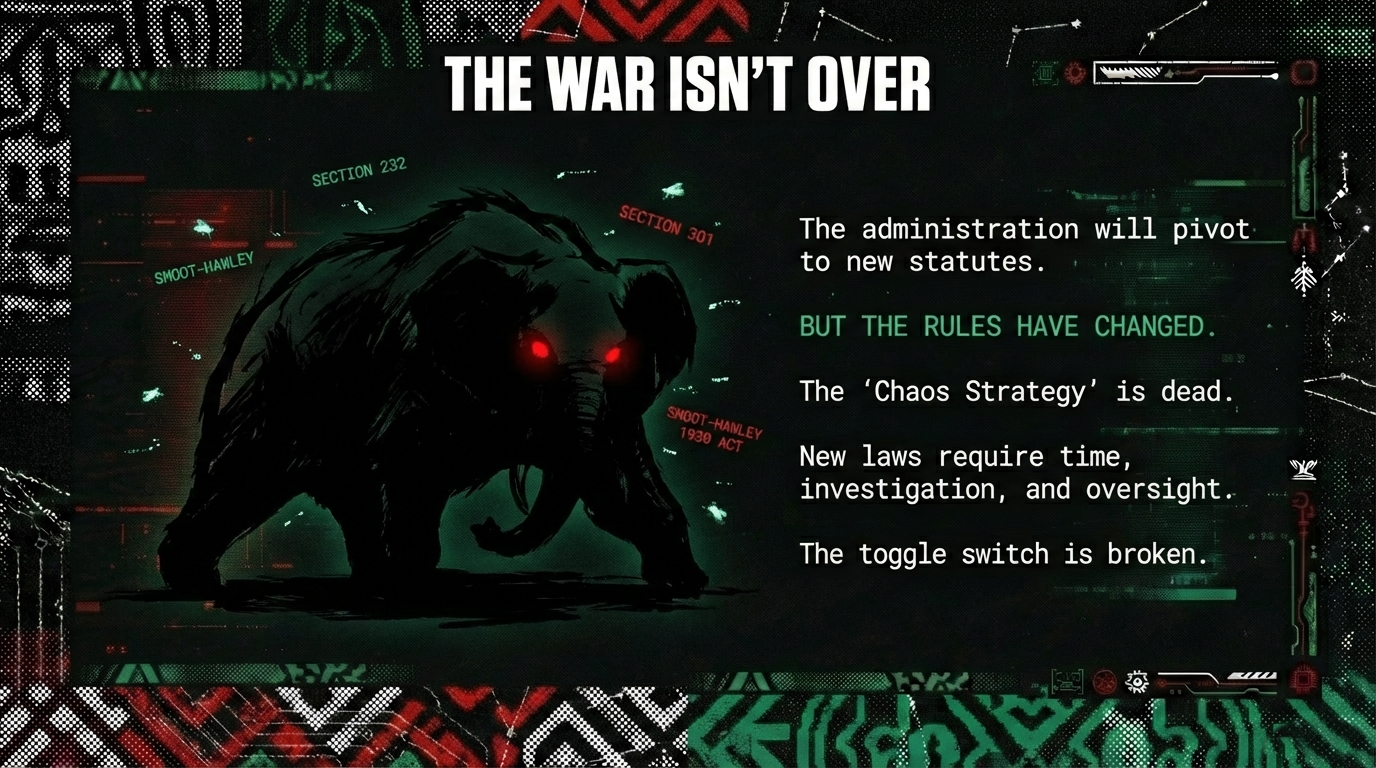
Trump is not finished. Wounded beasts with nuclear codes rarely are. His administration has signalled it will attempt to rebuild the tariff regime under other legal authorities: Section 232, Section 301, Section 201, and even Section 338 of the Smoot-Hawley Tariff Act of 1930 — legislation from the Great Depression that no president has ever invoked.
As Georgetown trade law professor Kathleen Claussen warned: "It's hard to see any pathway here where tariffs end."
But each of those authorities comes with constraints IEEPA did not: time limits, investigation requirements, industry-specific restrictions, and Commerce Department oversight. Trump's strategy of raising and lowering tariffs on a whim — the on-again-off-again chaos of 2025 — is now legally impossible under any remaining authority.
The Yale Budget Lab calculated that if Trump invoked Section 122 at its maximum 15% rate to replace IEEPA tariffs, the effective tariff rate would actually rise to 24.1% — higher than with IEEPA. But Section 122 expires after 150 days. The clock is ticking, and the legal challenges have not stopped.
The Verdict: He Waka Eke Noa — We Are All in This Waka Together
The Framers of the Constitution designed a system to prevent precisely this kind of executive overreach. On 20 February 2026, that system worked — barely, imperfectly, after a year of unconstitutional extraction, but it worked.
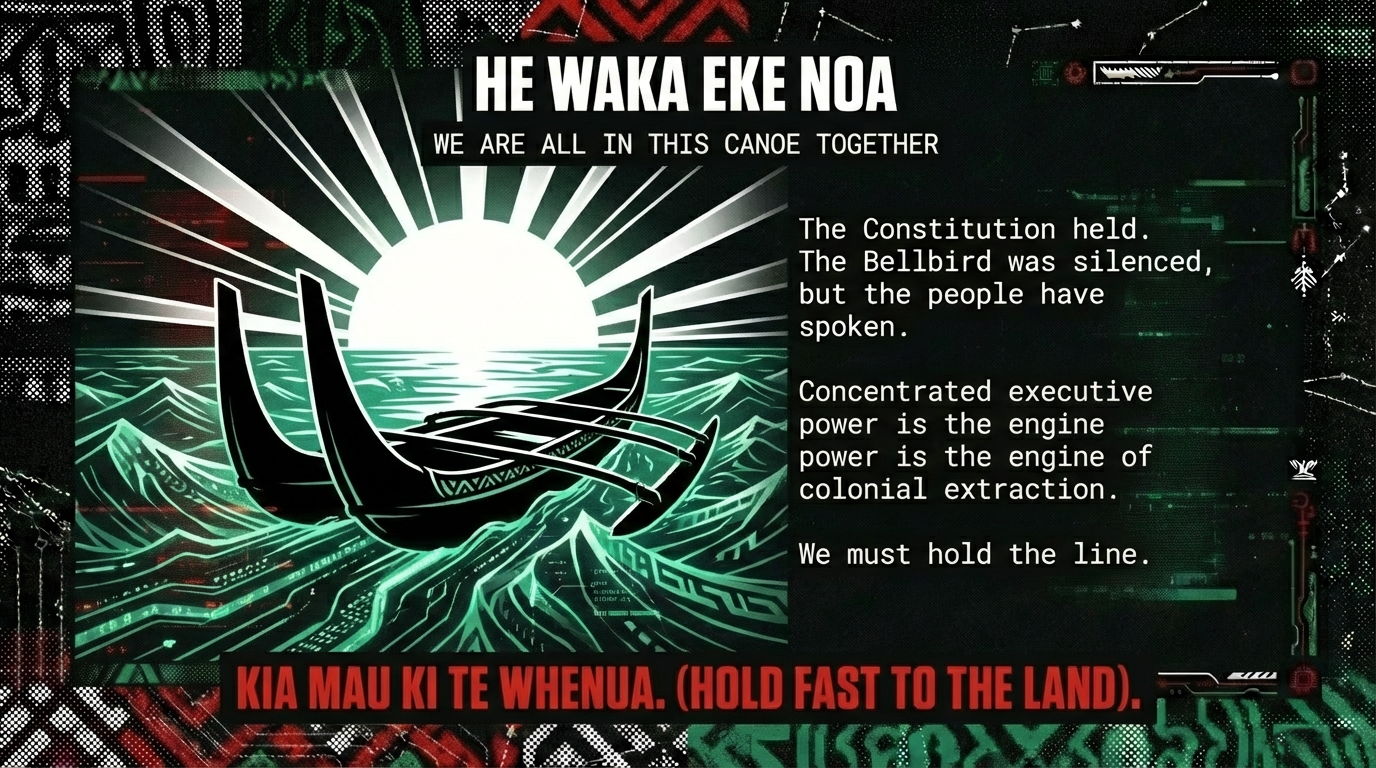
The ruling confirms what we at The Māori Green Lantern have documented across dozens of essays: concentrated executive power, unchecked by democratic institutions, is the engine of colonial extraction. Whether it wears a MAGA hat or a colonial governor's uniform, whether it invokes IEEPA or the New Zealand Settlements Act, the mechanism is identical: seize power, extract wealth, silence dissent, call it liberation.
Trump's credibility is not merely damaged. It is constitutionally annihilated. The man who claimed unlimited tariff authority has been told by six justices — including two he personally appointed — that he had no authority at all. The man who screamed "life or death" has been shown that America's economy improved the moment his grip was loosened. The man who called the ruling "a disgrace" is the disgrace — a would-be autocrat caught stealing from the national purse and told by his own judges to put it back.
As documented in "The End of the West? A Scathing Analysis of Geopolitical Fragmentation and the Rise of China", Trump's trade wars have accelerated the very geopolitical shifts they claimed to prevent. As explored in "The Three-Headed Dragon of Colonial Power", the authoritarian impulse does not respect borders. And as The Māori Green Lantern has documented in "WINSTON PETERS IS A TEMU TRUMP FOR REALS", the New Zealand coalition government's own authoritarian tendencies mirror the Trumpian playbook — and should take careful note of what happens when institutions finally stand up.
The taiaha has spoken. The Ring glows.
Kia mau ki te whenua. Kia kaha. Kia manawanui.
Hold fast to the land. Be strong. Be resolute.
The emperor has no tariffs. And the people — all of them, in every nation — are better for it.

Ivor Jones The Māori Green Lantern Fighting Misinformation And Disinformation From The Far Right
Research transparency: This essay draws on reporting from RNZ, 1News, Reuters, SCOTUSblog, CNN, CNBC, NBC News, the Yale Budget Lab, Legalytics, The Daily Beast, Fox News, ING, Bloomberg Law, Morningstar, Time, USA Today, Yahoo Finance, Verfassungsblog, Chatham House, Te Ara, ProPublica, and previous Māori Green Lantern essays at www.themaorigreenlantern.maori.nz. All URLs verified at time of research (21 February 2026 NZDT). Economic data sourced from the Yale Budget Lab, U.S. Customs and Border Protection filings, and the Tax Policy Center.