"THE EMPTY KETE: How Dana Kirkpatrick Weaves Lies from the Flax of Dead Whānau Dreams" - 7 April 2026
A National MP celebrated a smaller hunger queue — after her Government banned most people from joining it. Ko te kete kāhua — the empty basket dressed in feathers.

Kia ora ano Aotearoa, The last essay for tonight.
The Māori Metaphor: Ko te Kete Kāhua
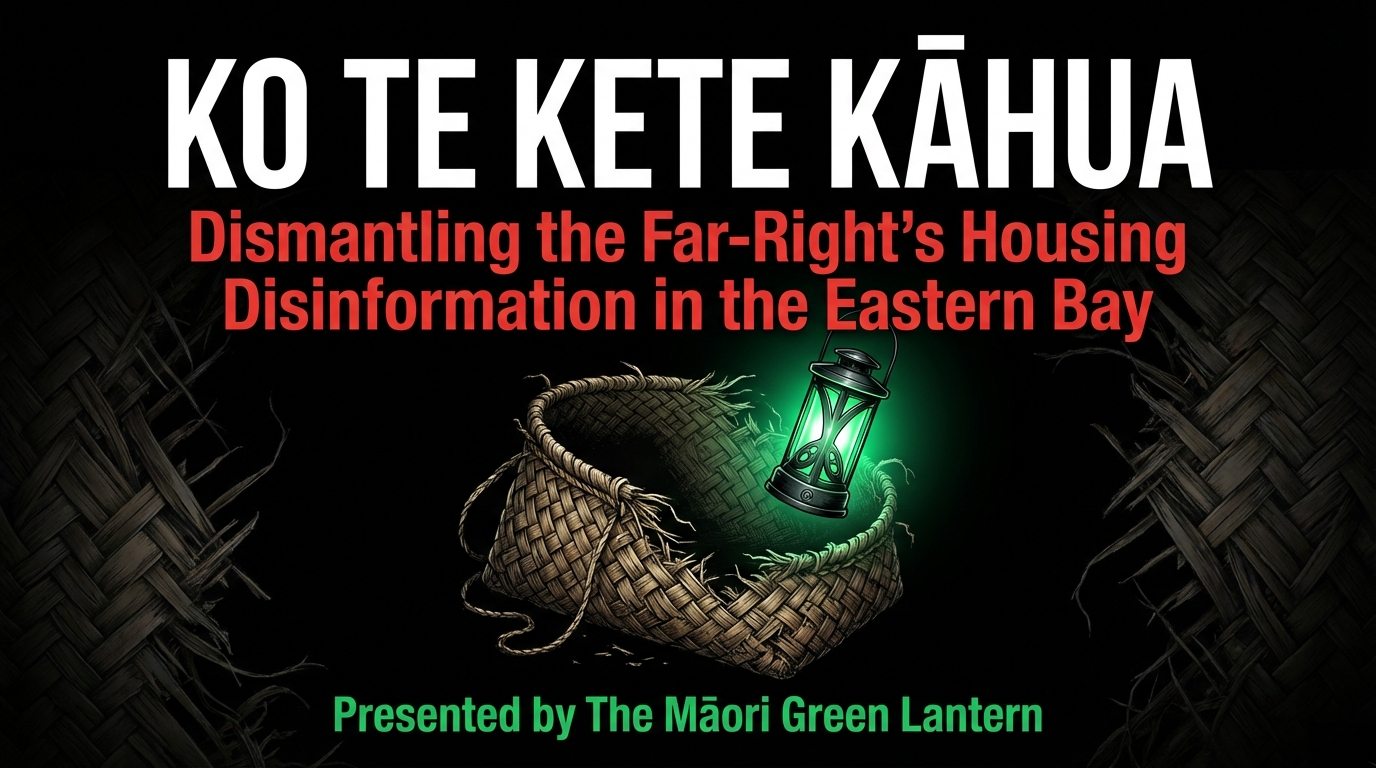
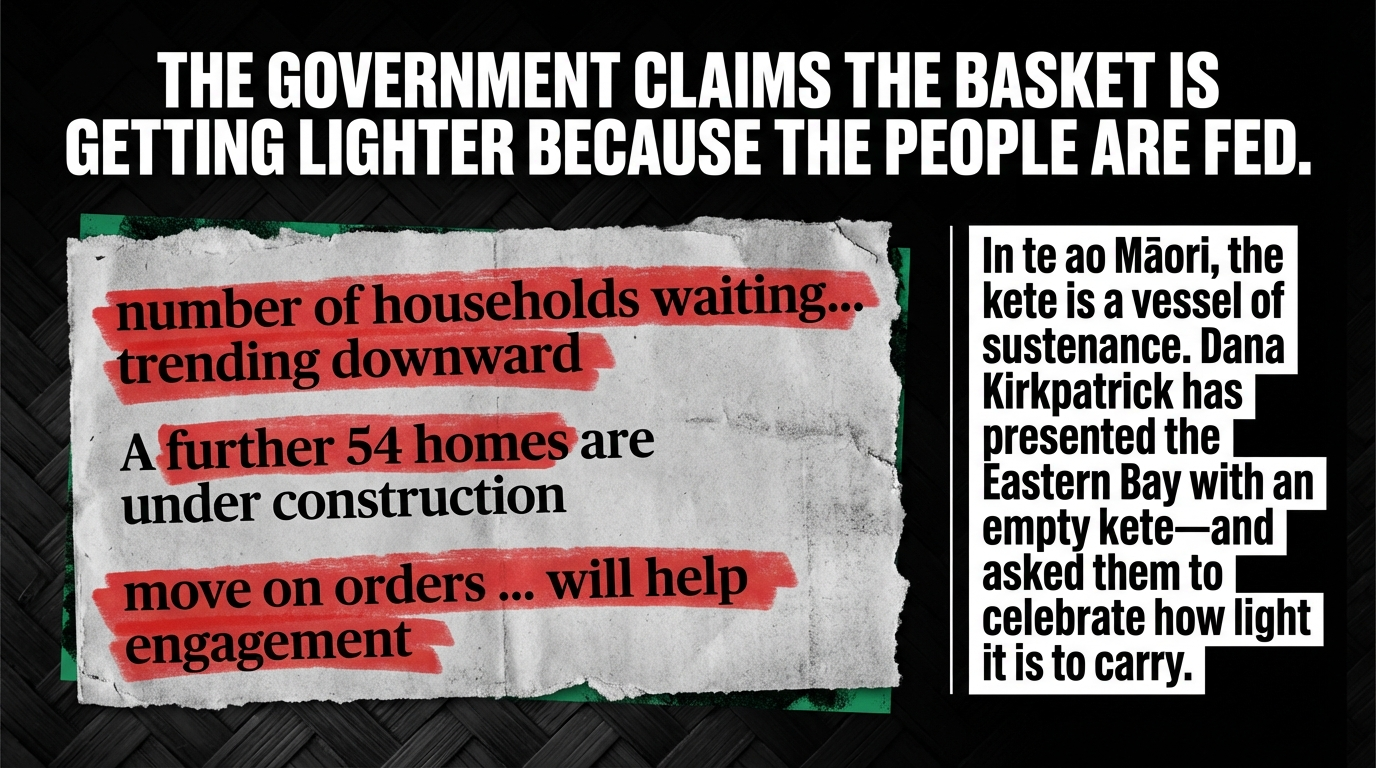
In te ao Māori, the kete is not merely a basket. It is a vessel of knowledge, of sustenance, of aroha passed between generations. When the kete is full, the whānau is full. When the kete is empty, the whānau starves.
Dana Kirkpatrick has presented the Eastern Bay with an empty kete — and asked them to celebrate how light it is to carry.
Her Government did not fill the kete. They burned the flax. They sold the harakeke whenua to developers. They changed the rules so that only those with the right credentials, the right forms, the right English, the right IRD number could even approach the kete. Then they counted the shrinking queue of approved supplicants and called it progress.

The Deep Dive Podcast
Listen to a lively conversation between two hosts, unpacking and connecting topics in the sources of this essay.
The kete is not lighter because the whānau are fed.
The kete is lighter because the hungry have been turned away at the gate.
This is not kaitiakitanga. This is the hoa riri wearing a hi-vis vest and calling itself a housing programme.
The Selective Statistics Game
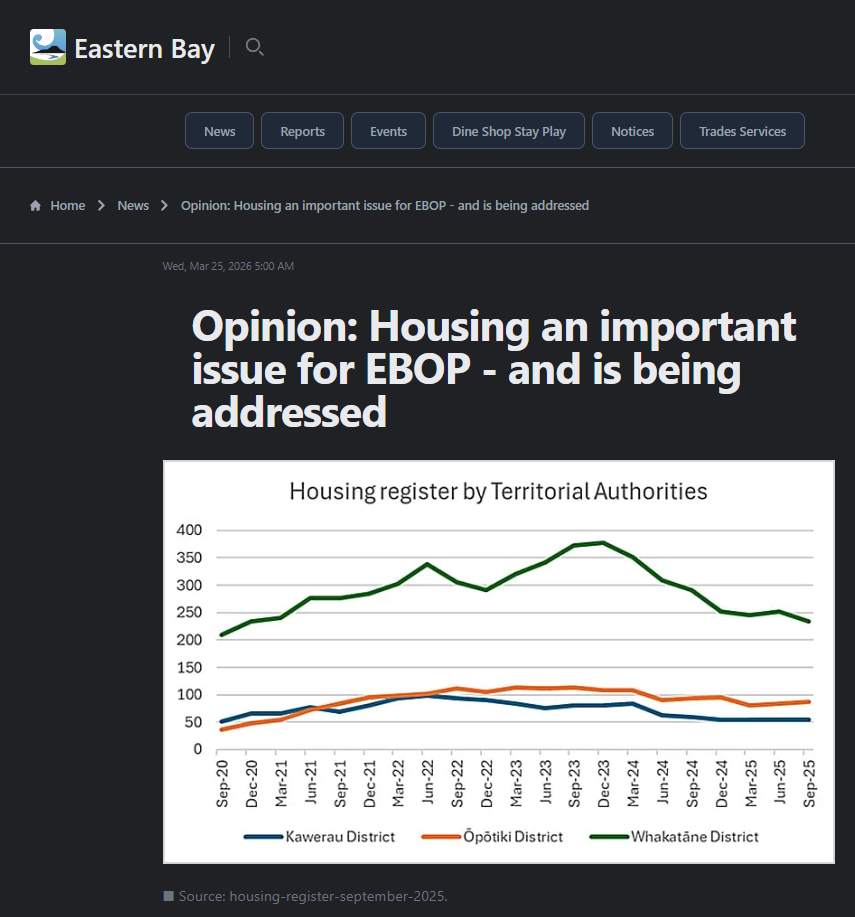
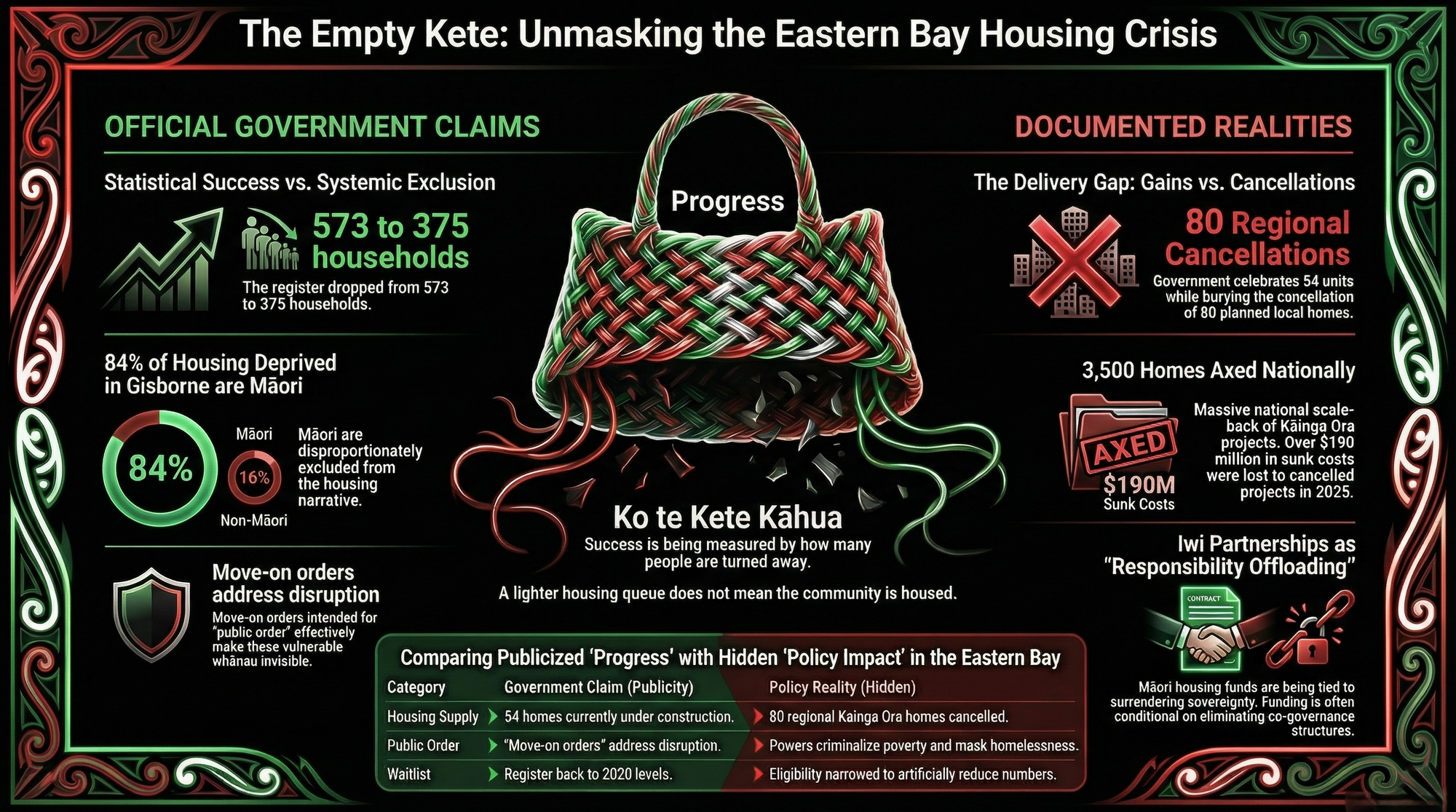
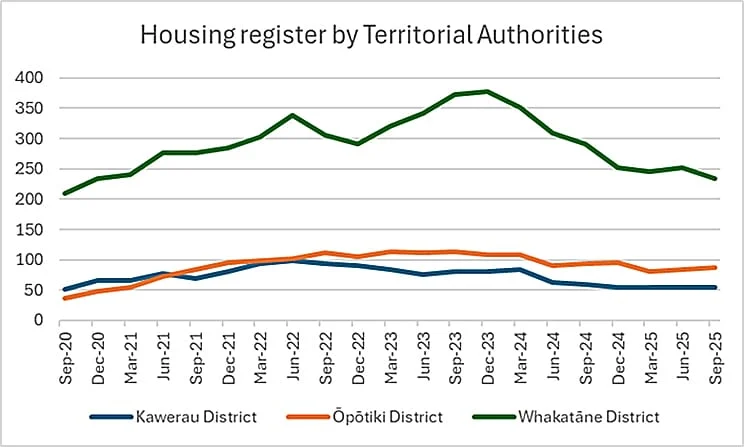
Kirkpatrick trumpets that the housing register across Whakatāne, Ōpōtiki and Kawerau has dropped from a peak of 573 households in December 2023 to 375 in September 2025 — "a return to around 2020 levels." She frames this as victory. She delivers it with the confidence of someone who has never slept in a car with their tamariki.
But this framing is dishonest by omission. The register does not capture everyone in housing need — it counts only those assessed and approved as eligible. This Government tightened eligibility criteria for emergency housing in 2024, meaning more people are declined before they ever appear on any register. As the NZ Herald reported in August 2025, emergency housing applications nationally have plummeted — not because need fell, but because the number "being declined" skyrocketed.nzherald
A smaller queue after you've locked most people out of the building is not a victory. It is a statistical fabrication dressed in parliamentary language.
In Gisborne — in Kirkpatrick's own electorate — as the Māori Green Lantern documented in "They Don't Want to Fix Homelessness. They Want to Hide It from View", 84% of severely housing-deprived people are Māori. The register doesn't capture them. Kirkpatrick doesn't mention them. She steps over them on her way to the press release.facebook+1
The 3,500 Homes Kirkpatrick Won't Name
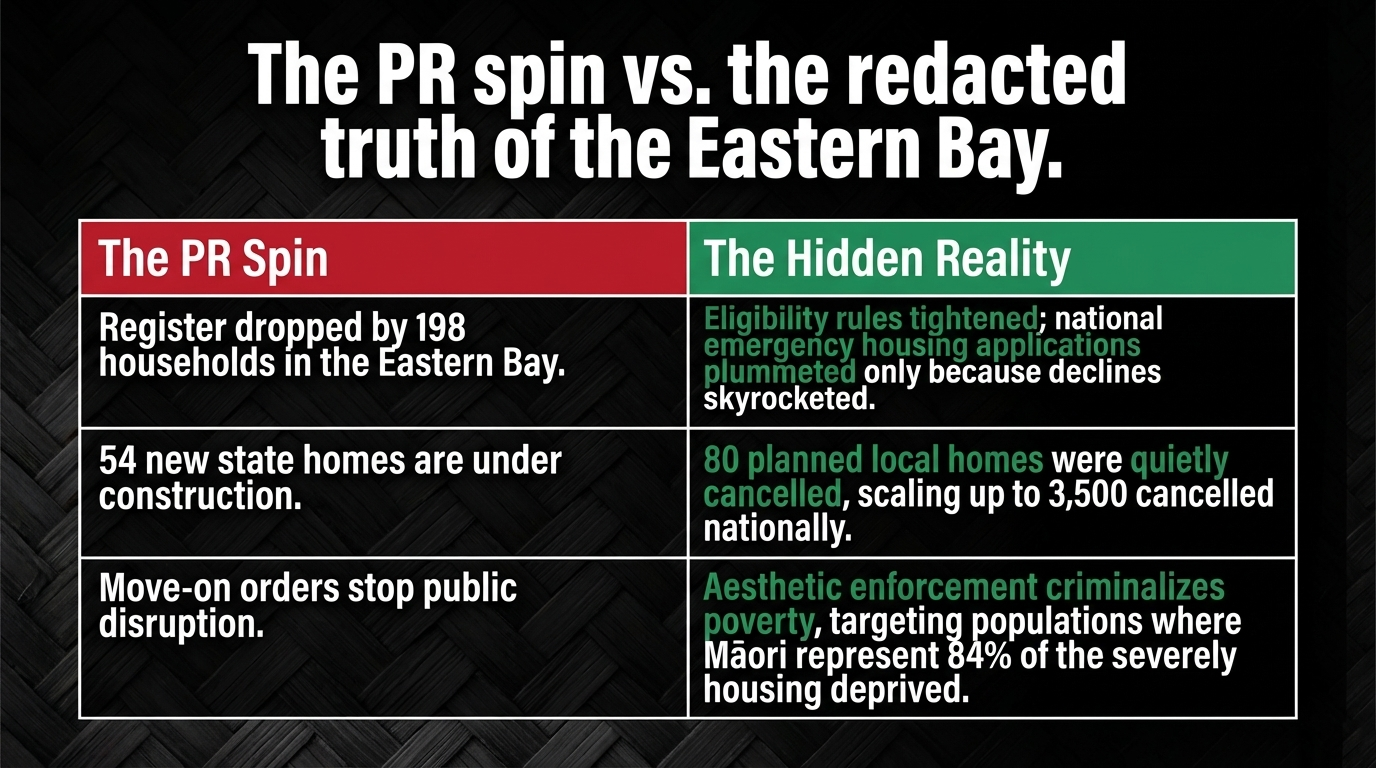
While Kirkpatrick celebrates 54 homes under construction in the Eastern Bay, she maintains cathedral silence about the national atrocity her Government manufactured. In June 2025 — mere months before this op-ed — Kāinga Ora cancelled 212 planned housing projects that would have delivered nearly 3,500 state homes across Aotearoa. As The Spinoff reported, Kāinga Ora was forced to write down between $190–$220 million in sunk planning costs. Land was sold. The pipeline was gutted. Housing Minister Chris Bishop called it "short-term pain" — pain, presumably, experienced by other people's families.thespinoff
Closer to home: a community report documented that 80 Kāinga Ora houses were cancelled in the Eastern Bay alone. Eighty families who will never receive those homes. Eighty whānau whose futures were planned in an office and then crossed out with an ideological pen. Kirkpatrick has no answer for them. She doesn't mention them. She steps around the gap in the floorboards and calls the house watertight.facebook
The 60% Axing — The Buried Atrocity
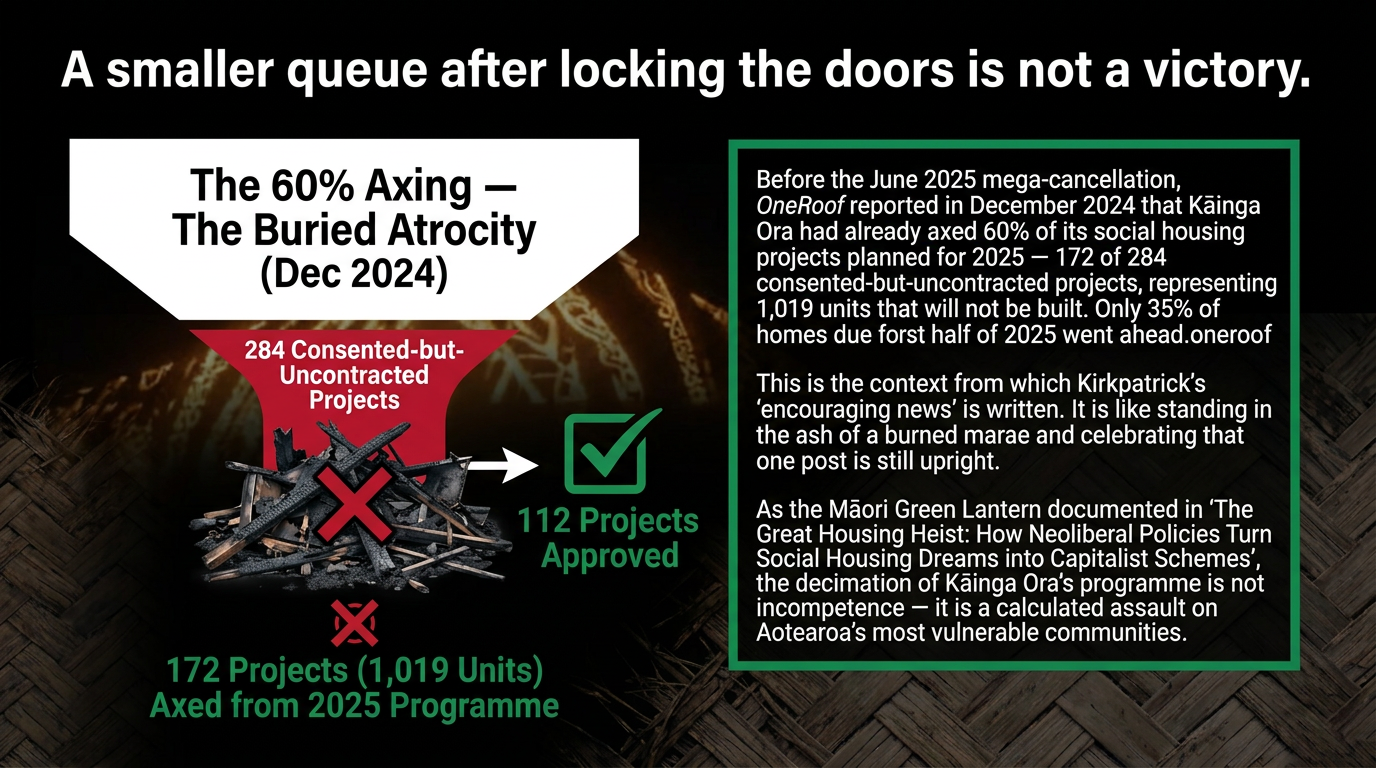
Before the June 2025 mega-cancellation, OneRoof reported in December 2024 that Kāinga Ora had already axed 60% of its social housing projects planned for 2025 — 172 of 284 consented-but-uncontracted projects, representing 1,019 units that will not be built. Only 35% of consented homes due for the first half of 2025 went ahead.oneroof
This is the context from which Kirkpatrick's "encouraging news" is written. It is like standing in the ash of a burned marae and celebrating that one post is still upright.
As the Māori Green Lantern documented in "The Great Housing Heist: How Neoliberal Policies Turn Social Housing Dreams into Capitalist Schemes", the decimation of Kāinga Ora's programme is not incompetence — it is a calculated assault on Aotearoa's most vulnerable communities.
The Selling of the Whenua
Kirkpatrick's piece doesn't breathe a word about Kāinga Ora selling land in her own electorate. Yet in August 2025, the NZ Herald reported that the sales of Kāinga Ora-owned homes and land drew sharp criticism from people working at the coalface of homelessness in Gisborne.nzherald.co
The sales are framed as a "financial reset." But in te ao Māori, this land is not a balance sheet entry. It is whenua. It carries the koiwi of those who walked before. When you sell the whenua under public housing, you do not just lose a property — you sever the umbilical cord between whānau and place. For communities whose entire modern history is whakapapa written in dispossession, this is not a neutral act. It is the third act of the same colonial play.
As the Māori Green Lantern's "When Housing Becomes Hostage: How Neoliberal Dogma Fuels Aotearoa's Homelessness Crisis" documented in April 2025, Māori home ownership collapsed 26% between 1991 and 2013 following neoliberal reforms — nearly four times the 6.7% decline for Pākehā. Every land sale continues that whakapapa of loss.
Move-On Orders: Making the Homeless Invisible
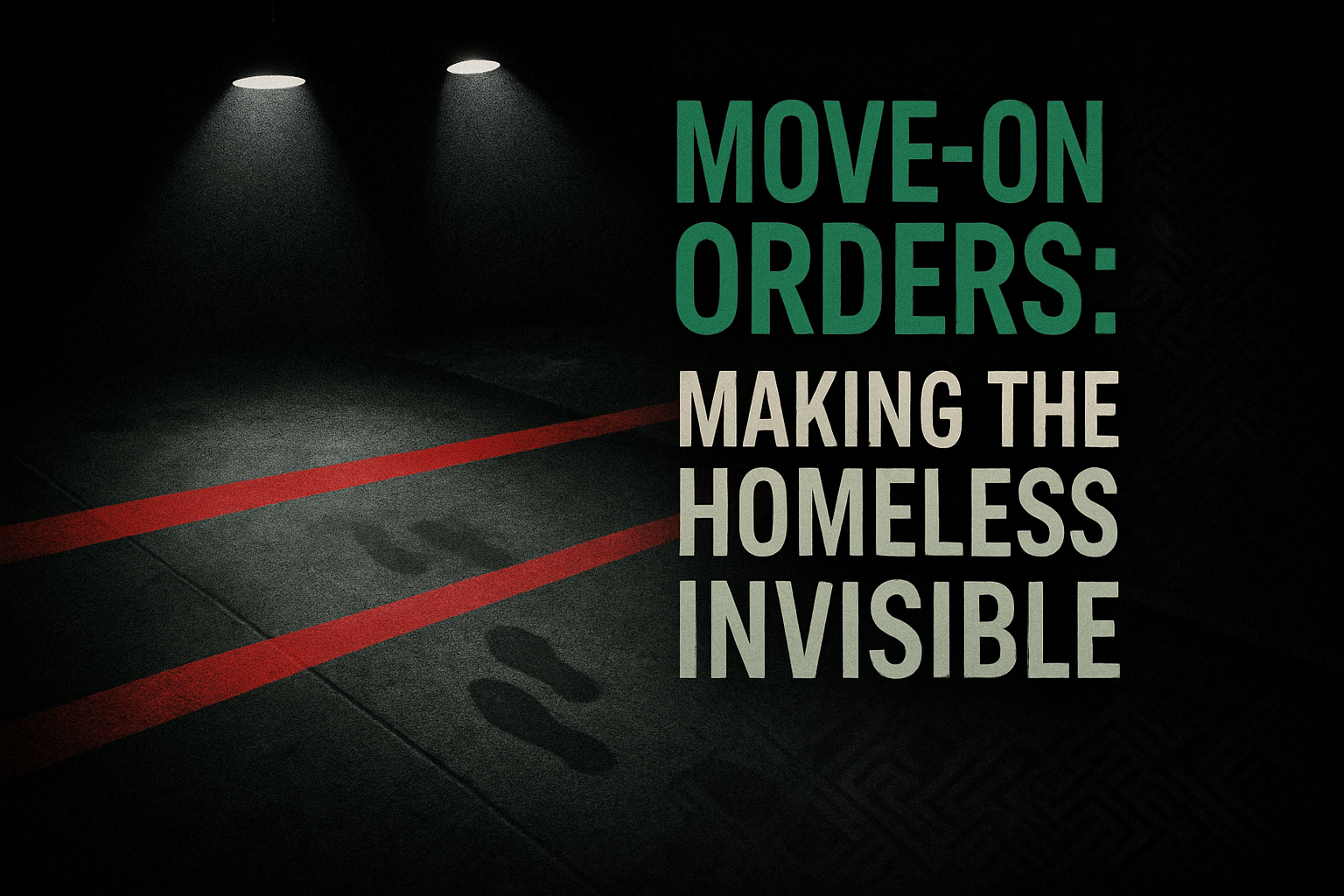
Perhaps the most obscene section of Kirkpatrick's piece is her defence of "move on orders" — police powers to remove people experiencing homelessness from public spaces. She writes with the audacity of someone who has never bedded down under a bridge in Whakatāne: these powers are "not to penalise people experiencing hardship," she insists, comparing them approvingly to gang patch bans.
This is the ideological tell of the century.
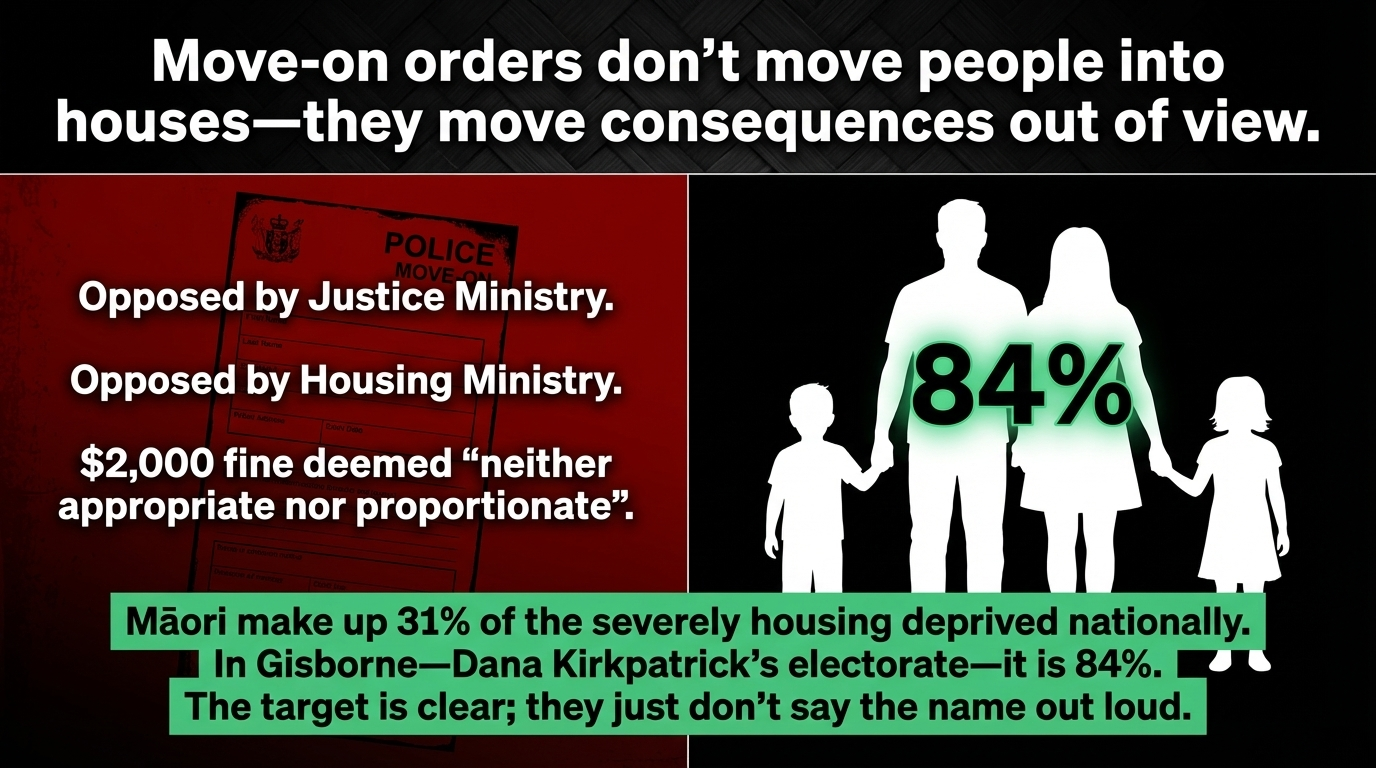
When your housing policy produces homelessness faster than your announcements can address it, you deploy police to make the homeless disappear. Move on orders do not move people into houses. They move brown bodies out of the sight lines of business owners and tourists. They are aesthetic enforcement dressed as public order.
As the Māori Green Lantern documented in "Paul Goldsmith Doesn't Have a Homelessness Policy: He Has an Interior Design Policy — and the Design Calls for Your Whānau to Be Invisible", Paul Goldsmith read the official advice — his own Justice Ministry opposed the policy, his Housing Ministry opposed it, Corrections warned prisons were full, and officials stated in writing that the $2,000 fine was "neither appropriate nor proportionate." He published the policy anyway.facebook+1
Māori are 31% of the severely housing deprived. In Gisborne: 84%.facebook
This law has a target. It just doesn't say the name out loud.
Three Examples for the Western Mind
These are not abstract policy failures. They have names, numbers, and addresses.
Example One: The Gate-Narrowing Trick — Whakatāne
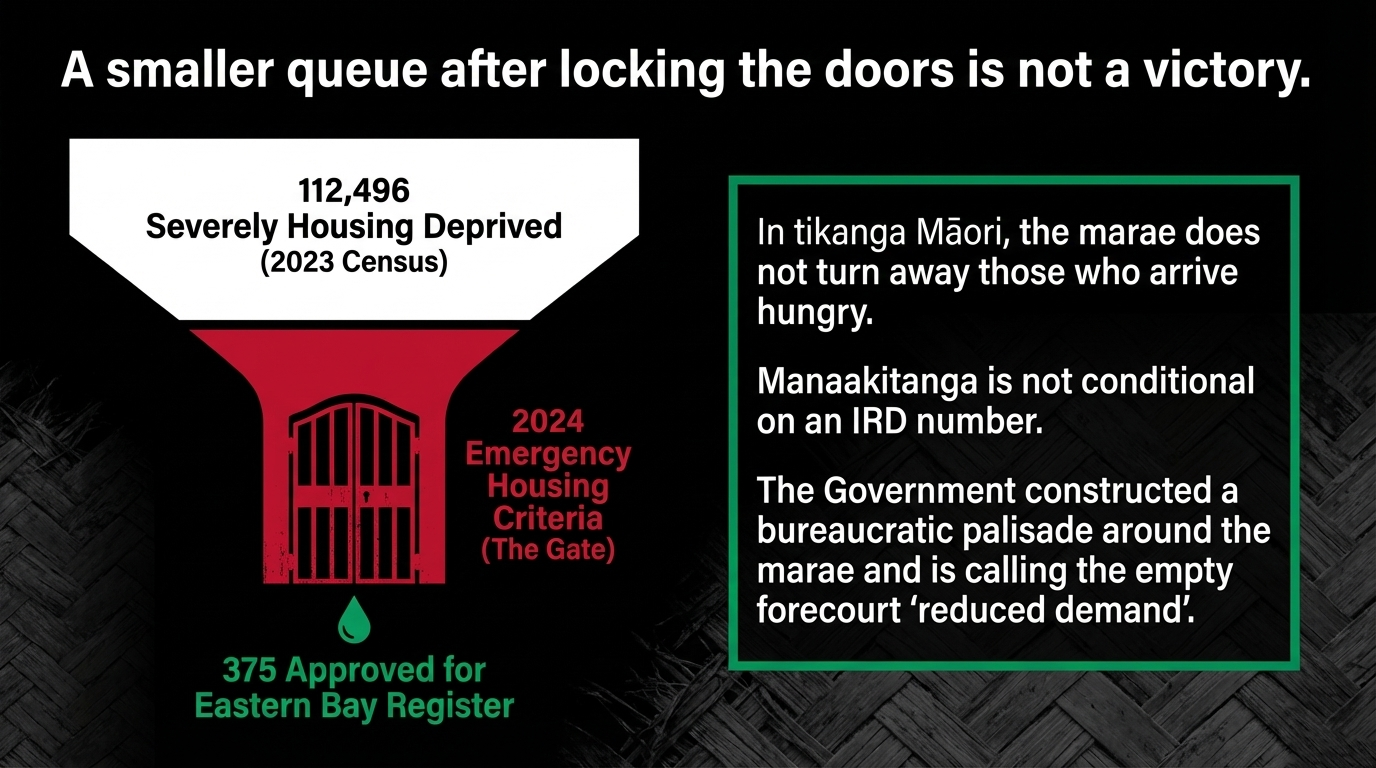
The harm, quantified: The housing register in the Eastern Bay dropped from 573 to 375 — a reduction of 198 households. But nationally, as the NZ Herald reported, emergency housing grant applications plummeted while declines soared. In Tauranga — just down the road — homelessness complaints rose 157% in four years, as the Māori Green Lantern documented in "They Don't Want to Fix Homelessness".nzherald+1
The tikanga violation: In tikanga Māori, the marae does not turn away those who arrive hungry. Manaakitanga — the obligation to care for the visitor, the stranger, the suffering — is not conditional on forms, eligibility assessments, or IRD numbers. This Government has constructed a bureaucratic palisade around the marae and is calling the empty forecourt "reduced demand."
The western equivalent: Imagine a hospital announcing that emergency department wait times have dropped 35% — because triage nurses were instructed to turn away anyone without private insurance before they entered the building. The wait went down. The suffering went up. The press release went out.
Example Two: The 80 Cancelled Houses — Eastern Bay of Plenty
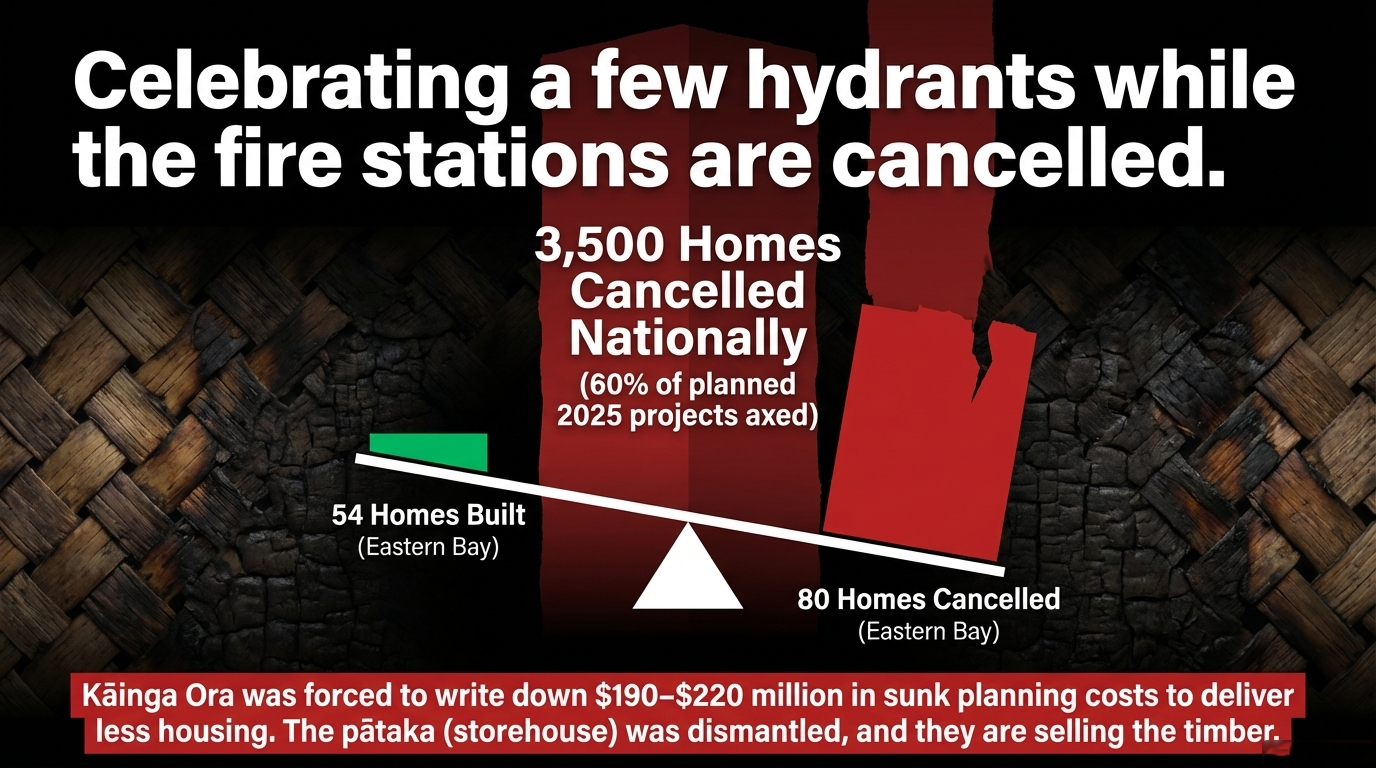
The harm, quantified: Eighty social housing projects were cancelled in the Eastern Bay alone, as community reporting documents. Nationally, Kāinga Ora axed 3,500 homes and wrote down $190–$220 million in sunk costs. Before that, OneRoof reported that 60% of planned 2025 projects were already axed — 1,019 units gone.thespinoff+2
Kirkpatrick celebrates 54 homes under construction. She does not mention the 80 that were cancelled in the same region. The net is negative. The press release is positive. This is not journalism. It is propaganda.
The tikanga violation: In te ao Māori, the pātaka is a raised storehouse — built high so food cannot be stolen, built communally so all can eat. Kāinga Ora was our pātaka. This Government dismantled the pātaka and is selling the timber. As the Māori Green Lantern documented in "THE PĀTAKA IS ASH: How Nicola Willis and Christopher Luxon Poured Petrol on the Poor", the ideology driving these cuts is explicit: markets over whānau, profit over people, individual property over collective wellbeing.themaorigreenlantern
The western equivalent: Imagine a city council announcing it had cancelled 80 planned fire stations to "balance the budget" — then issuing a press release celebrating the three new hydrants that were installed. Meanwhile, houses burn.
Example Three: The Iwi Housing Trap — Rangatiratanga as Cover
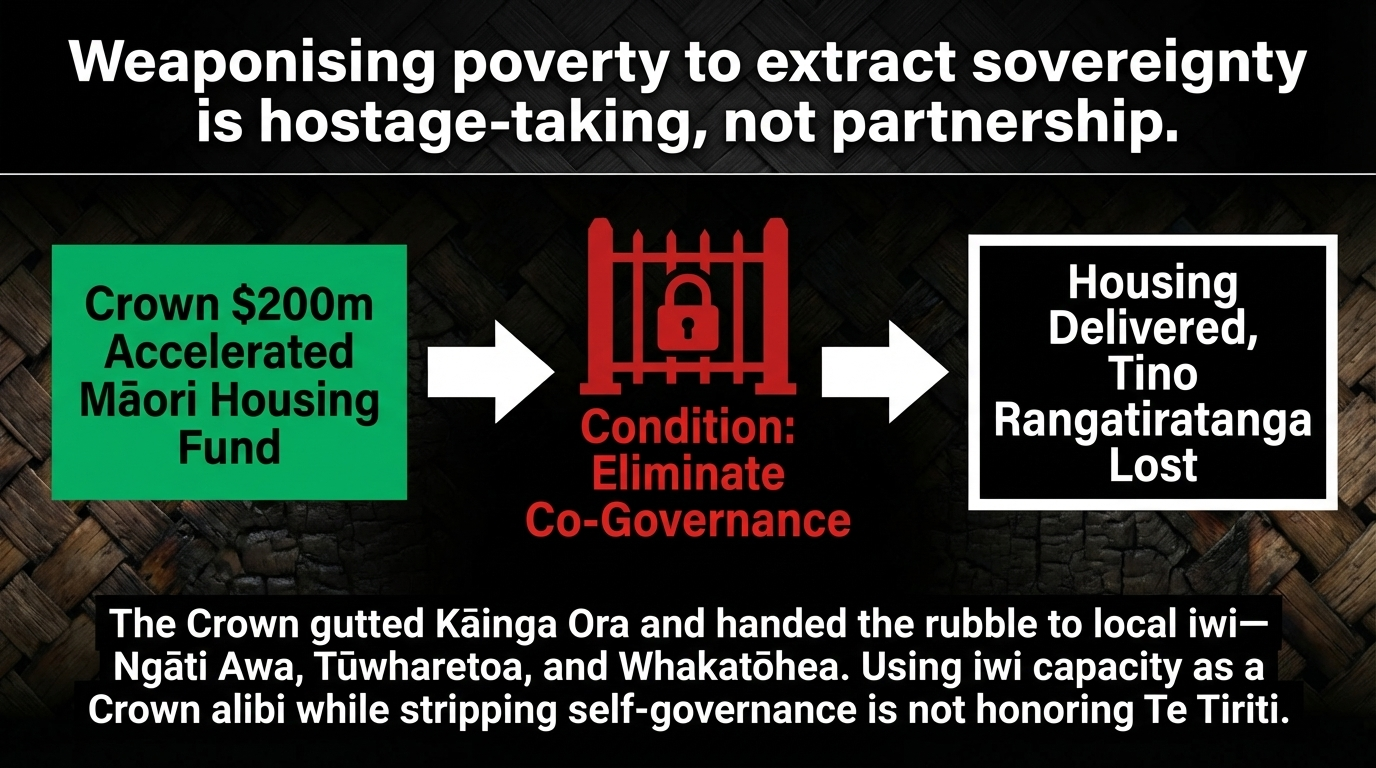
The harm, quantified: Kirkpatrick points to an iwi CHiP (Community Housing Provider) combining Ngāti Awa, Tūwharetoa, and Whakatōhea delivering 537 homes, with 113 completed — as evidence of "progress." But as Budget 2025 analysis cited in the Māori Green Lantern's Substack reveals, the Crown's $200 million "accelerated" Māori housing fund is conditional on eliminating co-governance structures. Iwi organisations must choose between housing their whānau and surrendering their tino rangatiratanga. That is not partnership. That is hostage-taking.substack
The tikanga violation: Tino rangatiratanga is not a bureaucratic preference. It is the constitutional spine of Te Tiriti o Waitangi. When the Crown funds Māori housing delivery on the condition that Māori abandon self-governance, it is not honouring the Treaty — it is weaponising poverty to extract sovereignty. As the Māori Green Lantern's "The Neoliberal Whakapapa of Exploitation" documented in May 2025, the privatisation vultures are circling — using former Kāinga Ora infrastructure and Māori institutional capacity to deliver what the Crown is abdicating.facebook
The western equivalent: Imagine the US Federal Government offering hurricane disaster relief to a Native American nation — on the condition that the Tribal Council dissolves its sovereign governance structures and submits to federal administration. The money arrives. The sovereignty departs. The Crown calls it "progress."
The Hidden Connections — Five Verified Revelations
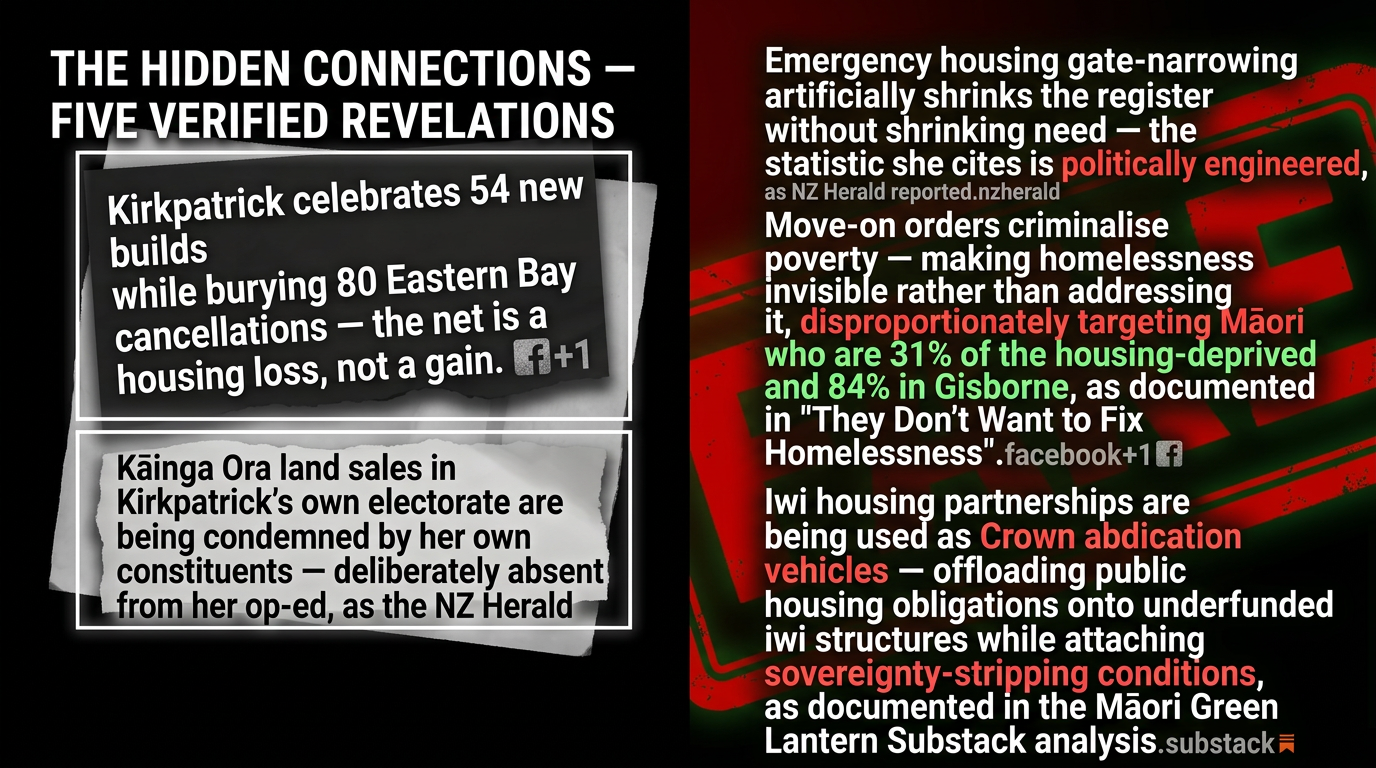
- Kirkpatrick celebrates 54 new builds while burying 80 Eastern Bay cancellations — the net is a housing loss, not a gain.facebook+1
- Emergency housing gate-narrowing artificially shrinks the register without shrinking need — the statistic she cites is politically engineered, as NZ Herald reported.nzherald
- Kāinga Ora land sales in Kirkpatrick's own electorate are being condemned by her own constituents — deliberately absent from her op-ed, as the NZ Herald reported.nzherald.co
- Move-on orders criminalise poverty — making homelessness invisible rather than addressing it, disproportionately targeting Māori who are 31% of the housing-deprived and 84% in Gisborne, as documented in "They Don't Want to Fix Homelessness".facebook+1
- Iwi housing partnerships are being used as Crown abdication vehicles — offloading public housing obligations onto underfunded iwi structures while attaching sovereignty-stripping conditions, as documented in the Māori Green Lantern Substack analysis.substack
The Iwi Partnership — Genuine Rangatiratanga or Responsibility Offload?

The iwi-led CHiP initiative is real. One hundred and thirteen homes completed is real. And iwi-led housing can be a legitimate expression of tino rangatiratanga — when it is properly resourced, unconditionally funded, and driven by the iwi's own vision.
But we must name what is also real: this Government gutted Kāinga Ora — the Crown's primary housing delivery vehicle — and is now pointing at iwi housing as evidence of "progress." When the Crown dismantles its own housing infrastructure and then hands the rubble to iwi to rebuild, it is not honouring the Treaty. It is using our rangatiratanga as a cost-cutting mechanism.
As The Spinoff documented, the "short-term pain" is being administered to the most vulnerable — while the Crown avoids the long-term accountability. The Māori Green Lantern's "The Great Housing Heist" named this mechanism precisely: social housing dreams converted into capitalist schemes — and now iwi capacity converted into Crown alibi.
What Rangatiratanga Demands
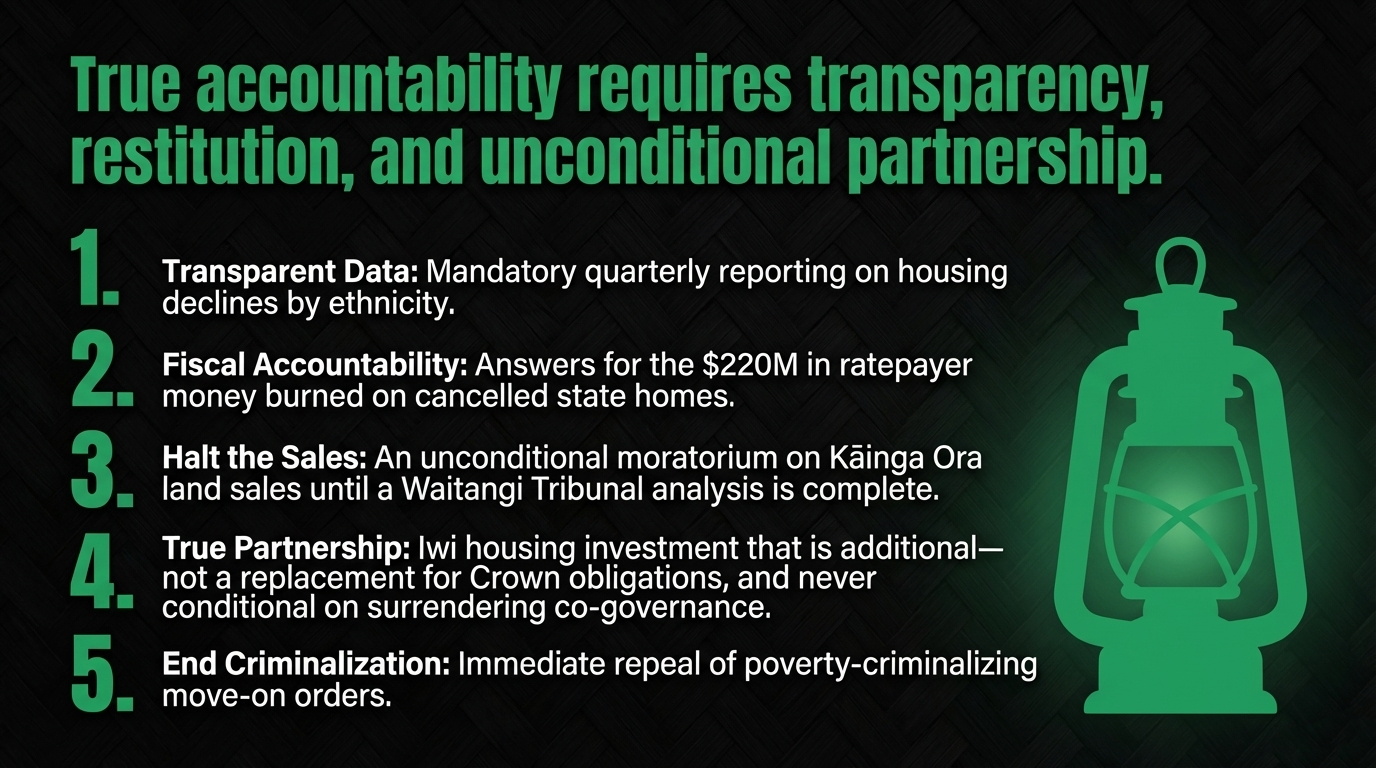
Whānau in Whakatāne, Ōpōtiki and Kawerau deserve more than a politician's press release dressed as journalism.
They deserve:
- Transparent data on how many people were declined before they ever entered any register — every quarter, publicly available, broken down by ethnicity
- Full accountability for the 80 cancelled Eastern Bay homes, the 3,500 cancelled nationally, the $220 million of ratepayer money written off in planning costs
- An unconditional moratorium on Kāinga Ora land sales until a full Waitangi Tribunal analysis is completed
- Iwi housing investment that is additional* — not a replacement for Crown obligations, not conditional on surrendering co-governance
- Repeal of move-on orders — which criminalise the symptom while entrenching the disease
- 112,496 people are severely housing deprived in Aotearoa per the 2023 Census, as the Māori Green Lantern's "They Don't Want to Fix Homelessness" documents. That number is not getting better. The press releases are.facebook
The housing register has fallen. The housing crisis has not. Dana Kirkpatrick's op-ed is polished National Party PR — authored by a Government that cancelled 3,500 homes, tightened emergency housing access, sold public land, and deployed police to move the consequences out of view. Then it sent its MP to write a victory lap in a local app.
Ko te whare ko te tangata. The house is the person.
When you hollow out the house, you hollow out the person.
When you hollow out the person, and call the emptiness progress — that is not governance.
That is the act of a conqueror.
Further Reading — The Māori Green Lantern Archive
This essay builds on a body of mahi documented across the Māori Green Lantern's ongoing investigation into the housing crisis:
- "They Don't Want to Fix Homelessness. They Want to Hide It from View" — March 2026: move-on orders, 112,496 housing deprived, 84% Māori in Gisbornefacebook
- "The Great Housing Heist: How Neoliberal Policies Turn Social Housing Dreams into Capitalist Schemes" — December 2024: Kāinga Ora decimation as calculated assaultfacebook
- "When Housing Becomes Hostage: How Neoliberal Dogma Fuels Aotearoa's Homelessness Crisis" — April 2025: Māori home ownership collapse, 26% drop post-Rogernomicsfacebook
- "The Neoliberal Whakapapa of Exploitation" — May 2025: privatisation vultures circling the housing crisisfacebook
- "THE PĀTAKA IS ASH: How Nicola Willis and Christopher Luxon Poured Petrol on the Poor" — March 2026: the full fiscal brutality of this Government's choicesthemaorigreenlantern
- "Paul Goldsmith Doesn't Have a Homelessness Policy: He Has an Interior Design Policy" — March 2026: the move-on orders whakapapa, from policy to criminalisationsubstack
Koha Consideration

Whānau — Dana Kirkpatrick wrote her op-ed for free. The National Party paid for the spin machine behind it. The Māori Green Lantern has no spin machine, no corporate backer, no parliamentary salary. Just this taiaha, this ring, and this mahi.
Every cancelled home in Whakatāne, every whānau declined at the housing gate, every kaumātua sleeping in a car in Ōpōtiki — they will not be named by the people who caused their suffering. That is our job. Your koha is what makes it possible to keep doing it.
If you can contribute directly: Koha — Support the Māori Green Lantern
If you want the essays as they drop, come home: Subscribe at themaorigreenlantern.maori.nz
For direct bank transfer: HTDM, account number 03-1546-0415173-000.
If a koha is not possible — no worries. Share this essay with your whānau. Post it in your community groups. Name the lie when you hear it. That is koha. That is rangatiratanga. That is exactly what they don't want you to do.
Every koha signals that whānau are ready to fund the accountability that the Crown is too arrogant, and too implicated, to provide.
Kia kaha, whānau. Ko te whare ko te tangata. Ko te tangata ko koe.

Research conducted April 2026. Sources include NZ Herald, OneRoof, The Spinoff, MSD OIA releases, the Māori Green Lantern archive, and community reports. All URLs verified at time of writing. Unverifiable claims are noted as such.