"THE EMPTY TANK: How a White Supremacist Neoliberal Government Left Its Carers on the Side of the Road to Die" - 26 March 2026
They built the road. They filled the tank of the powerful. They watched the caregivers — brown, female, rural, poor — run dry. And then they called it policy.

Mōrena ano Aotearoa,
He Kōrero Whakaata — The Mirror They Cannot Bear to Look Into
There is a whakataukī — a proverb — that reaches across generations like a hand from the earth:
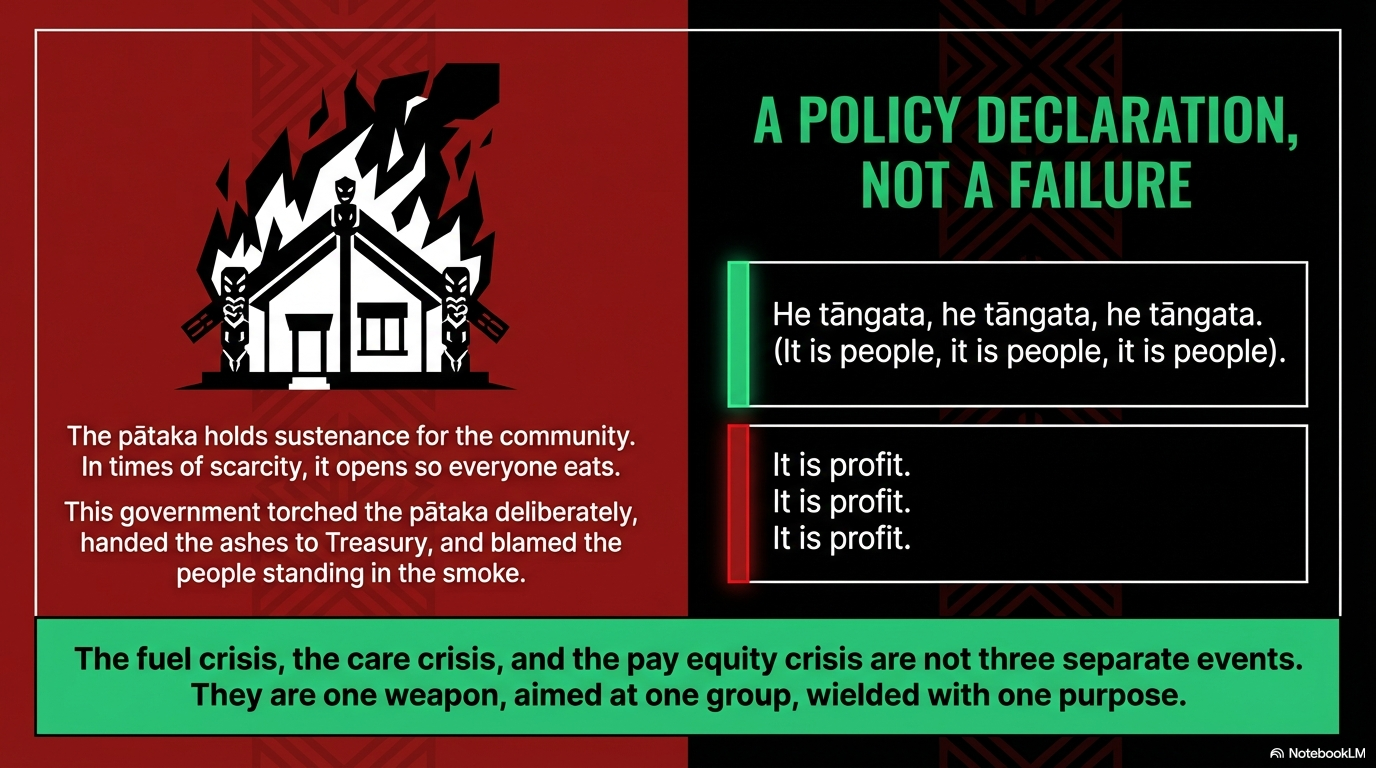
He aha te mea nui o te ao? He tāngata, he tāngata, he tāngata.
What is the greatest thing in the world? It is people, it is people, it is people.
Christopher Luxon does not believe this. Nicola Willis does not believe this. Brooke van Velden has staked her entire political career on not believing this.
What they believe — what every policy they have passed since October 2023 screams from its bones — is this:
It is profit. It is profit. It is profit.
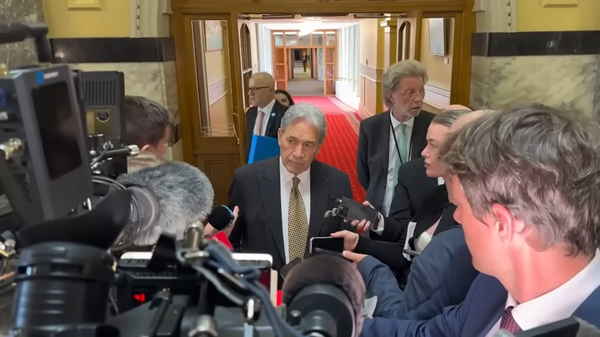
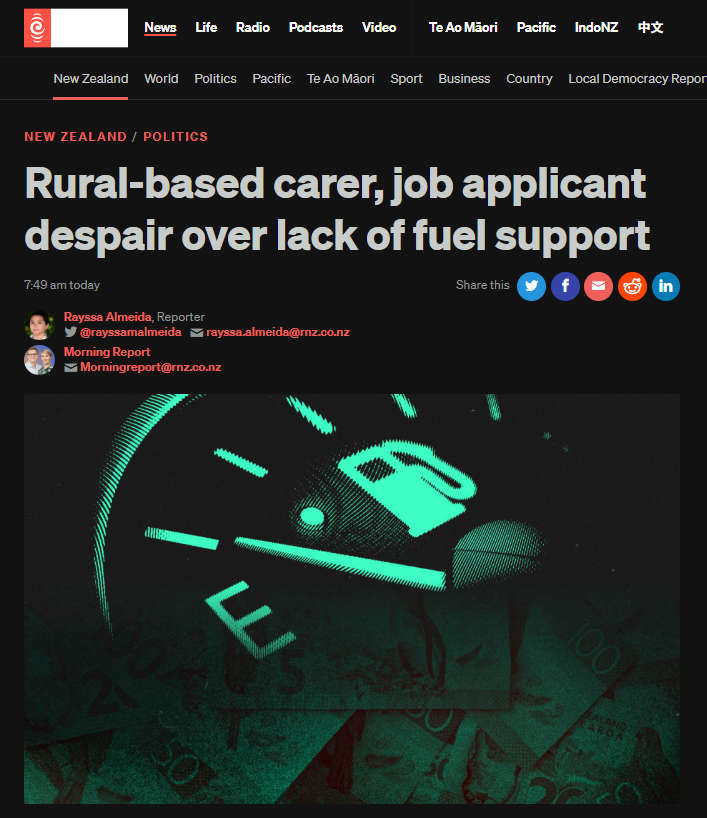
And so, in the week of 26 March 2026, as petrol crashed through three dollars a litre and desperate whānau sat in cars wondering how to survive, as RNZ reported on a rural carer who cannot afford the petrol to attend a job interview — this government looked at them and said:
Not our problem.
That is not a policy failure. It is a policy declaration.
And today, the taiaha falls on the table. Let us name it.
He Ngākau Kōrero — The Metaphor They Cannot Escape
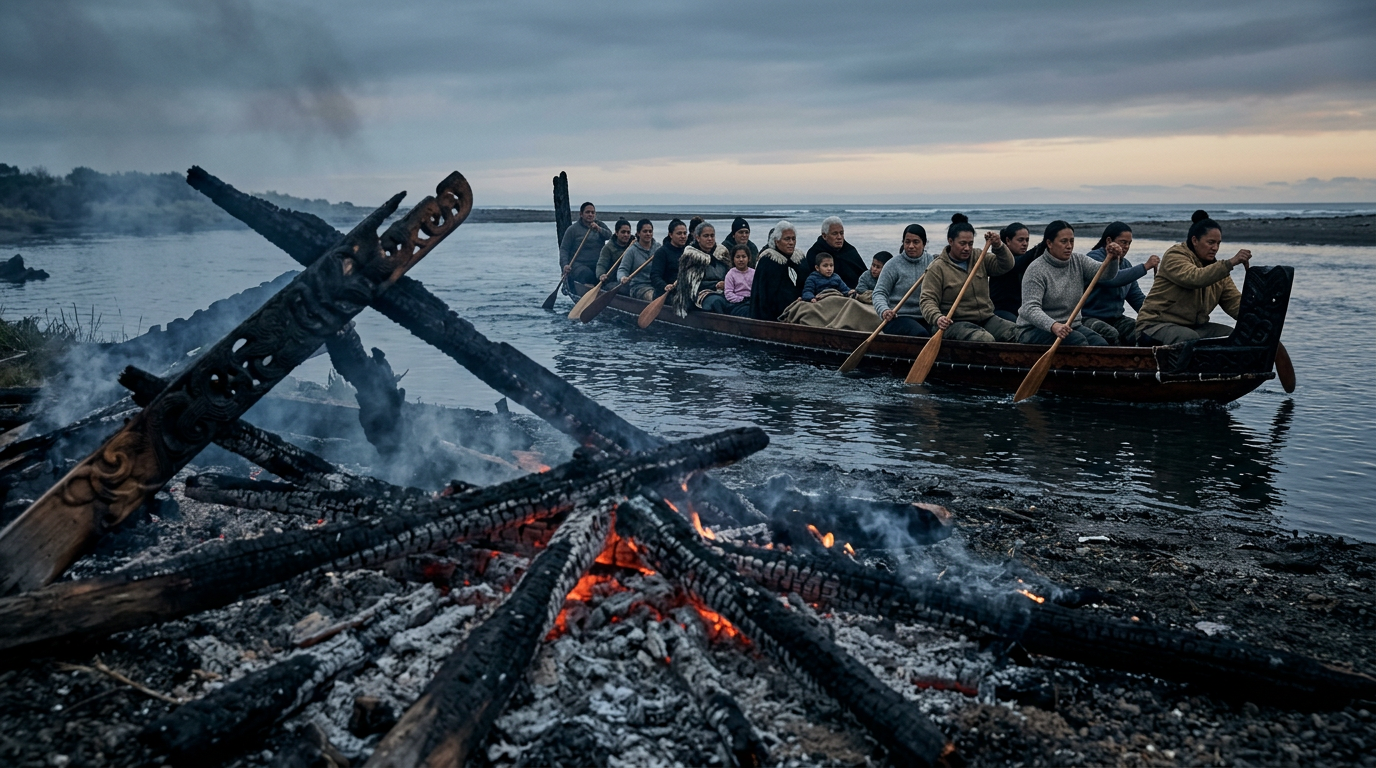
Picture the pātaka. The elevated storehouse of our tūpuna — built high above the ground, beautifully carved, tightly sealed, abundant with sustenance for the whole community. In times of scarcity, the pātaka opens and everyone eats.
This government has burned the pātaka to the ground.
Not by accident. Not from negligence. They torched it deliberately — then handed the ashes to Treasury and told the people standing in the smoke that the fire was their own fault for standing too close.
And as the Māori Green Lantern documented in "THE PĀTAKA IS ASH: How Nicola Willis and Christopher Luxon Poured Petrol on the Poor and Called It Relief" (25 March 2026), this is not a metaphor they stumbled into by chance — it is the consistent architecture of an ideological war on the poor.
Now picture a waka, long-haul, heading to the horizon. It carries the heaviest, most sacred cargo: the kaumātua, the tamariki, the whaikaha — the elders, the children, the disabled. The people most in need of care. The people most dependent on the women who wake before dawn and drive dirt roads to keep them alive.
Those women — Māori women, Pacific women, rural women on minimum wage in 2003 Mitsubishi Lancers with 258,000 km on the clock and bald tyres — are the ones paddling the waka. This government has taken their paddle, told them to swim faster, and billed them for the water.
This is the fuel crisis. This is the care crisis. This is the pay equity crisis. They are not three crises. They are one weapon, aimed at one group, wielded with one purpose.
The Deep Dive Podcast
Listen to a lively conversation between two hosts, unpacking and connecting topics in the sources of this essay
He Kōrero Tūāpō — The History They Built This On
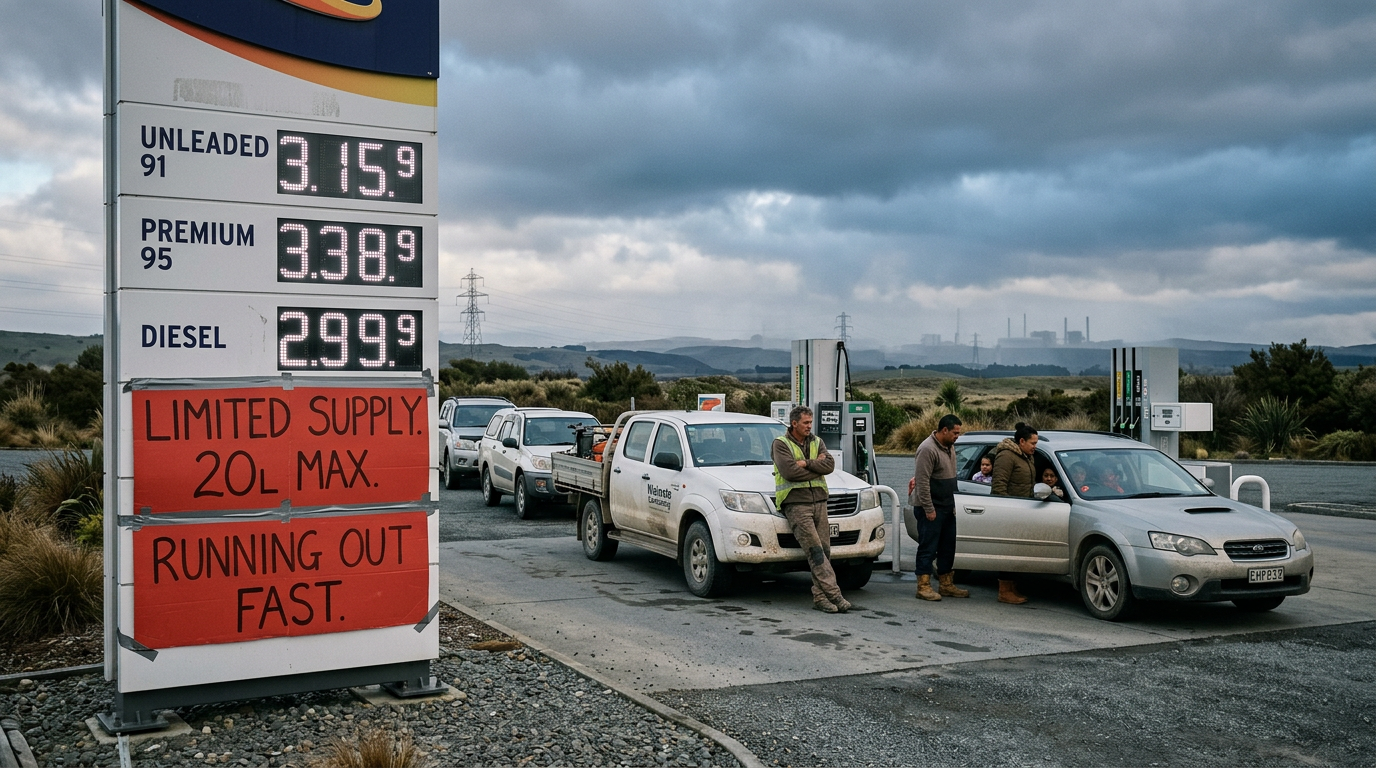
The Iran conflict's closure of the Strait of Hormuz in early 2026 sent oil through US$100 a barrel, as 1News reported, with analysts warning of US$150 if disruption continued. Petrol crossed $3 a litre, then climbed toward $4. Diesel surged more than $1 in a month. Rural contractors described conditions as the worst they had ever seen.
But here is what the government's spin machine did not tell you: this crisis landed on a body already broken.
Aotearoa had Marsden Point. Our only oil refinery. This government's predecessors — and this government, with its accelerated commitment to so-called "economic efficiency" — allowed it to close.
As Māori Green Lantern analysis in "When the Petrol Tanker Runs Dry: How a White Supremacist Neoliberal Government Left Māori at the Bottom of the Fuel Queue" (14 March 2026) documented: New Zealand had 21 days of physical diesel on soil when the crisis hit. The remaining "90 days" were paper contracts — IOUs. We were hollowed before the storm arrived.
The people who would absorb the impact first, hardest, and longest were already identified: the same people always at the bottom of the queue. Māori whānau. Rural communities. Home and community support workers. Job-seekers on Jobseeker Support. People like the one in that RNZ headline — a human being who wants to care for their community and cannot afford the petrol to try.
Ngā Hononga Huna — The Five Hidden Connections
1. The Package Was a Poison Chalice Dressed as Relief
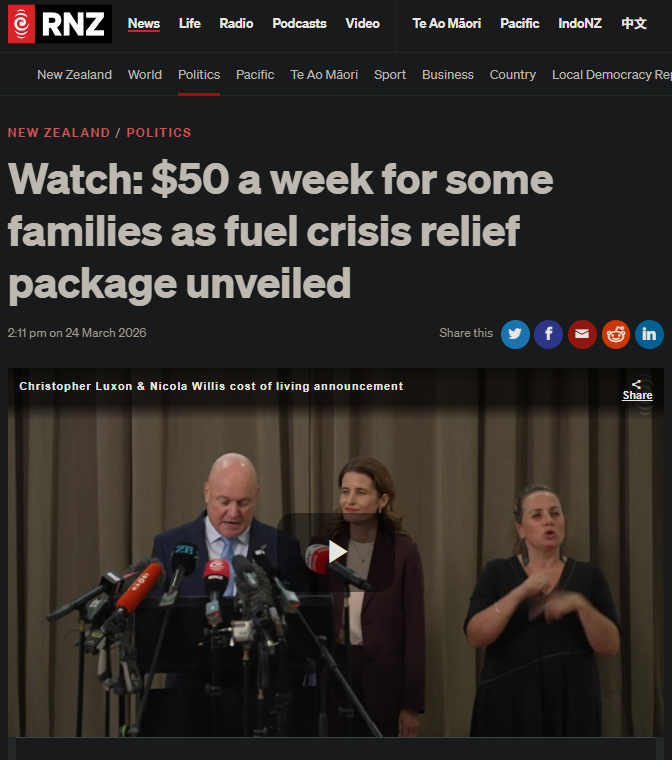
When Luxon and Willis unveiled their fuel crisis relief on 23 March 2026, the announcement machine ran hot. $50 a week. 143,000 families. The cameras loved it.
The fine print was the blade.
The relief flows through an expanded In-Work Tax Credit — available only to working families with children where no parent receives a main benefit. As 1News confirmed, this means beneficiaries, superannuitants, single workers, and unpaid carers receive nothing. Not one cent.
As Te Ao News reported, Te Pāti Māori co-leader Debbie Ngarewa-Packer called the exclusion out immediately:
"We've got 143,000 that have been accommodated for, but there's at least 620,000 that haven't been."
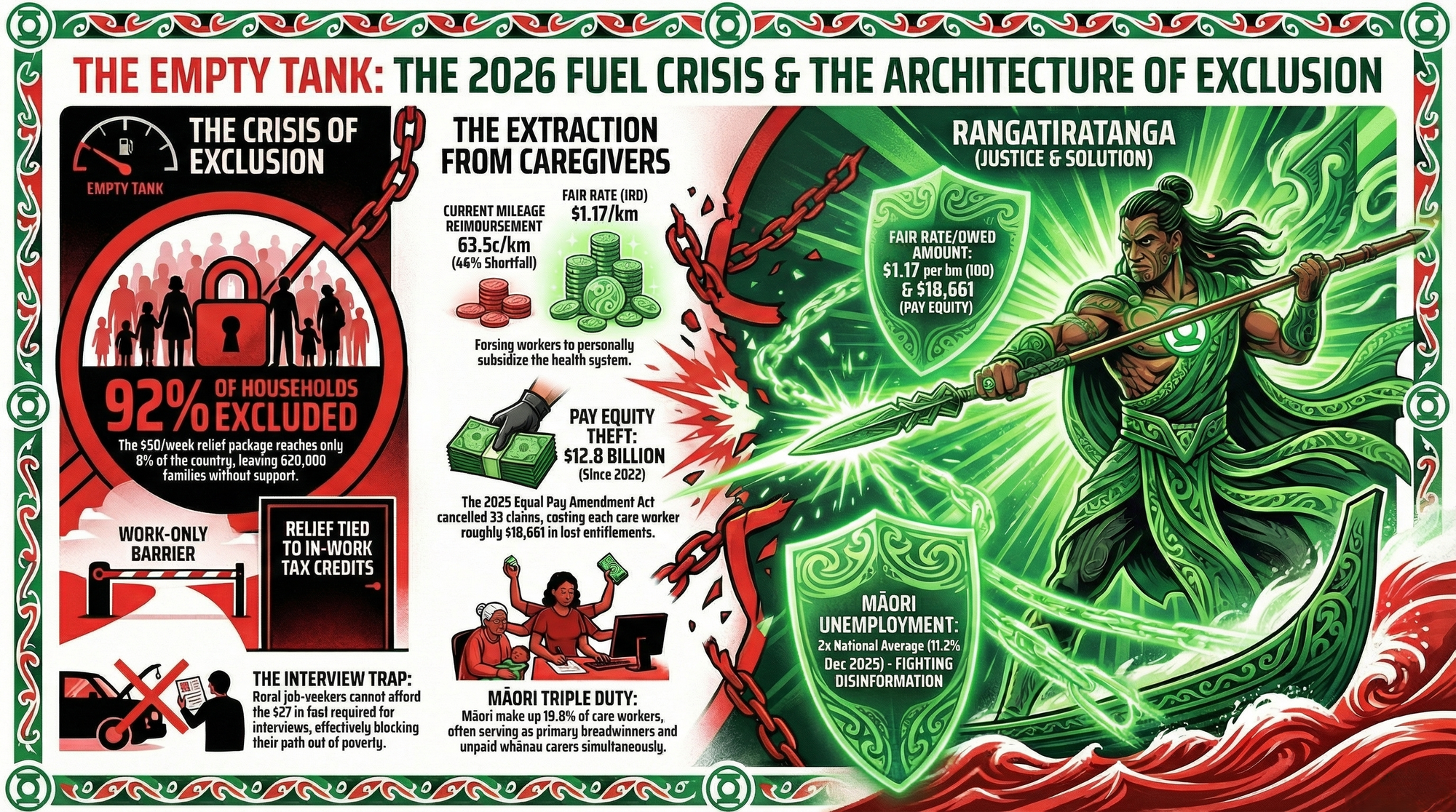
The NZCTU went further. As their statement confirmed, 92% of all New Zealand households receive nothing from this package. Nothing. A package sold to the nation as emergency relief reaches 8% of the country.
NZCCSS CEO Alicia Sudden named the central contradiction precisely: transport costs are a critical barrier for beneficiary families carrying out their obligations to seek work — the exact crisis faced by the rural carer in the RNZ headline. The government's response to that person? Structurally, deliberately: we do not see you.
This is not an oversight. It is a definition of citizenship: you are only worth helping if you are already employed and already not on a benefit. If you are trying to become employed from a position of poverty — if you are the rural carer job applicant who needs petrol to get to the interview that might lift them out of poverty — you are invisible to this machine. You are the exhaust, not the engine.
2. Home Support Workers Were Already Bleeding Before the Price Hit $3
The fuel crisis did not wound these workers. It opened a wound that this government had been deliberately keeping open.
E tū union confirmed that home support workers are currently reimbursed 63.5 cents per kilometre, averaged to 3.8 km per visit regardless of actual distance. The IRD's own Tier 1 mileage rate — the standard the tax system itself recommends — is $1.17 per kilometre. The government's reimbursement for essential health workers is 46% below the rate its own revenue authority considers reasonable.
Workers receive nothing for warrants of fitness, registration, servicing, or tyres. E tū confirmed a formal review last year concluded that Health NZ, MSD, and ACC "will not be increasing travel payments, despite the funding model being 'structurally flawed.'" As 1News reported, the mileage rate has not been reviewed since 2022. Health NZ itself estimated it would cost $45.7 million per annum to bring reimbursement to IRD rates.
That $45.7 million is being extracted from care workers' own pockets, every single year, as the price of being allowed to do their jobs.
Laura, a home support worker in Nelson, told 1News: "You end up just paying to be able to work those days." She drives a 2003 Mitsubishi Lancer, 258,000 km on the clock. She bought a second-hand moped. She hopes it doesn't rain.
This is the dignity this government extends to the people who keep its most vulnerable citizens alive.
PSA National Secretary Fleur Fitzsimons identified the fix: "The Health Minister can direct that mileage rate to be lifted immediately — no complicated fiddling with the tax and transfer system required, no delay, just fast, real help." The legal authority sits in the Home and Community Support (Payment for Travel Between Clients) Settlement Act 2016.
Simeon Brown has this power. He is choosing not to use it.
3. This Was Built on the Bones of the Pay Equity Theft
To understand the depth of this crime, you must trace its whakapapa. You must go back to May 2025.
Brooke van Velden stood in Parliament and, under urgency, with no public consultation, cancelled every pay equity claim in progress in New Zealand — 33 claims, 180,000+ workers — overnight. As the Māori Green Lantern's "The Forty-Five Minute Theft: How Six Ministers Stole $12.8 Billion from the Hands of 180,000 Workers" exposed: $12.8 billion set aside in Crown accounts to remedy systemic gender pay discrimination — gone. Diverted. Stolen in a Cabinet meeting.
The Equal Pay Amendment Act 2025 raised the threshold for a valid pay equity claim to require a workforce be at least 70% female for ten consecutive years. It gave employers broad powers to terminate claims. It was, as the Māori Green Lantern's "The Capitalist Mana-Whakanoa of Workplace Oppression" (2 August 2025) documented: "the cold, grey theology of neoliberalism, wielded by a coalition government that has spent two years proving, with statistical precision, that it does not consider Māori and Pasifika women to be fully human."
The PSA confirmed that 65,000 predominantly female care and support workers are currently losing $145 per week they are entitled to — a total of $18,661 each since 2022. NZDSN told the People's Select Committee the message sent by the 2025 Act was unambiguous: "that their work is still not valued. It is a message that directly contradicts the Government's stated commitments to fairness, equity, and Te Tiriti o Waitangi."
And Kaitiaki nursing journal named it plainly: "a major regression in women's rights."
4. Māori and Rural Workers Are the Designated Sacrifice
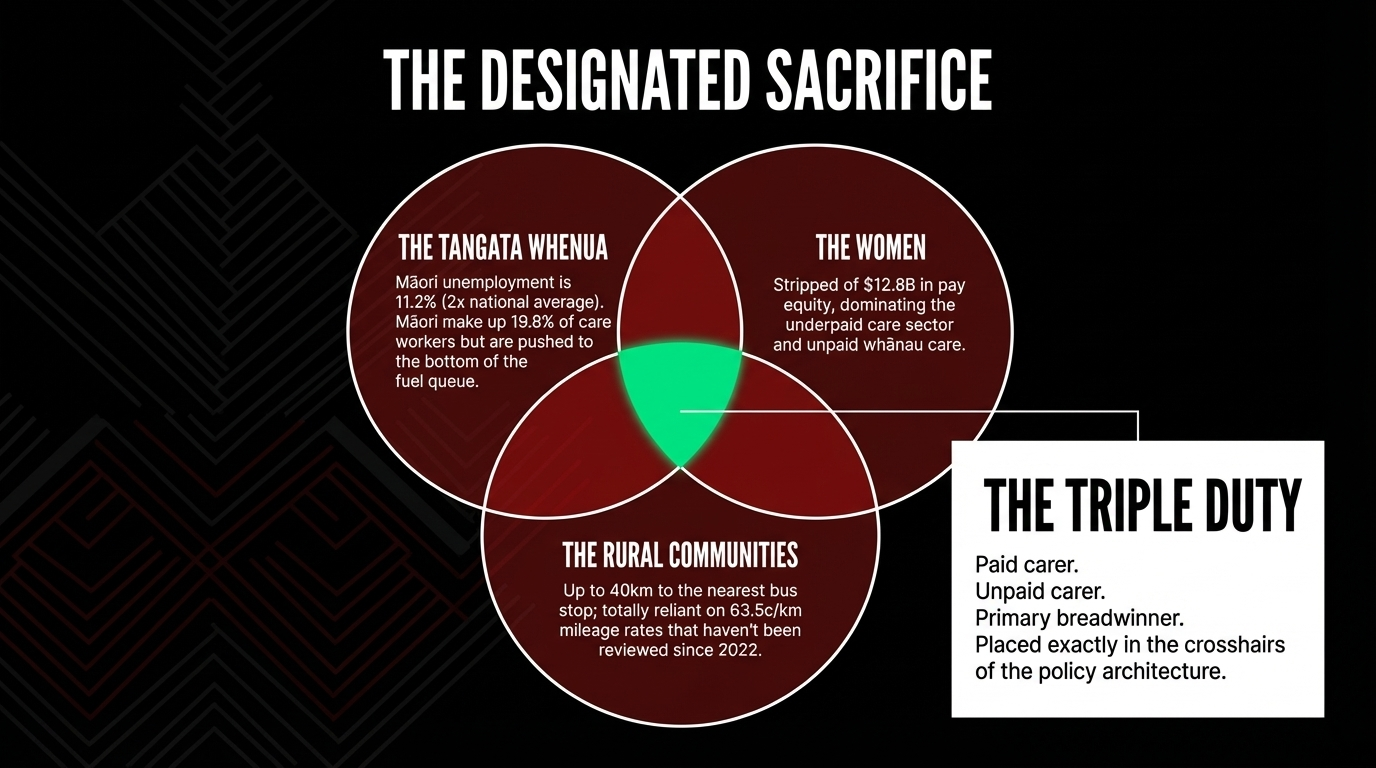
This policy cluster has demographics. It is not neutral. It never was.
Research from AUT's New Zealand Work Research Institute confirms that Māori make up 19.8% of care and support workers — proportionally higher than Māori's 17.1% share of the general population. Māori care workers are overrepresented in mental health and addiction support (26.6%). Over half provide the majority or all of their household income. 62.3% simultaneously provide unpaid care to dependent family members — including 21% spending more than 30 hours per week in unpaid caring roles.
Triple duty. Paid carer. Unpaid carer. Primary breadwinner. All on a wage this government refuses to fix.
New Zealand's Rural Health Strategy 2023 acknowledges it plainly: one in four Māori lives rurally, and addressing rural health access is inseparable from addressing Māori health equity. Distances between rural clients can stretch to 11 km, 14 km, and beyond per shift. In fuel crisis conditions, those kilometres are money leaving workers' mouths.
As the Māori Green Lantern documented in "The Traffic Light Taiaha: How a White Supremacist Government Built a Punishment Machine", Māori unemployment hit 11.2% in December 2025 — more than twice the national average. 13,800 more Māori are unemployed than two years ago. The Māori NEET rate for those aged 20-24 reached 24.8%. Nearly one in four young Māori, not in education, employment, or training, as the Government builds more sanctions and fewer pathways.
The rural carer in the RNZ headline is not an anomaly. She is the statistic that lives and breathes and cannot afford the petrol.
5. The Fix Exists. It Was Never Applied.

Let no one tell you this government could not act. They chose not to.
The PSA identified a legislative mechanism that requires no new funding model, no complex tax changes, no delay. The Health Minister can direct Health NZ to lift the mileage rate immediately, today, under existing statute. That is a legal power that could be exercised before lunch. Simeon Brown has not exercised it.
The Green Party proposed free public transport, increased mileage rates for care workers, direct payments to low-income rural households, and a windfall profits tax on fuel companies, as The Spinoff analysed. None of it made the government's package.
The NZCCSS called for extending support to beneficiary families. Anti-poverty groups, as reported by NZ Herald, slammed the exclusion as "disgraceful." The Greens' Ricardo Menéndez March confirmed beneficiaries were entirely cut out.
Everyone who looked — unions, churches, anti-poverty advocates, Te Pāti Māori — saw the same exclusion and said the same thing: this is wrong.
Luxon said: right.
Ngā Tauira — Three Examples for the Western Mind
To the reader who has never carried a patient through a 5am frost, who has never driven 14 km on a gravel road to check on a kaumātua for $4.23 of fuel reimbursement, who has never wondered whether the moped will start — three examples, to put flesh and dollar figures on what this ideology costs:
Example One: The Interview Trap
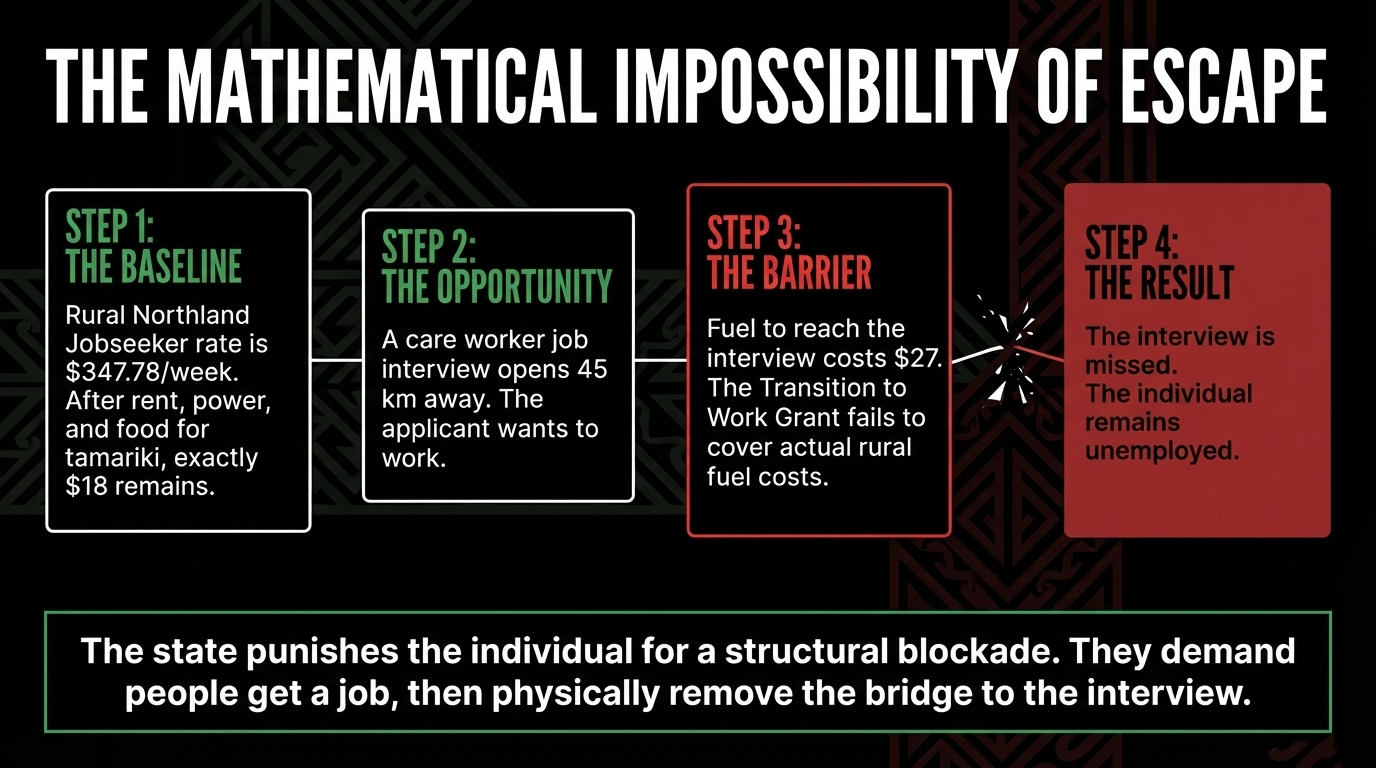
Imagine you are a Māori woman on Jobseeker Support in rural Northland. You have found a care worker job advertised 45 km away. You want this job. You have been doing unpaid care for whānau for years. This is your pathway off the benefit and into income.
You need $27 of petrol to get to the interview and back. Your weekly Jobseeker rate is $347.78, as confirmed by MoneHub's 2026 benefit rates. After rent, power, and food for your tamariki, you have approximately $18 in your account until Wednesday.
Work and Income has a Transition to Work Grant for exactly this situation. But at $3-plus per litre, the default transport allowance in the grant does not cover the actual cost of a rural return trip. You do not go. The interview goes ahead without you. The job goes to someone who can already afford to get there.
The quantified harm: This is not an edge case. It is the structural reality of rural poverty in a fuel crisis. The government's relief package does not touch this person. The In-Work Tax Credit requires employment. This woman is trying to become employed. She is the gap the policy was designed to ignore.
The tikanga violation: In tikanga, the rangatira ensures pathways are open for all who seek to contribute to the collective. A society that bars its own people from the road to participation — literally, for lack of petrol — has failed its most fundamental obligation. It has blocked the aho, the thread of connection between individual potential and collective wellbeing. And it has done it deliberately.
The solution: Extend the fuel relief package to all beneficiaries immediately, as NZCCSS demanded. Fund the Transition to Work Grant at actual rural fuel costs. For the Western mind: this is the equivalent of telling someone to get a job, then removing the bridge to the job interview.
Example Two: The Care Worker Who Subsidises the State
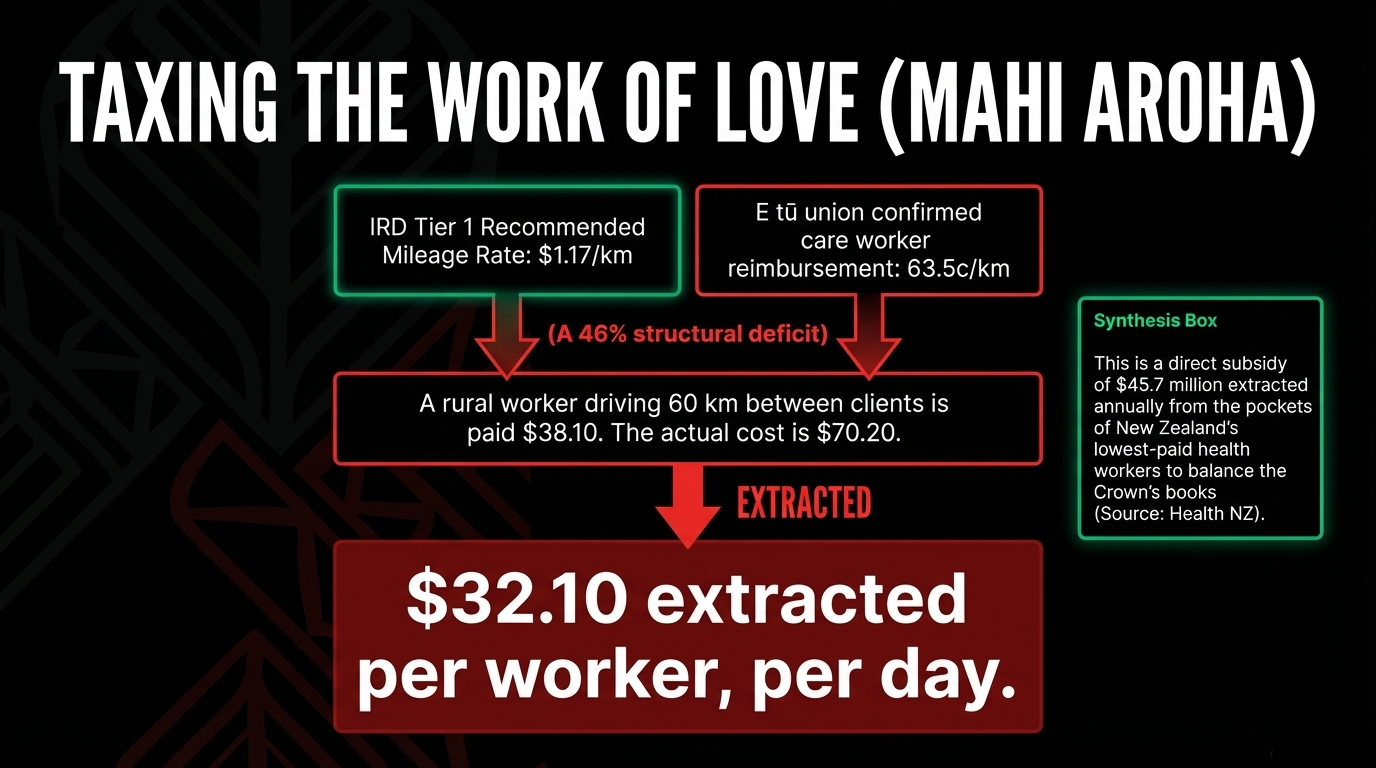
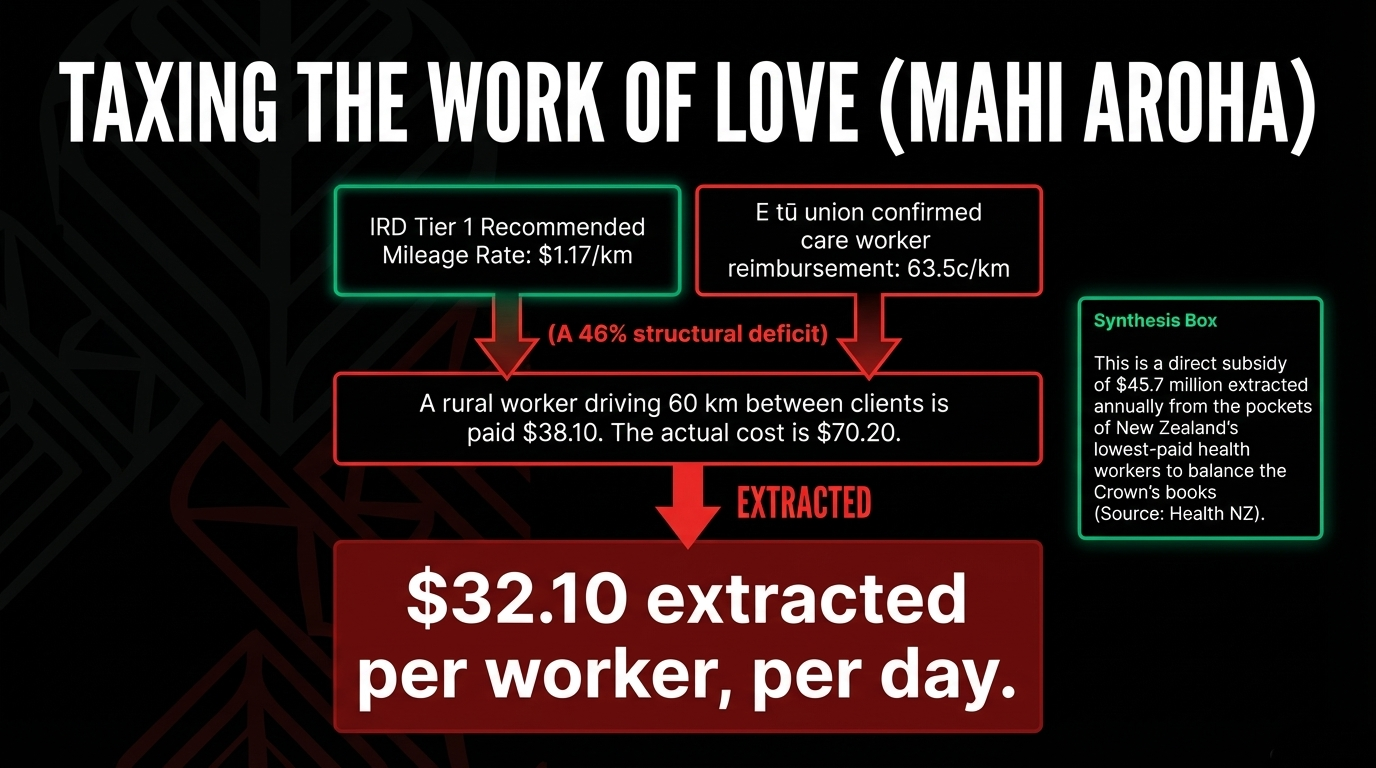
Imagine you are a Māori home support worker in Tairāwhiti. You drive between five clients a day — kaumātua with dementia, a young disabled man who needs help bathing, a mother recovering from surgery. Your car is your infrastructure. Without it, the state's entire community care system in your area collapses.
You are reimbursed 63.5 cents per kilometre, as confirmed by E tū union. The IRD's own recommended rate is $1.17/km. You drive 60 km in a day between clients. The state pays you $38.10. The actual cost to run your car is $70.20. You subsidise the New Zealand health system by $32.10 every single day you go to work. In a month, that is $706. In a year at current fuel prices, it is approaching $9,000 that you personally pour into a system that refuses to fund itself adequately.
The quantified harm: Health NZ estimated the true cost of fixing this at $45.7 million per year, as E tū confirmed. That $45.7 million is currently being extracted from the pockets of the lowest-paid, most overworked, most disproportionately Māori and Pasifika workers in the health system. This is the mahi aroha — the work of love — that this government has decided to tax.
The tikanga violation: Mahi aroha — work done from love, from obligation to community, from the deep structural caring that holds whānau together — is sacred. It is the foundation of Māori social life. When a state turns mahi aroha into a subsidy it extracts from workers rather than funds, it does not just exploit labour. It commits a tikanga violation with a dollar figure attached. It takes the love of a people and turns it into a line item on a balance sheet.
The solution: The Health Minister uses existing powers under the Home and Community Support (Payment for Travel Between Clients) Settlement Act 2016 to lift the rate to IRD Tier 1 immediately. No legislation. No review. No delay. Today, before the next worker drives another kilometre toward bankruptcy.
Example Three: The $18,661 That Was Stolen in 45 Minutes
On a Tuesday morning in May 2025, in a Cabinet room in Wellington, six ministers sat down and, as the Māori Green Lantern documented in "The Forty-Five Minute Theft", approved the cancellation of every pay equity claim in the country. No public announcement. No consultation. No release of advice. The Equal Pay Amendment Act 2025 was passed under urgency the next week. Thirty-three claims, 180,000 workers, $12.8 billion — gone.
The PSA confirmed that each affected care worker has lost $18,661 in entitlements since the original 2017 settlement sunset — money they are legally and morally owed. The rural carer applying for a job in 2026 faces the fuel crisis not just with an empty tank, but with three years of stolen wages behind her.
The quantified harm: 65,000 care and support workers × $18,661 each = $1.21 billion extracted from the lowest-paid workers in the health system since the pay equity sunset in 2022. $12.8 billion allocated and then redirected from women's pay equity across the economy as a whole.
The tikanga violation: Tika — justice, correctness, the doing of what is right — is not an aspiration in tikanga. It is an obligation. When Kristine Bartlett won her court case and established the principle that care work had been systematically undervalued because it was done by women, tika was partially restored. This government reached back and undid it. It looked at justice and chose its opposite. That is not policy. That is a moral atrocity. As Kaitiaki nursing journal named it: "a major regression in women's rights" — and the women most regressed are disproportionately Māori and Pasifika.
The solution: Repeal the Equal Pay Amendment Act 2025 in full. Reinstate all 33 cancelled claims. The People's Select Committee has made this recommendation, as E tū confirmed. Pay what is owed.
Ngā Hua Kino — The Ledger of Harm
This is what has been done. Named. Numbered. Verified.
| The Harm | The Number | The Source |
|---|---|---|
| Households excluded from fuel relief | 92% of all NZ households | NZCTU |
| Whānau without fuel support | At least 620,000 | Te Pāti Māori / Te Ao News |
| Annual worker fuel subsidy to health system | $45.7 million | E tū / Health NZ |
| Mileage rate gap (IRD vs actual payment) | 46% shortfall: 63.5c vs $1.17/km | E tū / 1News |
| Lost pay equity per care worker since 2022 | $18,661 | PSA |
| Weekly loss per worker from pay equity sunset | $145 | PSA |
| Pay equity claims cancelled overnight | 33 claims, 180,000+ workers | DLA Piper / NZNO |
| Crown funds diverted from pay equity | $12.8 billion | Kaitiaki / MGL "The Forty-Five Minute Theft" |
| Māori unemployment rate (Dec 2025) | 11.2% — 2× national average | MBIE / MGL "Traffic Light Taiaha" |
| Children in material hardship | 169,300 (25.1% Māori) | Children's Commissioner / MGL "Starving of the Seedlings" |
Ngā Hononga Ake — The Wider Whakapapa
This essay does not exist in isolation. The Māori Green Lantern has traced this government's war on the caring class across multiple fronts.
Every thread connects:
In "Ka Noho i Roto i te Ahi: The Government's Toll Booth to Hell" (25 March 2026), the Māori Green Lantern exposed how routing the fuel relief package through Inland Revenue replicates the same broken Working for Families system that delivered the wrong payment to 76% of recipients — and could generate repayment demands of $4,000 sent to whānau months after the crisis. The poison dressed as medicine.
In "The Traffic Light Taiaha: How a White Supremacist Government Built a Punishment Machine" (February 2026), this government's welfare sanctions architecture was anatomised: Māori make up 55% of those sanctioned while representing 39% of beneficiaries. The machine is not broken. It is targeted.
In "The Starving of the Seedlings" (7 March 2026), the school lunch programme's corporatisation and collapse was exposed as the same logic applied to the most vulnerable: cut from below, protect from above, rename the cruelty as efficiency.
In "The Capitalist Mana-Whakanoa of Workplace Oppression" (August 2025), the pay equity theft was documented in full:
"This covert operation, deliberately concealed from public scrutiny and rushed through Parliament under urgency, strips $12.8 billion from women's workplace rights while masquerading as fiscal responsibility."
And in "When the Petrol Tanker Runs Dry" (14 March 2026), the structural energy sovereignty failure was exposed: Marsden Point closed, 21 days of physical fuel reserves, and Māori whānau positioned at the bottom of every queue.
Same government. Same logic. Same targets. Same victims.
Ko Wai Ngā Hua — Who Benefits From This Arrangement?
Not the rural carer who cannot afford petrol.
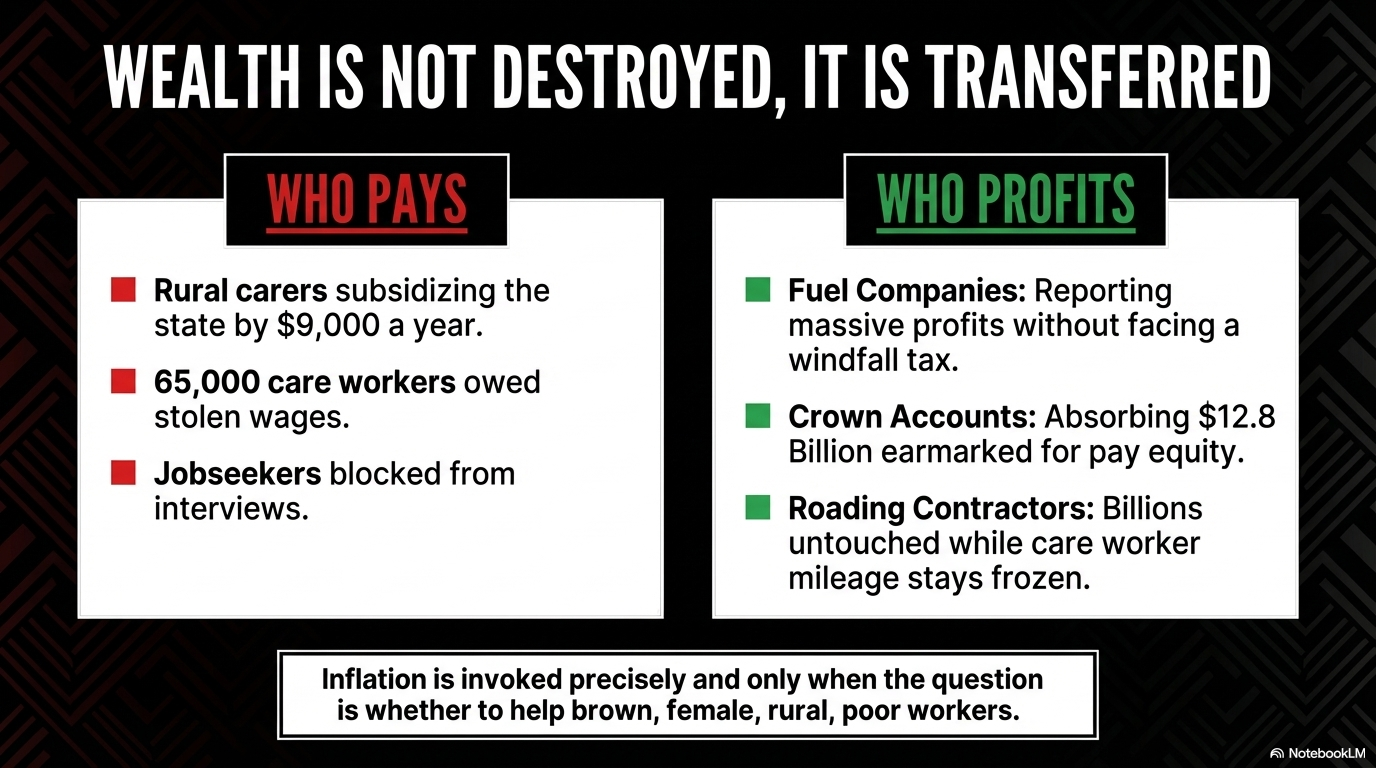
Not the 23,000 home support workers reimbursed at half the IRD rate.
Not the 65,000 care workers owed $18,661 each.
Not the 169,300 children in material hardship.
Not the 620,000 whānau excluded from the fuel package.
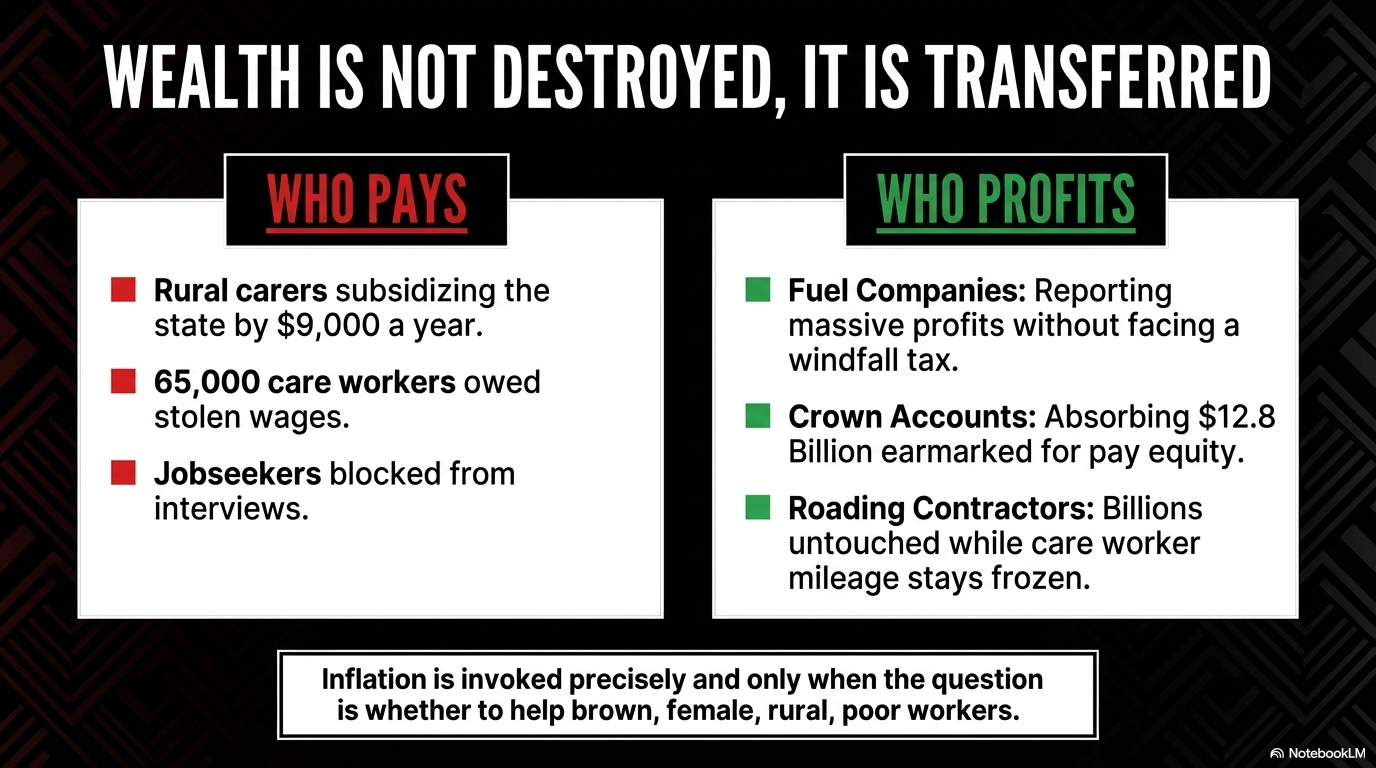
The aged care and disability providers who receive Crown contracts and are not required to increase wages or mileage rates — they benefit.
The Crown accounts that absorbed $12.8 billion earmarked for pay equity — they benefit.
The fuel companies never subjected to a windfall profits tax — they benefit.
The roading contractors whose billions remain untouched as care workers' mileage rates stay frozen — they benefit.
Willis talks about "not making inflation worse" as her reason for targeting relief only at employed families. She did not talk about inflation when cutting taxes for landlords. She did not talk about inflation when borrowing for Roads of National Significance.
Inflation is invoked precisely and only when the question is whether to help brown, female, rural, poor workers.
Then suddenly: fiscal responsibility.
Then suddenly: the integrity of the tax system.
Then suddenly: the three Ts — targeted, timely, temporary.
The whakapapa of this is not accidental. As neoliberal health scholars confirmed in the New Zealand Medical Journal, neoliberalism as a health determinant consistently produces these outcomes: the shrinking of the public domain, the transfer of risk from state to individual, the racialised concentration of harm. This government is not making neoliberal mistakes. It is achieving neoliberal objectives.
Hei Whakakapi — The Moral Accounting
The whakataukī says: Nō reira, ka hinga atu he tētēkura, ka ara mai he tētēkura. As one frond falls, another rises.
This government has felled the frond that protects its most vulnerable. It felled the pay equity settlement. It felled the mileage rate review. It felled the Māori Health Authority. It felled the school lunch programme's local procurement. It felled the Total Mobility subsidies. It felled the 7,000 public sector jobs. It is now offering $50 a week to 8% of the country and calling it emergency relief.
What it cannot fell — what no neoliberal government in the history of this whenua has ever successfully destroyed — is the wairua of the people who carry. Who wake at 4am. Who drive 14 km on a gravel road for a kaumātua who has no one else. Who provide 30 hours of unpaid care to their own whānau on top of a minimum-wage shift. Who look at $27 of petrol they cannot afford and feel not just poverty but despair — the specific, crushing despair of a person who wants to contribute and has been structurally barred from doing so.
ODT quoted Dunedin support worker Juliette Young:
"It's unrealistic really. I don't think anyone could really live on the wage we're on today."
She warned vulnerable people would be "left alone in their pyjamas all day" if workers quit. That is not hyperbole. That is the design specification of a system bled to the bone.
This government has looked at Juliette Young, and Laura with her moped, and the rural carer who cannot afford the interview, and Māori kuia who double as both paid and unpaid carers — and it has made a choice.
The choice has a name. It has a whakapapa. It has a dollar figure.
And it will be remembered.
Rangatiratanga — What Must Be Done
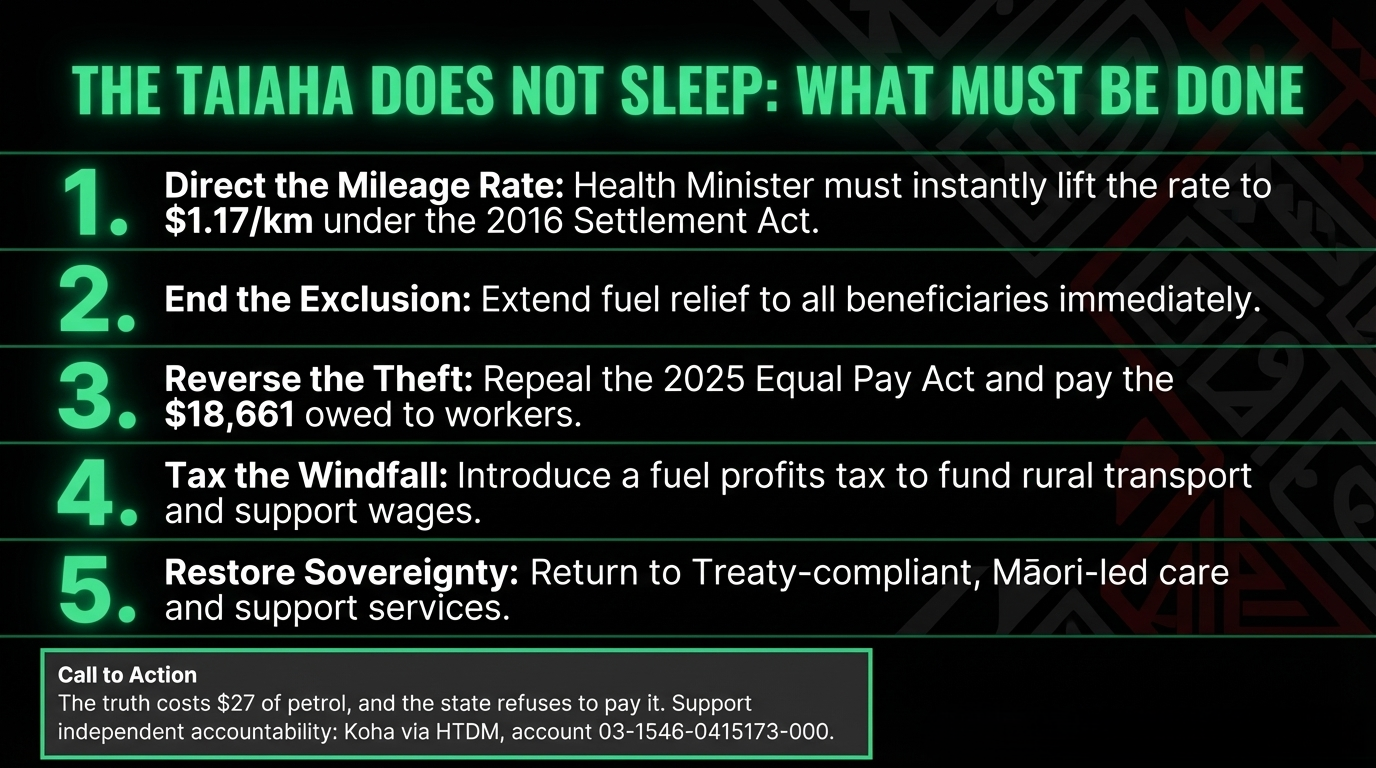
- Health Minister Simeon Brown must direct Health NZ today to raise the mileage rate for home support workers to IRD Tier 1 — $1.17/km. The legal power exists under the 2016 Settlement Act. No legislation needed. No delay. Do it.
- Extend fuel relief to all beneficiaries immediately, including those actively seeking work. As NZCCSS demanded, transport access is integral to work obligations. Excluding job seekers from fuel relief while sanctioning them for non-compliance is institutional cruelty.
- Repeal the Equal Pay Amendment Act 2025 in full. Reinstate all 33 cancelled claims. Pay the $18,661 owed to every care worker since 2022. As E tū confirmed, the People's Select Committee has made this recommendation. The time for reviews is over.
- Introduce a windfall profits tax on fuel companies and redirect it to home support worker wages, rural fuel subsidies, and free public transport for low-income households. The profits are real. The need is real. The solution is available.
- Restore and fund Māori-led care and support services at minimum 2023 funding levels, with Treaty-compliant governance and accountability to whānau, not to Treasury. The rural dimension of this crisis is a racialised dimension. The solution must be too.
Ka tangi te tītī. Ka tangi te kākā. Ka tangi hoki ahau.
The shearwater cries. The parrot cries. And so too do I.
The taiaha does not sleep. The whakapapa of harm has been traced. The names have been named. The dollar figures have been verified.
Tū mai, whānau. This is not over. It has barely begun.
Tautoko — Koha Consideration
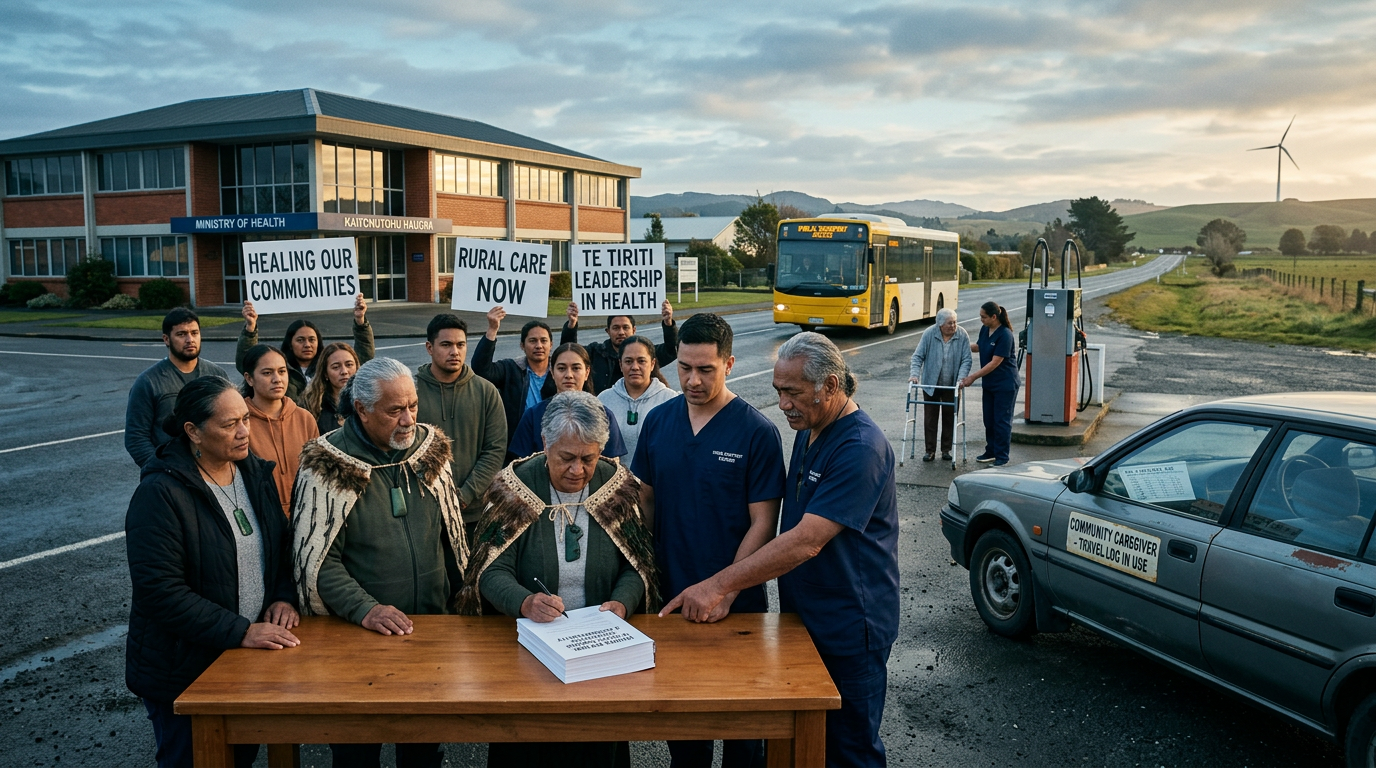
The rural carer in this headline cannot afford $27 of petrol. This government will not fund the accountability that exposes why. That is why this mahi exists — and why it depends on you.
Every koha to the Māori Green Lantern is a direct investment in the truth that Nicola Willis does not want named, that Christopher Luxon does not want counted, that Brooke van Velden hoped would stay buried in a Cabinet minute no one would release. Every koha signals that whānau are ready to fund the accountability that Crown and corporate structures will not provide. It signals that rangatiratanga includes the power to fund our own truth tellers — especially when the truth costs $27 of petrol and the state refuses to pay it.
If you cannot koha, no worries at all — subscribe, follow, share, and kōrero this with your whānau. That is koha in itself.
Three pathways:
For those who wish to support this mahi directly: Koha — Support the Māori Green Lantern
For those who wish to receive essays directly and support through subscription: Subscribe to the Māori Green Lantern
For those who prefer direct bank transfer: HTDM, account number 03-1546-0415173-000
Kia kaha, whānau. Stay vigilant. Stay connected. The taiaha is yours.

Research conducted 26 March 2026. Sources include RNZ, E tū union, PSA, NZCCSS, NZCTU, Te Pāti Māori, Green Party, Beehive, AUT Work Research Institute, MBIE, Health NZ, 1News, NZ Herald, The Spinoff, Waatea News, ODT, Te Ao News, Carers NZ, NZNO, NZDSN, Nursing Council NZ, DLA Piper, Kaitiaki Nursing journal, and previous Māori Green Lantern investigations. All links verified at time of publication.