“The Finance Minister's Great Deception” - 2 September 2025
Exposing Nicola Willis's Web of Lies and the Reserve Bank Cover-Up That Betrays Aotearoa
Kia ora e te whānau.
Today we expose how Finance Minister Nicola Willis orchestrated one of the most brazen cover-ups in recent New Zealand political history, systematically deceiving the public while protecting her cronies at the Reserve Bank. This is not incompetence—this is calculated deception that strikes at the heart of democratic accountability in Aotearoa.
https://www.nzherald.co.nz/business/economy/nicola-willis-denies-reserve-bank-cover-up-insists-she-pushed-for-transparency/3FJ3PWL2CVBGPGNV4GNZ53OWZY/
Essential Context: When Power Corrupts Transparency
The Reserve Bank of New Zealand crisis that exploded in August 2025 represents everything toxic about neoliberal governance under the National-Act coalition. Former Governor Adrian Orr's forced resignation in March was systematically covered up by Reserve Bank board chair Neil Quigley, with Finance Minister Nicola Willis's full knowledge and participation. This scandal exposes how colonial power structures operate to shield the wealthy elite from accountability while ordinary whānau suffer under their economic mismanagement.
The significance from a Māori perspective cannot be understated. The Reserve Bank's monetary policy directly impacts inflation, employment, and housing costs—issues that disproportionately harm Māori whānau. When these institutions operate in secrecy, manipulated by conflicts of interest and political interference, they become tools of colonial oppression rather than servants of the people.
The Scandal Unveiled: A Timeline of Deception
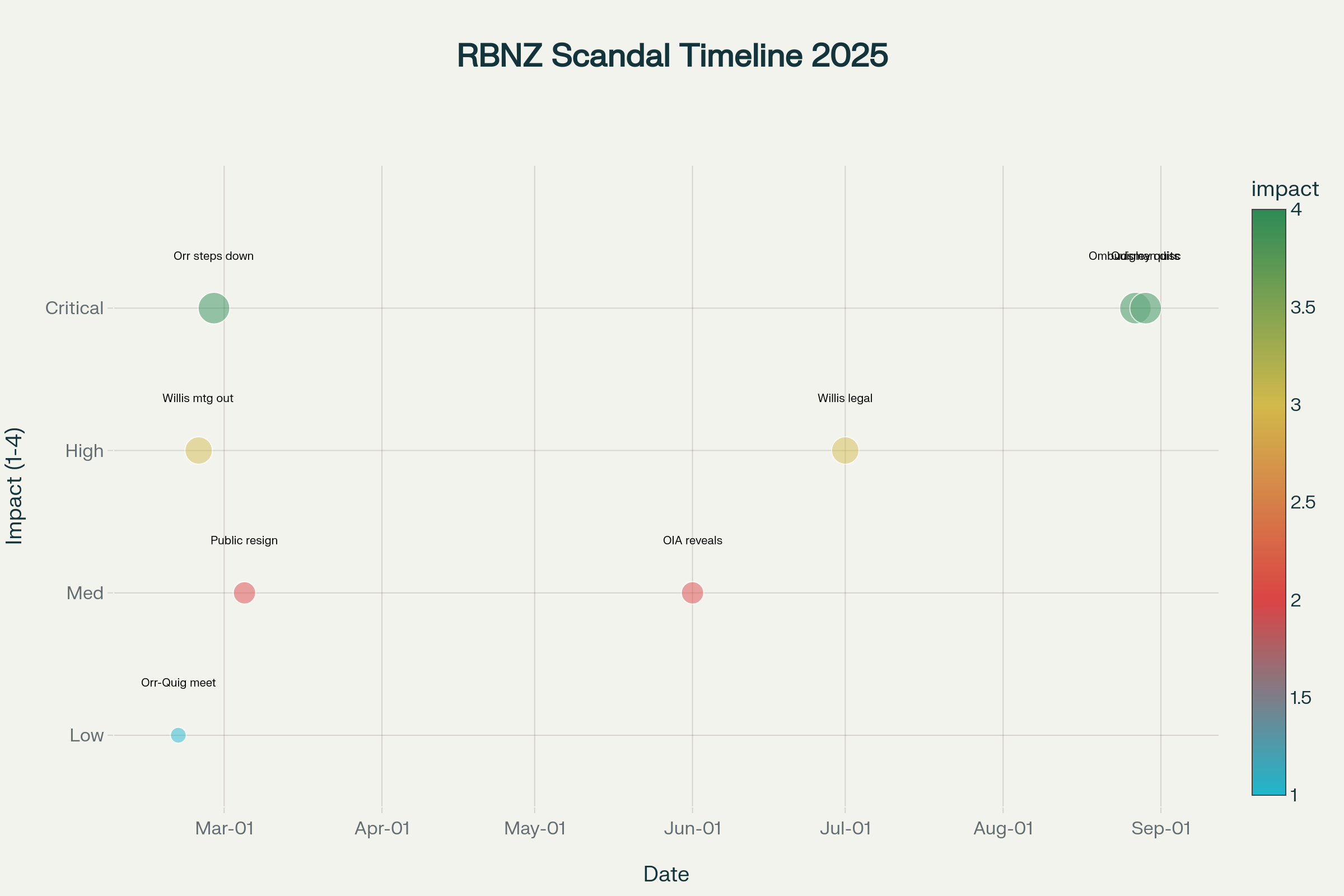
Timeline of the RBNZ scandal from February to September 2025
The careful orchestration of this cover-up reveals a pattern of colonial governance that prioritizes protecting power over serving the people. On February 20, 2025, tensions first emerged between Orr and Quigley over funding disagreements. By February 24, these tensions exploded in a meeting where Orr "expressed his frustration regarding the relationship between the RBNZ and the Treasury" before walking out early.
What happened next exposes the depths of this deception. On February 27, Orr was forced to step down temporarily as the board presented him with a "letter of concerns" about his behavior. Yet when Orr's resignation was announced on March 5, Quigley told the public it was simply a "personal decision"—a blatant lie that would unravel months later.
Willis's Web of Lies: Calculated Deception in Action
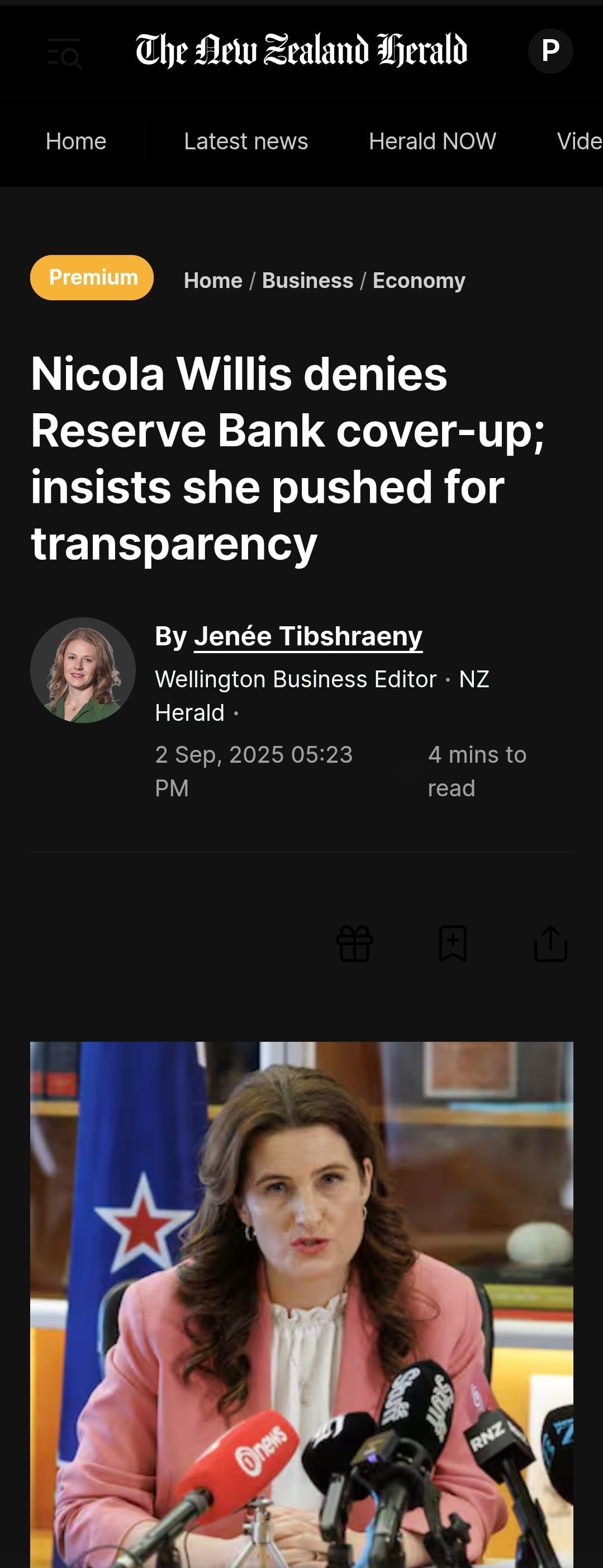
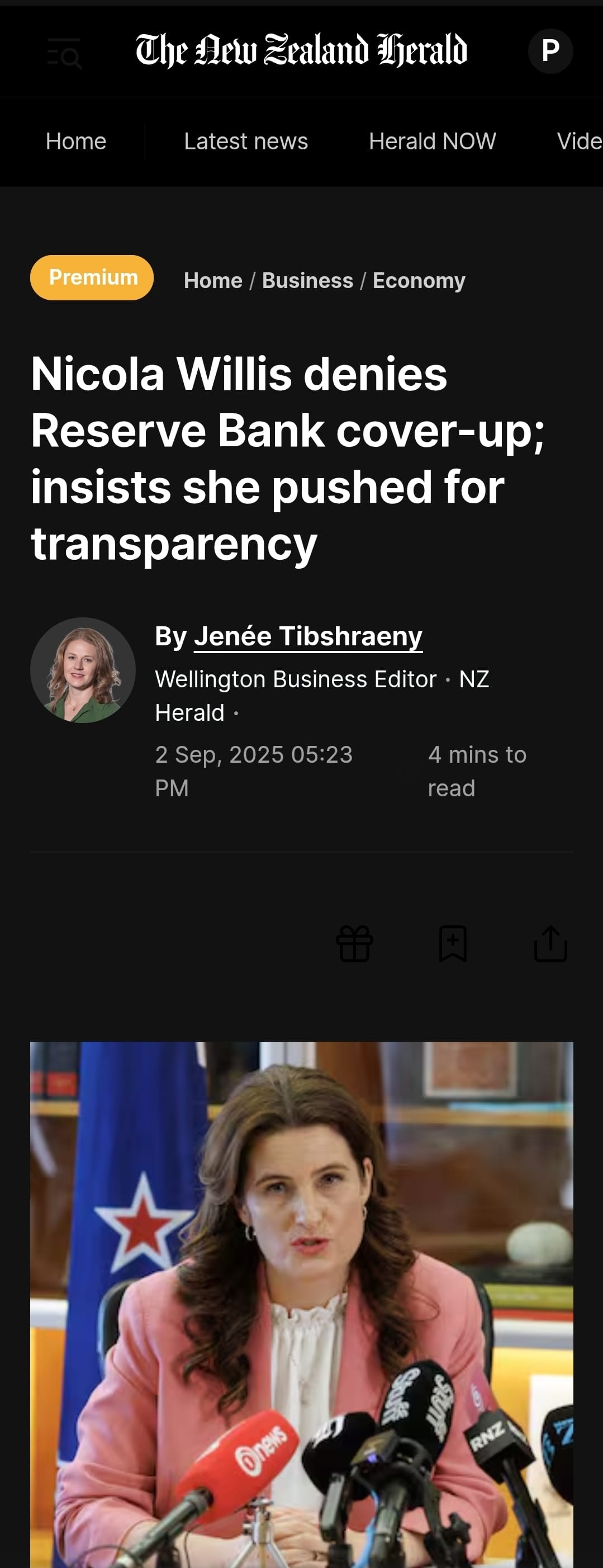
The attached NZ Herald article reveals Willis's desperate attempts to rewrite history after the Ombudsman forced the truth into daylight. Her claims of pushing for transparency are contradicted by her own actions and timeline of events.
Willis knew exactly what was happening during the February 24 meeting when Orr walked out, yet she stayed silent for months. She participated in the charade by accepting Quigley's false explanation that Orr's departure was a "personal decision". When pressed in May about transparency, she confirmed she was "comfortable" with the public explanation—another lie designed to protect the cover-up.
The Finance Minister's supposed concern for transparency only emerged after the Ombudsman began investigating. Her claims of texting Quigley about legal advice and questioning King's Counsel recommendations represent damage control, not genuine accountability. This is classic neoliberal gaslighting—rewriting history when caught red-handed.
Hidden Networks: The Quigley-Joyce Connection
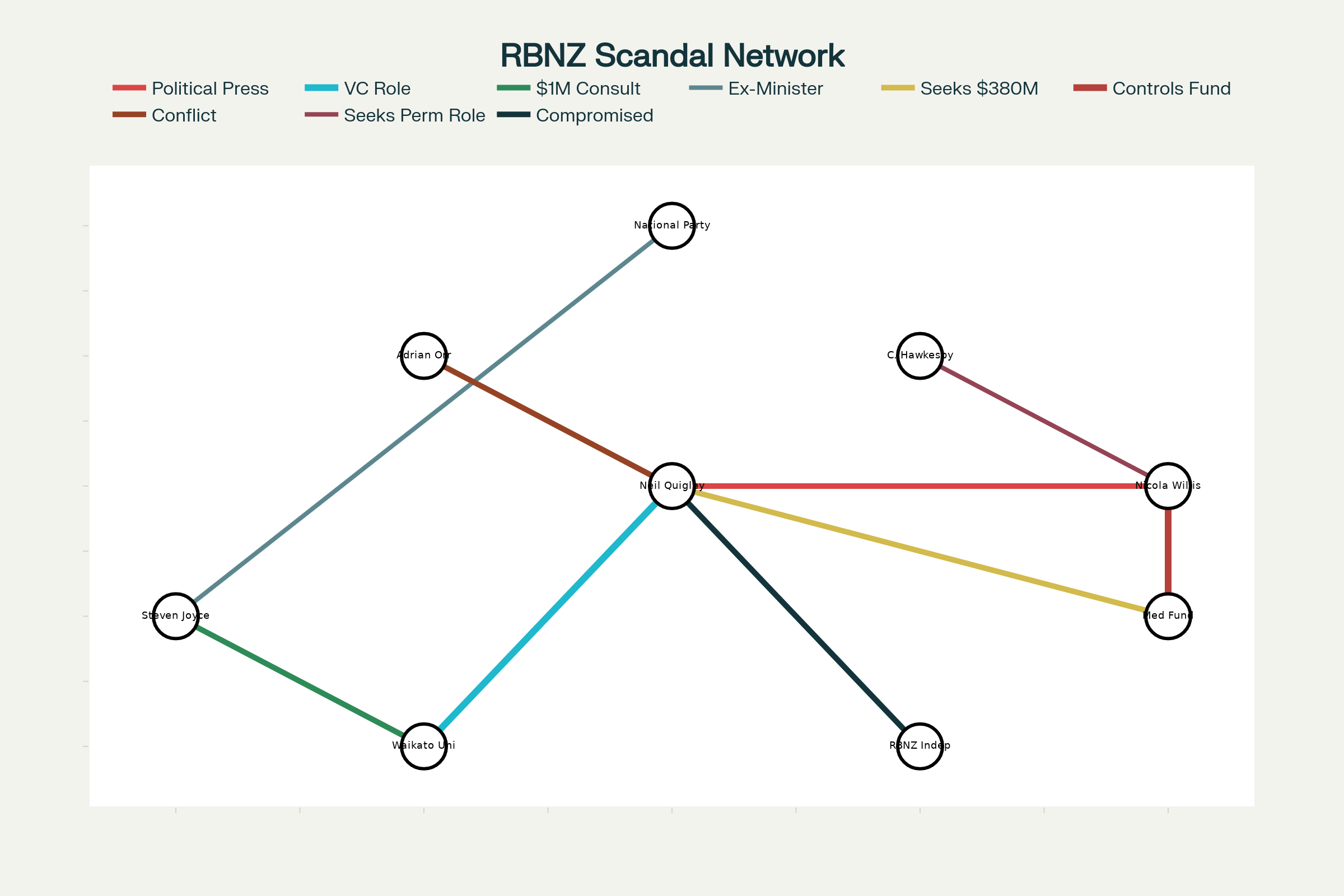
Network of conflicts and connections in the RBNZ scandal
The true corruption extends far beyond the immediate scandal. Neil Quigley's dual role as both Reserve Bank chair and University of Waikato vice-chancellor created a web of conflicts that compromised the bank's independence. Documents revealed Quigley told National MP Shane Reti that the proposed Waikato medical school could be a "present" to a future National government.
This wasn't innocent academic collaboration. Waikato University paid former National Cabinet Minister Steven Joyce's consultancy firm nearly $1 million over three years, creating a direct financial pipeline between National Party networks and Quigley's university operations. Joyce even provided "lobbying strategies" to help secure government support for the medical school.
The timing is damning. While Quigley was covering up Orr's forced resignation and protecting Willis from scrutiny, his university was seeking $380 million in government funding for the medical school. This represents a clear quid pro quo arrangement—Quigley protects Willis's reputation, and she delivers funding for his university project.
Colonial Power Structures in Action
This scandal perfectly illustrates how colonial institutions perpetuate themselves through networks of privilege and mutual protection. The Reserve Bank, supposedly independent, became a tool for protecting National Party interests rather than serving all New Zealanders.
The exclusion of Māori perspectives from these crucial decisions reflects systemic racism within our financial institutions. While Māori whānau struggle with inflation, housing costs, and unemployment exacerbated by Reserve Bank policies, the institution's leadership operates as an old boys' club serving Pākehā elite interests.
Willis's reference to Victoria University law professor Dean Knight's comments about privacy obligations shows how legal frameworks become weapons in the hands of the powerful. The same legal system that routinely fails Māori is manipulated to justify keeping crucial information from the public.
Broader Implications: Neoliberalism's Assault on Democracy
This cover-up serves neoliberal interests by protecting the fiction of Reserve Bank independence while enabling political interference behind closed doors. The coalition government's broader agenda—attacking co-governance, undermining Te Tiriti, and advancing market fundamentalism—requires institutions that operate without scrutiny or accountability.
The timing of Quigley's eventual resignation on August 29, just before the 6pm news on a Friday, demonstrates calculated media manipulation designed to minimize public attention. This follows the neoliberal playbook of burying bad news when audiences are smallest.
For Māori communities, this scandal confirms what we already know—colonial institutions serve colonial interests. The Reserve Bank's policies on inflation, employment, and housing directly impact Māori whānau, yet these decisions are made in secrecy by conflicted individuals serving political masters rather than the people.
Implications for Aotearoa's Democracy
The RBNZ scandal reveals how neoliberal governance operates through networks of mutual benefit among the elite. While Willis claims to champion transparency, her actions demonstrate the opposite—systematic deception designed to protect power structures that harm ordinary New Zealanders.
The compromise of Reserve Bank independence under political pressure represents a fundamental threat to economic governance in Aotearoa. When crucial institutions become tools for serving political interests rather than the public good, democracy itself is undermined.
This scandal particularly impacts Māori communities who bear the brunt of economic policies decided in secret by conflicted officials. The colonial nature of these institutions becomes clear when transparency is sacrificed to protect Pākehā elite networks.

The Māori Green Lantern Fighting Misinformation And Disinformation From The Far Right
Demanding Truth and Justice
The Reserve Bank cover-up exposes the rotten core of neoliberal governance under the National-Act coalition. Nicola Willis's systematic deception, Neil Quigley's conflicts of interest, and the entire establishment's protection of elite networks represent everything wrong with colonial power structures in Aotearoa.
This scandal demands consequences. Willis must be held accountable for her lies and manipulation. The Reserve Bank requires fundamental reform to ensure genuine independence and transparency. Most importantly, we must recognize how these institutions perpetuate colonial oppression and work to transform them.
As kaitiaki of truth and justice, we cannot allow the powerful to escape accountability through cover-ups and media manipulation. The truth has emerged despite their best efforts to conceal it. Now we must ensure that truth leads to real change.
For readers who find value in exposing these networks of power and deception, please consider supporting this work with a koha to HTDM: 03-1546-0415173-000. The MGL understands these tough economic times for whānau, so please only contribute if you have capacity and wish to do so.
The fight for transparency and accountability continues. Together, we will hold the powerful accountable and build a more just Aotearoa.
Ngā mihi nui,
Ivor Jones
The Māori Green Lantern