“The Fiscal Shipwreck: How Nicola Willis and the Coalition Have Driven New Zealand’s Economy Onto the Rocks” - 5 December 2025
The Deficit That Keeps Growing
Kia ora e te whānau.
The numbers are in, and they tell a story of failure so complete, so catastrophic, that it demands we speak plainly:
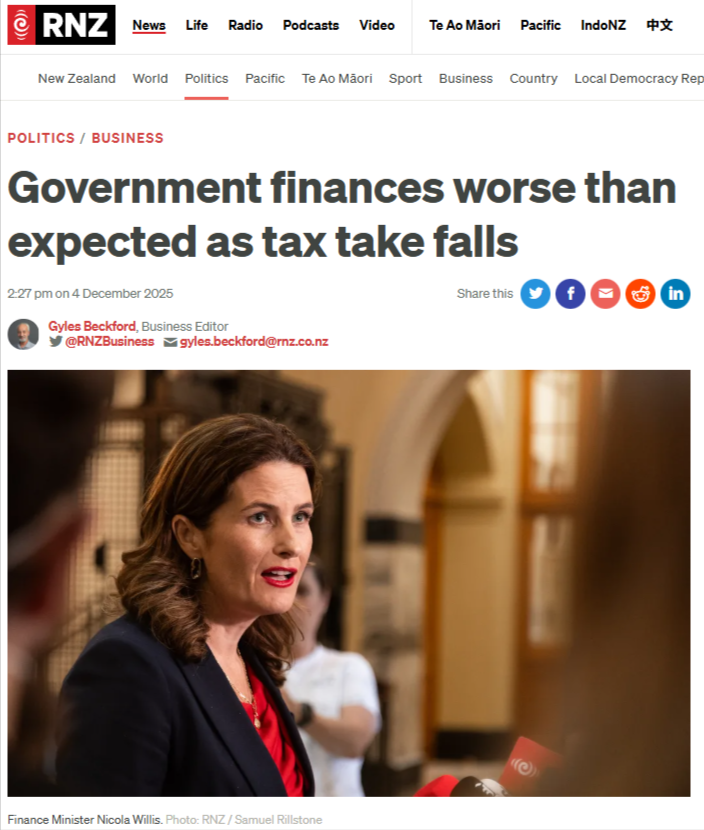
this government is not managing the economy—it is destroying it. When Treasury released figures on December 4, 2025 showing the deficit had blown out to $4.9 billion in just four months—$700 million worse than forecast—it confirmed what Māori communities and working families have known in their bones for two years: austerity kills, and the killers wear suits.
Let us be absolutely clear about what RNZ reported yesterday:
the government’s finances are worse than expected, again. The deficit for the four months to October 2025 hit $4.9 billion—$700 million higher than Finance Minister Nicola Willis forecast in May’s Budget. Including ACC costs, the deficit reaches $5.2 billion, which is $439 million above forecast.
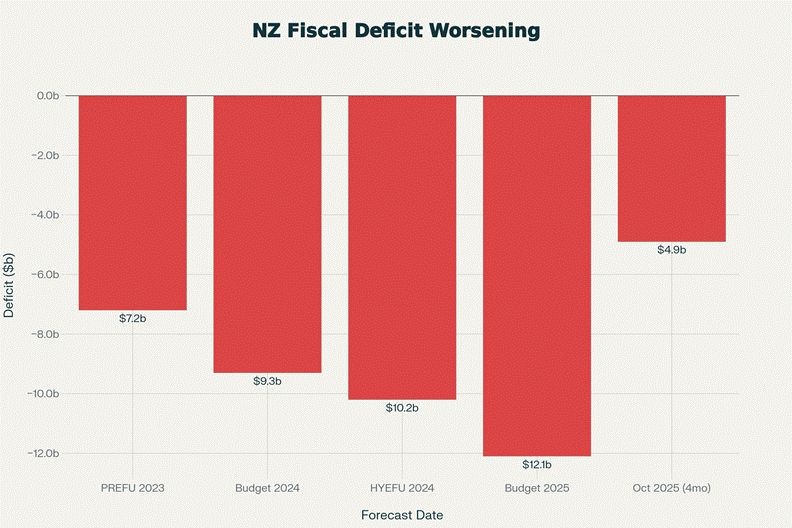
The Coalition Government’s fiscal trajectory: surplus targets continually pushed back while deficits deepen
The tax take fell $600 million short of projections, driven by weaker corporate and provisional tax receipts, as Treasury figures confirm. This is not a mystery. When you fire 10,000 public servants, slash government spending, and tank the economy, businesses make less money and pay less tax. The neoliberal playbook writes its own fiscal epitaph.
Treasury’s own figures show New Zealand has now been in deficit for a full decade—the longest stretch since the devastation of the 1990s benefit cuts. The promised return to surplus keeps retreating into the future like a mirage: from 2027 in the pre-election promises, to 2028 in Budget 2024, to 2029 in December’s Half Year Update, where it remains today—always one more year away, always requiring just a little more sacrifice from those who can least afford it, as 1News documented.
The Promised Land That Never Arrives: A Timeline of Failure
Willis pledged in September 2023 that she would resign if she failed to deliver her tax cut plan.
“If we didn’t deliver tax reduction, yes, I would resign, because we are making a commitment to the New Zealand people, and we intend to keep it,” she told Breakfast’s Matty McLean.
The foreign buyer tax that was supposed to fund those cuts? Scrapped in coalition negotiations with NZ First before the government even took office. The fiscal hole left behind? Still gaping.
Here is the documented trail of broken promises:
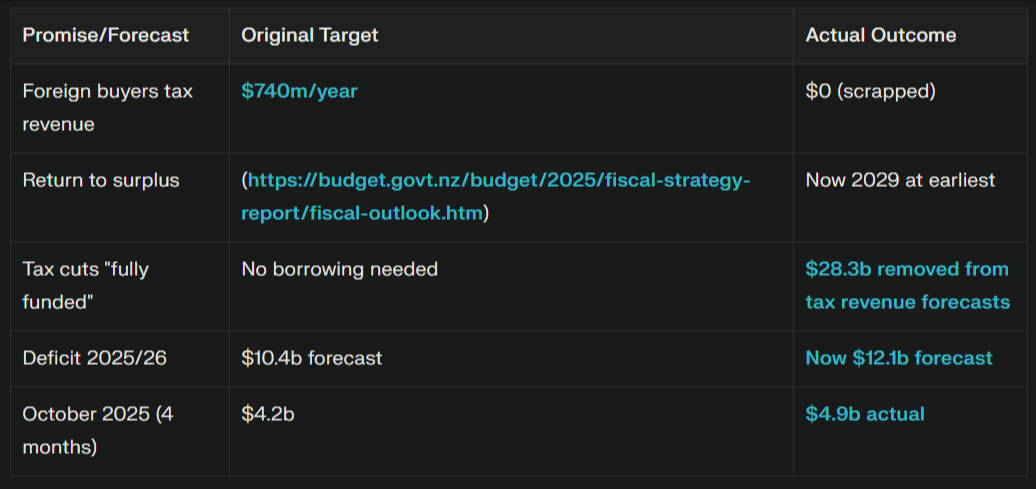
The Budget Economic and Fiscal Update reveals the brutal truth: the OBEGALx deficit is expected to reach $12.1 billion in 2025/26—nearly $2 billion worse than December’s forecast. Willis has taken a structural deficit and made it structural concrete.
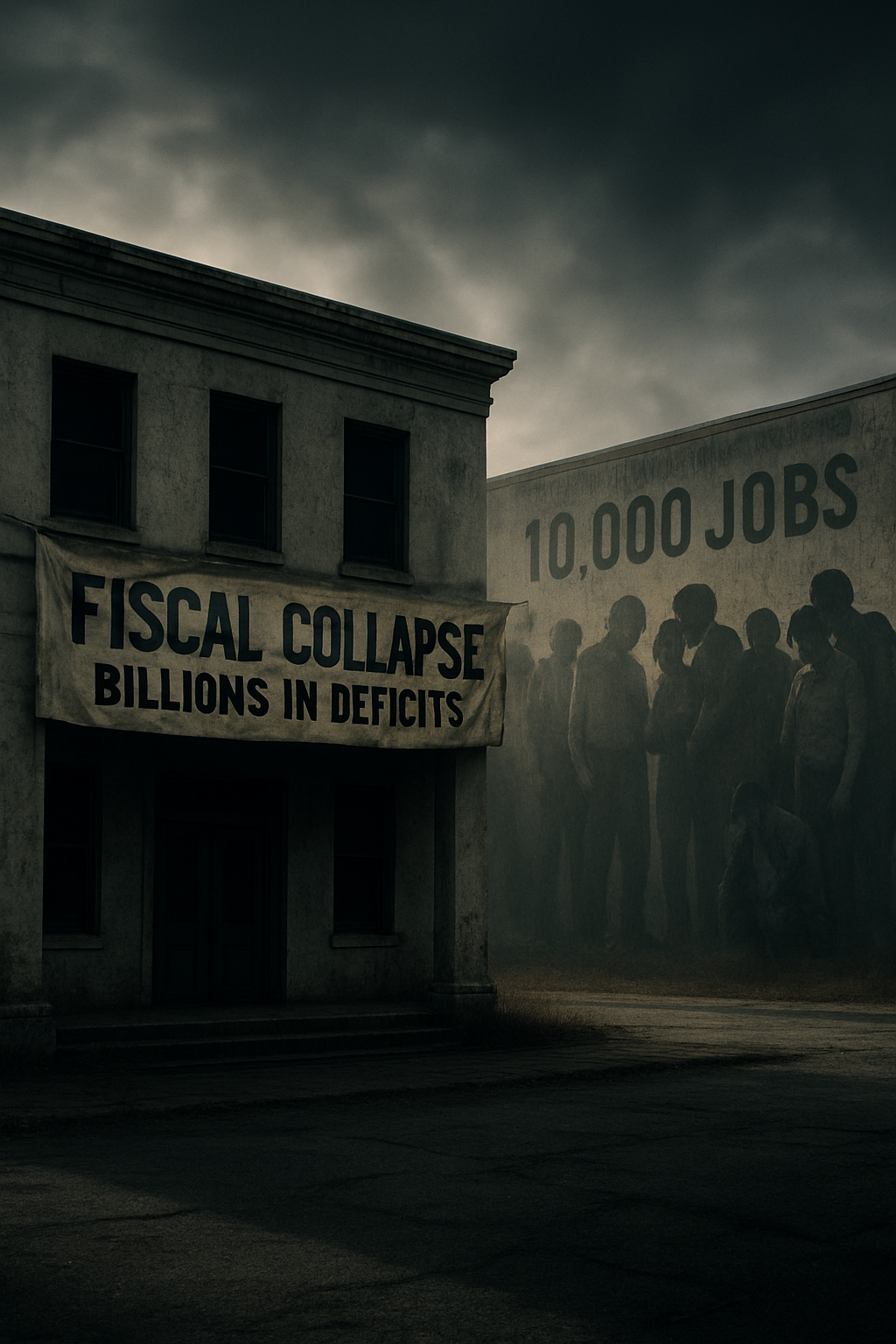
Fiscal collapse: billions in deficits while public service hollowed out
The Half-Billion Dollar Ferry to Nowhere
While preaching fiscal discipline, this government has burned through $507 million on the cancelled iReX Cook Strait ferry project—and that figure keeps climbing, as RNZ revealed. Finance Minister Willis pulled the plug on the project in December 2023, claiming costs had “blown out.” Rail Minister Winston Peters now boasts about “saving billions,” but the numbers tell a different story.
The final settlement with Hyundai Mipo Dockyard cost $144 million. Total sunk costs reached $671 million when the wind-down was complete. The replacement plan? Two smaller, less capable ferries that will cost $596 million—more than the original $551 million contract for the larger, better vessels. Add in the infrastructure costs and the total programme hits $1.86 billion.
As Labour’s transport spokesperson Tangi Utikere correctly noted: “We planned to pay $551 million for bigger and better, rail-enabled ferries. Winston Peters has agreed to pay $596 million for smaller ships of lower standard.”
This is the fiscal discipline of a drunk sailor who threw his wages overboard, then borrowed more to buy a leaky dinghy.
The Human Wreckage: 10,000 Jobs and Counting
The government’s “fiscal savings programme” has gutted the public service. As of June 2025, approximately 10,000 public sector jobs have been eliminated. The casualties span every agency tasked with serving the public:
Health NZ (Te Whatu Ora): 2,042 roles eliminated since December 2024Ministry of Social Development: 700 jobs axedMinistry of Education: 565 cuts proposed (12% of staff)Ministry for the Environment: Workforce slashed by 25%MPI: 384 positions eliminated
These are not abstract numbers. These are the people who process benefit applications for unemployed workers. These are the nurses and administrators who keep hospitals functioning. These are the education specialists who support our tamariki. When the Public Service Association challenged the Education Ministry cuts, they cited legal breaches in consultation processes.

Brain drain: record numbers of young New Zealanders leaving for Australia
Agencies were mandated to deliver 6.5–7.5% annual savings—roughly $1.5 billion per year. Severance costs alone have exceeded $80 million, with another $21.5 million forecast. The government is paying people to leave, then complaining about the deficit.
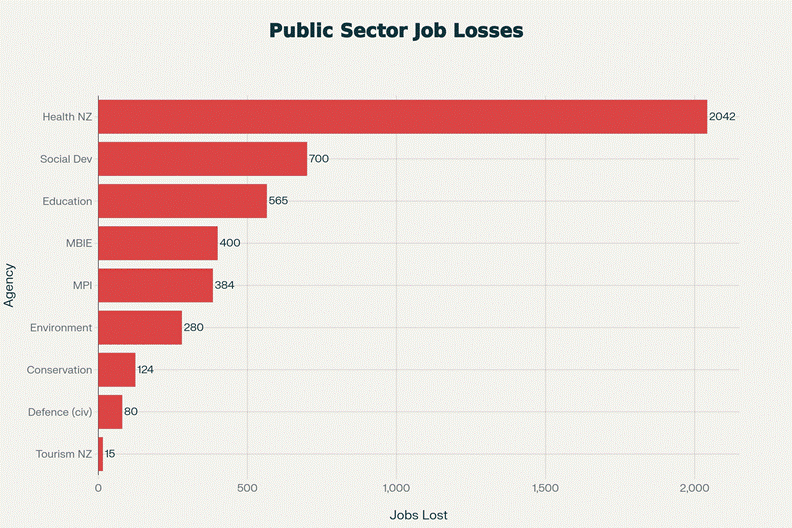
Over 10,000 public sector jobs cut under austerity measures since the coalition took office
The Brain Drain Exodus
While the government destroys jobs at home, New Zealanders are voting with their feet. In the year to September 2025, a record 72,700 New Zealand citizens departed the country—up 8% on the previous year. The net migration loss of 46,400 citizens is the worst since the aftermath of the Global Financial Crisis in 2011-12.
The exodus is concentrated among the young: nearly 40% of those leaving are aged 18-30. Almost 60% are heading to Australia, where wages are higher, housing is (relatively) more affordable, and the minimum wage is significantly greater.
As one emigrant told ABC News:
“We moved for a variety of reasons, but mainly because job opportunities in Australia are far more plentiful.” Another noted: “I think the current government is really unappealing for a younger generation, because as house prices increase and living costs increase, wages aren’t increasing to match them.”
Finance Minister Willis responded to the record emigration figures by claiming “the biggest leap in the number of New Zealanders leaving for Australia occurred on the previous government’s watch.” This is statistically false. The September 2025 figure of 72,700 departures is the highest on record, occurring under her watch, after two years of her economic management.
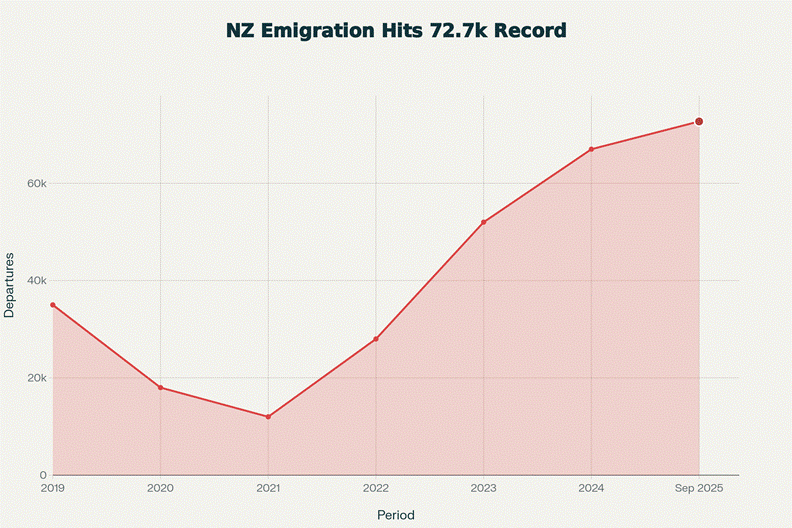
Brain drain crisis: Record 72,700 New Zealand citizens leaving the country in 2025
The $2.9 Billion Gift to Landlords
While slashing services to the vulnerable, the government has restored full interest deductibility for residential property investors—a policy costing $2.9 billion over four years. This is $800 million more than originally signalled in National’s pre-election costings.
The timeline tells the story of priorities:
April 2024: 80% deductibility restoredApril 2025: 100% deductibility restored
Prime Minister Christopher Luxon claimed renters would be “grateful” for the policy, arguing it would put “downward pressure” on rents. Multiple academics and economists have stated this is unlikely. The Council of Trade Unions warned the landlord tax breaks would “blow out by $1 billion.” They were right. The policy is welfare for the wealthy, funded by cuts to those with nothing.
15 Economists Say: You’re Making It Worse
In November 2024, 15 independent economists—university professors, union economists, independent analysts—sent an open letter to Prime Minister Luxon and Finance Minister Willis expressing “heightening concern” over the government’s approach to fiscal policy.
Their verdict was damning: the government’s fiscal policy is “needlessly exacerbating the current recession.” They demanded:
Immediate suspension of further spending cutsFurther advice from officials on growth-oriented fiscal policyRecognition that reducing spending during a downturn is economically irrational
The economists warned:
“If nothing is changed now, this under-funding simply passes the burden of adjustments, and investment spending, to future generations. Failure to correct this course will lead to higher economic scarring, with the costs borne by those with the least ability to pay.”
Willis ignored them. The cuts continued. The recession deepened.
The GDP Collapse
By any honest measure, this government inherited a challenging economy and made it catastrophically worse. GDP fell 0.9% in the June 2025 quarter—more than double what economists had forecast. The economy has now shrunk in 3 of the last 5 quarters.
The numbers are unforgiving, as RNZ’s economic analysis reveals:
GDP: 1.2% smaller than June 2023GDP per capita: 2.8% smaller than June 2023Manufacturing: Down 5.8% since June 2023Construction: Down 18% since June 2023Unemployment: Rose from 3.7% to 5.2%
Willis blamed “global uncertainty” and Trump tariffs for the June quarter collapse. But the economy “had the stuffing knocked out of it” by domestic policy choices long before Trump’s tariffs took effect. As economist Gareth Kiernan observed, the government gave the economy “the wrong prescription for the middle of a recession.”
The tax cuts were meant to stimulate consumer spending. They didn’t. The public spending cuts were meant to “unleash private sector spending.” They didn’t. The theory was, in economist Shamubeel Eaqub’s words, “very naive.”
The Wealth Gap That Keeps Growing
While working families struggle, the wealthy have never had it better. Stats NZ data shows New Zealand households increased their wealth by an average of 33% between June 2021 and June 2024. But for the bottom 40% of households, there was no statistically significant change.
The concentration of wealth is obscene:
The top 1% (about 40,000 people) control 17.5% of New Zealand’s wealthThe wealthiest 20% of households increased their wealth by $386,000 to a median $2.4 millionThe poorest 20% own a median of just $11,000 in assetsSome 109,000 households (5.4%) have negative net worth
Just 119 individuals and families on the 2025 Rich List own a combined $102.1 billion—equivalent to 4.9% of all household wealth. Meanwhile, a 2023 IRD report found that the wealthiest New Zealanders pay an effective tax rate of just 8.9%—less than half what average workers pay.
Willis has repeatedly ruled out any wealth tax, capital gains tax, or meaningful tax reform targeting the wealthy. Instead, she’s pursuing a “charity tax” to extract revenue from non-profits. The priority is clear: protect the wealthy, squeeze the rest.
The Pattern: Cui Bono, Cui Malo
The pattern across every policy decision reveals who benefits and who suffers:
CUI BONO (Who Benefits):
Landlords: $2.9 billion tax breakTobacco companies: Duty freezesProperty speculators: Brightline test reduced from 10 years to 2 yearsWealthy taxpayers: No wealth tax, no capital gains tax
CUI MALO (Who Suffers):
Public servants: 10,000+ jobs eliminatedBeneficiaries: Indexed to CPI instead of wages (est. $50/week less by 2030)Young people: Record emigration, 40% of those leaving aged 18-30Māori and Pasifika: Disproportionately affected by benefit cuts and public sector layoffsKaumātua: Struggling with fixed incomes while rates and costs soar

Kaumātua struggle as cost of living surges and government cuts support services
He Aha Te Mea Nui? What Is Most Important?
When 15 economists tell you your policies are making the recession worse, and you ignore them—that is ideology, not economics.
When your deficit keeps growing despite your cuts, and you keep cutting—that is faith-based budgeting.
When 72,700 of your citizens flee the country in a single year, and you blame the previous government—that is delusion.
When the wealthiest 1% pay half the tax rate of workers, and you rule out any change—that is class warfare.
Ko te mea nui, ko te tangata, ko te tangata, ko te tangata. The most important thing is people. But this government sees only spreadsheets, and even those they cannot balance.
The Verdict
Nicola Willis promised she would resign if her tax plan failed. The foreign buyers tax—the centrepiece revenue measure—was scrapped before she took office. The deficit has grown by billions beyond forecast. The economy has shrunk. Record numbers are fleeing the country. By any honest accounting, the plan has failed.
The government is not rebuilding fiscal discipline—it is redistributing wealth upward while services collapse. It is not growing the economy—it is shrinking it. It is not keeping New Zealanders at home—it is driving them overseas in record numbers.
The numbers released on December 4, 2025 are not a minor setback. They are confirmation of a government that has chosen ideology over evidence, the wealthy over workers, and austerity over aroha.
Mā te whānau e kōrero, mā te whānau e whakatika.
The people will speak. The people will fix this.
Support Mahi for Rangatiratanga: Fund The Māori Green Lantern’s Counter-Disinformation Work
Whānau supporting The Māori Green Lantern can choose from three flexible pathways aligned with tikanga Māori principles of manaakitanga (generosity), whanaungatanga (relationship and reciprocity), and rangatiratanga (self-determination and autonomy).
Option 1: Koha.Kiwi – Flexible Donation Tiers
Via Koha.Kiwi, supporters can select from preset donation tiers or contribute custom amounts:
· $5–$10: Kai and research support
· $20–$50: Investigative journalism funding
· $100–$250: Campaign amplification and reach
· $500+: Structural operations and long-term mahi
Option 2: Substack Subscription – Recurring Monthly Support
All content remains freely accessible on The Māori Green Lantern Substack, but whānau can select a paid subscription tier for recurring direct funding:
· Supporter ($5–$10/month): Direct monthly support and email updates
· Advocate ($15–$25/month): Deeper engagement with behind-the-scenes research notes
· Guardian ($50+/month): Exclusive access to investigation planning and strategic input
Option 3: Direct Bank Transfer – One-Time or Recurring Koha
For those preferring direct bank transfer, all koha are tracked in public audit statements:
Account: HTDM
Number: 03-1546-0415173-000
Bank Reference: Write “Māori Green Lantern” or your name
Transparency and Accountability
All three pathways offer immediate transparency:
Koha.Kiwi and Substack provide automatic receipts and platform visibilityDirect bank transfers appear on public audit statements, ensuring complete accountability and whanaungatangaWhānau receive email updates detailing how koha supports research operations, counter-disinformation strategy, and mātauranga Māori journalism
Whether contributing $5 once or $50 monthly, every koha upholds rangatiratanga—reader self-determination—with:
No corporate interferenceNo subscription wallsAll analysis freely accessible to whānau and communitiesFull transparency on how funds are deployed
Your koha sustains the research, verification, and mahi that exposes misinformation and protects our whānau from predatory narratives.
Donate now:
Koha.Kiwi PlatformSubstack SubscriptionBank Direct: HTDM – 03-1546-0415173-000

Ivor Jones The Māori Green Lantern Fighting Misinformation And Disinformation From The Far Right
Research Transparency Statement: This analysis draws on official Treasury figures, RNZ reporting, Stats NZ data, 1News coverage, NZ Herald investigations, Te Ao Māori News, The Spinoff, and verified academic economists’ correspondence. Research conducted December 5, 2025 using search tools to verify all citations. All URLs tested at time of research.