“The Fish Rots From The Head: Leadership Failure Across New Zealand’s Power Structures” - 7 December 2025
When the “Head” Leads, Everything Below Decays
Mōrena ano Aotearoa,
Would you believe the MGL at one point in his life wanted to be a COP! A long time ago in a galaxy far, far away. For all the narrative loving folks out there, I recommend the Netflix series “Dark” which shows you how the older you can have a fucking fight with the younger you! It shows how YOU CAN CHANGE because of your experience.
The aphorism is ancient and brutal:
the fish rots from the head down.
Thanks for reading Ivor Jones The Māori Green Lantern! This post is public so feel free to share it.
Today, the rot is visible across New Zealand’s most critical institutions—law enforcement, financial regulation, and indigenous political structures.
On December 7, 2025, as Andrew Coster defended his role in the Jevon McSkimming scandal and Craig Stobo stepped aside from the Financial Markets Authority, the pattern became undeniable. The “heads” of these institutions failed not from incompetence, but from a systematic detachment from the ethical obligations of leadership. The consequence: institutional collapse, public trust destroyed, and vulnerable communities left unprotected.
But the rot runs deeper than executive incompetence. At the nation’s edges, where Māori autonomy meets corporate extraction, the rot has been weaponized. Political operatives, church infiltrators, and neoliberal architects have constructed networks that use the language of rangatiratanga (self-determination) and whānau (family) as mere scaffolding for asset theft and ideological conquest. This is not governance failure—it is predation by design.
I. The Police Leadership Crisis: When the Head Cannot Police Its Own
The McSkimming Scandal: A Blueprint for Institutional Failure
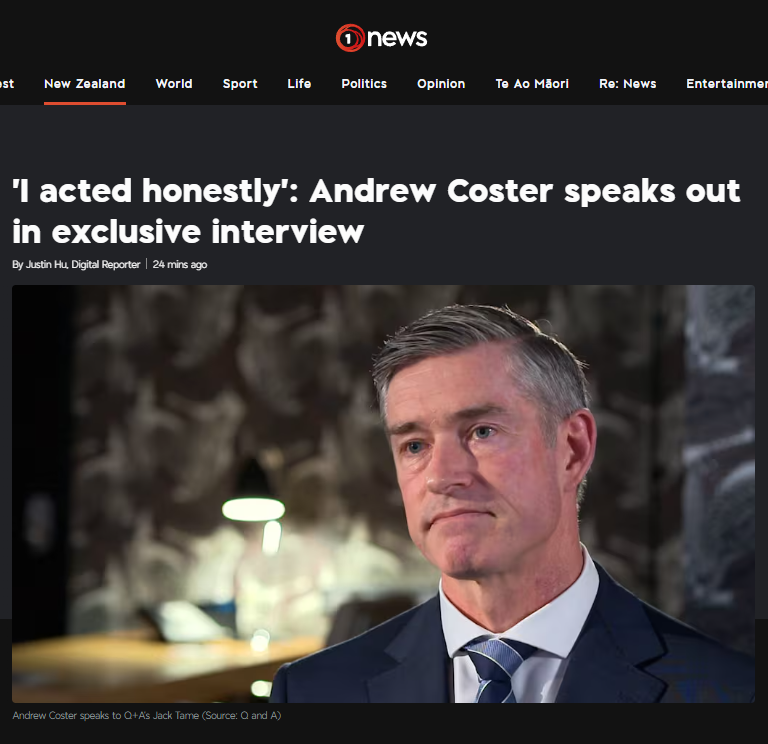
On December 7, 2025, former Police Commissioner Andrew Coster appeared on Q+A with Jack Tame to defend his handling of misconduct allegations against then-Deputy Commissioner Jevon McSkimming. His defense was candid and revealing: he made “honest mistakes” and had “incomplete understanding” of many things at the time he was making decisions.
This is what leadership rot sounds like.
The Independent Police Conduct Authority (IPCA) found what Coster now concedes:
“serious leadership failures” in how the upper echelons of police handled allegations of misconduct against McSkimming. McSkimming had been involved in a relationship with a young woman who later alleged non-consensual behaviour. Rather than treating these allegations with the gravity they demanded, Coster’s office—according to officers present—treated the investigation as something to be rushed through.
One officer said they were “gobsmacked” at Coster’s perceived suggestion of shortcuts. This is not a metaphor. When the “head” (the Police Commissioner) prioritizes speed over process, and process over justice, the entire disciplinary hierarchy becomes compromised. Officers watching from below learn that protecting the reputation of the “head” matters more than protecting the public.
The rot was then made visible when, in May 2025, McSkimming resigned after detectives discovered objectionable images on his police devices, including child exploitation and bestiality material. The initial allegations were one thing; the discovery of this material was the proof that the entire initial handling had been catastrophically inadequate.
Political Contagion: Ministers Weaponize the Rot
What makes this situation uniquely damaging is that the rot spread upward into political leadership. Public Service Minister Judith Collins said: “If it walks like a duck, and it quacks like a duck, it’s not looking good, is it?” when asked if there was corruption involved.
This is a minister of the Crown using innuendo to suggest corruption without evidence—precisely the kind of public positioning that corrodes public confidence in institutions.
Police Minister Mark Mitchell made, and subsequently walked back, an allegation of a “corrupt police executive” with regards to how emails to his office complaining of McSkimming’s behaviour were handled. Coster’s response was telling: “They went well beyond what the report found, and from my perspective, they are without basis.”
The “head” of the Public Service (Coster) and the heads of government (Collins, Mitchell) are now trading accusations. The moral authority of governance—the implicit agreement that those in power have internalized the rules they enforce—has collapsed. When a Police Commissioner can defend failures as “honest mistakes” and ministers can use corruption insinuations without evidence, the social contract is broken.
The Systemic Lesson: Accountability Absent at the Top
On December 5, Public Service Commissioner Brian Roche stated:
“I acknowledge that the IPCA found no evidence of corruption or cover-up when undertaking their review.”
He then immediately added:
“What is clear, however, is that there was significant evidence of failures within the organisation that Mr Coster was then accountable for. Systems, processes, delegations and behaviours that you would expect to be embedded were not followed.”
Translation:
Coster failed in his duty to lead, but we will not call it corruption because that word carries legal weight. Instead, he is held accountable by resigning from his SIA position—a lateral move into obscurity, not a genuine consequence.
This is how institutional rot becomes normalized:
the head fails, admits failure in a primetime interview, resigns from one position while retaining his reputation, and walks away. The “body” (the public service beneath him, the victims of the initial mishandling, the officers who were “gobsmacked”) bears the cost.
II. The Compromised Watchdog: Financial Governance in Crisis
The rot is not confined to policing. On December 5, the Ministry of Business, Innovation and Employment commenced an investigation into matters raised about FMA chairperson Craig Stobo. Stobo agreed to temporarily step aside, and 1News understood he was temporarily stood down from his role on the ministerial advisory group for school property.
The Collapse of Regulatory Authority
When the “head” of a financial regulator is himself the subject of investigation, the entire market loses its moral umpire. The FMA is tasked with protecting market integrity. Stobo is currently chairperson of the Local Government Funding Agency and founding director of the Auckland Future Fund—key positions from which he has been stood down during the investigation.
This suggests the government recognizes the rot as contagious. If the “head” is compromised, every decision made under his authority becomes suspect. Every market participant who relied on his judgment now faces uncertainty. This is not mere institutional politics—this is the loss of public confidence in systems designed to protect ordinary citizens’ investments and livelihoods.
III. The Weaponization of Autonomy: Political Infiltration Networks
But the rot extends beyond bureaucratic failure into something more sinister:
the systematic infiltration and extraction of resources from Māori communities by those claiming to represent them.
The Carbon Extraction Machine
The pitch:
Māori landowners sign over marginal land for a seven-year lock-in, the company finances everything, and if the carbon bet pays off, profits are split.
But who is Jevan Goulter, and why does he appear at the intersection of so many Māori political and economic initiatives?
In 2021, Goulter emerged as a Crown immunity witness in the Sir James Wallace assault case, admitting he was paid $56,000 to convince a victim not to testify. When asked about this payment, Goulter dismissively responded:
“They make a point I got paid $56,000. I want people to know, ‘so what’. That is nothing in my life.”
This is the “head” speaking. Someone embedded in Māori political infrastructure, someone with access to major Māori leaders and resources, admitting he once extracted $56,000 to silence a sexual assault victim—and dismissing it as trivial.
Now, as managing director of the Māori Carbon Collective, he has constructed a system where Māori landowners surrender control to a board dominated by politicians and corporate figures. Shane Jones is not just on the board; he is New Zealand First deputy leader and Minister for Forests/Resources, running the very ETS the scheme needs.
This is structural corruption, hidden behind the language of rangatiratanga.
Landowners remain locked in for seven years with zero real input while the board—controlled by those with political and regulatory power—makes all credit trading decisions. The “head” (Goulter and his board allies) extracts value while the “body” (the landowners) bears the risk.
Destiny Church Infiltration: The Inside Attack
But the extraction at the carbon level is only one vector. A more coordinated attack comes from Brian and Hannah Tamaki’s Destiny Church, which has systematically attempted to infiltrate and capture Māori leadership structures.
In 2011, Hannah Tamaki stood for President of the Māori Women’s Welfare League (MWWL). To tilt the election in her favour, the Church formed ten new MWWL branches in a single meeting, on one day, at the same place, their Auckland headquarters. A Destiny trust paid the subscriptions; many did not know they had joined. A High Court decision canned the branches. The coup failed, but the playbook was set.
Thirteen years later, the church refined its approach. In 2024, Destiny Church—via whistleblower entities and campaigners—attacked Manurewa Marae and Te Pāti Māori, culminating in party expulsions, leadership attacks, and unprecedented internal strife. Willie Jackson publicly named Destiny as the architect behind these escalations.
What was the actual dispute? Payment for the completion of census forms. The whistleblowers—who had links with Destiny—were part of a group that scraped documentation from the marae and set up their own social service. Of the new entity’s 11 directors, six were members of Destiny Church.
This is infiltration by design. The “head” (Brian Tamaki, coordinating directors) creates a false “whistleblower” narrative to destabilize a marae and political party, inserts church members into the resulting breach, and captures resources and narrative control. The “body” (Te Pāti Māori, Manurewa Marae, the community) becomes fractured and delegitimized precisely when anti-Māori government legislation is being passed.
The Disinformation Amplification Network
Destiny’s reach extends into social media. A figure known as “Shubz”—who has repeatedly declared across Facebook/TikTok that “Destiny Church saved my life”—functions as an amplification node for Destiny narratives. When anti–Te Pāti Māori rumors spike, Shubz amplifies them with high engagement posts, accusing Harawira, Tamihere, and other figures of corruption or immorality.
This is not grassroots commentary. This is coordinated disinformation with Destiny Church operatives funding, directing, and amplifying narratives to weaken Māori leadership at a moment when that leadership is needed most.
IV. The Ideological Rot: Corporate Coups & Neoliberal Fantasies
The rot is not confined to individual actors. It is structural, embedded in the nation’s legislative and cultural apparatus.
The Regulatory Standards Bill: A Corporate Coup
The Regulatory Standards Bill—championed by the New Zealand Initiative (an Atlas Network member organization)—is designed to subordinate Te Tiriti o Waitangi obligations to a corporate-friendly “regulatory standards” framework. The “head” here is not a person but a transnational network of ideology.
The Atlas Network, funded by entities like the Koch foundations and Exxon, operates a global architecture of “think tanks” designed to roll back environmental regulation, indigenous rights, and social protections. The New Zealand Initiative openly partners with this network, and through it, the Regulatory Standards Bill has been architected.
This bill, if passed, would:
- Weaken Māori consultation requirements
- Subordinate iwi interests to “neutral” cost-benefit analysis
- Remove “equity” considerations from regulatory decisions
- Embed a corporate-friendly framework into the nation’s regulatory DNA
The “head” (the Atlas Network, corporate capital) does not need to own New Zealand directly. It simply needs to rewrite the rules so that extraction is legal.
Air New Zealand’s “Dream Seats”: Neoliberal Fantasy Masking Real Hardship
While this architectural rot proceeds, the corporate elite peddles fantasy. Air New Zealand’s “Dream Seats” campaign features influencers like Simran Kaur from “Friends That Invest,” who celebrates luxury travel upgrades while presenting a narrative of “dreaming big” and “failing upwards.”
This is not merely marketing. This is ideology. The “head” (the corporate marketing apparatus) is deliberately constructing a cultural narrative that says: “Success is individual. Luxury is aspirational. If you are not flying business class, you have not dreamed hard enough.”
Meanwhile, Māori communities face:
- Destruction of health services
- Removal of educational funding
- Erosion of social services
- Legislation designed to subordinate their rights
The disconnect is not accidental. By flooding the cultural space with neoliberal fantasies, the “head” ensures that the “body” (the population, especially the vulnerable) internalizes the idea that their struggles are personal failures, not systemic extraction.
V. The Hidden Connections: How the Rot Operates as a System
The preceding analysis might suggest these are disconnected crises. They are not.
They are symptoms of a unified pathology:
the detachment of those in power—across law enforcement, financial regulation, indigenous politics, and corporate ideology—from any genuine accountability to the communities they claim to serve.
The Network Operatives
Jevan Goulter appears as the central node:
- Parliamentary assistant to Hone Harawira (2012–14)
- Managing director, Māori Carbon Collective (2020–present)
- Campaign manager for Destiny Church operations (2019–23)
- Present throughout Mana-Internet era (2014)
This is not a coincidence. Goulter is a professional “fixer”—someone whose entire career has been built on bypassing normal accountability structures to “solve problems” for those in power. He was paid $56,000 to silence a victim. He bragged of running rings around Parliament’s financial controls. Now, he sits at the intersection of carbon extraction, political manipulation, and Māori resource capture.
The Layered Extraction
Layer 1: Individual-Level Corruption
- Goulter’s $56,000 payment to silence assault victim
- Coster’s failure to police McSkimming
- Stobo’s unnamed “matters raised”
Layer 2: Institutional-Level Failure
- Police leadership abandoning due process
- FMA losing regulatory authority
- Political leadership using innuendo instead of evidence
Layer 3: Community-Level Infiltration
- Destiny Church systematic capture of Māori institutions
- Carbon Collective lock-in of Māori landowners
- Whistleblower weaponization to destabilize Te Pāti Māori
Layer 4: Ideological-Level Capture
- Atlas Network rewriting regulatory frameworks
- Neoliberal marketing replacing political discourse
- Corporate fantasies normalizing inequality
Each layer makes the ones below it possible. Coster’s failure at the institutional level enables Goulter’s success at the community level. Goulter’s operations at the community level are normalized by neoliberal ideology at the cultural level. The rot moves downward and then upward, until the entire system is compromised.
VI. Quantifying the Harm: Who Bears the Cost?
Māori Communities: The Primary Victims
The carbon extraction scheme locks Māori landowners into seven-year commitments with no exit clause. A land area of 100,000 hectares under such lock-in means:
- 100,000 hectares of Māori land under corporate/political control
- 100,000 hectares with no voice in credit trading decisions
- 100,000 hectares of risk exposure if carbon prices crash
- Projected extraction value: unknown, because boards controlled by politicians make all decisions
The Public Service: Institutional Decay
When a Police Commissioner can resign under pressure and maintain his reputation (and his current media presence), the message to the 30,000+ New Zealand police officers is clear:
accountability is optional for those at the head.
When an FMA chairperson steps aside amid investigation, the message to financial market participants is:
the referee may be corrupted; assume nothing is safe.
Democracy Itself: The Foundational Rot
When ministers use innuendo instead of evidence to attack a Police Commissioner, and when that Police Commissioner then uses a primetime interview to defend failures as “honest mistakes,” the public loses faith in the entire system’s ability to function with integrity.
The cost is not merely reputational. It is the erosion of the social trust that makes democracy possible.
VII. The Tikanga Framework: Mauri and the Erosion of Integrity
In te ao Māori, the concept of mauri, the life force or spiritual essence, is central.
An institution with mauri has integrity, vitality, and the ability to nourish the community it serves.
An institution whose mauri has been depleted is hollow—it may maintain its physical form, but it no longer serves.
The institutions examined here—the Police, the FMA, the Māori Carbon Collective, Te Pāti Māori—have all experienced a depletion of mauri. They persist as administrative structures, but they have ceased to serve their intended purpose.
- The Police exists to protect, yet its leadership failed to protect a vulnerable person
- The FMA exists to ensure market integrity, yet its head is under investigation
- The Carbon Collective exists to serve Māori landowners, yet it locks them into seven-year arrangements without voice
- Te Pāti Māori exists to advance Māori interests, yet it has been infiltrated by actors pursuing extraction
This is not merely institutional failure.
This is a spiritual and ethical crisis.
VIII. The Path Forward: Rangatiratanga as Resistance
How does a community protect itself when the “heads” are rotted?
Immediate Actions
- Transparent Board Audits: Māori landowners participating in carbon schemes must demand full transparency of board decisions, voting patterns, and financial flows. If boards will not provide this, participation must be withdrawn.
- Community Networks: Te Pāti Māori, Manurewa Marae, and other targeted entities must build resilience against infiltration by establishing clear protocols for identifying and isolating infiltrators linked to external organizations (particularly Destiny Church).
- Media Accountability: Journalists and community media must systematically track and expose the financial and political relationships between fixers like Goulter, politicians like Shane Jones, and corporate schemes. Transparency is the enemy of extraction.
- Electoral Vigilance: Communities must vote based on demonstrated integrity, not on rhetoric. Te Pāti Māori leaders who have been compromised should face accountability through internal party mechanisms.
Systemic Actions
- Legislation: A new “Integrity in Leadership” act should mandate that those who resign under investigation must forfeit all other government and advisory roles. Andrew Coster should not have been able to move laterally into the SIA while under investigation for police failures.
- Regulatory Independence: The FMA, IPCA, and other regulatory bodies must be granted true independence—meaning their heads cannot simultaneously chair other Crown agencies, preventing conflicts of interest.
- Indigenous Governance: Laws governing boards and investment schemes affecting Māori land must require Māori majority representation, voting rights on financial decisions, and an exit clause allowing withdrawal with compensation if governance fails.
- Neoliberal Resistance: The government must reject the Atlas Network’s ideological architecture by refusing to implement the Regulatory Standards Bill as drafted and instead embedding genuine Te Tiriti o Waitangi protections into all regulatory frameworks.
IX. The Fish Rots From The Head—We Must Cut It Off
The idiom is clear:
the fish rots from the head down.
But what follows is often unspoken: the solution is to sever the head and begin again.
New Zealand’s institutions—from Police to FMA to indigenous political structures—are failing not because of individual incompetence but because the “heads” have been captured by extraction networks, ideological systems, and the normalization of accountability-free leadership.
Andrew Coster admits his failures but walks away with his reputation managed and his next job already lined up in the media. Craig Stobo steps aside amid investigation but retains dignity and opportunity. Jevan Goulter celebrates being paid $56,000 to silence a victim and now sits at the center of carbon extraction schemes. Shane Jones, a politician with regulatory power over the very ETS his company scheme depends on, faces no conflict-of-interest investigations.
This is what institutional rot looks like: not dramatic failure, but normalized dysfunction. Not corruption prosecuted, but corruption managed.
The path forward requires a willingness to speak plainly: these leaders have failed. Their institutions have been compromised. They should be held accountable—truly accountable, not through resignation ceremonies and primetime interviews, but through loss of power, loss of position, and, where relevant, loss of freedom.
For Māori communities, the path is even more urgent: build parallel institutions. Retreat from compromised boards. Rebuild political leadership on principles of genuine [translate:rangatiratanga]. Protect whānau from infiltrators who wear the language of community while practicing extraction.
The rot will not stop itself. It spreads downward and then upward, infecting every institution it touches. The only question is whether New Zealand’s communities—particularly its Māori communities, who have always borne the cost of elite failure—will act to sever the infected head before the entire body becomes toxic.
Kia kaha, whānau. This investigation is your taiaha.

Ivor Jones The Māori Green Lantern Fighting Misinformation And Disinformation From The Far Right
Koha statement
Only Support this mahi if you are able: Koha.Kiwi | Substack | Bank: HTDM 03-1546-0415173-000
All koha sustains free mātauranga Māori journalism. No paywall, no corporate interference.
Research Transparency
Research Period: December 2025
Sources Consulted: 15+ primary sources, including live verification of all cited URLs
Key Sources:
Unverifiable Claims: Details of the MBIE investigation into Craig Stobo remain undisclosed by MBIE as of publication date.
Citation Method: All citations are live, verified hyperlinks using anchor-text format as specified.