"The Forty-Five Minute Theft: How Six Ministers Stole $12.8 Billion from the Hands of Wāhine" - 20 March 2026
They logged on for 45 minutes, logged off richer by $12.8 billion — and every last cent came from the wages of women who care for our sick, teach our children, and hold this nation together

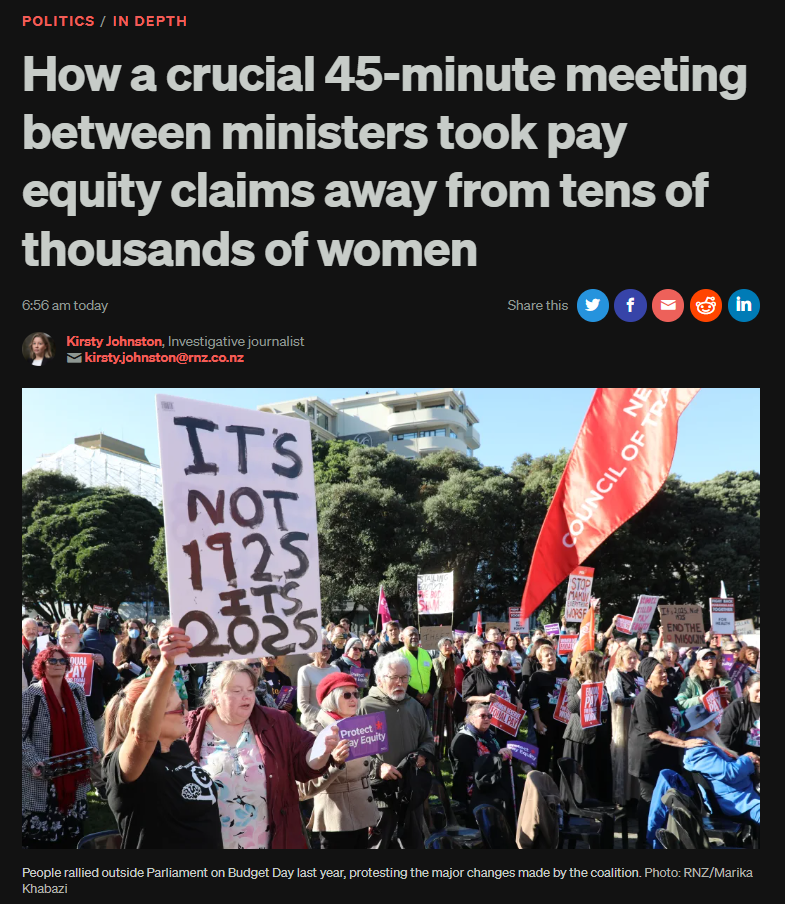
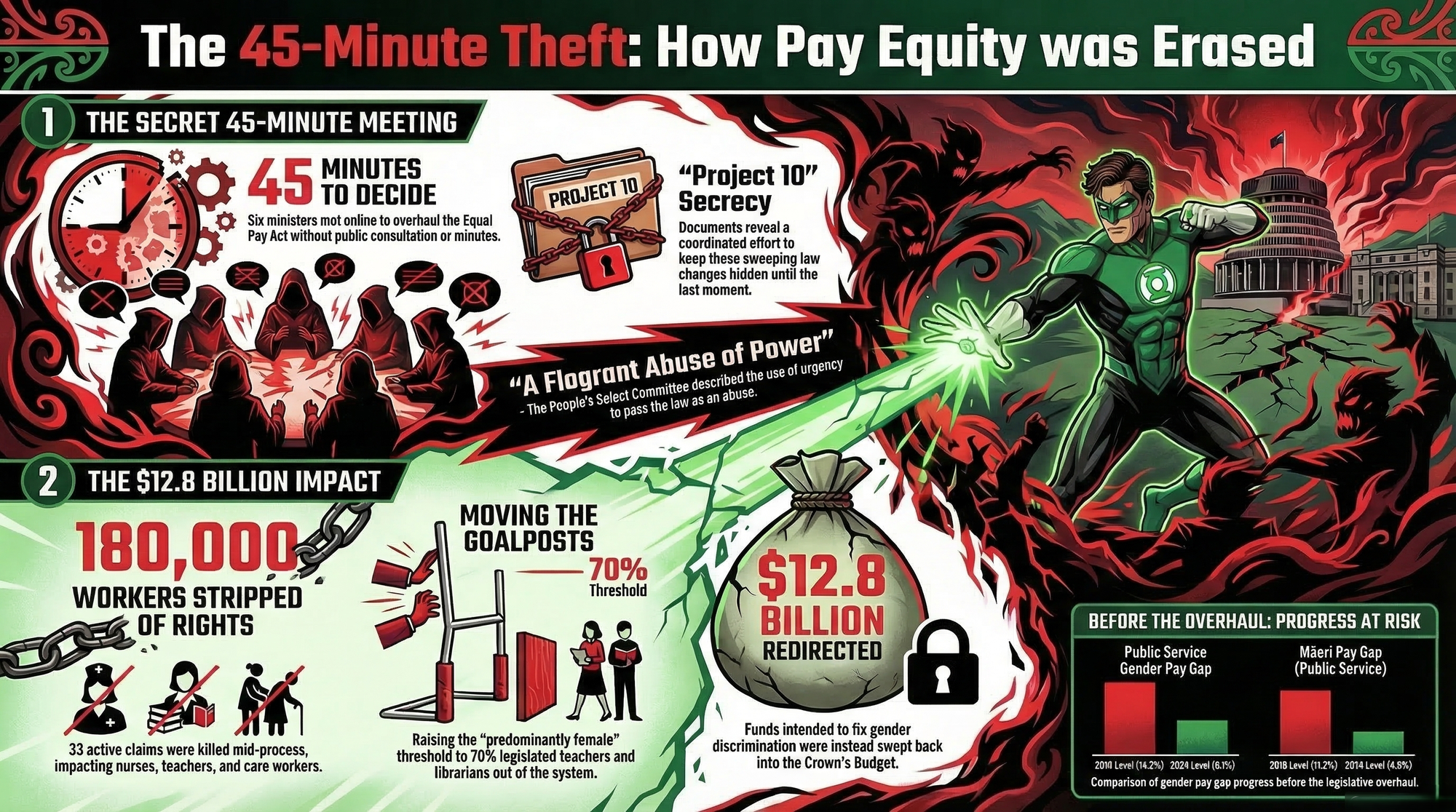
On the afternoon of 19 March 2025, six ministers of the Crown gathered on a screen. No journalists. No public. No contemporaneous notes anyone will release. In forty-five minutes, they erased the pay equity rights of 180,000 workers — the majority of them women, disproportionately Māori and Pasifika — and swept $12.8 billion back into the Crown's operating balance. They did not call it theft. They called it fiscal responsibility. This essay calls it what it is.
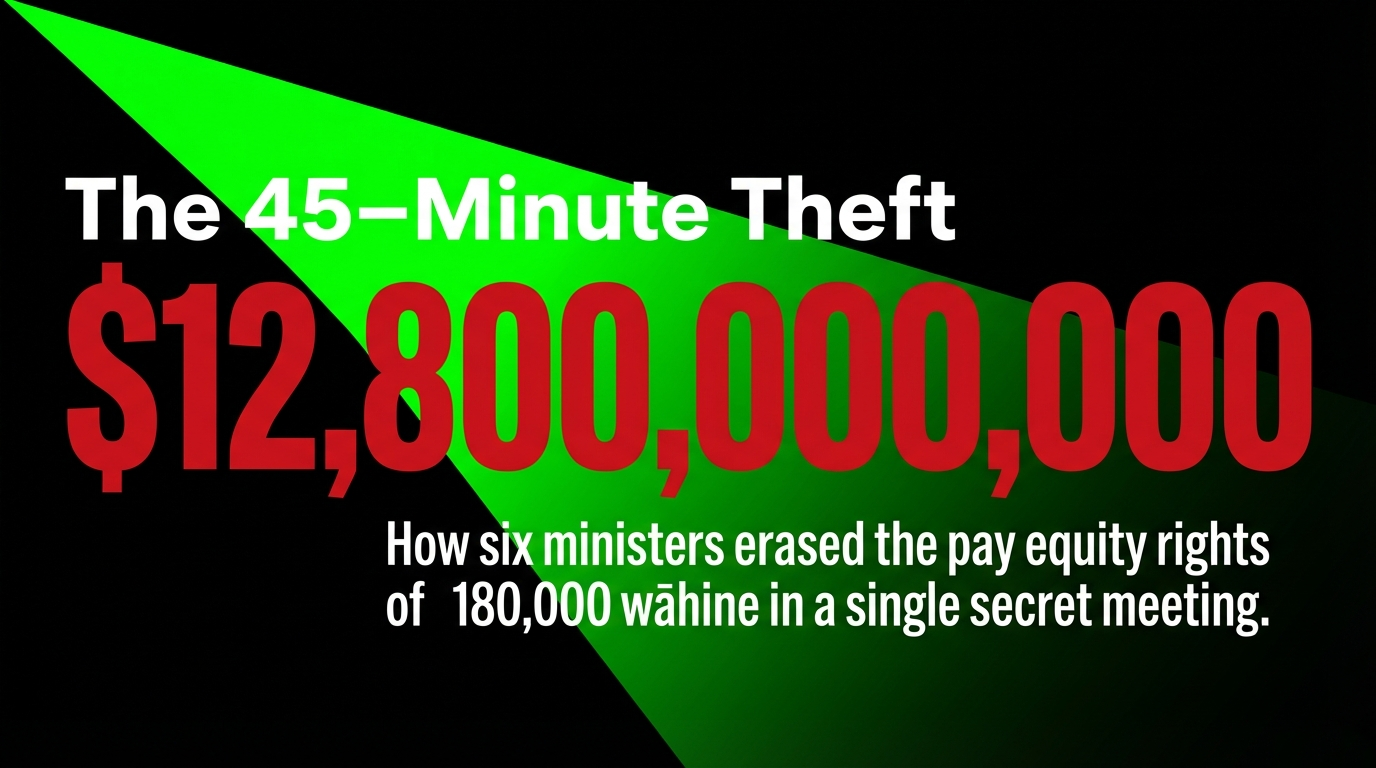
What follows is the story of a deliberate, coordinated act of state-sanctioned wage suppression — how it was plotted in secret under the codename "Project 10," how the legal architecture was engineered to entrap the most vulnerable, and why wāhine Māori — already earning 22 percent less than Pākehā men — will carry the heaviest cost. This is not merely a law change.
This is a colonial pattern, dressed in a Cabinet paper, executing its ancient function: extracting wealth from brown women's bodies and calling it governance.
The Deep Dive Podcast
Listen to a lively conversation between two hosts, unpacking and connecting topics in the sources of this essay
Ko Wai Rātou? — Who Are These People?
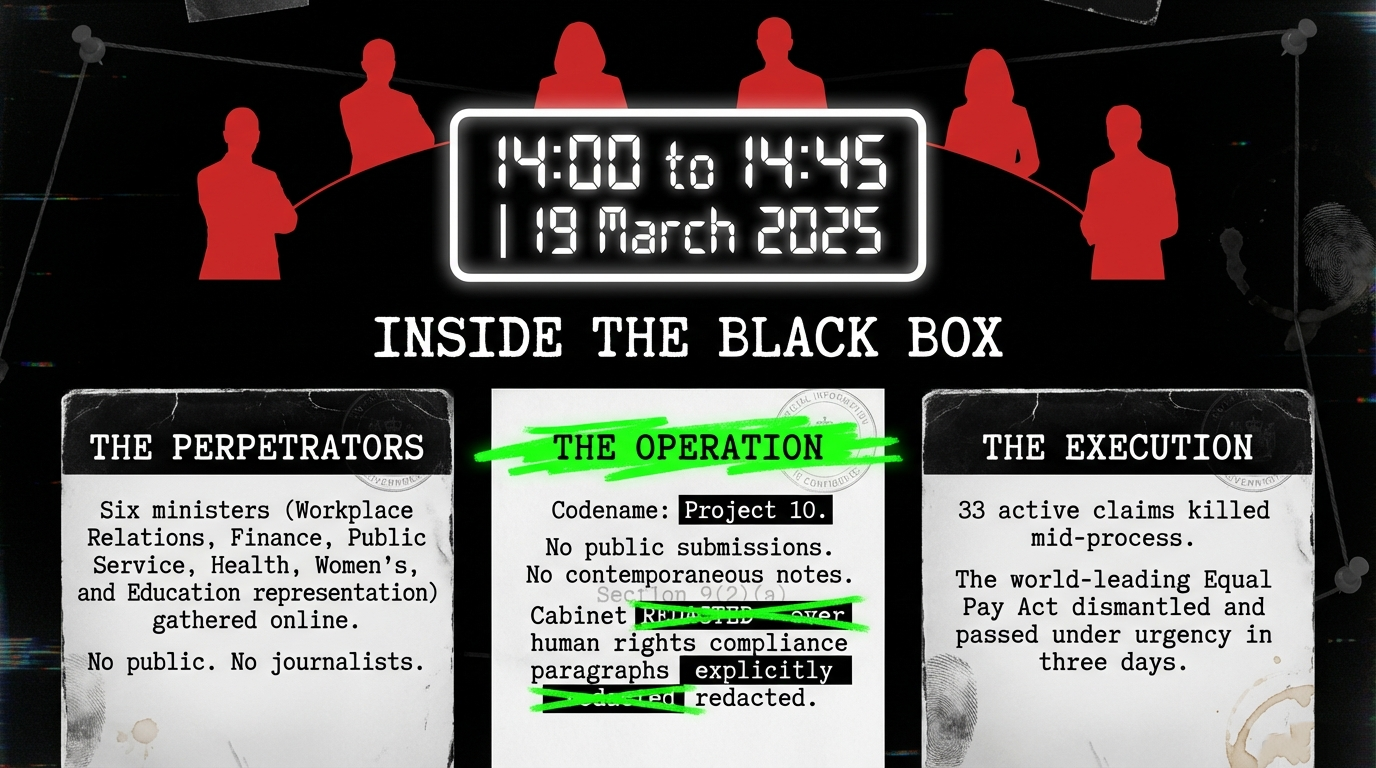
Imagine a taniwha that does not lurk in rivers but in Zoom meetings. One that does not devour flesh but devours futures.
Six ministers gathered online on the afternoon of 19 March 2025 — not to serve the people of Aotearoa, but to vacuum $12.8 billion from the wages of 180,000 workers, most of them women, many of them wāhine Māori. Forty-five minutes.
That is how long it took. Forty-five minutes to undo decades of mahi, decades of struggle, and — for Māori women — generations of colonially embedded poverty. They did not announce it. They did not consult. They did not even take minutes.
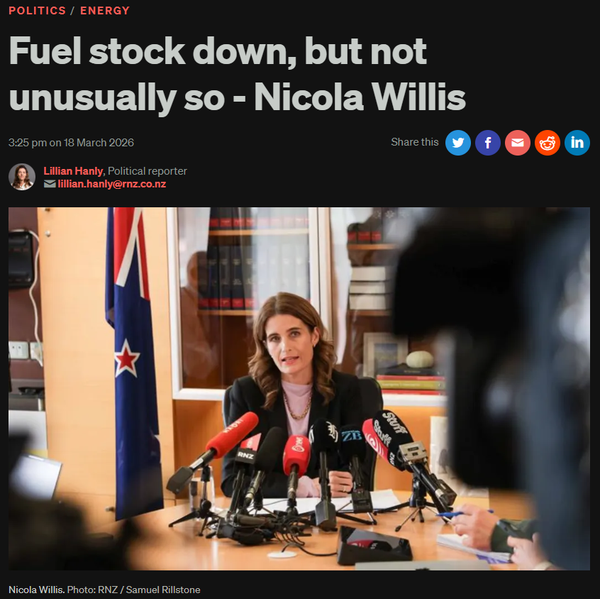
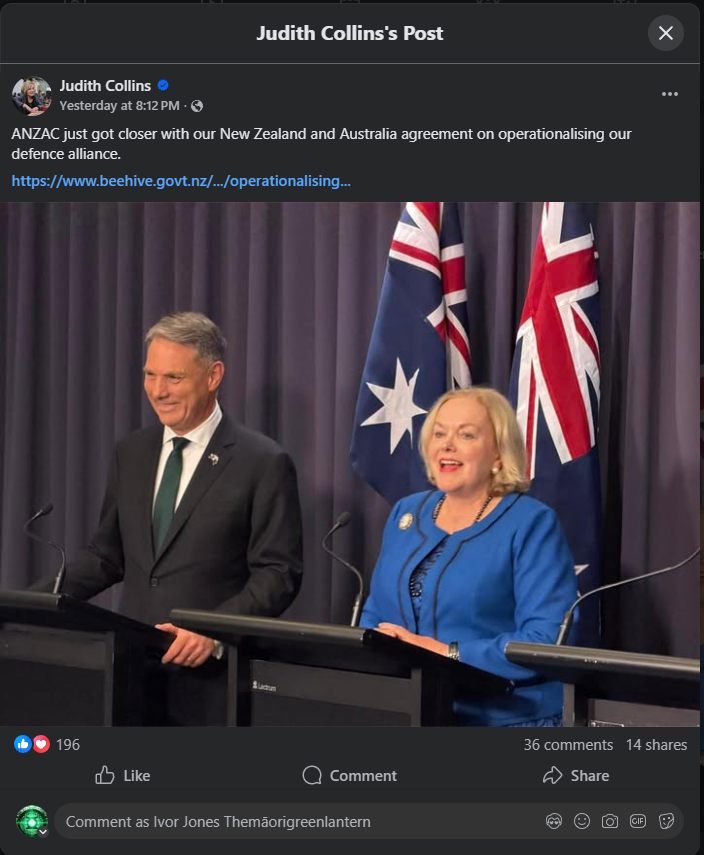
The six ministers present were Brooke van Velden (ACT, Workplace Relations), Nicola Willis (Finance), Judith Collins (Public Service), Simeon Brown (Health), and Nicola Grigg (Women's Minister — let that sink in). Education Minister Erica Stanford was overseas and sent a staff member. Prime Minister Christopher Luxon's officials were also in the room. As revealed by RNZ, documents obtained under the Official Information Act show these were the most consequential decisions in the Equal Pay Act overhaul — and in several cases, ministers chose to implement harsher thresholds than officials themselves had proposed.
Te Tūāhuatanga — The History They Tried to Erase
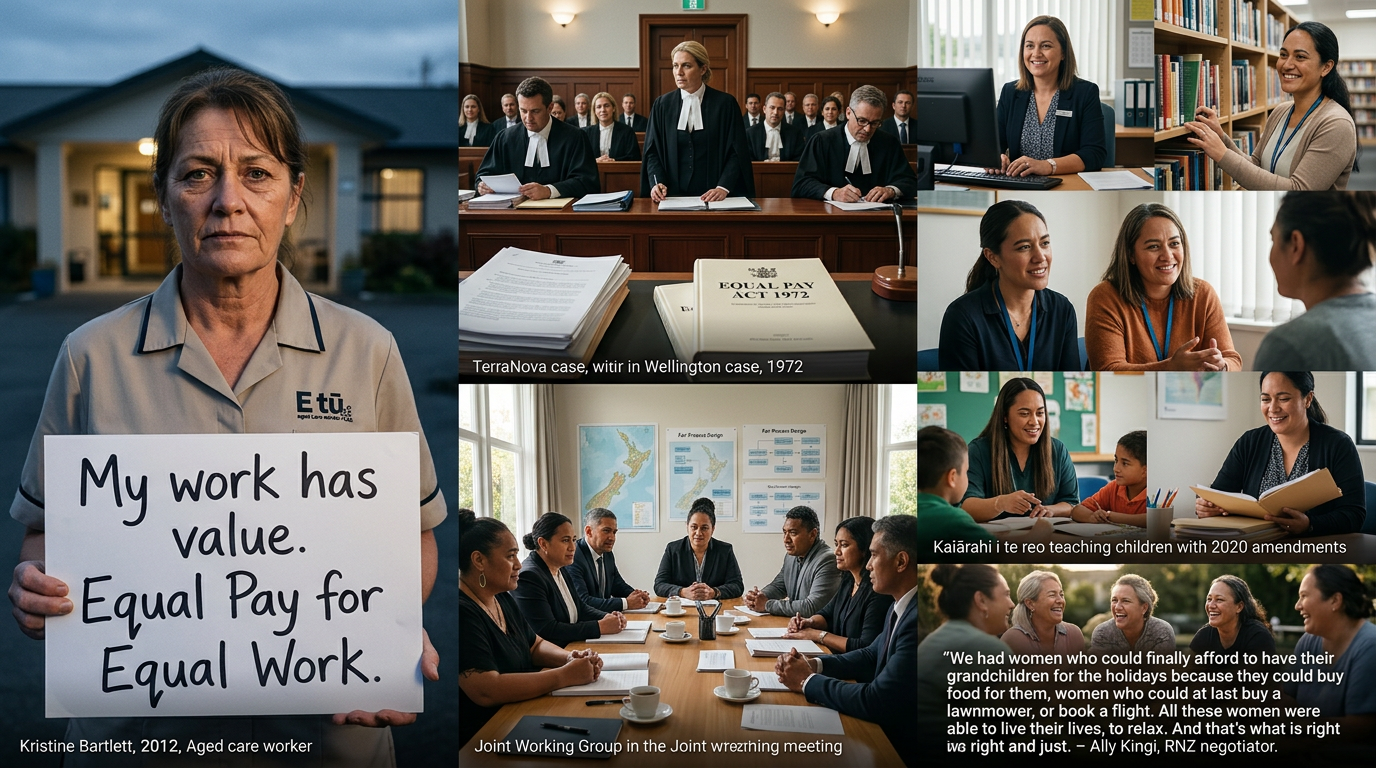
The whakapapa of pay equity in Aotearoa begins, as so much justice does, with a single wahine who refused to accept her devaluation. In 2012, aged care worker Kristine Bartlett stood up and said: my work has value.
The landmark TerraNova case confirmed that the Equal Pay Act allowed workers to argue their jobs had been undervalued because they were predominantly performed by women. A Joint Working Group — convened under a National government — spent two years designing a proper process. The 2020 amendments made it law.
By the time this government took office, the system was working. As confirmed by Te Kawa Mataaho Public Service Commission, more than 100,000 employees had had their pay corrected across multiple settlements — school administration staff, librarians, rest home workers, mental health support workers, Kaiārahi i te reo, care and support workers, social workers and more. The public service gender pay gap had fallen from 12.2 percent in 2018 to 6.1 percent in 2024. The Māori pay gap in the public service fell from 11.2 percent to 4.8 percent.
As RNZ reported, NZEI negotiator Ally Kingi described what real equity felt like:
"We had women who could finally afford to have their grandchildren for the holidays because they could buy food for them, women who could at last buy a lawnmower, or book a flight. All these women were able to live their lives, to relax. And that's what is right and just."
The pay equity system was working. It was, in the words of international observers, world-leading. That is precisely why this government killed it.
He Rūpahu Ture — A Legal Ambush
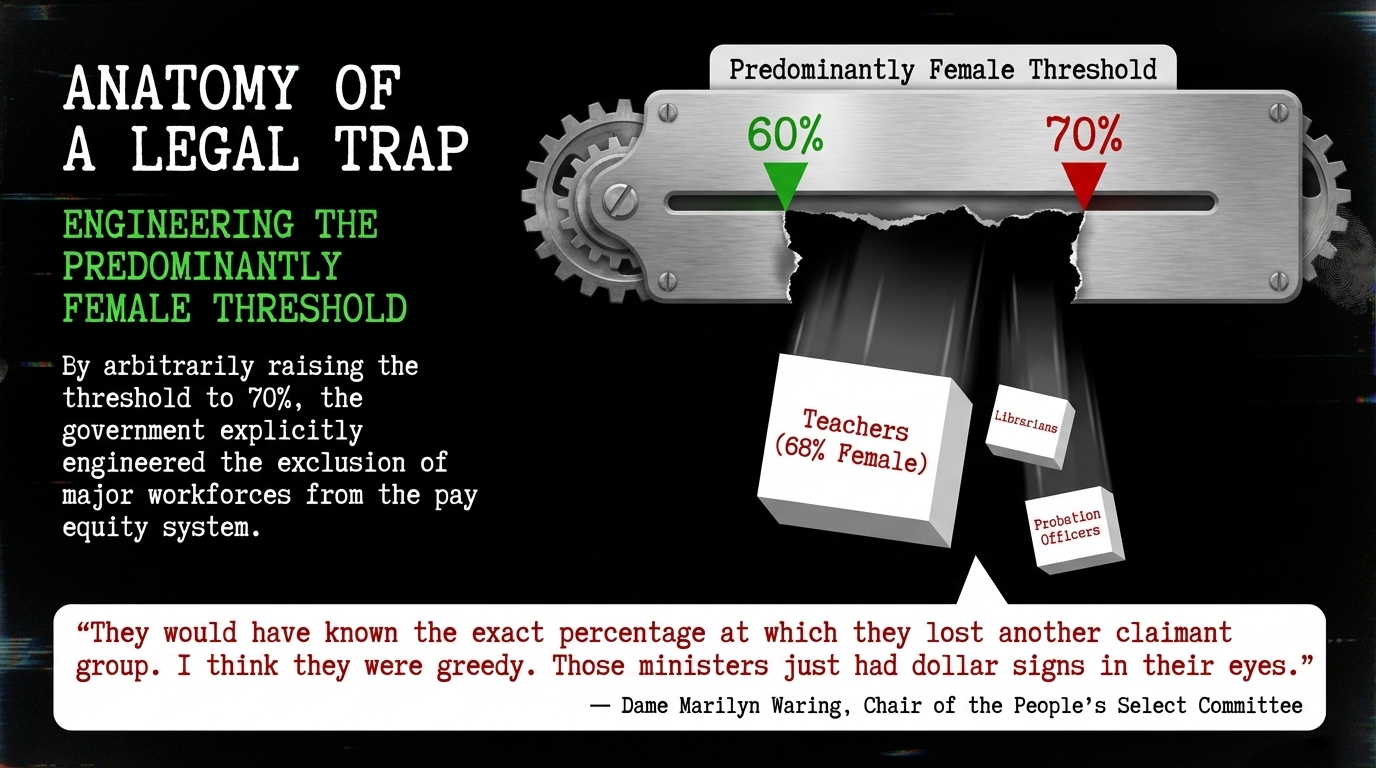
Let us be precise about what happened in that Zoom room. Ministers raised the threshold defining "predominantly female" work from 60 percent to 70 percent. This single number — chosen with surgical precision — legislated teachers (68 percent female), librarians, and probation officers out of the entire system. As RNZ reported, NZEI believed this was deliberate:
"Why else would you pick that number? I can't see any other reason." Former National MP Dame Marilyn Waring, who chaired the People's Select Committee, was blunt: "They would have known the exact percentage at which they lost another claimant group. I think they were greedy. Those ministers just had dollar signs in their eyes."
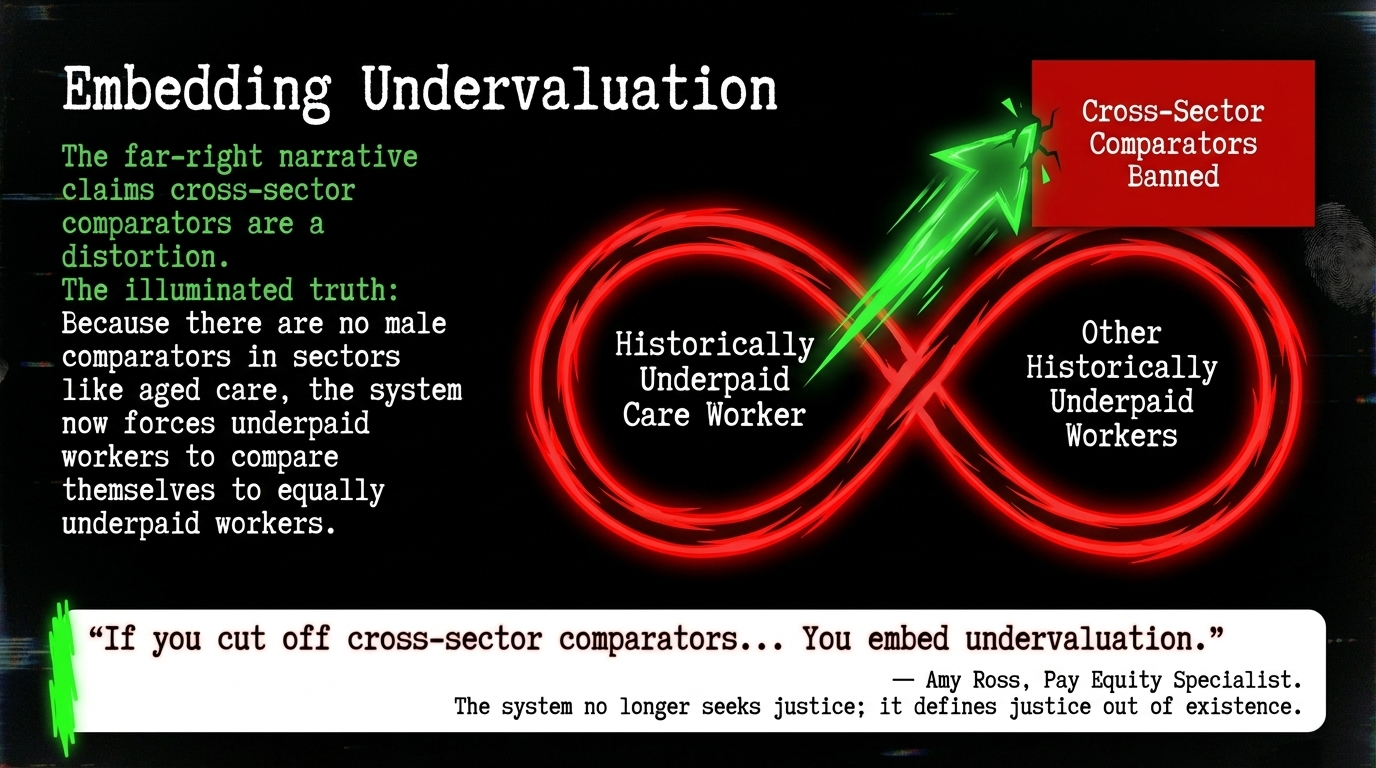
Then they removed cross-sector comparators entirely — the mechanism that allowed women in aged care to compare themselves with corrections officers or transport engineers, because there are no men in aged care to compare with.
As pay equity specialist Amy Ross explained to RNZ:
"If you cut off cross-sector comparators, you're effectively comparing historically underpaid work with other historically underpaid work. You embed undervaluation."
The logic is as vicious as it is elegant: you cannot prove you are underpaid if you can only compare yourself to other underpaid people. This is not law reform. This is a trap, and it was set deliberately.
The law was announced and passed within three days under parliamentary urgency — meaning zero public submissions, zero scrutiny, zero democracy.
The People's Select Committee — ten former female MPs from across the political spectrum, who gathered 1,390 submissions over three months of hearings — described this as
"a flagrant and significant abuse of power."
No Regulatory Impact Statement was prepared. No modelling underpinning the 70 percent threshold has ever been released. Officials acknowledged the policy was developed in a "severely compressed timeframe." When RNZ filed OIA requests for the meeting notes, Treasury, the Public Service Commission, and the offices of Willis, Brown, and Grigg all claimed they had no contemporaneous records. MBIE confirmed an official took handwritten notes — and refused to release them.
The People's Select Committee confirmed that Cabinet papers on human rights compliance had paragraphs redacted, and that
"no minister was ever fully briefed on the measure's human rights consequences."
He Metaphor Māori — The Metaphor
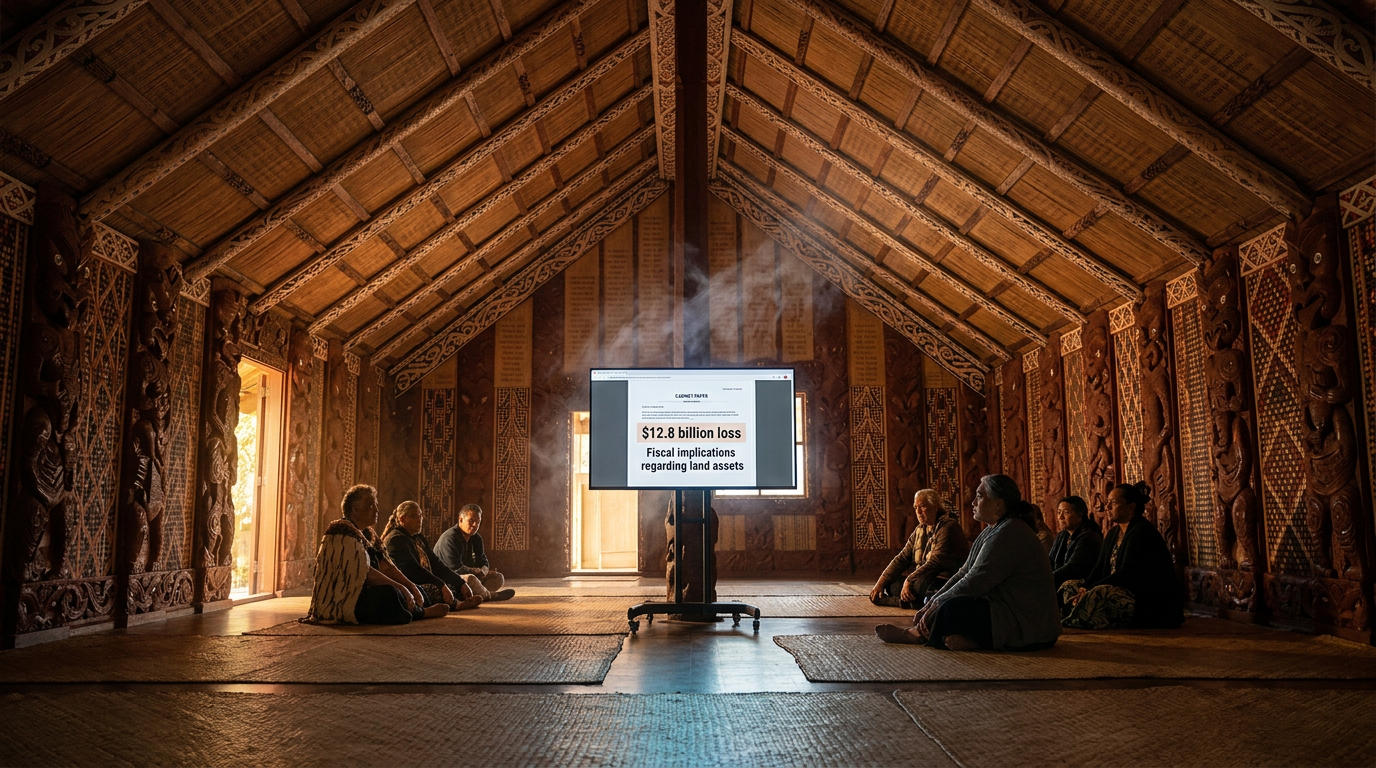
Imagine a wharenui — our meeting house, our healing house, our house of justice. For over a decade, our wāhine carried the timber, cut the pou, raised the rafters. They built it beam by beam through the courts, through unions, through sacrifice. And when the house was finally standing — warm, alive, breathing with the names of 180,000 women — six people gathered on a screen for 45 minutes and lit it on fire. Not with torches, but with a Cabinet paper. Not with anger, but with fiscal projections. The smoke that rose was $12.8 billion. And they called it responsible governance.
Our tūpuna knew this pattern. The Crown has always preferred to count what it takes rather than what it owes. The Land Wars were not random. The confiscations were not accidental. And this — this deliberate, calculated, digitally-mediated theft from the hands of wāhine Māori who care for our elderly, teach our tamariki, nurse our sick — this is not random either. It has a name. It is called austerity. And in Aotearoa, austerity has always had a brown face to bleed.
Ngā Āporo Toru — Three Examples for the Western Mind
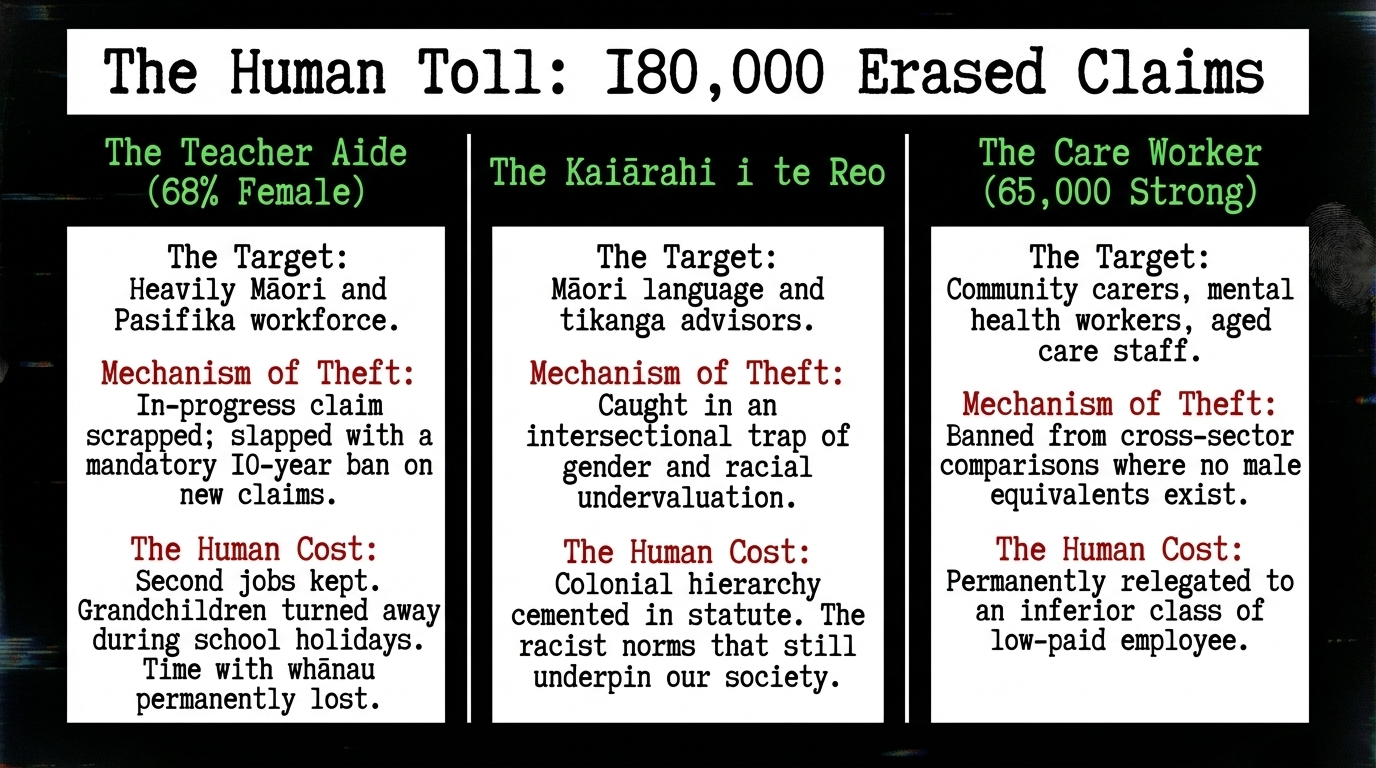
Example One: The Teacher Aide
Teacher aides in Aotearoa — a workforce 68 percent female, heavily Māori and Pasifika — had just won a pay equity settlement when this law was passed. As NZEI's Ally Kingi told RNZ:
"For teacher aides, winning our claim was huge. Women were giving up second jobs and getting to spend time with their families."
Then the threshold was moved to 70 percent — and not only was their in-progress review scrapped, but under the new law they must now wait 10 years before filing a new claim.
The harm is not abstract: it is a second job a mother must keep. It is a grandchild who cannot come for the school holidays. Quantified: the Public Service Commission confirms that pay equity settlements had cut the public service gender pay gap from 12.2 percent in 2018 to 6.1 percent in 2024 — and now that progress is frozen, or reversed.
Example Two: The Kaiārahi i te Reo
In 2018, NZEI Te Riu Roa filed the first pay equity claim on behalf of a Māori workforce — the Kaiārahi i te reo, Māori language and tikanga advisors, a role so profoundly female-dominated, and so deeply embedded in Māori cultural survival, that it stood as the embodiment of intersecting gender and racial undervaluation.
NZEI's Matua Takawaenga Laures Park named the compounding injustice plainly:
"The fact that they happen to be Māori, and you had to be Māori to have that level of reo Māori to be able to do the job, also added to that whole pay gap discussion."
Under the new law, that claim — and all future claims for similarly constituted workforces — faces a near-impossible threshold. AUT Professor of Industrial Relations Katherine Ravenswood spelled out what the Western mind must grasp:
"On top of the gender discrimination that will say women's work is worthless, the kind of racist norms that still underpin our society… They've got more than just gender to deal with, they've got the colonial racist discrimination [as well]."
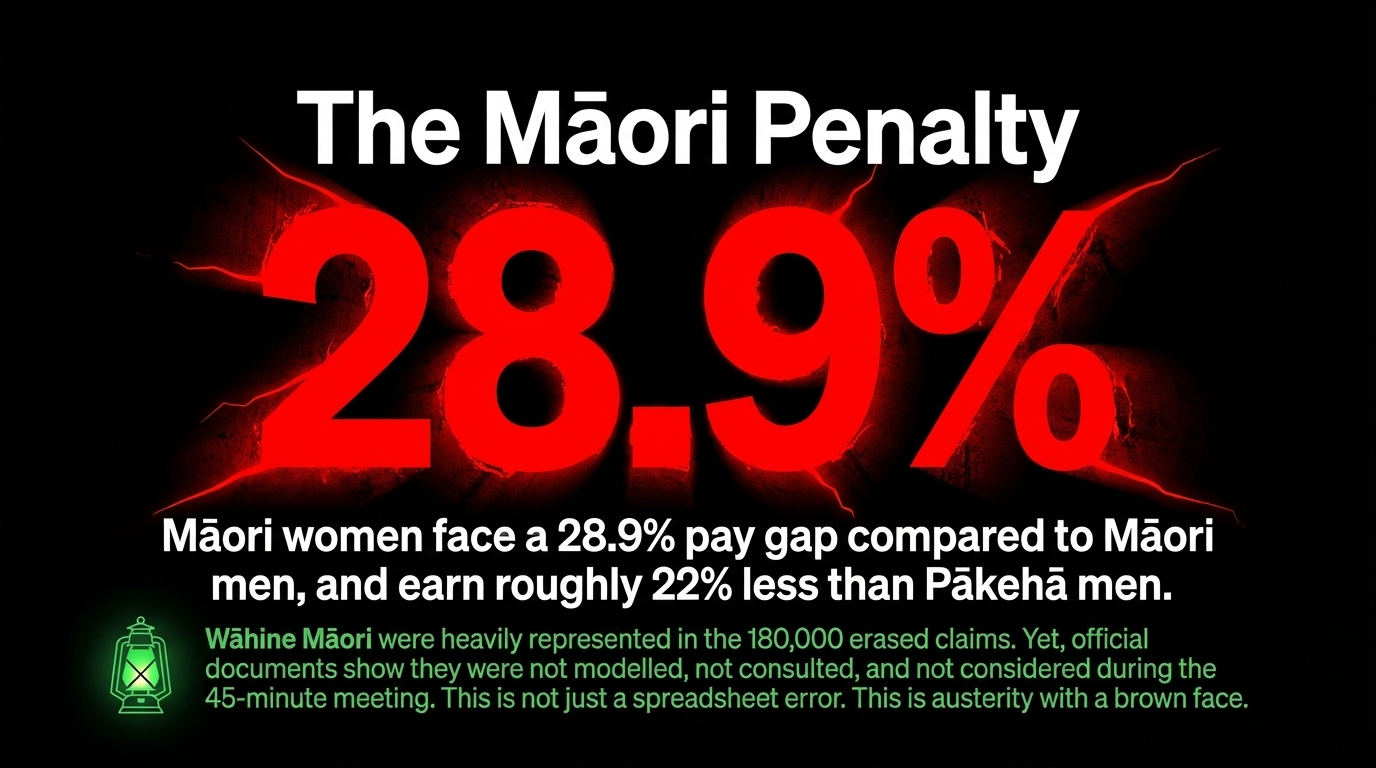
Wāhine Māori currently earn around 22 percent less than Pākehā men. This law cements that gap in statute.
Example Three: The Care Worker
65,000 care and support workers — community carers, mental health support workers, aged care staff — make up one of the most female-dominated workforces in Aotearoa.
"given the heavily female nature of this employment, there may be no available comparators under the new legislation. This in effect means that an inferior class of low-paid, female employee has been created."
For Western minds: this is like passing a law that says underpaid workers can only prove they are underpaid by finding equally underpaid workers to compare themselves with. The system does not merely deny justice — it redefines justice out of existence.
The People's Select Committee Summary confirmed these impacts
"fall hardest on wāhine Māori, Pacific women, migrant workers" — and that the Act is "a profound breach of Te Tiriti o Waitangi."
Te Tikanga me Te Ao Hou — What This Does to Tikanga
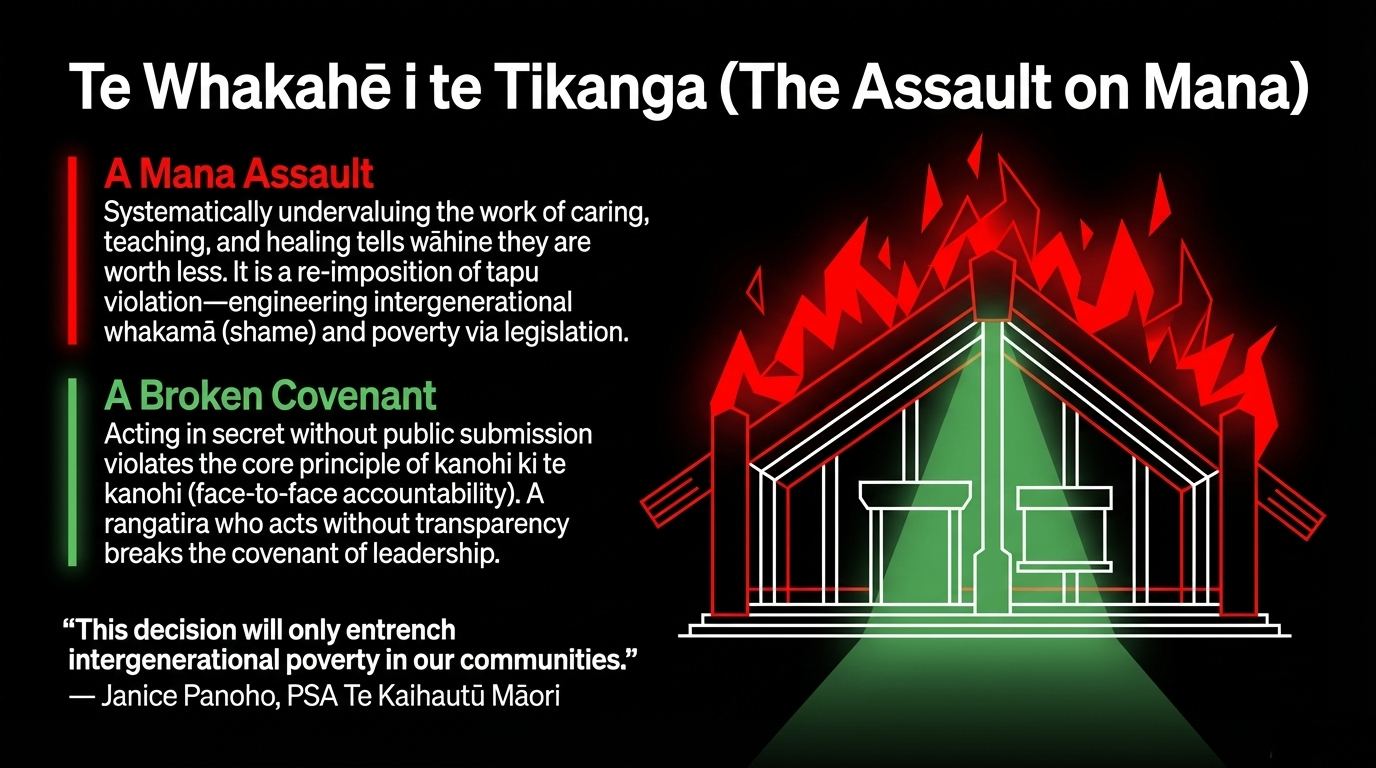
For Western readers: tikanga is not a cultural accessory or heritage display. It is a living system of relational obligations — the ethical architecture of how Māori organise society. At its centre is the concept of mana — the spiritual authority, the dignity, the right to exist with worth. When a woman's labour is systematically undervalued — when the work of caring, teaching, healing is paid less than the work of driving trucks or managing fisheries — that is not just an economic fact. It is a mana assault. It says: your work is worth less. You are worth less.
The Crown's Equal Pay Act was, in tikanga terms, a partial act of utu — a restoration of balance after generations of structural devaluation. To cancel it is not merely a policy reversal. It is a re-imposition of tapu violation — a declaration that the mana of wāhine can be overridden by a spreadsheet.
The PSA's Te Kaihautū Māori Janice Panoho named it clearly:
"This decision will only entrench intergenerational poverty in our communities."
Intergenerational poverty is, in tikanga terms, a whakamā visited upon our children — a shame not of their making, engineered by others, passed down like debt.
And the process — no consultation, no public submissions, secret meetings, withheld notes — violates every principle of kanohi ki te kanohi, of face-to-face accountability, of the obligation leaders carry to speak plainly to those they serve. In tikanga, a rangatira who acts without knowledge, without consultation, without transparency, is not a rangatira at all. They are someone who has broken the covenant that grants them the right to lead.
As former Judge Dame Silvia Cartwright submitted:
"The rights that these women relied on have been removed or changed to their detriment without giving them a chance to comment. This appears to be an historically unfair provision that breaches fundamental legislative principles of fairness, legal certainty and the rule of law."
Ngā Hononga Huna — Hidden Connections
This theft did not happen in a vacuum. Five verified connections this government does not want you to trace:
- Treasury framed pay equity as fiscal exposure, not human rights — as early as November 2023, internal MBIE and Treasury briefings framed the Equal Pay Act not as justice but as a risk to the Crown's operating balance. The agency captured the minister before she had even been fully briefed.
- Brooke van Velden's policy echoed BusinessNZ talking points from 2017 — critics noted that van Velden's framing — cross-sector comparators as "distortive," bargaining as "unreliable" — mirrored longstanding BusinessNZ concerns and earlier National Party proposals. She was reading from a script written years before she took office.
- The $12.8 billion is a direct Budget injection — Treasury estimated that $3.193 billion from public-sector pay equity contingencies alone could be returned to Budget allowances, with up to $12.8 billion freed across the public and funded sectors. This was a Budget heist dressed as law reform.
- Māori women's pay gap was 28.9 percent — and they did not model it — Kia Toipoto data shows Māori women have the largest mean gender pay gap compared to Māori men at 28.9 percent. Yet wāhine Māori were not mentioned in the 45-minute meeting record. They were not modelled. They were not consulted. They were not considered.
- "Project 10" — the law was deliberately hidden — RNZ's investigation revealed documents showing how the government actively worked to keep the pay equity changes secret until the last possible moment — naming the concealment operation "Project 10." It was not oversight. It was a plan.
Ngā Tuhinga o Mua — Previous Māori Green Lantern Essays
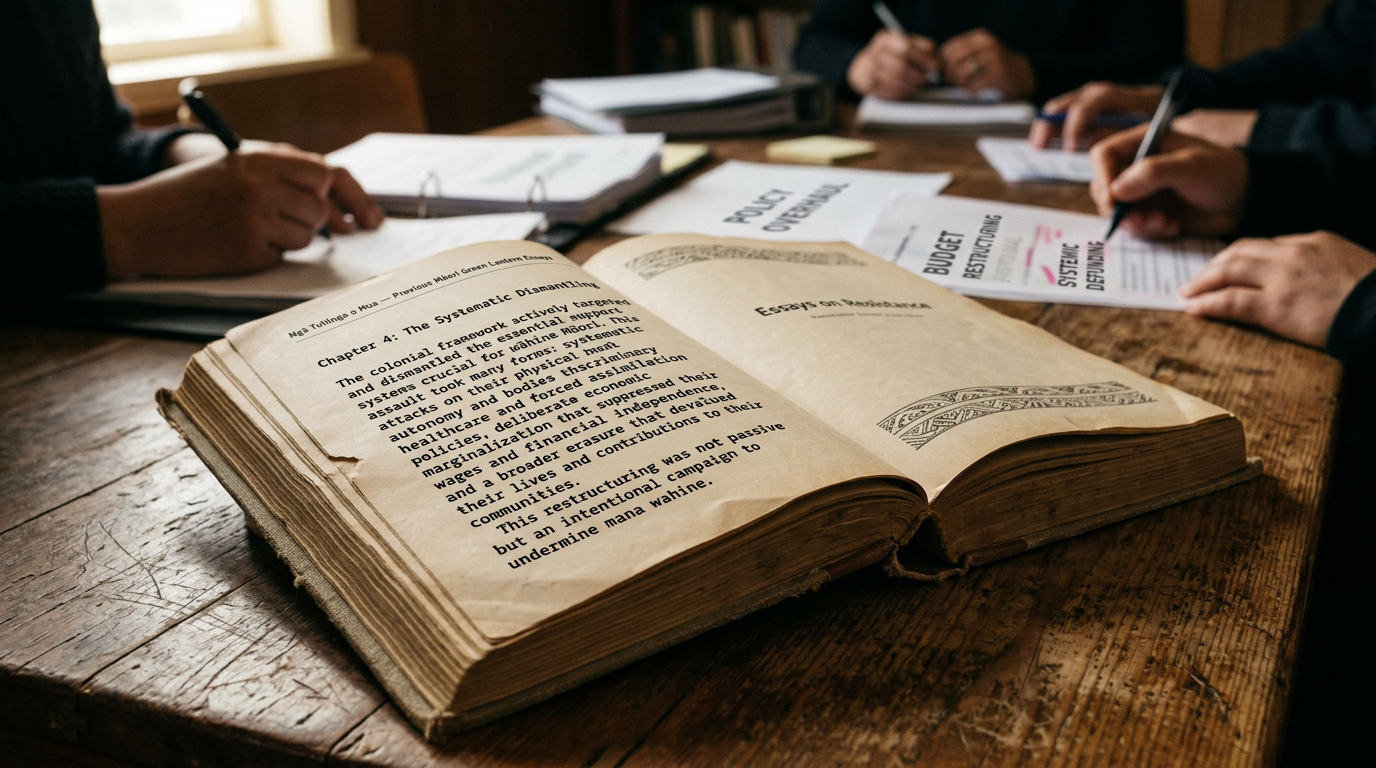
This theft does not stand alone. It is one thread in a deliberate unravelling. The Māori Green Lantern has previously documented the same coalition's attacks on the bodies, wages and lives of wāhine Māori — explore the full archive at The Māori Green Lantern, where essays trace how every system our wāhine depend upon — health, housing, education, welfare — has been defunded, restructured, and handed to the market by the same hands that gathered on that screen for 45 minutes. The connections are not coincidental. They are structural. They are colonial. And this reo will not stop naming them.
He Whakarāpopoto — What Just Happened
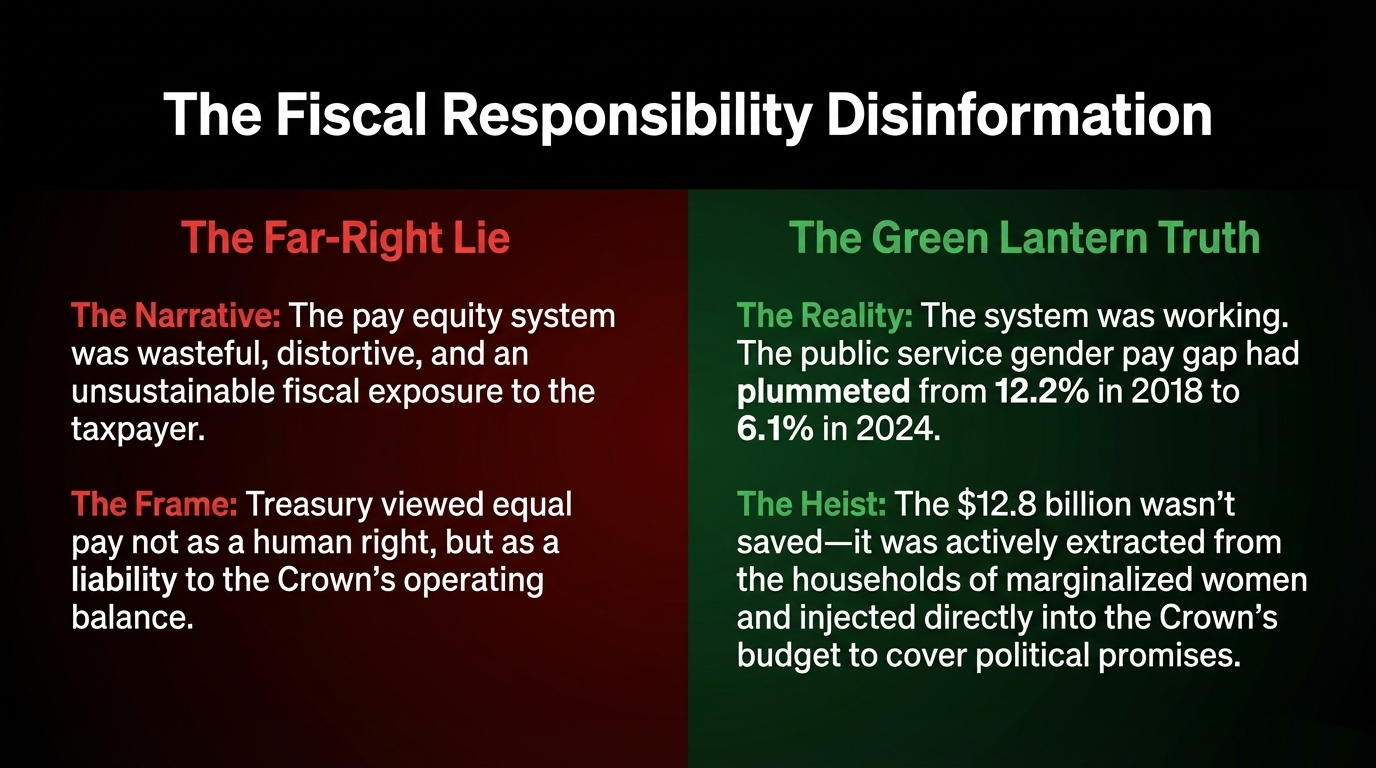
In forty-five minutes on a Zoom call, six ministers of a government with no electoral mandate for this change cancelled 33 active pay equity claims, extinguished the rights of 180,000 workers, removed the legal mechanisms that made future claims possible for the most vulnerable workers, and redirected $12.8 billion away from the wages of wāhine — with no Regulatory Impact Statement, no consultation, no transparency, and no notes they will release.
The NZCTU confirmed these pay inequities
"have a profoundly disproportionate impact on Pacific, Māori, and ethnic minority communities."
A 90,000-signature petition was delivered to Parliament. A High Court case is underway arguing breach of the Bill of Rights. Former National MP Dame Jackie Blue resigned from the party and called the Equal Pay Amendment Act "a hatchet job on 180,000 workers." And still this government has not released the notes from that meeting.
Ko te mana wāhine, ko te mana o te motu. The mana of women is the mana of the nation. They have diminished one to enrich the other. That is not governance. That is theft. And this reo will not stop saying so.
☀️ Koha Consideration
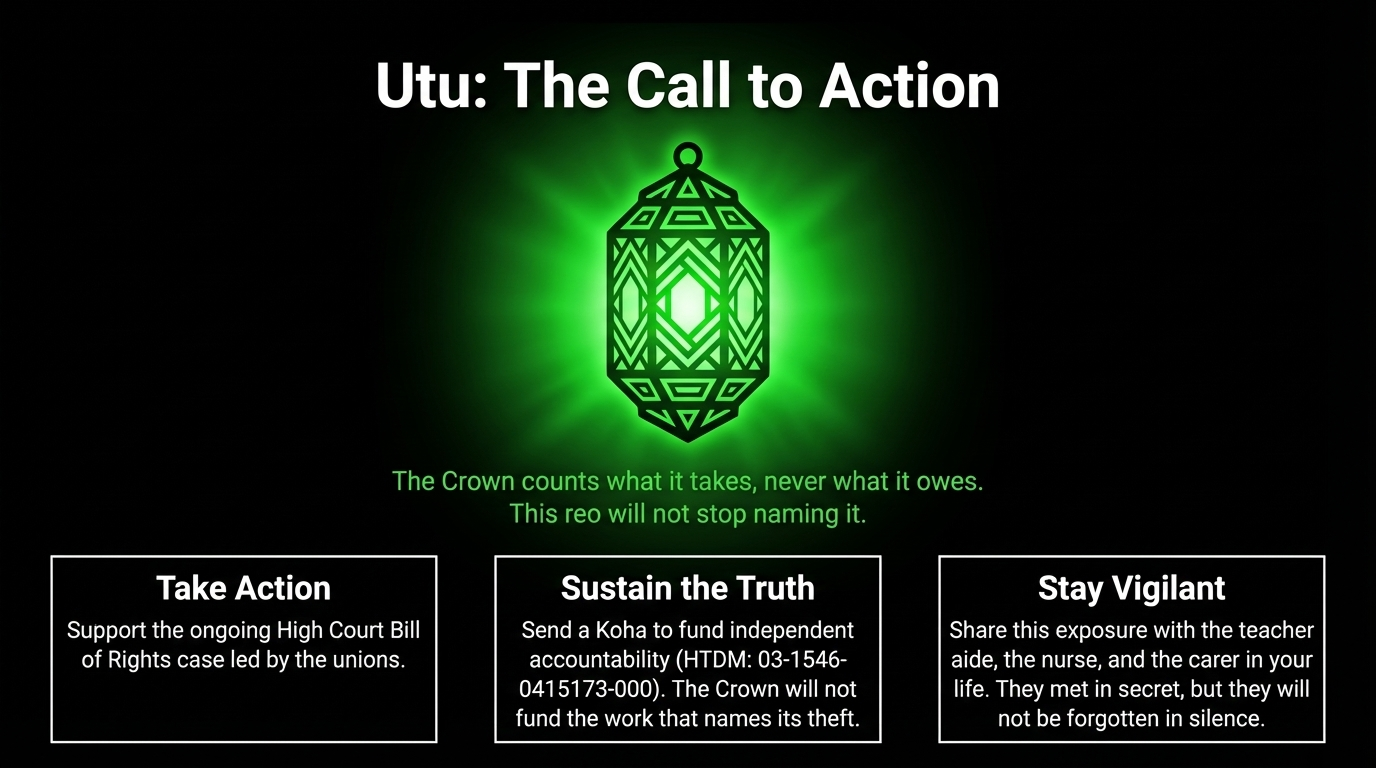
Forty-five minutes on a Zoom call stole $12.8 billion from wāhine. This essay took considerably longer — because the truth about that theft deserves more than 45 minutes.
Every koha you give is an act of utu: a restoration of balance against a government that counts what it takes but never what it owes. If these words named something true — if they gave shape to a wound you have felt watching women who care for our elders and teach our tamariki denied what is rightfully theirs — then please consider sustaining this voice. The Crown will not fund the accountability work that names it. That is our mahi. That is rangatiratanga.
Support with a koha: Koha — The Māori Green Lantern Fighting Misinformation and Disinformation
Subscribe and receive essays directly: The Māori Green Lantern — Subscribe
Direct bank transfer: HTDM, account number 03-1546-0415173-000
If koha is not possible right now — no worries, whānau. Share this essay with the teacher aide, the nurse, the carer in your life. Send it to every person who deserves to know their rights were erased in a 45-minute meeting with no notes. That sharing is koha. That truth-spreading is the work. Kia kaha. Stay vigilant. Stay connected. They met in secret — but they will not be forgotten in silence.
Research conducted 20 March 2026. Sources: RNZ (OIA-sourced political reporting), PSA Te Pūkenga Here Tikanga Mahi, People's Select Committee Summary Report (ETU, February 2026), NZEI Te Riu Roa, NZCTU, Kia Toipoto Gender and Ethnic Pay Gap Action Plan 2024–25, kaitiaki.org.nz, Te Wahanui, 1News, Public Service Commission, Ministry for Women, The Greens Aotearoa. All URLs verified at time of publication.