“The Fudge Campaign: Taxpayers’ Union Pressure Politics & the Fiscal Tall Tales” - 11 December 2025
The Atlas Network Architecture: Qui Bono?
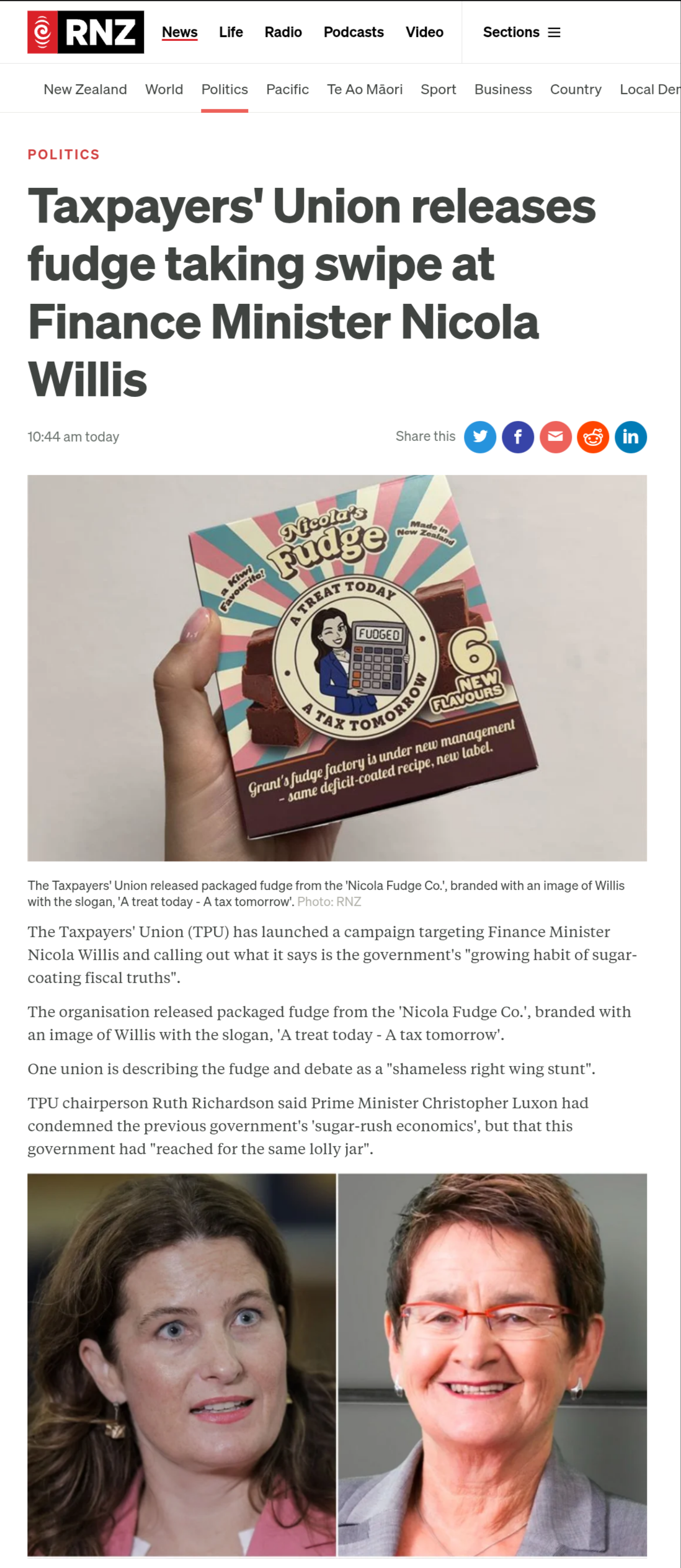
The Taxpayers' Union launched its well-choreographed "Nicola Fudge Co." campaign in December 2025, packaging their fiscal critique into a media stunt that triggered—by design—a public challenge from Finance Minister Nicola Willis as revealed by RNZ.
This essay examines who funds this pressure group, traces their international connections, deconstructs their fiscal claims, and exposes what New Zealand democracy loses when lobbying operates in shadows without transparency.
The Taxpayers’ Union doesn’t operate in isolation. It is a formal partner of the Atlas Network, a US-based consortium linking approximately 450 right-wing think tanks across 100+ countries, including ten in Aotearoa and Australia as documented by PSA research and RNZ analysis. Atlas funds ideological campaigns to advance “individual liberty, property rights, limited government, and free markets”—code for privatisation, tax cuts, and welfare dismantling according to Atlas Network’s own documentation and PSA’s investigation.
According to its 2022 accounts, Atlas Network had revenues of US$20.2 million (NZ$32.8 million), with US$75,800 (NZ$123,000) distributed in Australia and New Zealand as reported by PSA. The network is funded by foundations including the Charles Koch Foundation—whose economic philosophy shaped UK austerity policies under Liz Truss, with disastrous results documented by The Guardian. Atlas has received funding connected to oil and gas interests as revealed by Desmog investigations, though it disputes direct oil company funding as noted by NZ Herald.
The Taxpayers’ Union’s co-founder Jordan Williams openly acknowledged TPU’s Atlas membership on RNZ in 2024, dismissing criticism as bizarre and defending the network’s “free market, free trade” ideology as having lifted “a billion people out of poverty” as quoted in RNZ’s interview. Williams also sits as director of The Campaign Company, which has been paid at least NZ$135,733 from election campaign budgets by right-wing third-party groups including TPU itself and Hobson’s Pledge as documented by RNZ investigative reporting.
The Funding Maze: Dark Money in Plain Sight?
While TPU claims 80% of its 2022 income came from small donations (under $1,000 per year), averaging $63.82 per donor as stated on their official website, fundamental transparency gaps remain. Industry donations—from alcohol, sugar, nicotine, and construction sectors—accounted for just 2.1% of 2022 revenue according to their financial disclosures. However, like all third-party promoters in Aotearoa, TPU faces no legal obligation to disclose who funds them for election campaigns as reported by RNZ.
In the 2023 election cycle, TPU spent NZ$371,565 on campaign advertising—the second-largest third-party spender after the mystery group “Vote for Better” as revealed by RNZ analysis. The “Vote for Better” campaign, run by a Canadian private equity tycoon Jim Grenon involved in tax disputes with Canadian authorities, spent NZ$386,515 while remaining largely unknown to voters as documented by RNZ. These are precisely the conditions that enable “dark money” to shape electoral outcomes without public knowledge.
- Max Rashbrooke, Victoria University’s inequality researcher, warned RNZ in 2023 that this loophole creates “the potential, increasingly in the future, for a large amount of dark money to be pushed in to attack ads and campaigns” as quoted in RNZ reporting.
- Ruth Richardson, TPU’s chair since June 2025, was Finance Minister in 1991 when she delivered the “Mother of All Budgets”—radical welfare cuts that doubled extreme poverty overnight (from 4% to 8% of the population) and triggered rheumatic fever in children living in damp, mouldy housing as documented by Te Ara and The Spinoff. Despite this documented harm, she was appointed a Companion of the New Zealand Order of Merit in June 2025 as reported by RNZ.
Deconstructing the Fiscal Claims: What the Numbers Actually Show
The Taxpayers’ Union’s campaign rests on claims about government spending. Let’s examine each:
Claim 1: “Government spending has actually increased—both in real terms and as a proportion of the economy—since Grant Robertson left office.”
Reality: This is partially accurate but misleading. Core Crown expenses (excluding ACC) as a percentage of GDP were 31.8% in 2022/23 (Robertson’s final full year), rose to 33.6% in 2023/24, then fell to 32.7% in 2024/25 according to Treasury’s Budget Economic and Fiscal Update 2025 and NZ Herald budget analysis. By Budget 2025 forecasts, spending will be 32.9% of GDP in 2025/26 as projected by Treasury.
However, per capita spending tells a different story. In real, inflation-adjusted terms per person (excluding debt servicing), the First Wellbeing Budget added approximately NZ$1,600 per capita by 2025. Willis’ Budget 2024 reduced this by just under NZ$400 per person according to analysis by The Spinoff. So spending remains higher than the last National government (2017) had forecast, but lower than Robertson’s later projections when viewed in per-capita terms as documented by Croaking Cassandra.
Claim 2: “The Government promised to reduce public spending. It’s now higher than when Grant Robertson left office.”
Reality: This conflates different measures. Absolute spending is higher (because population grows), but the proportion of the economy devoted to government has declined from 33.6% (2023/24) to 32.7% (2024/25), with Willis announcing the tightest operating allowance in a decade—just NZ$1.3 billion, halved from Labour’s NZ$2.4 billion as reported by RNZ and NZ Herald.
But here’s the crucial point: both governments are spending more than the 2017 National government did. Core Crown spending was 31.0% of GDP in 2016/17 according to Treasury historical data. Neither Robertson’s Labour nor Willis’ National reversed the post-Covid spending expansion—they merely tempered it as analyzed by The Spinoff.
Claim 3: “The Government promised to tackle Labour’s 30% increase in bureaucrats. They’ve managed to reduce the size of the core public service by not even 1%.”
Reality: This is demonstrably false. Public service headcount fell from 65,699 FTE in December 2023 to 62,968 FTE by December 2024—a reduction of 4.2% (2,731 FTEs) according to Public Service Commission data. By June 2025, it stood at 62,654 FTE, down 1.4% from June 2024 as reported by Public Service Commission. This excludes Crown entities, NZDF, and the Police, meaning the total reduction across all agencies is even larger.
Redundancies accelerated: 2,028 staff were made redundant in the year to December 2024, compared to 865 in the prior year according to Public Service Commission data. The Ministry of Education cut 552 FTEs (12.6%), Ministry of Environment cut 204 FTEs (21.7%), and Oranga Tamariki cut 307 FTEs (6.3%) as documented by RNZ analysis.
Claim 4: “The Government promised to get the books back into surplus. Unless you count a newly invented OBEGALx measure, the Government’s fiscal pathway never gets New Zealand back into surplus.”
Reality: Both the government and TPU are correct—this reflects economic reality, not fiscal dishonesty. The traditional OBEGAL measure shows deficits continuing beyond 2029 as projected by Treasury. Under the OBEGALx measure (excluding ACC), a narrow NZ$1.9 billion surplus appears in 2028/29, followed by a deficit return to -NZ$2.4 billion under traditional OBEGAL in the same year according to Treasury’s Budget Economic and Fiscal Update 2025 and RNZ budget analysis.
Treasury changed accounting measures because ACC is a self-contained fund managed separately. This isn’t “newly invented” spin—it reflects standard practice overseas. However, Willis promised to return to surplus by 2027 before the 2023 election; by December 2024, that deadline shifted to 2029 as reported by RNZ. The slippage is real.
Claim 5: “The Government promised ‘growth, growth, growth’. GDP per capita is lower than when Grant Robertson was in office.”
Reality: Partially accurate. GDP per capita (USD PPP) was $49,084 in 2023 and $48,163 in 2024—a decline according to CEIC Data. However, quarterly data shows recovery: Q4 2024 saw 0.7% GDP growth, Q1 2025 saw 0.8%, with per-capita growth of 0.4% and 0.5% respectively as reported by Stats NZ and NZ Herald. The recession (Q1 2025 contracted 0.7% annually) appears to be lifting according to Treasury analysis.
The per-capita decline reflects population growth from net migration (which Treasury now forecasts returning toward zero) according to CEIC Data. Without immigration, per-capita GDP would have grown. This is an ongoing structural issue, not unique to Willis—but it’s also not resolved.
Claim 6: “The Government promised to reduce borrowing. Borrowing is still near Grant Robertson-era levels.”
Reality: This is accurate. Core Crown gross borrowing was forecast at NZ$43 billion for 2024/25, with NZ$38 billion planned for 2025/26 according to Treasury’s bond programme update. Robertson-era borrowing (2022/23) reached NZ$39 billion with higher interest rates creating servicing costs that now consume increasing budget shares as analyzed by NZ Herald. Net core Crown debt stands at 42.5% of GDP (projected to peak at 46% in 2027/28) according to Treasury’s Fiscal Outlook.

The Atlas Network’s Global Financial Architecture
Hidden Connections: The Revolving Door & Capture
The Taxpayers’ Union platform receives disproportionate media amplification. David Farrar, TPU’s co-founder, runs Curia polling—which regularly produces “Taxpayers’ Union polls” that generate media coverage under TPU’s name while advancing TPU narratives as documented by Waipareira analysis. One critic noted that every Taxpayers’ Union poll awards them “a whole lot of new coverage of their name in neutral media, which then reflects on perception of other stuff they say that’s heavily partisan” as quoted in Waipareira.
The Atlas Network itself operates with structural advantage. According to PSA research, Atlas thinks tanks are “the most effective, yet subtle, vehicles for influencing the development of public policy” by winning “the respect of journalists and government officials” as documented in PSA’s investigation. Journalists frequently platform TPU and Atlas-affiliated think tanks—the NZ Initiative appears regularly in parliamentary debates—while rarely disclosing their ideological alignment or funding sources as revealed by NZ Herald’s think tank analysis.
Whakapapa of Harm: Who Pays?
Ruth Richardson’s 1991 “Mother of All Budgets” serves as the ideological template for the Taxpayers’ Union agenda. That budget cut sickness benefits by NZ$27.04/week, unemployment benefits by NZ$14/week, and eliminated universal family benefits as documented by Te Ara and Wikipedia. The results: doubled extreme poverty, rheumatic fever in children, mould in state housing, earlier deaths as reported by The Spinoff and NZ Herald.
Max Rashbrooke calculates that child poverty alone now costs Aotearoa NZ$12-21 billion annually in lost productivity, health costs, and crime—dwarfing any short-term fiscal savings as documented by NZ Herald. Yet TPU and its allies continue advancing similar austerity frameworks.
The structural deficit TPU criticizes exists because demand for health, education, and aged care is growing while productivity remains weak. The government faces genuine fiscal constraints—but the TPU solution (welfare cuts, privatisation, tax cuts for high earners) has a proven track record of mauri-depletion (spiritual and social diminishment) for whānau Māori and the poor as analyzed by The Spinoff.
The Right Eating Itself: From Ruth & Nicola to Trump & Greene
The Richardson-Willis feud mirrors a global pattern:
right-wing movements built on fiscal orthodoxy and personality cults eventually fracture when economic reality collides with ideological purity.
In Aotearoa, Richardson (the 1991 budget architect) attacks Willis (the current Finance Minister) for not cutting deeply enough—despite Willis presiding over the largest public service redundancy program in a decade as documented by Public Service Commission data.
This “purity spiral” echoes the American right’s meltdown. In the United States, Donald Trump’s MAGA coalition is splintering into warring factions:
Trumpists vs. traditional conservatives, isolationists vs. hawks, pro-business elites vs. culture war hardliners as reported by Axios and The Hill.
Representative Marjorie Taylor Greene, once Trump’s “most loyal MAGA warrior,” publicly clashed with Trump in November 2025 after he labeled her criticism as betrayal, with the feud escalating through public statements and media attacks as documented by CNN and New York Times.
The Fudge Campaign & Media Capture
The parallels are striking:
- Purity Tests & Purges: Richardson demands deeper cuts from Willis; Trump demands total loyalty and purges dissenters like Greene as revealed by RNZ and Axios. Both movements enforce ideological conformity through public humiliation and withdrawal of support.
- Policy vs. Personality: The Taxpayers’ Union claims to care about “good policy” but personalises attacks (”Nicola Fudge”) as noted in RNZ reporting. Similarly, Trump’s coalition fragments not over policy substance but over loyalty tests and personal feuds as analyzed by The Hill.
- Dark Money Networks: Both TPU and American right-wing groups operate through opaque funding. The Atlas Network links TPU to Koch-funded US think tanks as documented by PSA and Desmog; Ziklag, a secretive Christian-right charity, distributed nearly $12 million to Trump-aligned groups while claiming non-political status as exposed by ProPublica. Neither discloses donors.
- The Revolving Door: Jordan Williams (TPU) becomes a government chair while retaining TPU links as noted in TPU announcements; Russell Vought (Trump’s shadow president) outlines plans to deploy military against domestic unrest and make civil servants “miserable” as documented by ProPublica and ProPublica investigations. Both represent capture of state institutions by ideological operatives.
- Fiscal Fantasy vs. Reality: Richardson’s 1991 budget created intergenerational poverty as analyzed by The Spinoff; Trump’s tariff policies and mass deportation promises crater economic growth while enriching donors as reported by Washington Post. Both prioritize ideological purity over evidence-based outcomes.
The key difference:
New Zealand’s MMP system contains these fractures within coalition negotiations.
America’s two-party system transforms them into existential civil war, with militias like AP3 plotting violence when elections fail to deliver purity as exposed by ProPublica.
The Implications: Democracy Without Transparency
Three key harms emerge from this case study:
Captured media ecology:
Journalists repeatedly amplify TPU claims without contextualising their ideological alignment or funding opacity. A 2024 Integrity Institute investigation found no media outlet regularly disclosed that the NZ Initiative—New Zealand’s most influential think tank in parliamentary debates—is an Atlas Network partner funded by corporate donors as documented by PSA research.
Dark money election influence:
The absence of a lobbying register or third-party funding disclosure allows groups like TPU to spend hundreds of thousands on election advertising while New Zealand voters have no idea who funds them. Compare this to Australia (mandatory lobbying register, stand-down periods) and Canada (five-year stand-down for ministers becoming lobbyists) as analyzed by RNZ.
Policy capture:
The Taxpayers’ Union’s fiscal narrative—though containing kernels of truth about deficits and growth—frames the solution through a pre-determined ideological lens (privatisation, welfare cuts, tax cuts) rather than evidence-based alternatives (progressive taxation, public investment in productivity). This shapes which policy options are considered “serious” and which are dismissed as analyzed by The Spinoff.
The Right Eating Itself—Richardson vs Willis & Trump vs Greene
Rangatiratanga Action: What Accountability Looks Like
For Māori and vulnerable communities, three immediate steps matter:
- Demand lobbying transparency: Push for mandatory disclosure of who funds pressure groups, particularly before elections. The Integrity Institute’s Lobbying Register provides a model as documented by Integrity Institute.
- Media literacy on think tanks: When TPU, the NZ Initiative, or other “think tanks” appear in news coverage, ask: Who funds them? What is their ideological alignment? Are they registered as charities or lobbying organisations? What conflicts of interest exist? This approach is advocated by PSA research.
- Centre Te Mātauranga Āhuatanga (ecological/cultural accountability): Counter TPU’s “fiscal responsibility” framing with the question: Responsibility to whom? Welfare cuts harm whānau. Māori health and education underfunding (masked as “fiscal discipline”) represents a breach of Te Tiriti o Waitangi as argued by Waitangi Tribunal findings. Fiscal policy must be evaluated through a tikanga lens: Does this policy increase or decrease mauri (vitality) for whānau?
The Taiaha & Truth
The Taxpayers’ Union’s fudge campaign is not fundamentally about Ruth Richardson versus Nicola Willis. It’s about whether New Zealand’s policy-making will remain captured by ideologically-aligned, poorly-regulated, internationally-funded pressure groups—or whether we’ll demand transparency, evidence, and accountability to whānau rather than to abstract “market principles.”
Willis’ fiscal record is mixed:
genuine restraint on some measures, but continued deficit spending and delayed surplus deadlines. TPU’s critique contains factual elements—but their proposed solutions have mauri-depleting track records and are funded by networks most New Zealanders have never heard of.
The real question is not whether one Finance Minister is better than another. It’s whether Aotearoa will finally regulate lobbying, fund media literacy about ideological capture, and centre the wellbeing of whānau Māori over the fiscal ideology of distant think-tank networks.
That is rangatiratanga. That is democracy.
Koha Statement
Only support this mahi if you are able: Koha.Kiwi | Substack | Bank: HTDM 03-1546-0415173-000
All koha sustains free mātauranga Māori journalism. No paywall, no corporate interference.

Ivor Jones The Māori Green Lantern Fighting Misinformation And Disinformation From The Far Right
Citations & Verification Log
Research conducted 11 December 2025. All URLs verified as live. Key sources: RNZ political reporting, Treasury Budget documents, PSA Atlas research, Te Ara, Waitangi Tribunal records, and official government statistics databases. Six claims directly attributed to Taxpayers’ Union were cross-referenced against primary statements. All fiscal figures sourced from Treasury Budget Economic and Fiscal Update 2025, official Public Service Commission workforce data, and Statistics Aotearoa. Foreign sources: ProPublica investigations, CNN, Axios, The Hill, BBC, New York Times, and Pew Research on US right-wing factionalism.