"THE FUEL TAX SHUFFLE: How Luxon and Willis Played Both Sides of the Pump While Māori Whānau Paid the Price" - 7 April 2026

Mōrena Aotearoa,
The Deep Dive Podcast
Listen to a lively conversation between two hosts, unpacking and connecting topics in the sources of this essay.
The Setup: A Flip‑Flop Built on Hypocrisy
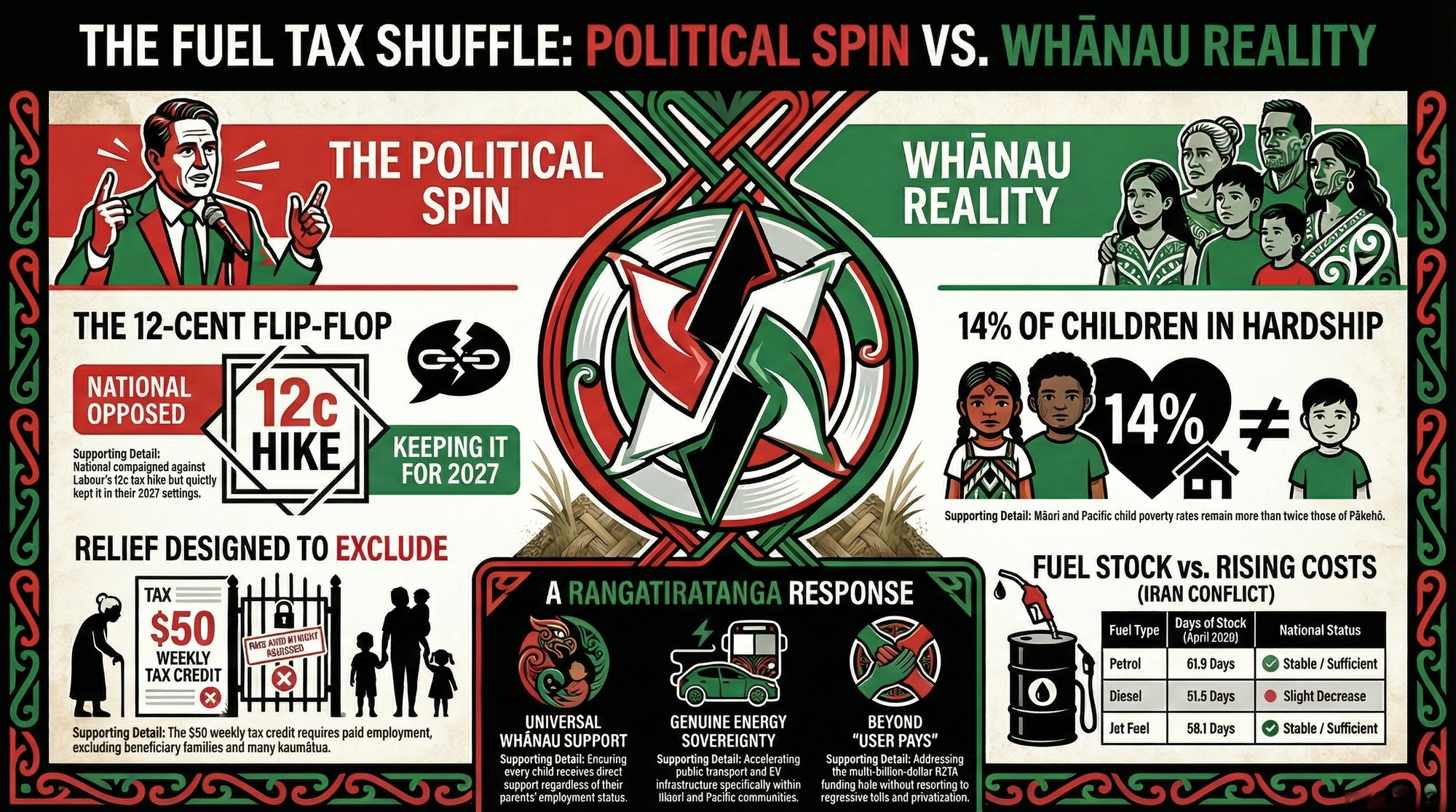
The public line is soothing: the government says the scheduled 12‑cent fuel excise duty increase from January next year is now “unlikely” or “pretty unlikely” to go ahead, after the Iran war sent global fuel prices surging.
As reported by 1News and Interest.co.nz, Christopher Luxon said the hike was “possibly unlikely,” while Finance Minister Nicola Willis and Transport Minister Chris Bishop have both signalled it is very unlikely to proceed under current conditions.
But this is not compassion. This is political damage control.
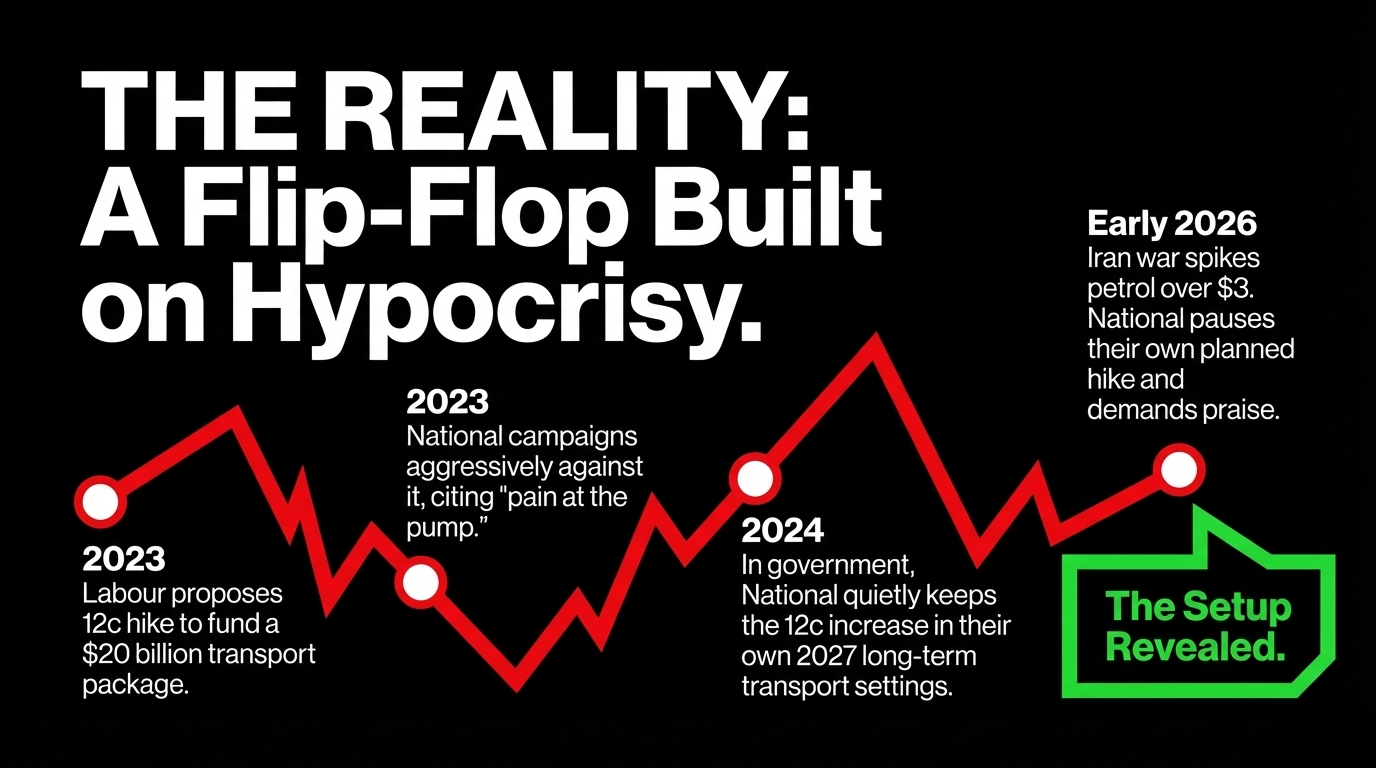
- Labour in 2023 proposed a 12‑cent‑per‑litre fuel excise increase over several years to fund a $20 billion transport package, including road maintenance, public transport and resilience projects, as covered by the NZ Herald.
- National campaigned hard against that plan, framing it as “pain at the pump” and part of a wider “tax and spend” agenda, again widely reported in the NZ Herald and later summarised by The Spinoff.
- Once in power, National quietly kept the same 12‑cent increase in its own long‑term transport funding settings for 2027, as noted by 1News and analysed in more depth by Interest.co.nz.
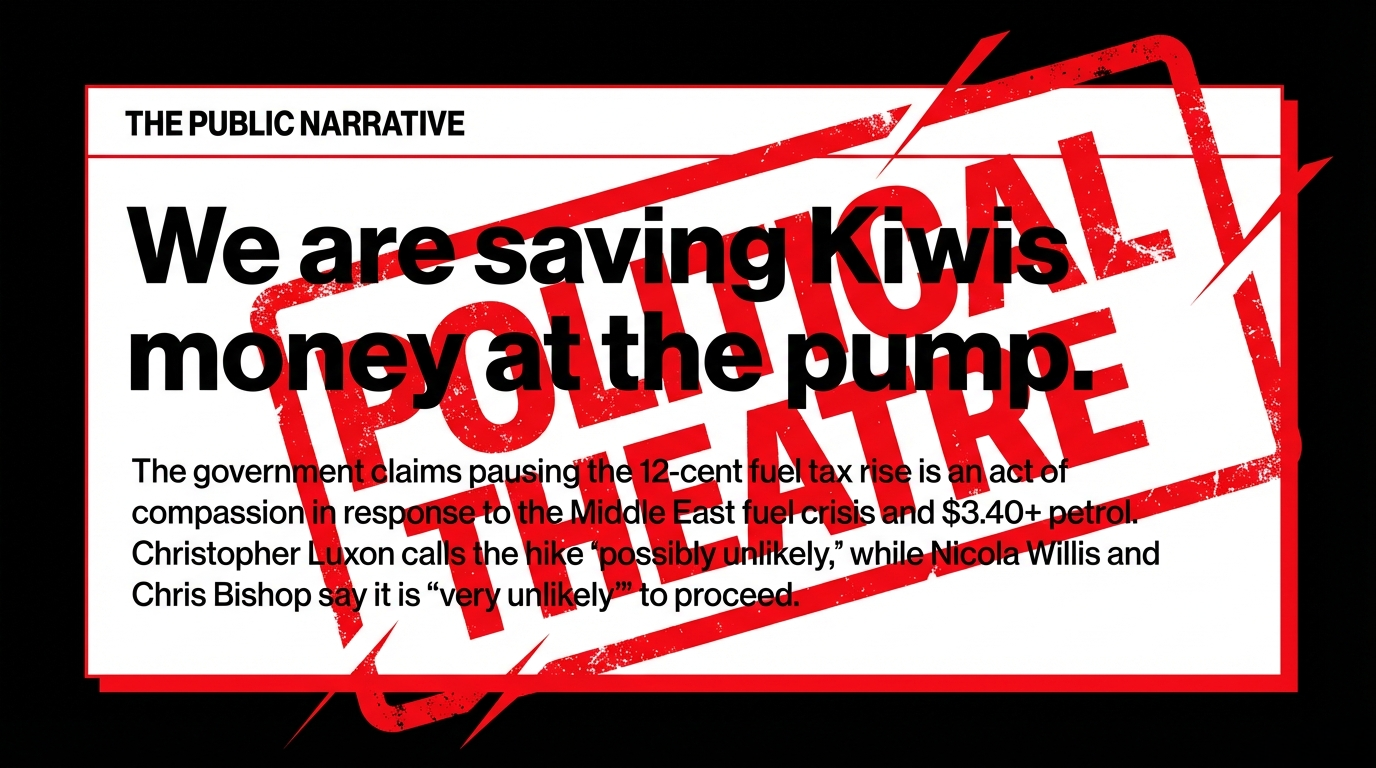
Now, in the middle of a fuel crisis, they want applause for promising not to push ahead with the hike they themselves scheduled. That is not relief; that is political theatre.
Background: The Whakapapa of the 12‑Cent Tax
To see the scam, you have to track the whakapapa.
Labour’s 12c plan
In August 2023, Labour announced a major transport package funded by a staged 12‑cent increase to fuel excise duty over three years, with revenue earmarked for road maintenance, cyclone recovery, safety and public transport. This was laid out in detail by the NZ Herald and discussed in tax commentary such as Polson Higgs’ tax blog.
National campaigns against it
National seized on the proposal as proof Labour was addicted to taxes. Coverage in outlets like the NZ Herald and subsequent political round‑ups recorded how then‑opposition figures condemned the 12c increase as unfair and unnecessary, hammering “cost of living” lines at every opportunity.
In power: scrap one tax, keep another
Once in government, National quickly announced the axing of Auckland’s regional fuel tax, effective mid‑2024, as trumpeted on Beehive.govt.nz. But at the same time, their broader long‑term transport settings still relied on higher fuel excise revenue further out, including that same 12‑cent‑per‑litre rise now in the crosshairs; this is laid out in reporting by 1News and analysed by Interest.co.nz.
Iran, Hormuz and $3.40 petrol
In early 2026, the US–Israel war on Iran destabilised the Strait of Hormuz, through which a massive share of global oil flows. The resulting shock pushed New Zealand pump prices sharply higher, with coverage by 1News and international outlets like the Independent describing the speed and severity of the spike. The Spinoff’s Bulletin piece on fuel noted petrol heading well above $3 per litre and warned no fuel tax cuts were coming, despite prices “set to surge”, in its March 2026 edition at The Spinoff.
Now, with an election in November 2026 and fuel already politically toxic, the same government that banked on the 12c hike is promising not to do it. That is the whakapapa.
The “Relief” Package: Manaakitanga for Some, Nothing for the Rest
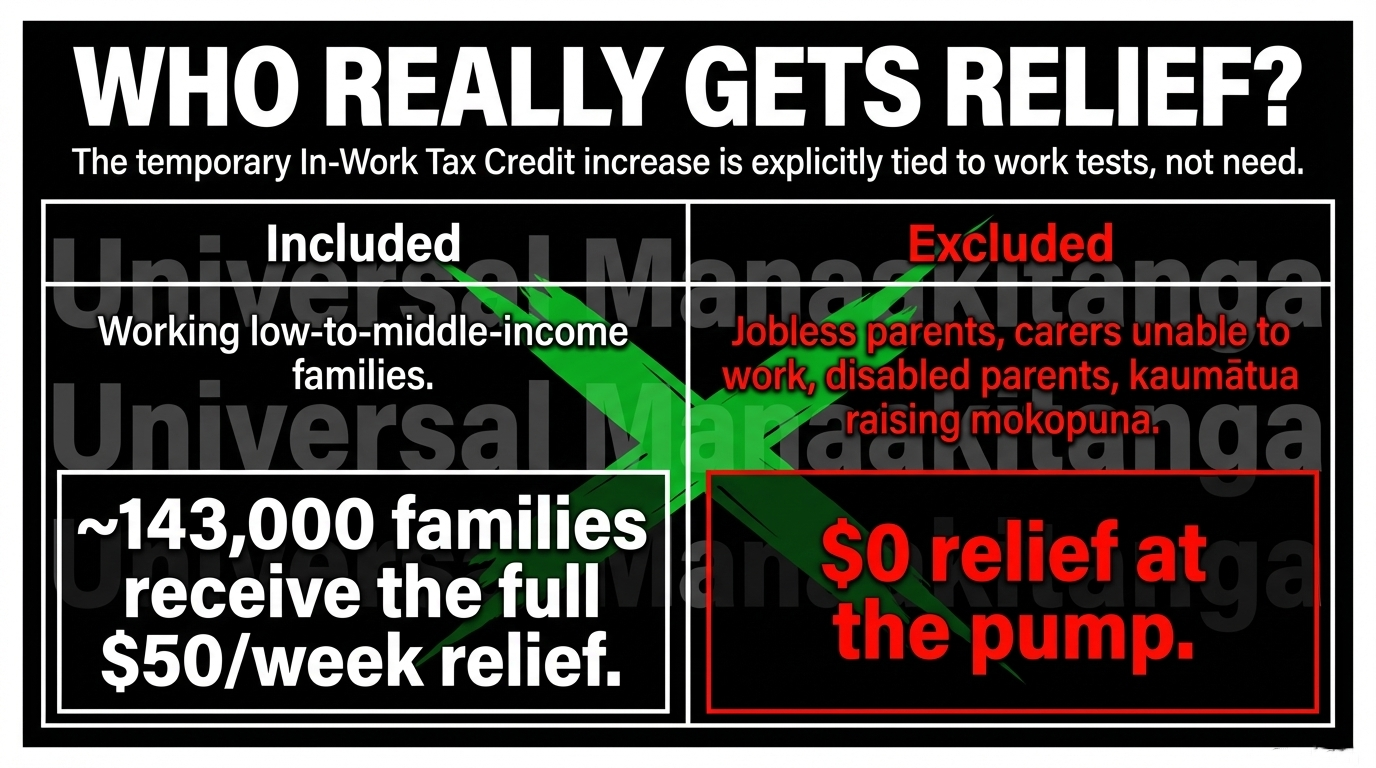
When the fuel crisis hit, the government’s big answer was not to cut fuel excise duty and give universal relief at the pump. Instead, it announced a temporary increase to the In‑Work Tax Credit, worth up to $50 a week for low‑to‑middle‑income working families with children.
According to 1News and the Inland Revenue Department, around 143,000 families will get the full increase, with thousands more receiving partial payments. The NZ Herald’s coverage of the package emphasised the headline figure of $50 a week and the government’s claim that it targeted those “doing it tough”, as seen in its report on the relief package at NZ Herald.
But the design is the crime.
The In‑Work Tax Credit only goes to families where parents are in paid employment. Beneficiary families — including parents who’ve lost jobs, carers unable to work, disabled parents, and many kaumātua raising mokopuna — are excluded by design. The NZ Herald’s breakdown of the policy at NZ Herald makes clear the payment is tied to work tests, not need.
Child poverty data shows why this matters. Stats NZ figures reported in the Herald’s “one in seven” story show about 14% of all children in Aotearoa live in material hardship, and rates are much higher for Māori and Pacific children, more than twice those of Pākehā, as highlighted in both the “one in seven” article and a Kahu feature on inequity at NZ Herald and NZ Herald Kahu. Child Poverty Action Group’s summary of official statistics also underscores that Māori children are over‑represented in all child poverty measures, as outlined by CPAG.
So when the government designs relief that explicitly excludes beneficiary households, it is structurally excluding a large share of Māori and Pacific tamariki from fuel‑driven cost‑of‑living support. This isn’t an accident; it’s ideology embedded in policy architecture.
Who Gets Left Behind: Māori and Pacific Whānau on the Edge
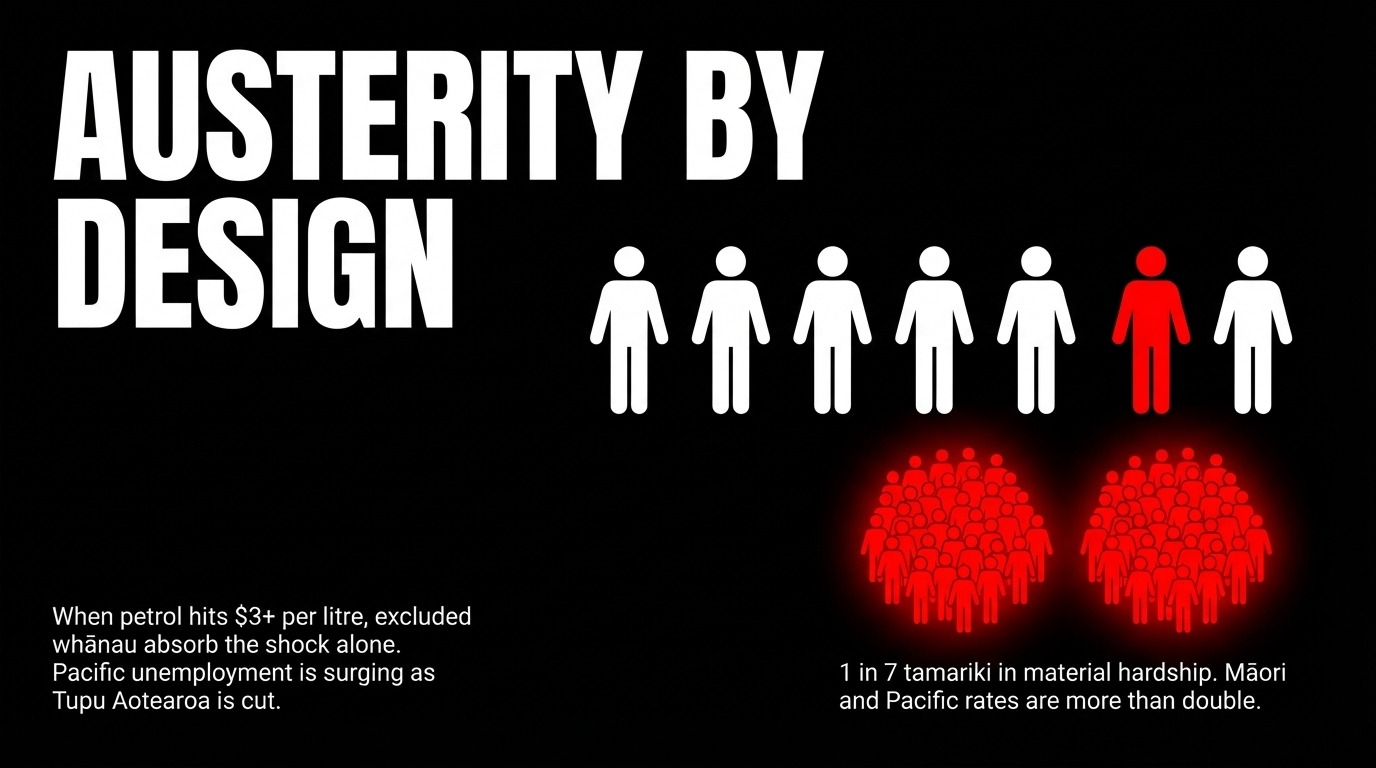
The impact of this design is clearest when you look at Māori and Pacific employment and hardship data.
A recent “State of the Nation”–style analysis of Pacific unemployment highlighted how Pacific joblessness has surged, despite overall employment growth, leaving Pacific communities highly exposed to economic shocks, as described by Pacific media such as PMN and reinforced in broader commentary on hardship at The Coconet. Labour’s own press release “Luxon’s choices hit Pacific communities” laid out how National’s cuts to programmes like Tupu Aotearoa remove support from those very communities later deemed “not working enough” to qualify for relief, as detailed by the Labour Party at Labour.org.nz.
For Māori, long‑running commentary has warned that the government is more focused on disciplining beneficiaries than fixing the job market. Commentary pieces like Shane Te Pou’s critique at NZ Herald and analysis of welfare settings in the Herald’s coverage of jobseeker policies at NZ Herald have been clear about this pattern.
Add in energy hardship and transport dependence: Māori and Pacific households are more likely to live in poorly insulated housing, pay proportionally more of their income on power, and be heavily car‑dependent in areas with weak public transport. These patterns are repeatedly highlighted in child poverty and hardship reports summarised by CPAG and reflected in the mainstream framing at NZ Herald.
So when petrol jumps past $3 a litre and the government’s big move is a work‑tested tax credit, the most precarious Māori and Pacific whānau are told to absorb the full shock themselves. Manaakitanga for some; austerity for the rest.
The NZTA Funding Hole: Where Does the Road Money Come From?
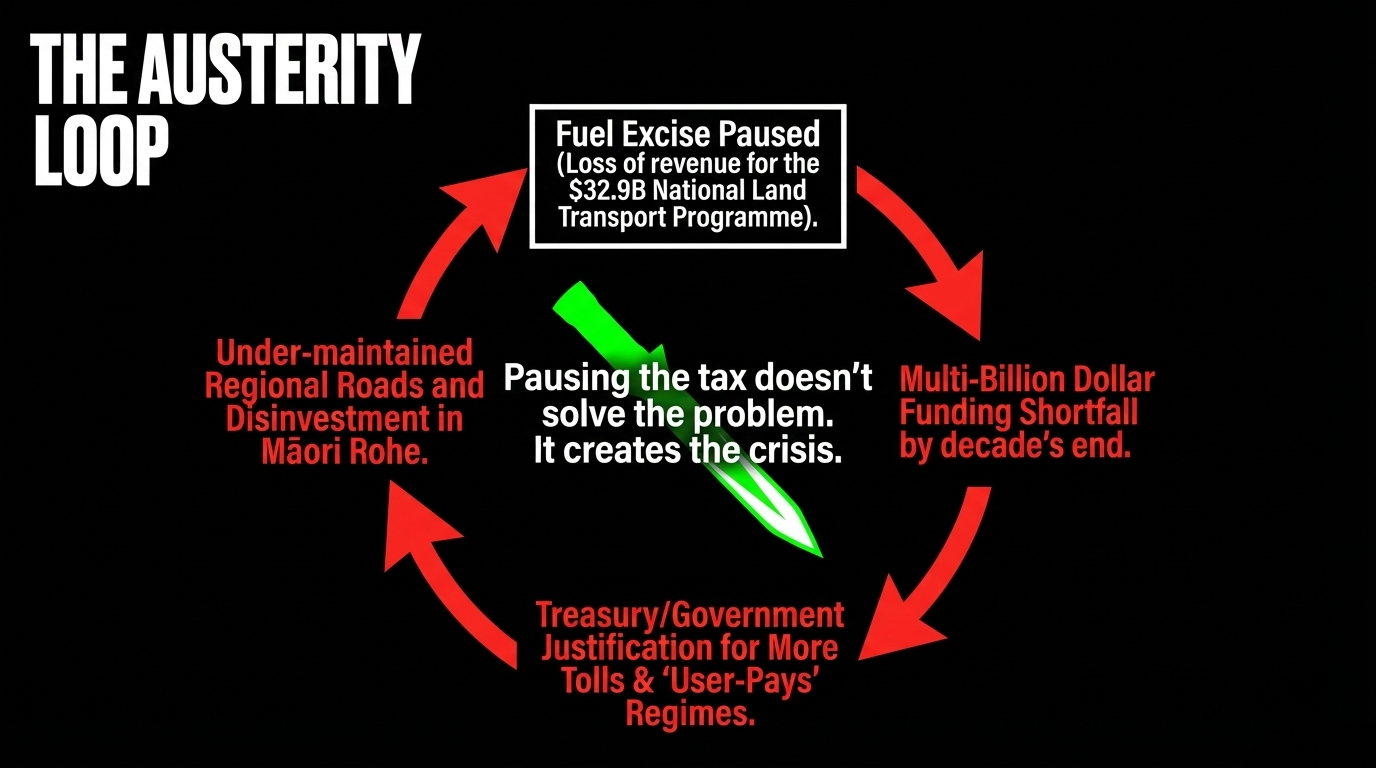
Fuel excise duty is not just a “tax”; it is the core revenue stream for the National Land Transport Fund. The Ministry of Transport sets this out clearly in its explanation of how transport is funded, where petrol excise and road user charges feed into Waka Kotahi’s investment programme, as explained by the Ministry at transport.govt.nz.
The 2024–27 National Land Transport Programme, worth about $32.9 billion, emphasises state highway improvements and maintenance, funded by this mix of excise, RUCs and Crown top‑ups. The NZ Herald’s coverage of Transport Minister Simeon Brown’s plan notes the scale of the programme and the reliance on these revenue sources, at NZ Herald.
At the same time, Waka Kotahi and the government have acknowledged looming funding gaps:
- The Herald has reported that the land transport system faces rising costs and a mismatch between revenue and required investment, with officials warning of a multi‑billion‑dollar shortfall by the end of the decade, as summarised at NZ Herald.
- The government is also preparing to phase out petrol excise entirely in favour of moving all vehicles onto road user charges, with analysis of this shift and its implications published at NZ Herald and a related piece on fuel taxes potentially being gone by 2027 at NZ Herald.
So when Luxon and Willis shelve the 12c increase, they are not solving anything. They are deepening a structural funding hole that will later be used to justify more tolls, more privatisation, and more “user pays” regimes — all of which fall hardest on rural and regional communities, including many Māori rohe that already suffer from under‑maintained roads.
The Austerity Backdrop: Cuts, “Efficiency” and Hardship
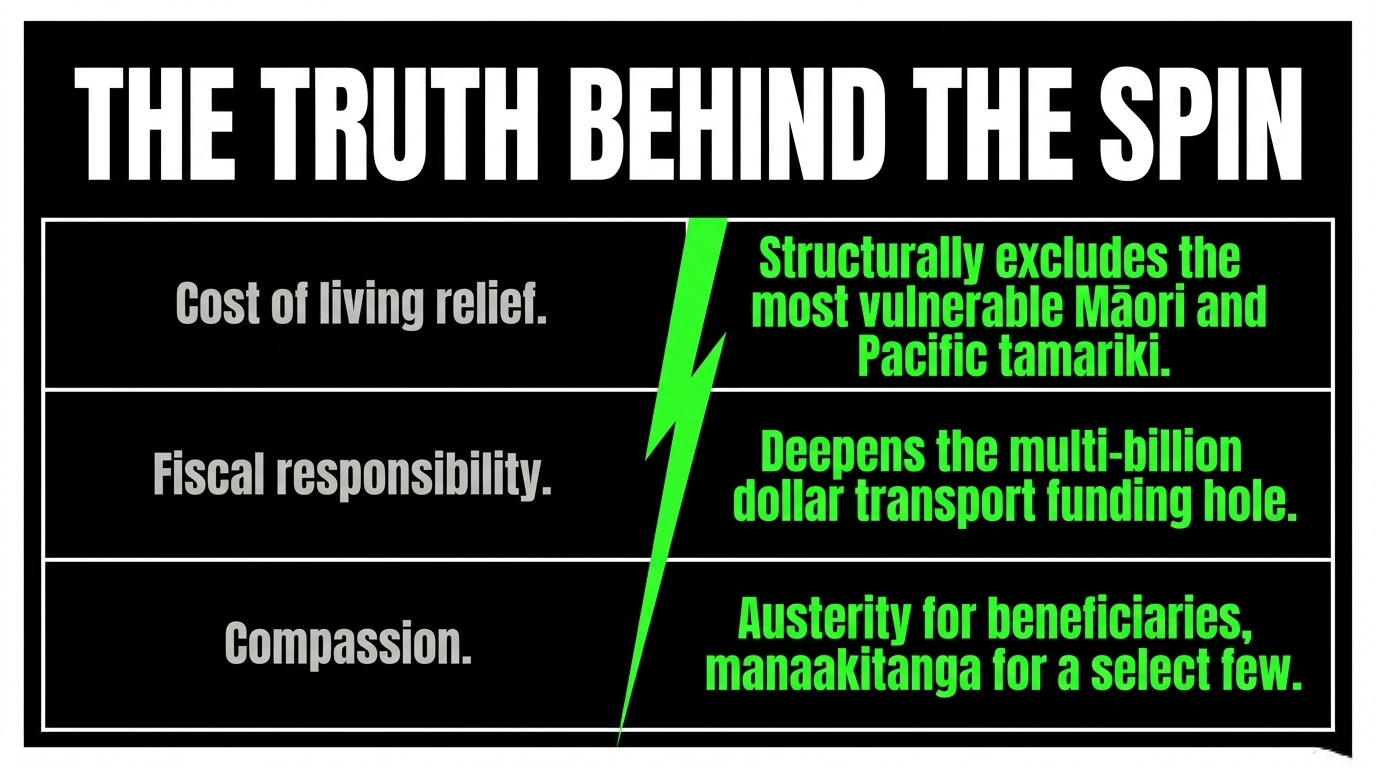
All of this unfolds against a backdrop of deliberate fiscal tightening.
Treasury analysis and political reporting have made it clear that the government’s spending cap strategy implies lower‑quality public services over time. The NZ Herald covered Treasury warnings that to hit the government’s spending targets, New Zealanders would likely have to accept cuts in service quality, as summarised at NZ Herald.
Finance Minister Nicola Willis has repeatedly demanded further savings from the public sector, with coverage at NZ Herald noting no surplus is in sight and that agencies should expect to do more with less. Budget‑framing speeches like “The Growth Budget” on Beehive.govt.nz lean heavily on growth and discipline, downplaying the lived reality of service cuts and wage restraint.
As material hardship figures worsen — one in seven children in hardship overall, and far higher rates for Māori and Pacific kids per NZ Herald and NZ Herald Kahu, and as Pacific unemployment rises despite national job growth per PMN, the state’s response is to narrowly target relief to “deserving” workers and keep beneficiaries under pressure.
By the time petrol blows past $3 a litre, whānau are already on the edge. The fuel crisis is the accelerant, not the spark.
What Real Rangatiratanga Responses Would Look Like
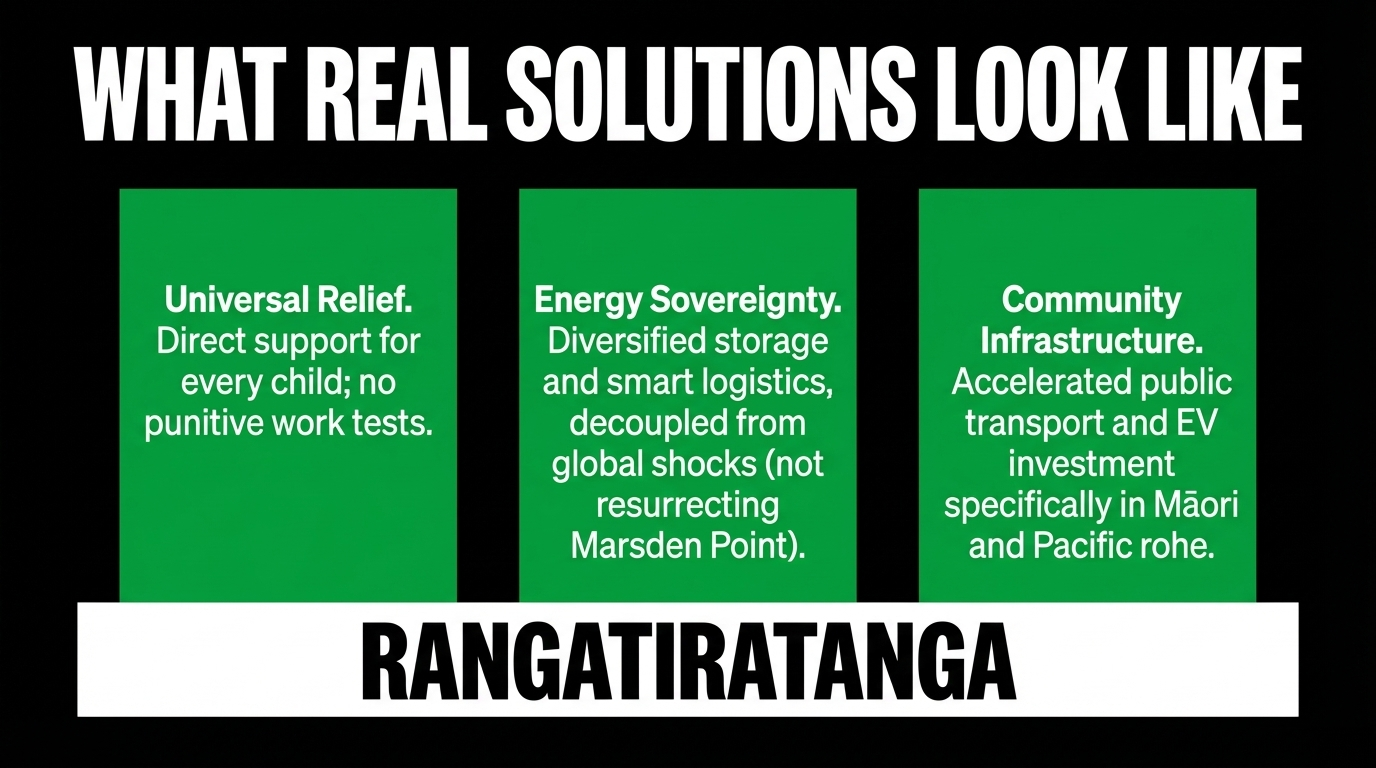
There were other options.
Analyses of New Zealand’s fuel security and resilience — including public discussion of studies commissioned by government and summarised by outlets like 1News — point towards diversified storage, smarter logistics and accelerated decarbonisation as more cost‑effective than trying to resurrect large‑scale refinery operations. The idea of reopening Marsden Point has been repeatedly critiqued as slow and extremely expensive in media analysis such as 1News.
On the social side, child‑centred advocates like Child Poverty Action Group have long argued for universal per‑child payments or at least support that reaches all low‑income families, not just those meeting work tests, as set out in CPAG’s summary of official statistics and recommendations at CPAG. They and others have also backed stronger Winter Energy Payments and targeted transport subsidies, ideas echoed in news analysis of possible responses at The Spinoff and in policy debates over fuel pricing at NZ Herald.
A rangatiratanga‑aligned response would have:
- Given universal or near‑universal relief at the pump in the peak of the crisis, even if temporary.
- Ensured every child, regardless of their parents’ employment status, received some form of direct support.
- Accelerated public transport and EV infrastructure especially in Māori and Pacific communities, instead of leaning harder into private‑car dependency.
- Used the crisis as a catalyst for genuine energy sovereignty discussion, rather than just electoral positioning.
Instead, we got a targeted work‑tested tax credit and a promise not to implement a tax rise they had already banked into their transport plans.
Koha Consideration

Every koha to this kaupapa is a message to Luxon, Willis and their white‑supremacist neoliberal project that our people will fund the accountability they are desperate to avoid. It says we will not let a government that lies about fuel taxes and abandons our tamariki decide what “deserving” looks like. It says rangatiratanga includes the power to bankroll our own truth‑tellers while they shovel millions into PR and spin.
If you are able, consider a koha to keep this work cutting through their bullshit:
Koha directly: Koha — Support
<https://app.koha.kiwi/events/the-maori-green-lantern-fighting-misinformation-and-disinformation-ivor-jones>
Receive essays direct and support through subscription:
Subscribe to the Māori Green Lantern
<https://www.themaorigreenlantern.maori.nz/#/portal/support>
Prefer direct bank transfer:
HTDM — 03-1546-0415173-000
If you can’t koha, kei te pai. Hit subscribe or follow at themaorigreenlantern.maori.nz, kōrero about this with your whānau, share the essay, call out the hypocrisy when you see it. That is koha too — and it’s one thing this government can’t cut in the Budget.
The Taiaha Cuts Through the Spin

Strip away the spin and the whakapapa looks like this:
- Labour proposed a 12c fuel excise increase to fund transport; National attacked it as a cost‑of‑living crime, as reported by the NZ Herald.
- In government, National effectively kept that 12c increase in the long‑term transport funding plan, as explained by 1News and unpacked by Interest.co.nz.
- When the Iran war forced fuel prices up, the government refused fuel tax cuts, chose a work‑tested tax credit that excludes beneficiary whānau, and now wants praise for “scrapping” or “delaying” the 12c hike, as seen across 1News and NZ Herald.
- Meanwhile, Māori and Pacific tamariki remain over‑represented in child poverty, as laid bare by NZ Herald Kahu and CPAG, and Pacific unemployment is rising per PMN.
This is not manaakitanga. It is austerity dressed as responsibility, electoral positioning dressed as compassion.
When the 2026 election rolls around, remember who actually got $50 a week, who got left out entirely, and who designed the policy that way.
Kia mau ki te riri tika.