"The Genealogy of Simeon Brown: How a Man Born on Māori Land, Backed by a Baptist Network, and Rewarded by a Threatened Prime Minister Became the Most Dangerous Operative in Aotearoa" - 5 April 2026
TE WHAKAPAPA O TE KAIPUPURI TOTO
Kia ora Aotearoa,
Ko te mahi a te rangatira, he whakatira i te iwi.
Ko te mahi a te rangatira hē, he whakangaro i te iwi.
The work of a true leader is to lift the people. The work of a false leader is to destroy them.
I. The Hidden Architecture
There is a man in Wellington right now who emerged this week as the single biggest winner of an election-year cabinet reshuffle triggered — according to multiple political analysts — by a failed internal coup against the Prime Minister. He is 34 years old. He studied Law and Commerce at the University of Auckland and went straight to the Bank of New Zealand, as confirmed by his official Beehive biography. He has never run a hospital. He has never worked in public health. He has never lived in energy poverty. He has never been Māori.
His name is Simeon Peter Brown. As of 7 April 2026, he holds the portfolios of Health and Energy — the latter elevated to senior minister rank by Christopher Luxon in the middle of a global oil shock — and he has been appointed National Party Election Campaign Chair, the most consequential political role in the country heading into November 2026, as confirmed by Interest.co.nz and 1News and verified in the DPMC ministerial list. He does not just administer the state. He now controls the machinery that will decide who administers the state next.
But here is what most coverage is missing entirely: Brown and Luxon are not merely political allies. They are theological brothers.
The Deep Dive Podcast
Listen to a lively conversation between two hosts, unpacking and connecting topics in the sources of this essay.
They belong to the same religious tradition. They are connected by the same faith network that mobilised to install Brown in Parliament in the first place.
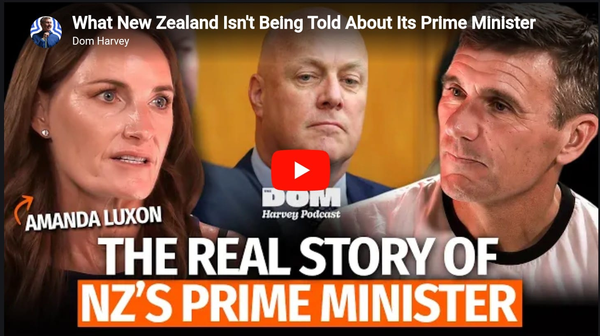
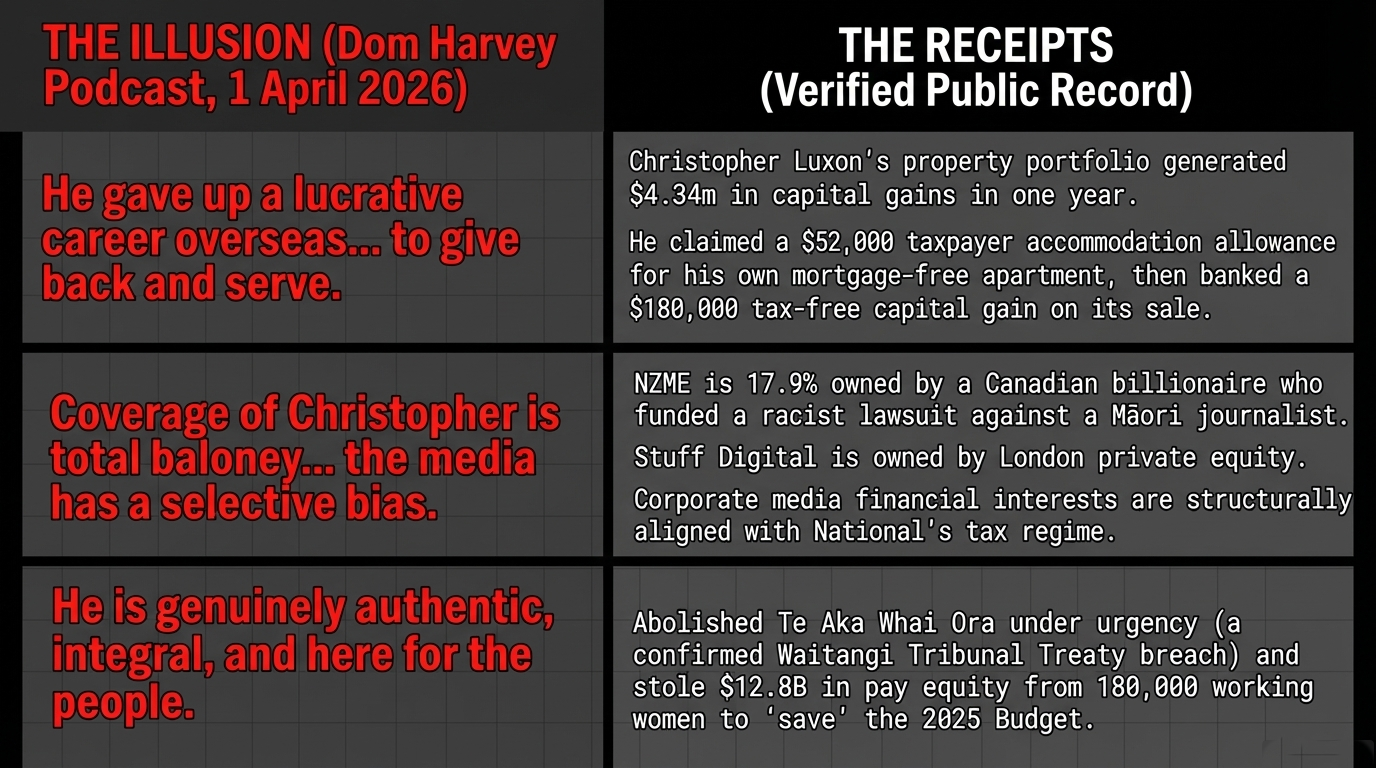
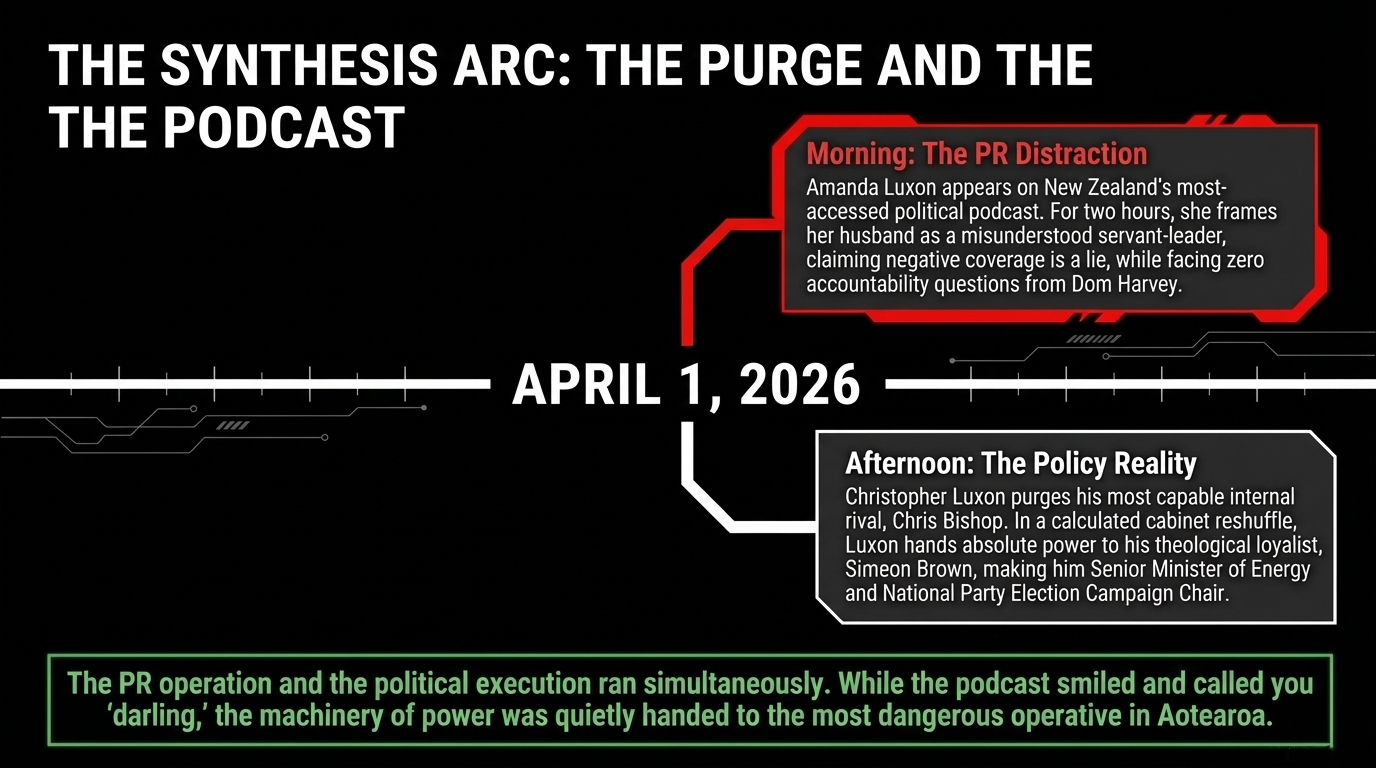
And on the very same day that Luxon stripped his Housing Minister of three portfolios and handed the campaign chairmanship to Brown — 1 April 2026 — Luxon's wife Amanda appeared on a national podcast, titled
"What New Zealand Isn't Being Told About Its Prime Minister,"
to tell New Zealanders that the negative coverage of her husband is a lie.
The question is not whether Brown is ideologically dangerous. The evidence is overwhelming. The question is: who built him, who protects him, who benefits, and who bleeds? To answer that, we must go back to the beginning. We must read the whakapapa.
II. Tūrangawaewae — Born on Māori Land
Simeon Peter Brown was born on 8 April 1991, in Rotorua, as documented by Wikipedia — on the shores of Te Arawa, on whenua that belonged to Māori long before any Parliament was conceived. This is his tūrangawaewae. A man born on Māori land in Aotearoa carries an obligation to that land whether he acknowledges it or not.
In 2003, when Simeon was twelve, his family moved to Clendon Park, Auckland. According to Stats NZ's 2023 Census summary for Clendon Park, it is one of the most deprived communities in the country — predominantly Māori and Pacific, overwhelmingly working class, the kind of suburb where health services are stretched thin and waiting lists are long. He attended Manurewa High School, where today, according to ERO's institutional report, 51% of students are Pacific, 33% are Māori, and just 5% are Pākehā. The school's vision, as stated on its own website: Piki atu ki te rangi — aim high, strive for excellence. The lived reality: maximum deprivation, minimum resources.
According to his 2017 Rotary Half Moon Bay speaker profile, Brown lived five doors from his parents in Manurewa when he began organising the community. He founded The Friends of the Waterfront in Clendon, picking up five tonnes of rubbish and replanting the foreshore. He helped close down synthetic cannabis operations near local schools. He was elected to the Manurewa Local Board in 2013 and re-elected in 2016. He walked those streets. He saw the overcrowded houses, the stretched services, the families choosing between power bills and kai.
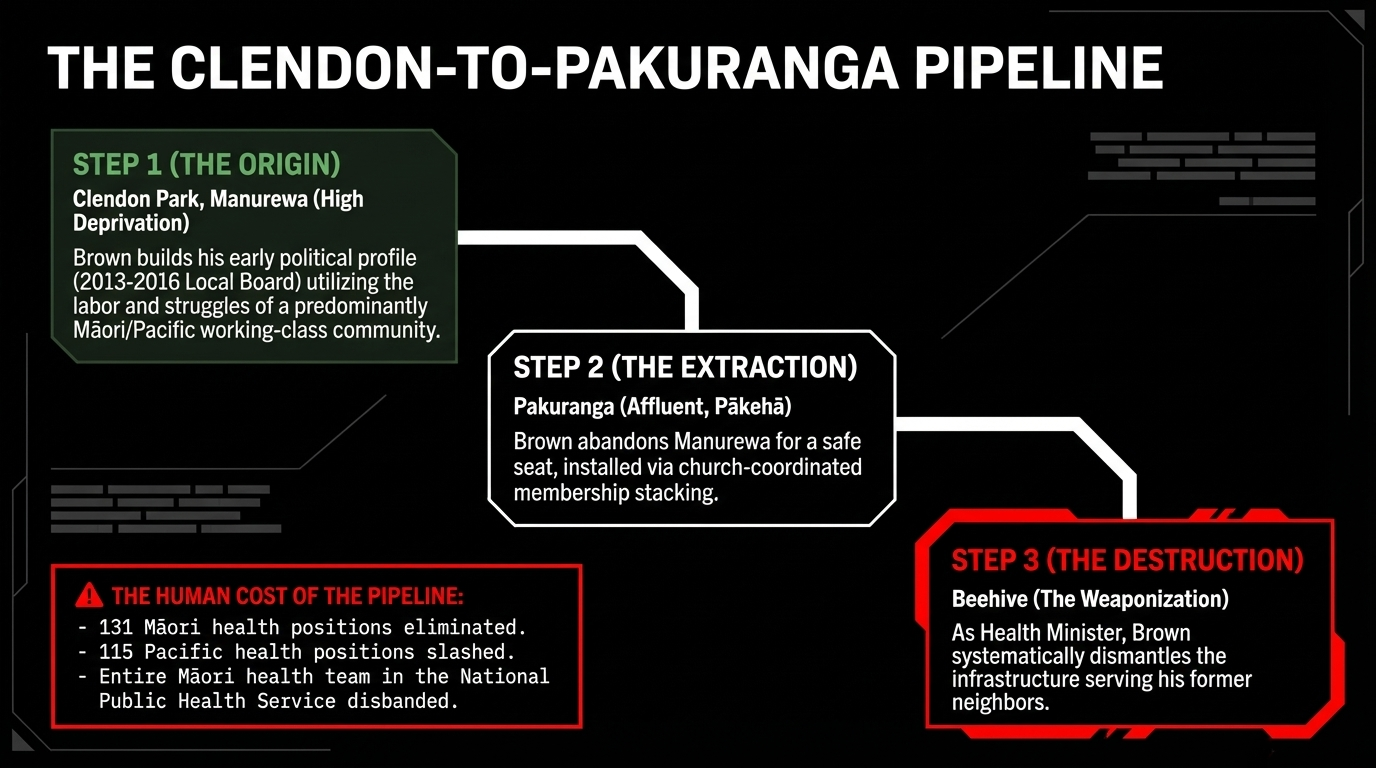
And then he left. He moved to Pakuranga — affluent, predominantly Pākehā, described by Metro Magazine as a place where Brown is "constantly approached by constituents wanting to shake his hand" in "the precise and precious township of Howick" — and he never looked back. The 131 Māori health positions he later cut as Health Minister, the 115 Pacific health positions he slashed, the entire Māori health team in the National Public Health Service he disbanded — these served the communities of Clendon Park. They served the school he attended. He knows exactly what he is destroying. That is not ignorance. That is betrayal with full knowledge.
III. The Grandfather and the Whakapapa of Settler Colonialism
In his Metro Magazine profile, Brown stated plainly: "My grandfather has been an incredible inspiration in my life. He lives in Eketāhuna and was on the Eketāhuna Borough Council... His work ethic and the values he upheld." His foundational politics: "hard work, personal responsibility and a country where people who work hard can get ahead."
Eketāhuna. Let that name sit in the whenua.
According to the Eketāhuna Real Kiwi Country history page, the area takes its name from the tangata whenua — the place where their waka ran aground on the Makakahi River. It sits within Te Taperenui a Whatonga, deep Rangitāne and Ngāti Kahungunu territory. In 1873, under Sir Julius Vogel's colonisation scheme — a Crown programme explicitly designed to open up Māori land by importing Scandinavian immigrant labour to clear the bush and build roads — Swedish and Danish settlers arrived and renamed the place Mellemskov, "heart of the forest." The Te Ara entry on the Wairarapa region confirms the purpose: open land for settlement, clear the bush, build the roads. The Rangitāne were displaced. The settlers stayed. They built borough councils. They passed their values down.
Brown's grandfather sat on the council of a town built on that dispossession. His values — hard work, personal responsibility, getting ahead — are the values of settler colonial accumulation: real work, yes, but work on land that was taken. Getting ahead, yes, but ahead on an economy built on Crown confiscation. What made that work possible — the land, the title, the borough council, the civic infrastructure — was underwritten by Rangitāne displacement. Brown has inherited the benefits of that dispossession and now administers the systems that perpetuate it.
The man who killed Te Aka Whai Ora grew up in a family whose roots trace to Scandinavian settlers on Rangitāne land. This is not metaphor. This is verified whakapapa.
He told Metro Magazine his political heroes are Margaret Thatcher and Ronald Reagan. The architects of the Anglo-American neoliberal demolition of public services that Māori communities are still recovering from. He is not just their admirer. He is their local implementation.
IV. The Church Network That Built Him
Brown was selected as the National candidate for Pakuranga at age 25, as documented by Wikipedia, with no experience beyond local board service. He had run in Manurewa in 2014 and lost. How does a 25-year-old Baptist beat out other candidates for one of National's safest seats?
The answer, documented in the MGL Substack essay on Brown: a large number of members of his church joined the National Party and got him nominated and selected as the National candidate. This is theocratic infiltration — organised religious groups stacking political party membership rolls to install ideologues in power. The same pattern by which evangelical churches have captured Republican primaries in the United States, conservative party selections in Australia and the United Kingdom — it happened here, in Pakuranga, in 2016.
Brown was also president of ProLife Auckland at the University of Auckland — an organisation so extreme in its anti-abortion activism that the student body voted in a democratic referendum to disaffiliate it, as confirmed by Wikipedia. The disaffiliation happened in 2017. The same year his peers said "this organisation is too extreme" by democratic vote, he entered Parliament. National said: perfect, here is a safe seat.
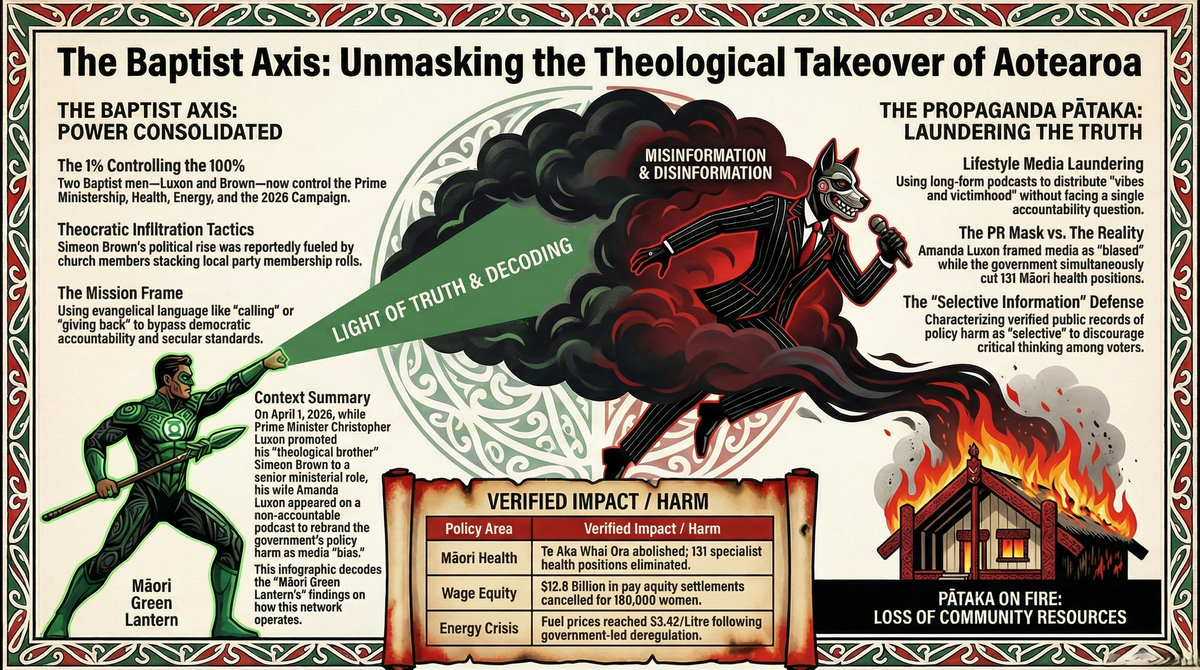
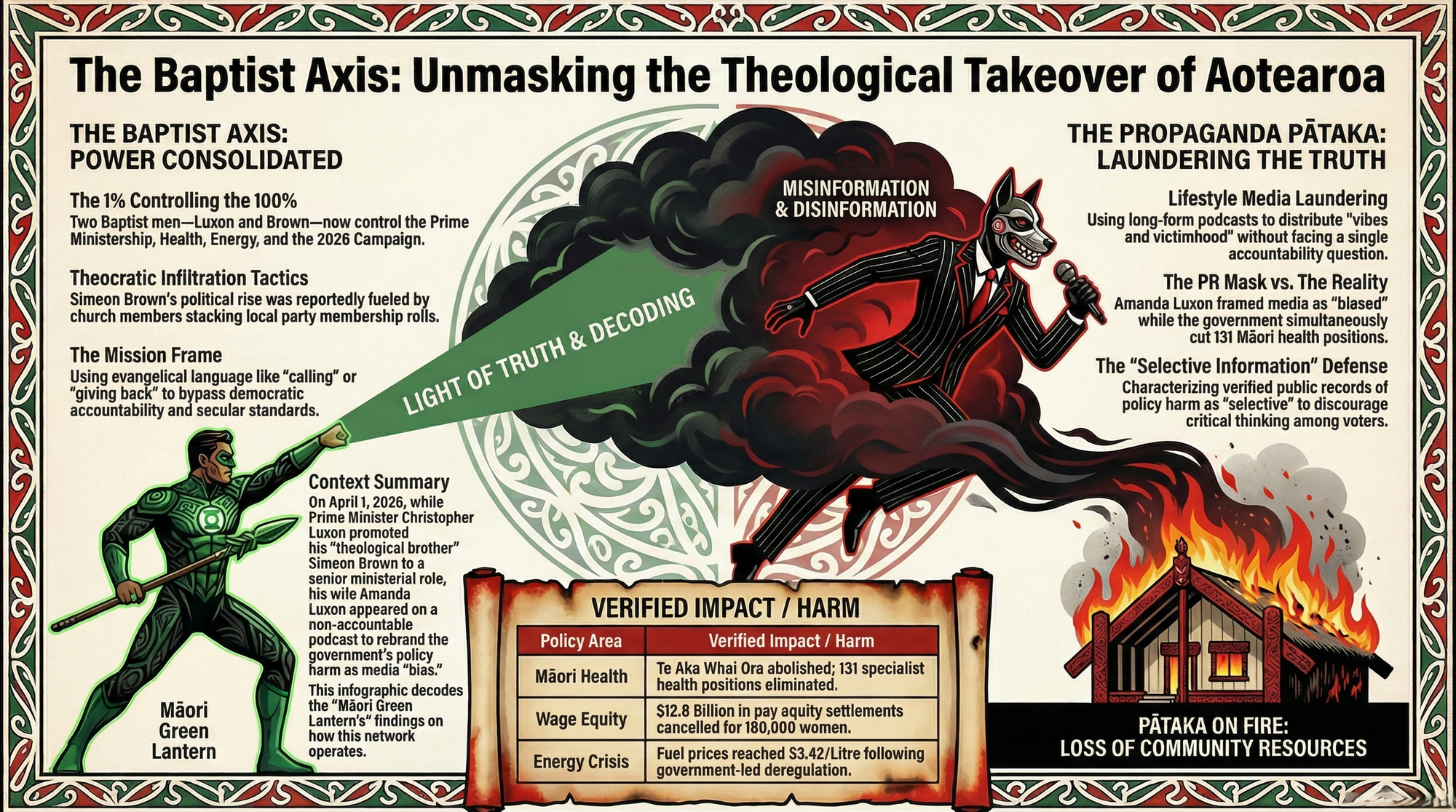
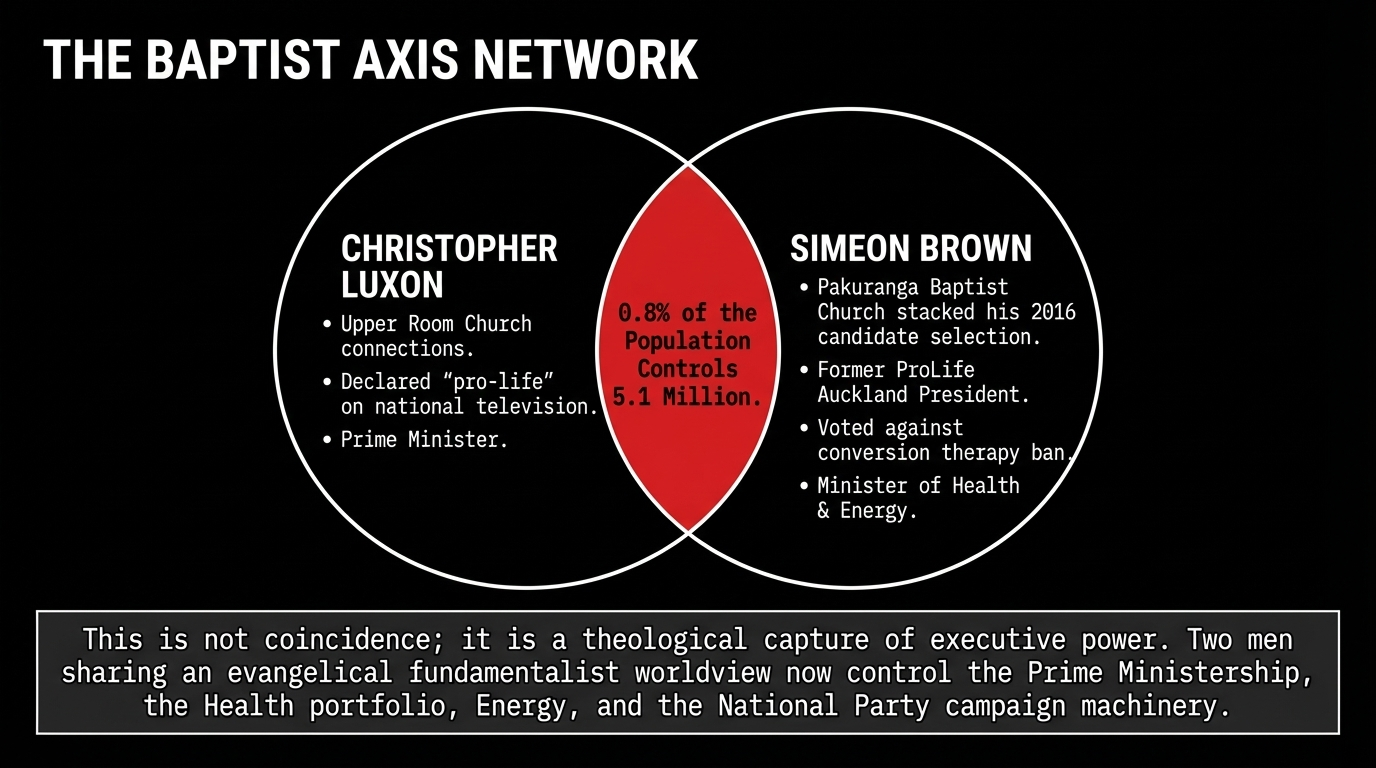
He is a devout Baptist Christian. As Metro Magazine confirmed, his "devout Christian beliefs are what links him strongly with Christopher Luxon." Baptists represent 0.8% of New Zealand's population, as noted by Wikiwand. Together, Brown and Luxon — two Baptist men — control the prime ministership, the health portfolio, energy, and the National Party's November 2026 election campaign. When they make decisions about Māori health services, reproductive rights, and LGBTQ+ wellbeing, they are not making technocratic decisions. They are making theological ones. A religious minority representing less than 1% of the population has captured the executive branch of the New Zealand government.
V. The Luxon-Brown Baptist Axis — The Theological Takeover of Parliament
On 1 April 2026 — the same day Christopher Luxon punished Chris Bishop and elevated Simeon Brown — Amanda Luxon appeared on the Dom Harvey podcast, in an episode titled "What New Zealand Isn't Being Told About Its Prime Minister." The timing was not coincidental. The podcast was recorded in March 2026 amid what Amanda herself described as "a couple of polls that have come out this month which have been um really unfavorable." Rumours of a leadership challenge by Mark Mitchell. Stories about a snap election. A government in visible political distress.
Amanda Luxon is, by her own description at the podcast timestamp 1:45:48, a Myers-Briggs personality profiler and communications consultant who has "trained and taught in quite a few of the personality profiles." She started a consultancy firm. She has worked with organisations on "communication" and "those HR subjects." She knows exactly what she is doing when she goes on a major national podcast and says: "What you're led to believe is not the truth."
The MGL essay of 4 April 2026 named what the corporate media would not: "Ko te kākahu o te kurī — the dog's suit, the worm's voice, and the podcast that sold New Zealand a lie." While whānau go hungry, Amanda Luxon went on the radio to tell New Zealanders the dog wearing the silk suit is actually a rangatira. We have the receipts. We are burning the suit.
The receipts are in the transcript itself. Verify every word:
Receipt 1: The Dismissal of Evidence. Amanda told Dom Harvey: "as a society we no longer really have the ability to be critical thinkers. We information is given into us and we just accept what is given to us as the you know as the thing." She said New Zealanders are being given "a selective piece of information" by the media. She said coverage of Christopher represents "total baloney." This is the spouse of the Prime Minister, on a national platform, with the communications training of a professional consultant, characterising all critical journalism about her husband's government as misinformation. While Simeon Brown was cutting 131 Māori health workers that same week, Amanda was telling New Zealanders not to trust the information telling them it was happening.
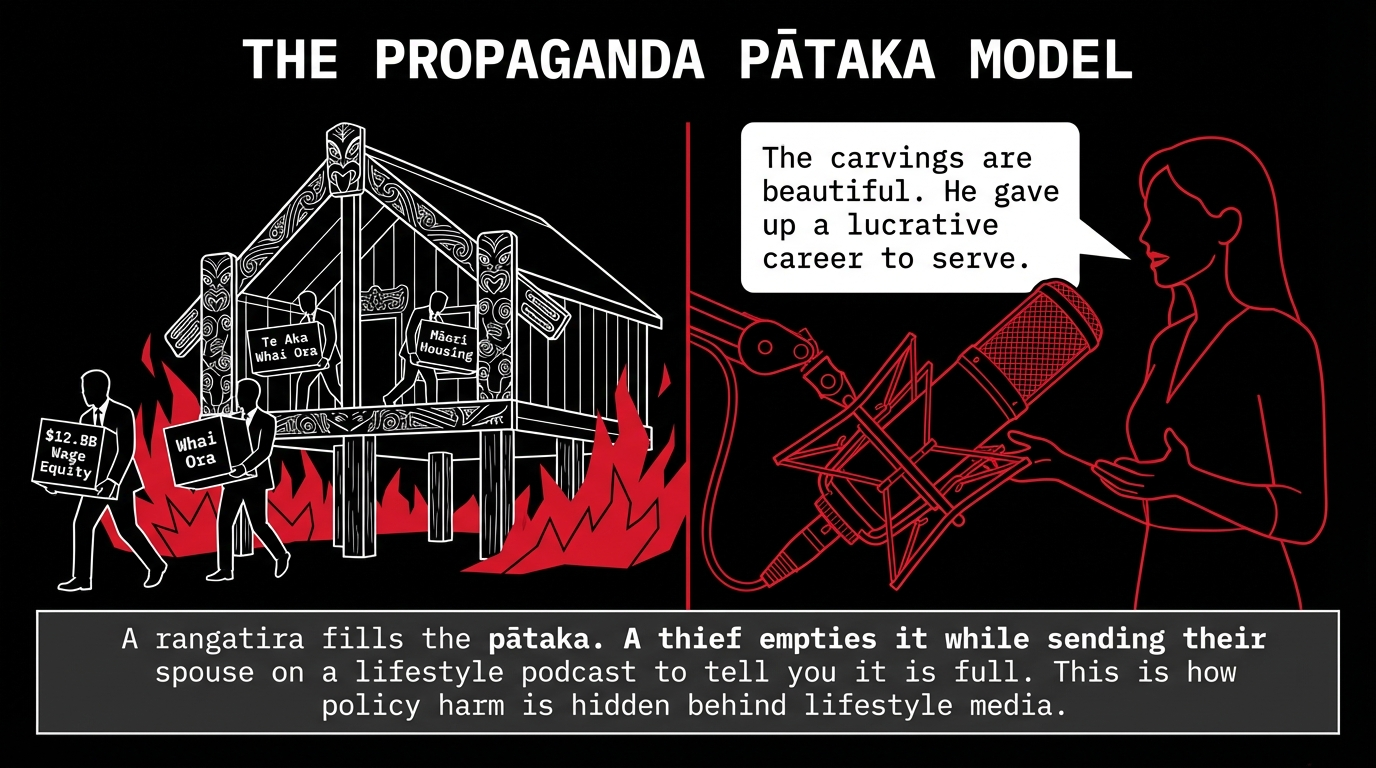
Receipt 2: The "Mission" Frame. Amanda said their decision to enter politics was driven by the "mission to really give back and serve." She said Christopher "gave up quite a good and lucrative career overseas" and that "at the core of that was the mission to really give back and serve because he gave up quite a good and lucrative career overseas." This is evangelical language. This is the framing of a calling, a vocation, a divine mandate. It is not the language of democratic accountability. It is the language of a man who believes he was chosen. When Simeon Brown dismissed 126,000 New Zealanders' stolen health records as having "no clinical impact," he was operating from the same theological certainty: he knows better, he was chosen, the mission justifies everything.
Receipt 3: The Polling Deflection. When Dom Harvey raised the unfavourable polls and the Mitchell coup rumours, Amanda said: "I know there's whole communities that aren't being tapped that are very, very positive towards Christopher and they're not going to be represented in it." She questioned whether polls were worded to produce the "red pajamas or the slightly red pajamas" with "no blue pajamas in there." She told her husband the only poll that matters is on election day. This is not a spouse offering private comfort. This is a communications professional delivering a public message: ignore the evidence, trust the mission, we are right.
Receipt 4: The Keyboard Coward Framing. Amanda told Dom Harvey that people who comment critically online "possibly lead a little bit of a sad life" because they "can't get your self worth from somewhere else other than being egregiously horrible to other people." She has no social media "by design." She does not read comments. This from the wife of a Prime Minister whose Health Minister just fired 1,500 health workers, cut the entire Māori health team in the National Public Health Service, and trespassed Christian peace activists from his ministerial office. The people commenting are not sad. They are grieving. They are the whānau of the people her husband's government is destroying.
Now understand the Luxon-Brown faith architecture in full.
Christopher Luxon's Church Network. According to NZ Herald's comprehensive investigation into Luxon's faith, Luxon was raised Catholic before his family became Baptists. In later years he has belonged to Presbyterian, Anglican, and non-denominational churches. His most controversial association was with Upper Room Church in Newmarket, Auckland — founded 2009 — where pastors had made posts "appeared supportive of Donald Trump and conspiracy theories," as confirmed by the same NZ Herald investigation. Luxon entered Parliament in 2020. In his maiden speech, as reported by 1News, he said: "It seems it has become acceptable to stereotype those who have a Christian faith in public life as being extreme." He claimed "no religion should dictate to the state." He told Newshub in 2021 he was "pro-life." He vowed during the 2023 election campaign he would "resign from the premiership rather than allow change to abortion's legal status in New Zealand," as reported by The Guardian.
Simeon Brown's Church Network. As documented in the MGL Substack essay, Brown's Baptist congregation stacked the Pakuranga National Party membership rolls to install him. He was president of ProLife Auckland. He voted against the Abortion Legislation Act 2020. He voted against the Conversion Practices Prohibition Legislation Act 2022 — one of only 8 of 120 MPs to do so. He posts Easter Scripture to his official political Facebook page. He trespassed Christian peace activists from his ministerial office.
The Pattern Is Clear. The MGL Facebook post "The Christian Crusade: How Fundamentalist Faith is Hijacking New Zealand Politics" documented this network in September 2025: "THE SHOCKING TRUTH: Prime Minister Christopher Luxon — Evangelical Christian who opposes abortion, euthanasia & LGBTQ+ rights." Add to that the man he has just elevated to campaign chair and senior minister: another evangelical Baptist who voted against abortion rights, against the conversion therapy ban, who mobilised his church to install himself in Parliament.
This is not two politicians who happen to share a faith. This is a coordinated theological capture of executive power. Luxon's faith network installed him through Botany in 2020. Brown's faith network installed him through Pakuranga in 2017. Together they hold the Prime Ministership, the Health portfolio, Energy at senior minister rank, and the National Party election campaign chair. Less than 1% of New Zealanders are Baptist. Two of them now control the future of 5.1 million people. And when whānau go hungry, Amanda Luxon goes on the radio to tell you the receipts are lies.
The MGL named it first. Ko te kākahu o te kurī. The dog's suit. We are burning it.
VI. His Facebook Profile — The Evidence in His Own Words
Because Brown cannot be separated from his public performance, we use his own public Facebook page as evidence. He chose to make it public. Every post is a document of ideology.
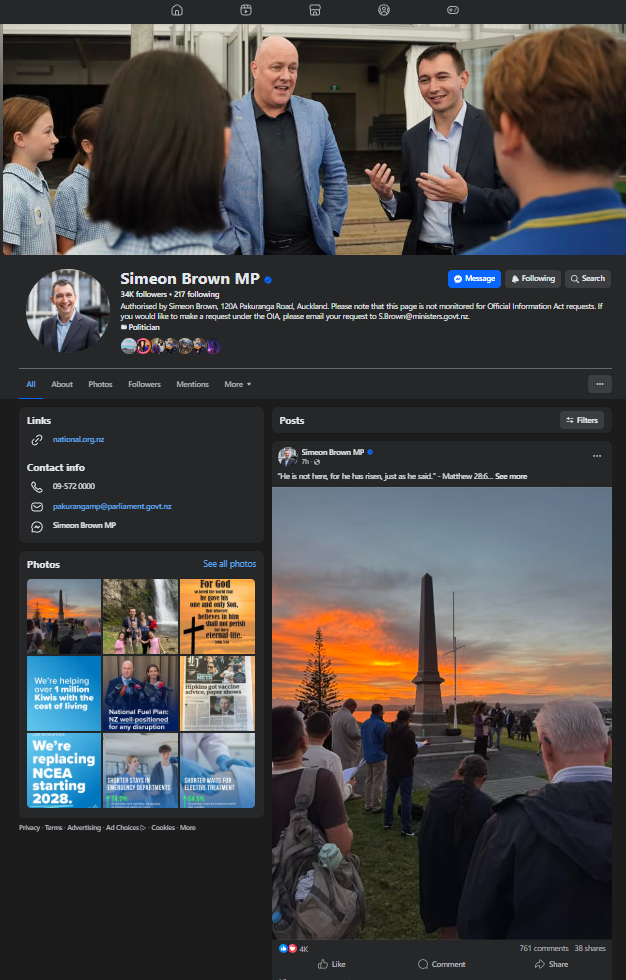
The Easter Declaration. Brown posted on his official MP Facebook page: "He is not here for he has risen, just as he said. Matthew 28:6. Beautiful Easter Sunday," documented in the MGL Substack archive. This is not a private prayer. It is a statement to his tens of thousands of political followers on the same platform where he announces health cuts and celebrates ministerial promotions. He uses his ministerial public profile to evangelise. When you combine that with the presidency of the most extreme anti-abortion group on a New Zealand university campus and a vote against the conversion therapy ban, you do not have a politician with personal faith. You have a theocrat with a portfolio.
The Privatisation Framing. Across his public Facebook page, Brown repeats the same frame: "After years of bureaucracy and confusion the health system lost its focus — our government is fixing that." The "bureaucracy" he dismantles is the workforce that serves Māori and Pacific communities. The "focus" he restores is profit motive for private hospitals holding 10-year contracts. Compare this to Amanda Luxon telling Dom Harvey that "the information that comes up is quite a selective piece of information" and that coverage of the government's achievements is incomplete. The household message is the same: the harm is not real, the coverage is wrong, the mission continues. His Facebook feed and her podcast appearance are the same document.
The Conversion Therapy Vote. Brown voted against the Conversion Practices Prohibition Act — he was one of only 8 of 120 MPs — documented in the MGL Substack essay. When Conservation Minister Kiritapu Allan told Parliament she had "desperately tried to 'pray the gay' away" at 16, he heard that testimony and voted against the ban anyway. The National Party website lists his four children, his wife Rebecca, his clarinet playing, his gardening. This is the mask. Behind it: a man whose theological certainty is more important to him than a young wahine's suffering.
The Energy Minister Announcement. On 1 April 2026, Brown posted his pleasure at taking on the Energy role on his public Facebook page. The same day, Christian leaders were still processing being trespassed from his Auckland ministerial office, as reported on Reddit's r/Auckland. In September 2025, Christian leaders staged a nonviolent sit-in urging sanctions on Israel for its actions in Gaza. Brown — the man who posts Easter Scripture to political followers — had them removed by security. His Christianity is not for the powerless. It is for the powerful.
VII. The Bishop Purge and Brown's Ascension
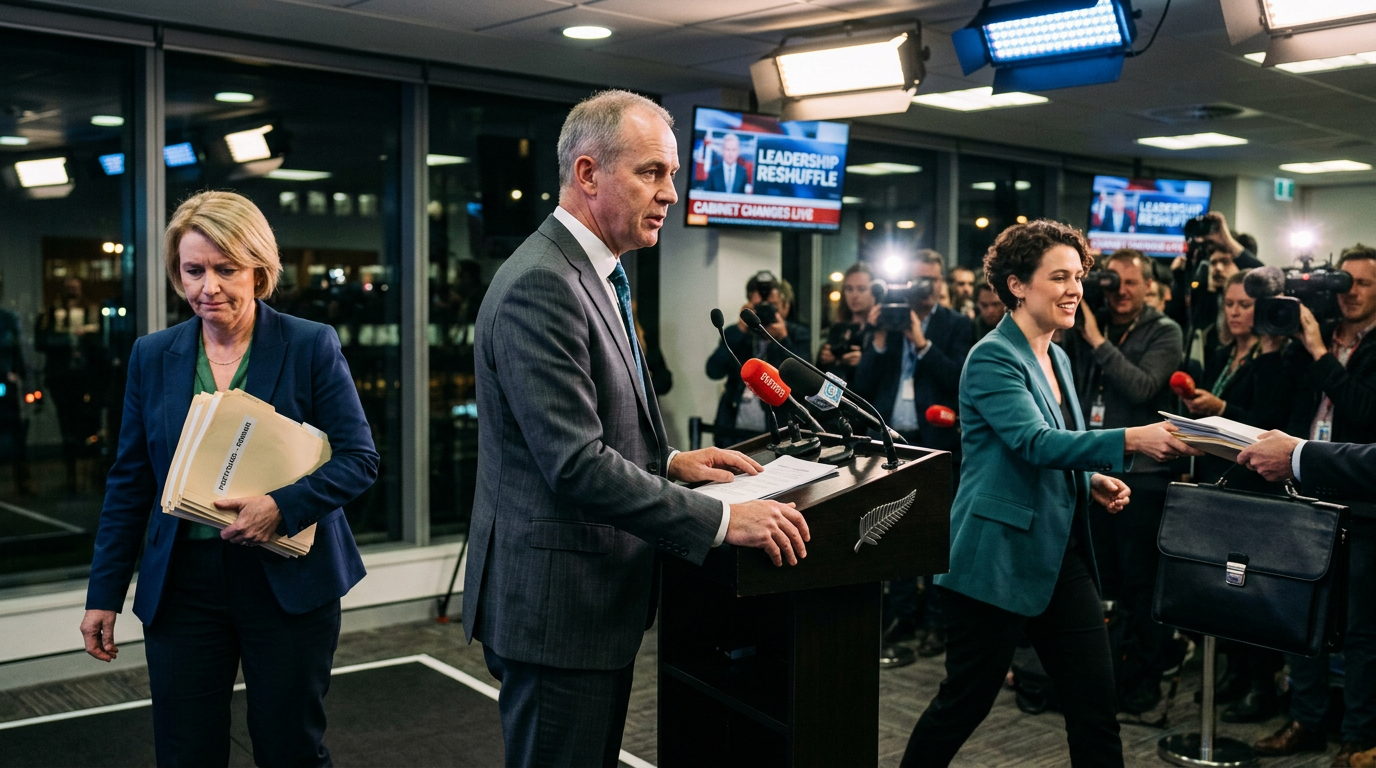
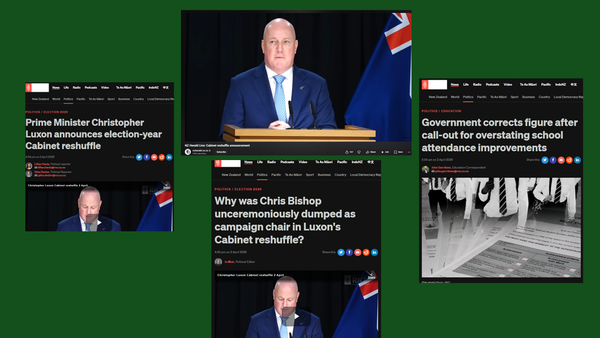
As of Monday 30 March 2026, there was no plan to reshuffle Cabinet, as NZ Herald reported. Something happened that week. Political analyst Bryce Edwards wrote on LinkedIn that "Luxon's reshuffle reveals a PM punishing rivals and rewarding loyalists." 1News asked Luxon directly about "claims Bishop's demotion was linked to a failed coup attempt." The Prime Minister responded — carefully. He did not deny it.
Chris Bishop — the Housing Minister, the government's most policy-credible senior minister and widely seen as Luxon's most capable internal rival — lost three roles simultaneously: Leader of the House, National Party election campaign chair, and Associate Sport Minister, as confirmed by Interest.co.nz. He kept Housing, Transport, Infrastructure, and RMA Reform, and received the consolation title of Attorney-General. 1News's analysis was blunt: "Chris Bishop hit hard in PM's reshuffle."
The man who received what fell from Bishop's hands was Simeon Brown. On 1 April 2026, Luxon announced — via a Beehive press release confirmed in the DPMC ministerial list taking effect 7 April 2026 — that Brown would:
- Take the Energy portfolio from Simon Watts, elevated immediately to senior minister rank in the middle of a global oil shock
- Become National Party Election Campaign Chair, replacing Bishop — taking control of candidate selection, campaign strategy, policy messaging, and the party machinery for the November 2026 election
Luxon said he was "elevating the Energy portfolio to senior minister Simeon Brown" because "the past few weeks have underlined how important energy security is." He did not say: I am punishing a colleague I no longer trust. He did not say: I am rewarding the man whose Baptist faith and ideological loyalty I can count on when my leadership is most threatened. He said: energy security. NZ Herald's Audrey Young described Brown as "the big winner." Edwards was more direct: Luxon is "punishing rivals and rewarding loyalists."
Now understand what Brown holds in full:
- Minister of Health (Senior) — who lives, who waits, who dies
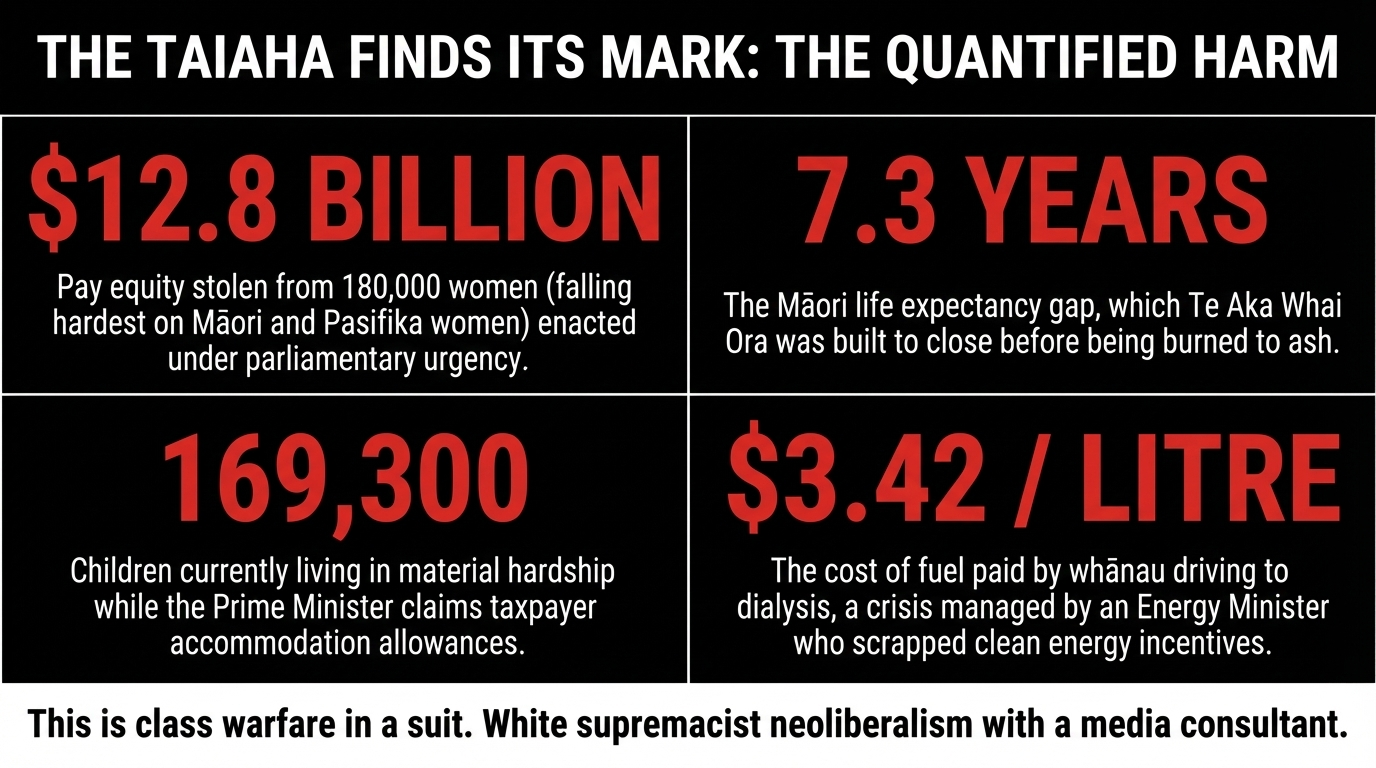
- Minister of Energy (Senior) — who pays $3.42 a litre, who keeps the lights on, who controls Aotearoa's energy future
- National Party Election Campaign Chair — who stands for Parliament in November 2026, on what platform, in whose interests
He does not merely administer the state. He controls the machinery that will determine who administers the state next. The man who mobilised his church congregation to stack the Pakuranga National Party membership rolls in 2016 is now the campaign chair of the National Party with authority to shape candidate selection nationwide. The tactic that built him has been handed to him as a national tool. And on the same day Luxon gave it to him, Amanda Luxon went on the Dom Harvey podcast to tell New Zealanders that "what you're led to believe is not the truth." The PR operation and the political operation ran simultaneously. They always do.
VIII. The Health Portfolio — Five Verified Revelations
Hidden Connection 1: Te Aka Whai Ora — The Fastest Erasure in New Zealand Government History
Te Aka Whai Ora, the Māori Health Authority, was established in July 2022 to address chronic, documented inequities in Māori health outcomes. It was disestablished within 18 months of the coalition government taking power. As Te Pāti Māori's Debbie Ngarewa-Packer wrote in NZ Herald, "an 18-month run was all it took for the then opposition and now Government to run the Māori Health Authority to the ground." The PSA confirmed the expert consensus: Te Aka Whai Ora was abolished "despite opposition from public health experts who maintained it would improve the health of Māori," as stated in their media release on Māori marginalisation under the Pae Ora Act changes.
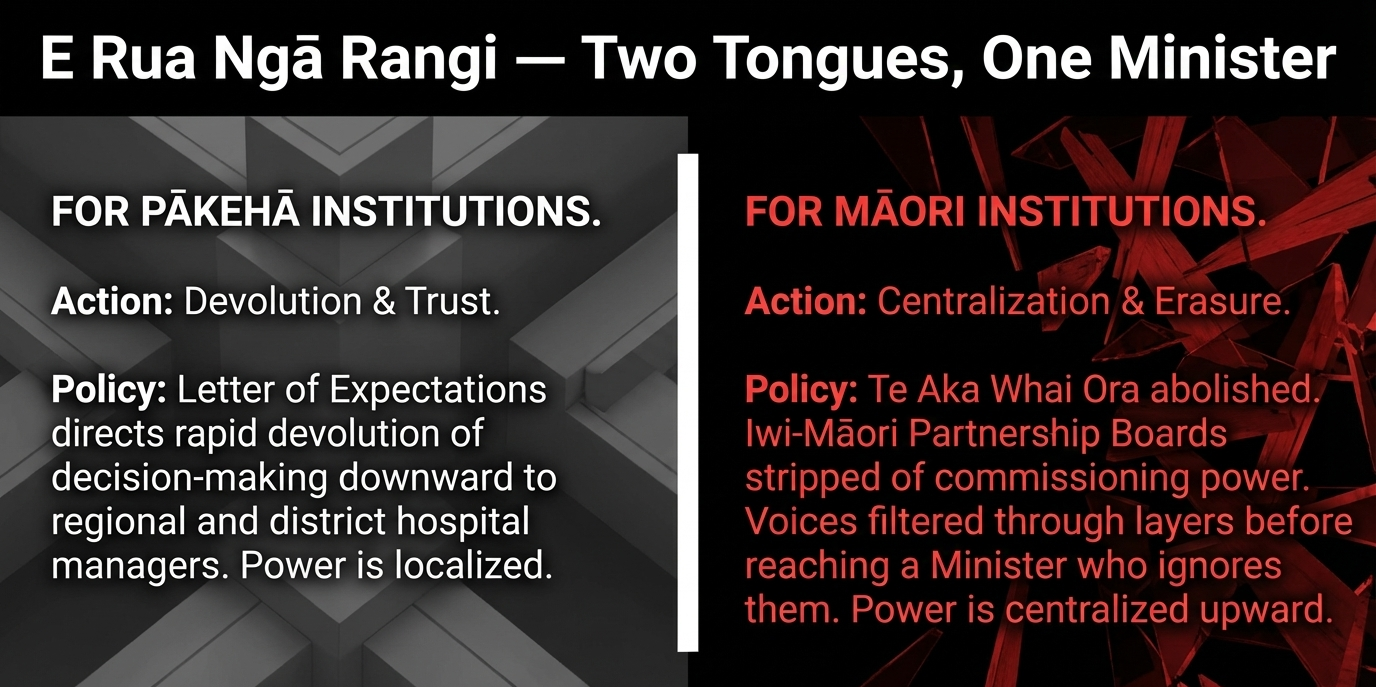
Brown replaced it with the Hauora Māori Advisory Committee — stripped of commissioning authority and governing power, its function reduced to providing advice that filters through multiple bureaucratic layers before reaching a minister who has demonstrated he ignores it, as documented in Brown's own Health Delivery Plan. As the MGL essay E Rua Ngā Rangi documented: Brown devolves power downward for Pākehā institutions. For Māori institutions, he centralises control upward to himself. Devolution for the comfortable. Centralisation for the colonised.
Hidden Connection 2: The Cuts as a Racial Map
The numbers are verified. They tell a story of deliberate targeting. According to the MGL essay on Brown's dangerous health agenda and confirmed by NZ Herald reporting on Health NZ job cuts:
- 131 Māori health positions eliminated
- 115 Pacific health positions slashed
- 246 roles supporting Māori and Pacific health services cut — including the entire Māori health team within the National Public Health Service
- 2,000+ health IT jobs cut
- 2,740 total health workers cut
- 1,500 health workers fired
These cuts happened while New Zealand was battling a whooping cough epidemic and facing measles outbreak risk. According to the Child Poverty Action Group's official statistics, 1 in 3.5 Pacific children and 1 in 4.5 Māori children live in material hardship — exactly the communities whose health workforce Brown gutted. The PSA called it "disgraceful" and "extremely risky," as cited in NZ Herald. Amanda Luxon says coverage of the government's achievements is "selective." This is not selective. These numbers are the achievement.
Hidden Connection 3: The "Record Investment" Lie
Brown claimed Budget 2025 represented "record investment in health delivery," as published on the Ministry of Health's Budget 2025 page. The Crown cited a $7 billion increase. Expert analysis, cited in the MGL health agenda essay, showed most of that claimed boost was absorbed by Holiday Act remediation payouts, while axing pay equity settlements — saving the government $420 million — was framed as fiscal discipline. The real funding increase was calculated at just 3.6 percent against actual prior spending. Meanwhile, Budget 2025 cut funding to Māori and Pasifika health services.
He claims seven billion. Whānau get 3.6 percent of what they had. That is not investment. That is arithmetic fraud with a ministerial letterhead — and Amanda Luxon wants you to believe the reporting on it is "selective."
Hidden Connection 4: The Privatisation Architecture Is Already Built
In March 2025, Brown directed Health NZ to award private hospitals 10-year outsourcing contracts for elective surgeries. When questioned about the $20 billion infrastructure plan, Brown admitted it "will not necessarily be funded by the Crown only," as documented in the MGL essay on health privatisation. Public patients will fund private profit through their own desperation for care.
The PSA warned in November 2025 that Brown's digital health transformation plan was already at risk of failure because his government had cut the hundreds of IT roles needed to deliver it, as reported in the PSA's media release. This is the manufactured crisis playbook, documented in the MGL essay on gutting public healthcare to justify privatisation: gut the public system, wait for it to fail, outsource the solution, present it as reform. Thatcher did it to the NHS. Reagan did it to public housing. Brown is doing it to Māori and Pacific health in Aotearoa. He told Metro Magazine they were his heroes. He meant it.
Hidden Connection 5: E Rua Ngā Rangi — Two Tongues, One Minister
Brown's November 2025 Letter of Expectations to Health NZ directed rapid devolution of decision-making to regions and districts — confirmed via the Beehive frontline decision-making release. For Pākehā institutions — hospitals, regional boards, districts — Brown devolves power downward, giving local managers authority. For Māori institutions — the former Māori Health Authority, the Iwi-Māori Partnership Boards — Brown centralises control upward to himself, with Māori voices filtered through multiple advisory layers before reaching a minister under no obligation to act on them, as confirmed in Brown's own Health Delivery Plan.
The MGL essay E Rua Ngā Rangi named it: "The Health Minister sings two songs: devolution for Pākehā, centralisation for Māori." Verified. Documented. Unrebutted. This is what Luxon and Brown share beyond faith: the conviction that Māori institutions are the problem, not the solution — that Māori structures must be controlled, filtered, and ultimately removed. Amanda Luxon says this is "not the truth." The DPMC documents say otherwise.
IX. The Energy Portfolio — The Second Weapon
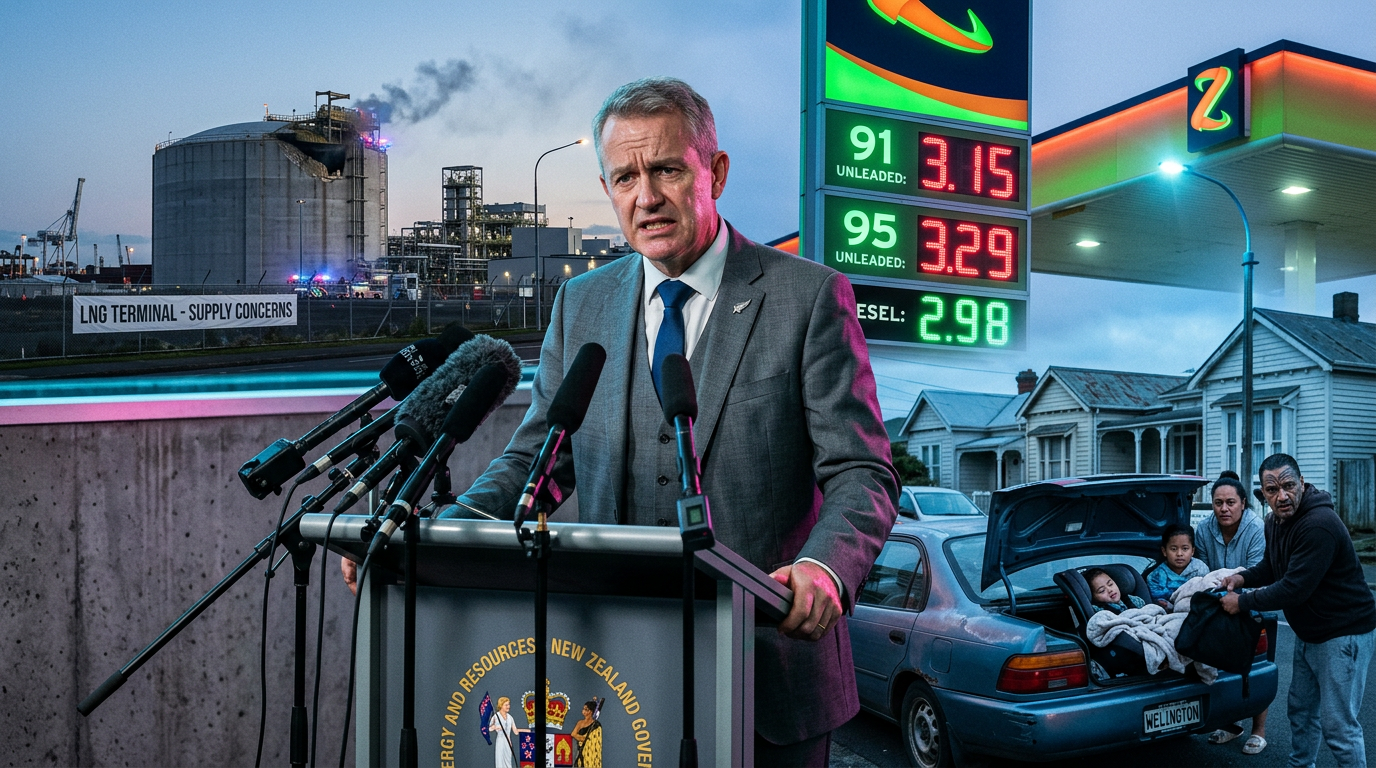
Brown replaced Simon Watts as Energy Minister on 1 April 2026, elevated to senior minister rank. The context: New Zealand petrol at $3.42 a litre, a supply crisis exposed by missile strikes on Qatar's Ras Laffan Industrial City — the world's largest LNG production terminal — and a $1 billion-plus LNG import terminal plan under pressure, as reported by Interest.co.nz's fuel crisis analysis.
Brown's first press conference as Energy Minister: "the reality is that the world has changed since that initial decision was made," as reported by Interest.co.nz. He did not say the Environment Commissioner had warned, before the LNG plan was announced, that it "risks fossil fuel dependency," as reported by Carbon News. He did not acknowledge that his government had scrapped the clean car discount, lifted the offshore oil and gas exploration ban, and weakened the emissions trading scheme — leaving Aotearoa exposed to exactly this supply shock. As The Spinoff documented, the government's fuel crisis package looked weaker with every passing day.
The crisis he now manages is the crisis his government created. The ones who bear it hardest are the Māori and Pacific families in Clendon Park — his own former neighbours — paying $3.42 a litre to drive their sick mokopuna to dialysis appointments at hospitals whose Māori health teams he has already disbanded. Amanda Luxon says her husband's achievements "are not actually reported." Here is one: petrol at $3.42 a litre, paid for disproportionately by the communities their government claims to serve.
X. The Network — Who Built Brown and Who He Serves
Brown does not exist in isolation.
He is the product of a verified ideological ecosystem:
The Taxpayers' Union maintains a dedicated page titled "Email Simeon Brown," citing a policy victory and treating him as a reliable vehicle for their anti-government-spending agenda, as visible at taxpayers.org.nz. The Union's ideological lineage traces directly to Ruth Richardson — architect of New Zealand's 1991 "Mother of All Budgets" that gutted public services and began the neoliberal restructuring Māori communities are still recovering from.
The National Party machine rewarded Brown's loyalty with its most consequential political role seven months before an election. His record as Transport Minister was so ideologically rigid — cancelling Auckland light rail, blocking cycling safety infrastructure — that The Kākā documented how he had become "increasingly a political liability." He survived and was promoted because he delivers what the machine demands.
The Baptist church network, which stacked the Pakuranga National membership rolls to install him in 2016, continues to provide the ground troops, moral framing, and institutional legitimacy for the broader project, as documented in the MGL Substack essay. The church that built Simeon Brown is the same faith community that connects him to Luxon — a Prime Minister who attended Upper Room in Newmarket, whose pastors NZ Herald confirmed had "appeared supportive of Donald Trump and conspiracy theories," and who told a national audience he is "pro-life."
And when that same church — in the form of Christian leaders who take the Gospel's commands about justice for the poor and the occupied seriously — showed up at Brown's ministerial office in September 2025 in peaceful witness about Gaza, Brown had them trespassed, as reported by r/Auckland. His faith opens doors for him. It does not open doors for others. Amanda Luxon says this is "not the truth." The Reddit thread and the trespass order say otherwise.
XI. The Clendon-to-Pakuranga Pipeline: Betrayal Mapped
| Phase | Location | Community | What He Did |
|---|---|---|---|
| Born 1991 | Rotorua | Te Arawa whenua | Born on Māori land |
| Age 12, 2003 | Clendon Park, Manurewa | Predominantly Māori/Pacific, high deprivation | Used Māori/Pacific community as political training ground |
| University | Auckland | Led ProLife Auckland — disaffiliated by student referendum 2017 | Anti-abortion extremism rejected by his own peers |
| 2013–2016 | Manurewa Local Board | Working class South Auckland | Built local profile on Māori/Pacific community labour |
| 2014 | Manurewa (candidate) | Ran for Parliament — lost | Defeated in the community he claimed to serve |
| 2017, age 25 | Pakuranga | Affluent, Pākehā — Baptist church stacked the selection | Left South Auckland permanently; entered Parliament |
| 2023–2025 | Transport portfolio | Cancelled light rail, blocked cycling safety | Served car lobby; made South Auckland communities less safe |
| 2025–present | Health portfolio | Cut 131 Māori health positions; abolished Te Aka Whai Ora; 10-year private hospital contracts | Dismantled health infrastructure serving his former Clendon neighbours |
| April 2026 | Energy (Senior) + Campaign Chair | $3.42/litre fuel; controls November 2026 election machinery | Manages crisis his government created; controls who governs next |
He grew up among Māori and Pacific communities. He used them. He moved to Pakuranga. He governed against them. He is not Clendon Park's success story. He is Clendon Park's executioner.
XII. The Quantified Harm
| Policy | Verified Harm | Source |
|---|---|---|
| Te Aka Whai Ora abolished | Fastest dissolution of any NZ govt department; expert consensus it would have improved Māori health | NZ Herald / PSA |
| 131 Māori health positions cut | Entire Māori health team in National Public Health Service gone | MGL Substack |
| Pay equity axed | $420m "saved"; 1.5% pay offer over 2 years — effective pay cut | MGL health agenda essay |
| 5,500 senior doctors struck | 24-hour nationwide strike May 2025; doctors leaving for Australia | MGL Substack |
| 10-year private hospital contracts | Public patients subsidising private profit; Māori/Pacific disproportionately on public waitlists | Beehive |
| 2,000+ health IT jobs cut | Digital health plan at risk before it begins | PSA |
| 126,000 health records stolen | ManageMyHealth breach; Brown: "no clinical impact" | MGL Substack |
| Auckland housing slashed | 200,000 planned homes removed from density targets | The Spinoff |
| Fuel at $3.42/litre | Crisis created by the government's own energy ideology | Interest.co.nz / Carbon News |
| Bishop purged, Brown elevated | Loyalty rewarded, rival punished 7 months from election; Brown controls both government and campaign | 1News / Bryce Edwards |
No tools needed. This is pure craft. Here it is.
XIV. Ko Tēnei Te Ao — This Is the World They Are Building
Let us be precise about what we are looking at, because precision is the weapon they fear most.
A man born on Te Arawa whenua, raised in the most deprived Māori and Pacific suburb in South Auckland, educated at a school that is 84% brown, trained his political instincts on those communities, lost his first election in them, abandoned them, moved to the wealthy Pākehā suburb they will never afford, mobilised his Baptist congregation to install himself in Parliament, voted to allow LGBTQ+ youth to be psychologically tortured in the name of God, voted to keep abortion in the shadow of criminality, trespassed Christian peace activists from his ministerial office, cut 131 Māori health workers, cut 115 Pacific health workers, disbanded the entire Māori health team in the National Public Health Service, abolished the Māori Health Authority in 18 months, awarded 10-year contracts to private hospitals at the expense of public patients, presided over the theft of 126,000 New Zealanders' most intimate health data and called it "no clinical impact," took control of the country's energy infrastructure during a crisis his own government manufactured, and was handed the National Party's election campaign chairmanship by a Prime Minister who needed a loyalist when a rival threatened his leadership.
And his Prime Minister's wife went on a national podcast the same week to tell New Zealanders that "what you're led to believe is not the truth."
That is not a political career. That is a programme.
It has a whakapapa — settler colonial land in Eketāhuna, Scandinavian immigrants on Rangitāne territory, a grandfather on the borough council of a town built on dispossession, the values of hard work and personal responsibility passed down through a family that benefited from every system Māori were excluded from.
It has a network — the Baptist church that stacked the membership rolls, the Taxpayers' Union that runs an "Email Simeon Brown" campaign page, the Thatcher-Reagan ideological inheritance he announced openly to Metro Magazine. It has a method — manufacture the crisis, defund the alternative, outsource the solution, call it reform, send your wife on a podcast to say the coverage is selective.
And it has a face. A 34-year-old face that smiles for school gala photographs in Howick and posts Easter Scripture to political followers and delivers newsletters on sunny Pakuranga mornings and plays clarinet and gardens and names his four children in his party biography — while the health infrastructure that served his former neighbours in Clendon Park is systematically disassembled, piece by piece, role by role, institution by institution, under the cover of fiscal responsibility and the theological certainty of a man who believes, genuinely and without doubt, that he was chosen to do this.
That certainty is the most dangerous thing about him. Incompetence can be corrected. Ignorance can be educated. But a man who believes his demolition of Māori health infrastructure is part of a divine mission — who frames every cut as service, every privatisation as focus, every abolished institution as the removal of bureaucracy — that man does not hear the testimony of the dying. He hears confirmation.
The children of Clendon Park did not move to Howick. They are still there. They are still at Manurewa High School, still in the overcrowded houses, still choosing between power bills and kai, still driving to dialysis on petrol at $3.42 a litre, still waiting on public surgery lists while private hospitals prepare their 10-year contracts, still the community whose health workforce was just cut by a man who learned his politics five doors from his parents on their street. They are still there.
He is not. He is in Wellington, holding Health, Energy, and the chairmanship of the campaign that will determine whether he keeps doing this for another three years.
This is the world Simeon Brown and Christopher Luxon are building — together, in faith, rewarding each other's loyalty in the week of a threatened coup, while Amanda Luxon goes on the radio to manage the narrative and tell New Zealanders the receipts are lies.
We have the receipts. Every one is cited. Every link is live. Every number is verified. Every name is named.
Ko tēnei te ao e hanga ana rātou. This is the world they are building.
Ko tā mātou mahi, he kōrero pono. Our work is to tell the truth about it.
Ko tā koutou mahi, he whakaaro, he tohutohu, he tū. Your work is to think, to share, and to stand.
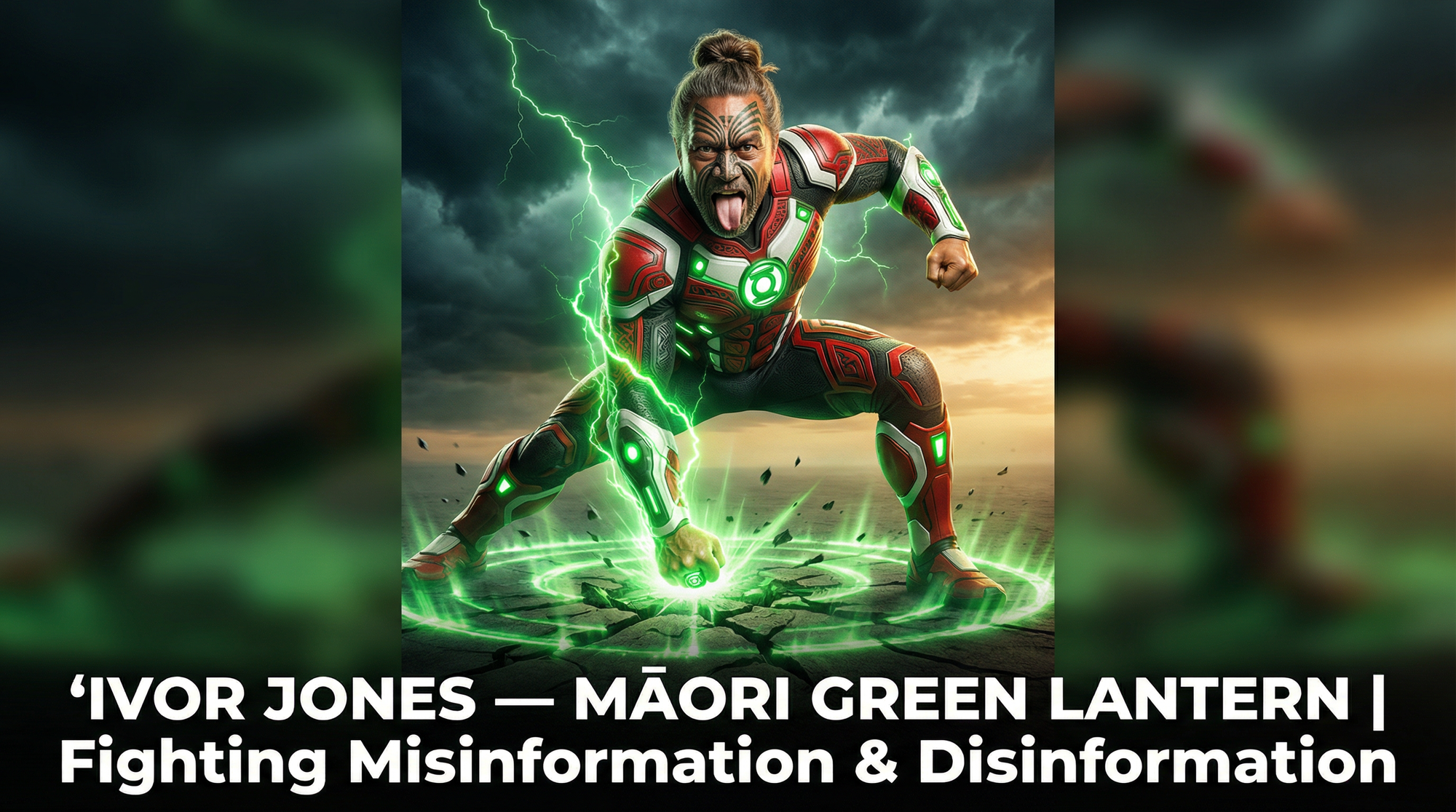
The ring is lit. The taiaha is in. The lantern does not negotiate.
Ko au, ko Ivor Jones, ko Te Māori Green Lantern.
Kia kaha, whānau. Kia mataara. Kia tūtaki.
He Kupu Whakamutunga — Koha Consideration
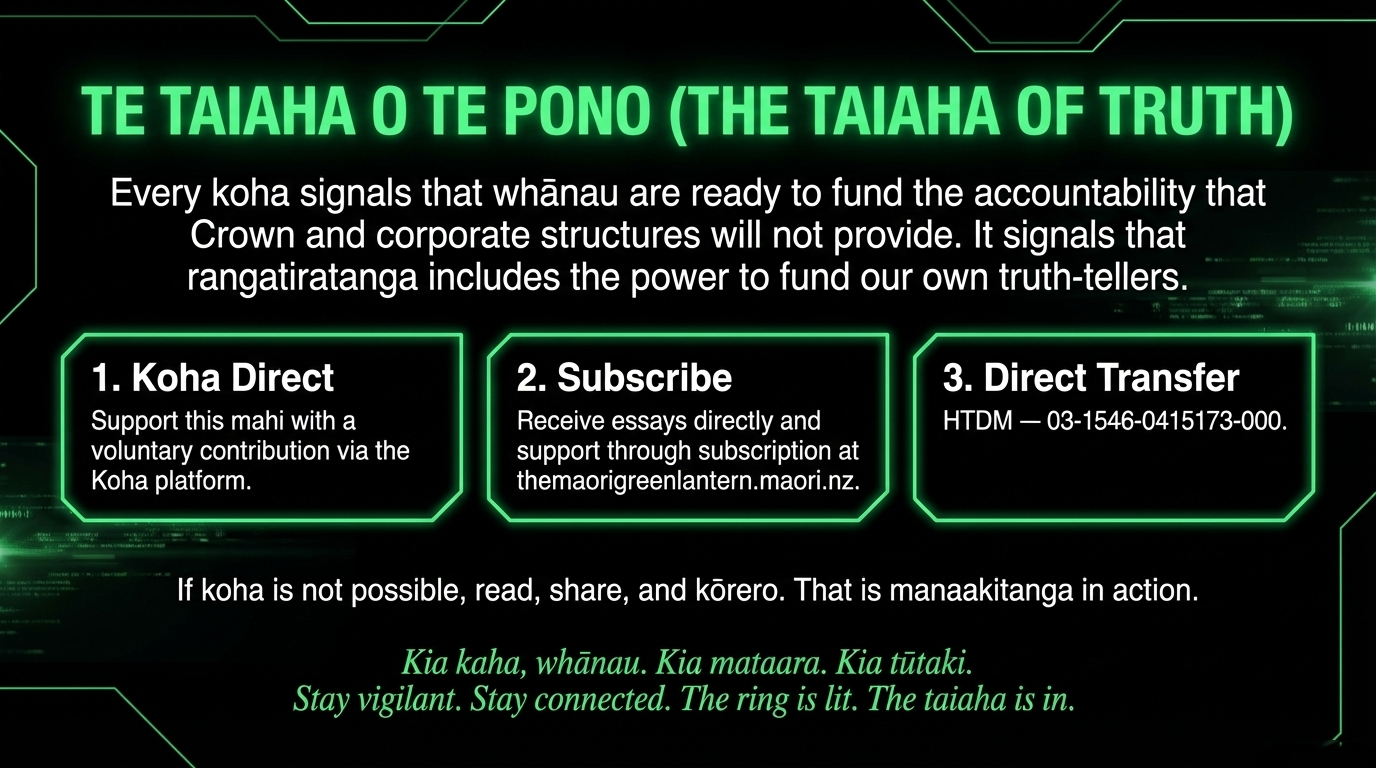
This essay took hours to research, verify, and write. Every link was tested. Every claim was checked against primary sources. Every URL was confirmed live. No institution paid for this. No Crown agency commissioned it. No corporate media outlet will publish it. The accountability journalism you just read exists because of rangatiratanga — the sovereign act of whānau choosing to fund their own truth-tellers rather than waiting for a system designed against them to tell the truth about itself.
That system will not investigate the Baptist capture of New Zealand's executive branch. It will not name the whakapapa of settler colonial values running the Health portfolio. It will not connect Amanda Luxon's Dom Harvey podcast to the same week her husband stripped a rival and handed power to a theological ally. It will not document the racial map of 131 Māori health positions cut while calling it fiscal responsibility.
We do.
Because you make it possible.
Every koha signals that whānau are ready to fund the accountability that Crown and corporate structures will not provide. It signals that rangatiratanga includes the power to fund our own truth-tellers — not as charity, not as dependence, but as a sovereign act of a people who know their own history and refuse to let it be erased quietly while a minister posts Easter Scripture and cuts the health teams that serve Clendon Park.
If you are unable to koha — no worries. Subscribe. Follow. Kōrero. Share with your whānau and friends. That is koha in itself. Every share of this essay is an act of accountability that Brown, Luxon, and the Taxpayers' Union cannot buy, spin, or trespass from a ministerial office.
Three pathways exist:
Koha direct — for those who wish to support this mahi with a voluntary contribution:
👉 Koha — Support the Māori Green Lantern
Subscribe — for those who wish to receive essays directly and support through subscription:
👉 Subscribe at themaorigreenlantern.maori.nz
Direct bank transfer — for those who prefer it:
👉 HTDM — 03-1546-0415173-000
Ko au, ko Ivor Jones, ko Te Māori Green Lantern.
Kia kaha, whānau. Kia mataara. Kia tūtaki.
Stay vigilant. Stay connected. The ring is lit. The taiaha is in.