“The Great Data Centre Con: Luxon's Corporate Theatre and the Digital Colonisation of Aotearoa” - 3 September 2025
When Prime Ministers become cheerleaders for phantom investments while our renewable energy gets strip-mined by Silicon Valley vampires
Tēnā koutou katoa (Greetings to you all).
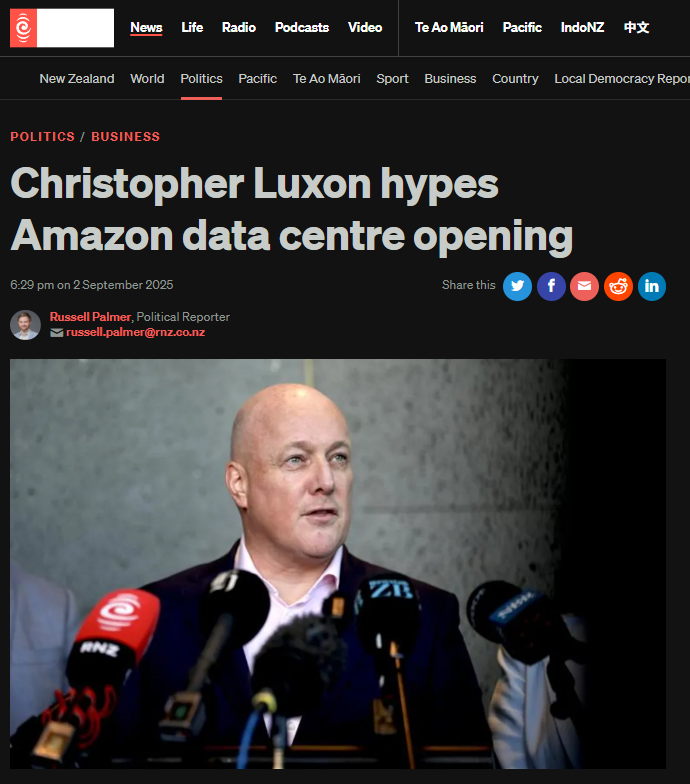
In a world drowning in corporate spin and neoliberal fantasies, another day brings another spectacular display of political theatre from our Prime Minister. Christopher Luxon, master of the empty gesture and champion of the 1%, has outdone himself by re-announcing a four-year-old Amazon deal as if it were his own economic miracle. This isn't just political opportunism - it's a perfect encapsulation of how neoliberal capitalism operates in Aotearoa: big promises, corporate welfare, and the systematic plunder of our renewable energy while tangata whenua are left out of the conversation entirely.
Background
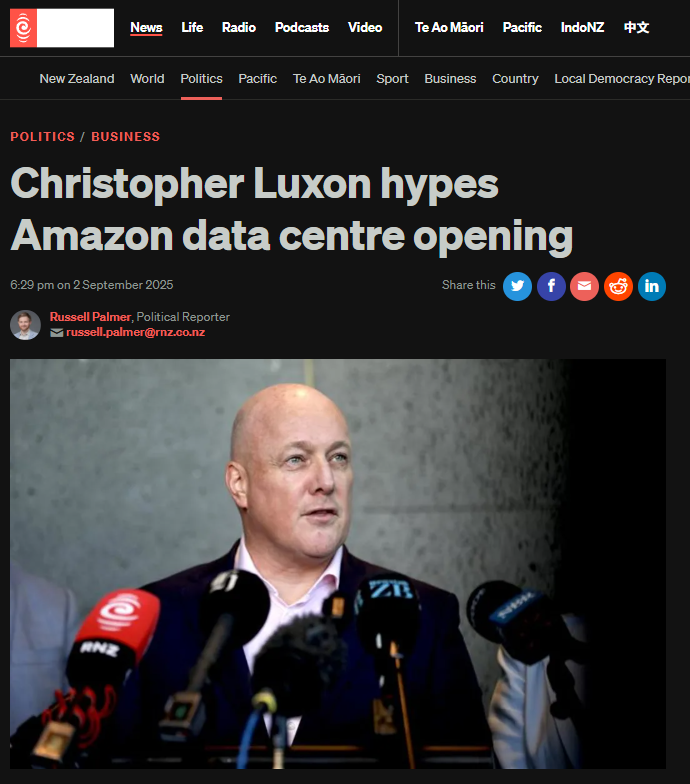
The art of political re-announcement has reached new heights of cynicism with Christopher Luxon's shameless promotion of Amazon's data centre "opening" in Auckland. This isn't new investment - it's old news being repackaged as fresh success. The original Amazon Web Services commitment was announced back in 2021 under the Labour government, promising $7.5 billion in investment and 1,000 jobs. What Luxon failed to mention is that Amazon never actually built the data centres they promised, instead quietly abandoning their purpose-built West Auckland facility due to soaring power costs.
The timing is particularly revealing. On the same day Luxon was celebrating this phantom investment, his government quietly announced changes to the foreign buyers ban, allowing wealthy "golden visa" holders to purchase luxury homes worth over $5 million. This isn't coincidence - it's coordinated policy designed to serve the ultra-wealthy while creating the illusion of economic progress for struggling New Zealand families.
For tangata whenua, these developments represent more than just economic policy failures. They symbolise the ongoing colonisation of Aotearoa's resources, where Māori data sovereignty and environmental guardianship are systematically ignored in favour of corporate profits. Data centres aren't just energy consumers - they're digital colonisation infrastructure, extracting value from Aotearoa's renewable energy while contributing nothing meaningful to Māori economic development or tino rangatiratanga.
What’s going on?
The core issue here isn't just Luxon's pathetic attempt to claim credit for someone else's work - it's the entire neoliberal framework that treats New Zealand as a corporate playground while ordinary whānau struggle with the cost of living crisis. Tech commentator Peter Griffin warned that Amazon's job and GDP claims should be taken "with a pinch of salt", noting they've "added up every dollar and probably things that they've replicated from overseas" to create inflated economic projections.
The reality is far more damning. Amazon didn't build the promised data centres at all. Instead, they're renting space in existing facilities operated by companies like CDC, avoiding the massive capital investment they originally promised. This is corporate rent-seeking at its finest - extracting profits from Aotearoa's renewable energy grid without contributing the infrastructure investment that would justify their access to our resources.
Meanwhile, data centres are projected to consume up to 7 percent of New Zealand's total electricity supply by 2030 - equivalent to what the Tiwai Point aluminium smelter currently uses. Unlike Tiwai, which at least provides local employment and contributes to manufacturing, these data centres offer minimal local employment while serving primarily international markets. They're digital strip mines, extracting our renewable energy to power Silicon Valley's AI fantasies.
The environmental justice implications are staggering. While power prices soar for ordinary households, with 4.2 percent of families now behind on their winter energy bills, tech giants secure preferential power purchase agreements that guarantee them cheap electricity for decades. This is energy apartheid - socialising the costs while privatising the benefits.
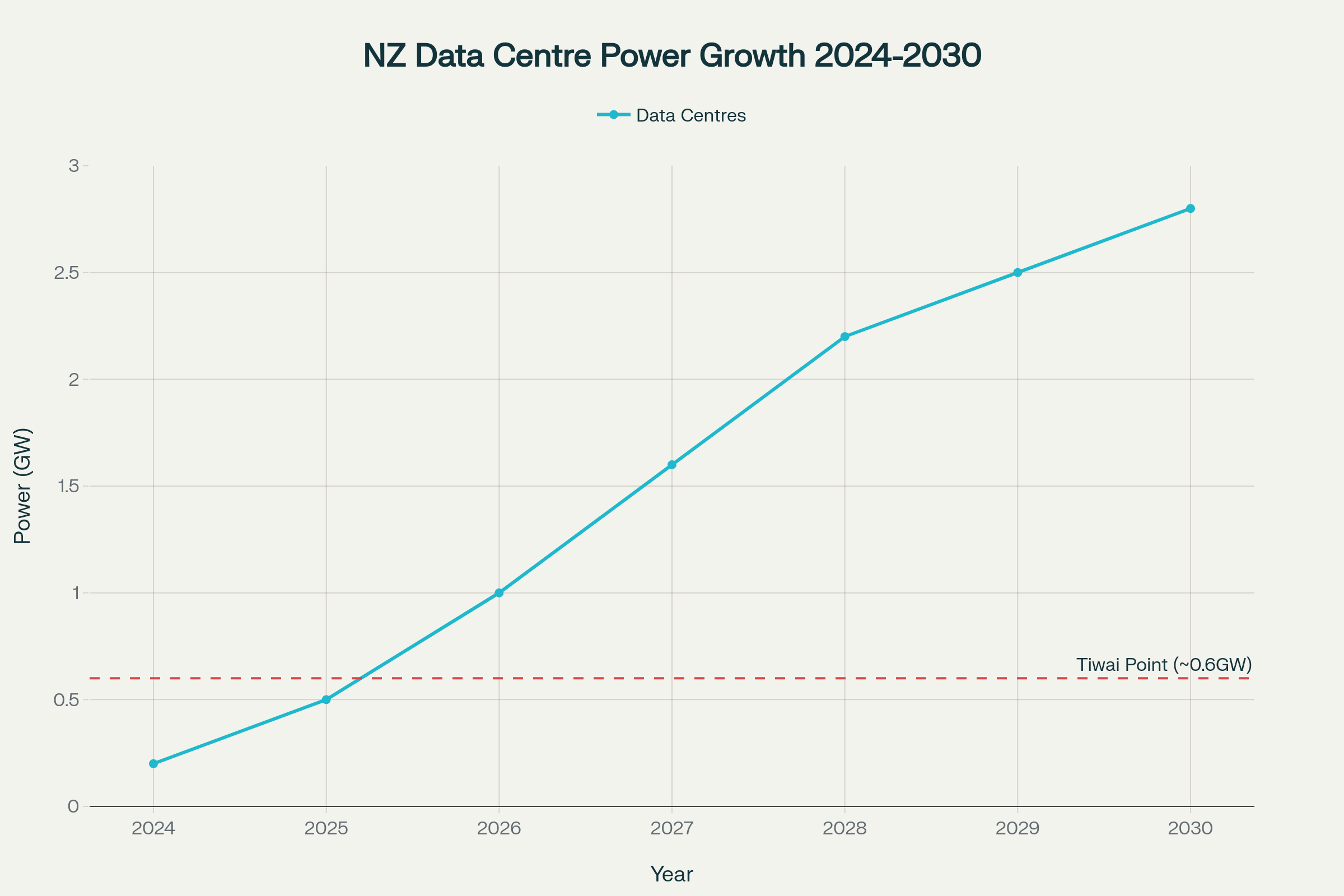
New Zealand data centre power consumption is projected to surge from 0.2GW in 2024 to 2.8GW by 2030 - equivalent to nearly five Tiwai Point aluminium smelters
For Māori communities, this represents a fundamental violation of the principle of kaitiakitanga - guardianship of natural resources for future generations. These data centres will consume massive amounts of electricity that could power Māori communities, marae, and economic development initiatives. Instead, that energy is being exported digitally to serve international corporations that contribute nothing to Māori wellbeing or self-determination.
The Neoliberal Shell Game in Action
Luxon's Amazon announcement perfectly demonstrates what neoliberalism actually looks like in practice: corporate welfare disguised as economic dynamism. The Prime Minister stood beside Amazon executives, playing the role of salesman for a company that has a notorious reputation for worker exploitation and discriminatory workplace practices. This isn't economic leadership - it's corporate genuflection.
The timing reveals the calculated nature of this political theatre. Just hours before the Amazon event, Luxon's government announced the partial reversal of the foreign buyers ban, allowing golden visa holders to purchase luxury homes worth over $5 million. Nearly 40 percent of these applications come from the United States, representing potential investment of $1.8 billion. The message is clear: if you're wealthy enough, New Zealand's sovereignty is for sale.
This isn't economic policy - it's plutocracy with a Kiwi accent. While homelessness increases and families struggle with basic necessities, Luxon's government prioritises making life easier for millionaire investors and multinational corporations. The golden visa programme exemplifies neoliberalism's core principle: the market serves capital, not communities.
Digital Colonisation and the Theft of Renewable Energy
The data centre boom represents a sophisticated form of digital colonisation that extracts Aotearoa's renewable energy resources to serve global capital. Amazon's cloud services primarily benefit international customers, not New Zealand businesses or communities. This is resource colonialism dressed up as technological progress.
The environmental implications are profound and deliberately obscured. Data centres consume massive amounts of water for cooling, with AI globally projected to draw "as much water as half of the United Kingdom annually" by 2027. In a country where water rights are contested and Māori have fought for decades to protect their ancestral waterways, this represents another form of resource appropriation.
The government's projection that data centres could consume 7 percent of New Zealand's electricity by 2030 equals the consumption of our largest industrial energy user, the Tiwai Point aluminium smelter. But unlike Tiwai, which at least provides local employment and contributes to manufacturing exports, these data centres serve primarily as digital infrastructure for international tech giants. They're energy colonisation infrastructure, extracting our renewable resources to power Silicon Valley's artificial intelligence dreams.
The Māori Data Sovereignty Vacuum
Perhaps most revealing is what's completely absent from Luxon's celebration: any consideration of Māori data sovereignty or indigenous rights in the digital economy. In traditional Māori worldview, data is considered taonga - treasured possessions that must be protected and managed according to tikanga Māori. The Treaty of Waitangi's Article II guarantees Māori "full exclusive and undisturbed possession" of their taonga, yet data centres operate with zero consideration of these rights.
Dr Karaitiana Taiuru, a leading advocate for Māori data sovereignty, argues that data collection and processing without indigenous consent constitutes "digital colonialism". When international corporations like Amazon establish data processing facilities in Aotearoa without engaging with tangata whenua, they're continuing the colonial project by different means.
The absence of Māori voices in data centre development decisions reflects a broader pattern of excluding indigenous perspectives from economic policy. While Luxon talks about "growth, growth, growth," there's no consideration of whose growth or who benefits. This is neoliberal racism in action - treating Māori communities as irrelevant to economic decisions that will fundamentally affect their digital future.
The Golden Visa Grift
The timing of the golden visa announcement alongside the Amazon celebration reveals the interconnected nature of neoliberal policy making. Both initiatives serve the same master: international capital. The golden visa programme allows wealthy foreigners to buy luxury homes without living in New Zealand for more than half the year, essentially creating a bolt-hole market for the global elite.
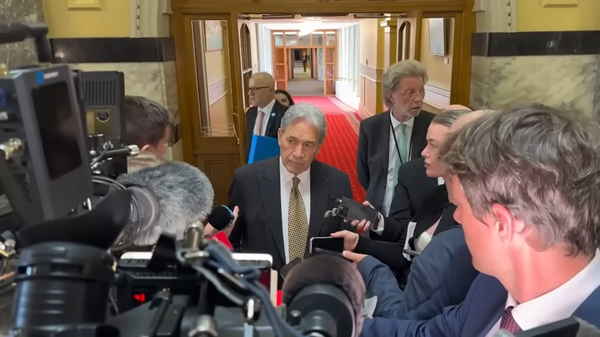
Winston Peters, who built his political career opposing foreign ownership and neoliberal economics, now defends this policy as a "very, very, very minor" adjustment. This spectacular betrayal of his own principles demonstrates how neoliberalism corrupts even its supposed critics. Peters has transformed from populist defender of New Zealand sovereignty into an apologist for plutocracy.
The economic arguments for these policies are transparently fraudulent. Labour's Chris Hipkins correctly identifies that pushing up prices at the luxury end affects the entire housing market, as displaced buyers move down market segments. This is basic economics that the government chooses to ignore because it doesn't serve their ideological agenda.
The Infrastructure Con
The most damning aspect of the Amazon announcement is that it's based on a fundamental deception about infrastructure investment. Amazon abandoned building their own data centres and instead leases space in facilities built by other companies. The West Auckland site they purchased remains empty, described as a "ghost data centre" by media observers.
This isn't job creation - it's job destruction through automation and overseas outsourcing. The promised 1,000 jobs are largely fictional, spread across "the supply chain" rather than direct employment. Meanwhile, Amazon's own employment practices include non-compete agreements so restrictive that employment lawyers advise against signing them.
The government's celebration of this phantom investment while real infrastructure crumbles represents the triumph of perception over reality. Schools lack adequate funding, hospitals are understaffed, and housing remains unaffordable, but Luxon prioritises photo opportunities with tech executives over actual economic development.
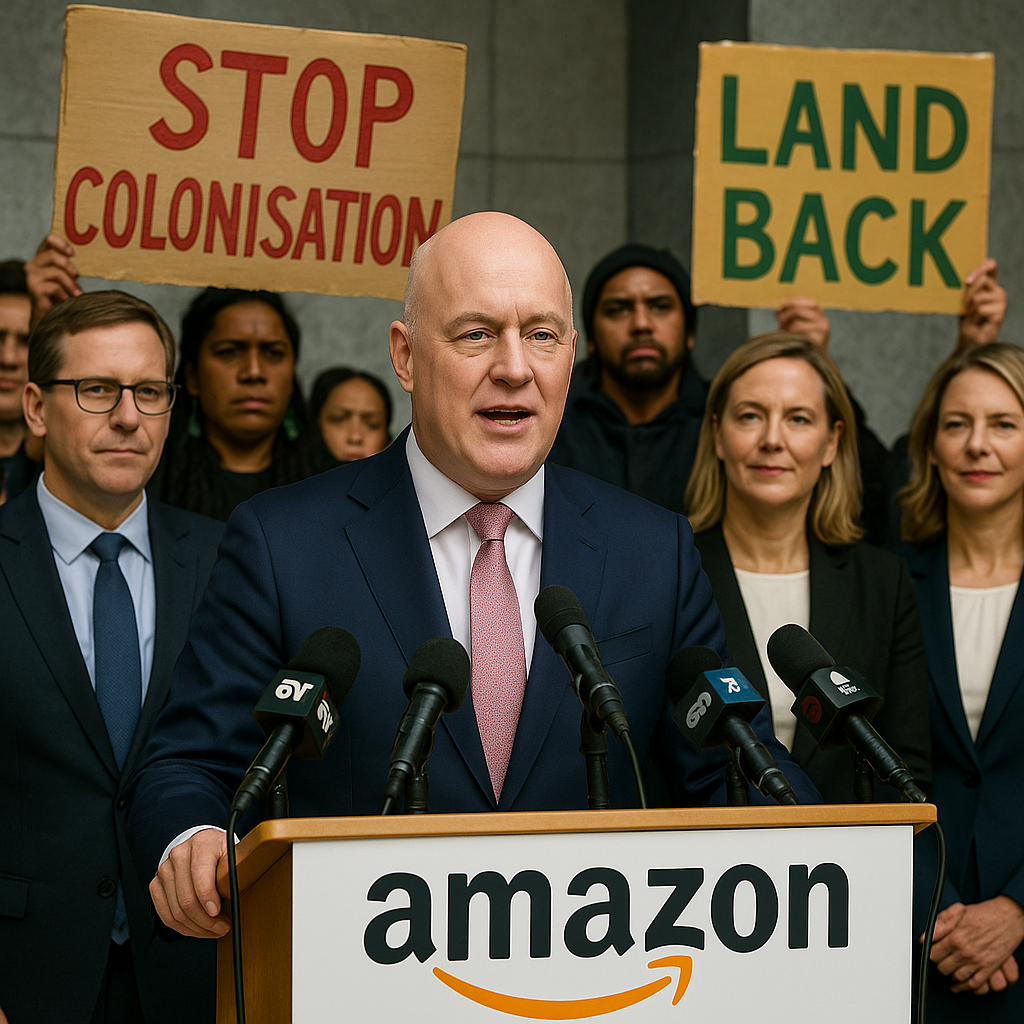
Political theatre of corporate power and indigenous resistance
Implications
The broader implications of this corporate theatre extend far beyond a single misleading announcement. Luxon's government is systematically restructuring New Zealand's economy to serve international capital rather than local communities. The Amazon celebration and golden visa announcement are symptoms of a deeper ideological project: the complete capture of New Zealand's economic policy by neoliberal interests.
For tangata whenua, these developments represent the continuation of colonisation by digital means. Data centres extract value from indigenous resources while contributing nothing to Māori economic development or self-determination. The complete absence of Māori voices from these policy decisions violates the principles of tino rangatiratanga and partnership embedded in Te Tiriti o Waitangi.
The energy implications are particularly concerning for future generations. By 2030, data centres could consume electricity equivalent to five Tiwai Point smelters, locking in decades of resource extraction to serve international markets. This energy apartheid - cheap power for corporations, expensive bills for families - represents a fundamental violation of energy justice principles.
The precedent being set is deeply troubling. If governments can re-announce old policies as new achievements while serving corporate interests over community needs, democratic accountability becomes meaningless. Luxon's performance demonstrates how neoliberal politicians operate: maximum spin, minimum substance, with ordinary whānau paying the price for policies designed to enrich the already wealthy.

The Māori Green Lantern Fighting Misinformation And Disinformation From The Far Right
We Must Resist
Christopher Luxon's pathetic attempt to claim credit for Amazon's phantom data centre investment reveals everything wrong with neoliberal politics in Aotearoa. This isn't economic leadership - it's corporate cheerleading dressed up as governance. While families struggle with power bills and housing costs, Luxon celebrates fictional job creation and infrastructure investment that doesn't exist.
The real scandal isn't just the misleading announcement - it's the systematic restructuring of New Zealand's economy to serve international capital at the expense of local communities. Data centres consume our renewable energy to power Silicon Valley's dreams while contributing minimal employment or economic benefit to New Zealand. The golden visa programme turns New Zealand sovereignty into a commodity for wealthy foreigners while ordinary Kiwis are priced out of their own housing market.
For tangata whenua, these policies represent digital colonisation - the appropriation of indigenous resources and data without consent or consultation. The absence of Māori voices from these decisions violates Te Tiriti o Waitangi and perpetuates the colonial project through technological means.
The solution isn't better spin or more corporate welfare - it's fundamental change to how we structure our economy. New Zealand needs energy democracy that serves communities over corporations, housing policy that prioritises residents over investors, and economic development that includes Māori as partners rather than excludes them as irrelevant.
Until we reject the neoliberal fantasy that corporate profits automatically translate to community wellbeing, we'll continue getting political theatre instead of actual progress. Luxon's Amazon announcement is just the latest act in this ongoing performance of economic failure.
To those readers who find value in exposing these corporate cons and defending genuine economic justice, please consider supporting this work with a koha if you have capacity: HTDM: 03-1546-0415173-000. In these tough economic times, please only contribute if you're able and wish to support independent analysis that puts communities before corporations.
Kia kaha, kia maia, kia manawanui.