"The Great Deception" - 17 August 2025
How National Created More Homelessness While Claiming Victory
Tēnā koutou katoa.
Today I uncover the brutal truth behind this government's manufactured homelessness crisis.
This coalition government's treatment of our most vulnerable whānau is nothing short of state-sanctioned cruelty masquerading as fiscal responsibility. While Chris Bishop and his ministerial cronies celebrate reducing emergency housing numbers, they have systematically engineered a homelessness crisis that disproportionately punishes tangata whenua and Pacific families. The data reveals a government that would rather see our people sleeping rough than acknowledge their fundamental failure to uphold human dignity.
https://thespinoff.co.nz/politics/14-08-2025/why-homelessness-is-worse-under-this-government-a-story-in-10-graphs
In the shadow of gleaming press releases announcing the government's early achievement of emergency housing reduction targets, a far more sinister story emerges. Between December 2023 and December 2024, households in emergency housing motels fell from 3,141 to 591 - a statistic the government trumpets as success. Yet this apparent victory conceals a brutal reality: rough sleeping has exploded by 90% in Auckland alone since September 2024, with Wellington seeing a 25% increase and Christchurch recording 270 new homeless clients in six months, up from 156. This essay exposes how Housing Minister Chris Bishop, Social Development Minister Louise Upston, and Associate Housing Minister Tama Potaka knowingly implemented policies that would drive our most vulnerable whānau onto the streets, all while violating Te Tiriti o Waitangi and breaching international human rights obligations.
Background: The Architecture of Cruelty
Emergency housing represents the absolute bottom rung of Aotearoa's housing safety net - a last resort for those with nowhere else to turn. Under previous governments, the Ministry of Social Development could not decline emergency housing grants if it would "cause serious hardship" or "increase or create any risk to the life or welfare of the applicant". This safeguard recognised emergency housing as exactly what its name suggests: emergency accommodation for people facing imminent homelessness.
The current government's "Priority One" policy, which fast-tracks families with children from emergency housing to social housing after 12 weeks, initially appeared progressive. Since June 2023, 21,224 applicants have been housed from the social housing waitlist, with notable spikes in July 2024 when 1,298 people were placed into homes. The completion of Labour-funded Kāinga Ora builds meant 1,635 new homes came online in July 2024 alone.
However, this apparent progress masked a calculated strategy to reduce emergency housing numbers not through improved housing outcomes, but through systematically denying access to those who needed it most. From a te ao Māori perspective, the concept of manaakitanga - caring for others, especially those in need - stands in direct opposition to this government's approach of abandoning our most vulnerable whānau.
Manufacturing Homelessness Through Policy Design
The crux of this government's deception lies in its implementation of "Tightening the gateway into emergency housing" in August 2024. This policy fundamentally altered emergency housing eligibility, removing critical safety provisions and introducing punitive measures designed to exclude rather than support.
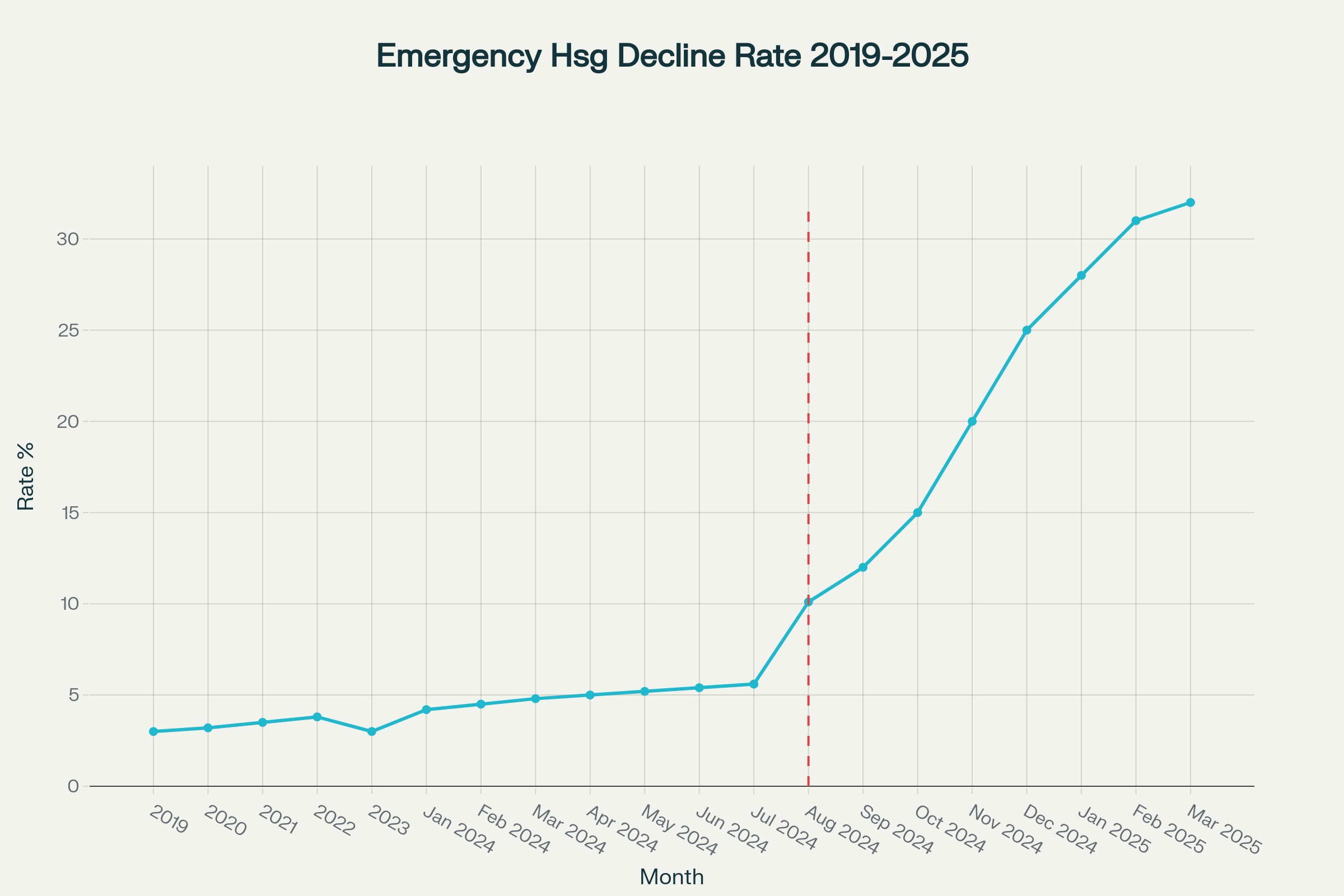
Emergency housing application decline rates skyrocketed after the government's "Tightening the Gateway" policy was implemented in August 2024
The data reveals the devastating impact with surgical precision. Emergency housing application decline rates skyrocketed from 4% to 32% following the policy's implementation. By February 2025, MSD was declining 507 applications out of 1,602 total applications - a rejection rate that would have been unconscionable under previous governments.
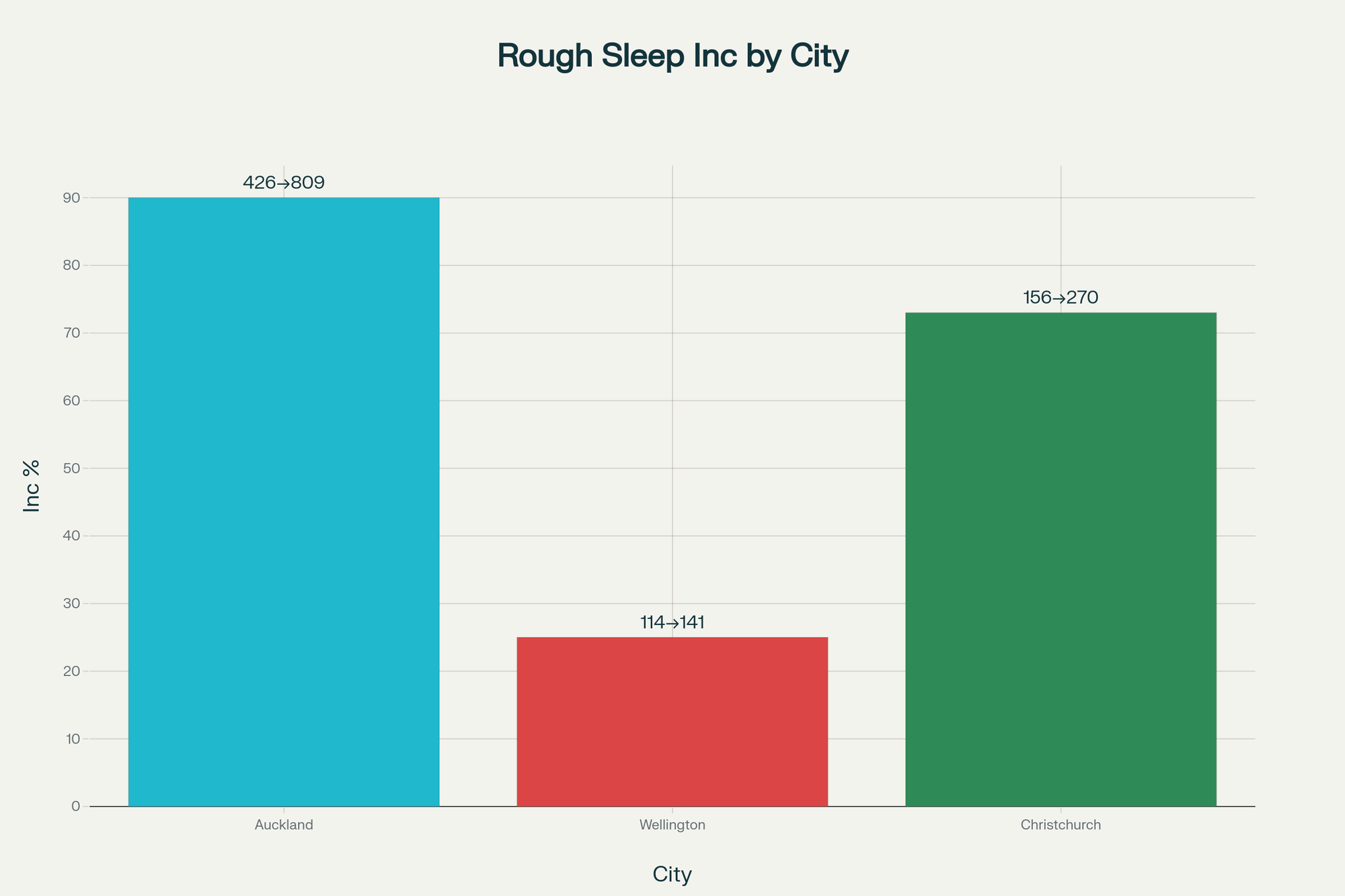
Rough sleeping has surged across New Zealand's major cities since the government's emergency housing restrictions
The reasons for these rejections reveal the policy's inherent cruelty: "The need can be met another way" (34.3%), "Circumstances could have been reasonably foreseen" (22.5%), "not eligible" (16.7%) and "not an emergency situation" (14.7%). The second category is particularly insidious, essentially blaming people for their own homelessness - a victim-blaming approach that runs counter to both Christian values of compassion and Māori principles of collective responsibility.
This matters profoundly to tangata whenua because Māori make up over 40% of Auckland's homeless population despite being just 11% of the city's residents. Four out of five homeless women in Aotearoa are Māori, many having experienced state care, sexual abuse, and family separation. When this government restricts emergency housing access, it specifically targets our whānau who are already bearing the compounding impacts of colonisation and structural racism.
Analysis: The Web of Deliberate Harm
Ministerial Knowledge and Wilful Negligence
The most damning aspect of this policy is that Ministry of Social Development officials explicitly warned ministers Louise Upston, Chris Bishop and Tama Potaka that "the proposed changes are likely to increase the risk of homelessness, rough sleeping, people living in cars, overcrowding, and could increase the number of people living in unsafe situations". These weren't vague concerns - they were specific, evidence-based predictions of exactly what would occur.
MSD officials further warned that "without sufficient housing supply, more people may end up homeless as a result of tightening the [emergency housing] gateway" and that "costs and risks associated with homelessness are likely to accrue over time, especially in the longer term". The government proceeded anyway, prioritising budget savings over human welfare.
The Financial Motive: Trading Lives for Dollars
Government modelling estimated that 1,000 fewer households would access emergency housing, saving $350 million over five years. This money was then reallocated for Budget 2024, revealing the true motive: balancing the books on the backs of our most vulnerable whānau. The concept of utu - balanced exchange - is corrupted here into a zero-sum calculation where human suffering becomes an acceptable cost for fiscal discipline.
Targeting Māori and Pacific Families
Officials specifically warned that changes would "disproportionately impact population groups over represented in [emergency housing], including low-income single people, sole parents and their children, Māori and Pacific peoples". This wasn't an unintended consequence - it was a predictable and predicted outcome that the government accepted as the price of their policy.
Pacific families represent less than half of Kāinga Ora tenants in Manurewa but make up three-quarters of enforcement action. In Porirua, Pacific tenants represented 46% of tenants but made up 62% of tenancy enforcement. The pattern is clear: this government systematically targets communities of colour for punitive housing policies.
Breaching Te Tiriti and International Law
MSD's report warned that the changes could breach the Crown's obligations to Māori under article 3 of te Tiriti o Waitangi and to children under the United Nations Convention on the Rights of the Child. Article 3 of Te Tiriti guarantees Māori the same rights and protections as British subjects - yet this government's policies specifically harm tangata whenua at disproportionate rates.
The UN Convention on the Rights of the Child guarantees children's right to an adequate standard of living, including housing. New Zealand's Human Rights Commission has already found the emergency housing system in breach of human rights, describing "a failure to deliver human rights obligations to provide emergency housing that meets basic standards of decency" and breaches grounded in Te Tiriti o Waitangi.
The Disappeared: Where Do the Rejected Go?
When pressed about where people go after being denied emergency housing, Chris Bishop admitted "we don't have trackers on everyone" - a callous admission that the government simply doesn't care what happens to those it abandons. While most people who leave emergency housing enter transitional or social housing, 14% become unknown to the government - and this only tracks those who were accepted in the first place.
Housing advocate Kevin Murray reports clients denied emergency housing after fleeing domestic violence, including people "sitting there crying, asking them for help" only to be told they "contributed" to their own homelessness by leaving violent situations. This represents the complete abandonment of the principle of manaakitanga that should guide our treatment of those in crisis.
Hidden Connections: The Neoliberal Housing Machine
This policy connects to broader neoliberal ideology that treats housing as a commodity rather than a human right. National-led governments typically prefer to incentivise community housing providers rather than investing in Kāinga Ora houses, reflecting their ideological commitment to privatisation even when public provision proves more effective.
A Cabinet paper revealed the current government does not intend to increase the overall stock of Kāinga Ora homes, despite knowing that Housing First is considered the most effective programme for getting severely homeless people into stable tenancies. This ideological rigidity trumps evidence-based policy, even when lives hang in the balance.
Māori Values and the Path Forward
From a Māori worldview, this government's approach violates fundamental values:
- Manaakitanga (hospitality, care for others) is replaced with deliberate exclusion
- Whakatōhea (collective responsibility) is abandoned for individual blame
- Kotahitanga (unity, working together) gives way to punitive division
- Rangatiratanga (self-determination) is denied through systemic disadvantage
- Whakapapa (interconnectedness) is severed by policies that separate families
The principle of tino rangatiratanga demands that tangata whenua have authority over matters affecting our wellbeing. Yet this government implements policies that specifically harm Māori communities while excluding us from decision-making processes.
Implications for Our Communities
This policy represents more than housing failure - it's a deliberate assault on the most vulnerable members of our society. The Salvation Army identified the changes as "a key contributor to rising street homelessness and housing insecurity", while frontline workers report children as young as nine seeking emergency accommodation.
Research shows that 46% of women experiencing homelessness live in dangerous situations rather than sleep rough, meaning many "disappeared" applicants likely remain in abusive relationships or unsafe housing. The government's policy effectively traps vulnerable women and children in dangerous situations by removing their exit options.
For rangatahi Māori, homelessness often leads directly to further criminalisation and state intervention. The cycle of harm extends across generations, violating the principle of whakatiputanga (nurturing future generations) that should guide all government policy affecting children and young people.

The Māori Green Lantern fighting misinformation and disinformation from the far right
A Government That Chooses Cruelty
This government had alternatives. Emergency housing numbers were already declining rapidly before the policy changes, suggesting they could have achieved their targets through existing measures combined with increased housing supply. Instead, Chris Bishop, Louise Upston, and Tama Potaka chose the path of maximum harm - knowingly implementing policies that would drive vulnerable whānau onto the streets.
Their defence that emergency housing was "essentially a free-for-all" reveals their fundamental misunderstanding of the safety net's purpose. Emergency housing was never meant to be easily accessible - it was meant to be there when people had absolutely nowhere else to turn. By eliminating this last resort, they have created a class of "undeserving" homeless people whose suffering becomes invisible to official statistics but painfully visible on our streets.
The evidence is overwhelming: this government manufactured a homelessness crisis through deliberate policy choices, disproportionately harming Māori and Pacific communities while violating both Te Tiriti obligations and international human rights law. They prioritised budget savings over human dignity, choosing cruelty as a political strategy.
We must demand better. We must hold these ministers accountable for their willful negligence and systematic harm. Most importantly, we must work to elect a government that recognises housing as a human right, not a privilege to be rationed based on worthiness.
The spirits of our ancestors demand justice for their mokopuna forced onto the streets by this government's calculated cruelty. Kia kaha, whānau - our fight for housing justice continues.
For readers who find value in exposing this government's failures and supporting kaupapa Māori journalism, please consider contributing a koha to support this mahi: HTDM: 03-1546-0415173-000. The MGL understands these are tough economic times for whānau, so please only contribute if you have capacity and wish to do so.
Ngā mihi nui,
Ivor Jones - The Māori Green Lantern
Kaitiaki of Truth, Exposer of Colonial Lies
- https://ppl-ai-file-upload.s3.amazonaws.com/web/direct-files/attachments/2123776/9ac88e72-14ad-47af-b739-95be7239c650/Why-homelessness-is-worse-under-this-government_-a-story-in-10-graphs-_-The-Spinoff.PDF
- https://ppl-ai-file-upload.s3.amazonaws.com/web/direct-files/attachments/images/2123776/013157d7-2824-482a-9992-3f8433a84306/Screenshot_20250817_064323_Brave.jpg
- https://thespinoff.co.nz/politics/14-08-2025/why-homelessness-is-worse-under-this-government-a-story-in-10-graphs
- https://www.rnz.co.nz/news/national/534007/number-of-emergency-housing-applications-denied-rises-rule-change-blamed
- https://www.rnz.co.nz/news/political/557114/third-of-emergency-housing-applications-being-rejected-by-msd
- https://www.rnz.co.nz/news/pacific/568689/pacific-families-bear-the-brunt-of-public-housing-evictions
- https://www.rnz.co.nz/news/political/525607/government-was-warned-emergency-housing-crackdown-could-increase-homelessness
- https://www.rnz.co.nz/news/national/568282/one-in-every-1000-new-zealanders-without-shelter-salvation-army
- https://www.rnz.co.nz/international/pacific-news/536334/pacific-housing-crisis-stagnates-despite-growing-demand
- https://www.rnz.co.nz/news/national/526461/what-you-need-to-know-about-the-new-rules-tightening-the-gateway-into-emergency-housing
- https://www.rnz.co.nz/news/political/524658/ministry-of-social-development-to-introduce-new-rules-for-cutting-emergency-housing-numbers
- https://www.nzherald.co.nz/northern-advocate/news/northland-homelessness-crisis-calls-for-urgent-government-action/3SX7VO2G6JFHDG7Q2IRDPSSIGU/
- https://www.rnz.co.nz/news/political/528008/government-spend-on-emergency-housing-drops-nearly-a-third-in-a-month
- https://www.rnz.co.nz/news/political/567818/we-have-a-real-problem-homelessness-increases-but-by-how-much-unclear-government-report
- https://www.1news.co.nz/2025/07/20/many-link-govts-emergency-housing-policy-to-homelessness-rise-minister/
- https://www.rnz.co.nz/news/political/539858/government-says-it-s-hit-emergency-housing-target-5-years-early
- https://www.nzherald.co.nz/nz/sharp-rise-in-homelessness-prompts-salvation-army-call-for-action/TOXMHT7DPZCQFHVC32EGGD6PIY/
- https://www.1news.co.nz/2025/08/03/govt-seeks-urgent-advice-as-rough-sleeping-increases/
- https://www.rnz.co.nz/news/political/564401/associate-housing-minister-tells-officials-domestic-violence-victims-get-emergency-accommodation
- https://www.nzherald.co.nz/nz/auckland-council-urges-government-action-amid-homelessness-surge/F22ZRIRYTFEGLFBWZLQIV5G6HE/
- https://www.nzherald.co.nz/nz/emergency-housing-access-tightens-homelessness-rises/FI7ZV255WNDGREYNQQOFCWGTI4/
- https://www.rnz.co.nz/news/national/568414/auckland-homelessness-spike-who-or-what-is-to-blame
- https://www.rnz.co.nz/news/national/561772/the-social-housing-waitlist-woman-told-no-emergency-homes-available-at-all
- https://www.rnz.co.nz/news/national/389336/maori-make-up-more-than-over-40-percent-of-auckland-homeless-report
- https://www.rnz.co.nz/news/business/567152/as-house-prices-drop-will-the-retirement-nest-egg-still-be-such-a-safe-bet
- https://www.nzherald.co.nz/nz/inside-the-plan-to-prevent-wellington-from-running-out-of-water-this-summer-money-to-fix-leaks-forecast-to-dry-up/PYBG7U5RVZB7LH3RCXTAEOGCEY/
- /content/files/podcasts/the-house.xml
- https://www.rnz.co.nz/news/national/535943/the-grim-picture-of-homelessness-for-nz-women
- https://www.rnz.co.nz/news/business/536796/government-s-financial-update-expected-to-show-bigger-deficits-for-longer
- https://www.rnz.co.nz/news/national/526210/protesters-target-msd-office-in-calling-for-end-to-benefit-sanctions
- https://www.rnz.co.nz/news/national/568266/more-women-living-without-shelter-in-aotearoa
- https://www.rnz.co.nz/news/political/558082/government-considers-axing-education-scheme-involving-nearly-2000-schools
- https://www.rnz.co.nz/news/thedetail/564850/nowhere-to-go-for-more-than-100-000-kiwis-the-worsening-reality-of-homelessness
- /content/files/webcontent/document/201151/housingreport.pdf
- https://www.nzherald.co.nz/nz/homelessness-crisis-advocates-call-for-better-housing-solutions-the-front-page/OGZCBOS3DRAVPHRXZU6WIT5JHU/
- /content/files/webcontent/document/201351/sixth-national-communication1.pdf
- https://www.rnz.co.nz/news/national/544007/almost-a-trap-advocates-say-near-impossible-to-get-into-emergency-housing-as-homelessness-increases
- https://www.rnz.co.nz/news/national/565918/more-rough-sleepers-on-auckland-streets-nz-doesn-t-have-to-be-this-way
- /content/files/2202-00138.pdf
- https://www.tandfonline.com/doi/pdf/10.1080/13504509.2022.2120109?needAccess=true
- https://www.mdpi.com/1660-4601/18/21/11660/pdf
- /content/files/2503-18389.pdf
- https://www2.gov.bc.ca/assets/gov/birth-adoption-death-marriage-and-divorce/deaths/coroners-service/statistical/homeless.pdf
- https://www.mdpi.com/2077-1444/12/7/474/pdf
- /content/files/record/8424183/files/79_ejtas_fullah.pdf
- https://onlinelibrary.wiley.com/doi/10.1111/1475-6773.14428
- https://www.degruyter.com/document/doi/10.1515/npf-2022-0037/pdf
- https://pmc.ncbi.nlm.nih.gov/articles/PMC10445596/
- https://www.mdpi.com/1660-4601/20/4/3265/pdf?version=1676276418
- https://dx.plos.org/10.1371/journal.pone.0314339
- https://www.mdpi.com/2673-995X/4/3/70
- https://www.mdpi.com/1660-4601/19/1/46/pdf
- https://www.tandfonline.com/doi/full/10.1080/1756073X.2024.2383044
- https://pmc.ncbi.nlm.nih.gov/articles/PMC11229599/
- https://www.1news.co.nz/2022/12/13/emergency-housing-in-breach-of-human-rights-hrc/
- https://www.rnz.co.nz/news/national/304737/govt-failing-'clear-obligation'-to-children
- https://www.1news.co.nz/2025/03/31/bishop-denies-emergency-housing-policy-leading-to-homelessness/
- https://www.rnz.co.nz/news/national/483201/emergency-housing-global-embarrassment-expected-at-un
- https://www.rnz.co.nz/news/political/290005/govt-working-on-kids'-homelessness-bennett
- https://www.rnz.co.nz/news/national/541574/things-have-got-tougher-salvation-army-releases-latest-state-of-the-nation-report
- https://www.rnz.co.nz/news/national/480680/emergency-housing-human-rights-commission-s-damning-report-points-to-rights-breaches
- https://www.rnz.co.nz/news/political/313582/un-challenges-nz-on-child-poverty
- https://www.1news.co.nz/2024/10/30/pacific-people-employment-rises-but-housing-crisis-hurts-families/
- https://www.1news.co.nz/2024/03/07/emergency-housing-revamp-human-rights-protections-not-clear/
- https://www.1news.co.nz/2023/07/06/affordable-healthy-homes-still-beyond-reach-for-some-report/
- https://www.rnz.co.nz/news/national/320242/third-generation-of-kiwi-children-face-life-of-poverty
- /content/files/webcontent/document/201631/20151201sppusahomelessbabyboomersrreportwebv1.pdf
- https://www.rnz.co.nz/news/te-manu-korihi/490213/waitangi-tribunal-finds-crown-breached-treaty-obligations-in-dealing-with-maori-homelessness
- https://www.rnz.co.nz/news/political/315157/un-report-demands-action-on-nz-child-poverty
- https://www.rnz.co.nz/news/national/493244/commissioner-says-housing-should-be-recognised-as-a-human-right-calls-for-ombudsman