“The Great Infrastructure Con” - 26 August 2025
How Bishop's $30 Billion Mirage Masks a Neoliberal Shell Game
Kōrero mai e hoa - Greetings, friend
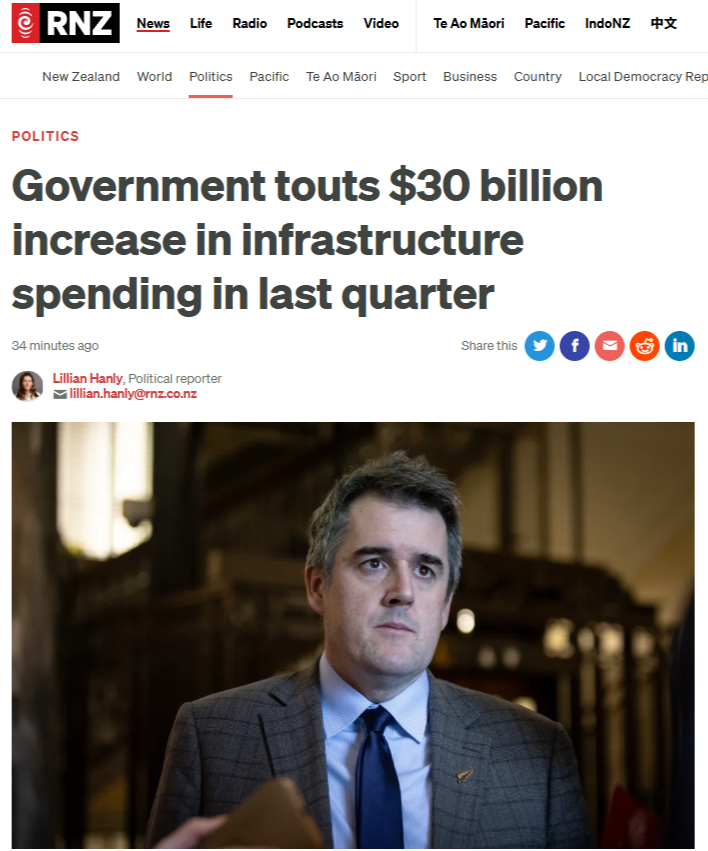
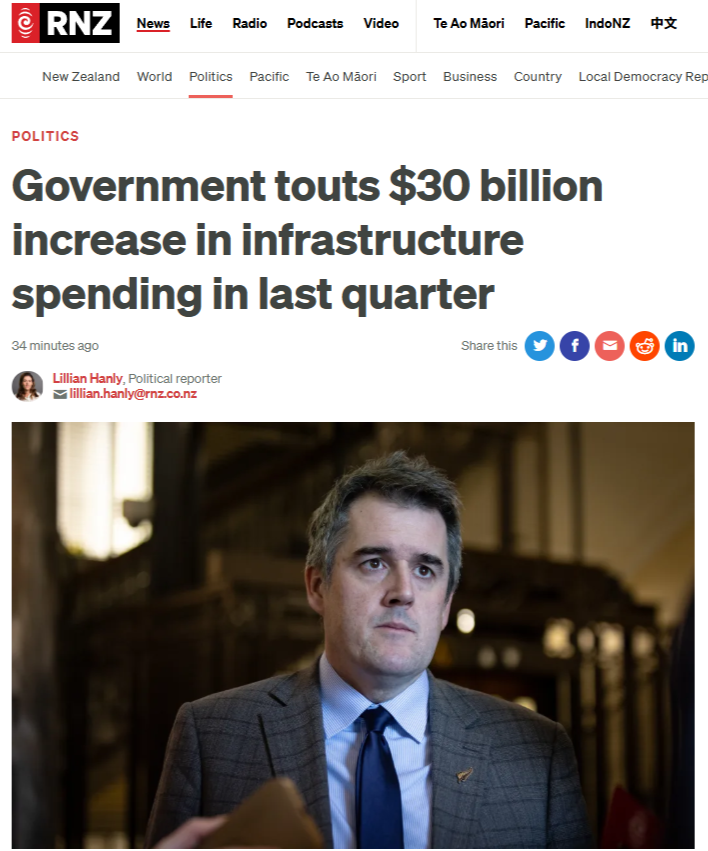
The Coalition's announcement of a $30 billion increase in infrastructure spending sounds impressive until you peer behind the curtain of this elaborate theatre. Infrastructure Minister Chris Bishop's triumphant parade of numbers is nothing more than neoliberal smoke and mirrors - a cynical exercise in moving public assets into private hands while leaving tangata whenua and working communities to foot the bill.
The Mirage of Numbers
Let's dissect this carefully crafted deception. Bishop boasts that the National Infrastructure Pipeline has grown to $237.1 billion, with the latest quarterly update showing an increase of $30.2 billion. Yet this headline-grabbing figure conceals a damning truth: only $125.1 billion of this massive pipeline has confirmed funding. That leaves a staggering $112 billion gap - nearly half the total - floating in the realm of wishful thinking and political posturing.[1][2]
This is classic neoliberal sleight of hand: inflate the numbers, create the impression of action, then quietly shift the financial burden to private investors who will extract decades of profit from essential public infrastructure. The inclusion of NZTA highway maintenance programmes and prison redevelopments in the pipeline increase reveals the true agenda - rebranding routine government responsibilities as grand infrastructure achievements.[1]
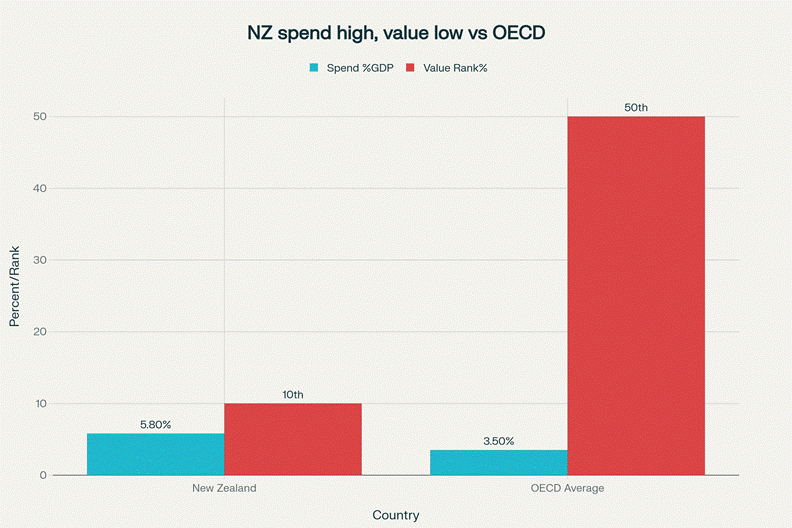
New Zealand's Infrastructure Spending Paradox: High Investment, Poor Value
The White Supremacist Economics of Infrastructure
The Coalition's infrastructure approach epitomises what we must recognise as white supremacist economic policy. By prioritising public-private partnerships and user-pays models, Bishop is systematically excluding Māori and Pacific communities who cannot afford tolled roads, privatised water systems, or commercially-operated schools and hospitals.[3]
This exclusion is intentional. Research shows that Māori view infrastructure projects as levers for enacting social change, by creating jobs and creating opportunities for local communities. The Coalition's privatisation agenda directly contradicts these values by prioritising profit extraction over community benefit.[4]
Consider Bishop's revealing statement that ratepayers don't care about environmental standards or architectural quality. This dismissal of te taiao (the environment) and cultural values in infrastructure design is a direct assault on Māori worldviews where kaitiakitanga - guardianship of the environment - is fundamental.[5]
The Privatisation Trojan Horse
The Coalition's true intentions become clear when examining their refreshed Public Private Partnership framework. Despite Labour's Barbara Edmonds providing a foreword to legitimise this neoliberal agenda, PPPs remain what they have always been: a mechanism for privatising public assets while socialising the risks.[6]
International evidence consistently shows that PPPs are an expensive and inefficient way of financing infrastructure. Private finance is invariably more expensive than government borrowing, yet Bishop persists with this ideological obsession because it serves corporate interests, not public good.[7]
The new National Infrastructure Agency, rebranded as "National Infrastructure Funding and Financing Limited," is little more than a corporate shopfront designed to attract international capital to extract profits from New Zealand's essential services. This agency will facilitate the transfer of public assets to private control while providing a veneer of government oversight.[8]
The Performance Paradox
Here lies the most damaging aspect of the Coalition's approach: New Zealand already spends more on infrastructure than most countries but gets appalling value for money. We rank in the top 10% of OECD countries for infrastructure spending but in the bottom 10% for value delivered.[9]
This performance paradox isn't accidental - it's the inevitable result of neoliberal ideology that prioritises process over outcomes, private profit over public benefit. When infrastructure becomes a commodity to be traded rather than a public service to be delivered, waste and inefficiency are guaranteed outcomes.
The Infrastructure Commission's finding that New Zealand infrastructure deteriorates by $15 billion annually while spending nowhere near that amount on repairs reveals the false economy of privatisation. Private operators have no incentive to maintain assets beyond their contract terms, leaving future generations to pay for deferred maintenance.[9]
The Colonial Pattern
Bishop's infrastructure agenda follows a well-established colonial pattern: present immediate benefits while concealing long-term extraction. Just as colonial governments built railways to extract resources for export, the Coalition's infrastructure programme is designed to extract wealth from communities through tolls, user charges, and private ownership of essential services.
The exclusion of Māori perspectives from infrastructure planning is particularly egregious. While Māori entities contributed significantly to the economy - growing from $17 billion (6.5% of GDP) in 2018 to $30 billion (8.4%) in 2023 - they remain marginalised in major infrastructure decisions that affect their communities.[10]
The Coalition's approach ignores Māori values that emphasise intergenerational thinking and environmental stewardship. Instead of viewing infrastructure as a legacy for future generations, Bishop treats it as a commercial opportunity for immediate profit extraction.
The Fiscal Fraud
Bishop's claim that this infrastructure boom will drive economic growth is contradicted by extensive research showing that typical infrastructure investment fails to deliver positive risk-adjusted returns. The Coalition is essentially promising economic growth through projects that are likely to destroy value rather than create it.[11]
The timing of this announcement - coinciding with economic difficulties and approaching election pressures - reveals its political rather than economic motivation. Bishop needs to demonstrate action while avoiding the fiscal responsibility of actually funding these projects through traditional government borrowing.
This fiscal fraud extends to the Coalition's refusal to adequately fund existing infrastructure. While announcing grand new projects, they simultaneously implement rates caps and cut funding for local government, ensuring that communities cannot maintain even basic services.[5]
Hidden Connections and Corporate Capture
The web of relationships surrounding this infrastructure announcement reveals the extent of corporate capture in New Zealand politics. Bishop's background in corporate consulting, the rapid establishment of the National Infrastructure Agency, and the prominent role given to private investors in shaping policy all point to a government serving corporate interests rather than public needs.
The Infrastructure Investment Summit attended by representatives managing $6 trillion in assets was not about finding the best solutions for New Zealand's infrastructure needs - it was about creating investment opportunities for international capital.[12]
These corporate interests have no commitment to New Zealand communities or environmental protection. Their sole focus is maximising returns, which inevitably means extracting as much value as possible while minimising investment in quality or maintenance.
The Democratic Deficit
Perhaps most concerning is Bishop's dismissive attitude toward democratic participation in infrastructure decisions. His criticism of councils for environmental considerations and community consultation reveals a fundamentally authoritarian approach that sees public input as an obstacle rather than a right.
This democratic deficit is particularly harmful to Māori communities whose rights to consultation and consent are guaranteed under Te Tiriti. The Coalition's fast-track consenting processes and emphasis on commercial expediency override these fundamental democratic and treaty rights.
The exclusion of meaningful community input ensures that infrastructure projects serve corporate interests rather than community needs. Without democratic accountability, these projects become vehicles for wealth extraction rather than tools for social and economic development.
Implications for Tangata Whenua
The Coalition's infrastructure agenda poses particular threats to Māori communities. The emphasis on user-pays models will create barriers to accessing essential services, while privatisation removes democratic control over assets that affect Māori interests.
The exclusion of Māori values from infrastructure planning represents a form of cultural violence that undermines tino rangatiratanga. When infrastructure decisions ignore environmental and cultural considerations, they perpetuate colonial patterns of resource extraction that harm both tangata whenua and te taiao.
The Coalition's refusal to adequately fund Māori-led infrastructure development while simultaneously opening opportunities for international investors reveals the racist double standard at the heart of neoliberal policy. Māori entities, despite their proven economic contribution, are expected to compete for crumbs while corporate interests receive red-carpet treatment.
The Broader Pattern of Neoliberal Destruction
Bishop's infrastructure programme fits within the broader neoliberal pattern of privatising profits while socialising costs. The immediate beneficiaries are corporate interests who will extract decades of returns, while communities bear the long-term costs of inadequate maintenance, restricted access, and reduced democratic control.
This pattern has been repeated globally with devastating consequences. From Britain's failed rail privatisation to Australia's expensive toll road networks, PPPs consistently deliver worse outcomes at higher costs than public provision. Yet the Coalition persists with this failed model because it serves their ideological and corporate backers' interests.
The human cost of this approach is incalculable. When essential services become profit centres, quality inevitably suffers while access becomes restricted to those who can afford to pay. This creates a two-tier system that entrenches inequality and undermines social cohesion.

The Māori Green Lantern fighting misinformation and disinformation from the far right
Chris Bishop's $30 billion infrastructure announcement is not a solution to New Zealand's infrastructure challenges - it's a cynical exercise in corporate welfare disguised as public investment. By inflating pipeline numbers while concealing funding gaps, promoting expensive privatisation over efficient public provision, and excluding democratic participation from decision-making, the Coalition is setting New Zealand up for decades of expensive, inadequate infrastructure that serves corporate interests rather than community needs.
The Māori values of manaakitanga, kaitiakitanga, and whakatōhea offer alternative approaches that prioritise community benefit, environmental protection, and intergenerational thinking. These values provide a pathway to infrastructure development that serves people rather than profits, but they require rejecting the neoliberal ideology that has captured our political system.
We must demand infrastructure policies that embody these values: public ownership of essential services, democratic participation in decision-making, environmental protection as a fundamental principle, and investment strategies that build community wealth rather than extracting it. Only by rejecting Bishop's corporate agenda can we build infrastructure that truly serves Aotearoa's people and environment.
The choice is clear: continue down the path of privatisation and corporate capture, or embrace indigenous values that prioritise collective wellbeing over individual profit. The infrastructure we build today will shape our society for generations - we must ensure it reflects our values, not corporate interests.
Kia kaha, kia māia, kia manawanui - be strong, be brave, be steadfast in opposing this neoliberal assault on our infrastructure and our values. The future of our communities depends on our resistance to this corporate capture of our essential services.
For readers who find value in this analysis and wish to support continued investigation of corporate capture and neoliberal policies affecting tangata whenua, please consider a koha to HTDM: 03-1546-0415173-000. The Māori Green Lantern understands these tough economic times for whānau, so please only contribute if you have capacity and wish to do so.
Ngā mihi nui,
Ivor Jones - The Māori Green Lantern
References