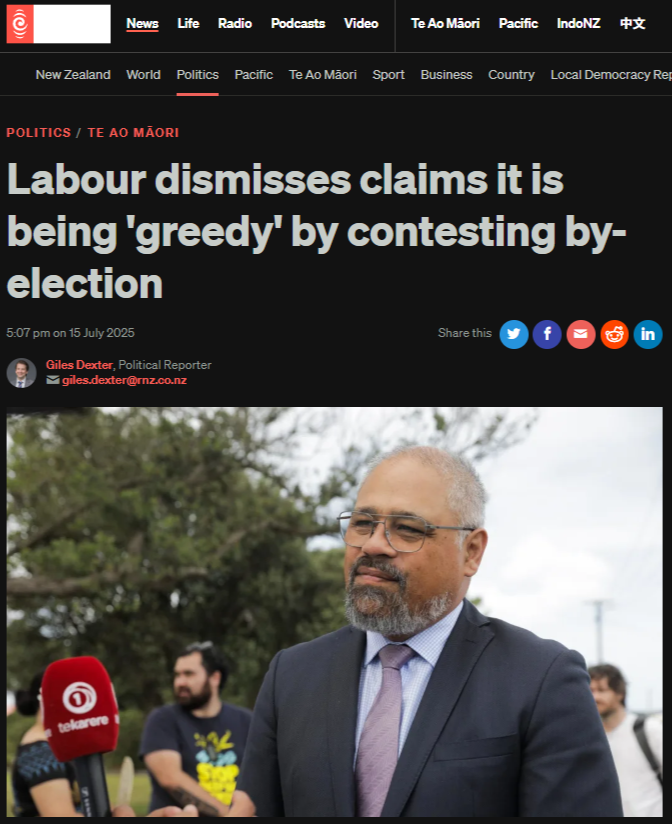
“The Greed of the Red Machine: Labour's Shameless Power Grab Over Māori Graves” - 16 July 2025
How Labour's Vultures Circle the Death of a Māori Warrior
Kia ora whānau - In the spirit of our tūpuna who fought against colonial greed, this kōrero exposes how Labour's parasitic hunger for power knows no bounds, not even the sacred space of tangihanga.
In a breathtaking display of political opportunism that would make even the most cynical Westminster politicians blush, the Labour Party has proven once again that their so-called commitment to Māori representation is nothing more than a convenient facade. Labour's decision to contest the Tāmaki Makaurau by-election following the death of Te Pāti Māori's Takutai Tarsh Kemp exposes their naked greed for power at the expense of genuine Māori voices.
The Labour Party's actions represent the epitome of colonial political calculation, where electoral arithmetic matters more than tikanga, where power-hungry politicians circle like vultures over the death of a Māori warrior. This is not politics - this is desecration of the sacred relationship between tangata whenua and their representatives.
Background: The Death of a Māori Voice
The political landscape shifted dramatically when Te Pāti Māori MP Takutai Tarsh Kemp died at age 50 following her battle with kidney disease. Kemp, who served as tumuaki of Manurewa Marae and won the Tāmaki Makaurau seat by just 42 votes from Labour's Peeni Henare in 2023, represented the authentic voice of her people - a voice that Labour now seeks to silence through their opportunistic by-election campaign.
The by-election, scheduled for 6 September 2025, has exposed the fundamental difference between Labour's performative politics and Te Pāti Māori's authentic representation. Where Te Pāti Māori fights for tino rangatiratanga, Labour fights for seats. Where Te Pāti Māori advocates for structural change, Labour advocates for structural power.
The significance of this contest extends beyond electoral politics into the realm of cultural values. As Kemp was farewelled at Opaea Marae, her whānau and communities mourned not just a political representative but a cultural leader who embodied the struggle for Māori liberation.
The Greed Exposed: Labour's Calculated Opportunism
The evidence of Labour's greed is overwhelming and undeniable. Te Pāti Māori president John Tamihere's pointed question cuts to the heart of Labour's desperation: "How many times are you going to run and lose?" This question exposes the pathetic reality of Peeni Henare's political career - a man so desperate for electoral validation that he will contest a seat he has already lost, using the death of a Māori woman as his political opportunity.
Even more damning is the analysis from Kiri Tamihere-Waititi, who correctly identified Labour's true motivation: "Them standing a current MP in the by-election is a greedy move to take away from Māori. Why? Because Peeni already holds a seat in Parliament." This isn't about representation - it's about mathematical manipulation of Parliament's composition to benefit Labour's power base.
The mathematical reality exposes Labour's cynical calculation. As outlined in the electoral analysis, if Henare wins, Labour gains an additional seat by bringing Georgie Dansey off their party list, increasing their total from 34 to 35 seats. This isn't about serving Tāmaki Makaurau - it's about serving Labour's parliamentary mathematics.
Willie Jackson's pathetic justification that Labour "did not want to be really contesting and having a bad relationship with Te Pāti Māori" while simultaneously fielding a candidate exposes the duplicitous nature of Labour's approach. If they truly cared about relationships with Te Pāti Māori, they would have respected the tikanga of allowing the seat to remain with authentic Māori representation.
The most insulting aspect of Labour's campaign is their attempt to use Māori identity as a shield against criticism. Henare's claim that bringing Georgie Dansey onto the list maintains Māori representation demonstrates a fundamental misunderstanding of what authentic Māori representation means. List MPs serve party hierarchies; electorate MPs serve their people. Labour's version of "Māori representation" serves Labour first, Māori second.
The Pattern of Colonial Power-Grabbing
Labour's actions in Tāmaki Makaurau fit a broader pattern of colonial political behavior that prioritizes institutional power over authentic representation. The party's historical relationship with Māori has been one of convenient alliance when it suits their electoral needs, and calculated abandonment when it doesn't.
Jackson's reference to the 2013 Ikaroa-Rāwhiti by-election when Te Pāti Māori contested after Parekura Horomia's death reveals Labour's selective application of tikanga. They demand respect when it benefits them but show no respect when it costs them. This is the essence of colonial political behavior - the rules apply differently depending on who holds the power.
The timing of Labour's announcement, coming so soon after Kemp's tangihanga, demonstrates their complete disregard for Māori cultural protocols. While whānau were still processing their grief, Labour was calculating their political advantage. This is the behavior of political scavengers, not partners in the struggle for tino rangatiratanga.
Prime Minister Christopher Luxon's dismissal of the contest as a "pillow fight" between Labour and Te Pāti Māori reveals how the colonial establishment views Māori political competition - as entertainment rather than legitimate democratic contest. Labour's participation in this circus validates the colonial power structure that reduces Māori political agency to a sideshow.
The Broader Implications: Neoliberal Māori Politics
Labour's approach to the Tāmaki Makaurau by-election exemplifies the neoliberal co-optation of Māori politics. Rather than supporting authentic Māori political expression through Te Pāti Māori, Labour seeks to channel Māori political energy through their own institutional structures. This is classic neoliberal strategy - maintain the appearance of diversity while ensuring all power flows through established channels.
The party's broader record on Māori issues during their last term in government demonstrates how they use Māori representation as a political shield while implementing policies that ultimately serve Pākehā interests. Their establishment of the Māori Health Authority, which they now desperately promote as evidence of their commitment to Māori, was undermined by their continued support for a health system that perpetuates colonial structures.
Jackson's role as Labour's Māori caucus co-chair represents the pinnacle of this neoliberal co-optation. His job is not to advance Māori interests but to manage Māori political expression within acceptable parameters. His defense of Labour's by-election strategy demonstrates how effectively the party has neutralized potential Māori dissent within their own ranks.
The mathematical manipulation of parliamentary representation through the by-election reveals Labour's fundamentally transactional approach to Māori politics. They don't seek to empower Māori communities; they seek to extract political value from Māori identity. This is the essence of neoliberal politics - everything is commodified, including cultural identity and political representation.

The Resistance: Te Pāti Māori's Authentic Voice
In stark contrast to Labour's opportunistic maneuvering, Te Pāti Māori's selection of Oriini Kaipara represents authentic Māori political expression. Kaipara, a former television presenter who made history as the first person with moko kauae to present mainstream news, embodies the cultural confidence that threatens Labour's colonial political model.
Rawiri Waititi's critique that Henare's victory would result in a "lost" Māori voice in Parliament cuts to the heart of the difference between authentic and performative representation. Te Pāti Māori represents Māori political autonomy; Labour represents Māori political subordination.
The party's broader resistance to the coalition government's attacks on Māori demonstrates what authentic Māori political representation looks like. While Labour offers measured opposition and calls for "respectful campaigns," Te Pāti Māori offers uncompromising resistance to colonial oppression.
Kaipara's pledge to tackle the cost of living crisis with specific focus on housing and youth homelessness represents policy making that centers Māori community needs rather than party political strategy. This is the difference between representation that serves the people and representation that serves the party.
The Pathway Forward: Rejecting Labour's Colonial Politics
The choice facing Tāmaki Makaurau voters extends far beyond this single by-election. They are choosing between colonial political subordination and indigenous political autonomy. Labour's campaign represents the former - the perpetuation of a system where Māori political expression is managed and controlled by institutions that ultimately serve Pākehā interests.
Te Pāti Māori's campaign represents the latter - the assertion of tino rangatiratanga through authentic political representation. This is not about personality or party loyalty; it is about the fundamental question of whether Māori will accept political subordination or demand political autonomy.
The principles of manaakitanga demand that we care for our political institutions with the same reverence we show our marae. Labour's opportunistic contest of this by-election violates this principle by treating Parliament as a marketplace for political advantage rather than a sacred space for democratic representation.
Whakatōhea wisdom teaches us that authentic power comes from serving the people, not from accumulating institutional advantage. Te Pāti Māori's campaign embodies this wisdom; Labour's campaign rejects it in favor of colonial political calculation.
The time has come for Māori to reject the false choice between Labour's neoliberal co-optation and National's open hostility. Te Pāti Māori offers a third way - the path of authentic indigenous political expression that refuses to compromise our values for electoral advantage.
The Greed of the Red Machine Exposed
Labour's decision to contest the Tāmaki Makaurau by-election represents everything that is wrong with New Zealand's colonial political system. It prioritizes party advantage over people's needs, institutional power over authentic representation, and electoral arithmetic over cultural values.
The party's pathetic attempts to justify their greed through references to Māori representation on their party list only emphasize how fundamentally they misunderstand what authentic Māori political representation means. They offer us crumbs from their table while Te Pāti Māori offers us our own feast.
The choice for Tāmaki Makaurau voters is clear: they can choose Labour's colonial politics of managed Māori representation, or they can choose Te Pāti Māori's politics of authentic indigenous autonomy. The ancestors who fought for our political rights would not hesitate in making this choice.
As we honor the memory of Takutai Tarsh Kemp, we must reject the politics of those who would use her death as an opportunity for their own advancement. True manaakitanga demands that we continue her work through authentic representation, not through the calculating machinations of political opportunists.
The red machine's greed has been exposed. Now it must be rejected.
Ko te whakapapa, ko te whenua, ko te iwi - these are the values that should guide our political choices. Labour's campaign represents none of these. Te Pāti Māori's campaign represents all of them.
Readers who find value in this analysis and wish to support the ongoing work of exposing colonial misinformation and white supremacy can consider contributing a koha to: HTDM: 03-1546-0415173-000. The MGL understands these are tough economic times for whānau, so please only contribute if you have the capacity and wish to do so.
Kia kaha, kia māia, kia manawanui.
Ivor Jones
The Māori Green Lantern