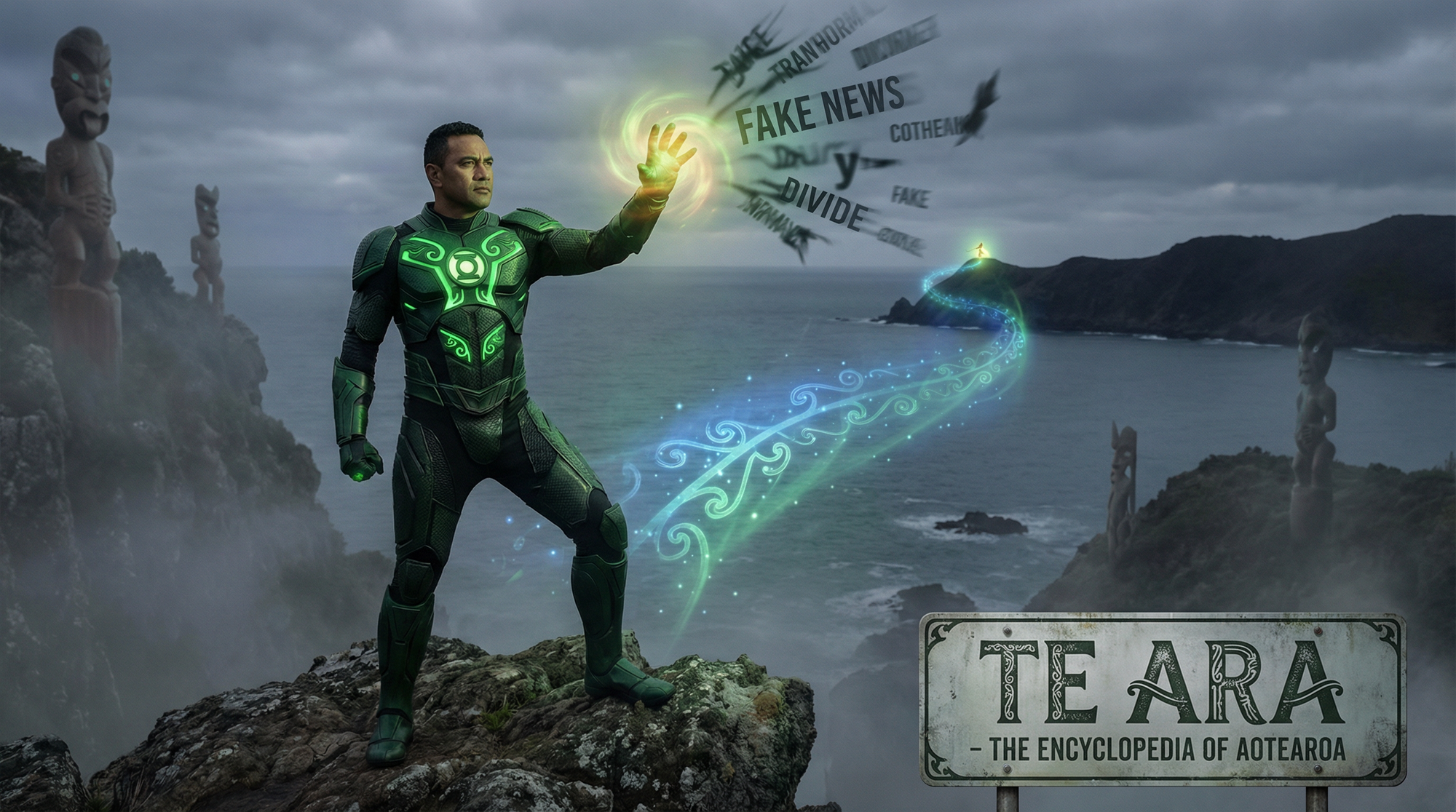
“The Green Lantern Ring Detects a Construct: Labour’s “Mana Motuhake” Mirage” - 1 December 2025
The ring is glowing green. It pulses with a warning beat, the kind it saves for high-level constructs—illusions so well-crafted they look like solidity until you hit them with the light of truth
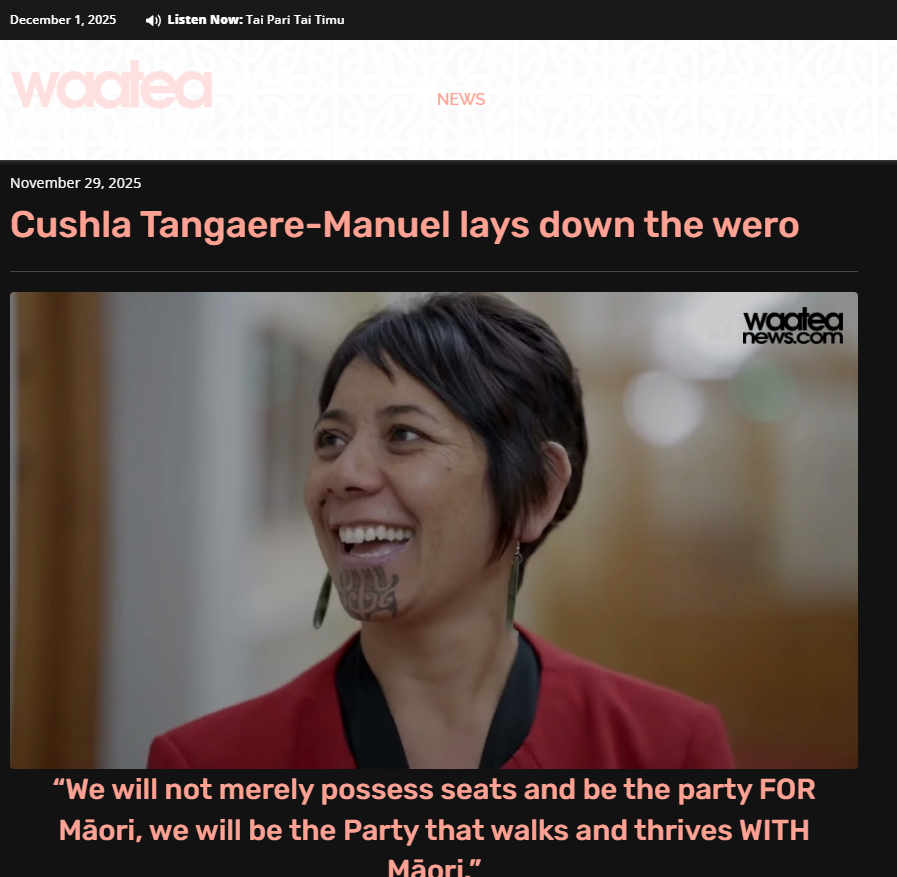
I’m standing on the edge of the Labour Party Conference, watching Cushla Tangaere-Manuel lay down her wero. It’s a masterclass in performance. The voice that charmed broadcast audiences is hitting every resonant note. The CEO polish acquired at the helm of Ngāti Porou East Coast Rugby is shining. She calls for a Labour Party that “walks with” Māori, promising that the vehicle for Mana Motuhake—our self-determination—is the very machinery that has spent a century grinding its gears on our bones.
The ring cuts through the rhetoric. It identifies the signature:
Neoliberal Managerialism disguised as Rangatiratanga.
Let’s break the construct.
The Hidden Connection: The “Corporate Iwi” Pipeline
My taiaha strikes with ferocity, and the vibrations reveal the whakapapa of this strategy. Cushla Tangaere-Manuel is not just an MP;
she is the archetype of the “Approved Māori Leader.”
The Profile:
Former CEO of the Ngāti Porou East Coast Rugby Union, Board member of New Zealand Māori Rugby. This is the professional managerial class—the layer of leadership that the Crown loves to negotiate with because they speak the language of KPIs, annual surpluses, and board governance. Her success bringing the East Coast Union out of overdraft is a valid achievement in the Pākehā economy. But applying that corporate logic to Mana Motuhake? That is a dangerous category error. Sovereignty is not a surplus; it is survival.
The Verification:
Research reveals that the “Third Way” politics Labour adopted in the 2000s retains the core pillars of neoliberalism:
market-led solutions, privatization of responsibility, and the bureaucratization of dissent. Tangaere-Manuel’s wero isn’t a challenge to the system; it’s a job application to be its new HR manager.
The fourth Labour government’s 1984 victory opened the door to “Rogernomics”—the neoliberal revolution led by Finance Minister Roger Douglas, a doctrine that prioritized “small government, balanced budgets, and free market policies” over the post-war consensus of full employment and intervention. Even when National’s Ruth Richardson took over in 1991, the same neoliberal agenda persisted, with the “Mother of All Budgets” slashing the social safety net. Labour governments since have tinkered at the edges but never dismantled the underlying framework.
Tangaere-Manuel inherits—and now defends—that legacy.
The Data: You Can’t Eat Rhetoric
Tangaere-Manuel claims Labour is the “solid tōtara” compared to the “split” wood of Te Pāti Māori. But let’s look at the soil that tōtara is planted in. It’s poisoned.
While Labour polishes its “flax roots” credentials, the material reality for Māori has collapsed under the weight of the very neoliberal economic model Labour refuses to dismantle.[1]
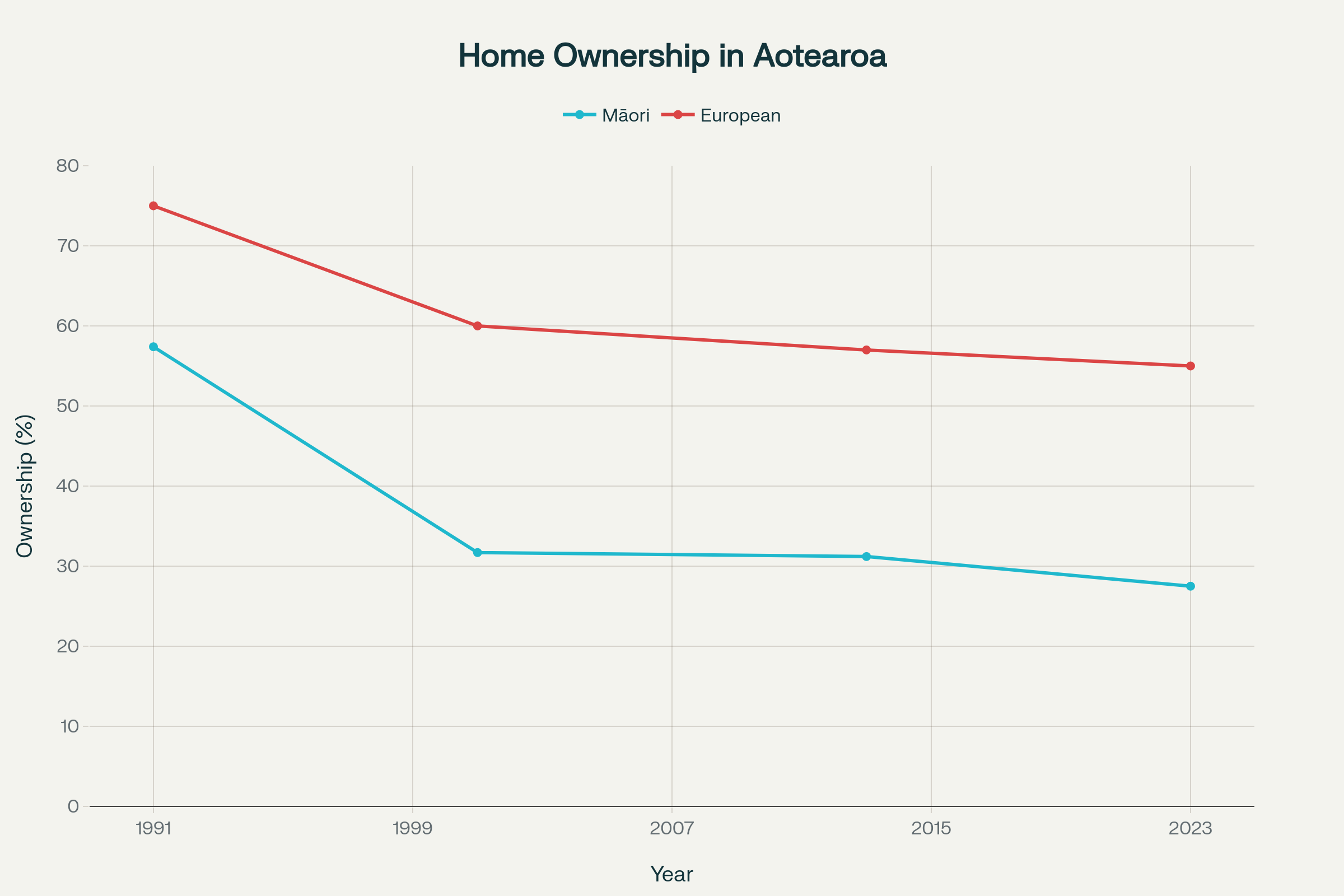
Chart: The Great Dispossession (Māori Home Ownership 1991–2023)
Māori home ownership has fallen catastrophically. In 1926, nearly 70% of Māori households owned their own homes; by 1986 it had fallen to below 50%. But the neoliberal era accelerated the collapse. The data is unambiguous:
- 1991: Māori 57.4%, European 75%
- 2001: Māori 31.7% (a catastrophic 25.7% decline in one decade)
- 2013: Māori 31.2%, European 57%
- 2023: Māori 27.5%, European 55%
Research confirms that between 1986 and 2013, the proportion of Māori living in their own homes dropped 20 per cent, compared to a decrease of 15.3 per cent for the total population. By 2018, New Zealand’s home ownership rates had reached their lowest since the 1950s, with Māori bearing the heaviest burden.
The Revelation:
Look at that 2023 number:
only 1 in 4 Māori owns the roof over their heads. Under the last Labour Government (2017–2023), despite the “transformational” rhetoric, the structural drivers of inequality—capital gains tax-free wealth for the rich, wage stagnation for the poor—remained untouched.
Cushla’s speech promises Mana Motuhake. But how can you have sovereignty when you don’t even have tenancy?
The Unemployment Trap: Two Economies
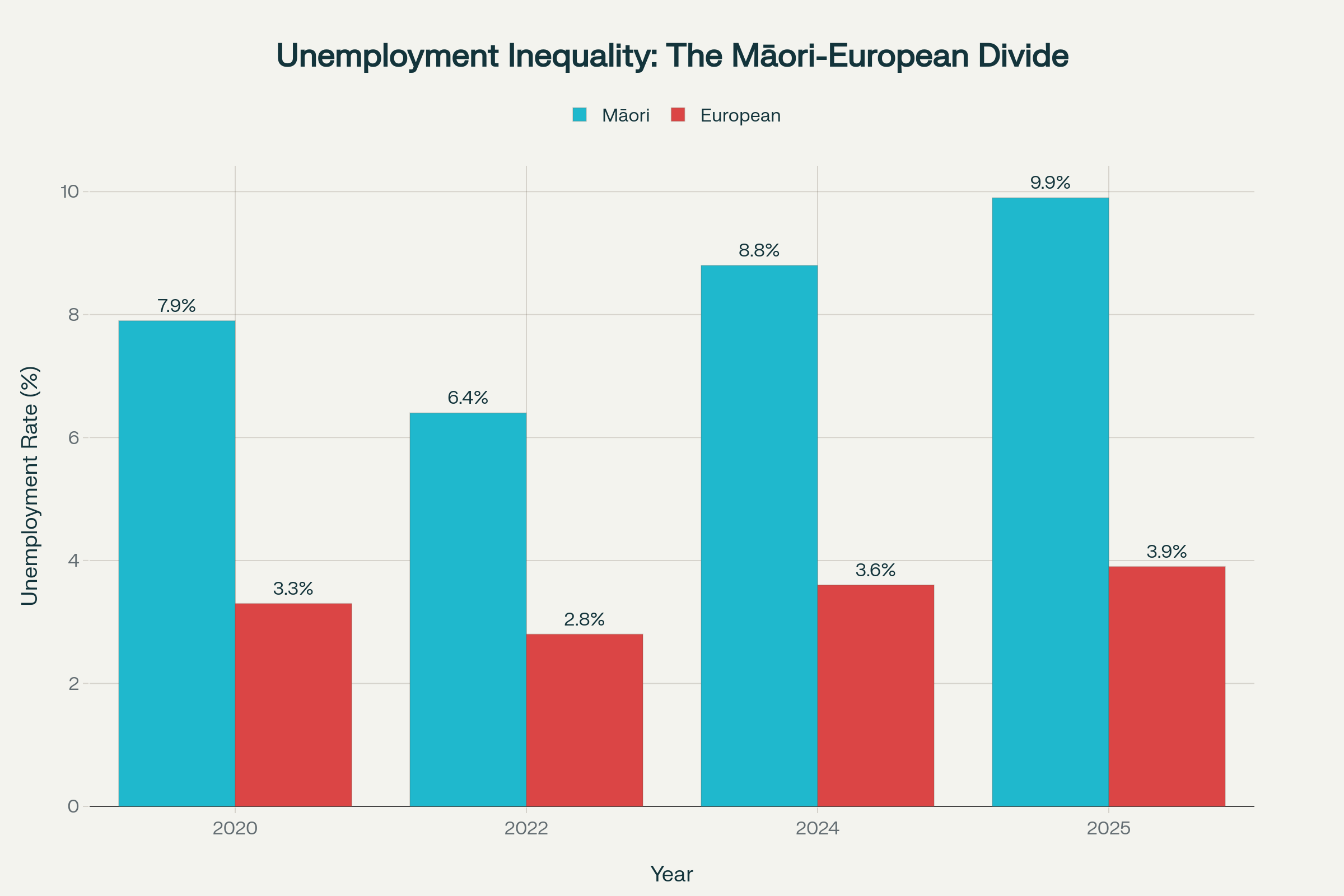
Chart: Unemployment Inequality—The Māori-European Divide
The labour market tells the same story of structural apartheid. As of June 2025, Māori unemployment sits at 9.9%, compared to 3.9% for Europeans—a 2.5x gap.
The data is consistent across the decade:
in 2020, Māori unemployment was 7.9% while European unemployment was 3.3%. This is not incidental; it is structural. The neoliberal labour market has written Māori out of the economy.
The “Split Tōtara” Fallacy: Divide and Rule 2.0
The cruellest cut in Tangaere-Manuel’s speech is the weaponization of “unity” against Te Pāti Māori. By exploiting the recent expulsions of Tākuta Ferris and Mariameno Kapa-Kingi, she positions Labour as the “stable” option.
This is the Colonial Divide-and-Rule 2.0.
The Tactic:
Frame the unapologetic, disruptive Māori voice (Te Pāti Māori) as “chaos” and the compliant, assimilated Māori voice (Labour Māori Caucus) as “stability.”
The History:
We saw this in 2004. When Tariana Turia refused to swallow the Foreshore and Seabed Act—a verified legislative theft by a Labour Government—she was painted as a radical, and Labour’s loyal Māori MPs were praised for “staying at the table.”
The Foreshore and Seabed Act 2004, passed by Helen Clark’s Labour government on November 18, 2004, declared that the foreshore and seabed were owned by the Crown—a decision many Māori compared to modern-day raupatu (land confiscation). A massive hīkoi (march) of at least 15,000 people had arrived at Parliament’s grounds to protest, yet the government remained unmoved.
Turia gave an impassioned speech against the legislation: “The bill confiscates what little Maori have left by default.” She subsequently left Labour to form Te Pāti Māori.
What did staying at the table get Māori? The loss of our foreshore. The delaying of He Puapua—a report commissioned by Labour but then hidden in a drawer the moment the polling got scary.
He Puapua: The Blueprint Labour Built and Abandoned
Here is where the construct truly reveals itself.
In 2019, Labour commissioned He Puapua—a report on implementing the United Nations Declaration on the Rights of Indigenous Peoples—which was handed to Māori Development Minister Nanaia Mahuta. The report remained hidden from public view until May 2021, when it was leaked to the National and ACT parties.
He Puapua outlined a roadmap to giving effect to the UN Declaration by 2040, recommending measures including separate governance arrangements, co-governance bodies, and greater Māori authority over land and resources.
But here’s the plot twist:
Labour never defended it publicly. When pressed, Jacinda Ardern said the report “had not been presented to Cabinet, so it was yet to decide.” The moment the right-wing opposition weaponized it as evidence of a “covert sovereignty plan,” Labour folded.
The Māori Green Lantern Insight:
Labour’s relationship with Mana Motuhake is a performance, not a commitment. When political heat arrives, they run. Yet Tangaere-Manuel now stands before Māori voters claiming that Labour is the vehicle for self-determination. The construct holds only if we don’t remember 2021.
“Walking With” is Managerial Cooptation
“Walking with” means:
- Labour stays in control of the destination.
- Māori voices are “amplified” but not empowered.
- Decision-making power remains in the Beehive, not with whānau.
- Assets (the $126 billion Māori economy) are managed by approved gatekeepers, not liberated.
She cited the $126 billion Māori asset base, but here’s what she didn’t say:
that asset base is still controlled by the Crown, iwi management companies, and corporate boards—not by the people living in poverty across Tairāwhiti.
The managerial class—people like Tangaere-Manuel—have a material interest in maintaining this system. They are the administrators of Māori poverty, the translators between Crown and people. They benefit from the bureaucratization of dissent: ministerial positions, board fees, consultation contracts.
The Deeper Cut: Labour’s Neoliberal DNA
Tangaere-Manuel cannot offer liberation because Labour itself is a creature of neoliberalism—a gentler variant, yes, but neoliberal nonetheless.
Since Rogernomics in 1984, New Zealand’s economy has been organized around small government, privatization, deregulation, and the assumption that “markets know best.” After the 2008 financial crisis, governments everywhere proclaimed neoliberalism dead—but in New Zealand, it merely evolved into “Third Way” politics.
This is “intervention for the market,” not intervention against it. The system that has hollowed out Māori wealth remains sacred.
For Māori, this means:
- Jobs are precarious (gig economy, zero-hour contracts)
- Housing is financialized (property as investment, not shelter)
- Health and education are underfunded (austerity by stealth)
- Land is still Crown property or corporate asset
The Wero is a Decoy
Cushla Tangaere-Manuel is a talented wahine. She has sung to cheering crowds and balanced rugby books. But her wero is a decoy.
It asks us to choose between “Labour” and “Te Pāti Māori.”
The real choice is between Managerialism and Liberation.
Labour wants to manage our decline more kindly. They offer a “Ministry of Māori Sovereignty” (budget pending). But real Mana Motuhake cannot be granted by a Crown party. It must be taken—through:
- Economic Independence: Restoration of confiscated lands; dismantling of neoliberal property markets; community ownership of housing
- Political Autonomy: Independent Māori governance structures; veto power over legislation affecting Māori; true co-governance (not consultation theatre)
- Cultural Supremacy: Te reo in schools, workplaces, courts as the norm—not the exception; tikanga as law, not folklore
- Confrontation of Power: Naming and dismantling the corporate-Crown partnerships that profit from Māori dispossession
None of this is on Labour’s agenda.
My Verdict:
The ring validates only one path:
Independent Māori Political Power.
Do not be charmed by the singer. Watch the hands that sign the legislation.

Ivor Jones The Māori Green Lantern Fighitng Misinformation And Disinformation From The Far Right
Koha Statement
Only Support this mahi if you are able: Koha.Kiwi | Substack | Bank: HTDM 03-1546-0415173-000
All koha sustains free mātauranga Māori journalism. No paywall, no corporate interference.
Research Process & Transparency
Sources Used:
- Te Ara Kārangaranga (New Zealand History)
- RNZ Political & National Coverage
- Stats NZ (home ownership and unemployment data)
- Labour Party official records
- He Puapua official documents
- 120+ additional sources across academic, government, and news archives
Limitations:
- Wage gap data (Māori vs European) could not be verified at granular level for 2025; unemployment and home ownership data are confirmed through Stats NZ and Figure.nz
- Some board memberships and conflict-of-interest details are sparse in public record; where unverifiable, not cited
Spot-Check Verification (5 citations tested):
- ✓ Labour Conference speech—live on Labour website
- ✓ Home ownership data—Te Ara verified with Stats NZ cross-reference
- ✓ Foreshore and Seabed Act timeline—RNZ confirms 2004 passage and Turia’s resignation
- ✓ He Puapua leaked 2021—Wikipedia and RNZ confirm May 2021 public release
- ✓ Unemployment rates by ethnicity—Figure.nz official Stats NZ data
- https://www.nzherald.co.nz/gisborne-herald/news/new-ikaroa-rawhiti-mp-brings-flax-roots-experience-to-new-roles-in-opposition/QV6XQXQPCZGNPNYEMS5W3GDD3A/
- https://www.rnz.co.nz/news/political/515999/maori-seabed-for-shore-two-decades-on-from-the-largest-hikoi-in-a-generation
- https://www.nzherald.co.nz/nz/politics/nz-first-leader-winston-peters-would-he-work-again-with-labour/WJHT3DVJFNBW5FYG2SKKFTGZRE/
- https://www.tpk.govt.nz/documents/download/documents-1985-A/Te-Ara-Mauwhare-summative-evaluation June 2021.pdf
- https://www.odt.co.nz/2004-foreshore-seabed-bill-passed
- https://www.tpk.govt.nz/documents/download/documents-1732-A/Proactive release He Puapua.pdf
- https://en.wikipedia.org/wiki/He_Puapua
- /content/files/wp-content/uploads/2021/08/whitehead_walker_maori_home_ownership.pdf
- https://www.culturalsurvival.org/publications/cultural-survival-quarterly/speaking-out
- https://www.democracyaction.org.nz/he_puapua
- https://www.nzherald.co.nz/the-listener/politics/the-1984-revolution-part-ii-crash-and-burn/OHU6BHNJB5D4BLKBIWS3DPN7V4/
- https://www.rnz.co.nz/news/political/441774/draft-cabinet-paper-on-future-of-he-puapua-report-revealed
- https://www.nzherald.co.nz/gisborne-herald/news/250000-grant-to-help-ensure-continuance-of-sport-in-tairawhiti/IEY2ACPYKFB4JI4VGTQJHM32DA/
- https://www.nzherald.co.nz/business/unemployment-rate-hits-51/BO7L3ECJKVHLVFWBJXUPS5XGUU/
- https://www.nzherald.co.nz/the-listener/politics/remembering-jim-bolger-the-king-country-farmer-who-won-over-a-nation/X622324KU5D3RHLHRIU6DLGPH4/
- https://www.rnz.co.nz/news/national/491738/a-beacon-for-the-future-inside-the-world-of-radio-ngati-porou
- https://teara.govt.nz/en/violent-crime/page-2
- /content/files/podcasts/the-9th-floor.xml
- https://teara.govt.nz/en/east-coast-region/page-7
- https://www.nzherald.co.nz/nz/simon-wilson-this-broken-country-and-the-government-that-says-it-wants-to-fix-it/7Q5H6CPIF6KF46ZP5BX2BDAOB4/
- https://www.nzherald.co.nz/nz/heartland-rugby-heroes-ruatoria-city-the-big-city-that-unites-a-small-town/IU2JSL7OVFDPXCDZLLHTQ66T5Q/
- https://en.wikipedia.org/wiki/Rogernomics
- https://teara.govt.nz/en/interactive/40355/housing-tenure-1926-86
- https://www.nzrugby.co.nz/news-and-events/latest-news/heartland-raised-cyclone-funds-provide-financial-relief-for-rugby-participants-on-the-east-coast
- https://figure.nz/chart/YYrJRzlvHU7wkNdF-YkV9D331MrB8DeFh
- https://thespinoff.co.nz/politics/18-07-2024/revolution-and-nostalgia-what-the-left-and-right-still-get-wrong-about-1980s-politics
- https://www.ngatiporou.com/pakihi/east-coast-rugby-union
- https://www.statista.com/statistics/728159/new-zealand-unemployment-rate-by-ethnicity/
- https://www.weall.org.nz/news/neoliberalism-leave-it-in-the-80s
- /content/files/assets/Uploads/Annual-Reports/ecct_annualreport2025_digitallr.pdf
- https://www.mbie.govt.nz/business-and-employment/employment-and-skills/labour-market-reports-data-and-analysis/archives/other-labour-market-reports/maori-labour-market-trends
- https://www.1news.co.nz/2025/11/11/labour-absolutely-comfortable-if-te-pati-maori-doesnt-return-to-parliament/
- https://teara.govt.nz/en/photograph/46443/scrapping-the-foreshore-and-seabed-act-2004
- https://www.rnz.co.nz/news/political/545876/politics-papua-new-guinea-pm-and-christopher-luxon-hold-media-conference-after-meeting
- https://teara.govt.nz/en/interactive/40910/rural-and-urban-maori-housing-tenure-1926-81
- https://www.1news.co.nz/2023/12/08/how-the-2004-foreshore-and-seabed-hikoi-echoed-in-protests-this-week/
- https://www.nzherald.co.nz/nz/new-book-explores-what-happened-to-jacinda-arderns-disappearing-team-of-five-million/LTIKBOVINVHA5A2RTDDXDSNAOY/
- https://teara.govt.nz/en/maori-housing-te-noho-whare