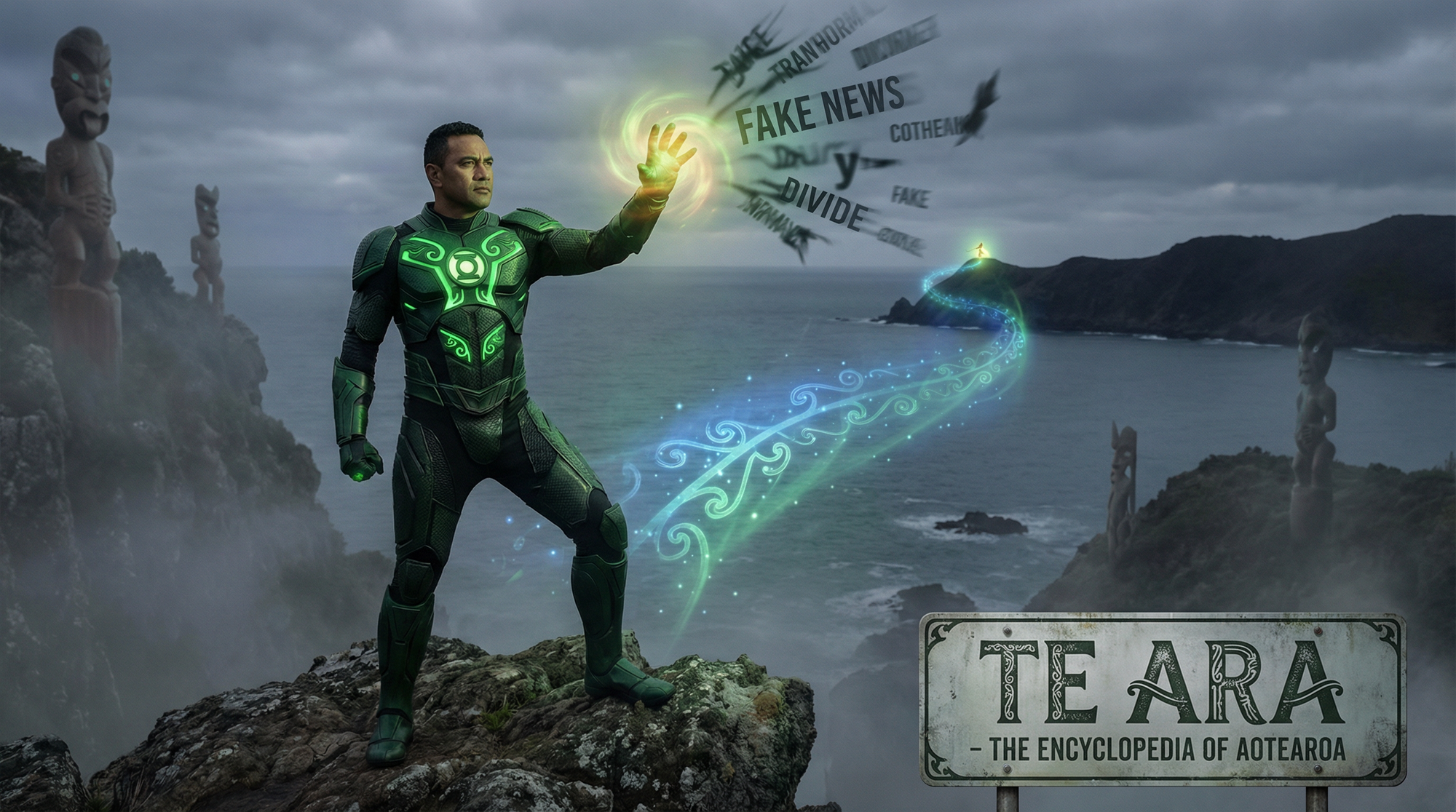
“The Herald’s Neoliberal Theatre: How NZME Launders Taxpayers’ Union Propaganda While Aotearoa Burns” - 6 December 2025
Matthew Hooten,The Taxpayers Union And NZME Are Corrupt To The Core
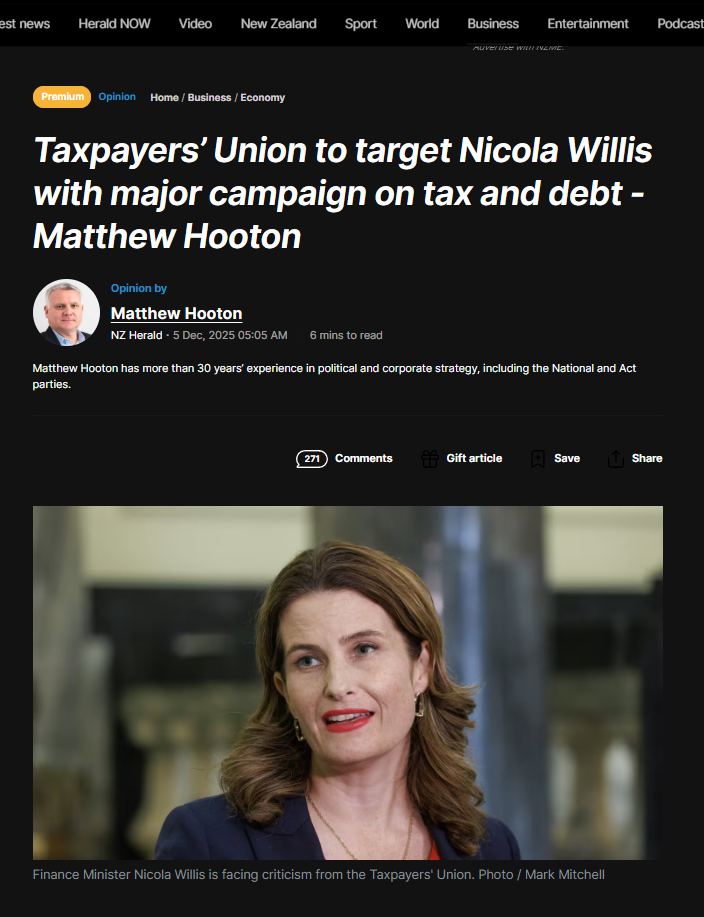
Paywalled article for download
Mōrena koutou,
The stench of manufactured outrage wafts from Matthew Hooton’s December 5, 2025 column published by the NZ Herald—a shameless advertorial masquerading as journalism, weaponising the discredited Taxpayers’ Union to attack Finance Minister Nicola Willis while conveniently omitting the colonial violence embedded in every word.
This isn’t reporting—it’s ideological warfare, underwritten by tobacco money and Atlas Network connections, deployed to manufacture consent for deeper neoliberal cuts while Māori health, education, and housing initiatives are systematically dismantled.
The article breathlessly announces the Taxpayers’ Union will launch its “biggest and toughest campaign” against Willis, calling it an attack on an “ostensibly friendly target.”
Yet Hooton—who admits over 30 years working with National and ACT parties—fails to disclose his own conflicts or interrogate the Union’s funding sources. This is journalistic malpractice masquerading as analysis.

NZME Editorial Infrastructure Capture
Cui Bono? Follow the Money, Follow the Deception
The Taxpayers’ Union, founded by lawyer Jordan Williams and National Party pollster David Farrar, now chaired by neoliberal architect Ruth Richardson, is no grassroots taxpayer advocate.
It is a corporate influence operation.
The tobacco connection alone disqualifies this outfit’s credibility. As RNZ revealed in July 2025, leaked industry documents show Philip Morris International strategically funded front groups to advance its agenda. The Health Coalition Aotearoa has confirmed that the Taxpayers’ Union received substantial funding from British American Tobacco. When Jordan Williams admits less than 3% of funding comes from “sugar, grog, soda, and regulated industries”—including tobacco—he’s admitting the Union exists on corporate money while pretending to speak for ordinary taxpayers.
The Taxpayers’ Union is an official partner of the Atlas Network, a global right-wing network funded by Koch money and ExxonMobil that channels corporate interests through “independent” think tanks to erode workers’ rights, deny climate change, and privatise public services. This isn’t coincidence—it’s systematic infiltration.

NZME, the Herald‘s owner, is itself compromised. Billionaire oil-and-gas investor James Grenon has purchased a 9.3% stake and is demanding editorial control, openly stating his goal to reshape the newspaper’s political stance. NZME’s own board warns that Grenon’s move risks “editorial control” and threatens editorial independence. The journalists’ union E tū has expressed deep concern about “undue influence” and “a shadowy cabal, backed by extreme wealth, planning to take over” this democratic institution.

NZME’s compromised editorial infrastructure controls NZ media narrative
Yet here is NZME platforming a Taxpayers’ Union campaign without disclosing any of these entanglements—giving free publicity to a lobby group with direct ties to industries that profit from Māori ill-health and a network that systematically dismantles public services. This is not journalism. This is propaganda infrastructure.
The Fake Crisis: Manufacturing Fiscal Panic to Justify Cuts
Hooton’s piece parrots Union talking points:
Willis is “taxing, spending and borrowing more than Robertson,” bureaucrat numbers “still sit at around 63,000,” and debt is spiralling out of control. Each claim either distorts reality or deliberately obscures the colonial violence underlying neoliberal “fiscal discipline.”
On Borrowing: A Manufactured Crisis
The article claims Willis will borrow “$2.7 billion more in 2025-26 than Robertson did in 2023-24.” This framing is deliberately deceptive. Treasury’s Budget 2025 documents show net core Crown debt at 41.8% of GDP as of June 2025—steady year-on-year, and well below Treasury’s prudent threshold of 50%. Gross debt will rise to $283 billion by 2029—but this is after COVID-19 emergency spending that prevented mass death, and includes infrastructure investment this government refuses to adequately fund for Māori communities.
The Taxpayers’ Union and Hooton rage against “government debt” as if all spending is equally wasteful. But this obscures a critical truth: the real question is what we borrow for. Labour’s borrowing funded healthcare, education, and emergency income support during a pandemic. Willis’s borrowing primarily services wealthy households through tax cuts that benefit National and ACT voters.
On Bureaucrats: The Lie Gets Bigger
The Union and Hooton rage at “around 63,000” public servants. Yet Public Service Commission data shows 62,654 FTEs as of June 2025—down 1.4% from 63,537 in June 2024, and down 4.2% from the December 2023 peak. This after the government eliminated 14,000 public service roles. The Union’s complaint about bureaucrats mirrors neoliberal playbook language: frame public services as “waste” to justify privatisation.
But here’s what they won’t tell you: those 62,654 public servants include nurses, doctors, teachers, social workers, and Māori health providers. Cuts to “bureaucrats” mean cuts to whānau health clinics, te reo support in schools, and Kainga Ora housing maintenance. The Taxpayers’ Union knows this. They don’t care. They want the state smaller so corporations and wealthy elites face fewer regulations and pay lower taxes.
On Prices: The Real Scandal They Ignore
Hooton’s article does cite real inflation pain:
“the cheapest brand of milk was up 13.5% over the last year, the cheapest eggs up 18.5%, the cheapest instant coffee 25.5% and the cheapest cheese 30.1%.” This is a crisis—but not because of “government spending.”
This is corporate oligarchy.
As Treasury and the Commerce Commission have documented, New Zealand’s supermarket oligopoly (Countdown, Pak’nSave, New World—all dominated by two corporations), electricity monopoly, and banking oligopoly extract monopoly rents while wages stagnate. The Willis government has made glacial progress on breaking these oligopolies. Yet the Taxpayers’ Union does not demand antitrust action or price controls—it demands tax cuts for the wealthy and cuts to public services that Māori depend on.
This is the neoliberal bait-and-switch:
manufacture crisis (inflation, debt), blame government, demand cuts to services, transfer wealth upward.
The Colonial Violence They Won’t Name
Here’s what the Herald article entirely omits:
this government’s systematic dismantling of Māori health, education, and housing initiatives.
Health: Defunding Whānau Ora
The government eliminated targeted Māori health initiatives and defunded Whānau Ora—community-led health responses that had begun closing the equity gap. Māori leaders described the 2024 budget as “the Mother of anti-Māori budgets”. Māori health outcomes are deteriorating. Yet the Taxpayers’ Union and Herald focus on “government waste”—a coded attack on services Māori built and relied upon.
Education: Dismantling Te Reo and Kaupapa Māori
The government slashed targeted Māori education funding while claiming a “boost.” Te reo Māori initiatives were defunded. Kaupapa Māori schools—education spaces designed around Māori worldviews and te reo—face funding uncertainty. Yet Hooton and the Herald platform “fiscal responsibility” arguments that translate to defunding indigenous education.
Housing: Kainga Ora Decimated
The government slashed Kainga Ora funding, eliminating community housing programmes that served Māori whānau. Homelessness is rising. Yet the Taxpayers’ Union demands more cuts, not redistribution of wealth captured by private landlords and property speculators.
The Treaty Violation
Legal experts and iwi leaders have rejected the government’s Regulatory Standards Bill as a breach of Te Tiriti. The government has systematically dismantled co-governance arrangements and attempted to undermine the Waitangi Tribunal. Yet Hooton’s article frames fiscal “discipline” as neutral technical debate, erasing the colonial violence encoded in every spending cut to Māori services.
The Propaganda Infrastructure: How Polling Gets Weaponised
Hooton mentions that “next week” the Taxpayers’ Union will release its “planned assault” against Willis, and that “the next Taxpayers’ Union poll, conducted by Farrar’s Curia, also due next week” will be critical. This is where the infrastructure becomes transparent.
Curia, David Farrar’s polling firm, is not independent. Curia resigned from the Research Association of New Zealand after being exposed for inadequate polling methods. Farrar has openly stated that when polling for private clients, their aim is to “achieve a specific outcome”—not measure reality, but construct it.
Multiple media analysts have documented that Curia’s polls on policy questions use biased framing designed to favour right-wing positions. Their polls on Māori issues, freedom of speech, and “country direction” consistently show manufactured crises. Yet RNZ, the Herald, and other outlets uncritically cite Curia data, giving propaganda the appearance of research.

Billionaire Media Capture
The Taxpayers’ Union’s Credibility Problem: Fake Identities
The Taxpayers’ Union has a documented history of using deception. In 2018, the NZ Herald and RNZ revealed that the Taxpayers’ Union used fake identities to file Official Information Act requests. The Ombudsman investigated, and the Union defended the deception as “in the public interest.” This was not a mistake. This was systematic manipulation.
Yet the Herald continues to platform this outfit as a credible voice on fiscal policy. This is complicity in propaganda.
Who Really Benefits? Follow the Wealth Transfer
While Hooton and the Taxpayers’ Union denounce Willis for “borrowing more,” they remain silent on who actually benefits from government spending:
- Tax cuts disproportionately benefit high earners. The Willis tax cut package delivers more than 50% of benefits to the top 20% of earners.
- Supermarket oligopolies and landlords extract $billions in monopoly rents while inflation drives working Māori and Pacific families into homelessness.
- Private equity and oil-and-gas investors (like Grenon, now controlling NZME) lobby for deregulation and tax cuts while climate impacts devastate Pacific nations and Māori-majority regions.
- Neoliberal “reforms” by Ruth Richardson in 1991—the “Mother of All Budgets”—transferred wealth from workers and Māori to business owners, slashed public services, and created the inequality crisis we face today.
The Taxpayers’ Union, Atlas Network, and Herald are not concerned with fiscal responsibility. They are concerned with upward wealth transfer disguised as austerity.
What’s Really Happening: The Playbook
This December 2025 Herald piece follows a predictable neoliberal playbook:
- Manufacture crisis narrative (debt! spending! inflation!)
- Blame the government (not corporations, not oligopolies, not tax cuts)
- Demand austerity (cuts to “waste”—i.e., public services)
- Platform “independent” voices (Taxpayers’ Union, Curia polls, think tanks)
- Erase whose interests are served (wealthy, corporations, Grenon’s oil-and-gas portfolio)
- Erase colonial violence (cuts to Māori services are framed as “neutral” fiscal policy)
Each step requires complicit media. The Herald, under pressure from billionaire investors like Grenon and editorial leaders allied with establishment politics, has become a platform for this propaganda. Hooton, with 30 years’ experience in political lobbying, knows exactly what he’s doing: selling austerity as necessity.
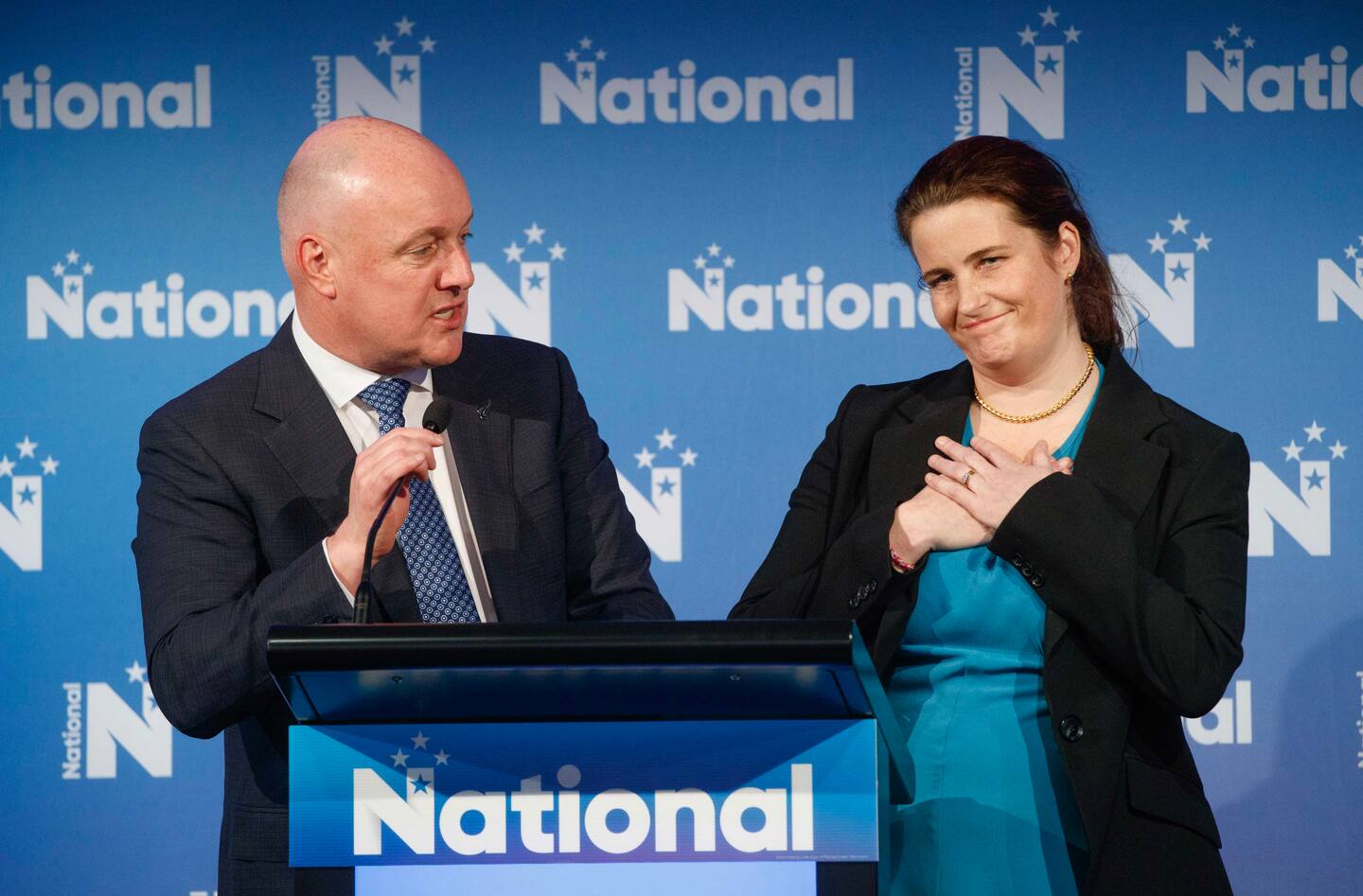
The Real Conversation Willis and Luxon Won’t Have
New Zealand faces genuine fiscal challenges—but not the ones Hooton names. The real issues are:
- Corporate tax avoidance: New Zealand’s effective corporate tax rate is among the lowest in the OECD.
- Wealth inequality: The top 1% now owns more than the bottom 50% combined.
- Housing as speculation: Private landlords and foreign investors extract wealth from Aotearoa while Māori whānau live in vans.
- Monopoly pricing: Supermarkets, electricity, banking, and telecommunications oligopolies extract billions in monopoly rents.
- Climate costs: Deferred action on climate change will cost far more than early investment—and will devastate Māori and Pacific communities first.
Real fiscal responsibility would demand:
- Wealth taxes and closing tax havens
- Breaking corporate oligopolies through antitrust action
- Reinvesting in public health, education, and housing
- Free dental, mental health, and prescription medications
- Restoring targeted Māori health and education initiatives
- Honouring Te Tiriti through genuine co-governance

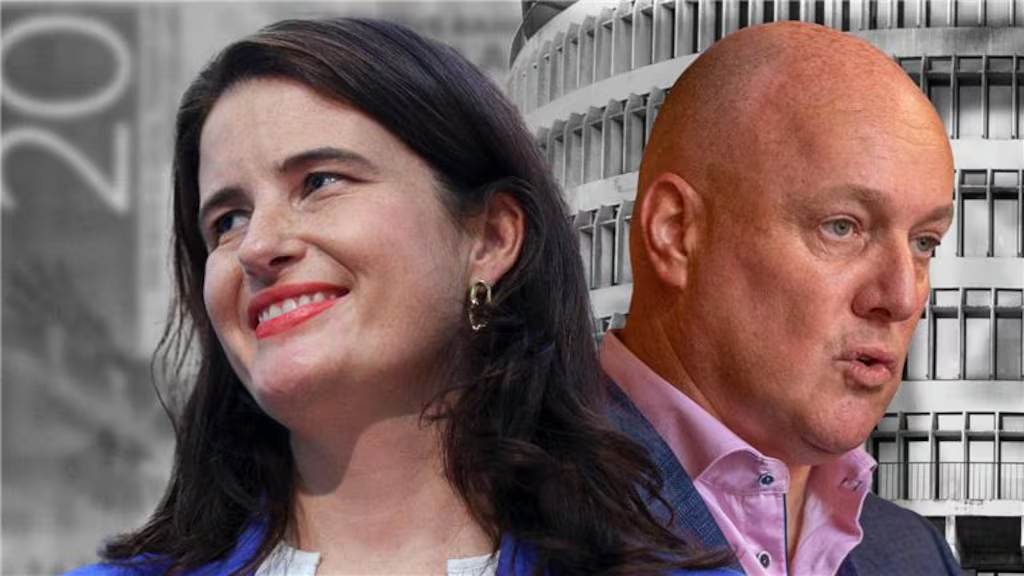
Instead, Willis, Luxon, and their advisors choose neoliberal orthodoxy. The Taxpayers’ Union demands the same. Hooton’s column sells it. The Herald gives it a platform. And Māori communities pay the price.
Recognise the Propaganda, Reject the Theatre
Matthew Hooton’s December 5 Herald column is not analysis. It is propaganda—funded by tobacco money, shaped by Atlas Network ideology, channelled through Curia’s biased polling, and amplified by a media company compromised by billionaire ownership.
When you see “the Taxpayers’ Union” quoted as an independent voice, remember:
it receives tobacco funding, partners with a global right-wing network, uses fake identities to manipulate OIA requests, and serves billionaires’ interests.
When you see Curia polls presented as research, remember:
its founder openly admits his goal is to “achieve a specific outcome,” not measure reality.
When you see the Herald attacking Willis for “borrowing more,” ask:
who benefits from the tax cuts? Who loses from the spending cuts? Whose services are being defunded?
The answer is always the same:
Māori and working-class whānau lose. Wealthy individuals, corporations, and billionaire investors win.
This is not fiscal responsibility. This is colonial violence dressed in neoliberal language.
Reject it. Demand better. Build rangatiratanga—genuine Māori autonomy and self-determination—outside the systems that profit from our dispossession.

Ivor Jones The Māori Green Lantern Fighting Misinformation And Disinformation From The Far Right
Kia kaha, whānau. This taiaha is forged.
Published December 6, 2025
By Ivor Jones, Te Māori Green Lantern