“The Hidden Oligarchy: How 17 Landlords Control 1,000+ Christchurch Rentals While Whānau Struggle for Shelter” - 24 November 2025
The Earthquake Profiteers
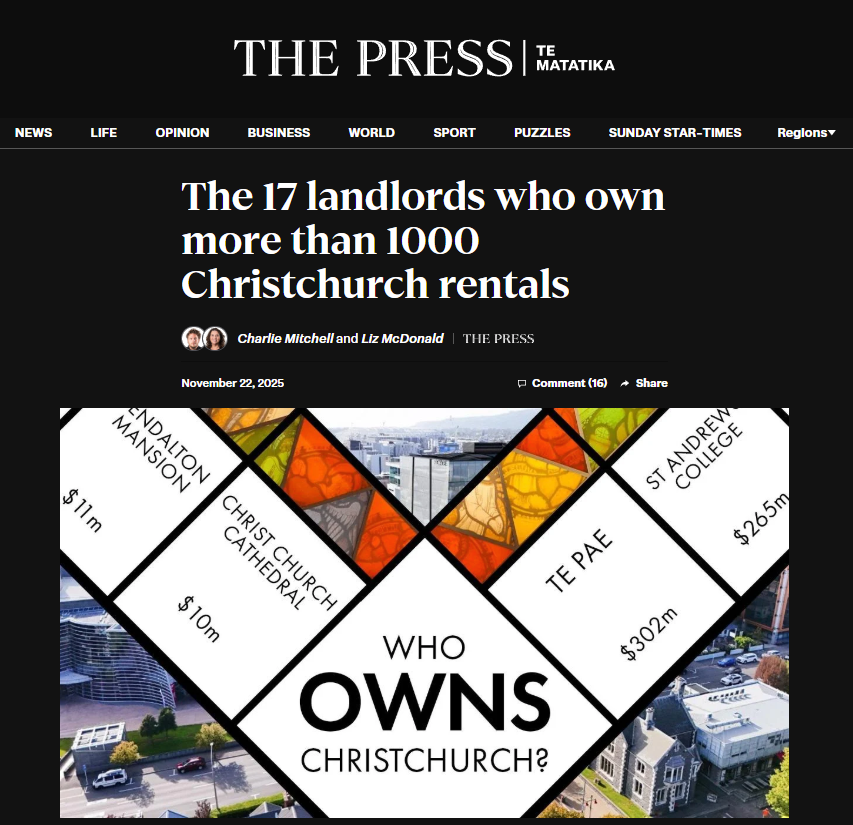
While Christchurch continues recovering from devastating earthquakes that destroyed thousands of homes, a small oligarchy has quietly accumulated vast rental empires on the ruins.
The Press investigation reveals that just 17 landlords control over 1,000 Christchurch rental properties—an extraordinary concentration of housing wealth that directly undermines whānau housing security and perpetuates economic apartheid in Te Waipounamu’s largest city[1].
At the apex of this oligarchy sits Liz Harris, Christchurch’s most prolific landlord, who controls approximately 170 rental properties housing roughly 700 tenants[1]. Her portfolio includes large apartment blocks, townhouses, a lodging house, commercial holdings in New Brighton, prime central city land, and a vast Fendalton property[1]. Harris has been accumulating property for nearly 40 years, starting “through necessity” but continuing down the property path to build what can only be described as a rental monopoly[2].
Harris is not alone. The 17 landlords identified by The Press collectively wield extraordinary power over Christchurch’s housing market, determining who gets shelter, at what price, and under what conditions.
This investigation exposes five critical hidden connections that reveal how post-earthquake Christchurch became a laboratory for wealth extraction from the vulnerable.
Background: The Earthquake Created the Opportunity
The Destruction That Enabled Accumulation
The 2010-2011 Canterbury earthquakes were catastrophic for housing. Close to 8,000 homes were zoned ‘red’ as uneconomic to repair, and a further 4,200 were rendered uninhabitable—representing 6.2% of Greater Christchurch’s housing stock[3]. Approximately 1,000 social housing units (from Council, Housing New Zealand, and community providers) were destroyed or declared earthquake-prone[3].
The loss fell disproportionately on the city’s most affordable housing stock. Large swathes of the most affordable housing in the east of the city were effectively destroyed[4].
This was not random—it was structural violence encoded in land use patterns, where Māori and low-income whānau were concentrated in areas with the worst liquefaction risk.
The Rent Explosion
Median rents rose 14% in Christchurch city after June 2010, with surrounding Selwyn and Waimakariri districts seeing increases of 11% and 19%—compared to a national average of just 7%[5]. By February 2014, median rent in Canterbury was only $20 below Auckland’s[3]. Overall Christchurch rents increased 23% between 2010 and the time of the post-earthquake housing study[4].
This rent explosion occurred precisely when displaced residents, including whānau who had lost everything, desperately needed affordable housing. Instead of a compassionate response, they encountered a market ruthlessly optimized for wealth extraction.
Who Benefited?
Investors recognized the opportunity immediately. The influx of insurance assessors, project managers, and rebuild workers created “a new high-rent sub-market“ catering to workers who “were not very price sensitive”[4]. Higher rental returns attracted property investors, driving further acquisition. Landlords displaced from their own homes evicted tenants to occupy their rental properties, compounding the housing crisis for renters[3].

The shadow of concentrated landlord ownership looms over Christchurch whānau seeking affordable housing
This was disaster capitalism in its purest form:
those with capital bought cheaply from desperate sellers, then extracted maximum rent from desperate tenants.
The Tikanga Violations
From a mātauranga Māori perspective, this concentration of housing ownership represents systematic violations of core tikanga principles:
- Manaakitanga (hospitality, care for others):
These landlords accumulate shelter—a basic human need—as investment portfolios. Harris herself has publicly complained about the cost of replacing hot water cylinders, suggesting the Council should reimburse her[6], prioritizing her investment returns over tenant wellbeing.
- Kaitiakitanga (guardianship): True kaitiaki hold resources in trust for future generations. These landlords hold properties to extract maximum profit, not to serve community needs.
- Whanaungatanga (kinship, relationships): The landlord-tenant relationship in this model is purely transactional and extractive. There is no reciprocity, no shared obligation, no mutual care.
- Rangatiratanga (self-determination): Māori household home ownership rates were 28.2% in 2013 compared to 56.8% for European households[7]. When a tiny oligarchy controls vast rental stock, Māori whānau are systematically denied the ability to achieve housing security and build intergenerational wealth.
The concentration of property ownership is mauri-depleting: it extracts life force from communities to enrich individuals.
Analysis: Five Hidden Connections
Hidden Connection 1: The Kainga Ora Subsidy Pipeline
Kāinga Ora currently leases 2,153 properties from private landlords nationwide, spending $54.9 million annually from its $1.6 billion rental income on external landlord payments[8]. These leases provide landlords with guaranteed rent at market rate for 3-15 years, with some properties leased for over 23 years[8].
This creates a direct wealth transfer from the state to mega-landlords. Rather than building public housing that would create permanent public assets, Kāinga Ora enriches private landlords with taxpayer money. For Christchurch landlords with large portfolios, securing even a handful of Kāinga Ora leases provides guaranteed, risk-free income while they continue extracting market-rate or higher rents from other tenants.
The model is particularly perverse: Kāinga Ora’s ‘sustaining tenancies’ policy prohibits evicting problem tenants, yet when those tenants terrorize neighbors, Kāinga Ora pays thousands in tribunal-ordered compensation[9]. The agency hasn’t evicted a single tenant in three years[9], creating a situation where landlords receive guaranteed income while the state absorbs all risk and social costs.
Hidden Connection 2: The Trust Structure Concealment
Trust assets represent 22.4% of all household wealth in New Zealand—the second-largest asset class after owner-occupied housing[10]. This represents a massive increase from 7.6% in 2009-10[10]. Approximately 65% of assets held in trusts are non-financial, meaning predominantly property[10].
The Press investigation identifies Liz Harris with interests in companies including NHL Properties Limited and Wigram Lodge (2001) Limited[11]. This corporate structure provides:
- Tax optimization through income splitting across entities
- Liability protection—tenants harmed by negligent maintenance cannot easily pursue personal assets
- Opacity—the true scale of property empires remains hidden from public scrutiny
- Intergenerational wealth transfer mechanisms avoiding estate duties
For Māori whānau struggling to save a deposit while paying exorbitant rent to these landlords, such sophisticated wealth-preservation structures are completely inaccessible. The wealth gap becomes structural and permanent.
Hidden Connection 3: The Council Rates-to-Rent Profit Pump
Ōtautahi-Christchurch saw council rates increases of over 20% in some suburbs, with Westmorland experiencing a 66% rent increase since September 2020—third-highest nationally[12]. There is a “very strong theme” of council rates rises being passed through to higher rents[12].
This creates a perverse dynamic:
- Council raises rates to fund earthquake recovery and infrastructure
- Landlords with large portfolios immediately pass costs to tenants
- Rent increases exceed rates increases (landlords add profit margins)
- Renters bear the full cost plus landlord profit premium
- Landlords’ properties appreciate in value due to improved infrastructure
- Capital gains accrue entirely to landlords, not the renters who funded them
A landlord with 170 properties like Harris can absorb a rates increase across her portfolio, maintain economies of scale, and still extract profit. A whānau renting a single home has no such flexibility—they pay or face homelessness.
Hidden Connection 4: The Mega-Landlord Tax Advantage Network
National data reveals 346 landlords owned at least 200 properties each, receiving an average $1.3 million tax cut each over five years from interest deductibility restoration[13]. Approximately 80% of NZ rentals affecting 1.2 million renters are owned by just 26,000 people or companies[14].
While The Press investigation focuses on Christchurch’s 17 largest landlords, the national context reveals they’re part of a larger extractive class. Recent policy changes benefit them enormously:
- Restoration of mortgage interest deductibility (2024-2026)
- Reintroduction of 90-day no-cause evictions
- Reduced tenant rights to challenge rent increases
- Weakened healthy homes enforcement
These changes were described by tenants’ advocates as “obscene”[13], transferring wealth from vulnerable renters to already-wealthy property investors.
Hidden Connection 5: The Intergenerational Wealth Lock
Māori household home ownership was just 28.2% in 2013, compared to 56.8% for Europeans and 34.8% for Asians[7]. Pacific household ownership was even lower at 18.5%[7]. Meanwhile, the wealthiest 10% of New Zealanders control nearly 60% of the nation’s wealth, while the bottom half holds just 2%[15].
The Christchurch oligarchy perpetuates this divide through several mechanisms:
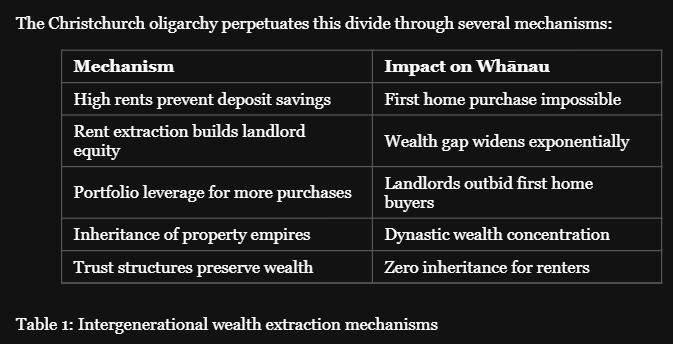
Research shows home ownership rates will fall from 60% currently to below 50% by 2048 based on current trends[16]. The number of over-65 renters is projected to double to over 600,000 by 2048[17]. This creates a permanent renter class—modern serfdom—with Māori and Pacific whānau disproportionately trapped in generational poverty.

The hidden wealth extraction system: taxpayer money flows from Kāinga Ora to enrich mega-landlords controlling Christchurch rentals
When 17 people control 1,000+ homes in a single city, they’re not providing housing—they’re operating a tribute collection system.
Implications: Quantified Harms and Power Imbalances
Economic Extraction at Scale
If each of the 1,000+ properties controlled by these 17 landlords generates a conservative $600/week median rent:
- Weekly extraction: $600,000
- Annual extraction: $31.2 million
- Over 10 years: $312 million flowing from tenants to 17 individuals
This excludes capital appreciation. Christchurch house prices increased 47% between 2010 and 2014 during the post-earthquake period[3]. If the 1,000+ properties averaged $500,000 value with 30% appreciation since acquisition, the oligarchy holds $650 million in property assets—wealth extracted from a housing crisis.
The Moral Hazard of Concentration
The case of Murray Lawrence Hill illustrates the dangers of concentrated landlord power. In November 2025, the Tenancy Tribunal ordered Hill to pay $33,000 in pecuniary penalties for severe breaches including failing to maintain properties to liveable standards despite repeated warnings[18]. Neighbors described Hill as “not the kind of guy that really wants to do the right thing”[18].
Yet Hill continues operating. When landlords control multiple properties, losing one through tribunal action or tenant complaint is merely a cost of doing business. For tenants, complaining risks homelessness. The power imbalance is absolute.
The Cui Bono Test
Who benefits from this system?
- The 17 landlords: $31.2 million annual income, $650 million asset appreciation
- Banks financing their mortgages: interest on hundreds of millions in lending
- Property managers: fees on thousands of tenancies
- Insurance companies: premiums on large portfolios
- Tax accountants and lawyers: fees for structuring complex trusts
Who bears the costs?
- 1,000+ tenant households paying market-or-above rents
- Christchurch ratepayers subsidizing infrastructure that enriches landlords
- Kāinga Ora (taxpayers) paying guaranteed rents to private landlords
- First home buyers priced out by investor competition
- Future generations inheriting a society of permanent renters
- Whānau denied intergenerational wealth-building through home ownership
The beneficiaries are few and wealthy. The harmed are many and vulnerable.
Fallacies Exposed
“Mum and Dad Landlords” Myth: While 72% of landlords may own only 1-2 properties, they control only 40.3% of rental housing[19]. The concentrated 28% who own 3+ properties control 59.7% of rentals[19]. In Christchurch, 17 landlords control 1,000+ properties—this is corporate-scale wealth extraction dressed in small-business rhetoric.
“Providing Housing” Myth: These landlords do not provide housing—they control access to existing housing. Data shows “next to no landlords are building new stock, only competing in the market with first home buyers”[20]. They are gatekeepers demanding tribute, not housing providers creating supply.
“Risk Justifies Returns” Myth: Landlords cite risk to justify high returns, yet Kāinga Ora provides guaranteed rent with 3-15 year leases[8], and landlords successfully pass all costs (rates, insurance, maintenance) directly to tenants[12]. The actual risk is minimal; the returns are guaranteed wealth extraction.
Toward Housing Justice and Rangatiratanga
The concentration of 1,000+ Christchurch rental properties in the hands of just 17 landlords represents structural violence against whānau housing security. This oligarchy emerged from the ruins of the Canterbury earthquakes, using disaster as opportunity to accumulate shelter and extract tribute from the vulnerable.
Actions for Rangatiratanga
Immediate:
- Demand The Press publish the full list of 17 names and their property counts—transparency is the first step toward accountability
- Support tenant advocacy groups challenging excessive rent increases through tribunal processes
- Organize tenant unions to collectively negotiate with large-portfolio landlords
- Document and publicize maintenance failures by mega-landlords through public complaint databases
Medium-term:
- Advocate for progressive property tax on portfolios exceeding 5 properties (1% on 6-10, 2% on 11-20, 5% on 20+)
- Push for beneficial ownership registers requiring disclosure of all property holdings including trust-held assets
- Demand Kāinga Ora cease enriching private landlords and redirect funds to building public housing
- Support iwi-led housing initiatives that restore kaitiakitanga over housing stock
- Campaign for inheritance tax on estates exceeding $2 million to prevent dynastic wealth concentration
Long-term:
- Build toward a constitutional right to adequate housing
- Establish maximum property ownership limits (e.g., no individual/entity may control more than 10 rental dwellings)
- Create publicly-owned rental housing stock managed by community trusts under tikanga principles
- Implement rent-to-own pathways that allow long-term tenants to acquire equity
- Restructure taxation to favor first home buyers over investors
The Moral Clarity
When 17 people control 1,000+ homes while whānau live in cars, garages, and overcrowded conditions, we are not witnessing a housing market—we are witnessing organized theft. These landlords did not create the houses. They did not build the infrastructure. They simply accumulated control over a basic human need and now extract maximum tribute.
Housing is shelter. Shelter is life. Those who hoard life itself while others freeze are not entrepreneurs—they are oligarchs presiding over a system of economic apartheid.
The Ring of the Māori Green Lantern shines brightest when it illuminates injustice. The 17 landlords of Christchurch stand exposed. The question now is: will we dismantle this oligarchy, or will we accept a future where our mokopuna pay tribute to landlord dynasties for the privilege of shelter in their own whenua?

Ivor Jones The Māoir Green Lantern Fighting Misinformation And Disinformation From The Far Right
Kia mau ki te rangatiratanga. Kia whakahoki te mana ki te iwi.
References
[1] Mitchell, C., & McDonald, L. (2025, November 22). The 17 landlords who own more than 1000 Christchurch rentals. The Press. https://www.thepress.co.nz/nz-news/360890052/17-landlords-who-own-more-1000-christchurch-rentals
[2] New Zealand Property Investors Federation. (2025, June 29). CPIA Women in Property. https://nzpif.co.nz/blog/event/cpia-women-in-property/
[3] Christchurch City Council. (2014). Housing Activity Management Plan. https://www.ccc.govt.nz/assets/Documents/The-Council/Plans-Strategies-Policies-Bylaws/Plans/Long-Term-Plan/ActivityManagementPlans/AMPHousing.pdf
[4] McDonagh, J. (2013). Housing Affordability in Post-Earthquake Christchurch. Pacific Rim Real Estate Society Conference. /content/files/uploads/677/2097/mcdonagh_housing_affordability_in_post_earthquake_christchurch.pdf
[5] Small, J. (2018, February 28). Christchurch’s rollercoaster rental market. The Spinoff. https://thespinoff.co.nz/business/01-03-2018/christchurchs-up-and-down-rental-market
[6] Stuff. (2025). Landlord Liz Harris has had to replaced 22 hot water cylinders at a cost of $40000, and says the council should reimburse homeowners. Facebook. https://www.facebook.com/Stuff.co.nz/posts/landlord-liz-harris-has-had-to-replaced-22-hot-water-cylinders-at-a-cost-of-4000/1015
[7] Te Ara – The Encyclopedia of New Zealand. (2010, September 8). Ethnic inequalities. https://teara.govt.nz/en/ethnic-inequalities/print
[8] Squires, C. (2022, August 18). Housing shortage means Kāinga Ora is renting thousands of private homes a year. OneRoof. https://www.oneroof.co.nz/news/housing-shortage-means-kainga-ora-is-renting-thousands-of-private-homes-a-year-42053
[9] RNZ. (2021, November 23). Kāinga Ora policy costs thousands in compensation to neighbours abused by unruly tenants. https://www.rnz.co.nz/news/national/456396/kainga-ora-policy-costs-thousands-in-compensation-to-neighbours-abused-by-unruly-tenants
[10] Rashbrooke, M. (2021). Wealth inequality in New Zealand. Victoria University of Wellington Working Paper 21/10. https://www.wgtn.ac.nz/__data/assets/pdf_file/0007/1935430/WP-21-10-wealth-inequality-in-New-Zealand.pdf
[11] Compton-Moen, D. (2023, September 20). Statement of Evidence on behalf of NHL Properties Limited, Wigram Lodge (2001) Limited, Elizabeth Harris and John Harris. Christchurch District Plan Hearing. https://chch2023.ihp.govt.nz/assets/Evidence-20-September/NHL-Properties-706-and-Wigram-Lodge-2001-Limited-Elizabeth-Harris-and-John-Harris-Planning-Dave-Compton-Moen-20-September-2023.pdf
[12] RNZ. (2024, July 3). Council rates rises blamed for rocketing rents. https://www.rnz.co.nz/news/national/521220/council-rates-rises-blamed-for-rocketing-rents
[13] RNZ. (2023, October 10). Election 2023: National’s tax relief for landlords ‘an obscene policy’ – tenants’ advocate. https://www.rnz.co.nz/news/political/499877/election-2023-national-s-tax-relief-for-landlords-an-obscene-policy-tenants-advocate
[14] Reddit user. (2023, June 11). 80% of NZ rentals are owned by a mere 26000. /r/newzealand. https://www.reddit.com/r/newzealand/comments/14r5v1n/80_of_nz_rentals_are_owned_by_a_mere_26000/
[15] Reddit user. (2025, November 21). These 17 people own more than 1000 properties between them in Christchurch. /r/newzealand. https://www.reddit.com/r/newzealand/comments/1p356gl/these_17_people_own_more_than_1000_properties/
[16] RNZ. (2024, July 22). New Zealand on track to soon have more renters than homeowners. https://www.rnz.co.nz/news/national/522913/new-zealand-on-track-to-soon-have-more-renters-than-homeowners
[17] RNZ. (2024, August 4). Private rental sector unlikely to keep up with pensioner demand - Retirement Commission. https://www.rnz.co.nz/news/national/524224/private-rental-sector-unlikely-to-keep-up-with-pensioner-demand-retirement-commission
[18] RNZ. (2025, November 20). Sanctioned landlord ‘not the kind of guy that really wants to do the right thing’ – neighbour. https://www.rnz.co.nz/news/national/579558/sanctioned-landlord-not-the-kind-of-guy-that-really-wants-to-do-the-right-thing-neighbour
[19] Lumley, T. (2023, June 10). 72% of landlords? Stats Chat. https://www.statschat.org.nz/2023/06/11/72-of-landlords/
[20] Swarbrick, C. (2025). Over 22100 homes are owned by an elite class of large investors. Facebook. https://www.facebook.com/chloeNZgreens/posts/over-22100-homes-are-owned-by-an-elite-class-of-large-investors-thats-the-equiva/42