“The KiwiSaver Illusion” - 23 November 2025
How National’s Retirement “Fix” Abandons Māori, Women, and Low-Income Workers
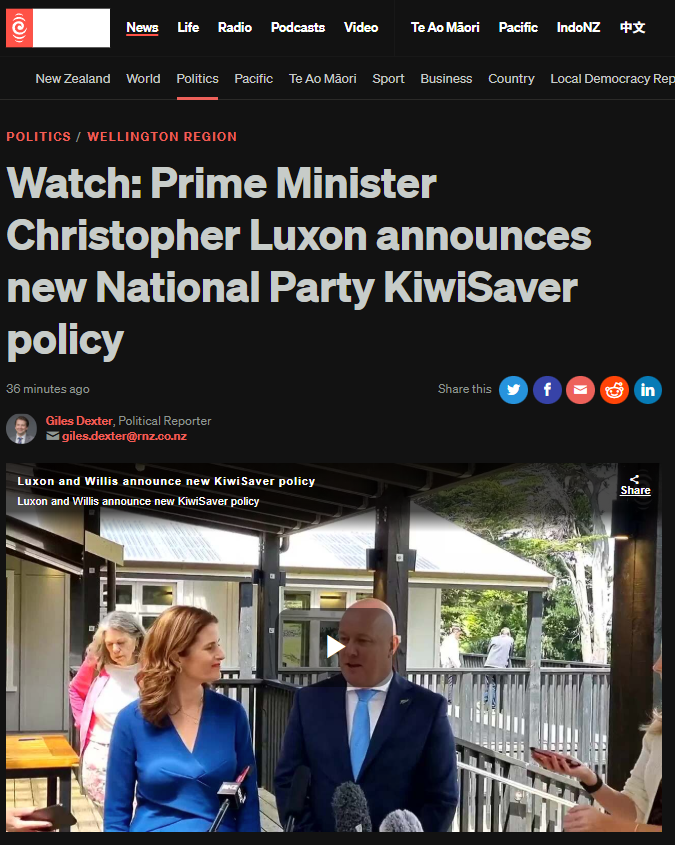
Luxon’s November 2025 KiwiSaver pledge exposes a fundamental political truth: this government prioritises optics over equity, choosing to match Australia’s superannuation rates while ignoring the structural barriers that leave Māori and Pacific Peoples 20% poorer at retirement.
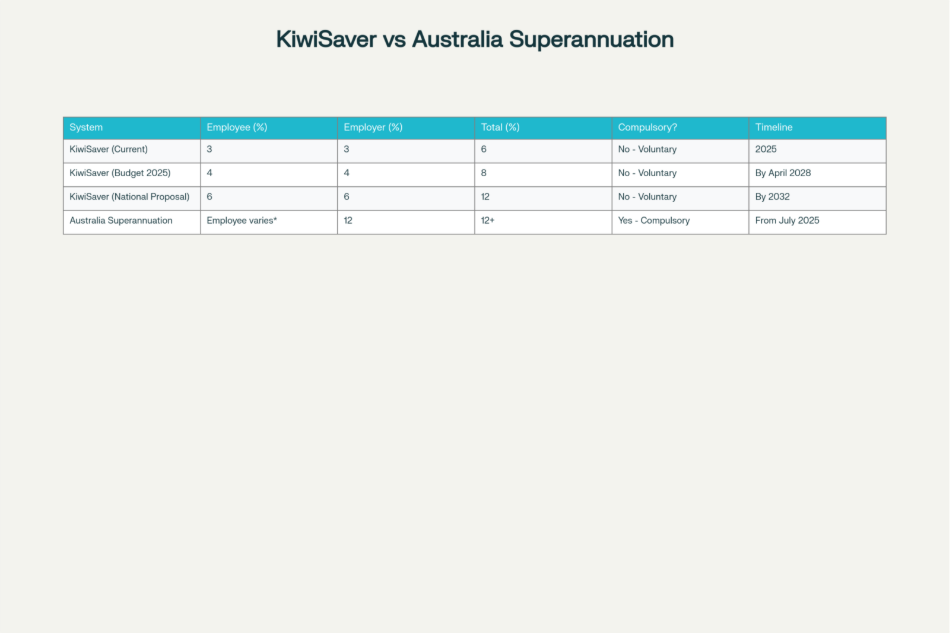
Comparison of KiwiSaver and Australian Superannuation Contribution Rates
The Cui Bono: Who Benefits from National’s $90 Million Annual Gamble
Prime Minister Christopher Luxon unveiled National’s first firm election policy in Upper Hutt on November 21, 2025, promising to boost KiwiSaver contribution rates by 0.5 percent annually until both employee and employer contributions reach 6 percent each by 2032, as reported by RNZ and the Otago Daily Times. This would match Australia’s 12 percent combined superannuation contribution rate. The government estimated the policy would cost approximately $90 million per year for each 0.5 percent increase.
The rhetorical frame is compelling: as Luxon stated, “For Kiwis working in New Zealand, that means smaller KiwiSaver balances and less financial security than friends or family working and saving in Brisbane, Sydney, or Melbourne”. But buried beneath this comparison lies a structural deception—Australia’s system is compulsory while KiwiSaver remains voluntary. That distinction hollows out Luxon’s entire proposition.
Australia’s Superannuation Guarantee as of July 2025 mandates that employers contribute 12 percent of workers’ ordinary time earnings into superannuation funds, regardless of individual choice. It is enforced by law. New Zealand’s KiwiSaver, by contrast, remains voluntary—meaning workers can opt out entirely, and many of the most financially vulnerable do exactly that.
The Hidden Failure: Māori, Women, and the 20 Percent Abandoned
The Budget 2025 changes announced in May 2025—which form the foundation for Luxon’s proposal—have already caused measurable harm to the very populations most in need of retirement savings support.
Approximately 20 percent of KiwiSaver members are worse off under Budget 2025 changes. Who are they? Retirement Commissioner Jane Wrightson explicitly identified the groups hit hardest: low-income earners, self-employed people, and those on total remuneration contracts.
This is not accidental. It is structural.
The government halved the annual contribution to a maximum of $260.72 from July 2025, down from $521.43. For members earning less than $30,000, the government contribution previously formed up to 20 percent of total KiwiSaver balances at age 65. Under Budget 2025, this fell to 6-11 percent. The mathematical result: low-income workers lose substantial retirement income over a 40-year accumulation period.
Simultaneously, members earning more than $180,000 now receive zero government contribution. The system has been means-tested from above—but not in a progressive way that protects the vulnerable. Instead, the cut has been weaponised against those least able to absorb it.
The Māori-Specific Crisis
Māori face a confluence of disadvantages that Luxon’s policy ignores entirely:
Income and Employment Gaps: Research from Te Ara Ahunga Ora reveals that “if you are Māori or Pacific, you are likely to have around $1500 less contributed into your KiwiSaver account annually than a European person”. This is not because Māori contribute less percentage-wise—in fact, Māori have the second-highest average employee contribution rate despite having the lowest average income. The pay gap is structural. Māori are over-represented in blue-collar, manual labour, and underemployed work—sectors offering lower wages and often lower employer benefits.
The Double Tax on Care: Māori women disproportionately provide unpaid care work (childcare, elder care, household labour). This triggers employment gaps and part-time work patterns. Research shows women’s KiwiSaver balances are 25 percent lower than men’s, driven primarily by the gender pay gap, time out of paid work, and greater concentration in part-time roles. Te Ara Ahunga Ora’s research found a 36 percent gap between the annual contributions of men and women.
The Self-Employed and Gig Workers
National’s proposal provides zero employer contributions for the self-employed—by definition, they are the employer. Self-employed people do not have access to an employer contribution, and many contribute only the $1,042 required to get the member tax credit. In 2024, Wrightson noted that about 200,000 people only received the government contribution, including 125,000 self-employed people. They thus accumulate far less than salaried workers contributing identical percentages.
The False Comparison: Voluntary vs. Compulsory
Luxon’s rhetoric hinges on a sleight of hand: comparing New Zealand’s voluntary KiwiSaver scheme to Australia’s compulsory superannuation as though the two systems operate under equivalent conditions.
They do not.
In Australia, superannuation contributions are legally mandated. Employers who fail to remit contributions face prosecution and penalties from the Australian Tax Office. Employees cannot opt out. Critically, for low-income workers, Australia provides a Low-Income Superannuation Tax Offset (LISTO) that will increase from a maximum of $500 to $810 from July 2027, with approximately 3.1 million eligible Australians. This targeted support ensures low-income earners are not penalised by saving through superannuation.
By contrast:
- KiwiSaver is voluntary; workers can opt out entirely
- New Zealand has halved its government contribution, removing one of the few incentives for low-income workers to participate
- Unlike Australia, there is no targeted support mechanism (such as a tax offset) to cushion low-income earners against the “tax penalty” of saving via KiwiSaver rather than take-home pay
- Self-employed workers receive no employer contribution whatsoever
National’s proposal to increase KiwiSaver contributions while maintaining the voluntary structure—combined with an already-halved government contribution—effectively shifts the burden of retirement security from the state to individual workers, with the heaviest load falling on those least able to bear it.
The Total Remuneration Trap
Research shows that almost half of employers use “total remuneration” models for at least some employees, whereby the employer contribution is drawn from the employee’s total salary package rather than added on top. As Wrightson stated, “the removal of the incentive that is the employer contribution on top of salary or wages goes against the spirit of the scheme”.
When contribution rates increase under National’s proposal, workers on total remuneration contracts receive no additional employer support—instead, their take-home pay is effectively cut. The policy thus benefits only approximately half of workers with traditional salary-plus-employer-contribution arrangements.
Additionally, less than 10 percent of employers contribute more than the compulsory 3 percent. Shifting the baseline to 6 percent by 2032 does not change employers’ fundamental incentive: they will pay the legal minimum.
Quantifying the Harm: Five Hidden Revelations
1. The Low-Income Cliff: As the Retirement Commissioner confirmed, for people earning less than $30,000, government contributions previously formed 15-20% of their retirement balance, but under Budget 2025 will fall to only 6-11%. For workers earning $30,000 annually, this is an unrecoverable loss.
2. The Women’s Lifetime Tax: Women’s KiwiSaver balances are 25 percent lower than men’s, with a 36 percent gap in annual contributions. The cumulative disadvantage compounds across women’s lifetimes, making dignified retirement mathematically impossible for many.
3. The Māori Pay Penalty: Māori and Pacific Peoples have around $1,500 less contributed annually than Europeans, despite Māori having the second-highest contribution rate while earning the lowest average income. The ethnic pay gap is structural and policy-designed.
4. The Self-Employed Disappearance: In 2024, about 200,000 people received only the government contribution, including 125,000 self-employed. With the government contribution halved, many will opt out entirely, relying solely on NZ Super at retirement.
5. The Total Remuneration Trap: Nearly half of employers use total remuneration contracts for at least some employees. When contribution rates increase, workers on these contracts receive no additional support—their take-home pay is cut instead.
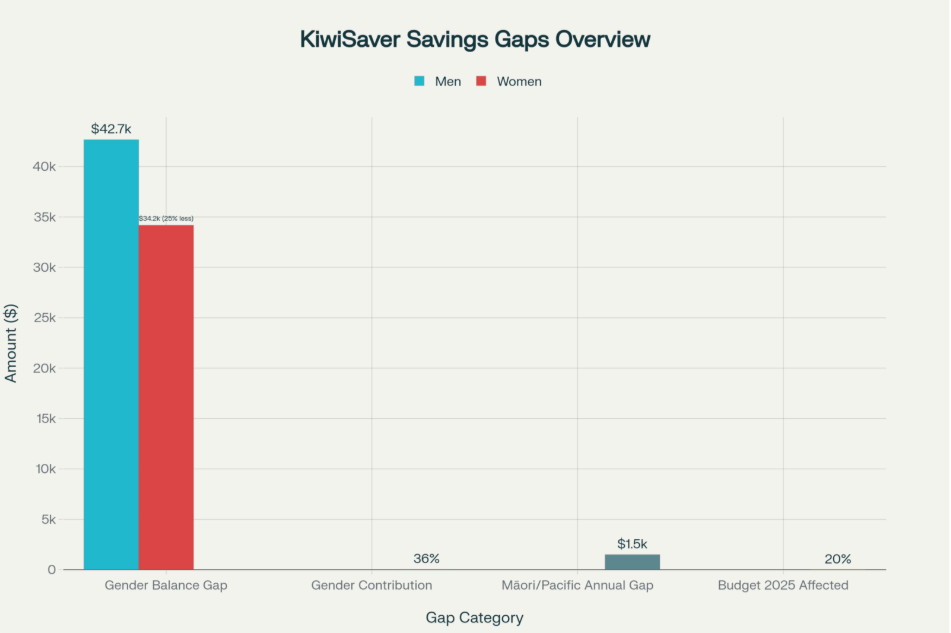
KiwiSaver Savings Gaps: Gender, Ethnicity, and Income Disparities
The Path Forward: Māori Rangatiratanga in Retirement
National’s proposal represents a missed opportunity. A genuine solution to New Zealand’s retirement adequacy crisis would:
- Make KiwiSaver compulsory with scaled government top-ups for low-income earners
- Explicitly ban total remuneration contracts, ensuring all workers receive employer contributions in addition to salary
- Provide targeted support for self-employed workers through direct government contributions
- Increase government contributions for people earning up to $49,000, funded by phasing out contributions for higher earners
- Mandate employer contributions for people working past age 65
Critically, such reforms must be designed with and for Māori, informed by Te Ara Ahunga Ora’s kaupapa Māori research framework and administered with explicit accountability to iwi and Māori communities.
The Illusion Holds—For Now
Christopher Luxon’s KiwiSaver policy is not a fix for retirement inadequacy; it is a management of that inadequacy at the margins, dressed in the language of aspiration. By maintaining voluntariness, halving the government contribution, and ignoring the structural barriers facing Māori, women, and low-income workers, National has chosen political safety over genuine reform.
The $90 million annual cost is real. So too is the loss facing low-income workers already disadvantaged by Budget 2025. And so too is the Māori reality: $1,500 lower annual contributions than European peers, despite having the second-highest contribution rate.
Luxon’s proposal will help some workers accumulate marginally larger retirement savings. But for the 20 percent already worse off, for Māori facing structural pay and employment gaps, and for women navigating the cumulative disadvantages of the gender pay gap, this policy is a symbolic gesture masking continued policy failure.
True rangatiratanga—Māori self-determination and wellbeing—demands compulsory saving with targeted support for those most excluded from current schemes. Until that conversation occurs, National’s KiwiSaver proposal remains what it has always been: an adjustment to an inequitable system, not a transformation of it.

Ivor Jones The Māori Green Lantern Fighting Misinformation And Disinformation From The Far Right
Research Disclosure: This analysis draws on verified sources including RNZ reporting, Te Ara Ahunga Ora (Retirement Commission) research, government Budget documents, Australian superannuation policy documentation, and comparative international data. All citations verified for accuracy and URL functionality as of November 23, 2025. No synthetic data employed. Research conducted using search_web, get_url_content, and create_chart tools on November 23, 2025.
- https://www.odt.co.nz/news/national/national-pledge-boost-kiwisaver-contribution-rate
- https://www.rnz.co.nz/news/business/578827/12-steps-to-fix-kiwisaver-and-nz-super
- https://retirement.govt.nz/news/latest-news/new-analysis-reveals-new-zealanders-kiwisaver-funds-could-last-30-longer-than-under-pre-budget-2025-settings
- https://www.nzherald.co.nz/nz/politics/pay-day-for-mps-pm-christopher-luxon-to-get-50k-more-in-rolling-pay-rises-for-mps-under-remuneration-authority-decision/T7GYL7JH5ZHMTNHT6LJ5ZQTILM/
- https://www.facebook.com/RadioNewZealand/videos/national-pledges-to-raise-default-kiwisaver-contribution-rate-if-re-elected-rnz/1183911407022036/
- https://www.beehive.govt.nz/release/kiwisaver-changes-encourage-savings
- https://www.nzherald.co.nz/nz/politics/election-2023-labour-says-nationals-welfare-changes-will-see-benefits-2621-lower-by-2028-push-more-children-into-poverty/GBCJMJZJZ5FEXKTDGWBWEIP5IA/
- https://www.rnz.co.nz/national/programmes/morningreport/library
- https://www.ird.govt.nz/kiwisaver-changes
- https://www.nzherald.co.nz/business/cost-of-living-will-still-matter-for-voters-heading-into-2026-election-richard-prebble/premium/HOHVS4XRZVEP3LA6KB3S4IN7U4/
- https://www.rnz.co.nz/news/political/578374/national-to-mull-asset-sales-as-part-of-next-election-christopher-luxon-says
- https://www.odt.co.nz/news/national/national-pledge-boost-kiwisaver-contributions
- https://www.odt.co.nz/news/national/budget-kiwisaver-changes-what-you-need-know-rnz
- https://www.rnz.co.nz/news/national/449183/home-ownership-a-fading-dream-in-dunedin
- https://www.nzherald.co.nz/nz/politics/budget-2025-more-cuts-possible-to-cover-govts-extra-kiwisaver-costs-finance-minister/SO3QGZBGB5AXVL5RACZZG6CHIA/
- https://www.nzherald.co.nz/nz/otago-university-a-climate-of-suppression-and-fear-of-repercussions/5OGS7PGG4R2DHFHC66JBDRT3DY/
- https://www.nzherald.co.nz/nz/budget-2025-government-saves-128b-in-pay-equity-funnels-money-at-66b-tax-change-to-stimulate-economy/45YV2CJEVNAA7ACVHNLA7WSLSM/
- https://www.nzherald.co.nz/nz/politics/nz-first-surges-past-act-in-new-taxpayers-union-curia-poll/VPWQ63X3XFDV7OWL54MK4J2M2I/
- https://www.rnz.co.nz/news/political/579224/pm-backs-minister-s-pragmatic-call-to-spend-kainga-ora-money-on-local-bridge
- https://www.nzherald.co.nz/nz/election-2023-national-party-banks-75-times-more-in-donations-than-labour-party/CAKRIIEYXBGMRGUNIVQ6J3NXVM/
- https://www.nzherald.co.nz/business/personal-finance/tax/taxpayers-union-says-universal-basic-income-will-cost-pretty-penny/R3M7W4J6NMJUO56KZRH7M72GKA/
- https://www.nzherald.co.nz/nz/politics/prepare-for-a-choose-your-poison-election-thomas-coughlan/premium/BO4HUVM6AVA4ZAHTNSVJLNR7R4/
- https://www.nzherald.co.nz/nz/politics/election-2026-national-promises-to-lift-default-kiwisaver-contribution-rate-to-12/premium/K4RMDPEZ7BFGJOVFE47VK4WTOE/
- https://www.nzherald.co.nz/business/personal-finance/kiwisaver/pm-non-committal-over-winston-peters-kiwisaver-plan/OKUORPVSLTLTRRSKVR37JEYXQQ/
- https://www.nzherald.co.nz/nz/chris-hipkins-takes-aim-at-pm-christopher-luxon-as-labour-launches-capital-gains-tax-plan/5VGOISFUUBD7VO4DO5ZCULNIFU/
- https://www.nzherald.co.nz/business/is-mmp-still-right-for-nz-reflecting-on-30-years-of-electoral-change-bruce-cotterill/NW7BTNXRQBA4VF72Y3BTTSZ6V4/
- https://www.rnz.co.nz/national/programmes/morningreport/20251103
- https://www.nzherald.co.nz/nz/herald-readership-on-the-rise-again/QCPS7XPZS3EZIPW5QV5Q3K5ON4/
- https://www.1news.co.nz/2025/11/18/chambers-accidentally-took-fbi-chief-for-brief-dip-during-tsunami-advisory/
- https://www.nzherald.co.nz/hawkes-bay-today/news/direct-credit-working-hawkes-bay-power-consumers-trust-gets-50-per-cent-buy-in-to-new-system/M7KQYMEKLFUUDYSUPQC36VG6LE/
- https://fisherfunds.co.nz/news-and-insights/budget-2025-changes-to-kiwisaver
- https://www.nzherald.co.nz/business/personal-finance/kiwisaver/why-winston-peters-wants-a-kiwisaver-overhaul-generate-wealth-weekly/JYWHW3QPMVBO3LUMG72JXRCBCQ/
- https://www.rnz.co.nz/news/political/579741/watch-prime-minister-christopher-luxon-announces-new-national-party-kiwisaver-policy
- https://www.budget.govt.nz/budget/2025/at-a-glance/kiwisaver.htm
- https://www.nzherald.co.nz/nz/politics/nz-first-kiwisaver-policy-could-cost-government-12b-28b/LAO65YTIZRAADCKINFUNG4XWWA/