“The Manufactured Crisis: How Health NZ Underspent $538 Million While Demanding Another $510 Million in Cuts” - 20 December 2025
A Neoliberal Shell Game Where Workers Go Unpaid, Consultants Get Rich, and Patients Pay the Price
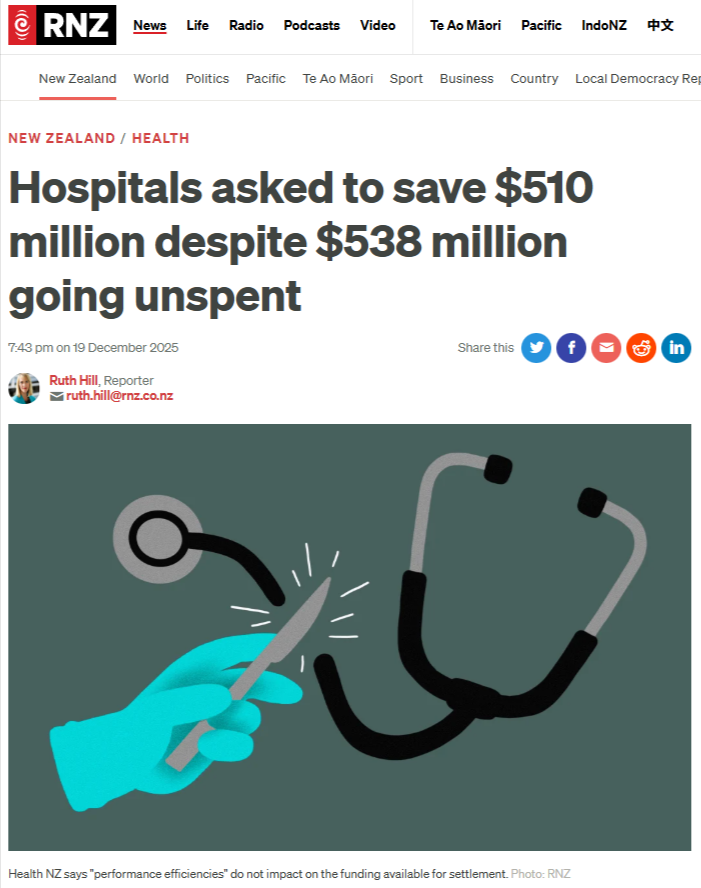
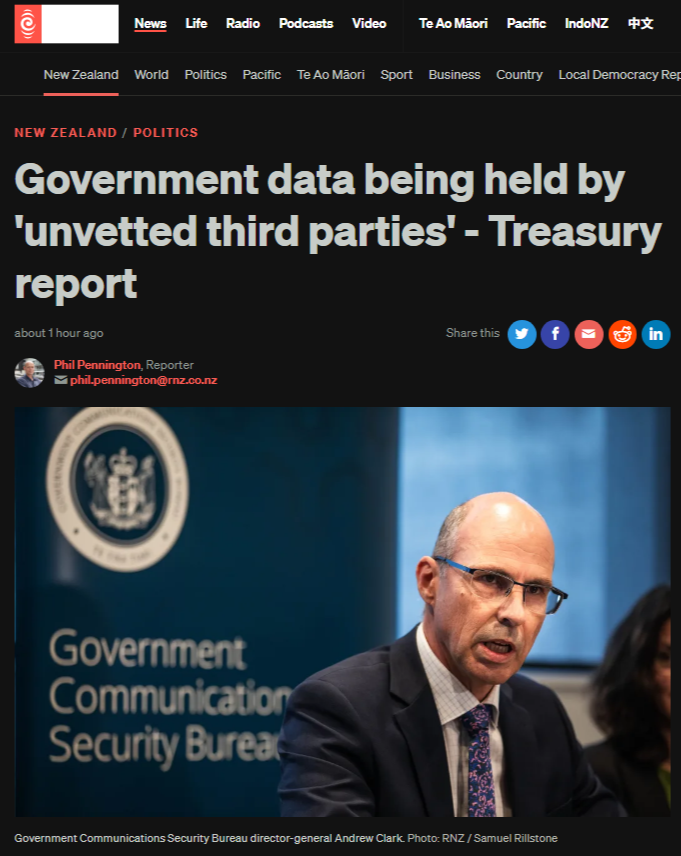
The arithmetic of austerity never adds up for those who need care. As revealed by RNZ, Health New Zealand left $538 million earmarked for salaries unspent in the 2023/24 financial year—money that should have gone to nurses, doctors, and healthcare workers—while simultaneously demanding that hospitals and health services find another $510 million in “efficiency savings” for 2025/26. This is not fiscal responsibility. This is neoliberal sleight of hand, where public healthcare is systematically starved while private contractors feast.[1]

Senior doctors standing firm in a New Zealand public hospital amid funding pressures
Follow the Money: Where $538 Million Disappeared
The $538 million “underspend” reveals the three-headed hydra of neoliberal healthcare destruction. Health NZ’s annual report shows $204 million came from delays to Collective Agreements and lower internal personnel costs.
Translation:
Health NZ refused to settle fair pay agreements with 6,600 senior doctors represented by the Association of Salaried Medical Specialists (ASMS) and approximately 60,000 nurses represented by the New Zealand Nurses Organisation.[1][2]
The ASMS collective agreement expired in August 2024, yet Health NZ stonewalled negotiations for over a year. In November 2025, the Employment Relations Authority threw out Health NZ’s unprecedented request to bypass bargaining entirely and simply impose contract terms on senior doctors and dentists. The authority found no serious breaches of good faith—Health NZ had simply refused to negotiate properly.[2][3]
Meanwhile, nurses received offers so insulting they amount to real-terms pay cuts. Under the June 2025 offer, registered nurses would receive just 2 percent in 2025 and 1 percent in 2026—far below inflation.
A briefing to Minister Simeon Brown in April showed each 1 percent increase for senior doctors costs $20-30 million; for nurses, with their larger numbers, each 1 percent costs over $100 million. Health NZ chose to leave that money unspent rather than value its workforce.[4][1]
The second vanishing act:
slower-than-expected Holidays Act remediation. More than 220,000 current and former health workers are owed approximately $1.8 billion for holiday pay miscalculations dating back to 2010. In 2016, it was discovered that former district health boards had not been paying holiday pay correctly. Nine years later, most workers still haven’t been paid. As of December 2024, only $308.2 million had been paid out across 41,929 current employees. Payment dates have been repeatedly pushed back—some workers report being given new dates “4-5 times”.[5][6]
Denise Heath, an 80-year-old Nelson support worker, captured the deliberate cruelty:
“My workmates laugh and joke that you’ll die on the job... you’ll die before you get it”.
She and her colleagues won’t retire because it would push them further down the payment queue. The Crown is sitting on nearly $2 billion owed to healthcare workers—earning interest—while those workers go without.[5]
The third pillar of the underspend:
unfilled vacancies. Not because qualified people don’t exist, but because Health NZ implemented a de facto recruitment freeze.
Labour health spokesperson Dr Ayesha Verrall stated:
“Every doctor and nurse I talk to says they can’t recruit to roles in their department, or if they do, they face massive delays, and the delays are designed to save costs”.
Health NZ increased its clinical workforce by approximately 750 full-time workers in 2023/24—barely keeping pace with population growth while waitlists exploded.[1]
The Outsourcing Bonanza: $162 Million Over Budget
Here’s where the shell game becomes visible. While Health NZ underspent $538 million on staff salaries, it simultaneously spent $162 million over budget on outsourced personnel, including locums to fill roster gaps. Let that sink in: they refused to pay permanent staff fairly, left positions vacant, then spent a fortune on expensive temporary contractors.[1][7]
ASMS executive director Sarah Dalton exposed the racket:
“Money is going to locums, to outsourcing to private. There is still a significant number of contracts going to consultancy firms and staff who come from those firms to do work that could and should be done by salaried staff”.[1]
The consultancy grift runs deep. Health NZ spent $2.7 million on consultants just to manage its restructures between October 2023 and February 2025. For a single IT project, Health NZ spent $72 million on contractors and consultants—including $17 million to one recruitment company, Robert Walters—while simultaneously planning to sack over 1,000 permanent IT employees.[8][9]
Health NZ is forecasting to cut $204 million in contractor and consultant spending in 2024/25—but only because it’s culling permanent roles they were filling. The financial year 2023/24 saw nearly $85 million more spent on contractors and consultants than the previous year.[10][11]
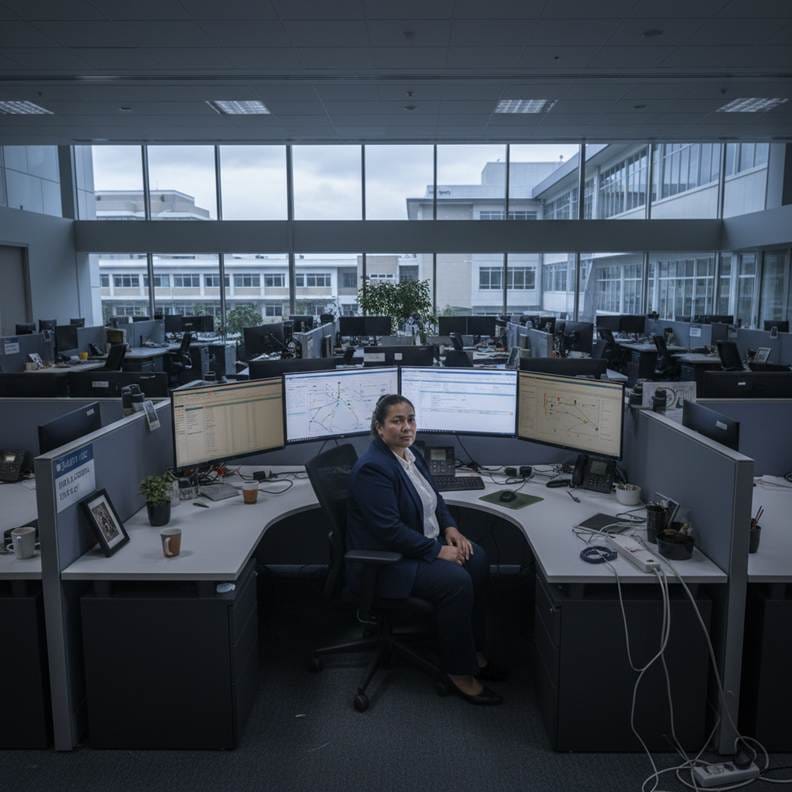
Empty desks in Health NZ’s Data and Digital department after sweeping back-office cuts
The “Back Office” Lie: Gutting the Systems That Keep Hospitals Running
Health Minister Simeon Brown claims the $510 million in new “efficiency targets” will come from “waste” in back-office and procurement functions without reducing clinical staff. This is the big lie neoliberalism always tells: that “back office” workers are unnecessary bureaucrats, not the people who keep hospitals functioning.[12]
“We discovered recently that the restructuring in Data and Digital meant they ended up with 200 fewer staff than they actually need, and they’re still trying to catch up with that”.
These aren’t abstract “back office” cuts. Health NZ proposed slashing nearly half of its Data and Digital positions—over 1,000 roles. These are the people who maintain patient records systems, manage hospital IT infrastructure, and ensure data security in an era of ransomware attacks.[1][7][13]
The Public Service Association forced Health NZ to restore 175 Data and Digital roles after litigation. But the damage was done. A survey of 1,300 health workers found that cuts to “back office” roles forced clinicians—nurses, social workers—to work as receptionists because of staff shortages. This is the false economy of austerity: highly trained, highly paid professionals doing administrative work because you fired the administrators.[14][15]
The Efficiency Targets: A Regional Shakedown
Minister Brown’s “efficiency targets” by region tell the story:[12]
- Northern region: 3.7% ($170 million)
Notice the South Island—rural, remote, with the longest travel distances—gets hit hardest at 4.9%. These targets are applied to “other operating cost” budgets, supposedly excluding staffing.
Yet Labour’s Dr Ayesha Verrall questioned how Health NZ could identify specific targets without specifying what should be cut:
“Five-hundred-million dollars is a massive amount to cut from health services, and to say they’ll do this without any accountability about where it’s coming from or where it’s going is absolutely outrageous”.[12]
Health NZ is already projecting a $200 million deficit for 2025/26. The 2024/25 revised budget forecasts a $1.1 billion deficit—down from the $1.76 billion they were heading toward without cuts. For 2023/24, Health NZ confirmed a $722 million deficit against a target surplus of $54 million. Every year the deficit grows. Every year the solution is more cuts.[16][17][12]
Who Benefits? Five Hidden Connections
Connection One: The Privatisation Pipeline. Health NZ has been directed to give private hospitals 10-year outsourcing contracts for elective surgeries. Not two years. Not five. Ten years—guaranteeing a decade of public money flowing to private providers. In March 2025, Brown announced nearly 10,600 surgeries would be outsourced at $50 million. Documents show Health NZ needed to fund another 5,300 operations by August 2025 and 15,800 more between September 2025 and June 2026—31,600 total outsourced surgeries.[18][19]
The private sector only takes the easy cases. Private hospitals receive “high volume low-complexity cases” while “high complexity work will be completed in-house”.
“That means that people who have more complex conditions won’t necessarily be the people targeted by the government initiative to bring down the waitlist, and it probably means longer waits for them”.
Cream-skimming leaves complex patients—disproportionately Māori and Pacific peoples—waiting longer in the gutted public system.[18]
Connection Two: The Consultancy-to-Contractor Pipeline. The same consulting firms that advise on “efficiency” restructures then supply the contractors to fill the gaps. Health NZ spent $2.7 million on consultants to manage restructures that cut permanent staff. Then those firms supply expensive temporary workers. It’s a closed loop that extracts public wealth.[8]
Connection Three: The Wage Suppression Strategy. By refusing settlements with doctors and nurses, Health NZ suppresses wages across the health sector. Police received 4% increases in both 2024 and 2025, plus a $1,500 lump sum—while nurses were offered 2% and 1% with $325 lump sums. The 2023 nursing pay equity settlement is already crumbling. This is deliberate: keep healthcare workers poor and desperate, too exhausted to organize.[20]
Connection Four: The Deficit Justification Loop. Health NZ’s deficit—$722 million for 2023/24, projected $1.1 billion for 2024/25, $200 million for 2025/26—is weaponized to justify more cuts. But the deficit itself is manufactured.
Of the $722 million 2023/24 deficit, one-off impacts included Holidays Act remediation costs and redundancy payments.
In other words:
the government underpaid workers for years, creating a liability, then uses that liability to justify not hiring workers. Neoliberal perpetual motion.[16][17]
Connection Five: The Commissioner Coup. In July 2024, Health Minister Shane Reti replaced Health NZ’s board with a single Commissioner, Professor Lester Levy. No board oversight. No democratic accountability. Just one man answering to the Minister, free to impose austerity without challenge. This is how democracy dies in healthcare: not with a bang, but with an “efficiency target.”[21]
The Manufactured Crisis: How Austerity Creates What It Claims to Fix
Neoliberalism’s central lie is that austerity is temporary—a bitter medicine that restores health. But austerity is the disease. Research on neoliberal healthcare restructuring shows that “health service cuts, user fees and privatization plans” create “biological sub-citizenship” through systematic exclusion from care. The embodied outcomes—preventable deaths, untreated conditions, chronic stress—are not unfortunate side effects. They are the point.[22]
Studies of austerity’s health impacts document how “conditionalizing processes” like pay ceilings for health workers and “contingent conditions” like civil war and NGO-ization combine with “outright exclusion from health services” to create tiered systems where the wealthy buy care and everyone else suffers. We’re watching this happen in real time in Aotearoa.[22]
The Greek healthcare collapse provides the template. Following IMF-imposed austerity after 2010, access to medicines, clinics, and mental health services fell rapidly while HIV infection, malaria, stillbirths, and suicide rates all rose. The IMF explicitly targeted public health care as “one of the primary contributors to Greece’s indebtedness”. Austerity doesn’t fix debt. It transfers the cost to bodies.[23][22]
Analysis of structural adjustment programs globally shows the same pattern: user fees, reduced state intervention, and tiered healthcare systems characterized by “higher quality private services for the wealthy” while public services collapse. The World Bank and IMF undermined the 1978 Alma Ata Declaration’s commitments to universal primary health care precisely through austerity’s “conditionalizing processes”.[22]
The Human Cost: Quantified
Let’s count what $538 million could have done—the opportunity cost of austerity:
- At $20-30 million per 1% for senior doctors, that’s an 18-27% pay increase for 6,600 specialists
- At over $100 million per 1% for nurses, that’s a 5% increase for 60,000 nurses
- Or the full $1.8 billion Holidays Act remediation—every worker paid what they’re owed
Instead:
More than 1.3 million people visited emergency departments in 2023/24—50,000 more than the previous year. Nearly 2.1 million people attended first specialist assessments—40,000 more than the year before. Demand rises. Staff shrinks. Waitlists explode. The system breaks. Then they call it “inefficient” and demand more cuts.[16]
Tikanga and the Violation of Manaakitanga
This is not just economic policy. It’s a violation of tikanga. Manaakitanga—the ethic of care, of supporting the wellbeing of people—demands that those who serve the community are themselves supported. Healthcare workers give their lives to caring for others. The Crown’s response? Leave them unpaid, undervalued, overworked.
Te Tiriti o Waitangi obligates the Crown to actively protect Māori health. Yet research shows Māori are disproportionately harmed by health privatization and outsourcing, which “cream-skim” less complex cases while Māori patients with complex, chronic conditions remain stuck in the gutted public system. The principle of partnership has been abandoned—current decision-making provides
“very little opportunity for partnership between Māori and the Crown”.[24]
This government’s approach embodies the opposite of manaakitanga. It’s extractive, exploitative, cruel. It treats healthcare workers as costs to be minimized, not people to be valued. It treats patients as numbers on a spreadsheet, not whānau deserving care.
Cui Bono? Who Wins?
Not patients. Not healthcare workers. Not communities. The winners are:
- Private hospital chains locking in 10-year contracts for simple, profitable surgeries
- Consulting firms charging millions to advise on cuts, then supplying contractors
- Recruitment agencies like Robert Walters, paid $17 million for one IT project
- Locum agencies filling roster gaps at premium rates
- Finance capital that profits from healthcare commodification
And the Minister, Simeon Brown, who can claim “efficiency” while gutting the public system, priming it for further privatization. This is neoliberalism’s endgame: manufacture a crisis, declare public services “broken,” sell off the pieces to your mates.
The Path to Rangatiratira: What Must Be Done
Immediate Actions:
- Pay the workers. Settle ASMS and NZNO agreements at inflation-plus increases. Pay the $1.8 billion Holidays Act remediation immediately—stop earning interest on stolen wages.
- End the recruitment freeze. Fill the 200+ Data and Digital positions. Hire permanent staff instead of contractors. Stop the outsourcing bonanza.
- Cancel the $510 million cuts. These are not “efficiency targets.” They’re service reductions that will kill people.
- Release the contracts. Full transparency on all consultancy and contractor agreements. Names, amounts, scope of work. Let the people see where their money goes.
- Restore the Health NZ board. End Commissioner rule. Return to democratic oversight with worker and community representation.
Structural Changes:
- End health privatization. No 10-year contracts locking public money into private hospitals. Invest those billions in expanding public capacity.
- Fund the determinants of health. The $538 million underspend plus the $510 million “efficiency savings” equals over $1 billion—enough to address housing, food security, and preventive care that actually reduces long-term costs.
- Empower healthcare workers. Restore collective bargaining rights. End “efficiency” mandates that override union agreements. Let those who know the system fix the system.
- Honor Te Tiriti. Full partnership with Māori in health governance. Fund kaupapa Māori health services. End the outsourcing model that disproportionately harms Māori.
- Break the consultancy-contractor loop. Ban firms that advise on restructures from supplying contractors. End the extractive cycle.
This is neoliberalism’s false economy laid bare:
save $538 million by refusing to pay workers, spend $162 million on contractors, create a crisis, then demand another $510 million in cuts to “fix” the crisis you manufactured. It’s a shell game where workers lose their pay, patients lose their care, and consultants walk away rich.
The solution is simple:
pay people what they’re owed, fund the services people need, stop giving public money to private profiteers. Everything else is misdirection.
Kia mau ki te tika. Hold fast to what is right.
Koha Statement
Only Support this mahi if you are able: Koha.Kiwi | Substack | Bank: HTDM 03-1546-0415173-000
All koha sustains free mātauranga Māori journalism. No paywall, no corporate interference.

Ivor Jones The Māori Green Lantern Fighting Misinformation And Disinformation From The Far Right