“The Māori Green Lantern's Exposé: Government's Violent Dismantling of Māori Education” - 15 July 2025
How Te Pūkenga Disestablishment Exposes Neoliberal Racism and Colonial Continuity
Kia ora koutou, Greetings to all.
The colonial violence continues. Prime Minister Christopher Luxon and Vocational Education Minister Penny Simmonds have unveiled their latest attack on Māori educational aspirations through the orchestrated destruction of Te Pūkenga. This calculated dismantling represents far more than mere policy restructuring - it embodies a deliberate assault on Māori tino rangatiratanga and the systematic entrenchment of educational apartheid across rural Aotearoa.
The government's narrative of "regional responsiveness" and "financial sustainability" masks a deeper ideological project: the privatisation of public education and the strategic exclusion of Māori from meaningful participation in their own educational futures. This essay exposes the lies, contradictions, and colonial violence embedded within these policy announcements, revealing how supposedly neutral administrative decisions serve to reinforce white supremacy and economic exploitation.
Background: The Colonial Architecture of Educational Control
To understand the significance of Te Pūkenga's dismantling, we must recognise the historical context of educational colonisation in Aotearoa. The systematic exclusion of Māori from educational decision-making has been a cornerstone of colonial governance, with education serving as a primary tool for cultural assimilation and economic subordination. The neoliberal restructuring of education since the 1980s has intensified these colonial dynamics, positioning Māori as deficient rather than recognising systemic barriers to educational access and success.
Te Pūkenga was established in 2020 as an attempt to address the fragmented and failing polytechnic system, bringing together 16 institutes of technology and nine industry training organisations under a single national structure. While imperfect, this model represented a move toward coordinated provision that could potentially address regional inequities and provide more coherent pathways for Māori learners. The system's first surplus of $16.6 million in 2024 demonstrated its emerging viability, contrary to government claims of inherent dysfunction.

Dismantling Under the Guise of Reform
The government's announcement reveals a complex web of contradictions and ideological motivations. Ten polytechnics will return to "regional governance" while four institutions face an uncertain future, with NorthTec, Western Institute of Technology at Taranaki, Whitireia and Wellington Institute of Technology, and Tai Poutini Polytechnic remaining under Te Pūkenga until they demonstrate "financial viability". This selective approach exposes the government's underlying agenda: abandoning rural and predominantly Māori communities while concentrating resources in urban centres.
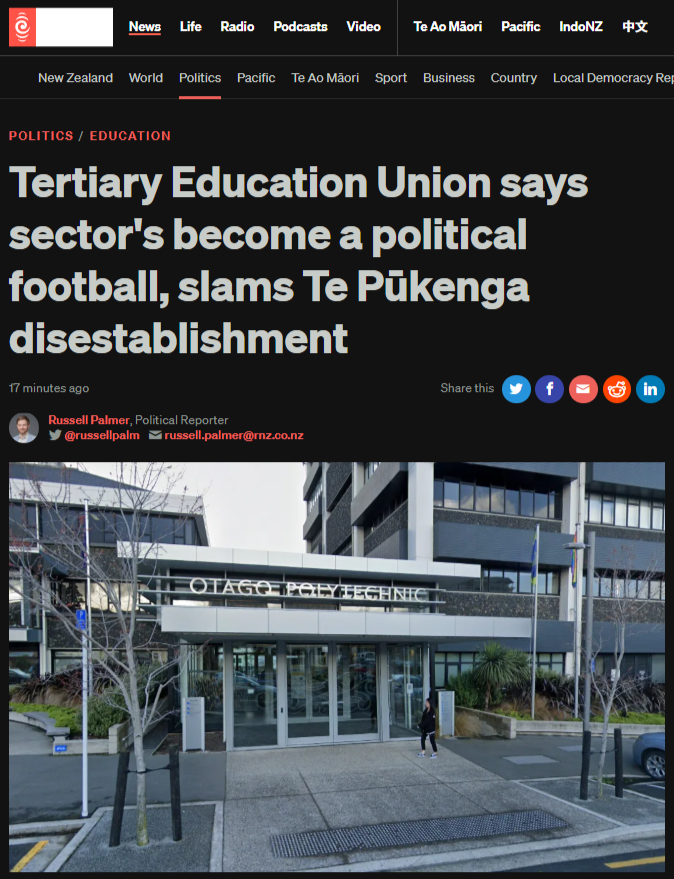
The creation of a "federation" model anchored by Open Polytechnic, which will absorb Otago Polytechnic and Universal College of Learning, represents a particularly cynical move toward online delivery that fundamentally undermines hands-on vocational training. As Tertiary Education Union national secretary Sandra Grey astutely observed, "That doesn't work so well when what you're teaching is cookery, or carpentry. They're not easy to teach online".
The simultaneous establishment of Industry Skills Boards to replace Workforce Development Councils opens the door to privatisation through competition between polytechnics and private training establishments. This fragmentation serves corporate interests while undermining the collective bargaining power of educational workers and the coordinated provision of training that serves community needs.
Exposing the Lies and Colonial Violence
The Myth of Regional Responsiveness
Luxon and Simmonds repeatedly invoke "regional responsiveness" as justification for their destructive policies, but this rhetoric obscures their actual abandonment of regional communities. The decision to leave four polytechnics in limbo, predominantly serving rural areas with significant Māori populations, reveals the government's true priorities. These institutions face potential closure or forced merger, effectively eliminating educational opportunities for communities that depend on local provision.
The government's approach violates the principle of mana whenua, failing to recognise that genuine regional responsiveness requires meaningful consultation with tangata whenua and respect for local knowledge systems. Instead, we see top-down decision-making that prioritises corporate efficiency over community needs, embodying the extractive logic of settler colonialism.
The Financial Sustainability Deception
Perhaps the most cynical aspect of the government's narrative is its claim that financial sustainability drives these changes. Te Pūkenga achieved a $16.6 million surplus in 2024, representing a remarkable turnaround from previous deficits. This success occurred despite the uncertainty and disruption caused by the government's disestablishment agenda, suggesting that the system was beginning to stabilise and deliver on its mandate.
Minister Simmonds' dismissal of this achievement as merely the result of "cost-cutting" rather than genuine improvement reveals the government's ideological commitment to destruction regardless of evidence. The intensive cost savings exercise that included "consolidation to reduce duplication, structural changes, vacancy management, lease reduction, property sales and programme rationalisation" represents exactly the kind of efficiency gains that public sector organisations should pursue. Yet the government treats success as failure, exposing the bad faith underlying their entire approach.
The selective application of financial sustainability criteria further reveals the government's colonial priorities. While Te Pūkenga's surplus is dismissed as irrelevant, the same government commits hundreds of millions to charter schools and other privatisation experiments with no demonstrated track record of success. This double standard reflects the systematic devaluation of institutions that serve Māori and working-class communities.
Penny Simmonds' Conflicts of Interest
The appointment of Penny Simmonds as Vocational Education Minister represents a grotesque conflict of interest that exposes the government's disregard for ethical governance. Simmonds served as CEO of Southern Institute of Technology for 23 years until 2020, directly benefiting from the very system she now seeks to dismantle. Her intimate knowledge of polytechnic operations could have been valuable for improving the system, but instead she weaponises this expertise to serve corporate interests.
Simmonds' advocacy for SIT's independence while serving as a minister responsible for the entire sector reveals the parochial nature of her vision. Rather than considering the needs of all communities, she prioritises her former institution while abandoning others. This approach violates the principle of aroha, which requires leaders to consider the wellbeing of all people, not just their immediate interests.
The minister's previous criticism of Te Pūkenga's impact on SIT's sponsorship arrangements demonstrates her inability to distinguish between institutional interests and public good. Her focus on marketing and branding rather than educational outcomes reveals the neoliberal mindset that treats education as a commodity rather than a public service.
Christopher Luxon's Corporate Colonialism
Prime Minister Luxon's approach to education reflects his corporate worldview that treats public services as costs rather than investments. His framing of New Zealand as a business enterprise positions Māori and working-class communities as expendable costs rather than valued stakeholders. This dehumanising logic underpins the government's willingness to sacrifice educational access for accounting efficiency.
Luxon's business background has consistently informed his approach to public policy, treating social institutions as underperforming subsidiaries rather than essential public services. His commitment to "nothing is off the table" regarding privatisation signals a broader agenda to dismantle public ownership across multiple sectors.
The Prime Minister's rhetoric of "regional decision-making" masks a deeper commitment to market-based solutions that invariably favour wealthy urban communities over rural and Māori populations. His corporate logic cannot accommodate the collective values of whakatōhia and manaakitanga that should guide educational provision.
The Assault on Te Tiriti Obligations
The government's education policies represent a systematic assault on Te Tiriti o Waitangi obligations that should guide all Crown activities. The Education and Training Act 2020 explicitly requires institutions to honour Te Tiriti, yet the government's fragmentation of the vocational education system undermines coordinated efforts to address Māori educational inequities.
The government's proposed changes to downgrade Te Tiriti's place in education legislation reveal its broader colonial agenda. By removing Te Tiriti from the primary objectives of educational governance, the government seeks to eliminate accountability for addressing historical and ongoing educational injustices.
The destruction of Te Pūkenga particularly impacts Māori communities in rural areas, where polytechnics serve as crucial pathways for whānau advancement. The government's abandonment of these institutions violates the Crown's obligation to ensure Māori have equal access to educational opportunities, perpetuating the colonial logic that treats Māori communities as peripheral to national development.
Implications: The Broader Pattern of Colonial Violence
The dismantling of Te Pūkenga represents one component of a broader colonial project that seeks to eliminate public institutions that serve Māori interests. The government's simultaneous attacks on co-governance arrangements, public health systems, and environmental protections reveal a coordinated strategy to restore uncontested Pākehā supremacy.
The privatisation agenda embedded within these educational reforms serves corporate interests while undermining collective ownership of essential services. This neoliberal project treats education as a commodity to be purchased rather than a public good to be shared, fundamentally contradicting Māori values of collective responsibility and intergenerational thinking.
The government's approach to rural education particularly exposes its colonial priorities. Rural communities face systematic disadvantage in accessing educational opportunities, yet the government's policies will deepen these inequities rather than address them. This reflects the continuing colonial logic that treats rural and Māori communities as expendable peripheries rather than valued centres of knowledge and culture.
The devastating impact on educational workers further reveals the government's disregard for human costs. The loss of expertise and institutional knowledge through redundancies and restructuring will take decades to rebuild, representing a massive waste of public investment in professional development.
Resistance and Restoration
The government's assault on Te Pūkenga exposes the continuing colonial violence that structures educational policy in Aotearoa. Beneath the rhetoric of efficiency and regional responsiveness lies a systematic project to privatise public education and eliminate Māori influence over their own educational futures. The contradictions between stated goals and actual policies reveal the bad faith underlying this entire enterprise.
The remarkable success of Te Pūkenga in achieving financial sustainability despite government sabotage demonstrates the potential for public institutions to serve community needs effectively. The union response led by Sandra Grey exemplifies the kind of principled resistance required to defend public education against corporate capture.
The path forward requires commitment to the values of whakatōhia, manaakitanga, and tino rangatiratanga that should guide educational provision. This means defending public ownership, ensuring community control, and recognising education as a collective responsibility rather than individual commodity. The government's colonial project can only succeed if we allow it to proceed unchallenged.
The time for polite disagreement has passed. The government's policies represent an existential threat to Māori educational aspirations and the broader project of decolonisation. We must expose these lies, resist this violence, and build alternatives that honour our collective responsibility to future generations.
Aroha nui
Ivor Jones, The Māori Green Lantern
Readers who find value in this analysis and wish to support this crucial work exposing government misinformation and colonial violence can contribute a koha to: HTDM: 03-1546-0415173-000. The MGL understands these tough economic times for whānau so please only contribute a koha if you have capacity and wish to do so.