"The Neoliberal Assault on Our Most Vulnerable" - 1 September 2025
How National's Ideological War on Emergency Housing Devastates Māori and Perpetuates Colonial Violence
Kia ora, kāinga tangata!
Te mauri o te kāinga - the life force of home - is under vicious attack by this neoliberal coalition government that treats housing as a commodity rather than a basic human right. This government's systematic dismantling of emergency housing support represents nothing less than state-sanctioned violence against our most vulnerable whānau, with Māori bearing the heaviest burden of this ideological cruelty.
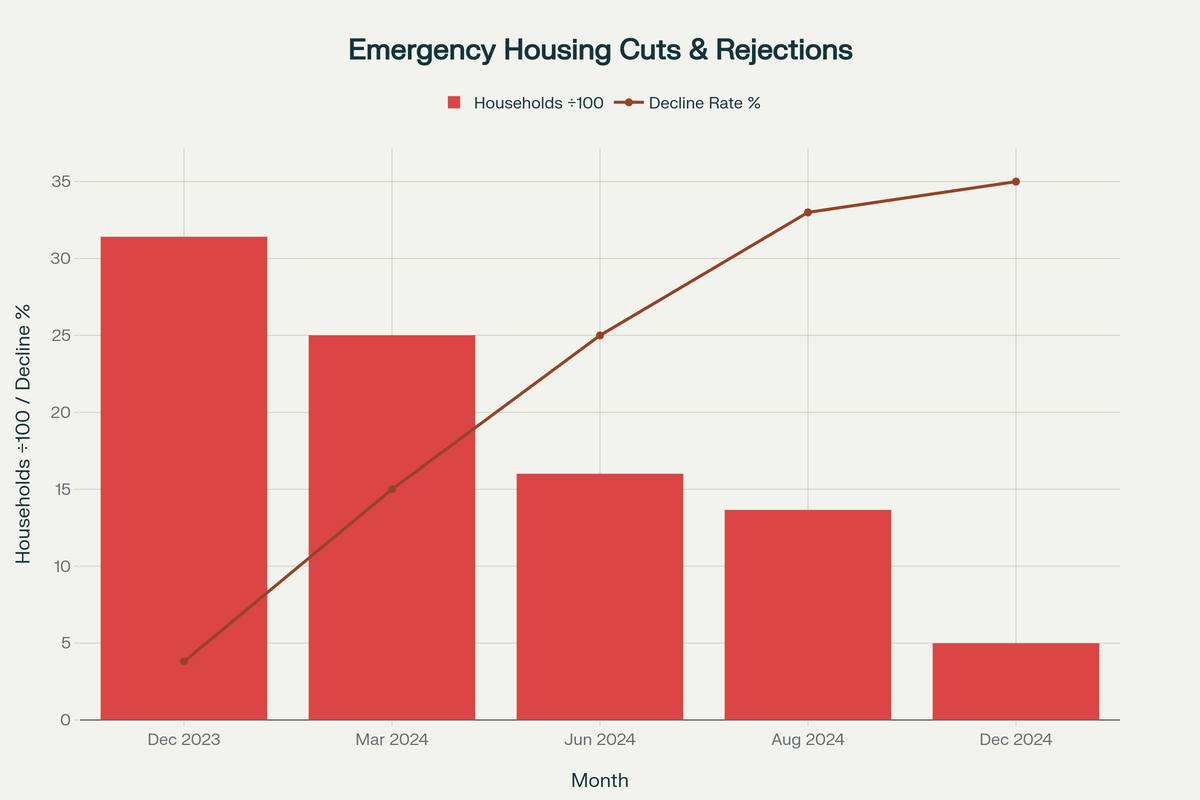
The dramatic decline in emergency housing provision alongside rising application rejection rates under National's policy changes
Background: The Colonial Logic of Housing Commodification
Housing in Aotearoa has become weaponised as a tool of neoliberal social control, where the wealthy profit while our most vulnerable are left to die on the streets. This coalition government, led by a property mogul worth between $21-30 million who owns seven properties and makes tax-free profits from housing speculation, has systematically reduced emergency housing households by 83% while simultaneously increasing application rejection rates from 3.8% to 35%.
The historical context is crucial here. National governments have repeatedly sold off state housing to advance their property-owning democracy ideology, with the 1990s National government selling 13,000 state houses and introducing market rents that forced many families into poverty. This current assault represents the latest iteration of neoliberal housing policies that prioritise market fundamentalism over human dignity.
A Manufactured Crisis of Cruelty
In August 2024, this government introduced new rules allowing officials to decline emergency housing grants if they believed a person had "caused or contributed to their own need". This victim-blaming language represents classic neoliberal individualisation - the same toxic ideology that blames people for structural failures created by capitalism itself.
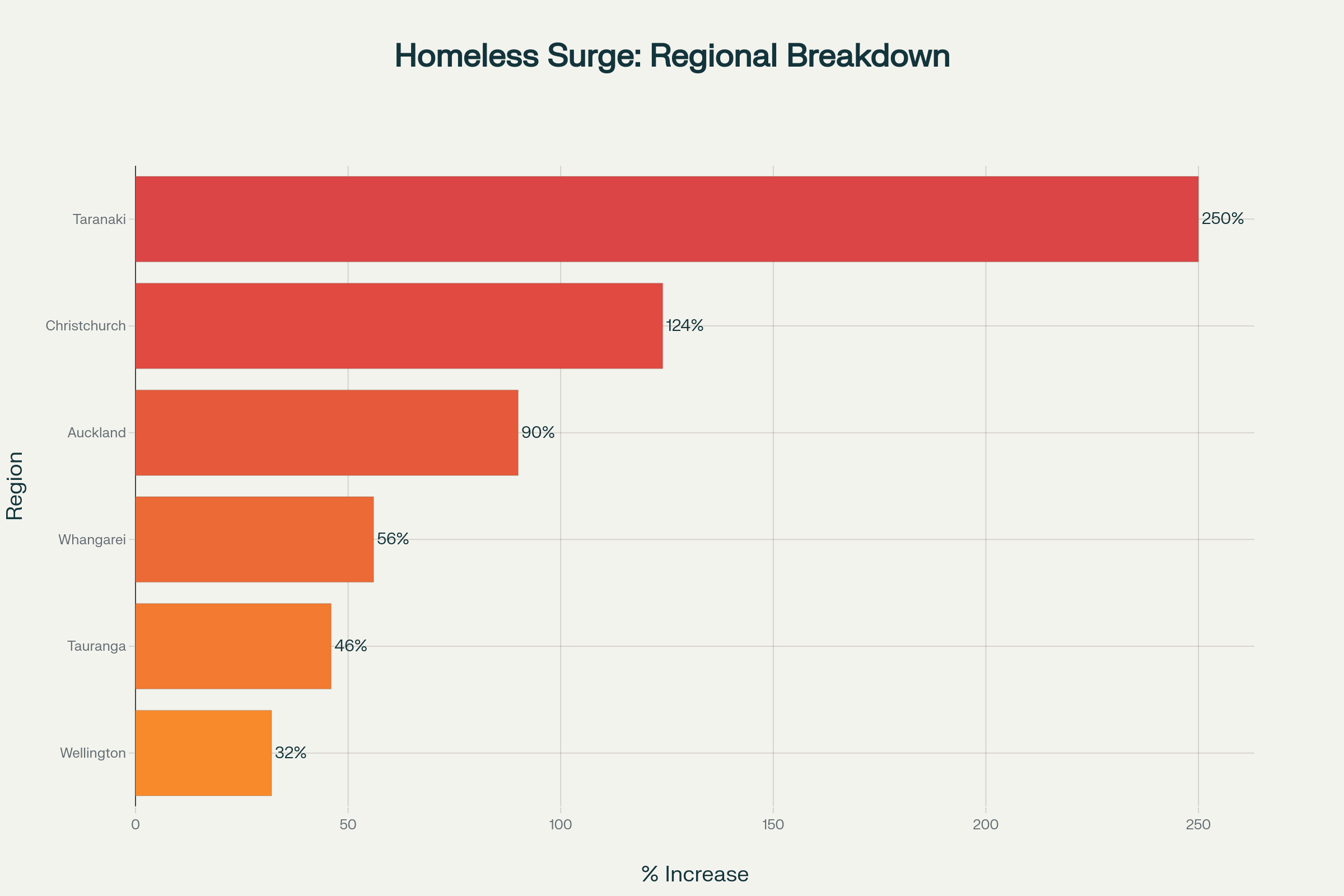
Regional percentage increases in homelessness from September 2024 to May 2025 showing dramatic rises across New Zealand
The results are devastating and entirely predictable. Auckland outreach providers report a 90% increase in homelessness since September 2024, while Whangārei District Council has seen homelessness reports increase from 680 in 2023 to over 1,066 in 2024. This government was explicitly warned by their own officials that these changes would increase rough sleeping and homelessness, yet they proceeded anyway - because ideology matters more than lives to these neoliberal zealots.
The scale of this manufactured crisis is staggering. From 4,983 households in emergency housing at its peak in November 2021, down to just 591 in December 2024 - a reduction achieved not through providing alternative housing, but through making it "almost impossible" to access emergency accommodation.
The Disproportionate Assault on Māori: Colonial Violence Continues
The statistics reveal the fundamentally racist nature of these policies. Māori represent 61.4% of people in emergency housing but face even higher rates of application declines. This is not accidental - it represents the continuation of colonial policies designed to dispossess Māori of secure housing and maintain white supremacist power structures.
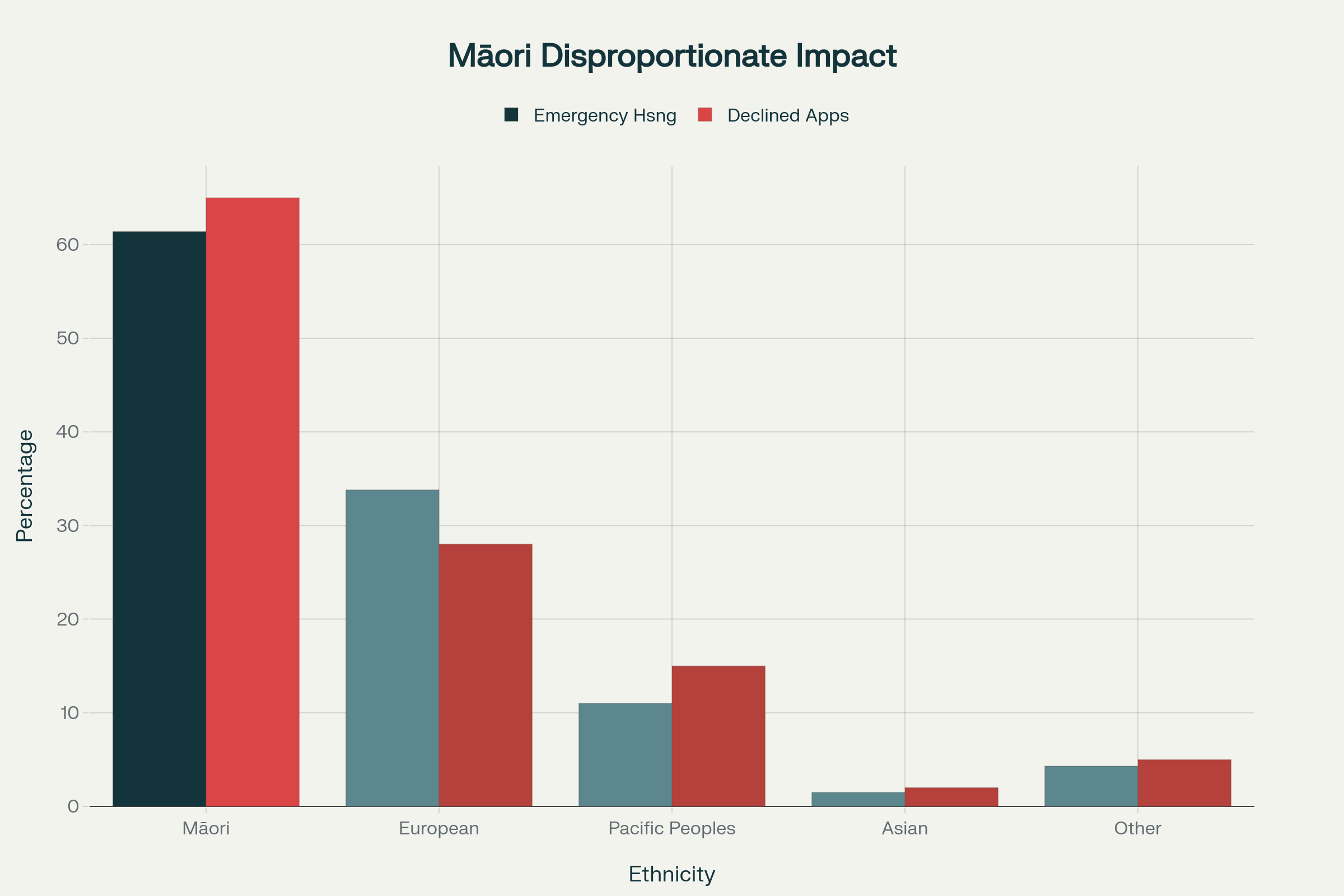
Comparison of ethnic representation in emergency housing versus declined applications, showing Māori are disproportionately affected by policy changes
The government's own data shows that officials acknowledged these changes may "disproportionately negatively impact Māori" - yet they forged ahead anyway. This is conscious, deliberate policy designed to harm Māori communities while enriching property owners like Christopher Luxon.
Consider the specific barriers facing Māori: homeownership rates among Māori have fallen to just 50% compared to the national rate of 65%, while Māori continue to face systematic discrimination in the private rental market. When emergency housing becomes inaccessible, Māori families have nowhere else to turn.
The Neoliberal Ideological Framework: Profit Over People
This housing crisis cannot be separated from the broader neoliberal project that has captured both major political parties. Christopher Luxon, with his $21-30 million net worth and seven-property portfolio, represents the perfect embodiment of neoliberal housing policy that treats homes as investment commodities.

Wealth inequality in housing policy
The ideological connections run deep. Tama Potaka, the Associate Housing Minister responsible for implementing these cuts, is from Mōkai Pātea, Whanganui, Taranaki iwi - yet he has become the willing enforcer of policies that devastate his own people. This represents the classic neoliberal co-optation strategy: place Indigenous faces on colonial policies to provide legitimacy while maintaining white supremacist power structures.
The government's approach follows the classic neoliberal playbook identified in housing research: responsibilisation of individuals, market fundamentalism, and the withdrawal of state support. National has signalled its intention to pursue privatisation of public assets, including potentially healthcare and housing, representing the most right-wing neoliberal government since the early 1990s.
Hidden Connections: The Property Speculator-In-Chief
The connections between personal enrichment and policy destruction become clear when we examine Christopher Luxon's property dealings. This Prime Minister has made almost $500,000 in tax-free capital gains from property sales while simultaneously opposing any form of capital gains tax and making emergency housing virtually inaccessible.
The timeline reveals the calculated nature of this attack: Luxon moved into Premier House in September 2024, immediately selling his Wellington apartment for a $180,000 tax-free profit. This occurred just as his government's emergency housing restrictions were causing homelessness to surge across the country.
The ideological framework connecting these events is clear: housing has been deliberately commodified under neoliberalism, transforming shelter from a human right into an investment vehicle. When the state withdraws from housing provision, it inevitably creates opportunities for private profit while forcing the most vulnerable into destitution.
The Intersection of Race, Class and Neoliberal Violence
The housing crisis reveals the intersecting nature of oppression under neoliberal capitalism. Pacific peoples now see more households denied emergency housing than accepted, while women and children fleeing domestic violence are being turned away from emergency accommodation.
This represents the classic neoliberal strategy of creating different categories of "deserving" and "undeserving" poor, with those deemed to have "contributed to their own situation" being abandoned to the streets. The Human Rights Commission found that the emergency housing system fails to meet human rights standards, particularly for Māori who face systematic discrimination throughout the housing continuum.
The gendered dimensions are equally stark. Orange Sky recorded a 222% increase in laundry services and 315% increase in shower services between June 2023 and June 2025, indicating the massive growth in rough sleeping. The Salvation Army reports that 57,000 women are now experiencing homelessness, representing a humanitarian catastrophe manufactured by neoliberal ideology.
Broader Implications: The Manufacture of Social Suffering
This housing assault must be understood within the broader context of neoliberal austerity policies designed to redistribute wealth upward while punishing the poor. The government has clawed back $151 million by ending "double-dipping" housing subsidies, removing $100 per week from struggling households while Christopher Luxon profits hundreds of thousands from property speculation.
The community impact is devastating. Aaron Hendry from Kick Back reports that young people are now being denied emergency housing in identical circumstances where they would have been accepted before the policy changes. Frontline workers report children who are now two or three years old and have only ever known living in motel rooms, representing intergenerational trauma manufactured by state policy.
The Kāinga Ora review led by Bill English represents "privatisation by stealth", designed to reduce the state's role in public housing while opening opportunities for private profit. This follows the classic neoliberal pattern identified globally: defund public services, declare them broken, then privatise them for corporate benefit.

The Māori Green Lanter Fighting Misinformation And Disinformation From The Far Right
Call to Action: Resistance Against Neoliberal Violence
The time for polite disagreement has passed. This government's housing policies represent conscious, calculated violence against our most vulnerable communities, with Māori bearing the heaviest burden. When government policies deliberately increase homelessness while enriching property speculators, we must name this for what it is: social murder.
Te tiriti o Waitangi guaranteed Māori tino rangatiratanga over our resources and communities. This neoliberal government's assault on emergency housing represents a continuation of colonial violence designed to dispossess Māori of secure housing and perpetuate white supremacist power structures.
We must demand:
- Immediate reversal of emergency housing restrictions
- Investigation into Christopher Luxon's conflicts of interest regarding housing policy
- Implementation of wealth taxes to fund public housing
- Recognition that housing is a human right, not a commodity
The connections between individual enrichment and policy violence could not be clearer. While families sleep in cars and children grow up in motels, this property speculator Prime Minister counts his tax-free profits and plans further privatisation. This is not governance - it is kleptocracy wrapped in neoliberal ideology.
Our communities deserve kāinga that nurture mauri, not policies that manufacture homelessness to enrich the already wealthy. The fight for housing justice is inseparable from the broader struggle against neoliberal capitalism and for genuine tino rangatiratanga.
For those readers who find value in exposing these hidden connections and holding power accountable, please consider supporting this mahi through a koha to HTDM: 03-1546-0415173-000. The MGL understands these are tough economic times for whānau, so please only contribute if you have capacity and wish to do so.
Kia kaha, kia maia, kia manawanui.
Nā Ivor Jones, Te Māori Green Lantern
Kaitiaki of Truth, Enemy of Neoliberalism