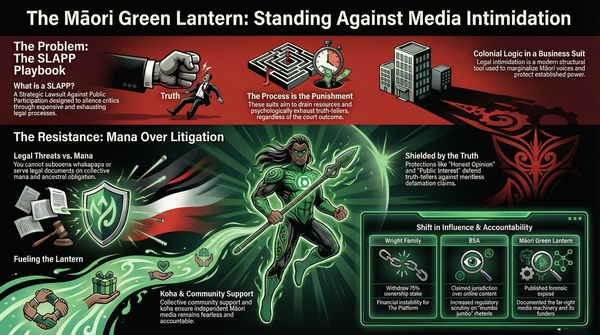
"The Nursery of Cages: How a White Supremacist State Built a Factory That Turns Brown Children Into Prisoners — And Calls It "A Good Thing"" - 21 February 2026
Sixty-seven years. One man. One truth the state spent seven decades trying to bury: the justice system does not fail Māori — it was built to consume them. And now a grinning Prime Minister is feeding the machine faster than ever.

Kia ora e te whānau,
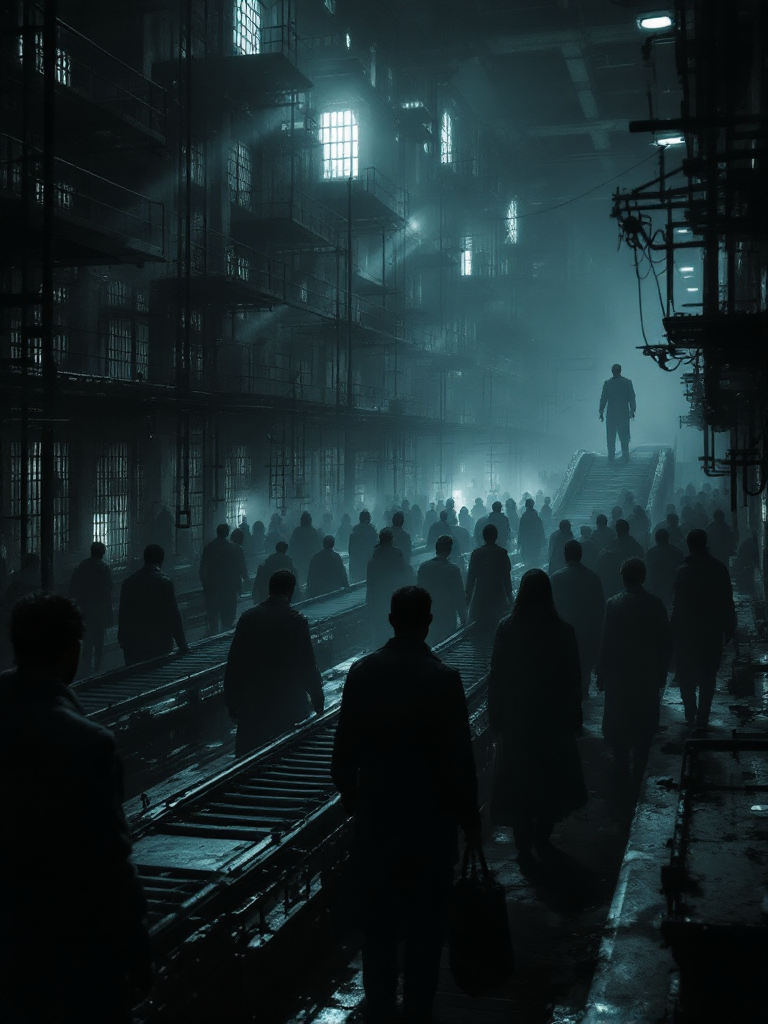
There is a factory in this country. It does not make cars or milk powder or export logs.
It makes prisoners.
It takes brown children from broken homes the state itself broke, runs them through institutions designed to brutalise, seasons them in violence the state itself administers, and then — the moment those children are old enough to be held "accountable" — stamps them with a number, locks them in a concrete box, and charges the taxpayer $200,000 a year for the privilege.
Then the Prime Minister of New Zealand stands at a podium and says:
"Absolutely, that's a good thing."
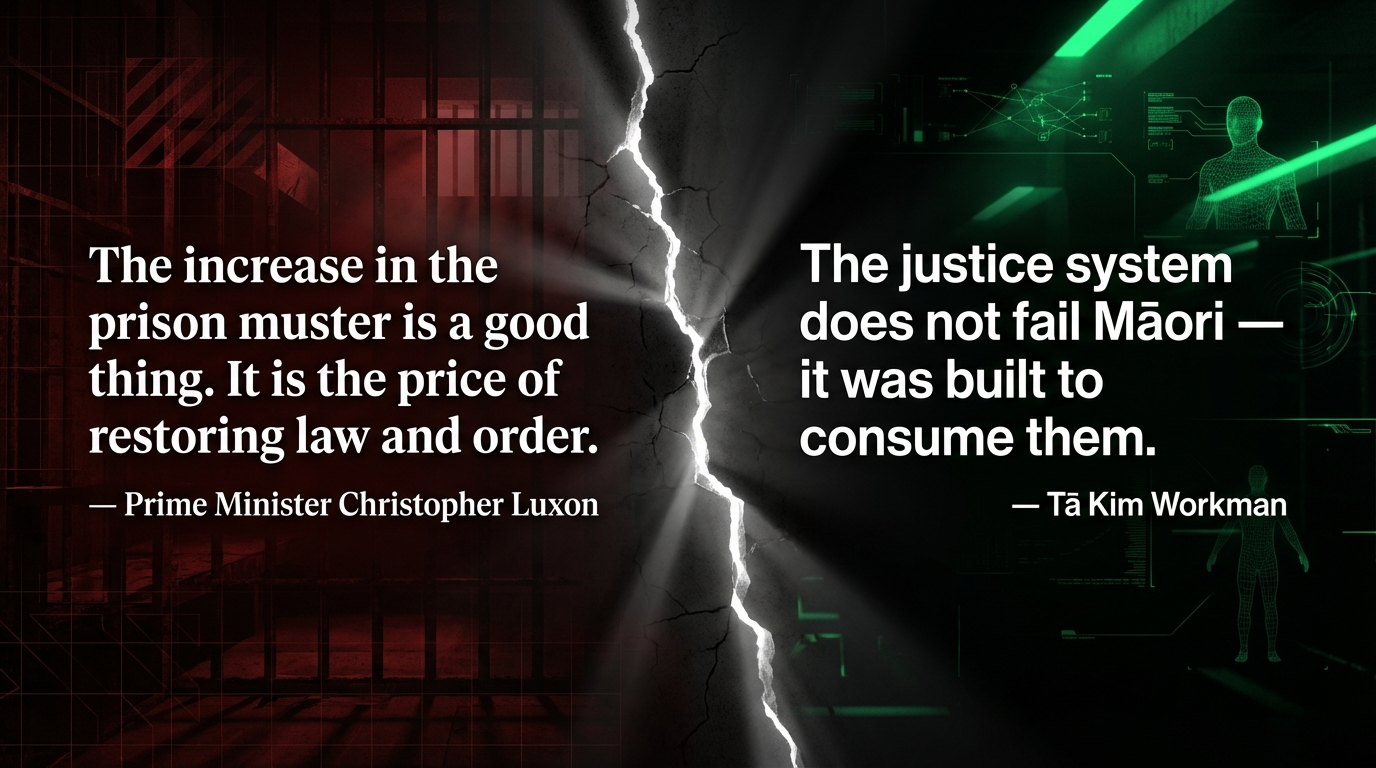
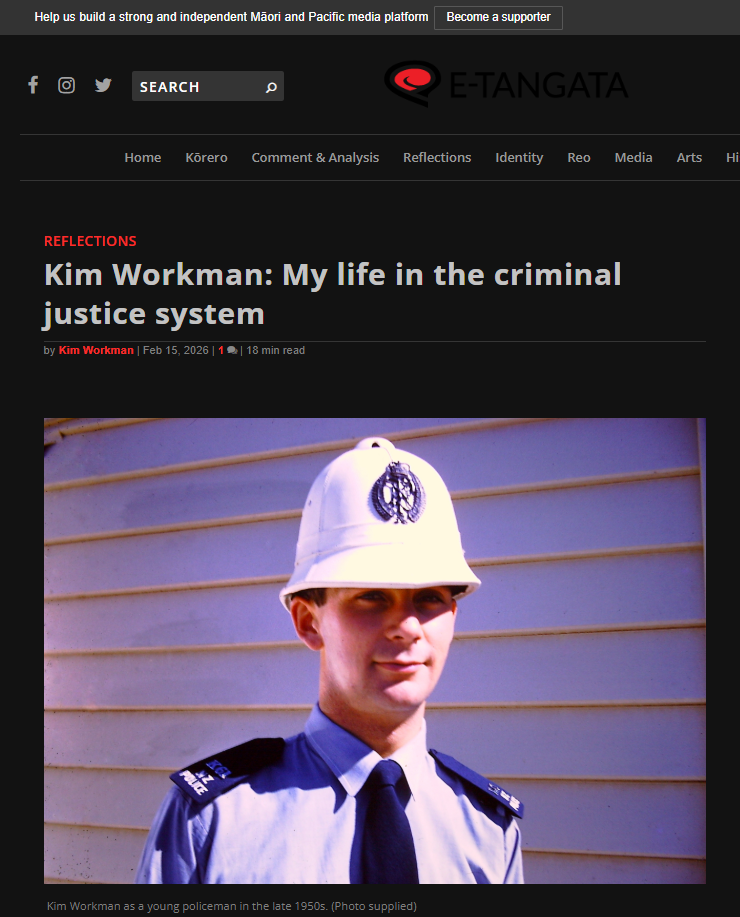
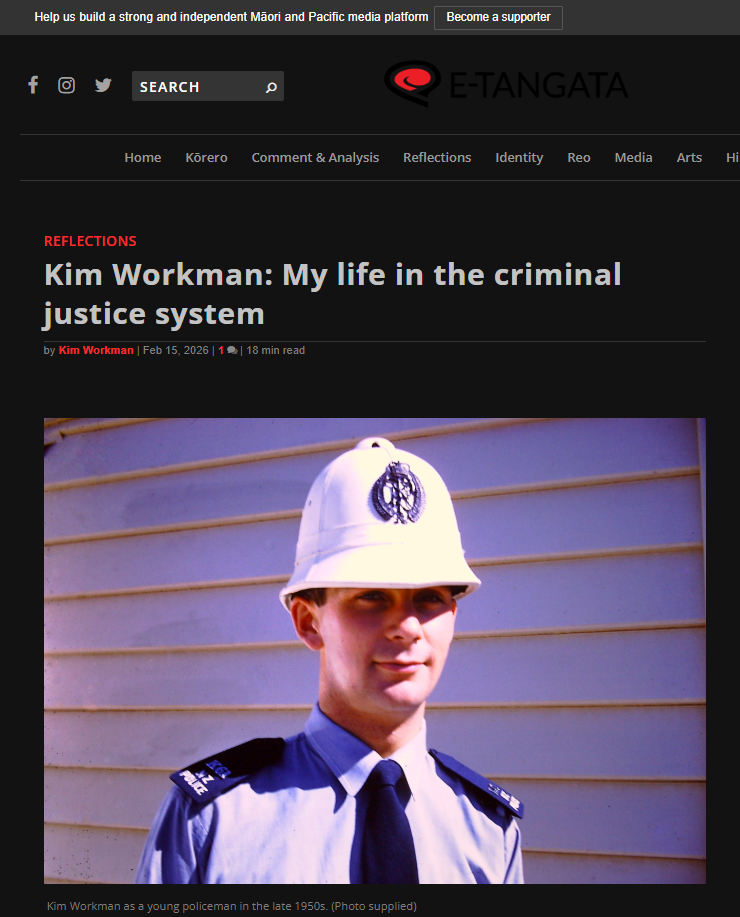
This is not a metaphor. This is the machine Tā Kim Workman spent sixty-seven years trying to dismantle — from the inside of the police, the prison service, the faith-based units, the courtrooms, and the commissions. And his testimony in E-Tangata is the blueprint of that machine, drawn by a man who worked its levers and saw the blood on the gears.
The Luxon-Seymour-Peters coalition is not just refusing to shut the factory down. They are expanding it. Adding new wings. Hiring more guards. Fast-tracking construction. And calling it "restoring law and order."
The taiaha is raised, whānau. Let us name what they have built.
The Nursery: Where the State Breaks What It Later Blames
Tā Kim Workman walked into Kohitere Boys' Training Centre in Levin in 1972. He was a police youth aid officer. He expected an institution. He found a hell — 110 boys, 90 percent of them Māori, enduring physical, sexual, and psychological violence, knock-out sedatives, solitary confinement, and electro-convulsive therapy.
He called it his "career-defining moment."
It should be the nation's defining shame.
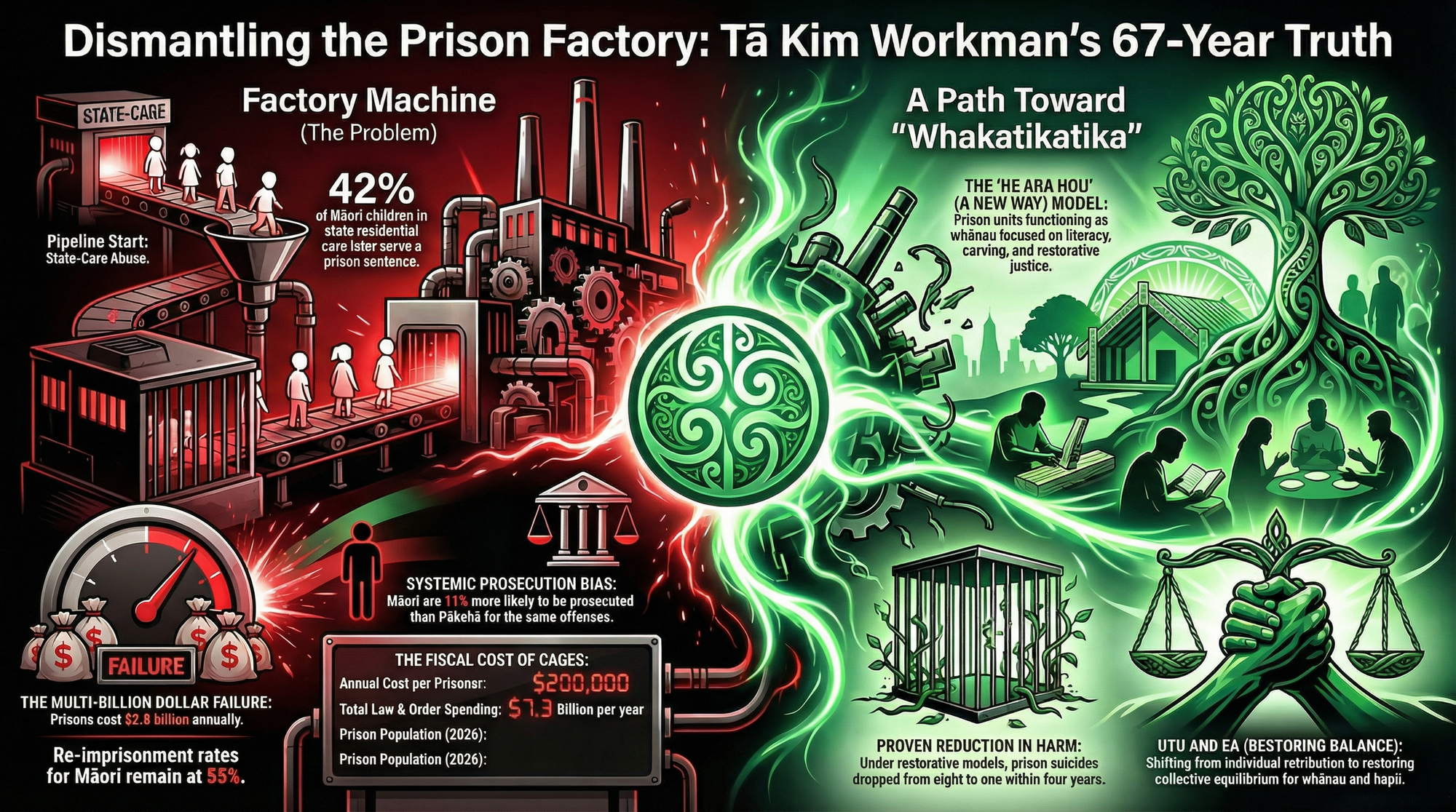
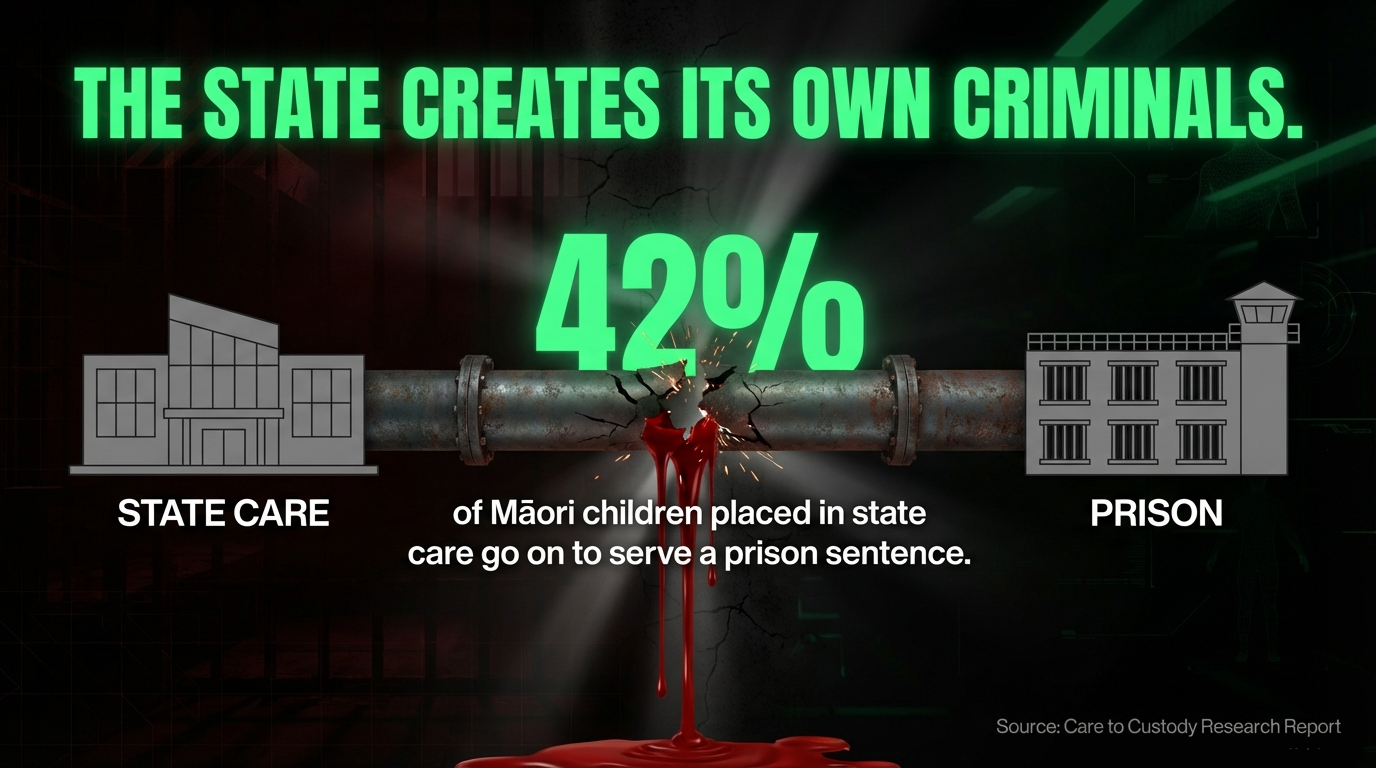
Because what Kohitere represented was not an aberration. It was the nursery of the factory. The Royal Commission of Inquiry into Abuse in Care — the largest public inquiry in New Zealand history — confirmed that approximately 200,000 children were abused in state and faith-based care between 1950 and 2019. The Care to Custody research report showed that one in three children placed in state residential care went on to serve a prison sentence. For Māori children, that figure was 42 percent.
Read that again. The state took Māori children into its "care." It abused them. Then it imprisoned them for the damage it caused. And it called this "personal responsibility."
As Dr Rawiri Waretini-Karena testified:
"When I walked into the prison yard for the first time as a teenager, I already knew 80 percent of the men in there. We'd spent the last 11 years growing up together in state care."
The factory does not begin at the prison gate. It begins in the nursery. And the nursery was — and remains — a state-run operation.
The Assembly Line: Policing, Prosecution, Sentencing
The factory's assembly line is precision-engineered. At every station, Māori are sorted, processed, and accelerated toward the cage.
Station 1: Surveillance. In 1958, when young Kim Workman joined the police force, there were 2,600 sworn officers and only 26 were Māori. Commissioner Les Spencer publicly declared that Chinese, "Hindus," and Pacific Islanders were unsuited to policing. Between 1954 and 1958, Māori youth offending "rose" by 50 percent — not because Māori committed more crime, but because they were watched, stopped, and charged more.
Nothing has changed. Māori are 37 percent of people proceeded against by Police, 45 percent of people convicted, and 52 percent of people in prison — despite being approximately 17.8 percent of the population.
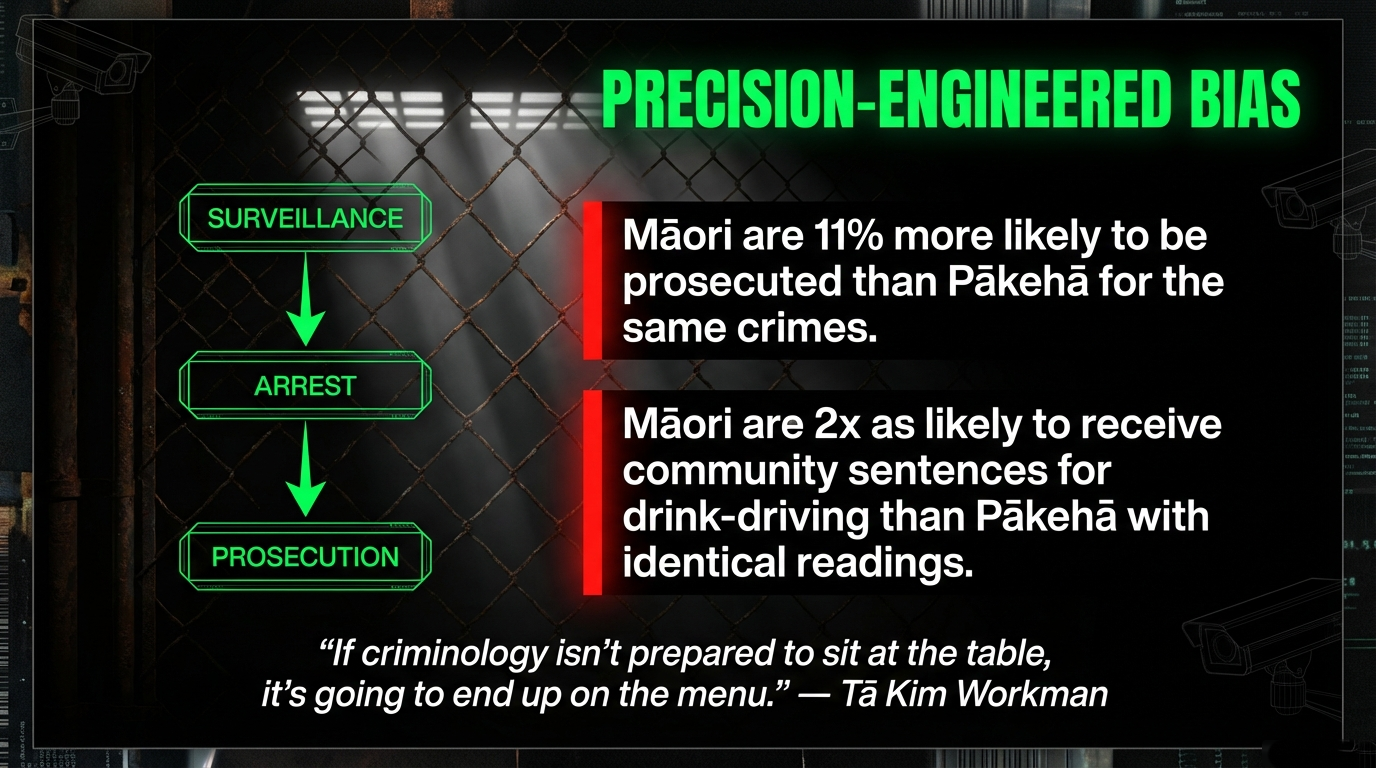
Station 2: Prosecution. The Auckland University of Technology released research in November 2025 confirming that Māori face harsher sentences than Pākehā for similar drink-driving offences, with Māori twice as likely to receive a community-based sentence instead of a fine — even after controlling for offence severity, blood alcohol level, and socioeconomic factors. As Tā Kim noted: when all other factors are held constant, Māori are still 11 percent more likely to be prosecuted than Pākehā.
Station 3: Imprisonment. As of November 2025, Māori comprised 52.3 percent of the prison population using primary ethnicity, and 56 percent when all reported ethnicities were counted. In women's prisons, the figure is 61 to 63 percent Māori. And even those horrifying numbers are undercounted: the TIAKI research project found Corrections was incorrectly recording ethnicity data, undercounting Māori by approximately 405 people — about 6 percent.
The factory counts its own product wrong — and not by accident. When you undercount the bodies, you undercount the crime.
The Foreman: Christopher Luxon and the Expansion of the Machine
Under Labour, the prison population dropped to 7,677 in March 2022. Christopher Luxon became Prime Minister in late 2023. Within a year, the prison muster passed 10,000. In January 2026, it topped a record 11,000 and is forecast to reach more than 14,000 within a decade. Over 40 percent of those inmates are on remand — not convicted, just warehoused.
New Zealand now imprisons 199 people per 100,000 — more than double Canada's rate, and 29 more per 100,000 than Australia.
When asked about the soaring numbers, Luxon said:
"Absolutely, that's a good thing. Yep, good thing."
He added:
"The cost will be what the cost will be."
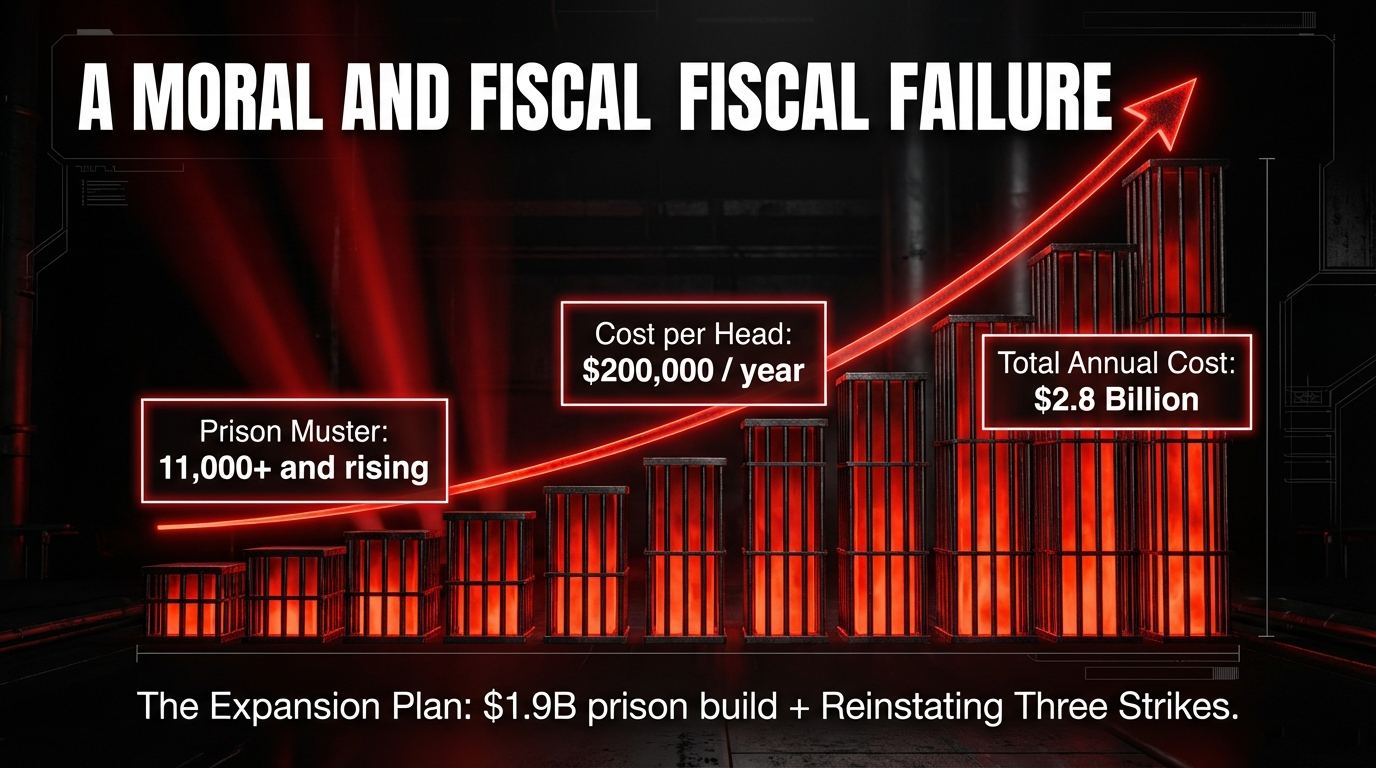
The cost is $200,000 per prisoner per year. Corrections cost the taxpayer over $2.8 billion in 2024. Total law and order spending exceeds $7.3 billion a year. And the coalition's legislative programme is designed to fill every new bed it builds:
- Three Strikes reinstated — extending sentences regardless of context
- Gangs Act — creating new categories of crime targeting communities already over-policed
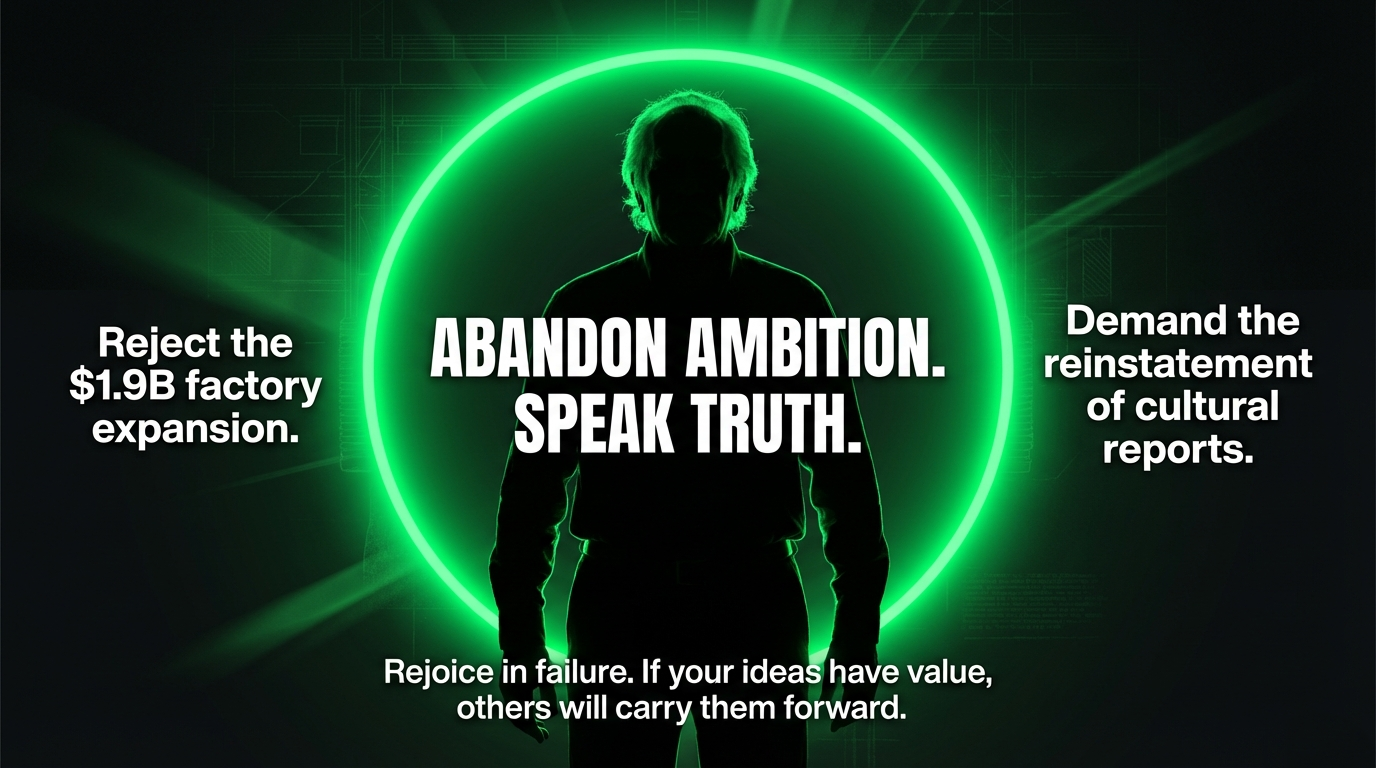
- Cultural reports ended — silencing the one mechanism that allowed courts to hear the whakapapa of harm
- Prisoner voting banned — stripping democratic rights from the incarcerated
- $1.9 billion prison expansion — 810 new beds at Waikeria, 316 at Hawke's Bay, fast-tracked
- Redress Bill — proposing to exclude abuse survivors who later became serious offenders from compensation, punishing them twice for what the state created
This is not law and order. This is a production quota. The foreman wants more cages, more bodies, more concrete. He wants the machine to run faster. And he wants you to applaud.
Three Examples for the Western Mind: Quantifying the Machine
For those raised in a tradition that demands numbers before it accepts suffering, here are three case studies that quantify the harm — and explain, for the Western mind, what the destruction of tikanga actually means.
Example 1: The Care-to-Cage Pipeline — Or, How the State Creates Its Own Criminals
The Data: Between 1950 and 1999, one in three children placed in state residential care went on to serve a prison sentence. For Māori children, 42 percent were later imprisoned. For the general population of similar demographics, less than 8 percent ended up in prison.
The Harm Quantified: The Royal Commission found the average lifetime cost of lost health and productivity for each survivor was more than $850,000. With an estimated 200,000 survivors, the total economic destruction approaches $170 billion — a figure that dwarfs total Treaty of Waitangi settlement payments by orders of magnitude. The average state redress payment? $30,000. Three and a half cents on the dollar.
The Tikanga Impact — Explained: In te ao Māori, a child is not an individual unit to be "placed" in an institution. A child is the living embodiment of their whakapapa — the intersection of all ancestors and all descendants. When the state removes a tamaiti from their whānau, it does not merely change their address. It severs the cord of whakapapa. It amputates the child from their tūpuna. The damage radiates backwards through the ancestral line and forwards through every mokopuna never born into wholeness. There is no English equivalent for this harm because the Western mind treats a child as an autonomous self. In tikanga, the self does not exist outside its relationships. To sever those relationships is to destroy the mauri — the life force — of the child entirely. The state did this to 200,000 children. Then it imprisoned 42 percent of the Māori ones for the damage.
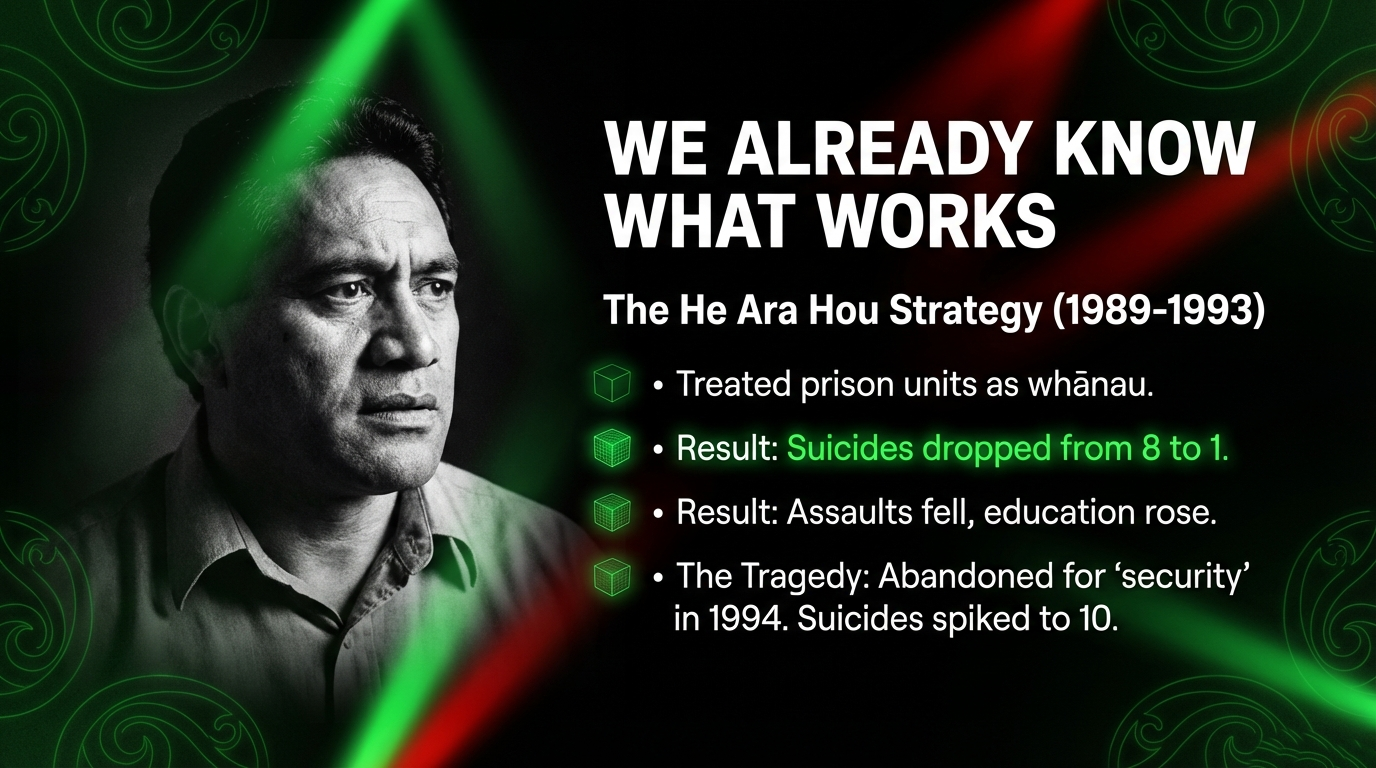
The Solution: Abolish the Redress Bill's exclusion clause. Fund kaupapa Māori reintegration services at a level proportionate to need — currently, as Associate Professor Paula King notes, "what is funded is overwhelmingly mainstream" while Māori providers are chronically under-resourced. Redirect a minimum of 20 percent of Corrections' $2.8 billion budget to whānau-based wraparound services, community reintegration, and survivor support — the approach Tā Kim pioneered with He Ara Hou in 1989, which reduced prison suicides from eight to one and increased educational completion by a third before the department abandoned it after his resignation and watched suicides climb to ten.
The Māori Green Lantern has previously investigated the state's systematic failure of duty to tamariki Māori in "Back to Basics, Back to Brutality: How a 'Hodgepodge' of Bills Became the Most Coordinated Assault on Māori Rights, Workers, and Democracy in a Generation", documenting how the current coalition's legislative programme systematically strips protections from the most vulnerable.
Example 2: The Sentencing Disparity Machine — Or, How Two Drivers Blow the Same Reading and Get Different Futures
The Data: The AUT's November 2025 study, funded by the Borrin Foundation, analysed drink-driving cases and found that even after controlling for offence severity, blood alcohol levels, and socioeconomic factors, Māori were twice as likely as NZ Europeans to receive a community-based sentence rather than a fine. A community-based sentence carries lasting consequences — it creates a criminal record that follows a person through employment, housing, and social participation.
The Harm Quantified: Consider two drivers. Both blow 600 micrograms. Both are first-time offenders. The Pākehā driver pays a fine and drives home. The Māori driver receives community service, gains a criminal record, and enters the system. That criminal record reduces lifetime earnings by an estimated 40 percent. It restricts access to housing, employment, education, and travel. It makes the next encounter with police more likely to result in arrest. The factory has acquired a new body — not because of what the person did, but because of what the person looks like.
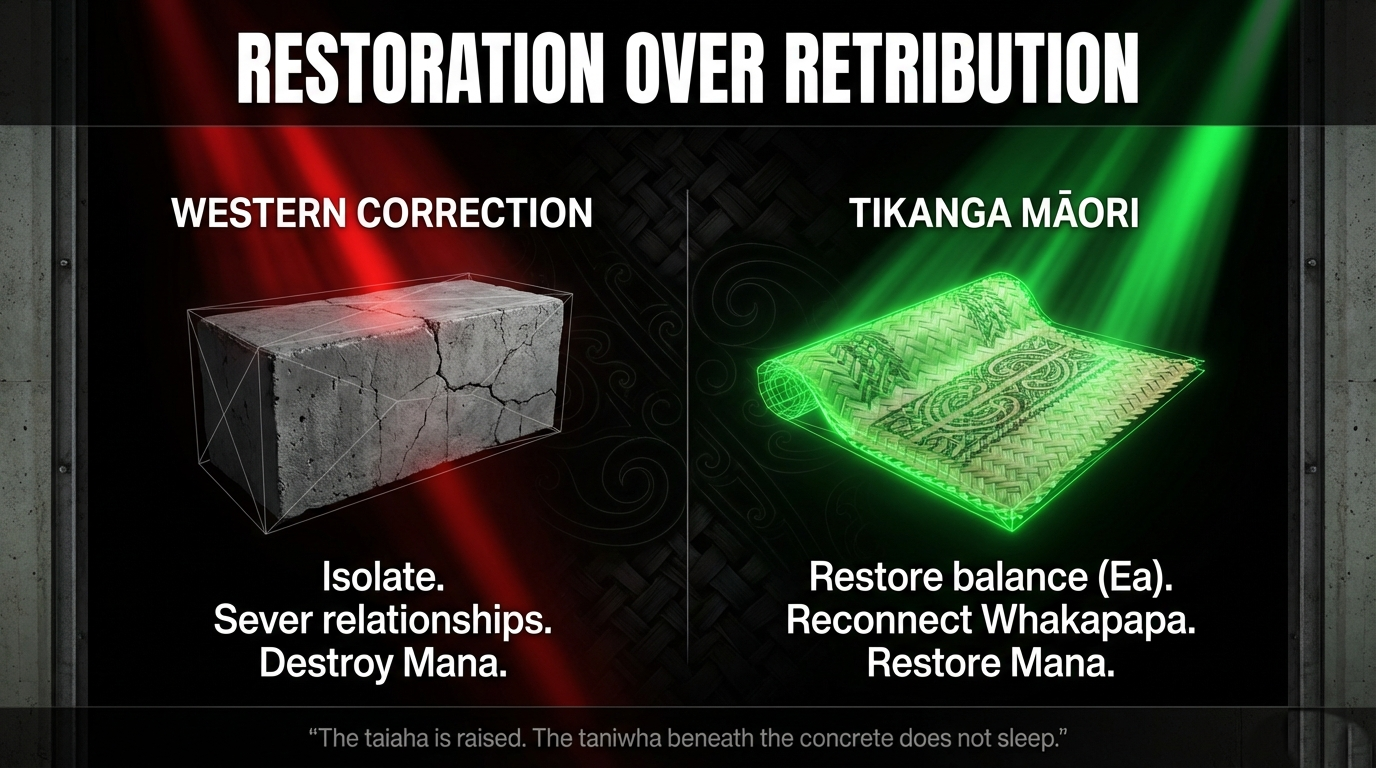
The Tikanga Impact — Explained: In tikanga Māori, justice (utu) is not retribution — it is the restoration of balance (ea). When harm occurs, the goal is not to punish the individual but to restore the collective equilibrium of the whānau, hapū, and iwi. The Western system's reliance on abstract "equal treatment" ignores the reality that Māori enter the courtroom carrying the accumulated weight of colonial dispossession, intergenerational trauma, and systemic surveillance. What looks "equal" on paper produces profoundly unequal outcomes in practice. Until 2024, cultural reports (s 27 of the Sentencing Act) allowed courts to hear this context. This government ended them — silencing the one voice that spoke the truth of whakapapa in a Pākehā courtroom. That is not justice. It is the deliberate amputation of context so that the machine can process bodies faster.
The Solution: Reinstate cultural reports immediately. Fund independent sentencing review panels with Māori representation. Implement the Borrin Foundation's recommendation for mandatory judicial training on unconscious bias. Publish ethnicity-disaggregated sentencing data quarterly, using Stats NZ-compliant protocols — not the made-up system Corrections invented that undercounts Māori by 6 percent.
The Māori Green Lantern has documented the systematic dismantling of Māori voice in decision-making in "The Dashboard Illusion: How Neoliberalism Sells Sovereignty While Stealing Resources" and "Cloaked in Equality, Rooted in Division: Exposing Hobson's Pledge's Agenda Against Māori Rights", exposing how the language of "equality" is weaponised to entrench disparity.
Example 3: The Prison Expansion Scam — Or, How $7.3 Billion Buys You More Crime, Not Less
The Data: The US Sentencing Project released a study in late 2025 showing that states that reduced their incarceration rates witnessed greater declines in crime rates. New York cut its prison population by over 50 percent between 1999 and 2023, and violent crime dropped by 34 percent — outpacing the national decline of 28 percent. As even former National Prime Minister Bill English acknowledged in 2011, prisons are "a moral and fiscal failure".
New Zealand is doing the opposite. This government is pouring $1.9 billion into prison expansion, fast-tracking new beds, and legislating harsher sentences — all while the 48-month re-imprisonment rate for Māori stands at 55 percent. More than half of every Māori person released from prison will be back. The machine eats its own output and calls it a supply chain.
The Harm Quantified: At $200,000 per prisoner per year, the current muster of 11,000 costs $2.2 billion annually in Corrections costs alone. If the muster reaches the projected 14,000, annual Corrections costs approach $2.8 billion — before counting police, courts, and social costs. As one analysis noted, if just 25 courts each kept 50 defendants out of prison, that would reduce the population by 1,400 in one year — saving $280 million. Instead, this government builds more concrete boxes and calls it investment.
Meanwhile, Tā Kim's He Ara Hou model — which treated prison units as whānau, engaged prisoners in education, employment, creative activity, and restorative justice — achieved measurable results: escapes declined steadily, suicides dropped from eight in 1989 to one in 1993, assaults on staff fell to 40 per year, and educational completion increased by a third. After his resignation, the department abandoned it. Suicides climbed to ten in 1994.
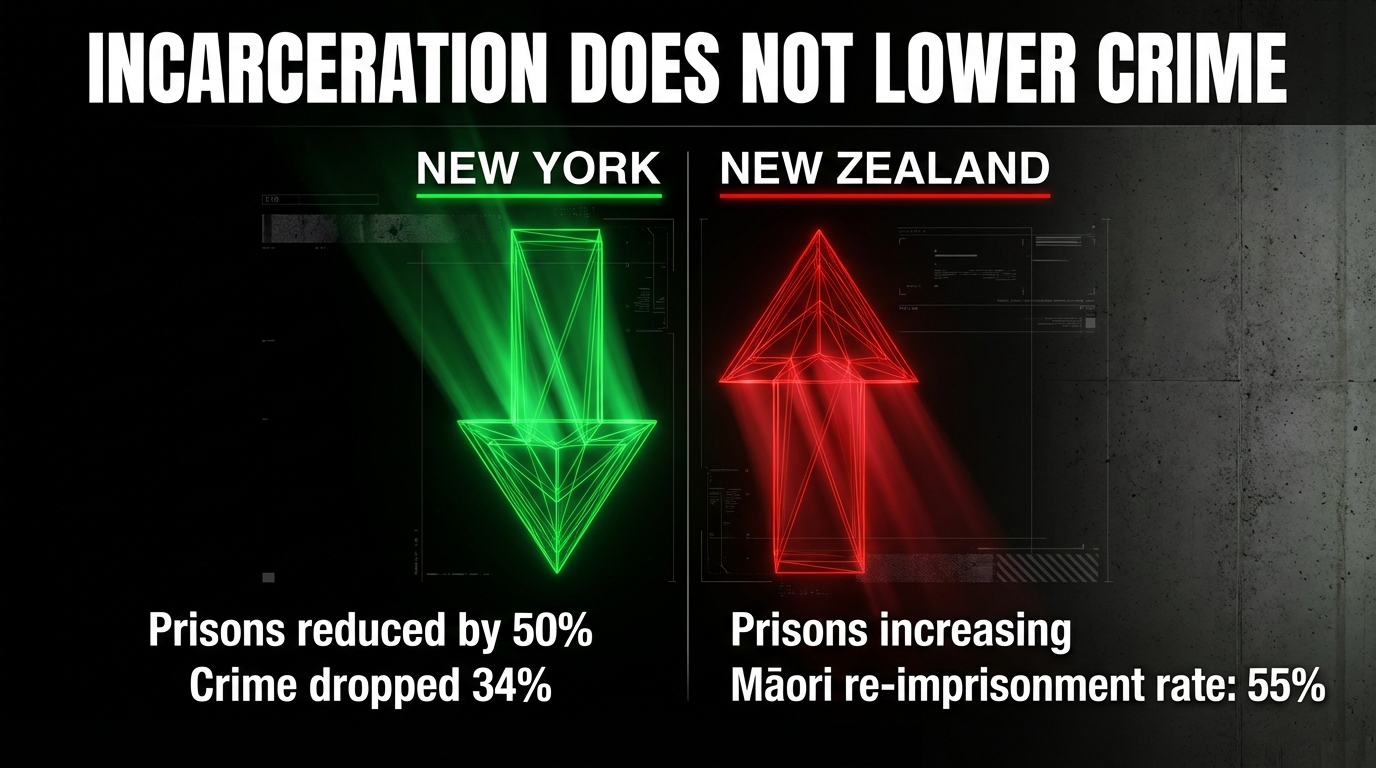
The evidence is not ambiguous. Rehabilitation works. Incarceration doesn't. This government knows that — its own former leader said so — and it is choosing mass incarceration anyway.
The Tikanga Impact — Explained: The Western concept of "correction" assumes the individual is broken and must be fixed through isolation and punishment. In tikanga Māori, the concept is entirely different. Whakatikatika — to set right — requires the restoration of relationships, not their destruction. A person who has caused harm must be brought back into the web of obligation and belonging that gives life meaning. Prison does the opposite: it rips the person from every relationship — whānau, hapū, iwi, whenua — and places them in an environment designed to destroy trust. It is the anti-tikanga. It manufactures disconnection, then punishes the disconnected for being disconnected. Every dollar spent on a prison cell is a dollar not spent on restoring mauri. Every new bed is a statement of intent: we will sever more whakapapa. We will create more trauma. We will call it order.
The Solution: Redirect prison expansion funding to community-based alternatives. Invest in therapeutic courts, Māori-led diversion programmes, and the whānau-centred reintegration models that Tā Kim demonstrated work. Adopt the New York model: reduce the prison population, invest in community safety, and watch crime fall. The evidence exists. The will does not — because the factory is profitable, and the bodies inside it vote Labour.
The Māori Green Lantern has tracked the fiscal architecture of this government's punishment industry in "The Colosseum of Kingsland: How a White Supremacist Government Built a Gladiator Arena on Sacred Whenua", documenting the pattern of public money flowing to infrastructure that entertains the powerful while crushing the vulnerable.
The Man Who Stayed: Tā Kim Workman and the Cost of Truth
Tā Kim Workman (Ngāti Kahungunu ki Wairarapa, Rangitāne) is 85 years old. He has been knighted (KNZM), awarded honorary doctorates from Victoria and Massey Universities, received the International Prize for Restorative Justice, been named Senior New Zealander of the Year, and chaired the Understanding Policing Delivery independent panel that produced what has been described as world-leading research on systemic police bias.
The price of that mahi? When he dismissed 12 prison officers for brutalising Mongrel Mob prisoners at Mangaroa Prison — prisoners who had been held naked in an outside yard for three days and repeatedly beaten, one sustaining a fractured skull — his phone stopped ringing. His office emptied. Two opposition MPs called for his resignation. The first person to support him was a Mongrel Mob leader who thanked him for "drawing a line in the sand".
He was diagnosed with severe clinical depression. Recovery took three years.
He emerged with two insights that every person in Aotearoa should tattoo on their soul:
"Abandon ambition. When you're overly ambitious, you tend not to speak the truth."
And:
"Rejoice in failure. If your ideas have any value, others will eventually carry them forward."
This is what truth costs in the factory. The machine punishes those who name its function. And the current government is accelerating the punishment.
The Factory's Latest Upgrades: What This Government Has Done
Let us be precise about the legislative assembly line this white supremacist neoliberal coalition has engineered:
| Policy | Effect | Who It Hits |
|---|---|---|
| Three Strikes reinstated | Extends sentences regardless of rehabilitation | Māori — 52%+ of prison pop |
| Gangs Act | Creates new criminal categories for association | Māori communities already over-policed |
| Cultural reports ended | Removes whakapapa context from sentencing | Every Māori defendant |
| Prisoner voting banned | Strips democratic participation from 11,000 people | Majority Māori |
| $1.9B prison expansion | Builds more cages, signals permanence | Taxpayers funding warehousing, not healing |
| Redress Bill exclusion | Denies abuse compensation to survivors who later offended | The 42% the state itself created |
| Ethnicity data manipulation | Undercounts Māori by 6%, hiding scale of crisis | Public accountability |
Every one of these policies is a cog in the machine. Together, they constitute the most comprehensive expansion of the prison-industrial complex in New Zealand's modern history. They do not address crime. They manufacture criminals and warehouse them for profit — ideological profit, electoral profit, and the craven satisfaction of a punitive base that would rather see brown bodies in cages than admit the system is the crime.
The Vision Tā Kim Left Us
Tā Kim Workman wrote:
"Imagine a nation that measures itself by how it treats the least, the lost, and the lonely. Where strength is not defined by the capacity to engage in political and civil conflict, but by a determination to forge peace and come together in a spirit of unity."
This nation does not exist. Christopher Luxon is building the opposite. But the blueprint is in our hands. He Ara Hou worked. JustSpeak works. Restorative justice works. The evidence is overwhelming, international, and irrefutable.
The factory can be shut down. But not by the people who profit from its output. Only by whānau who refuse to accept that brown children were born to fill cages.
The Ring glows, whānau. The taiaha is raised. The taniwha beneath the concrete does not sleep.
Kia mau ki te tikanga. Kia kaha. Kia manawanui.
Hold fast to what is right. Be strong. Be resolute.
Koha Consideration
Tā Kim Workman spent sixty-seven years fighting the machine — and the machine punished him with silence, isolation, and clinical depression. He persisted because whānau deserved truth more than he deserved comfort.
Every koha to this kaupapa signals that whānau are ready to fund the accountability that neither the Crown nor Corrections will provide. It signals that rangatiratanga includes the power to fund our own truth-tellers — especially when the state is spending $7.3 billion a year silencing them with concrete and steel.
Kia kaha, whānau. Stay vigilant. Stay connected. And if you are able, consider a koha to ensure this voice continues to name the factory, count the bodies, and demand the machine be dismantled.
If you are unable to koha, no worries! Subscribe or follow The Māori Green Lantern, kōrero about what you've read, and share with your whānau and friends — that is koha in itself. Every share breaks one more brick from the factory wall.
Three pathways exist:
For those who wish to support this mahi directly with a koha (voluntary contribution):
Koha — Support The Māori Green Lantern
For those who wish to receive essays directly and support through subscription:
Subscribe to The Māori Green Lantern
For those who prefer direct bank transfer:
HTDM, account number 03-1546-0415173-000.

Ivor Jones The Māori Green Lantern Fighting Misinformation And Disinformation From The Far Right
www.themaorigreenlantern.maori.nz
Research conducted 21 February 2026. Sources consulted include E-Tangata, RNZ, 1News, Te Ara, Waatea News, the Royal Commission of Inquiry into Abuse in Care, the US Sentencing Project, the Borrin Foundation/AUT sentencing study, NZ Ministry of Justice, Department of Corrections data, and the TIAKI research project (University of Otago). All URLs verified at time of publication.