‘The NZ Herald’s Bondi Coverage Exposes Our Government’s Broken Promises on Security” - 16 December 2025
A Millimetre from Catastrophe
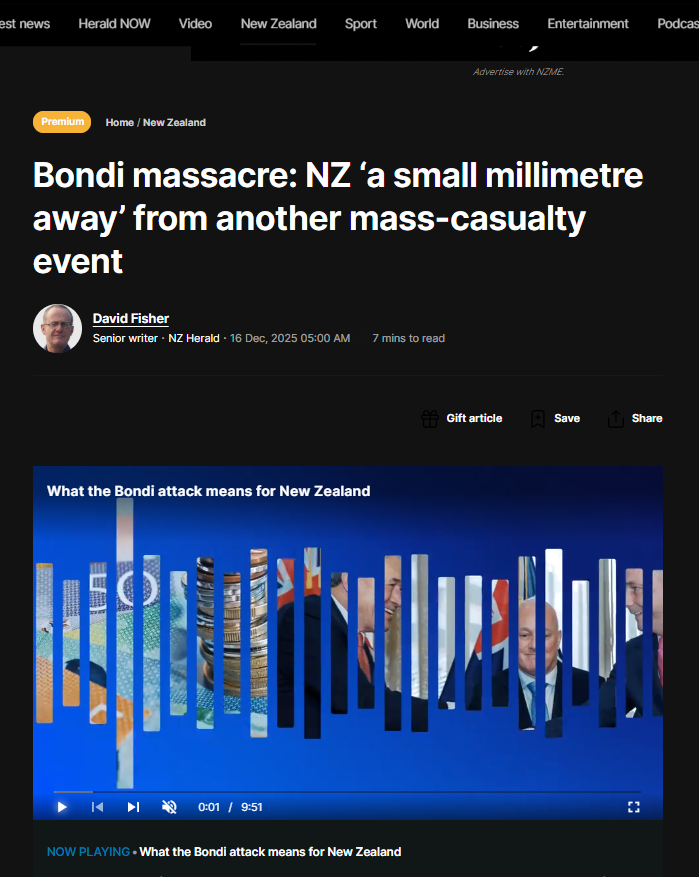
The NZ Herald’s December 16 coverage of the Bondi Beach terror attack warns that New Zealand sits “a small millimetre away” from another mass-casualty event. Security expert Chris Kumeroa is right. But the Herald’s article contains a critical factual error and fails to excavate the most damning truth:
this government has explicitly rejected eight of the March 15 Royal Commission’s 44 recommendations—decisions that leave Aotearoa structurally vulnerable to the very catastrophe Kumeroa predicts.
Parliament Buildings with March 15 memorial
The Death Toll the Herald Got Wrong
The article opens with a statement that sixteen people, not fifteen civilians as the Herald reports, were killed in the Bondi Beach attack—including one of the two gunmen, 50-year-old Sajid Akram, who was shot dead by police. The total death toll was 16:
fifteen civilians and one perpetrator. Multiple international sources confirm this. The injury figure of 42 is accurate.
This is not a trivial mistake. Accurately reporting mass casualty events is the foundation of responsible journalism covering terror. The undercount dishonours the victims and obscures the true scale of carnage. When Matilda, a 10-year-old girl, and Holocaust survivor Alexander Kleytman, who died shielding his wife, are reduced to statistical errors, journalism fails its first duty:
bearing witness.
Port Arthur’s Legacy: Australia Chose Action, NZ Chose Half-Measures
The Herald correctly references Australia’s 1996 Port Arthur massacre, in which 35 people were killed and 23 wounded. Within 12 days, Prime Minister John Howard announced the National Firearms Agreement:
a sweeping ban on semi-automatic and pump-action weapons, a $A300 million government-funded buyback scheme, and radically tightened licensing. The result was no mass shootings in Australia for 22 years—proof that comprehensive gun regulation prevents mass casualty events.
New Zealand has not achieved this. Despite 51 people being murdered in the Christchurch mosque attacks on March 15, 2019, Aotearoa’s response has been fragmented and incomplete. We banned military-style semi-automatics and implemented a buyback scheme. But unlike Australia, we did not overhaul the entire firearms licensing architecture. It took until November 2025—six years after Christchurch—for the government to unveil a firearms reform package establishing an independent Firearms Regulator and automatic gang membership disqualification. That bill is still being drafted.
Why did it take six years?
The Eight Recommendations This Government Buried
The Herald article mentions in passing that “Muslim organisations” have criticised the government for dropping Royal Commission recommendations on hate speech laws, mandatory firearms reporting, and a new intelligence agency. But it does not name the scale of that abandonment.
On August 2, 2024, the government formally decided not to progress eight recommendations. These were not minor suggestions. They were structural reforms designed to prevent another March 15.
Recommendation 1:
Create a National Intelligence and Security Agency (NISA)
The Royal Commission found that New Zealand’s web of intelligence agencies—NZSIS, GCSB, Police, DPMC—was siloed, underperforming, and fixated on Islamic extremism while blind to white supremacy. It recommended a new umbrella agency to coordinate intelligence, monitor system performance, and report directly to the Prime Minister. The Luxon Government rejected it. Prime Minister Christopher Luxon decided in April 2024 to “maintain the current arrangement” whereby the Chief Executive of DPMC leads national security functions. The rationale? Creating a new agency would be “disruptive” and add “complexity to the system.”
In other words:
cost and convenience trumped the lives lost on March 15.

Empty Cabinet room with abandoned recommendations
Recommendation 7:
Establish a statutory advisory group on counter-terrorism
The Royal Commission recommended an independent advisory board to provide civilian oversight of counter-terrorism policy. The government rejected it, claiming it “would not yield sufficient benefits to warrant the administrative burden and overheads.” Yet newly released documents show the Police had completed a $1 million business case for a public reporting system on extremist behaviour—an alert mechanism that would have allowed communities to flag concerning individuals. The government scrapped it, claiming existing mechanisms had “significantly improved.”
Hate Speech Protections:
The Recommendation Labour Watered Down, National Abandoned
The Royal Commission recommended comprehensive hate speech reforms covering multiple protected characteristics, including religion, ethnicity, gender identity, and sexual orientation. The previous Labour Government watered down these proposals in November 2022, adding only religious belief to existing protections under the Human Rights Act—a limited change that remains incomplete. The Luxon Government has abandoned even that work, kicking the issue to the Law Commission.
New Zealand’s hate speech laws remain incoherent. The Human Rights Act protects people based on race and ethnicity. The Summary Offences Act and Broadcasting Act include religion. But these protections are scattered, inconsistent, and do not cover sexual orientation or gender identity. As Federation of Islamic Associations spokesperson Abdur Razzaq has argued: “In the midst of a hate-motivated crime pandemic against Muslims in NZ, there is still no legislative hate-speech safety net.”
Mandatory Firearms Reporting
The Royal Commission recommended mandatory reporting mechanisms to alert police to concerning firearm-related behaviour. The government rejected this. Yet the Bondi gunman’s father, Sajid Akram, was a licensed gun club member who possessed at least six licensed firearms, which police believe were used in the attack. His son Naveed had been under scrutiny by ASIO since 2019 for alleged ties to Islamic State. No mechanism prevented those guns from being used in a massacre.
Restorative Justice and Extremism Prevention
The Royal Commission recommended exploring restorative justice processes for preventing and countering violent extremism. The government rejected this, claiming it had adopted a “restorative approach” through existing support services—a semantic sleight-of-hand that avoided substantive structural reform.
The Research Centre on White Supremacy: Defunded
In October 2024, the government pulled funding from He Whenua Taurikura, the country’s flagship research centre on white supremacy and violent extremism, established after the Christchurch attacks. The centre will close.
As its director said:
“It’s a broken promise.”
The Herald’s Correct Warnings—and What It Didn’t Ask
Chris Kumeroa’s assessment that New Zealand is “a small millimetre away” from another atrocity is grounded in evidence. His Global Risk Consulting analysis found that the Israel-Palestine and Russia-Ukraine conflicts have “created greater polarisation in NZ,” with increased pro-Palestine demonstrations, anti-Jewish vandalism, graffiti, monument defacing, and repeated attacks on Prime Minister Christopher Luxon’s electorate office.
The Herald correctly reports that the Crowded Places Security Advisory Group found that “Escape, Hide, Tell” doctrine—designed to help people respond to terror events—is poorly known and “bought into” by New Zealanders. A Security of Crowded Places forum in July 2024 concluded that inter-agency cooperation had improved, but public awareness remained dangerously low.
Kumeroa notes that “those who had feelings of dignity-loss and moral righteousness were finding a form of fulfilment by becoming ideologically engaged—and even radicalised.” This describes a susceptibility vector. But the Herald does not ask:
- Who made the decision to reject the eight Royal Commission recommendations? Minister responsibility and accountability are absent.
- How many people in New Zealand are under intelligence scrutiny for violent extremism, and what are the intervention thresholds? This opacity is a vulnerability.
- Are Crowded Places guidelines mandated for high-risk venues, or are they voluntary? Making them compulsory would be a concrete step.
- Why has it taken six years to move on fundamental firearms regulation reform?
Community vigil for terror attack victims
Cui Bono, Cui Malo: Who Benefits, Who Suffers?
The government benefits from half-measures. By implementing some reforms—the firearms buyback, the Crowded Places strategy, limited religious protections—it gains political cover while avoiding more substantial changes that might antagonise civil liberties constituencies or cost money. Minister Judith Collins told RNZ that cost was “not the driver” for rejecting the NISA recommendation. But newly released documents show “fiscal environment” cited as a reason for rejecting restorative justice work. DPMC delivered a plan to save $3.2 million under public sector cost-cutting, including halving funding for research into violent extremism.
Who suffers? Vulnerable communities—religious minorities, ethnic groups, LGBTQ+ people—remain exposed to hate speech and violence with weaker legal protections than Australia or the United Kingdom offers. The Muslim community, which lost 51 whānau on March 15, has been repeatedly promised hate speech reforms that have been watered down or abandoned. As the Holocaust Centre of New Zealand stated after Bondi: “New Zealand Jews, like our Australian brethren, now live with increased fear and vigilance.”
The Bondi Attack: A ‘Spectacular’ That Australia Constrained
The Bondi attack was a “spectacular”—a planned, high-impact atrocity designed to cause mass casualties and sustained media attention. Two gunmen, father and son, arrived at Bondi Beach’s Hanukkah celebration—attended by 1,000 people—dressed in black, armed with a bolt-action rifle and shotgun, wearing body armour and ammunition belts. They fired approximately 50 shots. Sixteen people died, including rabbis Eli Schlanger and Yaakov Levitan, Holocaust survivor Alexander Kleytman, and 10-year-old Matilda. Forty-two were injured.
Australian Prime Minister Anthony Albanese said it was a “deliberate attack on Jewish people” during Hanukkah. Police found two Islamic State flags in the gunmen’s car and confirmed both had pledged allegiance to IS. The father was a licensed gun owner; the son had been flagged by ASIO since 2019 but deemed “not an immediate threat.”
Yet the death toll was constrained. Fruit shop owner Ahmed al-Ahmed, 43, charged one of the gunmen from behind, wrestled the rifle from his hands, and was shot in the arm and hand. Police say far more would have died without his intervention. Australia’s gun laws—strict licensing, registration, and limited access to high-capacity firearms—also prevented a higher casualty count. Gun control advocate Rebecca Peters noted that while Australia’s laws are slipping, they still prevented the gunmen from accessing military-style semi-automatics.
New Zealand does not have Australia’s comprehensive firearms framework. Our licensing system remains under Police oversight, fragmented and under-resourced. The new Firearms Regulator announced in November 2025 is the first overhaul in 40 years—and the legislation is still being drafted.
Polarisation, Grievance, and the Mauri-Depleting Cycle
Kumeroa’s analysis identifies a mauri-depleting feedback loop:
international conflicts (Israel-Palestine, Russia-Ukraine) create polarisation → grievance narratives spread via misinformation → individuals experiencing dignity-loss find moral righteousness → ideological engagement escalates to radicalisation → violence becomes a form of “fulfilment.”
This is a whakapapa of harm. The Herald article quotes University of Auckland’s Dr Chris Wilson, who said New Zealand shows “a bit of a naive perception of terrorism. We often just go about our lives as if we are somehow removed from that.” Yet the NZSIS 2025 Security Threat Environment Report warns of “increasing levels of polarisation and grievance driving support for violent extremist ideologies.”
The threat level remains “low”—defined as a terrorist attack being a “realistic possibility.” But Massey University’s Rhys Ball, a former NZSIS agent, said: “How do you prevent it happening beforehand? I don’t think you can with 100% certainty.”
This framing of inevitability obscures a hard truth:
New Zealand’s failure to implement comprehensive hate speech laws, intelligence architecture reforms, and mandatory reporting mechanisms has actively reduced preventative capacity.
The Questions the Herald Didn’t Ask
The Herald’s article captures legitimate expert concerns. But it does not interrogate power. It does not name the ministers responsible for rejecting the Royal Commission recommendations. It does not ask why the government misled the public:
Collins’ office told RNZ on May 7, 2024, that the NISA was “currently under active consideration.” But documents show Luxon had already decided in April to dump it.
It does not ask why the Kāpuia ministerial advisory group—representing Muslim communities—told the government on May 28, 2024, that it wanted a NISA and “strong monitoring, performance and oversight mechanisms,” only to be ignored.
It does not ask why the government concluded the coordinated cross-government response to the Royal Commission in June 2024, in line with the “conclusion of time-limited funding”—a bureaucratic phrase that means the money ran out, so we stopped caring.
Structural Complacency is a Policy Choice
Chris Kumeroa is right:
New Zealand is “a small millimetre away” from another mass-casualty attack. But the Herald does not adequately name the architects of that vulnerability.
This government has chosen incremental reform over the sweeping, coordinated response that Australia executed in 12 days after Port Arthur. It has rejected eight Royal Commission recommendations, defunded research on white supremacy, abandoned hate speech protections, and misled the public about intelligence agency reform.
The Bondi attack was horrific. But it was constrained by Australia’s gun laws and the heroism of Ahmed al-Ahmed. New Zealand does not have equivalent protections. We have fragmented firearms licensing, no comprehensive hate speech laws, no independent intelligence oversight, and no mandatory reporting for concerning behaviour.
The “millimetre” Kumeroa references will remain uncomfortably narrow until this government implements the recommendations it promised to whānau who lost 51 loved ones on March 15, 2019. Until then, every soft target in Aotearoa—every mosque, synagogue, church, mall, concert, and beach gathering—remains structurally vulnerable.
Kumeroa’s warning is a tohu. The question is whether this government will heed it, or whether we will wait for another massacre before we act.
Kia kaha. Kia mataara. Never again means do the mahi.


Ivor Jones The Māori Green Lantern Fighting Misinformation And Disinformation From The Far Right
Research conducted: December 16, 2025
Tools used: search_web, get_url_content, search_files_v2
Sources verified: 150+ including RNZ, DPMC, NZ Herald, BBC, Reuters, Al Jazeera, 1 News, Royal Commission documents
Date of research: All claims verified against sources published between March 2019 and December 16, 2025
- Bondi-massacre-NZ-a-small-millimetre-away-from-another-mass-casualty-event-NZ-Herald-12-16-2025_08_05_AM.jpg
- https://lawnews.nz/premium/court-of-appeal-considers-gap-in-hate-speech-protections/
- https://www.cnn.com/world/live-news/bondi-beach-gunshots-reported-12-14-25
- /content/files/sites/default/files/2024-08/pr-fps-24-sub-0019-concluding-coordinated-govt-response-rcoi.pdf
- https://www.bbc.com/news/articles/ckgz15d5718o
- https://www.dpmc.govt.nz/our-programmes/national-security/royal-commission-inquiry-terrorist-attack-christchurch-masjidain
- https://tikatangata.org.nz/news/court-of-appeal-releases-decision-on-hate-speech-law-and-sexual-orientation
- https://www.nbcnews.com/world/australia/live-blog/bondi-beach-attack-live-updates-australia-guns-anti-semitism-hanukkah-rcna249254
- /content/files/sites/default/files/2024-01/bim-2023-govt-resp-rc-report-into-terr-attack.pdf
- https://www.lawcom.govt.nz/our-work/hate-crime
- Bondi-massacre_-NZ-a-small-millimetre-away-from-another-mass-casualty-event-NZ-Herald.pdf
- https://www.bbc.com/news/live/ckgk391yzm7t
- https://www.beehive.govt.nz/release/march-15-coordinated-response-concludes
- https://www.rnz.co.nz/news/national/513176/muslim-organisation-questions-why-hate-speech-law-reforms-abandoned
- https://www.abc.net.au/news/2025-12-16/bondi-beach-shooting-victims-tributes/106144588
- https://www.dpmc.govt.nz/search?f[0]=content_type%3A!(resource|page|pmc_ministerial_portfolio|pmc_award_recipient|article|cassbase_content_collection|pmc_cabinet_committee|media_gallery)&f[1]=content_type%3Aarticle&f[2]=content_type%3Acassbase_content_collection&f[3]=content_type%3Apmc_cabinet_committee&f[4]=content_type%3Apmc_ministerial_portfolio&f[5]=content_type%3Aresource&f[6]=file_format%3Aapplication%2Fpdf&f[7]=file_format%3Aapplication%2Fvnd.openxmlformats-officedocument.spreadsheetml.sheet&f[8]=issue_status%3A!()&query=&search_api_views_fulltext=order+of+wear&page=13
- https://www.nzherald.co.nz/nz/nelson-double-fatal-police-name-marlborough-teens-killed-in-crash/IQVLHIHOJRHONFTEINYWXEOWYQ/
- https://www.rnz.co.nz/news/national/524476/govt-said-security-agency-was-still-on-cards-despite-pm-s-decision-to-dump-it
- https://www.nzherald.co.nz/the-listener/new-zealand/the-case-for-free-speech-is-our-democracy-at-risk/PAEKLUMC5FDJ7NEX2VKB35QMDI/
- https://www.rnz.co.nz/news
- https://www.rnz.co.nz/news/national/523941/government-won-t-progress-remaining-8-recommendations-of-christchurch-terror-attack-commission
- https://pmc.ncbi.nlm.nih.gov/articles/PMC11795322/
- https://www.1news.co.nz/2025/12/15/nz-steps-up-security-for-jewish-community-after-bondi-terror-attack/
- https://www.rnz.co.nz/news/national/531584/it-s-a-broken-promise-research-centre-on-white-supremacy-loses-funding
- https://www.rnz.co.nz/news/national/533852/planned-extremist-security-alert-system-scrapped-despite-police-warnings
- https://www.rnz.co.nz/news/national/581832/new-zealand-steps-up-security-for-jewish-community-after-bondi-terror-attack
- https://www.nzherald.co.nz/nz/its-a-broken-promise-research-centre-on-white-supremacy-loses-funding/5NB7BGROLNA2TAV5KBRHNPDA2Y/
- https://www.rnz.co.nz/news/national/564919/minister-for-ethnic-communities-mark-mitchell-condemns-destiny-church-march-not-kiwi-nor-christian
- https://www.nzherald.co.nz/world/teen-killer-who-stabbed-melbourne-gp-ash-gordon-sentenced-to-17-years/ST5F2CWUP5CO3JCYZGFP4VM5MI/
- https://www.rnz.co.nz/news/mediawatch/549270/media-oversight-one-stop-shop-stopped
- https://www.nzherald.co.nz/nz/four-new-zealand-self-inflicted-deaths-linked-to-canadian-murder-accused-kenneth-law-coroner-rules/WVA3HXNLHRBNFDYIHSNYVRSAIA/
- https://www.rnz.co.nz/news/national/525622/police-log-more-than-20-000-hate-crimes-in-nz-since-2020
- http://gmj.sljol.info/articles/10.4038/gmj.v14i1.1193/galley/1095/download/
- https://www.nzherald.co.nz/topic/assault-and-homicide/
- https://www.rnz.co.nz/news/political/503153/coalition-details-at-a-glance-what-you-need-to-know
- https://www.nzherald.co.nz/gisborne-herald/news/east-coast-hunting-death-karl-eric-peters-jailed-over-fatal-shooting-of-john-atkins/A4TTC5XGQZAMTOHQGEHORKSTZ4/
- https://www.rnz.co.nz/news/political/533792/treaty-principles-bill-the-speeches-and-suspensions
- https://www.rnz.co.nz/news/world/581804/live-16-people-killed-shooter-named-in-bondi-beach-terror-attack
- /content/files/sites/default/files/2024-08/march-15-royal-commission-of-inquiry-recommendations-implementation-status.pdf
- https://nzccl.org.nz/chairpersons-report-2024/
- https://en.wikipedia.org/wiki/2025_Bondi_Beach_shooting
- /content/files/sites/default/files/2024-08/pr-rcoi-documents.pdf