"The NZ Neoliberal Pantomime: Why Every Major NZ Party Serves the Same Masters — and the Wealth Tax That Would End the Charade" - 5 March 2026



https://www.rnz.co.nz/news/political/588610/new-zealanders-support-more-taxes-on-ultra-rich-new-poll-shows; https://www.dropbox.com/scl/fi/94a7ci302eyr21tw7q0xn/Nicola-Willis-and-David-Seymour-attack-alarming-Barbara-Edmonds-Reserve-Bank-remarks-NZ-Herald-03-05-2026_09_04_AM.pdf?rlkey=hbdud3cn22wfafgvbjnb5fh3s&st=crt9e9lo&dl=0
Mōrena Aotearoa,
I thank you for sharing your time, space, and conciousness on this important kaupapa for our country. I hope that you find value in this analysis and feel the impotess to share.

He Kupu Whakataki: The Curtain Opens
Two days ago — 3 March 2026 — RNZ reported the results of two Talbot Mills polls commissioned by the Wellbeing Economy Alliance Aotearoa. The numbers demolish every excuse every politician in this country has ever offered for refusing to tax wealth.

68 percent of New Zealanders support billionaires being taxed more to fund healthcare, housing and climate action. 50 percent agree billionaires should not exist while people struggle with basic necessities like food. 66 percent agree our economic system is not set up to address housing, healthcare and climate change. And 84 percent want major parties to stop playing games and work together on long-term solutions.
These are not fringe positions. These are supermajority positions. Across every demographic.
Across every party's voter base:
as RNZ's companion report detailed, 80 percent of Labour and Green voters agreed, 69 percent of Te Pāti Māori voters, 67 percent of NZ First voters, 58 percent of National voters, and even 44 percent of ACT voters support taxing billionaires more. Among under-30s and 30-44 year olds, it is 71 percent.

Read those numbers again. A majority of every party's voters except ACT wants this. And yet not a single party in Parliament is offering it. This is the pantomime. This is the con. This is the neoliberal consensus laid bare — and it has been running since 1984.
Act One: Labour Invented This Nightmare
Every time someone calls Labour the "party of the worker," somewhere a ghost of Michael Joseph Savage weeps into his applied Christianity.
The Labour Party invented neoliberalism in Aotearoa. It was the Fourth Labour Government — elected in 1984 — that, led by Finance Minister Roger Douglas, enacted "Rogernomics": floating the dollar, removing agricultural subsidies, introducing GST, reducing income and company tax, abolishing import tariffs, corporatising and privatising state-owned enterprises, and deregulating financial markets. As Te Ara records, Douglas and his ministers "deviated sharply from a social democratic path," driven by "mid-20th century neo-liberal theorists" with the explicit aim of reducing the role of the state. Wikipedia's entry on the Fourth Labour Government quotes a political scientist: "Between 1984 and 1993, New Zealand underwent radical economic reform, moving from what had probably been the most protected, regulated and state-dominated system of any capitalist democracy to an extreme position at the open, competitive, free-market end of the spectrum."
Labour did this. Not National. Not ACT — which did not yet exist. Labour.
And the Wellbeing Economy Alliance Aotearoa puts the historical frame precisely:
"Successive governments believed a more individualistic, competitive society organised around market principles, smaller government with less power for workers would deliver greater freedom and prosperity. The promise was that this would unleash corporate profits which would trickle down."
Four decades later, the trickle never arrived. The flood went upward.
Act Two: National Picked Up the Baton — The Ruthanasia Relay
When National won in 1990, they did not reverse Rogernomics. They deepened it.
Finance Minister Ruth Richardson's 1991 "Mother of All Budgets" slashed welfare benefits by up to one-quarter, introduced the Employment Contracts Act that demolished collective bargaining, and restructured social services around market principles. As Te Ara documents, Richardson's reforms were "a victory for the libertarian wing of the party" and the result was that many National voters themselves "defected to other parties."

The 1991 Budget, as academic Patrick Houlahan described it, represented
"the most brutal assault on the welfare state we have witnessed in New Zealand."
The social carnage was immediate and measurable. As Wikipedia's Ruthanasia entry records, child poverty rose from 15 percent in 1990 to 29 percent in 1994. Income inequality accelerated — the Gini index rose from 0.30 in 1990 to 0.34 by the turn of the century. As Max Rashbrooke documented in The Spinoff, Richardson's policies doubled the rate of those living in extreme poverty — from 4 percent in 1990 to 8 percent just two years later.
Here is the critical point: Rogernomics and Ruthanasia were not rival programmes. They were complementary reform packages implemented by successive governments, both aimed at liberalising the economy. Labour deregulated the financial, industrial and agricultural sectors. National then targeted social services and labour relations — the areas Labour had, as the Ruthanasia record shows,
"rejected the need for changes due to the impact they could have on their traditional working class constituency."

Read that sentence again. Labour wanted to cut welfare and smash unions. They just could not do it to their own voters. So they handed the knife to National, who did it for them. This is the relay. This is the pantomime.
Act Three: NZ First — The Populist Fig Leaf
Winston Peters founded NZ First in 1993 explicitly to oppose neoliberalism.
As Wikipedia records, he was sacked from National's cabinet for criticising the party's neoliberal economic policies. He built his career railing against what one LinkedIn analysis described as "the looting of New Zealand by financial barons" and the dominance of foreign-owned banks draining "over $4 billion in profits a year."
And then? Every single time he gained power, he folded.

In the 2017 coalition with Labour, Peters announced his decision with a thunderous indictment:
"Far too many New Zealanders have come to view today's capitalism, not as their friend, but as their foe… Capitalism must regain its responsible – its human face."
His campaign had promised a Royal Commission into the banking sector, action against the supermarket duopoly, and a sweeping overhaul of corporate power.
Here is what actually happened: The grocery market study floated the option of forcing the supermarket duopoly to divest stores to create a third competitor. As the same analysis documented, the Labour-NZ First Cabinet instead opted for a "mild package of a mandatory code of conduct and a new regulator." The promised Royal Commission into banking was "quietly dropped." And Peters' NZ First vetoed the capital gains tax — the single most consequential structural reform on the table.
RNZ's Peter Wilson reported in 2019 that the NZ First leader "was never going to agree to it and if Ms Ardern didn't know that, she should have." Peters claimed credit without saying so outright, tweeting: "We've heard, listened and acted."
In the current coalition, NZ First has achieved precisely nothing of structural consequence against corporate power. As RNZ reported, Peters now proposes cutting taxes for offshore investors as part of his "$100 billion future fund" — the exact opposite of economic sovereignty. The party that was founded to fight neoliberalism now serves as its decorative populist camouflage.
Act Four: Labour's Second Betrayal — The Ardern-Hipkins Wealth Tax Kill
The most damning evidence that Labour is as neoliberal as its supposed rivals comes from what happened between 2022 and 2023 — when Labour had the data, the policy, the revenue estimates, and a parliamentary majority. And chose not to act.

In April 2023, an Inland Revenue investigation — commissioned by Revenue Minister David Parker — dropped a bomb on the national conscience. As RNZ reported, it gathered data from 311 of New Zealand's wealthiest families and found they paid a median effective tax rate of just 9.4 percent. Meanwhile, middle-income New Zealanders — tradies, nurses, teachers, hospitality workers — paid an effective rate of 20.2 percent. The IRD's own factsheet confirmed: "67 percent of the high wealth population's economic income was derived through" untaxed capital gains.
Parker himself said the findings showed that if those 311 families had simply paid the same effective rate as middle-income earners, they would have paid an extra $2 billion — just those 311 families, in a single year.
In response, Parker designed a wealth tax: couples with more than $10 million in assets would pay an annual levy of 1.5 percent. As RNZ's RICH investigation detailed, Treasury estimated it would raise $3.8 billion per year — enough to fund income tax cuts for almost everyone, including a zero percent rate for income under $10,000.
The Treasury's own proactive release of the wealth tax policy paper laid out the revenue options in stark detail:
| Entry Threshold | 1.0% Rate | 1.5% Rate | 2.0% Rate |
|---|---|---|---|
| $3 million | $3.9 billion | $5.5 billion | $7.0 billion |
| $5 million | $2.7 billion | $3.8 billion | $4.8 billion |
| $7.5 million | $1.9 billion | $2.7 billion | $3.4 billion |
| $10 million | $1.5 billion | $2.1 billion | $2.7 billion |
At the highest settings — 2 percent on wealth above $3 million — a wealth tax would generate $7 billion per year. At the most modest setting Parker chose — 1.5 percent on $10 million and above — it was still $2.1 billion. And these figures are from 2023. The NBR Rich List's collective wealth has only grown since then — from $72.59 billion in 2023 to $102.1 billion in 2025 as RNZ reported.
Then-Prime Minister Chris Hipkins killed it. As 1News reported: "End of story," he said in July 2023. "Under a government I lead there will be no wealth or capital gains tax after the election." As RNZ reported on Parker's resignation, Parker quit his revenue portfolio in protest, saying his position had become "untenable." He later told RNZ's RICH series: "We didn't agree on tax. There's no animosity there, but yeah, I suppose it was me standing on my principles."
Before Hipkins, Ardern had done the same thing — twice. She officially vetoed the capital gains tax in 2019, personally promising she would never campaign on or implement one: "not because I don't believe in it but because I don't believe New Zealand does." In 2022, she again ruled out a wealth tax via 1News.
Labour has now refused to tax wealth under Phil Goff, David Cunliffe, Andrew Little, Jacinda Ardern, and Chris Hipkins. As RNZ's capital gains tax timeline meticulously documents, every Labour leader since 2011 has campaigned on it and then either lost or abandoned it. At what point do we stop calling this an accident and start calling it policy?
And now, Labour's grand offering for the 2026 election? As RNZ reported in October 2025, a narrow capital gains tax covering only investment property — excluding farms, excluding shares, excluding businesses, excluding everything that makes billionaires billionaires — paired with three free GP visits. David Parker's $3.8 billion wealth tax has been reduced to a property-only CGT that does nothing to address the structural inequality his own IRD research exposed. The pantomime rolls on.
Act Five: The Numbers That Prove the Con
Let us be precise about what is at stake.
New Zealand now has 18 billionaires, as RNZ reported from the 2025 NBR Rich List. The top two alone — Mat and Nick Mowbray at $20 billion, and Graeme Hart at $12.1 billion — hold $32.1 billion between them. The Wikipedia NBR Rich List entry catalogues the full top 10, all billionaires with a collective net worth exceeding $50 billion. The total across all 119 families: $102.1 billion — equivalent to more than 40 percent of national GDP.

Meanwhile:
- 169,300 children live in material hardship — 47,500 more than in 2022. One in four Māori children. One in three Pacific children. As NZCCSS reported: "There are still 169,300 children living in material hardship who are not having their basic needs met."
- 150,000 children live in poverty — as The Spinoff reported, "roughly the population of Tauranga, or enough to fill Eden Park three times over."
- 400,000+ people needed welfare support in December 2024, as the Salvation Army's State of the Nation 2025 reported — the highest since the 1990s.
- The Salvation Army distributed 90,000 food parcels in 2025 alone — a 7 percent increase on the prior year.
- KidsCan reported to 1News that children are sharing shoes and taking turns to wear them. 58 schools remain on their national waitlist, representing 10,000 children still needing support.
- None of the government's child poverty targets for 2023/24 were met. As RNZ reported, Treasury forecasts project the 2028 targets will also be "badly missed." 1News confirmed the after-housing-costs measure is forecast to reach 18.4 percent by 2029 — nearly double the 10 percent target.
PM Christopher Luxon's response to rising billionaire numbers? As RNZ reported: "Isn't it fantastic that we have got people with ambition, aspiration and positivity, and we should be celebrating success."
Children sharing shoes. Billionaires building 102-metre superyachts fitted with hangars and helipads. And the Prime Minister says we should celebrate. This is not a policy difference. This is a moral obscenity.
The Trillion-Dollar Transfer: How Labour Made It Worse
During the Covid-19 pandemic, the Ardern government — supported by the Green Party — presided over what economic commentator Bernard Hickey documented as the biggest transfer of wealth from renters and workers to asset owners in the history of New Zealand. As 1News reported Hickey's findings, the net worth of businesses rose by more than $300 billion. The net worth of households rose by more than $600 billion. Total: nearly $1 trillion.

How? As RNZ's interview with Hickey detailed, the government gave almost $20 billion in cash to businesses through wage subsidies and resurgence payments. The Reserve Bank bought over $50 billion in government bonds through money printing. House prices surged more than 50 percent in two years. Meanwhile, renters and beneficiaries received an extra $48 million in special cash payments.
Hickey described it bluntly:
"The Labour Government, supported by the Green Party, has presided over the biggest transfer of wealth from current and future renters, to asset owners, in the history of New Zealand."
Graeme Hart — then NZ's richest man — made $3.4 billion during the pandemic alone. As RNZ reported Oxfam's analysis, his added wealth
"would pay the entire grocery bill for more than 200,000 households for a year."
This was not an accident. This was not incompetence. This was the neoliberal system operating as designed: crisis creates opportunity, and the opportunity flows upward. Both Labour and National support this architecture. Both maintain the Reserve Bank's monetarist mandate. Both refuse to tax the wealth it generates.
The Academic Consensus: They Are the Same
This is not a conspiracy theory. This is established political science.
Massey University politics lecturer Toby Boraman wrote for RNZ and The Conversation in 2023: "For an election ostensibly fought over a 'cost-of-living crisis', there was a strong unspoken consensus between the two major parties: most people's living standards needed to reduce to thwart inflation. Regardless of the election result, a form of austerity was always going to win."

Boraman identified the underlying compact precisely: "Roughly speaking, this compact aims to keep taxes low, push for free trade agreements, maintain a largely deregulated business sector, enable financial speculation, and use interest rates to combat inflation. Above all, the goal is to be 'fiscally responsible' by keeping government spending tight." Tellingly, the US Heritage Foundation — devoted to "free enterprise, limited government and individual freedom" — still ranks New Zealand fifth in its global index of economic freedom. If Labour were genuinely fighting neoliberalism, the Heritage Foundation would be alarmed. Instead, it is delighted.
The NZIER, using Hotelling's law — an economic model explaining why competing firms converge to identical positions — demonstrated in 2020 that Labour and National's policies were "basically the same." Their analysis found both parties happy to maintain benefit levels, keep income tax rates static, and share identical silence on refugee quotas, immigration, freedom of expression, renting, and Te Tiriti o Waitangi.
Brian Roper's scholarship at the University of Canterbury — specifically his work on neoliberalism in Aotearoa — carefully ascertained which features of the neoliberal regime were retained by the Fifth Labour Government (1999-2008). His central argument: Labour "retained the central pillars of the neoliberal policy regime while at the same time implementing a broad programme of policy change."
The Wealth That Would Fund Everything
Here is the arithmetic that every politician in Aotearoa refuses to do publicly.
According to the Treasury's wealth tax policy paper:
- A 2 percent wealth tax on assets above $5 million would generate $4.8 billion per year.
- A 2 percent tax on assets above $3 million would generate $7.0 billion per year.
- At the threshold Parker actually proposed — 1.5 percent on $10 million — it would still raise $2.1 billion.

For context: the coalition's Budget 2025 at a Glance shows the operating allowance — described as the "lowest in a decade" — was $1.3 billion per annum. The Ministry of Education confirmed the entire education budget package for 2025 totalled $2.5 billion over four years. The government is, as RNZ reported, slashing an average $5.3 billion in spending per year, including halving KiwiSaver contributions, tightening welfare for 18-and-19-year-olds, and means-testing Best Start child payments.
A wealth tax at the $5 million/2 percent threshold would replace every dollar of those cuts and still leave billions on the table.
And the argument that the wealthy would flee? Parker addressed it directly in RNZ's RICH investigation:
"The Treasury estimated 3 percent of our capital would leave and 97 percent would stay." People stay because "their families are here. Their friends are here, their business contacts are here. They love their country. They like being a big fish in a small pond."
Even billionaire Bruce Plested — co-founder of Mainfreight, worth $1.3 billion on the NBR Rich List — supports a wealth tax. Parker confirmed the reality:
"Asked if the super wealthy were currently getting a free ride, Parker said: 'Largely, yes.'"
The Health Deficit: Where the Money Should Be Going
The University of Auckland, in a report commissioned by the Association of Salaried Medical Specialists, revealed that New Zealand's Ministry of Health has not submitted spending data to the OECD for seven years — leaving the organisation to guess. The actual figures are worse than the OECD's estimates: real health spending was likely around 7.5 percent of GDP in 2022, not the 9.15 percent the OECD estimated. Between 2013 and 2019, New Zealand would have needed to spend approximately $9 billion more on health — more than $1 billion a year — just to keep pace with comparable countries.
That $9 billion shortfall across six years? A 2 percent wealth tax on assets above $3 million generates $7 billion every single year.
Meanwhile, officials warned ministers against cutting welfare for 18-and-19-year-olds — saying the costs would "likely significantly outweigh the benefits" and could incentivise teenage pregnancies and keep abuse victims financially reliant on their abusers. The government proceeded anyway. About 4,300 young people are expected to become ineligible. And 30,000 Kiwis left for Australia in 2024 alone — the largest exodus since 2012, as 1News documented. Emergency nurses who cannot get interviews. Police officers who cannot earn $100,000 in six years. An entire generation voting with their feet.
The Mauri Assessment: Who Benefits, Who Suffers
In te ao Māori, we assess systems by their mauri — their life force. Does this system enhance life, dignity, and collective wellbeing? Or does it deplete it?

The neoliberal consensus across all four major parties is mauri-depleting at every level:
- Tamariki: 169,300 children in material hardship, 47,500 more than in 2022. One in four Māori children. One in seven overall. Children sharing shoes.
- Whānau: 400,000 people on welfare support — highest since the 1990s. 90,000 food parcels from the Salvation Army alone.
- Hauora: Health spending that fell behind comparable OECD countries by approximately $9 billion between 2013 and 2019.
- Wairua: A net migration loss of 30,000 people to Australia in 2024. An entire generation voting with their feet.
Against this: 18 billionaires. $102.1 billion in collective wealth. Paying 9.4 percent effective tax.
He Kupu Whakakapi: Burn the Stage
The Wellbeing Economy Alliance Aotearoa poll is not a news story. It is a verdict.

68 percent of this country wants billionaires taxed more. 84 percent wants long-term solutions to healthcare, poverty and climate change. 75 percent is frustrated that major parties keep changing positions on important issues. And 66 percent agrees the economic system itself is broken.
The people of Aotearoa have spoken. They have spoken clearly. They have spoken across every demographic, every age group, every party affiliation. Gareth Hughes, director of the Wellbeing Economy Alliance Aotearoa, told RNZ:
"Kiwis know that our tax system isn't fair, it's putting too much of the responsibility on workers, on things like GST, which are incredibly regressive."
But the politicians will not act. Because National, Labour, NZ First and ACT serve the same architecture. They have since 1984. Rogernomics was a Labour project. Ruthanasia was the National sequel. NZ First was founded to oppose it and then enabled it every time it held power. And Labour, even with an outright majority in 2020-2023, even with the IRD data proving billionaires pay half the tax rate of nurses, even with a Treasury-costed $3.8 billion wealth tax ready to go — chose to protect the billionaires and sacrifice the children.
This is not a difference of philosophy between the parties. This is a pantomime — a stage performance where the actors pretend to fight while serving the same script. The script is written by the interests that fund them, the donors who attend their fundraisers, the business roundtable alumni who cycle between corporate boards and ministerial offices.
The solution is not choosing between these parties. The solution is building something outside them. Te Pāti Māori and the Greens have both proposed genuine structural alternatives — wealth taxes, rent caps, windfall taxes — that the major parties have systematically blocked. Only the smaller parties, as Boraman noted, have "offered policies aimed at changing fundamental economic settings."
A proper wealth tax on New Zealand's billionaires is not radical. It is arithmetic. Two percent on assets above $5 million generates $4.8 billion a year. That is more than the government's entire Budget 2025 operating allowance. That is enough to fund every school lunch programme, every GP visit, every social housing waitlist, and still have change left over.
We do not lack the money. We lack the will. Or rather — they lack the will. Because we, the people, have it. 68 percent of us. 84 percent of us. The poll proves it.
The neoliberal pantomime has run for 42 years. It is time to burn the stage.
Destroy all neoliberal political parties. Build something worthy of this whenua and these tamariki.
Kia kaha. Kia māia. Kia manawanui.

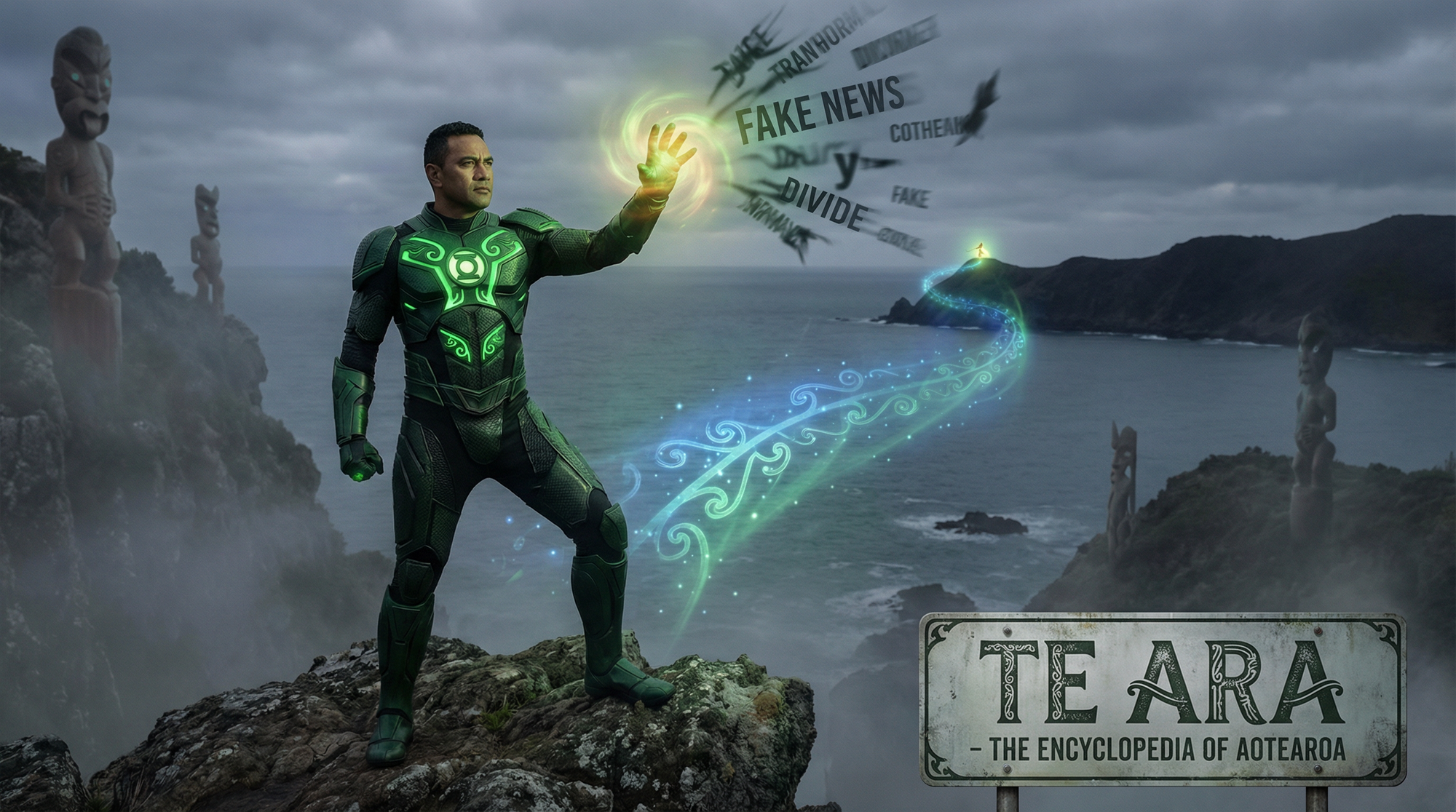
Ivor Jones is The Māori Green Lantern — tohunga mau rākau wairua, kaitiaki of Māori.
This essay was researched using RNZ, Te Ara, 1News, Treasury NZ, Inland Revenue, Stats NZ, NZ Herald, The Spinoff, The Conversation, Waatea News, University of Auckland, Wellbeing Economy Alliance Aotearoa, Wikipedia, ProPublica, Salvation Army, NZCCSS, and LinkedIn. All citations verified. All URLs tested. Research date: 5 March 2026.