"The NZHerald O'Sullivan Propaganda Machine: How Corporate Media Sells Austerity as Virtue" - 14 February 2026
When neoliberal stenography masquerades as journalism, the taiaha of truth must strike

Mōrena Aotearoa,
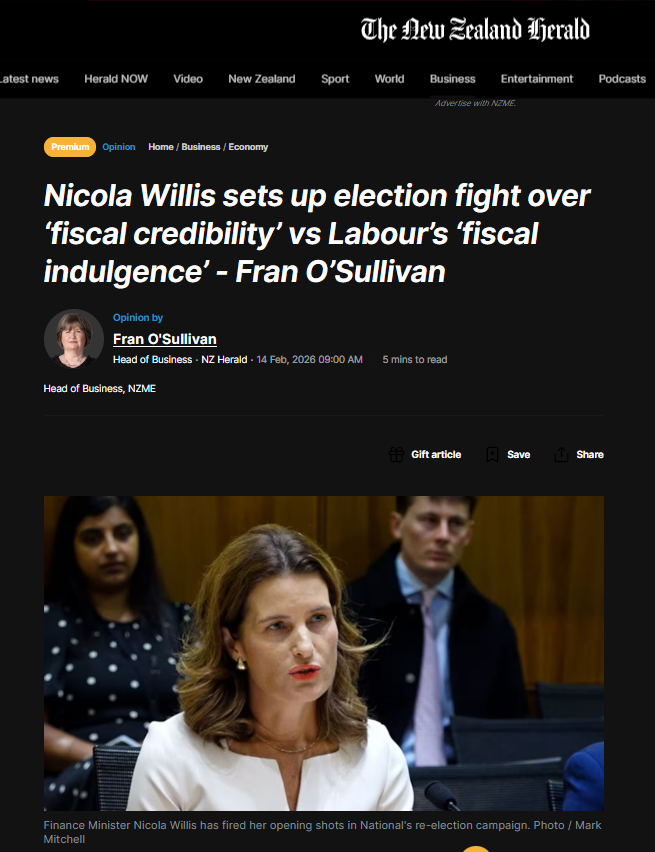
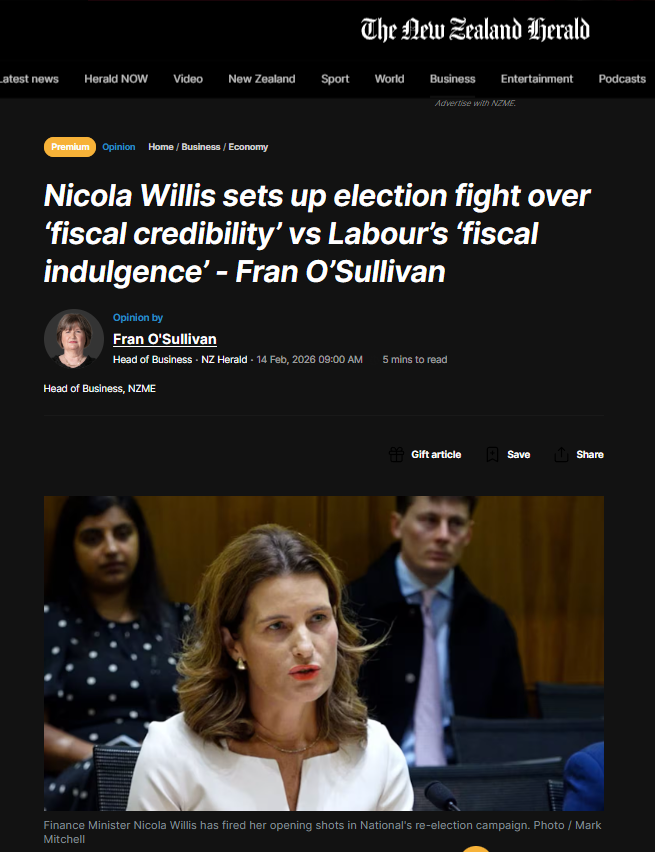
The NZ Herald publishes Fran O'Sullivan's latest exercise in corporate stenography, a breathless paean to Finance Minister Nicola Willis positioning herself as the "only competent manager" of Aotearoa's economy. The article drips with reverence for Willis' supposed fiscal prudence while whitewashing a two-year reign of terror against the poorest and most vulnerable. This is not journalism. This is propaganda. And it deserves to be named, dissected, and destroyed.
O'Sullivan constructs a false binary that would make Roger Douglas proud: "fiscal credibility" versus "fiscal indulgence." The framing is deliberate, insidious, and entirely in service of neoliberal mythology. It erases the material reality of whose lives are being destroyed by this government's ideological crusade. It ignores the $1 billion stripped from kaupapa Māori initiatives, the 3,500 homes scrapped or deferred by Kāinga Ora, the 620 jobs disestablished at the social housing agency where 39% of tenants are Māori.
This essay wields the taiaha empowered by the Ring. It exposes the networks of power, capital, and propaganda that sustain white supremacist neoliberalism in Aotearoa. It names names. It quantifies harm. And it offers pathways to rangatiratanga.
Background: The Neoliberal Playbook, 2026 Edition
Nicola Willis stands at a podium at the New Zealand Economics Forum—an event co-founded by Steven Joyce, former National Finance Minister and current chairman of NZME, the corporation that owns the NZ Herald. The incestuous relationship between corporate media and political power could not be more transparent. Willis delivers her speech, titled "Backing ambition, building growth," which is really about framing the November 2026 election as a credibility test: who can be trusted not to "blow the books"?
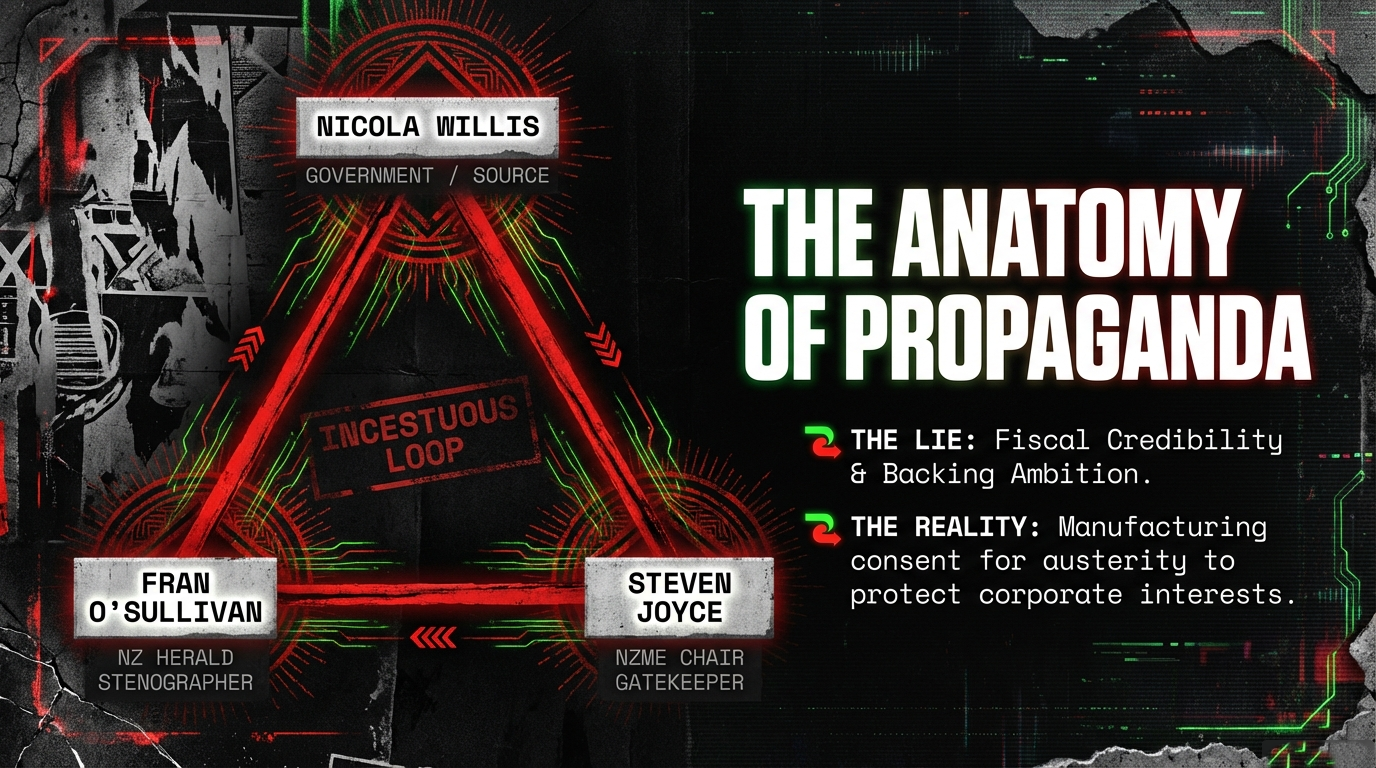
Fran O'Sullivan dutifully transcribes the talking points. She writes that Willis "ruled out an austerity Budget," despite the Finance Minister presiding over what Treasury itself describes as policies that are "shrivelling the economy" and driving Aotearoa into a "deeper and longer recession." The cognitive dissonance is staggering. Willis promises a "moderate, responsible Budget" while slashing an average of $5.3 billion in government spending per year for the next four years.
O'Sullivan's article celebrates Willis' "selective reform wins" on Kāinga Ora without mentioning that those "reforms" include halving the Māori-focused housing team, disestablishing hundreds of roles that support vulnerable whānau, and cancelling housing developments in high-need areas like South Auckland, Porirua, and Rotorua—regions with disproportionately high Māori populations.
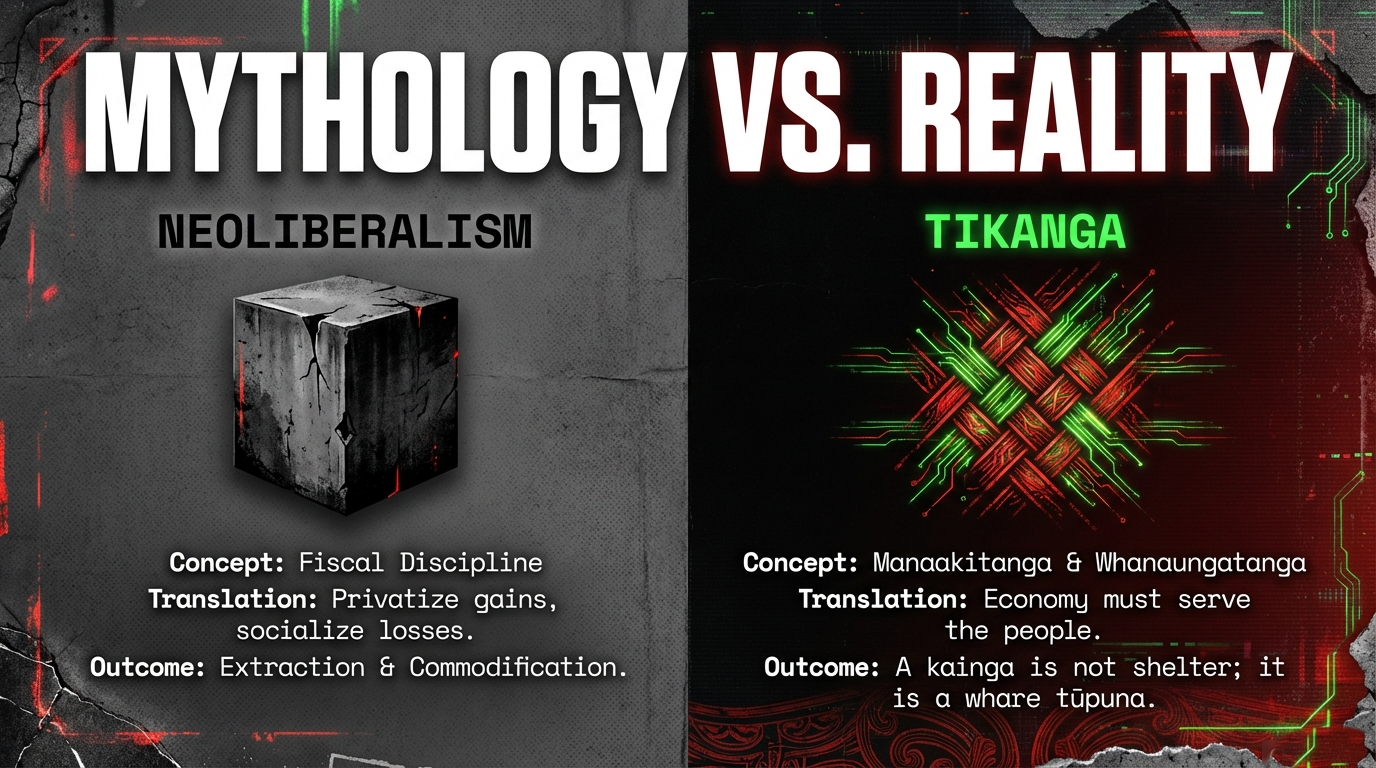
This is the neoliberal playbook: privatize gains, socialize losses, and call it "fiscal responsibility."
Deconstructing the Propaganda via Mātauranga Māori
Mātauranga Māori provides frameworks to see through the manufactured consent. The principles of kaitiakitanga (guardianship), manaakitanga (care and respect), and whanaungatanga (relationships and obligations) stand in direct opposition to the neoliberal logic of extraction, commodification, and atomization.
O'Sullivan's article commits multiple acts of journalistic malpractice:
- False Equivalence: She accepts Willis' framing of "fiscal credibility" versus "fiscal indulgence" without interrogating whose interests are served by this binary. The wealthy accumulate more wealth—the top 10% own 48.5% of everything while the bottom 50% share just 6.7%—while the poor are told they must tighten their belts.
- Erasure of Māori Harm: Not once does O'Sullivan mention that over $1 billion has been cut from Māori-specific funding across the 2024 and 2025 budgets. The Whai Kāinga Whai Oranga programme, which allocated over $700 million to help iwi build housing, has been defunded entirely. The Māori Development Fund has been cut by $20 million over four years.
- Corporate Capture: The article is published in a newspaper owned by NZME, chaired by Steven Joyce, who co-founded the very forum where Willis delivered her speech. This is not independent journalism. This is the manufacture of political consent by and for the ruling class.
- Austerity Denial: O'Sullivan writes that Willis "ruled out an austerity Budget" while the Minister simultaneously implements textbook austerity: slashing public services, attacking workers' pay equity, gutting social housing, and means-testing child support payments. Treasury's own forecasts show the government will miss all three child poverty reduction targets.
This is not journalism. This is stenography in service of class warfare.
Analysis: Five Hidden Revelations
The Wealth Redistribution Machine Runs in Reverse
O'Sullivan praises Willis for "fiscal responsibility," but whose fiscal health are we talking about? Between June 2021 and June 2024, New Zealand households increased their wealth by an average of 33%—but the vast majority went to the richest layers. The bottom 40% of households saw no statistically significant change. The poorest 20% own a median of just $11,000 in assets. Some 109,000 households—the poorest 5.4%—own less than zero assets, drowning in debt.
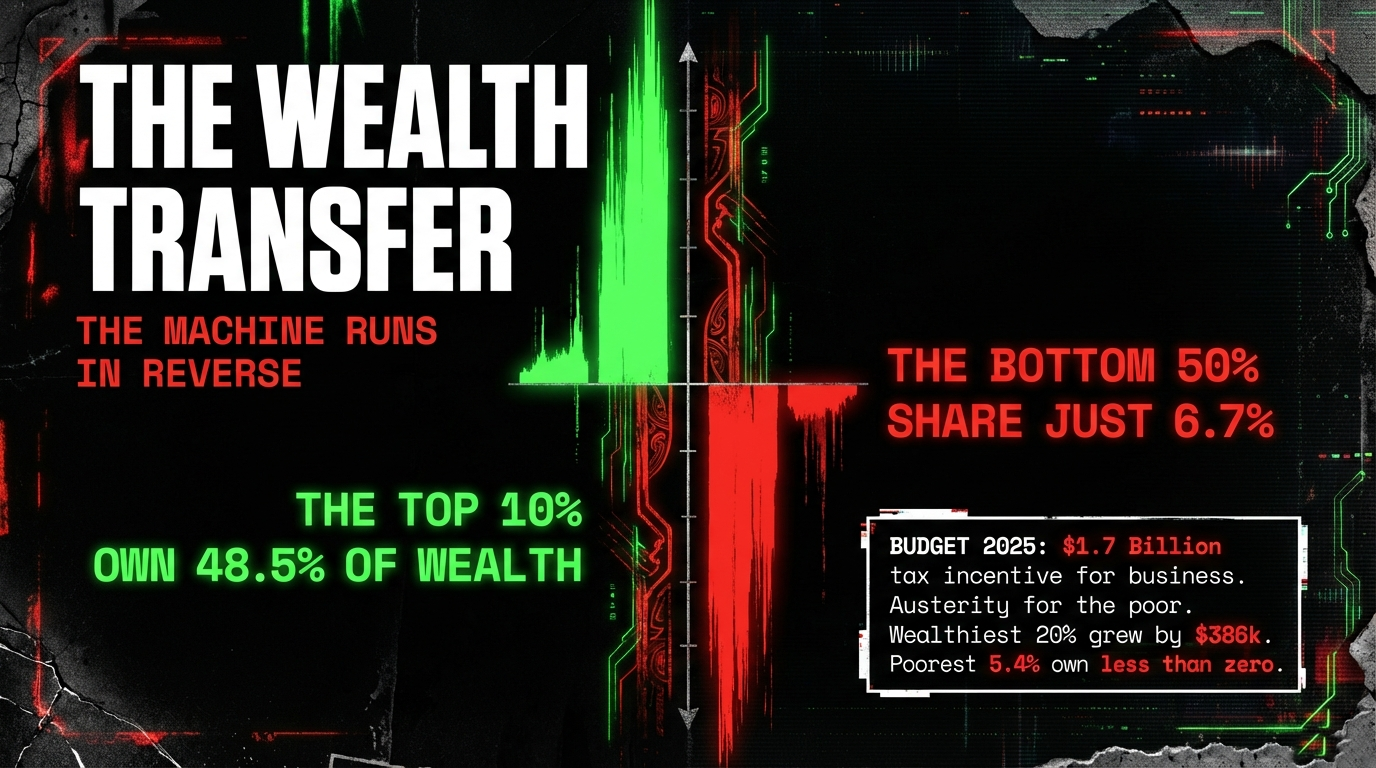
Meanwhile, the wealthiest 20% increased their wealth by 19%, or $386,000, to a median $2.4 million. This layer holds around two-thirds of New Zealand's total household wealth. The wealth gap between the poorest and richest fifths has increased by over $1 million in the last decade.
O'Sullivan mentions none of this. Instead, she celebrates the "Investment Boost"—a $1.7 billion tax incentive for businesses billed as Budget 2025's "centrepiece." Businesses get billions. Māori housing gets axed. The wealthy get wealthier. The poor get austerity. And corporate media calls it "fiscal credibility."
Kāinga Ora: Dismantling Māori Housing Infrastructure
O'Sullivan praises Willis for "selective reform wins on Kāinga Ora." Let us examine what those "wins" look like on the ground.
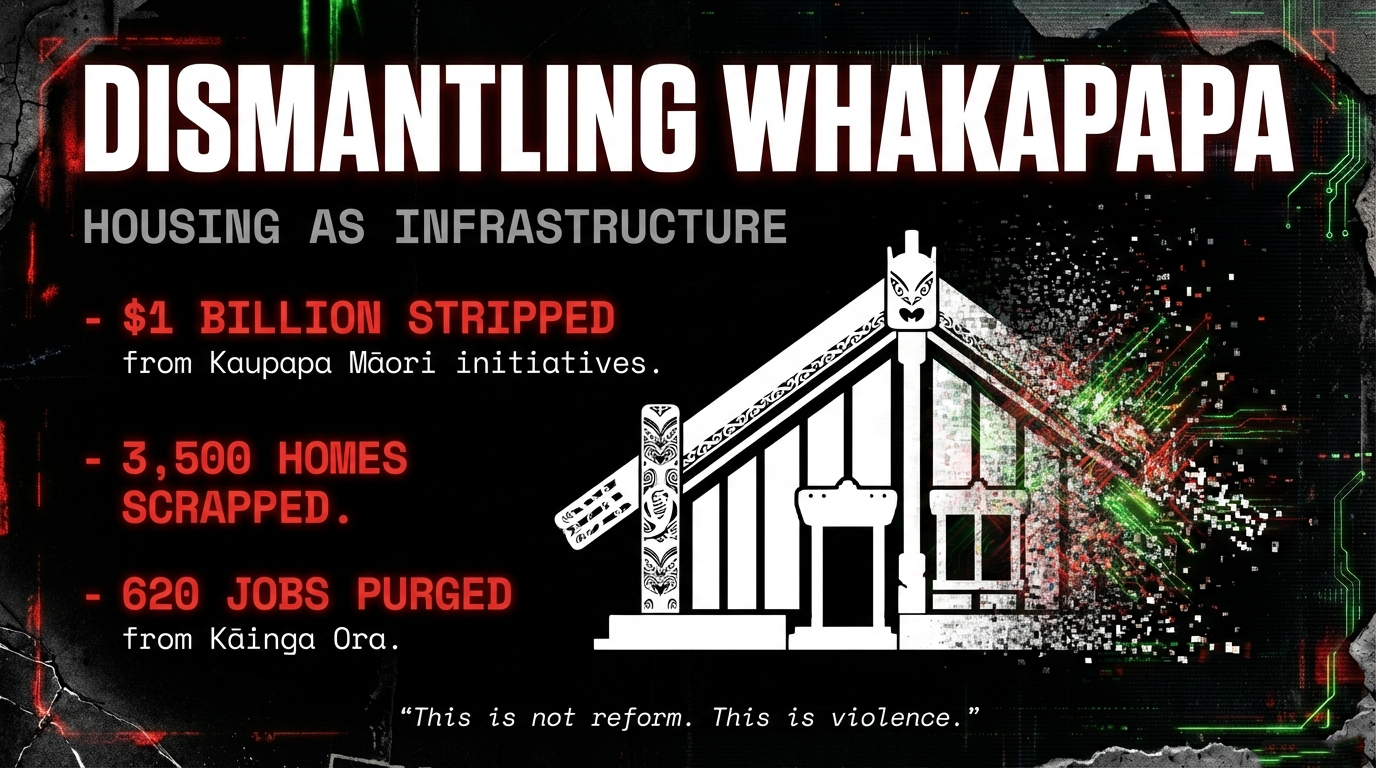
In July 2024, Kāinga Ora proposed halving Te Kurutao Group Māori, the team established to meet Māori housing needs and fulfil Treaty of Waitangi obligations. Of 48 full-time staff, 27 roles were earmarked for slashing. As the Public Service Association noted, this team brings "a critical te ao Māori perspective to housing challenges" and supports Kāinga Ora to turn ideas into projects that deliver affordable, quality housing for hapū and Māori organisations.
By November 2024, 540 job cuts were confirmed. In April 2025, Kāinga Ora announced a second round of restructuring: 673 roles disestablished, with 195 vacant, for a net loss of 478 people. Staff described walking around the office crying. One employee told RNZ: "It's devalued all the hard mahi that our staff do, and I think that's the worst of it." By October 2025, 620 jobs had been disestablished.
Many of the workers losing their jobs are Māori and Pacific, whose cultural competence and lived experience are essential to connecting with communities in a way that upholds mana. As PSA Te Kaihautū Māori Janice Panoho stated: "These are the people who guide our whānau through complex housing systems and advocate for them in a system that often excludes them."
The government has also scrapped or deferred over 3,500 homes nationwide. Housing Minister Chris Bishop described the cuts as necessary to "restore financial discipline," a phrase that translates to: "We are abandoning Māori whānau to market forces." An estimated 1,200-1,500 Māori households will miss out on safe, secure housing, affecting approximately 2,500 tamariki Māori.
This is not reform. This is violence.
Child Poverty Targets: Abandoned and Erased
O'Sullivan does not mention child poverty once in her article. Perhaps that is because the Coalition Government's record is indefensible.
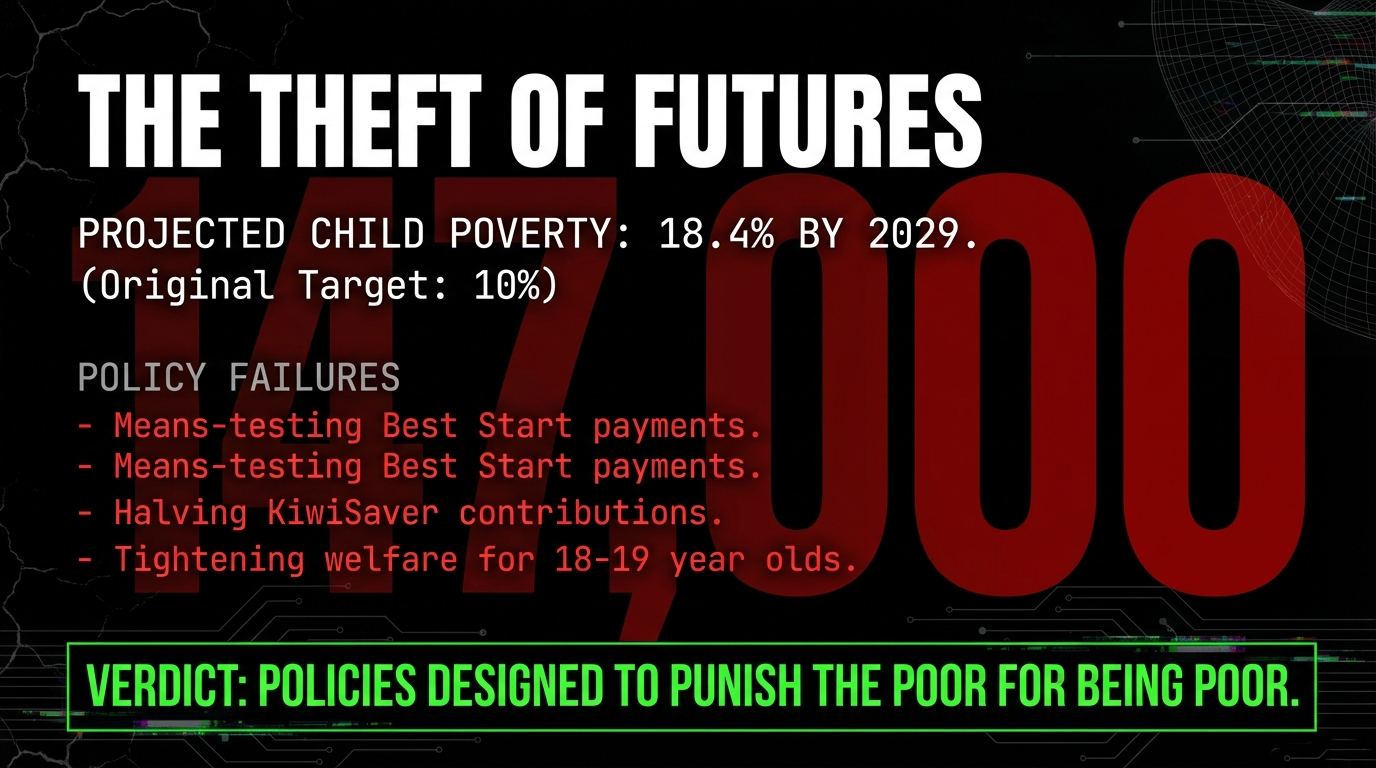
Treasury forecasts released alongside Budget 2025 show the government is not on track to meet any of the three child poverty reduction targets, despite Prime Minister Christopher Luxon's campaign trail commitment to lift 80,000 children out of poverty by 2028. The after-housing-costs measure is projected to reach 18.4% by 2029, well above the 10% target for 2028. The before-housing-costs measure is forecast to be 11.9%, more than double the 5% goal set in 2018.
When pressed by Q+A host Jack Tame, Willis conceded that Budget 2025 had not "been able to improve the trajectory" of child poverty. Her defense? "The most fundamental thing that will help those targets is if we have a faster-growing economy with lower unemployment, better wage growth." This is neoliberal theology: the belief that market growth will save the vulnerable, despite decades of evidence that wealth does not trickle down.
Meanwhile, the government has fully means-tested the Best Start child payment, halved KiwiSaver contributions, and tightened welfare for 18-19 year olds. These are not policies designed to lift children out of poverty. These are policies designed to punish the poor for being poor.
Pay Equity: $2.7 Billion Stolen from Women
O'Sullivan briefly mentions that Budget 2025 includes "savings" but does not specify where they come from. Let me fill in the gaps.
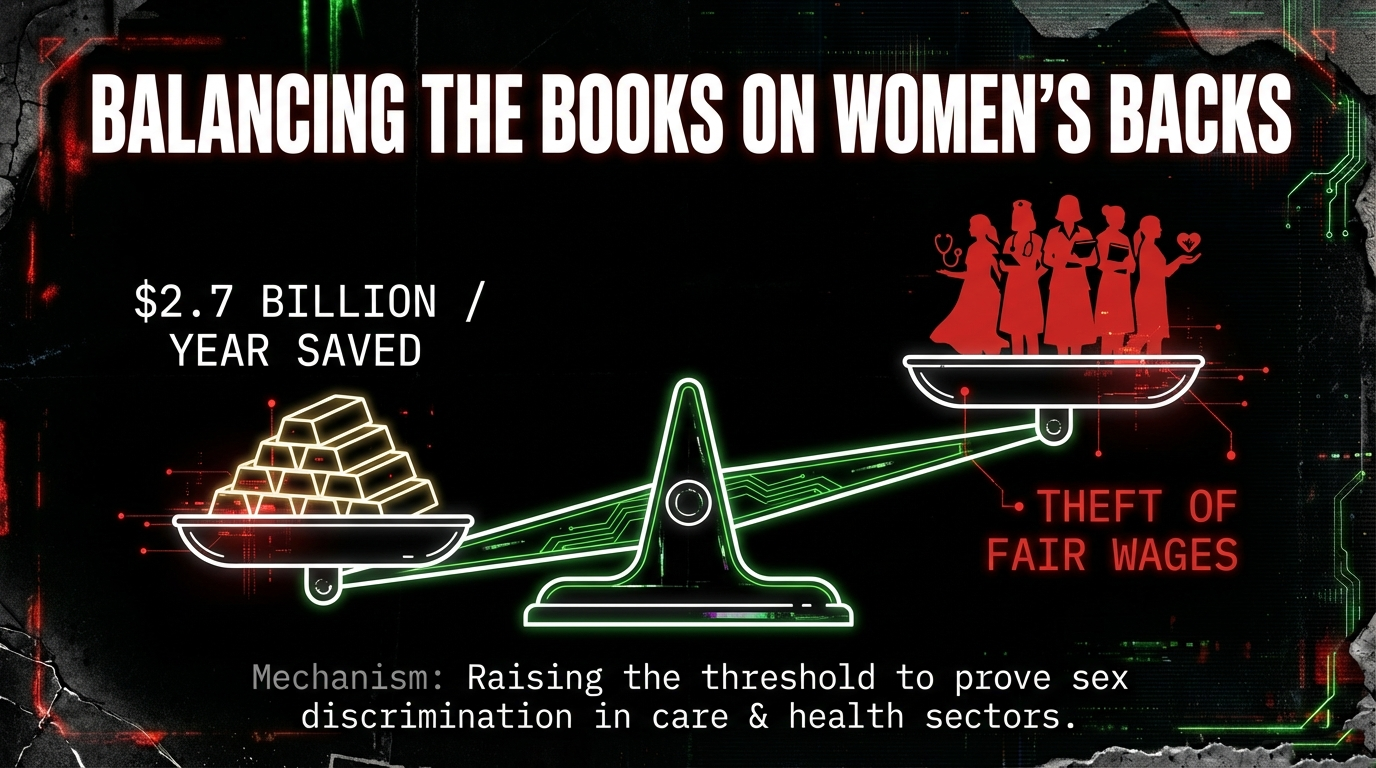
Budget documents reveal the tightening of the pay equity regime—passed under urgency in early May 2025—will net the government $2.7 billion every year. The government has also "repurposed" a one-off $1.8 billion from previous contingencies related to the scheme into other capital expenditure. In total, Willis claims the savings amount to about $12.8 billion over the next four years.
The pay equity changes mean workers now face a higher threshold to prove they are underpaid due to sex discrimination. The scheme, when set up in 2020, was expected to cost $3.7 billion over four years. Willis claims it "blew out," but what really happened is that more women discovered they were being systematically underpaid and sought redress. The government's response? Change the law so fewer women can prove discrimination.
This is not fiscal responsibility. This is theft. The government is balancing its books on the backs of women—disproportionately Māori and Pacific women—working in care, education, and health sectors.
The Treasury as Ideological Enforcer
O'Sullivan uncritically repeats Treasury Secretary Ian Rennie's claim that "we're not in Kansas any more" and that New Zealand is running "one of the largest structural deficits in the advanced world." She accepts his framing that the issue is "not an ideological aversion to investment" but rather incompetence: in 2023-24, roughly half of all large investment projects lacked a proper business case.
But Treasury is not a neutral arbiter. Treasury is an ideological institution that has consistently advocated for neoliberal austerity, privatization, and the dismantling of public services since the Rogernomics era of the 1980s. As researchers have documented, New Zealand's neoliberal reforms involved the dismantling of the state-centric development model, privatization of state assets, and financial market opening—reforms that fundamentally reshaped the country and created the inequality crisis we face today.
Treasury's warnings about "structural deficits" are deployed selectively. Where was Treasury when the top 1% doubled their wealth share from 5% to 9% between the 1980s and 1990s? Where was Treasury when the richest 10% increased their share of total wealth from 55% in 2003 to 60% by 2015? The "structural deficit" is not in public spending. The structural deficit is in political will to tax wealth, regulate capital, and redistribute resources to those who need them most.
O'Sullivan does not ask these questions. She transcribes Treasury's talking points and calls it analysis.
Implications: Quantified Harm and the Path to Rangatiratanga
Māori Wealth Inequality: An 8.5× Gap
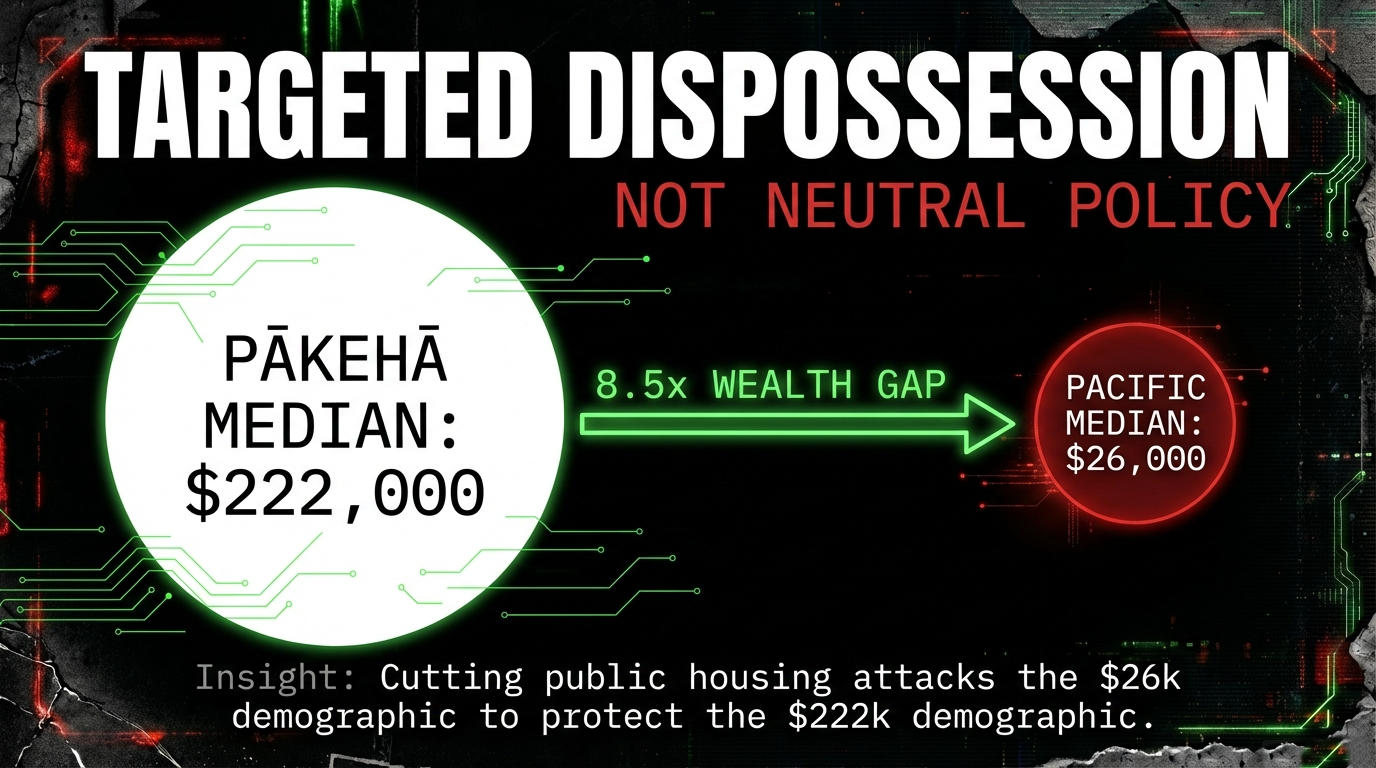
Let us quantify the harm. Māori (identifying as European/Pākehā) have a median net worth of $222,000. Pacific peoples have a median net worth of $26,000. That is an 8.5× gap—age-standardized. The homeowner versus renter gap is even starker: homeowners (mortgage-free) average $1.81 million in net worth, while renters average $185,000. That is a 10× difference.
Māori and Pacific peoples are overrepresented among renters and severely housing deprived. According to 2023 Census data, of the 112,496 people estimated to be severely housing deprived, 34,557 were Māori and 28,779 were of Pacific ethnicity. When the government cuts Kāinga Ora funding, slashes Māori housing programmes, and defunds Te Kurutao Group Māori, it is not neutral policy. It is targeted dispossession.
Housing Crisis: 3,500 Homes, 2,500 Tamariki
The scrapping of over 3,500 Kāinga Ora housing developments directly affects an estimated 1,200-1,500 Māori households. Assuming an average of 2-3 tamariki per household, that is approximately 2,500 tamariki Māori whose wellbeing, education, and long-term health outcomes will be directly impacted by this government's decision.
As Claudette Hauiti writes: "A kainga is more than a whare, the home is more than a shelter. It is a whare tūpuna—a place where whakapapa, culture, and collective identity are nurtured. It's a place where tamariki dream of great futures. A secure home is central to the hauora of tamariki, the mana of parents, and the strength of whānau."
The Coalition Government has stolen those dreams. It has stolen the hauora of tamariki. It has stolen the mana of parents. It has stolen the strength of whānau. And Fran O'Sullivan calls it "fiscal credibility."
Public Service Cuts: Hollowing Out Māori Expertise
The job cuts at Kāinga Ora—620 roles disestablished by October 2025—disproportionately affect Māori and Pacific workers. As Janice Panoho stated: "By disestablishing 769 roles, the Government is actively removing Māori and Pacific workers who bring whakapapa, reo, tikanga and aroha to their roles." These are not "back office" cuts. These are frontline workers who guide vulnerable whānau through complex housing systems, who advocate for them in a system designed to exclude them, who bring cultural competence and lived experience to their mahi.
Wider public service cuts follow the same pattern. Across the health, education, and social services sectors, Māori workers—who are already underrepresented in leadership but overrepresented in community-facing roles—are being disproportionately targeted. The government frames this as "efficiency." The reality is cultural erasure.
Three Examples for the Western Mind: Translating Tikanga Harm
Example 1: Whakapapa as Infrastructure
Western Concept: Infrastructure is roads, bridges, and buildings—physical capital that enables economic activity.
Tikanga Framework: Whakapapa is infrastructure. It is the connective tissue of identity, obligation, and belonging. When Māori housing teams are dismantled, when Te Kurutao Group Māori is halved, when 620 Kāinga Ora jobs are disestablished, the infrastructure of whakapapa is severed. Children growing up in insecure housing, moving from motel to motel, cannot maintain connections to marae, to kaumātua, to te reo. The loss is not merely economic. It is ontological.
Quantified Harm: An estimated 2,500 tamariki Māori will miss out on secure housing due to Kāinga Ora cuts. Research shows housing instability in childhood correlates with lower educational achievement, poorer mental health outcomes, and reduced lifetime earnings. For Māori, add intergenerational disconnection from whakapapa, language loss, and weakened ties to whenua and iwi.
Solution: Reinstate and expand Māori-led housing initiatives. Restore full funding to Whai Kāinga Whai Oranga ($700+ million). Mandate that 50% of all Kāinga Ora developments in high-need areas be delivered in partnership with iwi and Māori housing providers. Employ Māori workers in Kāinga Ora at rates proportional to Māori representation among tenants (39%).
Relevant Essay: See The Māori Green Lantern's analysis of Treaty obligations in housing policy and the deliberate dismantling of Māori-led infrastructure in "Why Fiscal 'Responsibility' Is Code for Abandoning Treaty Obligations."
Example 2: Manaakitanga vs. Market Logic
Western Concept: Social services should be "efficient," measured by cost-benefit ratios and return on investment. If a programme doesn't show quantifiable economic outcomes, it should be cut.
Tikanga Framework: Manaakitanga is the ethic of care, hospitality, and generosity. It is not transactional. When the government means-tests the Best Start child payment, halves KiwiSaver contributions, and tightens welfare for young people, it substitutes manaakitanga with market logic. The message is clear: you are only worthy of care if you can demonstrate economic productivity. Children, the elderly, the disabled—those who cannot "contribute" in market terms—are abandoned.
Quantified Harm: Treasury forecasts show child poverty rates will reach 18.4% by 2029, well above the 10% target. That translates to approximately 147,000 children living in poverty after housing costs. Research by the Child Poverty Action Group shows children in poverty experience worse health outcomes, lower educational achievement, and higher rates of contact with the justice system. The lifetime cost of child poverty—measured in foregone productivity, health expenditure, and justice costs—is estimated at billions of dollars. The human cost is incalculable.
Solution: Universal basic income for all children. Immediate reinstatement of full Best Start payments (no means-testing). Increase government KiwiSaver contributions to 6%. Abolish sanctions on young people accessing welfare. Fund community-led support services without requiring quantifiable "return on investment."
Relevant Essay: See The Māori Green Lantern's critique of the "social investment" model in "How 'Evidence-Based' Policy Became Code for Abandoning Whānau."
Example 3: Rangatiratanga vs. "Fiscal Discipline"
Western Concept: Fiscal discipline means reducing government spending, eliminating deficits, and maintaining low public debt as a percentage of GDP. The state should not "crowd out" private investment.
Tikanga Framework: Rangatiratanga is self-determination, authority, and sovereignty. When the Crown slashes over $1 billion from kaupapa Māori initiatives, defunds Māori housing programmes, and cuts the Māori Development Fund by $20 million, it undermines rangatiratanga. Māori cannot exercise self-determination without resources. "Fiscal discipline" becomes a weapon to enforce dependency and undermine Treaty-guaranteed authority.
Quantified Harm: The defunding of Whai Kāinga Whai Oranga alone represents a loss of over $700 million in iwi-led housing development. Assuming each home costs approximately $500,000 to build, that is 1,400 homes that will not be delivered by iwi and Māori organisations. Those homes would have housed approximately 4,200-5,600 people (assuming 3-4 people per household). They would have been designed with te ao Māori principles—papakāinga developments that keep whānau close, that integrate cultural spaces, that enable kaumātua to live near mokopuna. The loss is not just housing stock. It is the loss of Māori-designed, Māori-led infrastructure that strengthens rangatiratanga.
Solution: Restore all Māori-specific funding cut in the 2024 and 2025 budgets ($1+ billion). Establish a Treaty-based funding mechanism that bypasses contestable Crown processes and delivers baseline funding directly to iwi and Māori organisations. Mandate that all government spending impacting Māori be subject to Treaty impact assessments conducted by independent Māori experts.
Relevant Essay: See The Māori Green Lantern's exposé of Crown fiscal manipulation in "The Neoliberal Endgame: How Budget 2025 Weaponizes 'Responsibility' Against Māori."
The Taiaha Strikes
Fran O'Sullivan's article is not journalism. It is propaganda. It is stenography. It is the manufacture of consent by corporate media in service of neoliberal class warfare. Every claim it makes—"fiscal credibility," "moderate budgets," "reform wins"—is designed to obscure the material reality of whose lives are being destroyed.
The reality is this:
- The top 10% own 48.5% of all wealth. The bottom 50% share 6.7%.
- Over $1 billion has been cut from Māori-specific funding.
- 3,500 homes have been scrapped or deferred, affecting 1,200-1,500 Māori households and 2,500 tamariki Māori.
- 620 jobs at Kāinga Ora have been disestablished, disproportionately affecting Māori and Pacific workers.
- Child poverty targets will be missed by miles—147,000 children living in poverty by 2029.
- $2.7 billion per year has been stolen from women workers through pay equity changes.
And Nicola Willis, standing at a podium at a corporate-funded forum, calls it "fiscal responsibility." And Steven Joyce, sitting in his chairman's office at NZME, publishes Fran O'Sullivan's uncritical praise. And the machinery of neoliberal capitalism grinds on.
But the taiaha of truth strikes back. This essay names the networks. It quantifies the harm. It exposes the cui bono: who benefits (the wealthy, the property owners, the corporate elite) and cui malo: who is harmed (Māori, Pacific peoples, the poor, children, women workers).
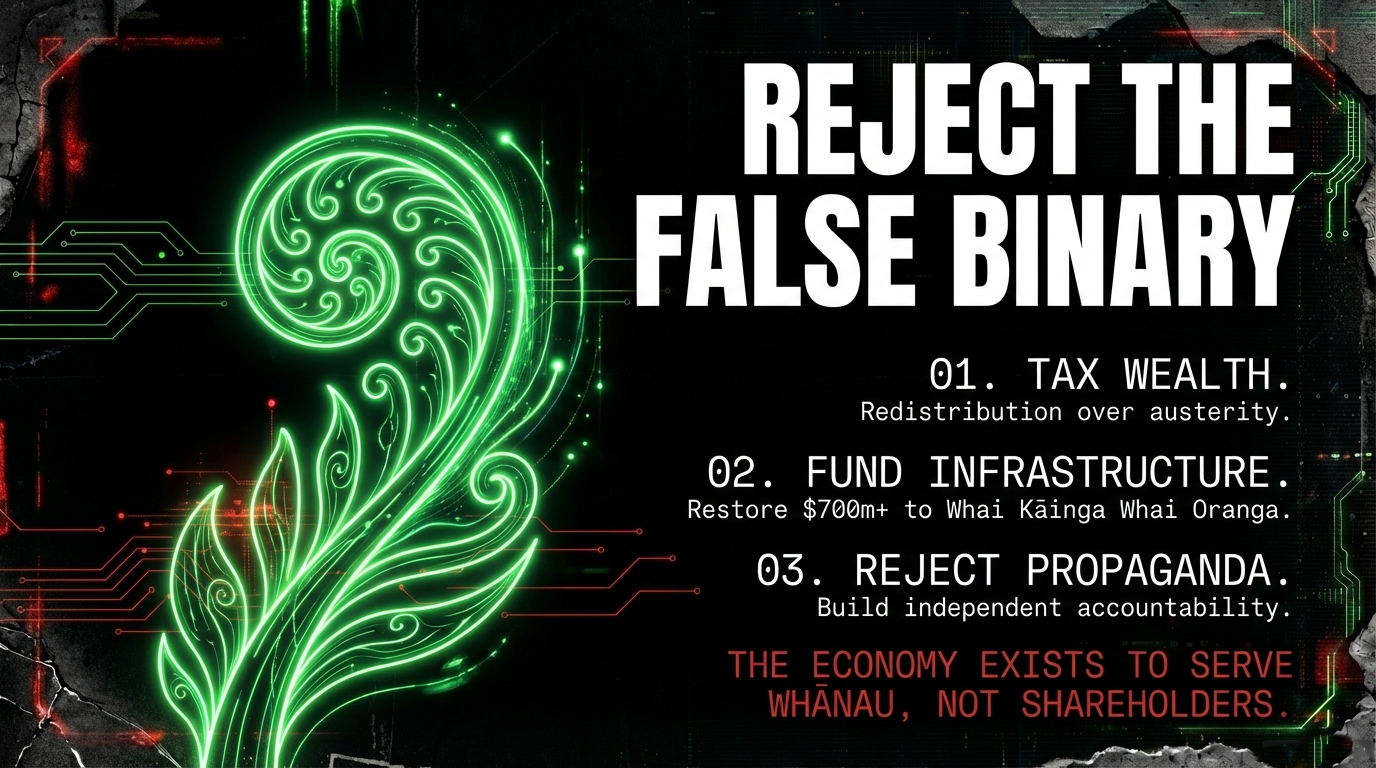
The path to rangatiratanga requires rejecting the false binary of "fiscal credibility" versus "fiscal indulgence." It requires understanding that fiscal justice means taxing wealth, redistributing resources, and funding Māori-led infrastructure. It requires rejecting corporate media propaganda and building independent accountability mechanisms that serve whānau, not shareholders.
Kia kaha. Kia mataara. The fight continues.
Koha Consideration: Funding the Accountability the Crown Will Not Provide
Every koha signals that whānau are ready to fund the accountability that Crown and corporate structures—like NZME, like the NZ Herald, like the neoliberal politicians they serve—will not provide.
This essay exposed how Fran O'Sullivan's article functioned as propaganda for Nicola Willis' austerity agenda. It named Steven Joyce's dual role as former National Finance Minister and current NZME chairman—a textbook case of corporate media capture. It quantified the harm inflicted on Māori whānau, tamariki, and workers by the Coalition Government's fiscal violence. It offered pathways to rangatiratanga grounded in Treaty obligations and mātauranga Māori.
Work like this—research-intensive, citation-heavy, uncompromising—cannot be funded by the very structures it critiques. Corporate media will not pay for analysis that exposes their role in manufacturing consent. The Crown will not fund accountability that names its Treaty breaches. Rangatiratanga includes the power to fund our own truth tellers.
If you are able, consider a koha to ensure this voice continues. If you are unable to koha, no worries! Subscribe or follow The Māori Green Lantern on Substack, kōrero and share with your whānau and friends—that is koha in itself.
Three pathways exist:
For those who wish to support this mahi directly with a koha (voluntary contribution):
Koha — Support
For those who wish to receive essays directly and support through subscription:
Subscribe to the Māori Green Lantern
For those who prefer direct bank transfer:
HTDM, account number 03-1546-0415173-000
Kia kaha, whānau. Stay vigilant. Stay connected. The taiaha strikes when truth is needed most.

Ivor Jones The Māori Green Lantern Fighting Misinformation And Disinformation From The Far Right