“The October 23 Strike: A Reckoning for New Zealand’s Forsaken Public Services” - 22 October 2025
The Core Truth: A Government Dismantling Essential Services While Enriching the Wealthy

Kia ora koutou,

On October 23, 2025, over 100,000 essential public sector workers will walk off the job in what is being described as the largest coordinated labour action in more than 40 years. This is not a single issue dispute—it is a collective cry of alarm from nurses, teachers, doctors, and support staff warning that the coalition government’s savage austerity regime has systematically dismantled the institutions that keep New Zealand functioning. The government has chosen to starve public services of resources while using those savings to fund tax cuts for landlords and wealthy business owners, creating a two-tiered nation: well-funded luxury for the privileged, crisis-level collapse for everyone else.[1][2]
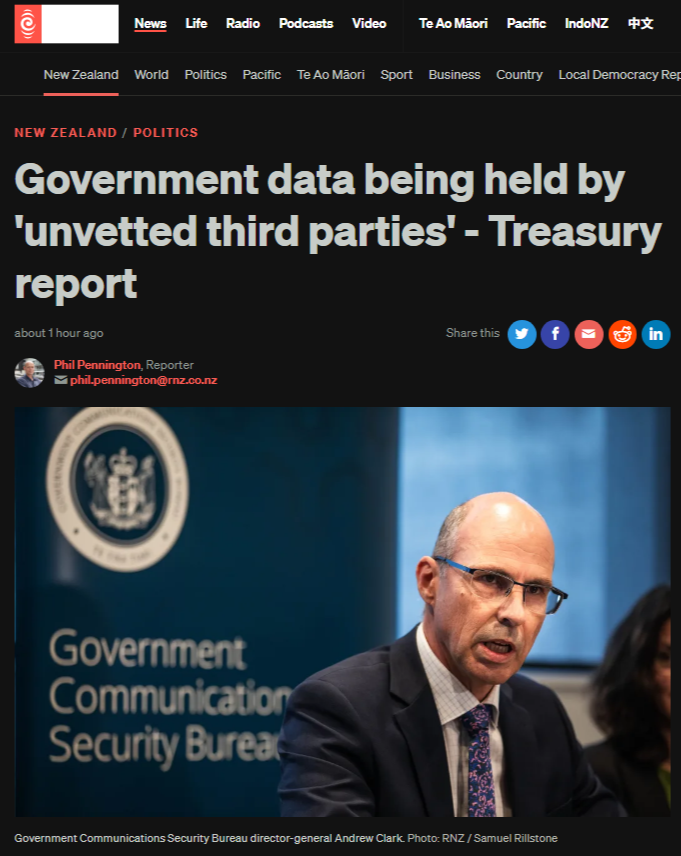
The coalition government—comprising the National Party under Prime Minister Christopher Luxon, the libertarian ACT Party led by David Seymour, and the right-wing populist New Zealand First under Winston Peters—has engineered a deliberate policy of public sector austerity that has no parallel in recent New Zealand history. The impact is catastrophic and measurable.[3][4]
The Scale of Devastation: By the Numbers
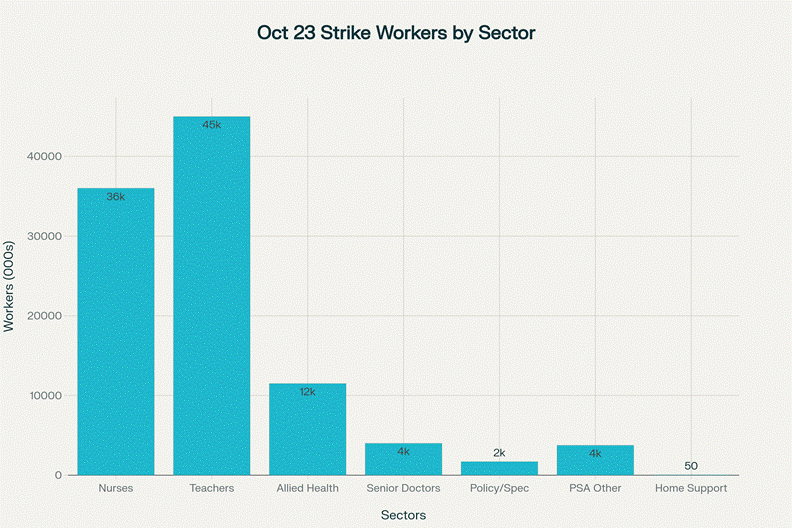
October 23, 2025 Strike Participation by Sector: Over 100,000 Workers Taking Action
Between late 2023 and mid-2025, approximately 10,000 public sector jobs have been eliminated across government agencies. This follows a period where the public service grew by 34% between 2017 and 2024—but the coalition seized on this expansion as justification for indiscriminate cuts, collapsing critical infrastructure regardless of consequences.[5]
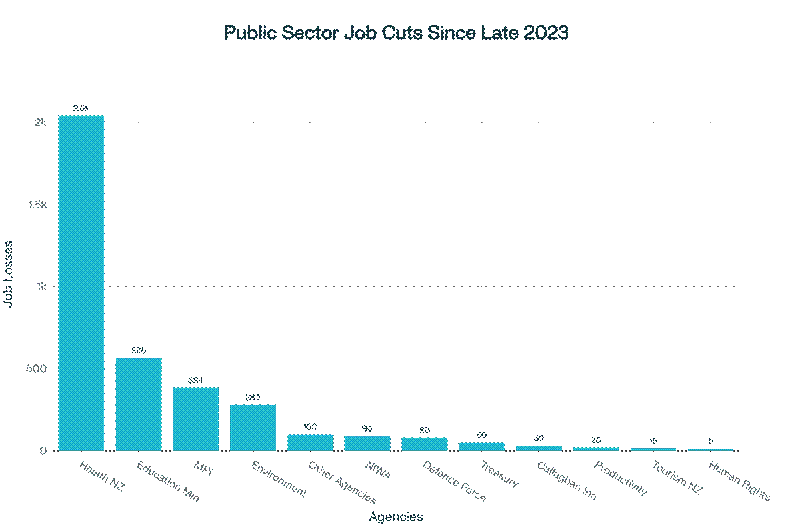
Public Sector Job Cuts Since Late 2023: Health and Education Hit Hardest (est. 10,000 total cuts)
Health New Zealand has shed 2,042 roles while simultaneously implementing hiring freezes that have left vacancies unfilled and clinical departments operating at dangerously reduced capacity. The Ministry of Education cut 565 positions just as schools face a projected shortage of 1,250 teachers—750 in primary schools and 500 in secondary schools—with some regional areas facing shortages of up to 7%. The ministry’s own forecasting showed that increasing classroom release time (a basic working condition negotiated by teachers) created legitimate demand, yet the government’s response was to cut positions rather than fund them.[6][7][8]
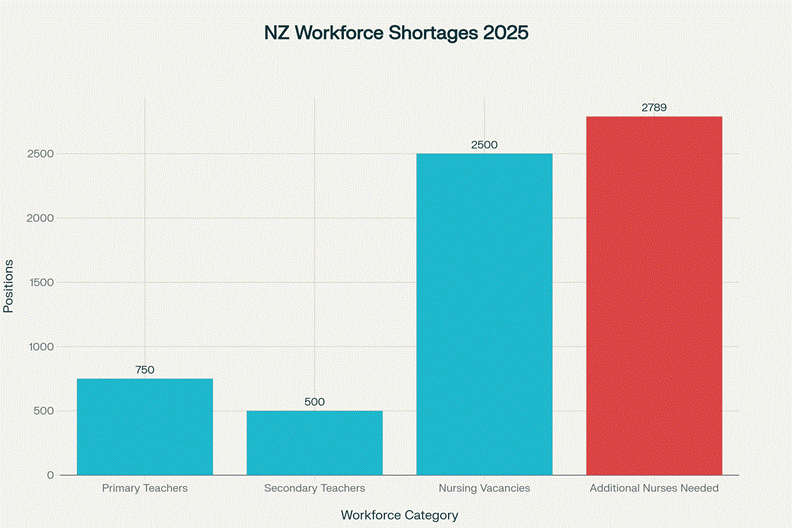
Workforce Shortages in Education and Healthcare for 2025: Critical Staffing Gaps
The nursing crisis is especially damning. New Zealand faces a vacancy of approximately 2,500 nursing FTEs with evidence suggesting that safe staffing would require an additional 2,789 nurses across the system. Yet Health NZ implemented hiring freezes and began deliberately not replacing departing nurses to bring headcount down to “budgeted” levels that were never sufficient to begin with. These are not abstract numbers—these represent real human beings deciding whether they can stay in professions that have become untenable.[9][10][11]
The Ideology Behind the Knife: Who Profits from Public Collapse
The cuts are not accidental or inevitable—they are ideological. ACT’s David Seymour represents a purist libertarian vision that views public services themselves as illegitimate interference in the market. His Treaty Principles Bill and obsession with dismantling collective rights extend to his vision of a privatised, marketised state where only those with money access quality healthcare, education, and emergency services.[12][13]
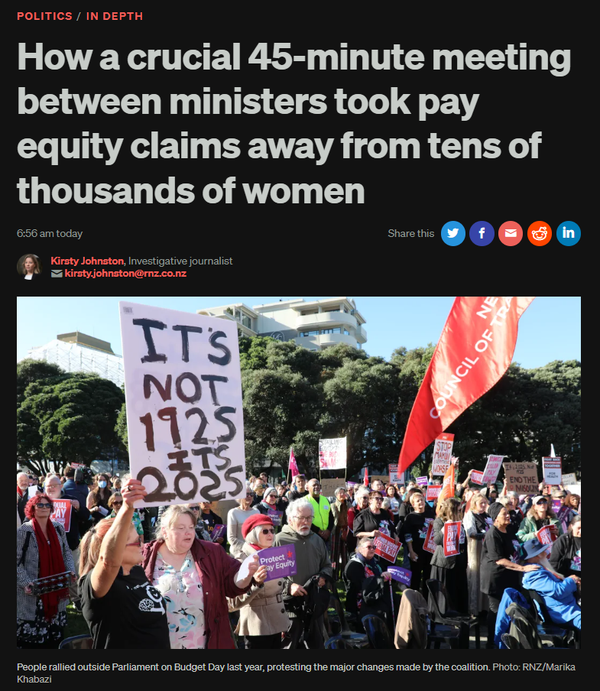
Christopher Luxon’s stated Christian faith has curiously failed to translate into compassion for the vulnerable as his government slashes support to beneficiaries, closes community services, and defunds mental health and addiction services. His government simultaneously granted enormous tax cuts to high earners and property investors while claiming there was no money for public services. In May 2025, the government raised the threshold for pay equity claims and scrapped existing claims, saving approximately NZ$12.8 billion over four years—money that should have gone to predominantly female-staffed roles like nursing, teaching, and home support work.[14][15][16][17]
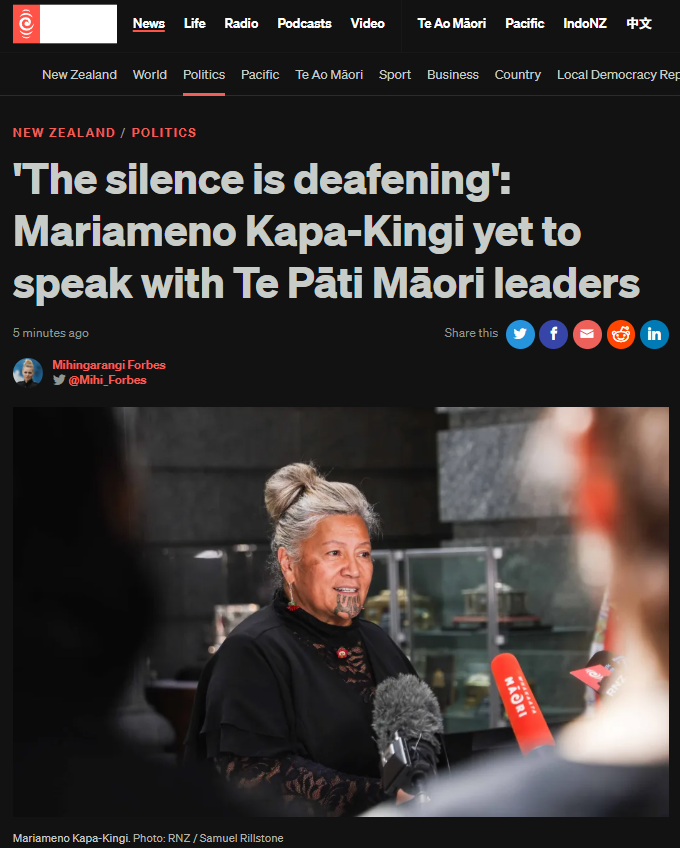
New Zealand First’s Winston Peters has delivered on his coalition agreement commitments to roll back co-governance with Māori and enforce English-only government operations, signalling a nationalist reorientation of the state that prioritises assimilation and market individualism over collective wellbeing and indigenous partnership.[18]
The Hidden Architecture: How the Coalition Built This Crisis
The destruction followed a calculated sequence:
2023: Coalition takes power with a mandate to cut “back-office bureaucracy.” Finance Minister Nicola Willis issues savings targets of 6.5-7.5% across departments—approximately NZ$1.5 billion annually. The messaging is dishonest: most cuts fall on frontline services, not bureaucracy.[19]
May 2025: The coalition announces Budget 2025, the so-called “Growth Budget.” Operating allowance is slashed from NZ$2.4 billion to NZ$1.3 billion—nearly halved. Pay equity law is gutted, erasing 33 ongoing claims and preventing future claims from women workers in underpaid roles. The government signals that tax cuts for the wealthy matter more than equity for workers.[20][21]
June 2025: The CTU warns that budget cuts are fundamentally unsustainable. The health system alone needs NZ$1.55 billion just to cover cost pressures—the government allocated NZ$1.3 billion across the entire operating budget. The mathematics are deliberate: underfunding creates crisis, crisis justifies privatisation.[22]
August-September 2025: Teacher shortages reach crisis levels. Health workers begin planning strikes. The government tightens the noose further: Health NZ implements hiring freezes and announces it will NOT replace departing nurses to bring workforce numbers down to “budgeted” levels.[23]
October 2025: Workers walk out. The government’s response is contemptuous. Prime Minister Luxon calls strikes “a shame” and accuses unions of “prioritising politics over patients”. Public Service Minister Judith Collins declares the strikes “unfair, unproductive and unnecessary”. There is no acknowledgment of the legitimate grievances, no offer of serious negotiation.[24][25]
The Human Cost: What Workers and Patients Are Experiencing
This is not theoretical. Health workers report:
Eighty-one percent of health workers surveyed stated that cuts and restructuring have damaged the services they deliver. Eighty-six percent say cuts will make it harder for people to get healthcare. Seventy-two percent agree health is fundamentally underfunded.[30][31]
In schools, principals warn that teacher shortages mean students are not receiving specialist teachers in key subjects, class sizes explode, and support for high-need students collapses. Northland, Bay of Plenty, and Nelson face primary teacher shortages of 7% of total demand.[32]
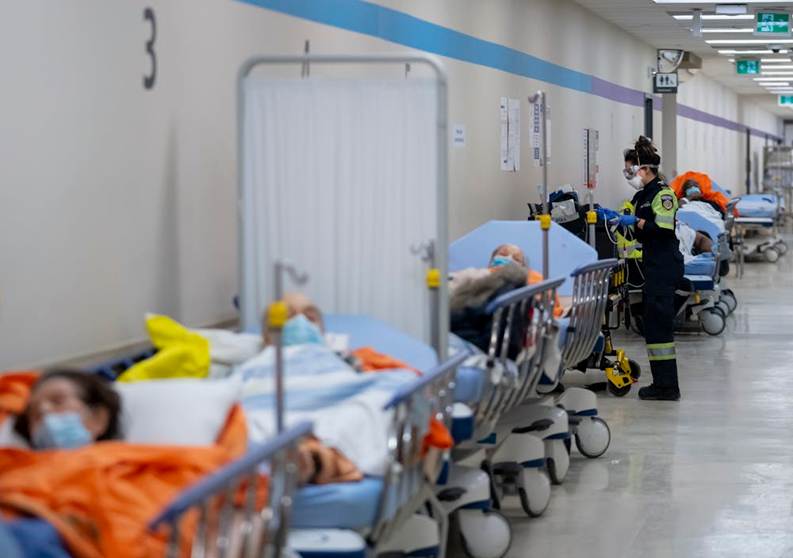
Overcrowded emergency department hallway showing patients on gurneys and medical staff attending, illustrating hospital crowding and pressure on health services.
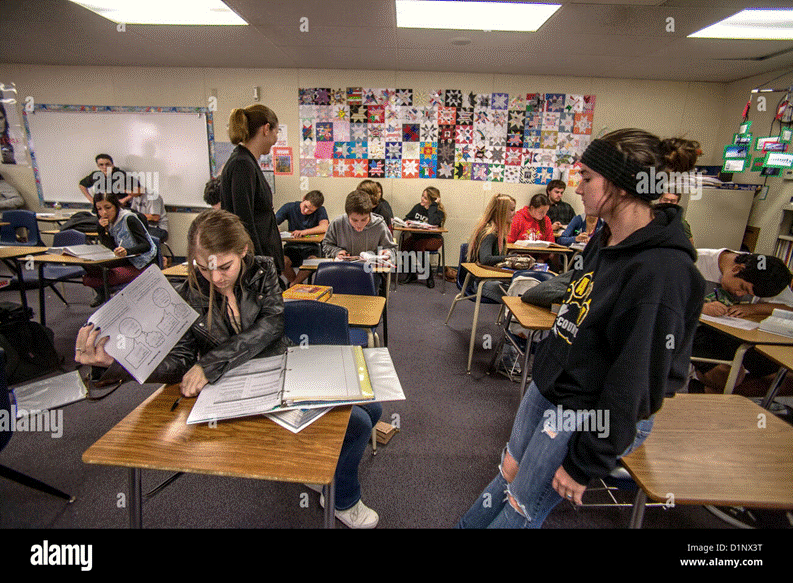
A crowded classroom where a teacher works closely with many students, illustrating resource challenges in education.
Where the Coalition’s Loyalties Truly Lie
The coalition government claims it must cut because of “fiscal responsibility.” Yet the same government:
The government has chosen to spend billions on tax cuts for speculators and provided huge tax cuts for tobacco companies, while claiming essential workers cannot receive fair pay or proper funding for the services they provide. Additionally, the government has increased public sector board directors’ fees by 80%—a staggering increase for executives while frontline workers face hiring freezes and wage suppression.[37]
The “fiscal responsibility” narrative is exposed as a lie. The government has unlimited money for tax cuts to landlords. It has unlimited money for defence spending. It has unlimited money for prison beds and police. It has no money for nurses, teachers, home support workers, or children receiving disability support.
This is not austerity born of necessity—it is austerity as ideology, austerity as punishment of working people, austerity as a mechanism to transfer wealth from the vulnerable to the rich.
The Essential Workers Who Make Society Function
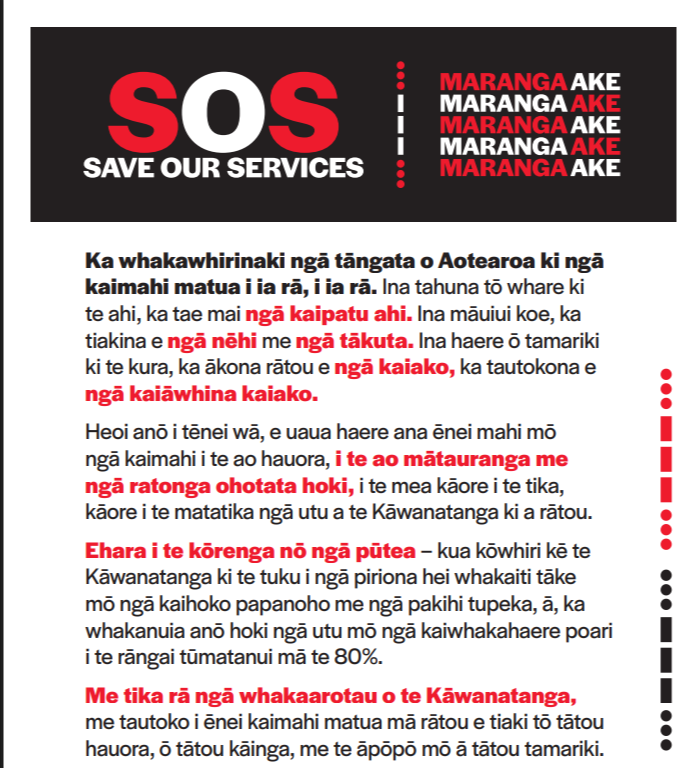
The striking unions—NZEI Te Riu Roa (teachers), NZNO (nurses), PSA (policy specialists), PPTA (secondary teachers), ASMS (senior doctors), and NZPFU (firefighters and emergency workers)—represent the workers upon whose labour society depends. As the SOS campaign emphasises: when your house catches fire, you need firefighters. When you are sick, you need nurses and doctors. When your children go to school, you need teachers and teacher aides.[37]
These are not optional services. These are the foundational institutions of a functioning society. Yet the government is deliberately undermining them through underfunding, hiring freezes, wage suppression, and policies that make continued employment untenable for thousands of workers.
The unions’ central message is unambiguous: the government must get its priorities straight. Workers are calling on the coalition to back essential service workers who protect public health, homes, and children’s futures. The government has prioritised tax cuts for the wealthy while essential workers cannot afford to keep working in professions they have dedicated their lives to.[37]
Workers are “here for you”—present and visible on October 23—and calling on all New Zealanders to stand together and demand change.[37]
The Sectarian and Nationalist Dimension
The coalition represents a particular ideological fusion: libertarian economic extremism married to Christian conservative social positioning and nationalist reorientation of the state.[38][39][40]
Luxon’s evangelical Christianity and social conservatism have translated into policy that dismantles support systems for vulnerable people—the exact opposite of Christian teachings on care for the poor and marginalised. Yet there is a consistency: in libertarian-influenced Christian conservatism, individual responsibility supersedes collective obligation. If you are poor, sick, or struggling, that reflects personal failure, not systemic inequality. Welfare is a moral hazard. Public services are socialist overreach.[41]
ACT’s libertarianism is explicitly hostile to collective recognition of any kind. The Treaty Principles Bill, co-governance dismantling, and push toward English-only government represent an ideological drive toward radical individualism and erasure of collective Māori rights. This is not moderate conservatism—it is a fundamental restructuring of New Zealand’s constitutional foundations.[42]
New Zealand First’s nationalist orientation—particularly the policy to establish English as official language and the reversal of the He Puapua report’s indigenous-centred development agenda—signals a state reorientation away from partnership and toward assimilationist nationalism.[43]
The coalition’s architecture reveals a coherent ideological project: dismantle collective institutions (public services, unions, Māori collectives, fair pay agreements), slash public investment, and redirect resources to private wealth creation. The rhetoric speaks of “efficiency” and “getting back to the taxpayer.” The reality is redistribution upward—from workers and the poor to landlords and corporations.
October 23: The Nationwide Response
Over 100,000 workers across the country will take action on October 23, 2025, refusing to accept this dismantling. The scale of participation reflects not just anger at wages and working conditions, but recognition that something fundamentally wrong is happening to the institutions that keep New Zealand functioning.[44]
Strike actions occurred in more than 40 locations nationwide, from Kaitaia in the far north to Invercargill in the south, with rallies and marches in major cities and regional centres. The strike schedule demonstrates the geographic reach of this action:[45]
Teachers, nurses, allied health workers, senior doctors, policy specialists, and home support workers will send a unified message across the country: we will not participate in the destruction of the services New Zealanders depend on.
A Call to New Zealanders: This Is Your Fight Too
If you use schools, you should be standing with teachers. If you use hospitals, you should be marching with nurses. If you depend on emergency services, you should stand in solidarity with firefighters and emergency workers. If you use public transport, community support services, or government agencies, you must understand that the crisis affecting them is being engineered by deliberate policy choice—not accident, not economic necessity, but ideological choice by a government captured by libertarian extremists and ideological austerity advocates.
The fundamental truth New Zealanders must grasp: this is not a narrow dispute about whether workers deserve higher wages (though they absolutely do). This is a crisis of public service provision itself. The government is deliberately starving essential services of resources. When nurses cannot staff hospital beds safely, when teachers cannot provide individual attention to students, when emergency responders cannot reach all calls promptly, when patients wait months for diagnosis, the fault lies not with workers but with the government that has chosen to underfund and neglect them.
The October 23 strike will not be the end—it was a warning, a demonstration of collective power, and an invitation to all New Zealanders to join this fight. Workers across the public sector are signalling that they will not accept indefinite austerity while wealthy New Zealanders capture an ever-larger share of national resources. Teachers are warning that the education system is collapsing. Nurses are warning that patients’ lives are at risk daily. Doctors are warning that the health system is breaking under strain not caused by overwork but by deliberate policy starvation.
The government has chosen its side—the side of landlords, speculators, and the wealthy. Now New Zealanders must choose theirs.
This is not about union politics or industrial relations technicalities. This is about whether New Zealand maintains the collective institutions that serve everyone—or whether we descend into a two-tier society where the wealthy buy private education and private healthcare while everyone else accepts collapsing public services. It is about whether workers have dignity, whether young people can aspire to meaningful careers in teaching and nursing, whether a child born into poverty can receive the same quality of education as a wealthy child, whether accessing healthcare is a right or a privilege purchased at the market price.
The October 23 strike will demonstrate that hundreds of thousands of New Zealanders understand these stakes. Teachers, nurses, and support staff were joined by community members who recognise that public services are not luxuries—they are the foundation of a functioning, equitable society. The challenge now is whether that understanding extends beyond strike day into sustained, relentless pressure on government to reverse course.
What Must Change
Every New Zealander should join this movement now. In Ōpōtiki and across the Bay of Plenty, in rural towns and urban centres, residents should recognise that standing with essential workers on October 23 and beyond is standing for their own ability to access healthcare when they need it, for their children to receive quality education, for emergency responders to save their homes and lives when crisis strikes.
Stand with us now. The public services that keep our nation functioning depend on it.

2. https://www.nzeiteriuroa.org.nz/about-us/media-releases/historic-strikes-to-save-our-essential-public-services
3. https://www.publicservice.govt.nz/publications/public-sector-industrial-action
4. https://waateanews.com/2025/06/13/public-sector-job-cuts-reach10000/
5. https://direemergency.nz/sos-save-our-public-services/
6. https://www.rnz.co.nz/news/top/575181/new-zealand-s-nurses-teachers-and-others-set-for-mega-strike-what-you-need-to-know
7. https://www.rnz.co.nz/news/political/562350/how-many-public-sector-jobs-have-really-been-axed
8. https://www.tewhatuora.govt.nz/corporate-information/news-and-updates/planned-strike-action-to-impact-thousands-of-patients
9. https://pmn.co.nz/read/political/public-sector-mega-strike-set-to-disrupt-schools-hospitals-and-essential-services
10. https://www.psa.org.nz/news-media/budget-2025-nervous-wait-for-thousands-of-public-service-workers
11. https://action.nzei.org.nz/events/porirua-sos-save-our-services-signwave-on-strike-day-on-titahi-bay-road-opposite-prosser-street-titahi-bay
12. https://thespinoff.co.nz/society/22-10-2025/brace-for-impact-here-comes-the-mega-strike
13. https://en.wikipedia.org/wiki/2025_New_Zealand_budget
14. https://www.beehive.govt.nz/release/strike-unfair-unproductive-and-unnecessary
15. https://www.rnz.co.nz/news/political/561810/budget-2025-at-a-glance-the-big-changes-winners-and-losers
16. https://www.nzherald.co.nz/nz/mega-strike-public-sector-is-walking-off-the-job-on-october-23-as-judith-collins-fires-back/JPFYNE36J5GRDKIVRFCEMD2STQ/
17. https://www.1news.co.nz/2025/10/21/public-service-commissions-ads-targeting-strike-unbelievable/
18. https://www.reuters.com/world/asia-pacific/new-zealands-budget-cuts-punish-public-sector-business-workers-2025-05-20/
19. https://www.facebook.com/teringahuia/videos/save-our-services-rallies-next-thursday-23-october-️-️-️aotearoa-new-zealand-wil/834797195752369/
20. https://www.nzherald.co.nz/nz/severe-weather-forces-change-to-plans-for-mega-strike-rallies/PMKATE4B4BH2BJBE23MS5IUHKA/
21.
22. https://www.1news.co.nz/2023/11/24/coalition-deal-peters-to-be-deputy-prime-minister-first-followed-by-seymour/
23. https://www.rnz.co.nz/news/on-the-inside/439247/luxon-s-religious-views-risk-turning-off-middle-ground-voters
24. https://en.wikipedia.org/wiki/ACT_New_Zealand
25. https://en.wikipedia.org/wiki/New_Zealand_First
26. https://en.wikipedia.org/wiki/Christopher_Luxon
27.
https://www.act.org.nz
28. https://en.wikipedia.org/wiki/Sixth_National_Government_of_New_Zealand
29. https://theconversation.com/history-made-the-national-party-a-broad-church-can-it-hold-in-the-mmp-era-173319
30. https://en.wikipedia.org/wiki/David_Seymour
31. https://www.nzfirst.nz/winston-peters
32. https://www.nzherald.co.nz/nz/national-party-leader-christopher-luxon-on-why-he-stopped-going-to-church/TFTD7WXSMQYX3X5IWWVFAVQWUI/
33. https://www.nzherald.co.nz/kahu/opinion-although-act-is-notionally-a-libertarian-party-it-has-little-respect-for-the-te-tiriti/IODWUFDLR5GNVMVLLBQ57YDZPA/
34. https://www.nzfirst.nz/about
35. https://www.nzherald.co.nz/nz/former-air-nz-boss-christopher-luxon-explains-his-christian-faith-in-maiden-speech/RWFT54SHFJBYERYXRZBW27XJM4/
36. https://theconversation.com/the-rise-of-act-in-2020-highlights-tensions-between-the-partys-libertarian-and-populist-traditions-147170
37. SOS-Save-Our-Services-2025.pdf
38. https://www.beehive.govt.nz/taxonomy/term/6700
39. https://www.rnz.co.nz/news/in-depth/468615/how-christopher-luxon-is-rebranding-the-national-party
40. https://www.davidseymour.org.nz/my_beliefs
41. https://www.rnz.co.nz/news/political/503138/live-updates-new-coalition-government-being-announced
42. https://www.nzno.org.nz/Portals/0/publications/Report - Infometrics report how many more nurses does New Zealand need August 2025 FINAL.pdf
43. https://principalstoday.co.nz/why-new-zealand-secondary-school-teachers-are-striking-in-2025/
44. /content/files/system/files/2025-08/h2025060083briefingintroductiontonursing.pdf
45. https://www.rnz.co.nz/news/national/542546/schools-could-be-short-1250-teachers-this-year-ministry-of-education-warns