“The Property Propaganda Machine: How Financial Elites Manufacture Consent for Continued Māori Dispossession” - 29 July 2025
When privilege masquerades as expertise: A Pākehā investment banker's prescription for economic colonisation
Kia ora koutou – greetings to you all
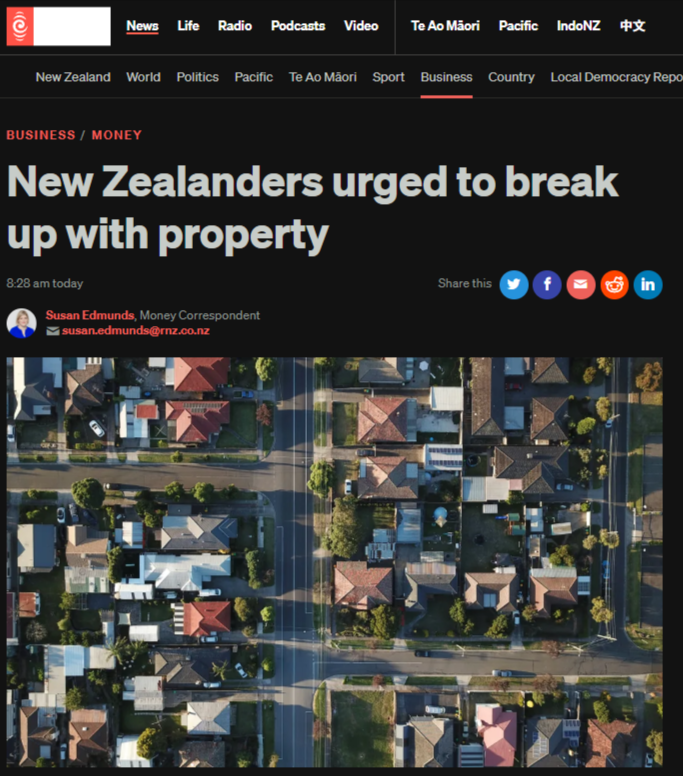
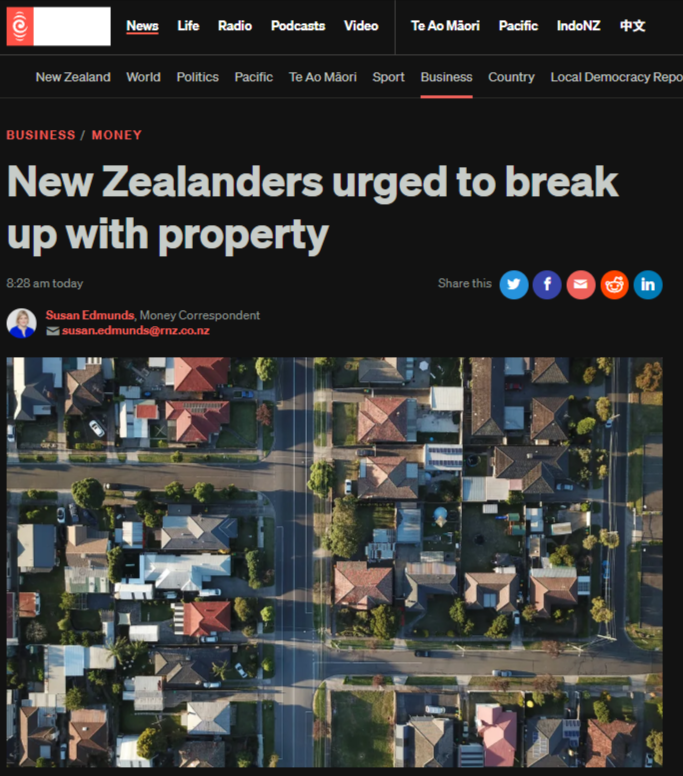
Jeremy Williamson, head of private wealth and markets at Craigs Investment Partners, recently graced RNZ with his expert opinion that New Zealanders should "break up with property" and instead funnel their investments into "productive" assets like shares. What sounds like sensible economic advice is actually a masterclass in neoliberal gaslighting that completely ignores how property speculation has become the primary vehicle for extracting wealth from tangata whenua while enriching the already privileged.
This essay exposes how financial sector propaganda disguised as economic wisdom perpetuates the colonial project of Māori dispossession while offering solutions that benefit the wealthy at the expense of those still fighting for basic housing security.
Background
The housing crisis gripping Aotearoa is not a natural disaster – it is the predictable outcome of forty years of neoliberal policy that transformed homes from shelter into speculative commodities. Since the 1991 "Mother of All Budgets," Māori homeownership has plummeted from 56% to just 27.5% today, while property investors have reaped massive tax-free capital gains.
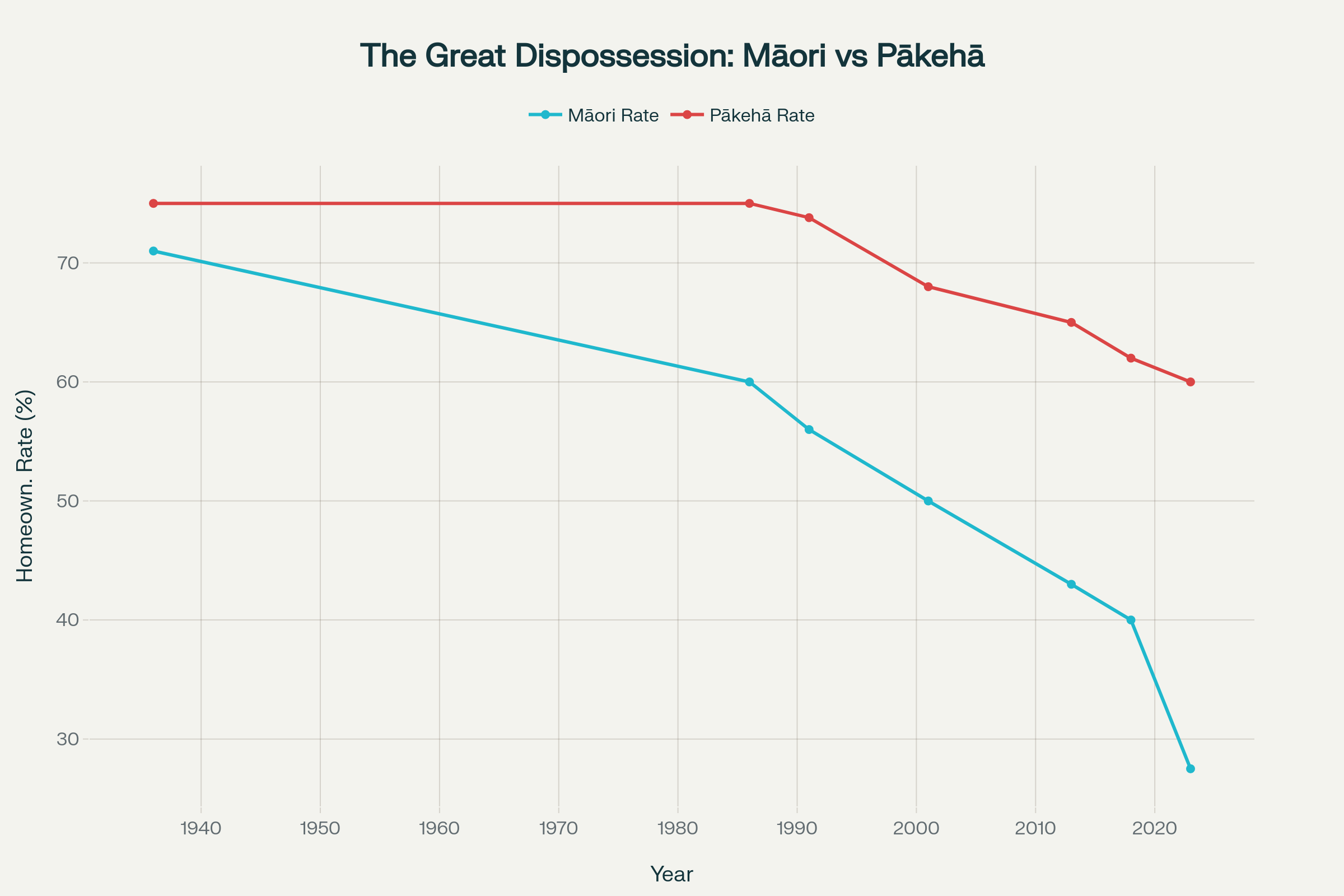
Declining Māori homeownership rates from 1936-2023 compared to relatively stable Pākehā rates, showing the devastating impact of neoliberal housing policies
This decline represents a continuation of colonial land theft by financial means, where institutional racism in banking, discriminatory lending practices, and property speculation have locked Māori out of wealth accumulation while enriching predominantly Pākehā property owners. When investment advisors like Williamson advocate for redirecting capital from property to sharemarket investments, they are not offering solutions to inequality – they are proposing new mechanisms for wealth extraction that leave the fundamental structures of dispossession intact.
The Great Property Con
Williamson's intervention comes at a time when property values have delivered obscene returns to existing owners – some areas experiencing over 1000% capital gains since 2000 – while Māori are disproportionately represented among the severely housing deprived, making up 33.4% of those without adequate shelter despite being only 17% of the population.
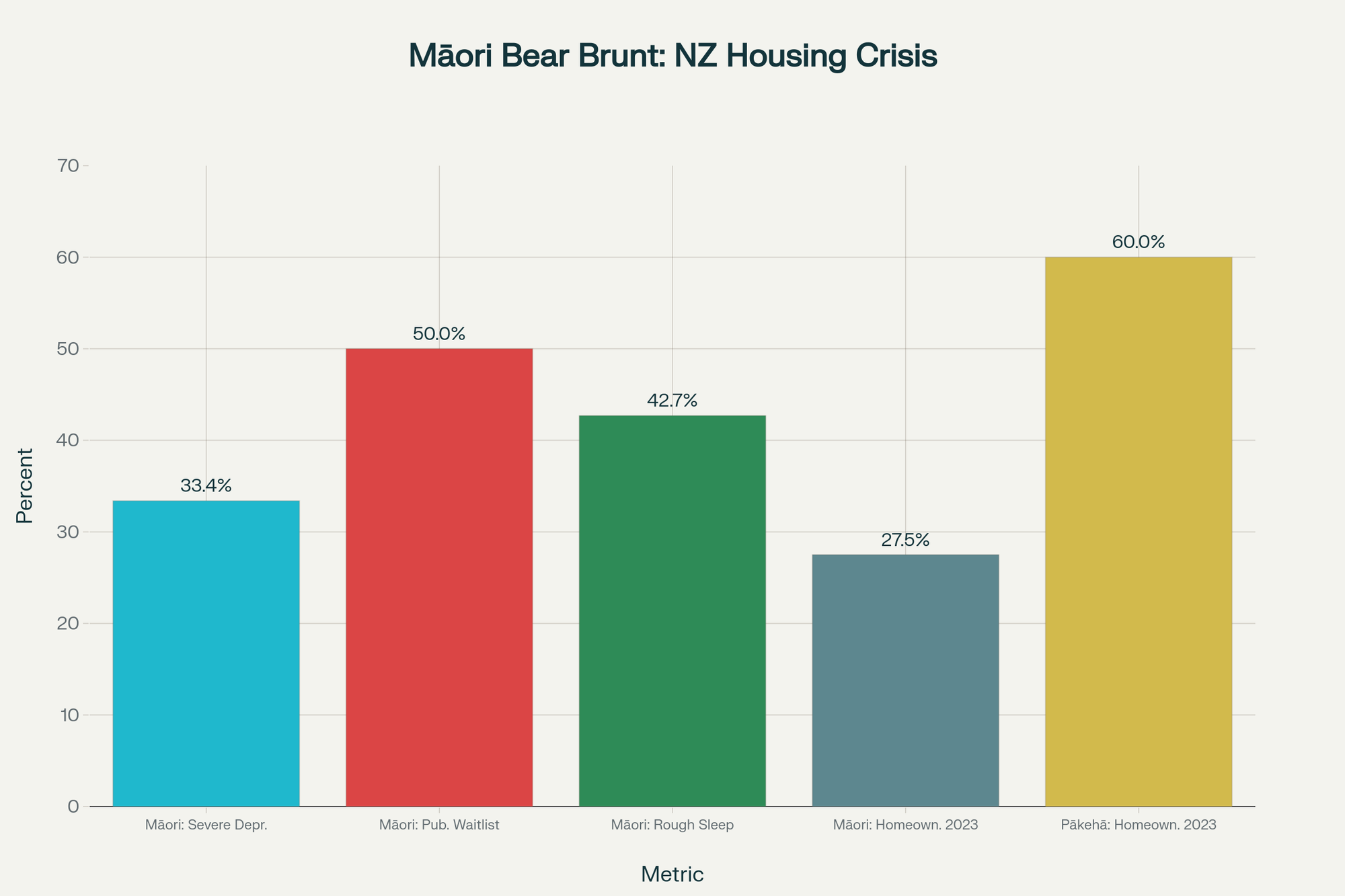
Chart showing the disproportionate impact of New Zealand's housing crisis on Māori across multiple indicators, despite Māori making up only 17% of the population
The financial sector's sudden concern about "unproductive" property investment rings hollow when banks have been the primary enablers of housing speculation through cheap credit. Craigs Investment Partners, where Williamson serves as head of private wealth, recently formed a strategic alliance with JP Morgan Asset Management, positioning the firm to capture wealth from New Zealanders seeking alternatives to property investment.
This matters to Māori because housing is not just an investment vehicle – it is the foundation of intergenerational wealth, cultural connection to place, and basic human dignity. When financial elites promote moving capital from property to shares, they ignore that for Māori, land and housing represent spiritual and cultural connections that cannot be commodified. They also conveniently overlook that sharemarket investments primarily benefit those who already have capital to invest, not those locked out of homeownership entirely.
The Neoliberal Shell Game: Moving Wealth Extraction to New Venues
Manufacturing Crisis and Selling Solutions
Williamson's argument follows a classic neoliberal playbook: identify a crisis created by deregulated markets, then propose market-based solutions that benefit financial intermediaries. He correctly identifies that property speculation "reinforces inequality through investment in an asset class that isn't productive" and puts housing "out of reach for the next generation." However, his proposed solution – redirecting investment to shares – does nothing to address the fundamental problem of treating housing as a commodity rather than a human right.
The housing crisis that disproportionately affects Māori stems from deliberate policy choices, including the 1991 decision to charge market rents for state housing, the withdrawal of government lending that previously enabled Māori homeownership, and the financialisation of housing through deregulated banking. Research shows that 86% of Māori housing finance came from state loans during the 1980s, and the removal of this support directly caused the collapse in Māori homeownership.
The False Promise of Productive Investment
Williamson's comparison showing that "$100 invested in New Zealand shares 30 years ago would be worth $1,100 versus $600 for property" conveniently ignores several crucial factors. First, sharemarket returns require existing capital to invest – something systematically denied to Māori through discriminatory lending and employment practices. Second, residential property provides both shelter and investment returns, making it inherently more valuable to families than abstract financial instruments.
Most importantly, Williamson's argument ignores that the "productive" companies he wants people to invest in are often the same entities driving the housing crisis. Banks, construction companies, and real estate firms all profit from housing speculation and shortage. Redirecting investment to these companies simply moves wealth extraction from direct property ownership to indirect exploitation through corporate profits.
The Colonial Logic of Capital Allocation
When Williamson argues that redirecting just 10% of property investment to other assets "would make a big difference," he reveals the colonial mindset that views land primarily as a store of wealth rather than the foundation of Indigenous identity and sovereignty. For Māori, whenua (land) means both land and placenta – the source of life and connection to ancestors. The financialisation of this relationship through sharemarket investment represents another form of cultural dispossession.
The focus on redirecting existing investment capital also ignores that the vast majority of Māori cannot afford to invest in property or shares at all. ANZ research shows Māori face multiple barriers to homeownership, including lower incomes, lack of intergenerational wealth, poor credit history, and what researchers term "colonisation of the mind" – internalised beliefs that homeownership is unattainable.
The Wealth Management Industry's Self-Interest
Williamson's employer, Craigs Investment Partners, directly benefits from promoting sharemarket investment over property ownership. As head of private wealth and markets, Williamson is responsible for "all aspects of the Private Wealth division, as well as the firm's private capital market and alternative asset initiatives". His advice to move away from property investment serves the company's commercial interests by creating new clients for wealth management services.
The recent JP Morgan alliance gives Craigs direct access to global investment products, positioning the firm to capture management fees from investors seeking alternatives to property. This creates a clear conflict of interest when Williamson presents himself as offering neutral economic advice while actually promoting products that generate revenue for his employer.
The Historical Pattern: Financial Colonisation Through Institutional Control
From Land Courts to Investment Banks
The promotion of sharemarket investment over property ownership represents a continuation of colonial strategies that have consistently transferred wealth from Māori to settlers through seemingly neutral institutional mechanisms. Historical research shows how the Native Land Court was deliberately designed to "free" Māori land for settler purchase by individualising collective title, while appearing to operate according to British legal principles.
Similarly, modern financial institutions present themselves as neutral market mechanisms while systematically disadvantaging Māori through discriminatory practices. Banks consistently deny loans to Māori seeking to build on ancestral land, citing collective ownership as a barrier to lending, while simultaneously promoting investment products that generate fees for the financial sector.
The Myth of Market Neutrality
Williamson's argument relies on the neoliberal myth that markets are neutral mechanisms for efficient capital allocation. However, research on colonial political economy shows that markets are always socially constructed to benefit particular groups. The New Zealand property market was designed to facilitate settler accumulation at Māori expense, and the sharemarket continues this pattern through different mechanisms.
The Treasury's own research acknowledges that wealth inequality has increased dramatically, with housing being the largest component of household wealth for most New Zealanders. Redirecting investment away from housing without addressing underlying inequality simply creates new mechanisms for wealth concentration among those who already have capital to invest.
Institutional Racism in Financial Services
The financial sector's promotion of sharemarket investment ignores extensive evidence of institutional racism in lending and investment services. Research documents systematic discrimination against Māori in mortgage lending, including bias based on "Māori appearance being less mortgage worthy" and complex barriers to building on collectively-owned land.
These same institutions now propose that Māori should trust them with sharemarket investments while continuing to deny basic access to homeownership. The disconnect reveals how financial sector advice serves to legitimise existing inequality rather than address its structural causes.
Implications: Deepening Dispossession Through Financial Innovation
Accelerating Wealth Concentration
Williamson's proposal to redirect property investment to shares would accelerate wealth concentration by creating new revenue streams for financial intermediaries while doing nothing to address housing affordability. Management fees on sharemarket investments typically range from 0.5% to 2% annually, creating substantial returns for wealth management firms while reducing returns for investors.
For Māori families struggling to afford basic housing, the opportunity cost is enormous. Rather than building equity through homeownership – even if leveraged through mortgages – resources would flow to financial intermediaries through fees and charges that primarily benefit already wealthy shareholders.
Entrenching Colonial Relationships
The promotion of sharemarket investment over property ownership entrenches colonial relationships by encouraging Māori to participate in capitalist accumulation on terms that benefit settler institutions. Rather than exercising mana motuhake through collective ownership and development of ancestral lands, Māori are encouraged to become minority shareholders in predominantly Pākehā-owned corporations.
This represents a sophisticated form of assimilation that appears to offer economic participation while actually reinforcing subordinate status within colonial economic structures. Indigenous scholars have identified how financial colonisation operates through seemingly progressive policies that maintain underlying power relationships.
Undermining Housing as a Human Right
By treating housing purely as an investment class to be optimised for returns, Williamson's argument undermines the basic principle that housing is a human right rather than a commodity. The UN Special Rapporteur on Housing has explicitly criticised New Zealand's treatment of housing as a financial instrument, noting how this approach violates international human rights obligations.
For Māori, who experience homelessness and housing deprivation at rates far exceeding their population share, redirecting investment away from housing construction and into sharemarket speculation represents a fundamental betrayal of Te Tiriti obligations to ensure Māori wellbeing.
Rejecting Financial Colonisation
Williamson's call to "break up with property" represents not enlightened economic policy but sophisticated propaganda designed to manufacture consent for continued Māori dispossession through financial rather than physical means. The solution to housing speculation is not to redirect capital to other speculative investments that benefit the wealthy, but to decommodify housing and ensure everyone has access to secure, affordable homes.
Real solutions require challenging the fundamental premise that housing should be treated as a commodity for wealth accumulation. This means massive public investment in social housing, restrictions on property speculation, support for Māori housing development on ancestral lands, and financial institutions that serve community needs rather than shareholder profits.
The wealth management industry's sudden concern about "unproductive" property investment comes not from genuine concern about inequality but from recognition that new mechanisms for wealth extraction are needed as property becomes unaffordable for most New Zealanders. We must reject these false solutions and demand policies that prioritise housing as a human right over profits for financial intermediaries.
As tangata whenua continue fighting for basic housing security while financial elites promote new forms of wealth extraction, it becomes clear that the colonial project continues through economic rather than military means. Only by recognising this reality can we build alternatives based on justice, sustainability, and genuine partnership under Te Tiriti.
For readers who find value in this analysis and wish to support independent Māori journalism that challenges neoliberal propaganda, please consider making a koha to HTDM: 03-1546-0415173-000. In these challenging economic times, please only contribute if you have the capacity and wish to do so.
Ngā mihi nui,
Ivor Jones
The Māori Green Lantern

- https://ppl-ai-file-upload.s3.amazonaws.com/web/direct-files/attachments/2123776/73e0168f-8959-498d-bcce-68a8d8db55de/New-Zealanders-urged-to-break-up-with-property-_-RNZ-News.pdf
- https://ppl-ai-file-upload.s3.amazonaws.com/web/direct-files/attachments/images/2123776/ce9e6cab-1706-48c5-87db-ed856536fe15/New-Zealanders-urged-to-break-up-with-property-RNZ-News-07-29-2025_10_51_AM.jpg?AWSAccessKeyId=ASIA2F3EMEYEXJ45SMVK&Signature=qbxHyLPUanw4XcxzDScUeY3fT0E%3D&x-amz-security-token=IQoJb3JpZ2luX2VjEG8aCXVzLWVhc3QtMSJGMEQCIDvrTZFT18iUUCEKyjXorjw7fKSOuDEnXDFK7FhlMTMWAiBwKUiJLWaggR3AkArawlTwpXDmQFI%2FyEGAt%2FhJBU8hFSr6BAiY%2F%2F%2F%2F%2F%2F%2F%2F%2F%2F8BEAEaDDY5OTc1MzMwOTcwNSIMzc%2F%2F6Wyzc1KZedZKKs4EBxXDscHGfZY8yB0Wee4%2FDUwcFfZgIX1mhSge6yihUcYUs19pkCTtmcyI47Qm1JjdjY3%2FHdkCRxsZmKBNPN6AzrBQyYBi%2FXtnwhrbpTl7sxBs65puvj2VdaKFDZHzm0k4X80FgDZpfVmGsTWctCyAVdXknU%2FGpmZJUFNCYzXUa%2BZIKxPXMsaIrscgC9idt6UdooDVJcHi0LCt%2FQy1%2BGLlr8Xpi7rypdoZ4MxPnKDRukqyxAuQSe%2BByBNqJORnKc7QeUEc6xte3ElTtzsYR%2FfPkvzaoR7ZgoLRaLBjTMwBfdxulY%2B%2F4o2yECm3mme1RIa9nUanJIYXXil2rddZICqH7X0iiAmRFT%2BwdRUW5wNf3jdiv4Ziqm%2FurH1Vzkn8sMZB%2B5sh%2FIes4oDCb6qkfFbG%2B8GSD80KbiGQmjZ%2FZazvZijqD0kvL5wLwaajR%2FIblFwgCdikbCBwnGbDBOR1ftYFtpaWd67z8%2B8yOJgD8B5ndM2OTVj0jFygj9lo41Nbx%2B3Hl0ZmdE0j79tLujGw8xF9vTRS6PJl4ZZsUXYpBnt%2B99i7%2F8g6PzS684ZQxdgkmyKNLFSdvS8BD7mbO4XkAVOcS9cS5IQkKouE%2FeovWHibid7ix5%2FO2tZdnWC3pvBi%2B9xP7vsC0j3F7TV1DaIOCPQulm2dR3zkFVdlQpNpK7lJOfBagk79Moqml6mxmiO0P7hJywsahZHIEYw4IhDqnpZy2IEAjffDTtlF%2BJVjz5DLkzg6%2FtQzvn2dJBXl2EToSqP4TYF9WygxQDPMRCIIfsYwyPOfxAY6mwHYWhgKrKQJzZ6SvyMLzyG9pQixgn%2BQQk7bPVfI%2BG5MsSwAKF5ZMQ7DUftBkuWt5mwVR1HGWYj6o8NCJVVSIa2%2FbpgKapFBcNdjXGkVQYKI8y6nSaZo%2FMYcQUIS1lmp8k5HeKwdfQpMefioyutWmnut5YZX39TXP0kFrGpbNy%2FKFrmXGca4GDiBsTbqy0rV6JCZaPtb7DACWQ5UhQ%3D%3D&Expires=1753743976
- https://www.rnz.co.nz/news/business/568286/new-zealanders-urged-to-break-up-with-property
- https://www.tandfonline.com/doi/full/10.1080/09599916.2024.2321363
- https://journals.vilniustech.lt/index.php/IJSPM/article/view/16947
- https://tobaccocontrol.bmj.com/lookup/doi/10.1136/tc-2022-057655
- https://onlinelibrary.wiley.com/doi/10.1111/jwip.12295
- https://www.scholarlyreview.org/article/123591-using-social-determinants-health-theory-as-a-framework-to-understand-the-complex-tapestry-of-geographic-social-and-economic-factors-that-perpetuate
- https://www.tandfonline.com/doi/full/10.1080/20430795.2022.2040944
- https://ojs.victoria.ac.nz/nzsr/article/view/8761
- https://onlinelibrary.wiley.com/doi/10.1111/jwip.12292
- https://www.rnz.co.nz/news/in-depth/396653/a-poor-outcome-maori-poverty-and-the-struggle-for-survival
- https://www.rnz.co.nz/news/national/521275/wairoa-flooding-has-worsened-existing-housing-woes-iwi
- https://www.1news.co.nz/2020/09/30/kiwis-have-perverse-incentives-around-property-investment-chloe-swarbrick/
- https://teara.govt.nz/en/ethnic-inequalities/page-7
- https://www.rnz.co.nz/news/ldr/484381/kainga-ora-tenants-sleep-in-flood-damaged-homes-as-agency-struggles-to-meet-demand
- https://www.rnz.co.nz/news/national/542625/where-houses-might-have-given-you-a-1000-percent-capital-gain
- https://teara.govt.nz/en/nga-haumi-a-iwi-maori-investment
- https://www.nzherald.co.nz/kahu/iwi-leading-urgent-housing-rebuild-and-managed-retreat-for-wairoa/KUNWNLLL2NA7HI35MCF63ZAEQ4/
- https://www.anz.com.au/newsroom/new-zealand/2025/02/ANZ-researcher-makere-hurst-studying-maori-inequity-in-housing/
- https://www.rnz.co.nz/news/te-manu-korihi/468266/call-for-govt-to-help-maori-out-of-unhealthy-homes-it-s-actually-killing-our-people
- https://www.treasury.govt.nz/publications/an/an-21-01
- https://www.buildingbetter.nz/wp-content/uploads/2023/10/Rout_et_al_2019_Homeless__landless_in_two_generations_KTKR.pdf
- https://theconversation.com/maori-communities-lead-innovative-ways-of-financing-housing-on-ancestral-lands-247179
- /content/files/pq/article/download/5108/4546/7152.pdf
- https://knowledgeauckland.org.nz/publications/maori-and-housing-in-tamaki-makaurau-a-stocktake-of-issues-experiences-and-initiatives/
- https://teara.govt.nz/en/maori-housing-te-noho-whare/page-3
- https://www.semanticscholar.org/paper/dac0fa966c9f22aa7f8d5b3a200cf78640de2cf8
- http://link.springer.com/10.1057/9781137295866_6
- https://link.aps.org/doi/10.1103/PhysRevD.104.022004
- https://link.aps.org/doi/10.1103/PhysRevD.100.061101
- https://link.aps.org/doi/10.1103/PhysRevLett.116.131102
- https://dx.plos.org/10.1371/journal.pone.0186496
- https://bmcpublichealth.biomedcentral.com/articles/10.1186/s12889-024-20276-4
- https://link.springer.com/10.1007/JHEP03(2019)082
- https://www.rnz.co.nz/news/business/507908/jp-morgan-craigs-announce-alliance-to-pursue-growth-opportunities
- https://www.rnz.co.nz/news/what-you-need-to-know/449159/can-labour-tackle-the-housing-crisis-like-its-lauded-party-predecessors-what-you-need-to-know
- https://www.nzherald.co.nz/nz/south-island-giant-moa-de-extinction-plans-sir-peter-jackson-teams-up-with-colossal-biosciences/5M5QPE2VWVBYRAXPWH6OWOO4DY/
- https://www.1news.co.nz/2025/07/29/new-zealanders-urged-to-break-up-with-property/
- https://www.nzherald.co.nz/the-listener/politics/the-1984-revolution-part-ii-crash-and-burn/OHU6BHNJB5D4BLKBIWS3DPN7V4/
- https://www.nzherald.co.nz/kahu/waitangi-day-2025-reflecting-on-history-and-maori-sovereignty-chloe-swarbrick/NULKE2DXQBFSHHB52K2TENVW7M/
- /content/files/arc/outboundfeeds/sitemap3/2020-05-20.xml
- https://www.nzherald.co.nz/nz/your-views-is-it-fair-the-rich-are-getting-richer/QMHL7PDMVS3HVW2TW45BBSF4F4/
- https://craigsip.com/team-member/jeremy-williamson
- https://www.saanz.net/wp-content/uploads/2022/11/1_McLeay_NZS_Affordable-housing_final_372_1-13.pdf
- /content/files/jnzs/article/download/5178/4596/7254.pdf
- https://craigsip.com/news/craigs-investment-partners-opens-wanaka-branch
- /content/files/assets/arts/our-research/research-institutes-centres-groups/ppi/policy-briefings/ppi-housing-full2.pdf
- /content/files/wp-content/uploads/2010/10/24petrie75.pdf
- https://www.linkedin.com/posts/jeremy-williamson-2a7ba323_craigs-new-director-of-philanthropy-and-activity-7344181748567592960-D989
- https://libcom.org/article/origin-housing-crisis-nzaotearoa
- https://www.semanticscholar.org/paper/fe0031ba3298ed72831740914c768ed9940227e5
- https://folkknowledgeplace.org/article/125729-belonging-to-the-land-indigenous-maori-narratives-of-home-and-place
- https://online.ucpress.edu/phr/article/87/1/54/80438/Archives-of-ProtectionLanguage-Dispossession-and
- https://link.springer.com/10.1057/s41296-020-00426-0
- https://journals.lww.com/10.1097/SPC.0000000000000558
- https://www.semanticscholar.org/paper/5af1d646842e603feaabcb6945eeed4812b4222b
- https://ojs.victoria.ac.nz/aha/article/view/7297
- http://thepolynesiansociety.org/jps/index.php/JPS/article/view/JPS.121.2.04
- https://www.rnz.co.nz/news/on-the-inside/447051/opinion-it-s-time-for-pakeha-kiwis-to-own-their-past
- https://www.nzherald.co.nz/nz/politics/bryce-edwards-time-for-a-big-debate-about-govt-use-of-business-consultants/WRFGYFZGRZC2RFLIOPA2VEZJUY/
- https://www.nzherald.co.nz/world/man-set-to-be-first-to-have-19m-farm-seized-in-south-africa-calls-it-theft/OQSO3AHHZYO7DVAUVRBKCYUREA/
- https://www.nzherald.co.nz/business/hit-housing-bubble-through-tax/MR75I26M6Y2AVJXLQVKNQYQD3A/
- https://www.nzherald.co.nz/rotorua-daily-post/news/greens-hoki-whenua-mai-policy-to-return-stolen-land/GJ3BPRNQ5VGQVD6P3ZTKGHT4DQ/
- https://www.1news.co.nz/2024/12/04/reserve-banks-orr-on-housing-market-infatuation-covid-era-decisions/
- https://www.nzherald.co.nz/kahu/the-conversation-from-parihaka-to-he-puapua-its-time-pakeha-new-zealanders-faced-their-personal-connections-to-the-past/HZAED6TZTD3WT63BFJH2OUNIXY/
- https://www.nzherald.co.nz/property/susan-st-john-housing-and-the-art-of-the-possible/GD7FB3OE53OXUT76RMPD6K4MJY/
- https://online.ucpress.edu/elementa/article/12/1/00118/202997/Land-based-resistance-Enacting-Indigenous-self
- /content/files/content/dam/uoc-main-site/documentss/reports/ntrc-contemporary-research-division/eco-and-fi-of-housing.pdf
- https://propertyupdate.com.au/the-wealth-divide-is-growing-and-property-is-the-line-in-the-sand/
- /content/files/media/2091/impact-of-housing-policy-on-m_c4_81ori-in-t_c4_81maki-makaurau-m-rout-imsb-ngai-tahu-research-centre-2020.pdf
- https://www.vox.com/the-highlight/23518642/new-zealand-reparations-maori-settlements
- /content/files/content/dam/uoc-main-site/documentss/reports/ntrc-contemporary-research-division/imsb-ma_c3_8c_ori-housing-final-version.pdf
- https://www.khanacademy.org/partner-content/museum-of-new-zealand-te-papa-tongarewa/x97ff253fed28b43c:the-history-of-protest-in-aotearoa-new-zealand/x97ff253fed28b43c:maori-land-rights/a/maori-land-loss
- https://www.cambridge.org/core/product/identifier/S1474746421000464/type/journal_article
- https://bmjpublichealth.bmj.com/lookup/doi/10.1136/bmjph-2023-000313
- https://www.tandfonline.com/doi/pdf/10.1080/1177083X.2023.2293988?needAccess=true
- https://pmc.ncbi.nlm.nih.gov/articles/PMC4349451/
- https://www.mdpi.com/2313-5778/7/3/47/pdf?version=1689840070
- https://pmc.ncbi.nlm.nih.gov/articles/PMC10098925/
- /content/files/record/2132681/files/article.pdf
- https://pmc.ncbi.nlm.nih.gov/articles/PMC9644742/
- https://www.mdpi.com/2076-0760/9/7/111/pdf
- https://pmc.ncbi.nlm.nih.gov/articles/PMC9420525/
- https://journals.sagepub.com/doi/pdf/10.1177/0306396820923482
- https://pmc.ncbi.nlm.nih.gov/articles/PMC9602565/
- https://www.nzherald.co.nz/nz/idialoguei-no-revival-in-sight-for-static-housing-market/WPCXJBPKUIZBPUUJOCZAF3JKCE/
- https://www.rnz.co.nz/news/the-wireless/374294/three-ideas-for-fixing-auckland-s-housing-crisis
- https://www.rnz.co.nz/news/political/529635/luxon-s-property-profits-highlight-unfairness-labour-says
- https://www.rnz.co.nz/news/national/378307/how-can-nz-close-the-gap-between-rich-and-poor
- https://www.1news.co.nz/2022/05/31/calls-for-iwi-led-bank-to-finance-building-on-maori-land/
- https://www.nzherald.co.nz/business/companies/banking-finance/why-house-prices-are-up-and-ownership-is-down/5SDRI4ZKSUYFNRK3ZLOV5FSNBA/
- https://www.rnz.co.nz/news/in-depth/489011/our-tipuna-knew-when-to-move-the-difficult-conversations-about-managed-retreat-for-maori
- https://www.nzherald.co.nz/business/personal-finance/investment/property-report-speculators-stash-land/KWBUCSPM5BON5TW2L6CSHVAUJQ/
- https://teara.govt.nz/en/land-ownership/print
- https://teara.govt.nz/en/housing-and-government/print
- https://en.wikipedia.org/wiki/New_Zealand_property_bubble
- https://theconversation.com/nzs-housing-market-drives-inequality-why-not-just-tax-houses-like-any-other-income-208003
- https://www.auckland.ac.nz/en/news/2025/05/29/a-maori-solution-to-the-housing-crisis.html
- https://www.auckland.ac.nz/en/news/2022/09/21/banks-playing-major-role-in-housing-speculation.html
- https://www.hud.govt.nz/our-focus/housing-for-by-and-with-maori
- https://lares.architexturez.net/doc/lares-2019-05-rehm-yang
- https://www.stats.govt.nz/reports/te-pa-harakeke-maori-housing-and-wellbeing-2021/
- https://www.buildingbetter.nz/annotatedbibliograpy/maori-and-housing-in-tamaki-makaurau-a-stocktake-of-issues-experiences-and-initiatives/index.html
- https://gatesopenresearch.org/articles/9-5/v1
- https://www.frontiersin.org/articles/10.3389/fpubh.2025.1542303/full
- https://www.rnz.co.nz/news/on-the-inside/357703/big-wins-in-housing-will-come-from-regulation-not-budgets
- https://www.rnz.co.nz/news/political/339209/the-leader-interview-jacinda-ardern
- https://www.nzherald.co.nz/nz/election-2023-labour-out-national-in-either-way-neoliberalism-wins-again/UVJDAJVQZFGC3EFU4TVE4L4JU4/
- https://www.nzherald.co.nz/nz/can-labour-tackle-the-housing-crisis-what-you-need-to-know/DRVZCASOH4KLG4NFADLJWGWKVU/
- https://www.nzherald.co.nz/business/economy/john-gascoigne-socialism-neoliberalism-and-a-mixed-economy/PB67KAR4GKURQ2F7XLL46M4R7E/
- https://www.nzherald.co.nz/nz/chloe-swarbrick-and-green-economics-the-lost-monopoly-lessons-simon-wilson/3RHCBIIL7BHLZAYCYXLCUGYLGQ/
- https://www.nzherald.co.nz/the-listener/politics/1984-revolution-the-rise-of-rogernomics-and-how-it-still-shapes-nz-lives/XN63LYQ37BCPFK3PNKCKCAT63I/
- /content/files/content/dam/uoc-main-site/documentss/reports/ntrc-contemporary-research-division/the-colonising-environment.pdf
- https://craigsip.com/about-us/leadership
- https://www.buildingbetter.nz/publication/neoliberal-social-housing-policies-market-logics-and-social-rented-housing-reforms-in-new-zealand/index.html
- https://www.mdpi.com/2073-445X/8/11/162
- https://nz.linkedin.com/in/jeremy-williamson-2a7ba323
- https://www.emerald.com/insight/content/doi/10.1108/ijhma-02-2020-0010/full/html
- https://tinangata.com/2021/05/04/colonial-economics-and-the-political-protection-of-privilege/
- https://www.bloomberg.com/profile/person/20134352
- https://chrisperleyblog.com/2016/05/25/the-housing-crisis-and-neoliberalism/
- https://e-tangata.co.nz/history/a-dark-tale-of-dispossession-and-greed/
https://www.zoominfo.com/p/Jeremy-Williamson/671698581
- https://www.saanz.net/wp-content/uploads/2024/04/Roper_Neoliberalism-in-New-Zealand_NZS-391_pp-39-59.pdf
- https://www.tandfonline.com/doi/full/10.1080/2201473X.2017.1409404
- http://www.liverpooluniversitypress.co.uk/doi/10.3828/bfarm.2003.1.9
- https://www.tandfonline.com/doi/pdf/10.1080/17449057.2022.2096767?needAccess=true
- https://www.mdpi.com/2071-1050/14/22/14672/pdf?version=1667900635
- https://www.tandfonline.com/doi/full/10.1080/2201473X.2023.2195062
- https://www.mdpi.com/2075-471X/10/2/45/pdf?version=1622790234
- /content/files/7018/pdf.pdf
- /content/files/document_file/c26cdc28-7dff-4618-aa45-ab79da0c981c/ScienceOpen/amps-25-1.pdf
- https://www.mdpi.com/2313-5778/4/2/46/pdf
- https://www.mdpi.com/2313-5778/6/1/10/pdf
- https://www.mdpi.com/2071-1050/14/18/11127/pdf?version=1663238130
- https://www.nzherald.co.nz/kahu/relationship-between-maori-and-royal-family-goes-beyond-politics/2VZYWYCUIAUMWTYND2RBBNAGAE/
- https://www.nzherald.co.nz/business/personal-finance/tax/gareth-morgans-new-party-policy-reiterates-call-for-tax-on-equity/WDSYGSSMEKTEFE4AYC4ZKZHSAE/
- https://www.nzherald.co.nz/nz/bryce-edwards-new-zealands-social-cohesion-is-being-torn-apart/YGRXIJQEZ5A7PMAIDULIBXJVBM/
- https://www.nzherald.co.nz/business/companies/construction/why-we-cant-build-our-way-out-of-housing-crisis/JBGOXIYWJLN244CUXXIFJJGS6Q/
- https://www.nzherald.co.nz/nz/bryce-edwards-political-roundup-how-the-government-has-fuelled-rampant-increases-in-wealth/54BIW3QJPCOCBZ2JO2ZYSMJ2WE/
- https://www.nzherald.co.nz/business/personal-finance/investment/how-to-get-a-17m-auckland-property-portfolio-in-4-years/3YP5VHO64YBP7J2LIQZ7OJEAD4/
- https://www.economicsobservatory.com/how-does-the-housing-market-affect-wealth-inequality
- /content/files/content/dam/oecd/en/publications/reports/2019/12/housing-wealth-accumulation-and-wealth-distribution-evidence-and-stylized-facts_23cc4d1a/86954c10-en.pdf
- https://e-tangata.co.nz/history/built-on-the-back-of-betrayal/
- https://www.juliusbaer.com/en/insights/company-insights/julius-baer-foundation/reducing-inequality-in-real-estate-how-an-impact-investment-model-provides-fair-housing-and-equal-opportunities/
- https://www.sciencedirect.com/science/article/abs/pii/S0962629820303474
- https://www.mdpi.com/2073-445X/8/10/152
- https://www.tandfonline.com/doi/full/10.1080/03085147.2021.2003086