“The Property Rights Putsch: How the Coalition’s RMA Replacement Weaponizes Compensation to Gut Environmental Protection and Rangatiratanga” - 10 December 2025
Mõrena,
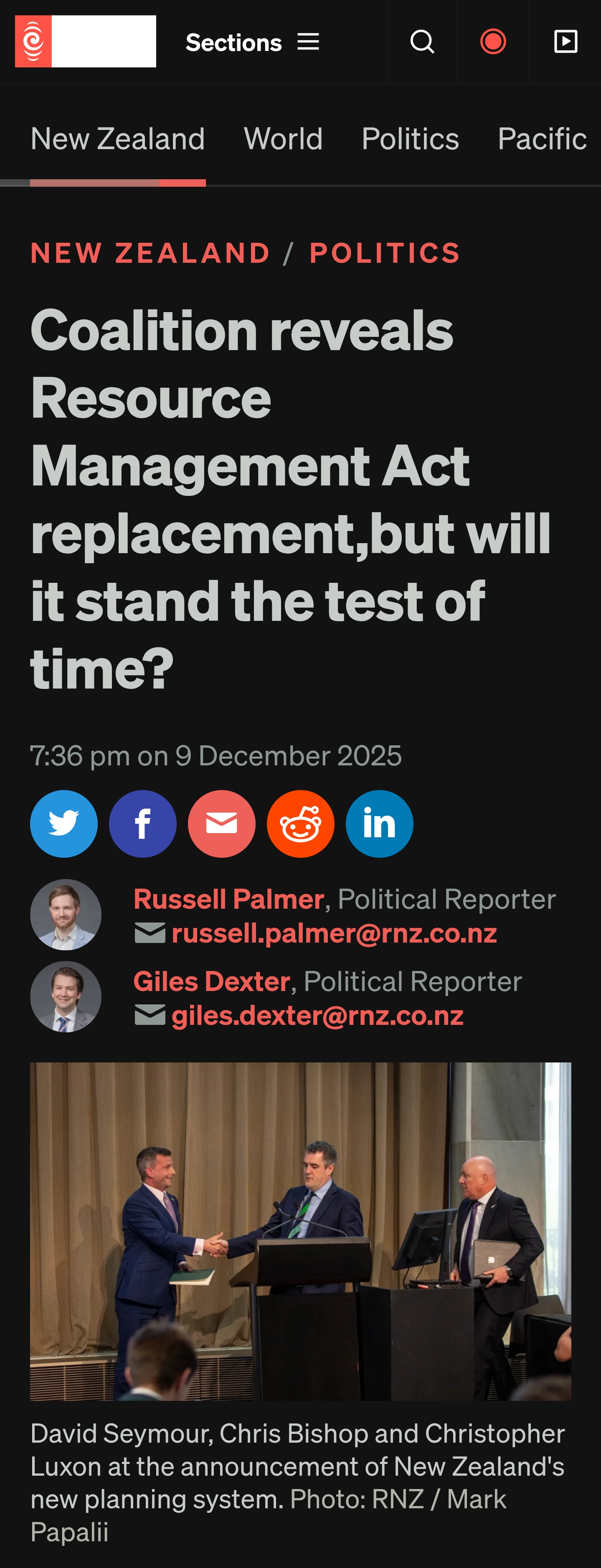
When Christopher Luxon, David Seymour, Chris Bishop and Simon Court assembled at the Beehive on December 8, 2025, to unveil their replacement for the Resource Management Act, they presented it as liberation—”less ‘no’ and a lot more ‘yes,’” as Luxon proclaimed. But beneath the sheen of economic promises lies a calculated assault on environmental protection, Māori rights, and democratic accountability.
This is not reform. This is ideological capture dressed as regulatory relief—a neoliberal power grab that privileges property owners and polluters while forcing ratepayers to subsidize environmental destruction.
The coalition’s Planning Bill and Natural Environment Bill represent the most comprehensive dismantling of environmental safeguards in a generation. Under the guise of cutting “red tape,” they have embedded a toxic concept called “regulatory relief”—essentially forcing councils to compensate landowners when environmental protections impact their ability to exploit their property.
As Greenpeace’s Gen Toop stated:
“In practice, this means that if regions like Gisborne want stronger rules to stop forestry slash destroying homes and rivers, ratepayers would likely be forced to pay offshore forestry companies ‘compensation’. It’s absurd.”
The Gisborne Test: When Ideology Meets Reality
The Gisborne region provides the clearest evidence of this bill’s perversity. After Cyclones Hale and Gabrielle, an estimated 1.4 million tonnes of forestry slash and woody debris devastated the region, destroying homes, clogging rivers, and covering beaches. Gisborne District Council successfully prosecuted eight forestry companies and invested heavily in strengthening environmental protections. The council has called for urgent reforms to the National Environmental Standard for Plantation Forestry, which they consistently opposed as creating “a permissive regulatory framework that does not work for Te Tairāwhiti.”
Now consider the coalition’s proposal:
if Gisborne strengthens rules to prevent future slash disasters, they must compensate the very forestry companies whose negligence caused the devastation. The council already spent over $1.2 million removing woody debris from just two beaches after Cyclone Gabrielle, with government funding of $54 million allocated for critical areas but an additional $100 million needed. Under the new regime, protecting communities from corporate-caused environmental destruction becomes financially impossible for rate-capped councils.
This is not hypothetical. China Forestry Group New Zealand Company Ltd was ordered by the Environment Court to remove approximately 16,000 cubic metres of woody debris and install water controls to “eliminate or minimise the risk of erosion.” Under the coalition’s regulatory relief framework, such enforcement could trigger compensation claims against the council—rewarding the polluter and punishing the protector.
The Neoliberal Lineage: From Rogernomics to Regulatory Takings
The coalition’s embrace of “regulatory takings” is not new—it represents the latest iteration of neoliberal ideology that has been pushed by ACT since its founding. David Seymour has consistently argued that “the first and most important job of any government is to protect your rights to private property,” positioning property rights as foundational to all other rights. This framework, echoing Milton Friedman’s assertion that “property rights are not in conflict with human rights...they are themselves the most basic of human rights,” subordinates environmental protection, workers’ rights, and collective wellbeing to individual property claims.
As Parliamentary Under-Secretary Simon Court stated, regulatory relief will “force councils to confront the real cost of these restrictions on private property that for too long have been costless to that council officer holding the highlighter, colouring in people’s property.” This framing deliberately obscures the actual costs: environmental degradation, climate vulnerability, biodiversity collapse, and the erosion of public goods for private gain.
The Treasury’s own 2002 analysis on “Protection Against Government Takings” acknowledged that regulatory takings claims can include “a planning requirement that limited the use to which property could be put.” New Zealand has historically rejected this approach, limiting compensation to extreme scenarios where land becomes “incapable of reasonable use.” The coalition’s bill dramatically lowers that threshold to where planning controls have “significant” impacts—a vague standard that could apply to heritage protections, significant natural areas, wetlands protection, and indigenous biodiversity.
The Ideological Architecture: Property Rights Über Alles
The coalition’s replacement rests on what legal scholar Victoria University analysis describes as “a myth of absolute property rights.” This 2024 academic article warned that “any policy that assumes private property rights should confer absolute rights on owners is a mischaracterisation of those rights and the law of private property. Making policy on a myth of absolute property rights is unlikely to result in good environmental outcomes.”
Bishop made the ideological foundations explicit: “The key change the government was making was returning the RMA to what it started as, which was ‘you can do what you like with your land as long as you don’t affect other people.’” But this is ahistorical fiction. The RMA 1991 never enshrined such a principle—its purpose was always “sustainable management of natural and physical resources,” balancing development with environmental protection.
The shift becomes clearer when examining what the coalition considers legitimate planning concerns. Bishop told Checkpoint that councils should not consider public health impacts when consenting developments like fast-food restaurants: “We do want to make sure we avoid situations like people in Auckland submitting on whether or not there’s a McDonald’s in Wanaka.” When asked about health impacts, he stated: “But you shouldn’t have a debate around the health impacts. That’s not a planning function.”
This represents a stunning narrowing of what constitutes legitimate public interest. Traffic, yes. Flooding risk, maybe. But public health, community wellbeing, cumulative environmental effects, cultural impacts? Not the council’s business. This is neoliberalism in its purest form: atomizing collective concerns into individual property transactions, dismissing social costs as illegitimate interference with market freedom.
Dismantling Te Tiriti: The Treaty by Stealth
While the coalition claims their legislation includes “descriptive, non-operative” Treaty of Waitangi clauses and “clear requirements for iwi participation,” analysis from Te Ao News reveals these are “framed as objectives rather than enforceable duties, and there is no requirement to give effect to Te Tiriti o Waitangi, a level of protection Māori have long argued is necessary.”
This represents a deliberate weakening from Labour’s Natural and Built Environment Act, which required decision-makers to “give effect to” Te Tiriti principles—the same standard as the Conservation Act. The coalition’s version requires only that Treaty obligations be “taken into account”—the weaker RMA standard that the 2020 Randerson Review Panel found had “failed to live up to its promise, leaving Māori out of critical decision-making.”
Extracts from Waitangi Tribunal reports compiled by the Ministry for the Environment document this failure comprehensively. The Tribunal found that “Te Rohe Pōtae Māori lack power under the RMA system” and that “while the RMA makes provision for these parties to work together...the Treaty aspirations of that legislation have never come to fruition.” The Tribunal concluded that “the Resource Management Act 1991 is inconsistent with the principles of the Treaty.”
Yet the coalition is doubling down on this failed approach while simultaneously conducting a review of 28 laws containing Treaty clauses, with NZ First’s Shane Jones targeting the Conservation Act’s Treaty provisions. Jones has stated the government is “bringing it back to the centre” after the country reached “peak Māori,” and NZ First is reviewing the Waitangi Tribunal to ensure “there’s no doubt as to the supremacy of Parliament.”
This “reset” is transparently about stripping Māori of the limited protections and participation rights that Treaty principles currently provide.
As Jones candidly stated in his announcement of the RMA reforms:
“Let’s see how the bill comes out of the Select Committee. But, you know, unless we have development in our Māori rural communities, they’re going to be in strugglers gully. But there’ll be people who disagree, because obviously the debate is ongoing as to how much veto power should Ngāi Tahu, for example, have over the development of the South Island.”
The framing is revealing:
Māori participation in environmental decision-making is characterized as “veto power” that must be curtailed.
Jones has previously posted on Facebook:
“No hapū, no Māori group is entitled to hold a veto over commerce in New Zealand.” This despite the fact that the Supreme Court has recently reaffirmed Te Tiriti as having “constitutional significance,” protecting interests that “go beyond tikanga Māori.”
The Chilling Effect: Councils Under Financial Siege
Environmental Defence Society chair Gary Taylor identified the mechanism of control: “That will have a chilling effect on councils protecting things. If they protect something, then arguably they have to pay the landowner for that, which is really bizarre and I think is a construct that comes out of right wing ideology. Councils will have rate caps, so they won’t be able to afford to pay, so they’ll have weaker controls.”
This is not speculation. The government has simultaneously imposed a 4 percent cap on rates increases while forcing councils to compensate property owners for environmental protections. Councils facing “rising costs and widespread changes in other areas” must now choose between protecting the environment and staying within their budget.
Forest and Bird general counsel Erika Toleman warned the consequences:
“Big environmental issues, from deforestation to water pollution, happen within property boundaries. Excluding these effects is a recipe for decline.” She added that “introducing compensation would make councils fear liability for protecting nature.”
The relief options—cash payments, rates rebates, extra development rights, land swaps—all impose costs on councils or reduce their revenue.
“councils must justify applying protections to each property, then develop a relief framework setting out what affected landowners are entitled to based on the impact on their land.”
This administrative burden alone will strain council resources, without even accounting for the actual compensation payments.
The Economic Snake Oil: Promises Without Evidence
The government claims its reforms will save $13.3 billion over 30 years and increase GDP by 0.56 percent annually by 2050, worth up to $3.1 billion per year. These figures demand scrutiny.
The economic modeling relies on assumptions about reduced compliance costs and increased development. But it does not account for the costs of environmental degradation that will result from weakened protections. It does not quantify the economic damage from forestry slash, water pollution, biodiversity loss, or climate vulnerability. It does not calculate the costs councils will bear for regulatory relief, or the opportunity costs of development that displaces sustainable alternatives.
An economic analysis of the 2020 Randerson Panel’s proposals—which the coalition claims to build upon—estimated “a net benefit of $14.8 billion in present value terms.” But that analysis was based on Labour’s reforms, which included stronger environmental protections, Treaty partnership, and limits-based planning. The coalition has gutted those features while keeping the economic projections. This is analytical malpractice.
The housing crisis argument is similarly dishonest. Bishop claimed the RMA “is directly responsible for New Zealand’s housing crisis - despite us having a land mass comparable to the United Kingdom but just five million people.” But New Zealand’s housing crisis is driven by factors the RMA reforms do not address: land banking, speculation, tax settings favoring property investment, inadequate social housing, and infrastructure funding gaps.
The Productivity Commission’s 2012 Housing Affordability Inquiry identified multiple contributing factors beyond planning rules, including the oligopolistic structure of building materials supply, restrictive building codes, and infrastructure funding models. Simply allowing more development without addressing these structural issues will not make housing affordable—it will enrich developers while communities bear the environmental and infrastructure costs.
Environmental Groups Sound the Alarm
The uniformity of opposition from environmental organizations is striking. Greenpeace has documented what it calls “Luxon’s War on Nature,” noting the coalition has repeatedly weakened environmental protections while claiming to protect the environment. The December 8 announcement marks the latest escalation.
Forest and Bird warns the replacement “could weaken critical environmental protections.” The Environmental Defence Society expressed deep concern about regulatory relief provisions. These are organizations with decades of expertise in environmental law and resource management—their warnings should not be dismissed as “vested interests” opposing change.
The Green Party’s Marama Davidson stated:
“This government has shown time and time again that they will pass laws that further erode our environment and our living systems, our habitats and species.”
The evidence supports her assessment. The coalition has already passed two RMA Amendment Bills weakening freshwater protections, biodiversity safeguards, and forestry controls. As Greenpeace documented, the Government secretly amended Section 107 of the RMA to allow councils to grant discharge permits “regardless that these discharges would cause significant adverse effects to aquatic life.”
The Repeal-and-Replace Merry-Go-Round
Perhaps the most cynical aspect of this reform is its similarity to the legislation it replaces.
Labour leader Chris Hipkins observed:
“From what I can see there’s a heck of a lot of similarities between what they’re proposing now, and the law that they repealed.”
The coalition repealed Labour’s Natural and Built Environment Act and Spatial Planning Act in December 2023—just two months after they were passed—claiming they needed to start fresh with a property-rights-based approach.
But the similarities are extensive:
both use two separate Acts, both reduce planning documents, both standardize zoning, both require 30-year spatial planning, both aim to streamline consenting.
Bishop acknowledged the similarities but defended repealing Labour’s version:
“We started again for a reason and I think we’ve ended up with a good outcome.”
The reasons are ideological, not functional: weakening Treaty protections, embedding property rights, and introducing regulatory relief.
The cost of this ideological purism is massive. The 2020 Randerson Review involved extensive consultation with 187 submissions, reference groups across all sectors, and comprehensive international research. Labour’s legislation built on that foundation. The coalition binned it, restarted the process, and is now rushing through 750 pages of legislation to be passed by mid-2026—before the next election.
“I think the repeal and replace cycle needs to end.”
But he has indicated Labour will not repeat the coalition’s behavior, instead making targeted amendments. This asymmetry—the left attempts incremental improvement while the right demolishes and rebuilds—is how neoliberal ideology becomes entrenched.
The Names Behind the Ideology
The personal politics of the ministers involved are instructive. Christopher Luxon “is not a great communicator. The public has not warmed to him.” Only 51 percent of New Zealanders believe Luxon wields the most influence on government decisions, with many seeing Peters and Seymour as the real power brokers.
David Seymour has been described as attempting “to embed the same extreme neoliberal ideas about ‘individual freedom’ and private property rights used by US gun lobbyists and climate deniers to block protections for people and the planet.” His Regulatory Standards Bill—which the coalition is obligated to pass—will require all future governments to prioritize property rights and “individual freedom” over environmental protection, with Te Tiriti explicitly excluded.
Shane Jones has criticized what he calls the “Americanisation of the judiciary,” defending the government’s fast-track legislation by arguing that “amenity values actually have more power than the growth of our economy.” His contempt for environmental protections is explicit: he wants to create “jobs for working-class whanau, my own people” by removing the ability of communities to object to development on environmental grounds.
Chris Bishop holds the combined portfolios of Housing, Infrastructure, and RMA Reform—a concentration of power that reveals the government’s priorities. Development über alles.
Cui Bono? Who Benefits?
Follow the money and the pattern becomes clear. Federated Farmers praised the reforms, celebrating that “Farm Plans can achieve much of the same environmental outcomes as a resource consent, without the need to fork out tens of thousands of dollars on expensive planners and lawyers.” Translation: farmers can self-regulate their environmental impacts.
Business NZ chief executive Katherine Rich celebrated that the bills “standardise rules targeted towards reducing the amount of compliance and provides better recognition of the burden landowners face when some planning controls limit the use of their land.” Translation: less environmental protection, more development rights.
The Taxpayers’ Union called scrapping the RMA “the most meaningful tax relief offered by this government or any government in decades.” Translation: gutting environmental protections is “tax relief.”
Who loses? Communities facing forestry slash. Iwi and hapū trying to protect ancestral waters and lands. Future generations inheriting degraded ecosystems. Ratepayers forced to compensate polluters. Anyone who values environmental protection over property rights.
The Path Forward: Resistance and Rangatiratanga
The coalition claims Labour won’t repeal their reforms, with Hipkins indicating Labour would “make changes” rather than another repeal-and-replace. But this represents a trap:
accepting the ideological framework while attempting incremental improvements. Regulatory relief and property-rights-primacy cannot be reformed—they must be rejected.
The resistance must be multi-pronged. First, the select committee process offers an opportunity for comprehensive public opposition. Environmental groups, councils, iwi, and communities must submit detailed critiques documenting the legislation’s flaws and proposing alternatives grounded in environmental limits, Treaty partnership, and intergenerational justice.
Second, councils must resist the chilling effect. Despite rate caps and compensation threats, they must continue setting strong environmental protections and documenting the costs imposed by the regulatory relief regime. This evidence will be crucial for future reform.
Third, Māori must assert rangatiratanga through Treaty-based challenges. The Waitangi Tribunal has consistently found the RMA inconsistent with Treaty principles. The coalition’s weakening of Treaty protections provides grounds for urgent inquiry, particularly given the climate change priority inquiry already underway.
Fourth, environmental litigation must continue. While the coalition has narrowed standing to challenge consents, legal challenges to the legislation itself on Treaty grounds, environmental justice grounds, and constitutional grounds remain viable.
Finally, the 2026 election must become a referendum on environmental protection. The coalition is rushing this legislation through precisely because they fear losing power. Every electorate targeted by environmental destruction—from Gisborne’s forestry slash to polluted waterways nationwide—must make this a voting issue.
Property Rights as White Supremacy
The coalition’s RMA replacement reveals the essential connection between neoliberalism and white supremacy. As scholars of environmental racism have documented, “the neoliberal reassertion of elite power” creates “new forms of rent collecting that hegemonically define the economy,” transforming “common rights to such things as education, health care, housing, and roads into lucrative windfalls for financial interests.”
Regulatory takings represent precisely this transformation: common environmental protections become opportunities for private enrichment. The framing of environmental limits as “takings” requiring compensation inverts the polluter-pays principle, forcing communities to subsidize destruction.
This is not accidental. Property rights have always been racialized in Aotearoa. As documented in Te Ara, Crown land policy dismissed Māori rights guaranteed by Te Tiriti, asserting that “Māori rights to land guaranteed by the Treaty only extended to land that was obviously used by them for housing or cultivation.” The Native Land Court individualized collectively-held land, enabling mass alienation. Confiscations were compensated with “barren or marginal land” or land returned to people who weren’t its former owners.
The coalition’s regulatory relief framework repeats this pattern: individual property rights trump collective responsibilities, environmental protection becomes compensable “taking,” and the costs fall on communities rather than polluters. It is structural racism masquerading as neutral economic policy.
David Seymour and Shane Jones have been explicit about their goal: “to put an end to any expectation that a Treaty partnership means giving Māori an equal say or veto in how things are run.” The RMA replacement achieves this by embedding property rights as supreme, weakening Treaty protections, and creating financial barriers to environmental protection that will disproportionately harm Māori.
The Planning Bill and Natural Environment Bill are not solutions to New Zealand’s environmental challenges. They are ideological weapons designed to privilege property owners, enrich polluters, disempower communities, marginalize Māori, and gut environmental protections—all while claiming to boost the economy and provide regulatory certainty.
This is the coalition’s vision: a New Zealand where forestry companies can sue councils for trying to prevent slash disasters. Where dairy farmers can demand compensation for water quality limits. Where heritage protections and biodiversity safeguards trigger payment obligations. Where environmental protection becomes unaffordable. Where property rights reign supreme and the common good withers.
It must be opposed. Not amended. Not accepted with reservations. Opposed. The merry-go-round of repeal-and-replace must end, but it must end with legislation that gives effect to Te Tiriti, operates within environmental limits, and prioritizes intergenerational wellbeing over property rights. Anything less is surrender.
Kia mau ki te Tiriti. Tiakina te taiao. Toitū te whenua, toitū te tangata.

Ivor Jones The Māori Green Lantern Fighting Misinformation And Disinformation From The Far Right
- https://www.rnz.co.nz/news/national/581324/coalition-reveals-resource-management-act-replacement-but-will-it-stand-the-test-of-time
- https://ojs.victoria.ac.nz/pq/article/view/9637
- https://onlinelibrary.wiley.com/doi/10.1111/j.1467-8376.2004.00230.x
- https://www.semanticscholar.org/paper/58a5fd72b57f9fe86dcf0b49653950f504dde62a
- https://www.semanticscholar.org/paper/c3b69bc3cba07457f57456ac0bc90eaab976d312
- https://www.semanticscholar.org/paper/7a51e5b367912d0ed1ffd14e5842d82aadcfb021
- http://www.jstage.jst.go.jp/article/ece1998/6/1/6_1_73/_article
- http://www.tandfonline.com/doi/abs/10.1080/08111140600591179
- https://www.semanticscholar.org/paper/4487e02ad3b922576835c3adbe33d16ffca73bdb
- https://www.semanticscholar.org/paper/6fbedf15a6caa0d9249cee6a00b2fa123c9298ac
- https://ojs.victoria.ac.nz/vuwlr/article/view/7407
- https://www.tandfonline.com/doi/pdf/10.1080/00908320.2023.2224116?needAccess=true&role=button
- /content/files/article_4538_26addc75c11caf7dcfc6c288201319cd.pdf
- https://linkinghub.elsevier.com/retrieve/pii/S0955395922001311
- /content/files/articles/10-3389/fclim-2021-734726/pdf.pdf
- https://arxiv.org/ftp/arxiv/papers/2312/2312.01649.pdf
- https://www.rnz.co.nz/news/political/581305/five-things-you-need-to-know-about-the-rma-replacements
- https://www.odt.co.nz/news/national/five-things-know-about-proposed-rma-replacements
- /content/files/wp-content/uploads/rma-reform-rollercoaster.pdf
- https://www.simpsongrierson.com/insights-news/legal-updates/unwrapping-the-resource-management-reforms
- https://www.interest.co.nz/public-policy/136519/replacing-resource-management-act-government-introduces-new-planning-system
- https://environment.govt.nz/acts-and-regulations/acts/rm-amendment-act-2025/
- https://environment.govt.nz/acts-and-regulations/acts/natural-environment-bill/
- https://thespinoff.co.nz/politics/09-12-2025/rip-rma-government-prays-for-economic-boom-with-new-bills
- https://www.lgnz.co.nz/policy-advocacy/key-issues-for-councils/resource-management/
- https://environment.govt.nz/news/government-unveils-major-overhaul-of-new-zealands-planning-system/
- /content/files/sites/default/files/2022-05/tfr-pppr-27oct09.pdf
- https://www.beehive.govt.nz/portfolio/nationalactnew-zealand-first-coalition-government-2023-2026/rma-reform
- https://www.bellgully.com/insights/resource-management-act-replacements-unveiled/
- https://www.politik.co.nz/the-rma-reforms-power-to-the-minister/
- https://www.beehive.govt.nz/release/replacement-resource-management-act-takes-shape
- https://www.beehive.govt.nz/release/transitioning-new-planning-system
- https://www.beehive.govt.nz/release/new-planning-laws-end-culture-%E2%80%98no%E2%80%99
- https://environment.govt.nz/news/resource-management-update-june/
- https://www.beehive.govt.nz/release/planning-reform-unlock-housing-growth
- https://www.rnz.co.nz/news/political/581294/landowners-to-get-more-compensation-from-councils-as-major-rma-overhaul-revealed
- https://www.rnz.co.nz/national/programmes/checkpoint/audio/2019016205/major-rma-overhaul-revealed
- https://www.rnz.co.nz/news/alert-top/581305/five-things-you-need-to-know-about-the-rma-replacements
- https://www.nzherald.co.nz/business/transformational-business-groups-farmers-welcome-rma-reforms/premium/3K2HLLAISRCIHJP7BAACPA337A/
- /content/files/webcontent/document/201151/housingreport.pdf
- https://www.rnz.co.nz/news/political/581235/government-to-reveal-resource-management-act-replacement
- https://www.nzherald.co.nz/nz/chris-bishop-is-confused-and-theres-a-reason-for-it-simon-wilson/premium/GN6LLWBP4RH3PAROB55Y46BZUQ/
- /content/files/webcontent/document/201251/localgovt.pdf
- https://www.nzherald.co.nz/the-listener/politics/danyl-mclauchlan-on-the-highs-and-lows-of-the-year-in-politics/premium/PEG7JSZBLBBYRHFIGOMSLCSGEE/
- /content/files/webcontent/document/201320/towards-better-local-regulation1.pdf
- https://www.rnz.co.nz/national/programmes/checkpoint/audio/2019016203/government-reveals-sweeping-overhaul-of-the-rma
- https://www.rnz.co.nz/programmes/news-extras/story/2018902030/election-2023-rnz-s-guide-to-party-policy
- https://www.1news.co.nz/2025/12/09/govt-reveals-big-consenting-reforms-once-in-a-generation-shift/
- /content/files/webcontent/document/201244/housing.pdf
- https://www.nzherald.co.nz/nz/politics/single-largest-economic-reform-in-a-generation-government-bins-rma-promises-new-planning-laws-will-slash-consents-add-3b-a-year-to-economy/7U33L7GD6FFYZGFKOVJ3VPPBXQ/
- https://www.nzherald.co.nz/nz/politics/government-gets-its-way-with-new-planning-reforms-thomas-coughlan/premium/5SKGBC3HQJFMPGE4PXONG2SAEE/
- https://www.nzherald.co.nz/nz/politics/government-to-unveil-radical-overhaul-of-rma-today-slashing-consent-requirements/premium/BHEMQVTRTJGGJEOJVMW3GSCUL4/
- https://www.rnz.co.nz/national/programmes/checkpoint/20251209
- https://www.beehive.govt.nz/release/better-planning-system-better-new-zealand
- https://businessdesk.co.nz/article/policy/rma-reform-major-battles-still-to-be-fought-as-government-moves-to-legislate
- /content/files/assets/publications/final-eag-report.pdf
- https://openaccess.wgtn.ac.nz/articles/thesis/Nobody_owns_water_Te_Tiriti_te_wai_and_changing_P_keh_/17013239/1
- https://www.ssrn.com/abstract=3685498
- https://journals.sagepub.com/doi/10.1177/14687968231171651
- https://www.semanticscholar.org/paper/f874d44b89467f71a4600cc3276e9613bc538138
- https://journals.sagepub.com/doi/10.1177/11771801251377891
- http://www.ecologyandsociety.org/vol21/iss4/art9/
- https://www.semanticscholar.org/paper/d9c1c3d7351999b34e72dc3ac89733d7768a23c5
- https://iopn.library.illinois.edu/journals/aliseacp/article/view/1961
- https://rgs-ibg.onlinelibrary.wiley.com/doi/10.1111/geoj.12238
- https://journals.sagepub.com/doi/10.1177/25148486251388972
- /content/files/vol21/iss4/art9/es-2016-8804.pdf
- https://pmc.ncbi.nlm.nih.gov/articles/PMC7348423/
- https://wires.onlinelibrary.wiley.com/doi/10.1002/wat2.1624
- https://academic.oup.com/ejil/advance-article-pdf/doi/10.1093/ejil/chae027/58310183/chae027.pdf
- https://pmc.ncbi.nlm.nih.gov/articles/PMC11459782/
- https://pmc.ncbi.nlm.nih.gov/articles/PMC9475301/
- https://www.mdpi.com/2075-471X/10/2/45/pdf?version=1622790234
- https://www.mdpi.com/2073-445X/13/6/886/pdf?version=1718785305
- /content/files/assets/publications/rm-reform-a-more-effective-role-for-maori.pdf
- http://www.qualityplanning.org.nz/node/705
- https://en.wikipedia.org/wiki/Sixth_National_Government_of_New_Zealand
- https://www.treasury.govt.nz/publications/wp/protection-against-government-takings-compensation-regulation-wp-02-18
- https://www.teaonews.co.nz/2025/12/09/rma-shake-up-maori-input-minimal-under-new-planning-rules/
- /content/files/sites/default/files/the_legitimacy_of_regulation.pdf
- https://www.environmentguide.org.nz/rma/maori-and-the-rma/
- https://www.nzinitiative.org.nz/reports-and-media/opinion/making-sense-of-the-case-for-compensation-in-regulatory-bill/
- /content/files/wp-content/uploads/2022/02/hierarchy-of-maori-rights-and-responsibilities-2.pdf
- https://www.harrisongrierson.com/about/news/rma-reform
- /content/files/media/q5eogtqh/treaty_legislation.pdf
- https://www.nbr.co.nz/politics/rma-reform-legislation-will-be-law-next-year/

- https://tikatangata.org.nz/human-rights-in-aotearoa/human-rights-and-te-tiriti-o-waitangi
- https://www.facebook.com/NZLabourParty/posts/christopher-luxon-is-too-weak-to-stand-up-to-david-seymour-the-regulatory-standa/1408546833974675/
- https://www.rnz.co.nz/news/what-you-need-to-know/481228/natural-and-built-environment-replaces-the-resource-management-act-what-you-need-to-know
- https://www.1news.co.nz/2024/04/19/concern-govts-fast-track-legislation-may-breach-treaty-rights/
- https://www.nzherald.co.nz/nz/politics/national-nz-first-act-coalition-christopher-luxon-to-be-sworn-in-as-prime-minister-today-along-with-ministers-new-government-kicks-into-gear/4ACAOUV6RBBOPJTNUJBF3UWYLM/
- https://www.rnz.co.nz/news/political/563636/the-regulatory-standards-bill-what-is-it-what-does-it-propose-and-what-s-next
- https://www.1news.co.nz/2023/11/24/what-the-new-government-may-mean-for-maori-te-tiriti/
- https://www.1news.co.nz/2024/04/30/poll-only-51-say-luxon-is-the-decision-maker-in-coalition-govt/
- https://www.rnz.co.nz/news/te-manu-korihi/436181/rma-ditched-treaty-s-place-in-new-laws-still-to-be-defined
- https://www.rnz.co.nz/news/political/503156/cabinet-lineup-for-new-government-unveiled-who-gets-what
- https://www.rnz.co.nz/news/political/578793/controversial-regulatory-standards-bill-passes-third-reading
- https://www.nzherald.co.nz/nz/politics/coalition-power-players-david-seymour-shane-jones-the-act-and-nz-first-ministers-who-hold-the-most-power-and-how-they-use-it/DK3BFLSFGJFXHC2EEZURMCF64Y/
- https://www.nzherald.co.nz/business/why-the-regulatory-standards-bill-matters-for-property-rights-richard-prebble/2M6PEQOMJBE5BEJ3YJDT5OK74M/
- https://www.nzherald.co.nz/nz/politics/maori-health-leader-lady-tureiti-moxon-takes-complaint-against-government-to-united-nations/AOZ7QJKWMBBPTE53OLUAIWQW44/
- https://www.1news.co.nz/2023/11/24/who-gets-what-list-of-new-zealands-new-ministers/
- https://www.nzherald.co.nz/business/towards-a-system-that-respects-property-rights-tidy-tweaks-or-real-change-nick-clark/QKTD7IVJFVF4NDM2YOFCMDKHWA/
- https://www.rnz.co.nz/news/ldr/446167/resource-management-act-changes-relationship-building-critical-to-outcomes-iwi-leader
- https://journalajarr.com/index.php/AJARR/article/view/784
- http://www.scirp.org/journal/doi.aspx?DOI=10.4236/nr.2013.41004
- https://onlinelibrary.wiley.com/doi/10.1002/sd.70266
- https://scholarship.law.tamu.edu/lawreview/vol10/iss2/5
- http://www.academicstar.us/issueshow.asp?daid=3950
- https://oaj.fupress.net/index.php/techne/article/view/11533
- https://brill.com/view/journals/gg/12/2/article-p205_7.xml
- https://www.semanticscholar.org/paper/803379871743f88fbb908441acfc445a890a0bae
- https://www.semanticscholar.org/paper/a5fd664ebf56e3e5bf098f0db2a44c1141680a05
- https://www.tandfonline.com/doi/full/10.1080/14693062.2023.2175637
- https://pmc.ncbi.nlm.nih.gov/articles/PMC8563925/
- https://pmc.ncbi.nlm.nih.gov/articles/PMC9378803/
- /content/files/journals/science/articles/10-3389/fsci-2024-1349350/pdf.pdf
- https://ebn.bmj.com/content/ebnurs/24/4/109.full.pdf
- https://conbio.onlinelibrary.wiley.com/doi/pdfdirect/10.1111/cobi.13317
- https://ppp-online.org/view-all-volumes/the-rights-of-nature-a-call-for-a-policy-of-mutually-assured-flourishing/
- https://www.tandfonline.com/doi/pdf/10.1080/13880292.2024.2375862?needAccess=true
- /content/files/assets/Publications/Files/improving-our-resource-management-system-summary-submissions.pdf
- https://innovatek.co.nz/victory-for-council-over-gisborne-forestry-companies/
- https://www.greenpeace.org/aotearoa/story/luxons-war-on-nature-timeline/
- https://www.gdc.govt.nz/our-recovery/woody-debris
- https://thelawassociation.nz/how-the-governments-plans-to-reform-the-rma-are-playing-out/
- https://www.rnz.co.nz/news/political/581324/coalition-reveals-resource-management-act-replacement-but-will-it-stand-the-test-of-time
- https://www.rnz.co.nz/news/top/580602/calls-for-government-to-stump-up-359-million-for-forestry-response
- https://www.russellmcveagh.com/insights-news/governments-plan-to-overhaul-the-rma-is-here/
- https://www.forestandbird.org.nz/rma-reform
- /content/files/sites/default/files/2023-11/dpmc-roia-oia-2023-24-0149.pdf
- https://thedailyblog.co.nz/2025/12/10/rma-replacement-risks-weakening-protections-for-nature-forest-and-bird/
- https://www.nzherald.co.nz/nz/council-battles-slash-damage-seeks-enforcement-at-waimata-valley/JGPYOBWAQBFH3AFBWTG2MRAJBI/
- https://www.forestandbird.org.nz/resources/submission-proposed-changes-rma-national-direction
- https://www.beehive.govt.nz/release/inquiry-investigate-forestry-slash-and-land-use-after-cyclone
- https://www.greens.org.nz/greens_question_govt_commitment_to_environmental_protection_with_rma_reform
- /content/files/assets/publications/land/cyclone-gabrielle-post-event-woody-debris-assessment-supplementary-for-hawkes-bay-2023.pdf
- https://www.rnz.co.nz/news/political/545868/rma-overhaul-government-seeks-common-ground-with-opposition
- https://www.rnz.co.nz/news/national/115434/environmental-groups-against-rma-changes
- https://www.nzherald.co.nz/nz/cyclone-gabrielle-prosecutors-widen-investigations-into-forestry-slash/XOCDAX3BERCSTKXGWROXYROITU/