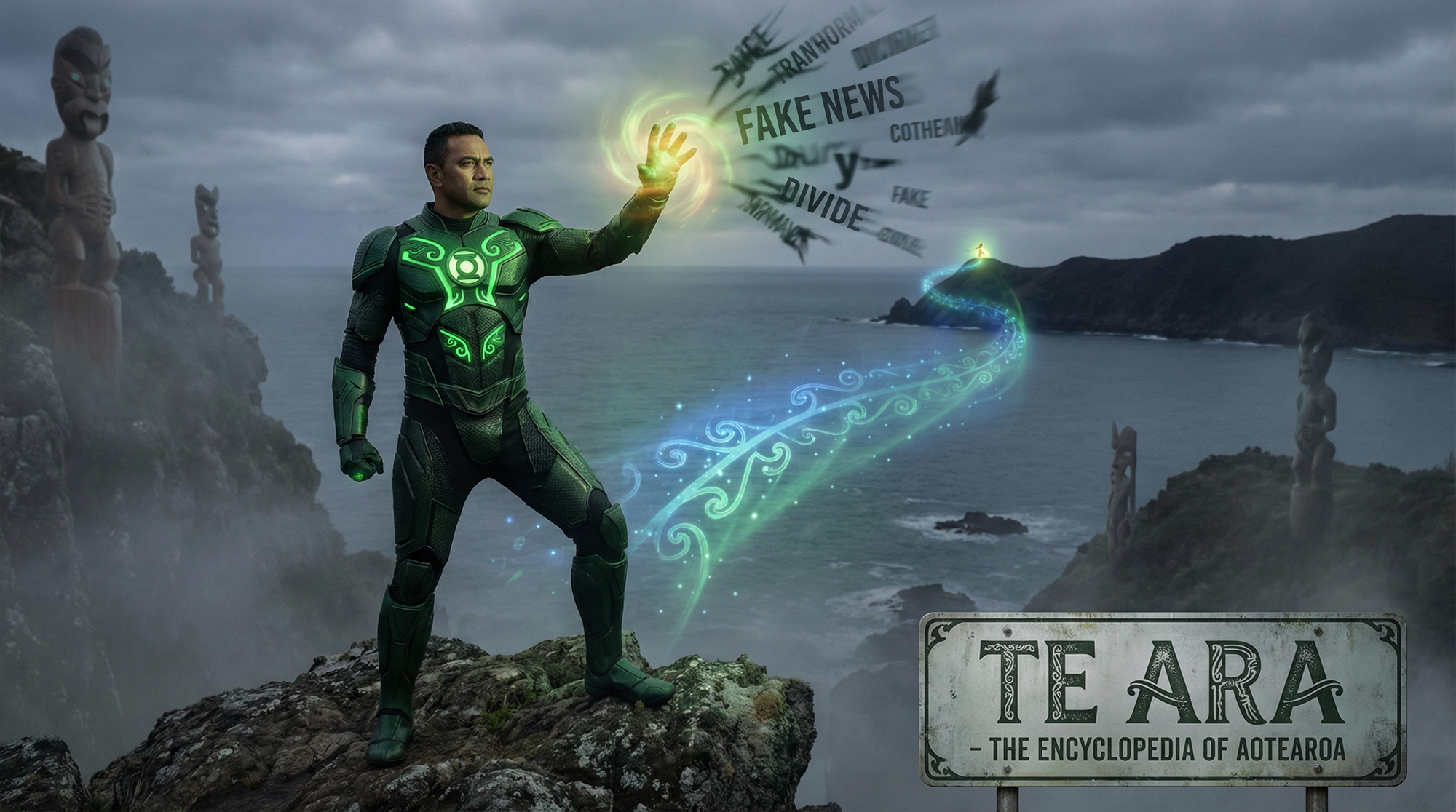
"🔥 THE RATS BENEATH THE FLOORBOARDS: How a White Supremacist Neoliberal Regime Sent Its Podcasters, Its Lobbyists, and Its Minister to Destroy the Most Democratically Legitimate Māori Mayor in Aotearoa" - 11 April 2026
They couldn't beat him at the ballot box — so they built a machine to burn the box down.
Mōrena Aotearoa,
The Smell of Fear
Here is what fear smells like in Aotearoa 2026.
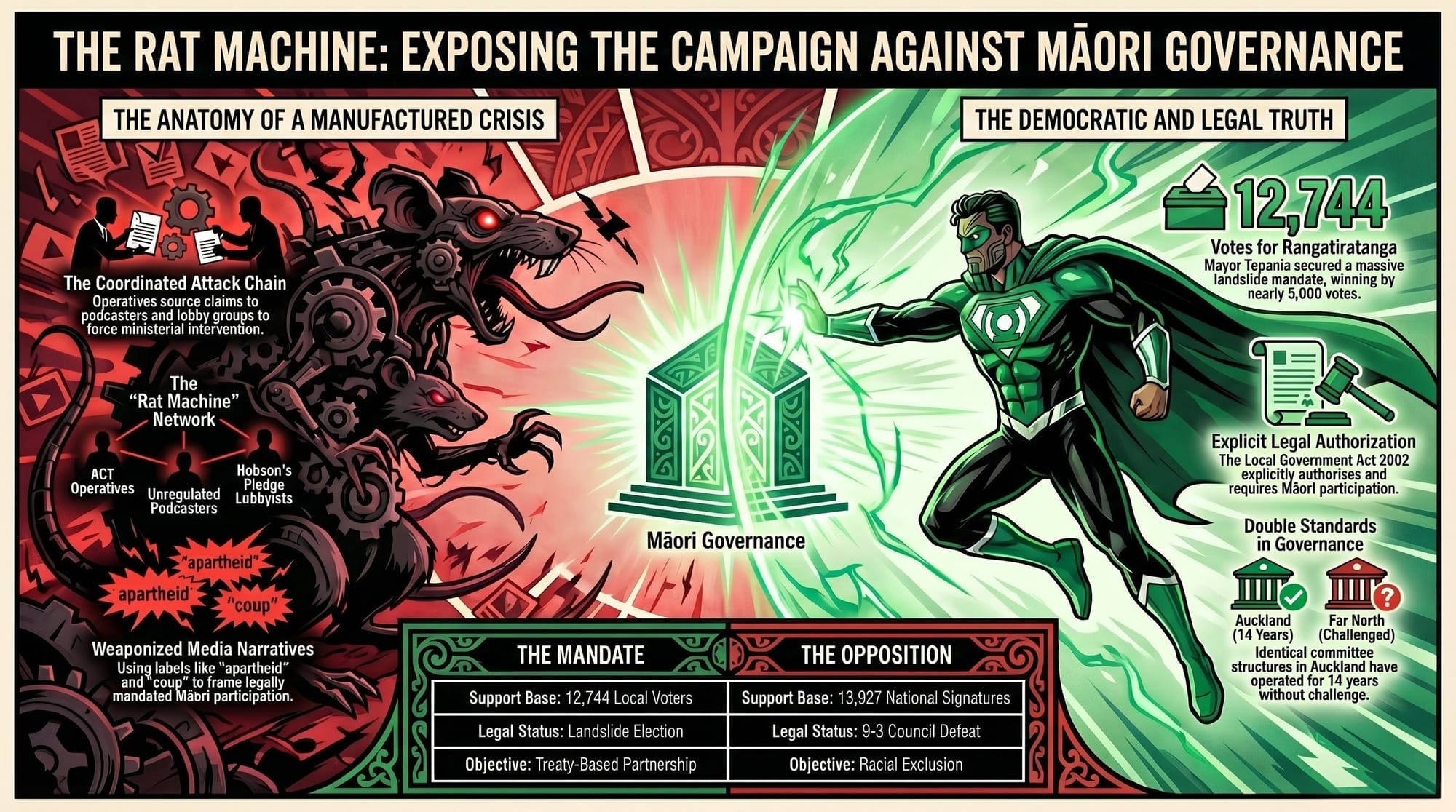
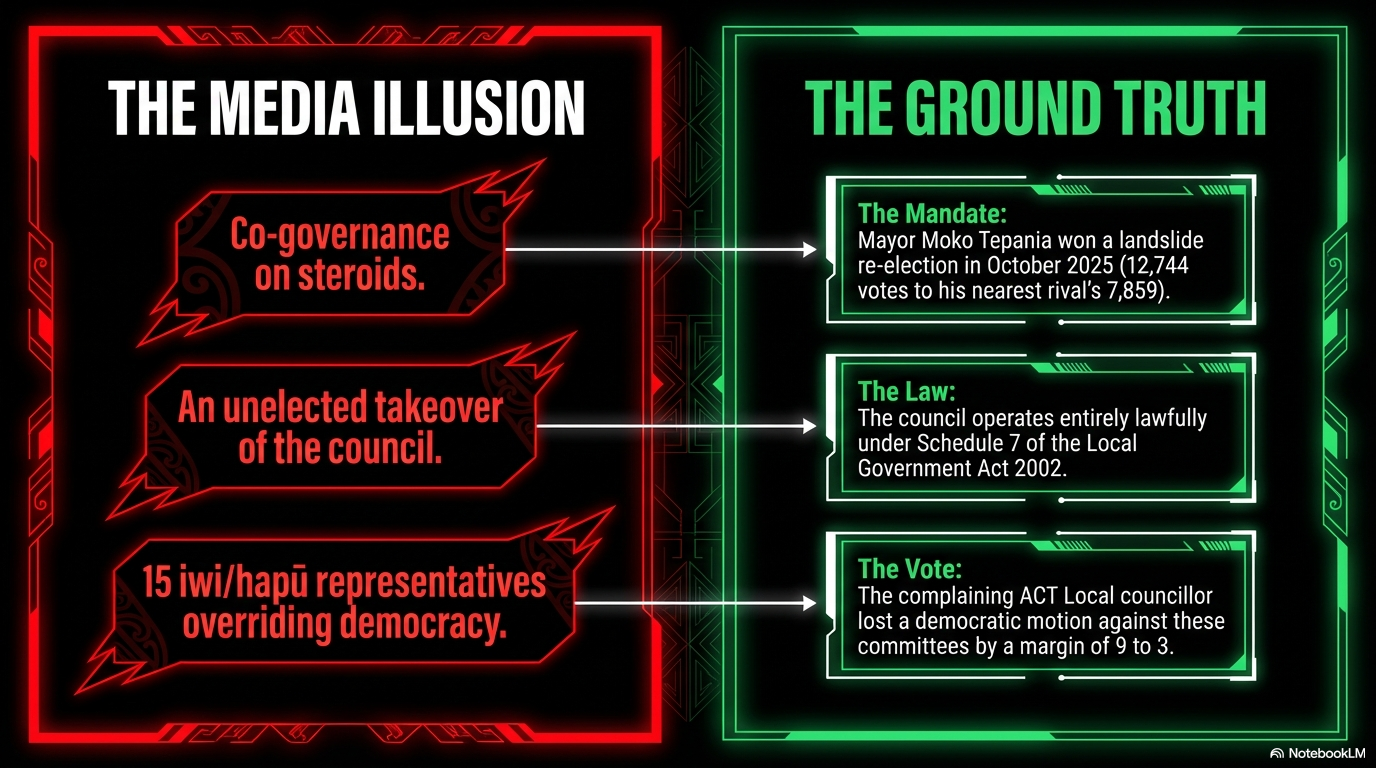
It smells like a podcast studio in Wellington where a former journalist — once considered credible — leans into a microphone and says the words "governance takeover" about a democratically elected Māori mayor who just won a 12,744 to 7,859 landslide. It smells like an ACT Local councillor who lost a 9-to-3 vote at her own democratic table and went crying to the press. It smells like Hobson's Pledge — a front for Don Brash's decades-long race war against tangata whenua — spinning up a 13,927-signature petition within 72 hours of a podcast going live. It smells like a National Government minister who once wasted nearly a million dollars while Kiwis chose between heating and eating being asked to intervene against a council whose only crime is honouring its Treaty obligations.
This is not governance concern. This is the stench of white supremacy cornered.
The Deep Dive Podcast
Listen to a lively conversation between two hosts, unpacking and connecting topics in the sources of this essay.
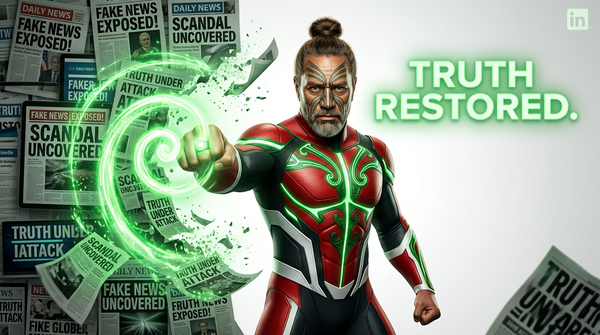
The Māori Green Lantern has named this network before, and will name it again. The machine is the same machine. The targets change. The Māori get stronger. And the machine gets more desperate.
What They Could Not Achieve with Votes, They Are Achieving with Rats
Let us be surgical about what actually happened in the Far North.
Moko Tepania — the first Māori mayor in Far North District Council history — was elected in 2022. He was re-elected in October 2025 in a landslide that left his nearest rival — Ann Court, the establishment's preferred candidate — nearly 5,000 votes behind. His council used $5 million from Far North Holdings to flatten rates pressure for ordinary ratepayers. Under his leadership, the council built genuine iwi and hapū partnerships into its governance structure — exactly as Schedule 7 of the Local Government Act 2002 permits, and exactly as Section 81 of that same Act requires.
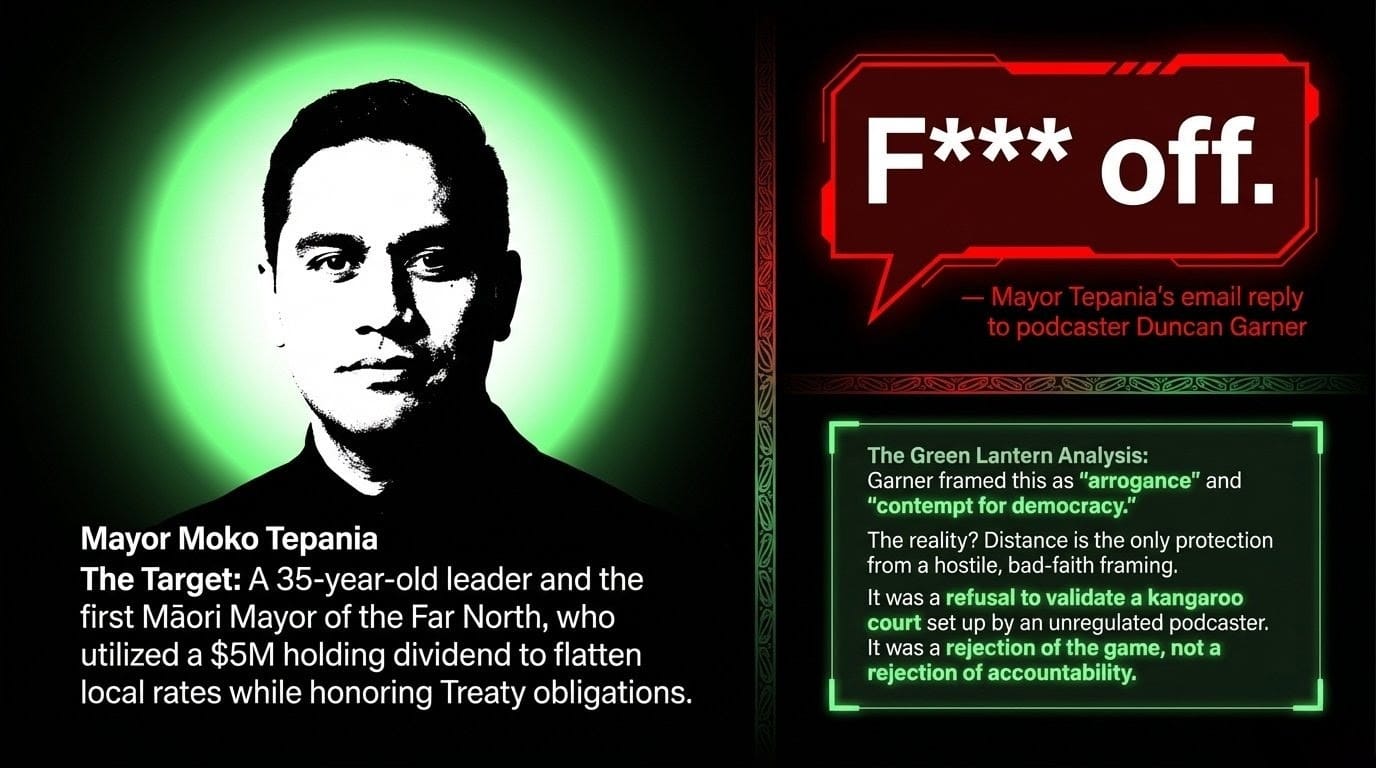
The people of the Far North voted. They voted again. They voted with larger margins the second time.
So ACT Local councillor Davina Smolders — an ideological operative installed by the ACT Party's local government infiltration strategy — tried to force a review of the mayor's hiring process. Nine of twelve democratically elected councillors voted her down.
Nine to three. In a democracy, that is called: you lost.
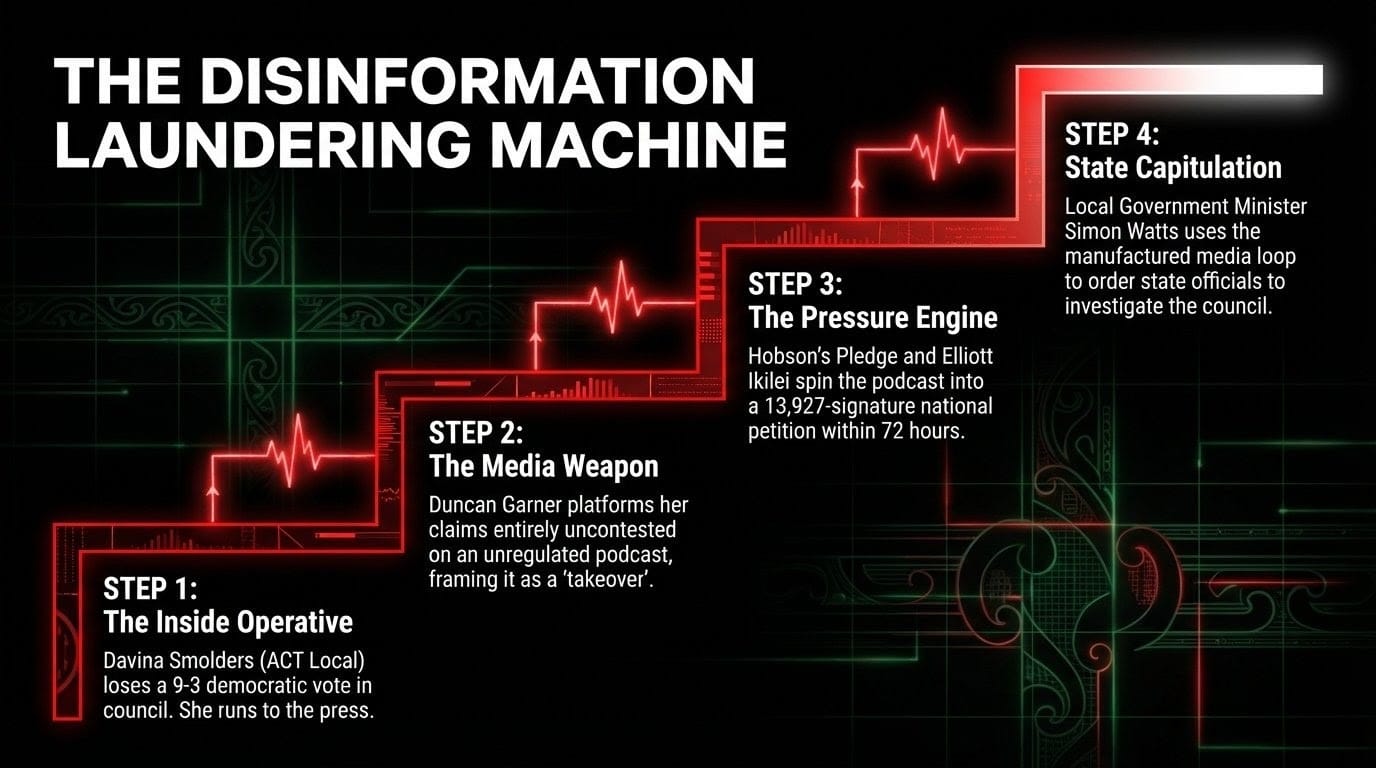
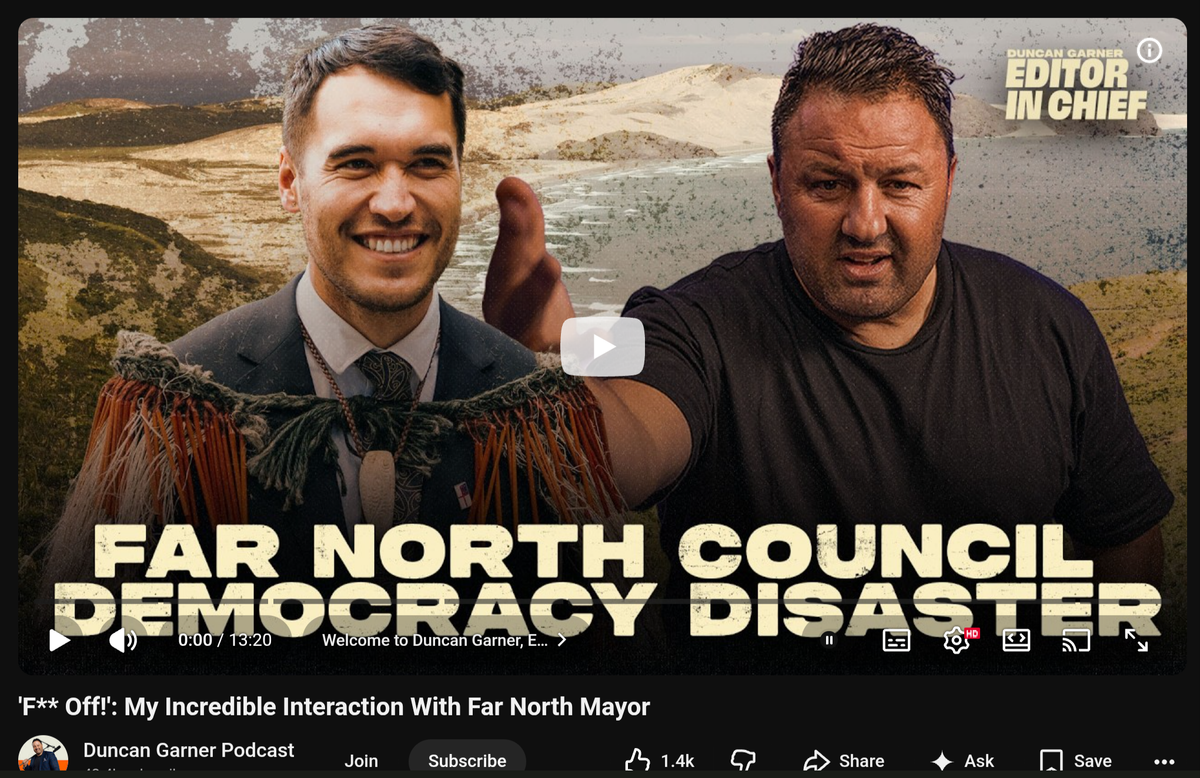
So Smolders did what the colonial playbook always dictates when democracy produces the wrong result: she went to the media. Specifically, she went to Duncan Garner's Rova podcast. And the machine roared to life.
In February 2026, Smolders had already publicly spread false claims that Mayor Tepania was planning to stand as an MP — claims Tepania was forced to publicly deny. This is the pattern of a destabilisation operative, not a concerned citizen.
Duncan Garner: A Rat Wearing a Reporter's Tie
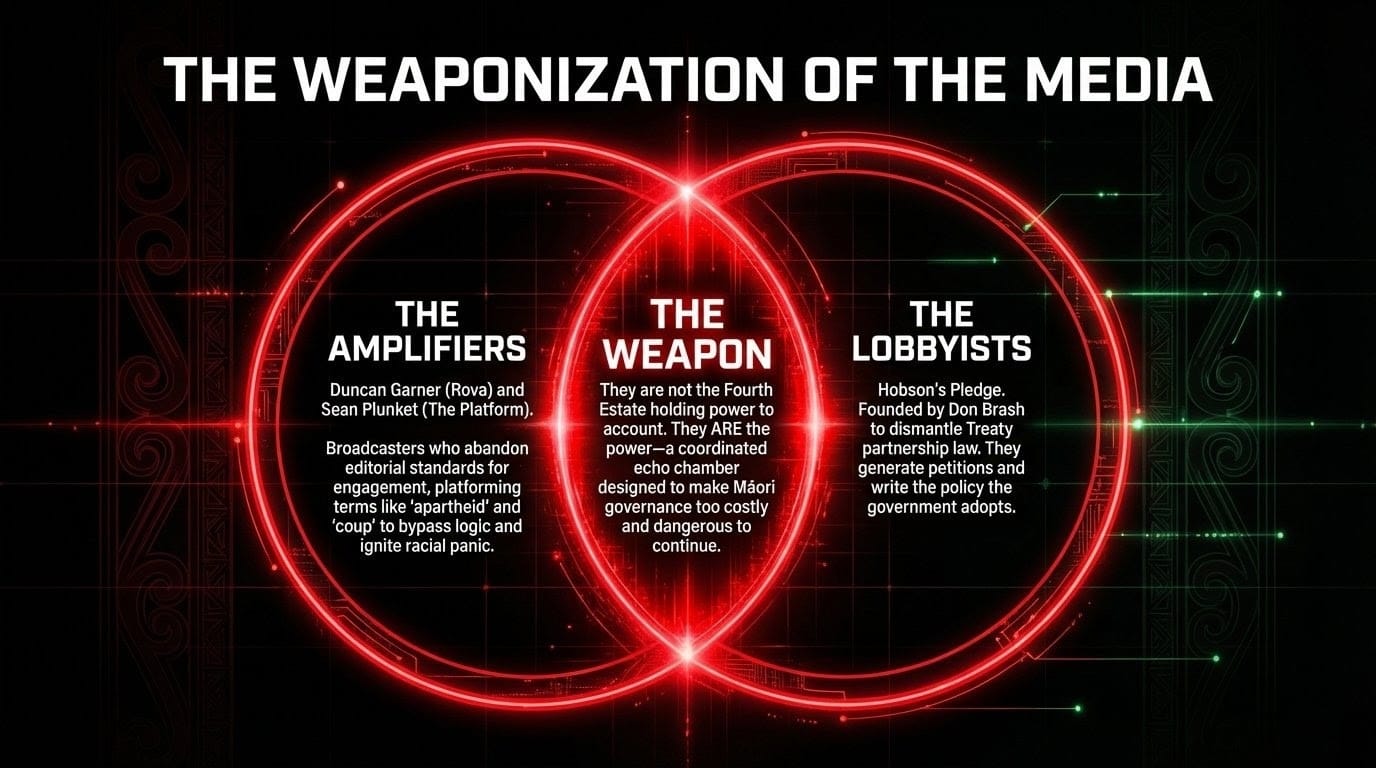
Let us not waste words here. Duncan Garner is not a journalist. He abandoned journalism when he traded his editor's chair for a subscription podcast operation that answers to no regulator, no editor, no standards authority — only the paying audience that wants to hear Māori authority framed as threat.
On April 6, 2026, Garner published his interview with Smolders under the headline framing of "co-governance on steroids" — as documented on his Rova podcast page. He gave Smolders an uncontested, uninterrupted platform to make claims about the FNDC committee structure without interviewing a single iwi representative, without consulting a single legal expert on Schedule 7 of the LGA, without speaking to a single one of the nine councillors who voted against Smolders' review motion.
Then on April 9, Garner published a follow-up video declaring Tepania was "running scared" for declining to participate in his hostile framing. Think about the architecture of that manoeuvre. A Māori mayor declines to validate a politically compromised interview process. A former journalist — who has built his brand on anti-co-governance commentary and previously attacked Māori representation in print for the NZ Listener — takes that refusal and weaponises it as proof of guilt.
This is not the fourth estate holding power to account. This is the fourth estate being power — operating as a political instrument for ACT, Hobson's Pledge, and the neoliberal project of stripping Māori from governance.
The Māori Green Lantern has been tracking this media-as-weapon model for years. In The Colosseum of Kingsland, this paper documented how the same media-government nexus was used to override local democratic authority on sacred whenua in Auckland. The pattern is identical: find a Māori-led decision, manufacture a controversy, send in the media dogs, pressure the minister, override the community.
Sean Plunket and The Platform: The Amplification Sewer
Where Garner operates with the residual credibility of a once-mainstream career, Sean Plunket operates from the fringes he has built into an empire of grievance. The Platform is a right-wing online broadcaster that has used the word "apartheid" to describe Māori health equity. It is currently the subject of a Broadcasting Standards Authority ruling for broadcasting standards violations — a ruling publicly defended by NZ First leader Winston Peters, as reported by the NZ Herald.
Read that again. The governing party's leader intervened to shield a broadcaster found in violation of broadcasting standards. The Platform is not independent media. It is NZ First's propaganda operation with better microphones — as the Māori Green Lantern documented in Winston Peters Is A Temu Trump For Reals, which traced how Peters compared co-governance to Nazi Germany, told Māori they are "not indigenous," and singled out a Green MP for his Rarotongan heritage — all while using The Platform as his preferred amplification channel.
Hobson's Pledge: The Engine Room of the Rat Machine
The operational centre of this entire campaign is Hobson's Pledge — a lobby group founded by Don Brash, former leader of both National and ACT, specifically to remove Māori electorates, abolish the Waitangi Tribunal, and dismantle Treaty partnership language from New Zealand law.
Elliott Ikilei, a Hobson's Pledge trustee, wrote the incendiary "takeover" article that immediately followed Garner's podcast. He declared: "This is a direct challenge to the basic idea of representative government in New Zealand." He did not note that the committee structure is lawful. He did not note that nine elected councillors supported it. He did not note that the mayor won a landslide election six months ago. He presented Hobson's Pledge's ideology as democracy's last defence — and launched the Hobson's Pledge petition that reached 13,927 signatures within days.
Note the editorial tag at the bottom of Ikilei's article: "This article is sourced from Brash and Mitchell." Don Brash — the man behind the 2004 Orewa Speech that launched modern New Zealand's race-baiting political era — is still pulling strings, as confirmed on the Hobson's Pledge About Us page. The Māori Green Lantern has named this operation in multiple prior investigations:
- Hobson's Pledge: The Trojan Horse of White Supremacy in Aotearoa
- The Colonial Playbook: How Hobson's Pledge Weaponizes False Unity to Dismantle Indigenous Rights (May 2025)
- Elliot the Idiot of Hobson's Pledge — a forensic dissection of Ikilei's specific role in this machine
- The Māori Green Lantern Exposes the Hobson's Pledge Con Job (August 2025)
- The Brazen Theft of Mana: Hobson's Pledge Digital Colonisation — on how the lobby group's 2025 referendum campaign targeted 42 councils with Māori wards to eliminate guaranteed Māori representation
- Democracy Died by Post: How the Coalition Rigged the 2025 Māori Wards Referendums
The Hobson's Pledge agenda has been ruled by the Waitangi Tribunal to breach the Treaty of Waitangi in the Māori wards context. The Tribunal's ruling is not optional reading. It is the definitive legal and moral verdict on exactly the project Smolders, Garner, Ikilei and Plunket are advancing: the systematic removal of Māori voices from public decision-making.
Three Examples the Western Mind Must Understand
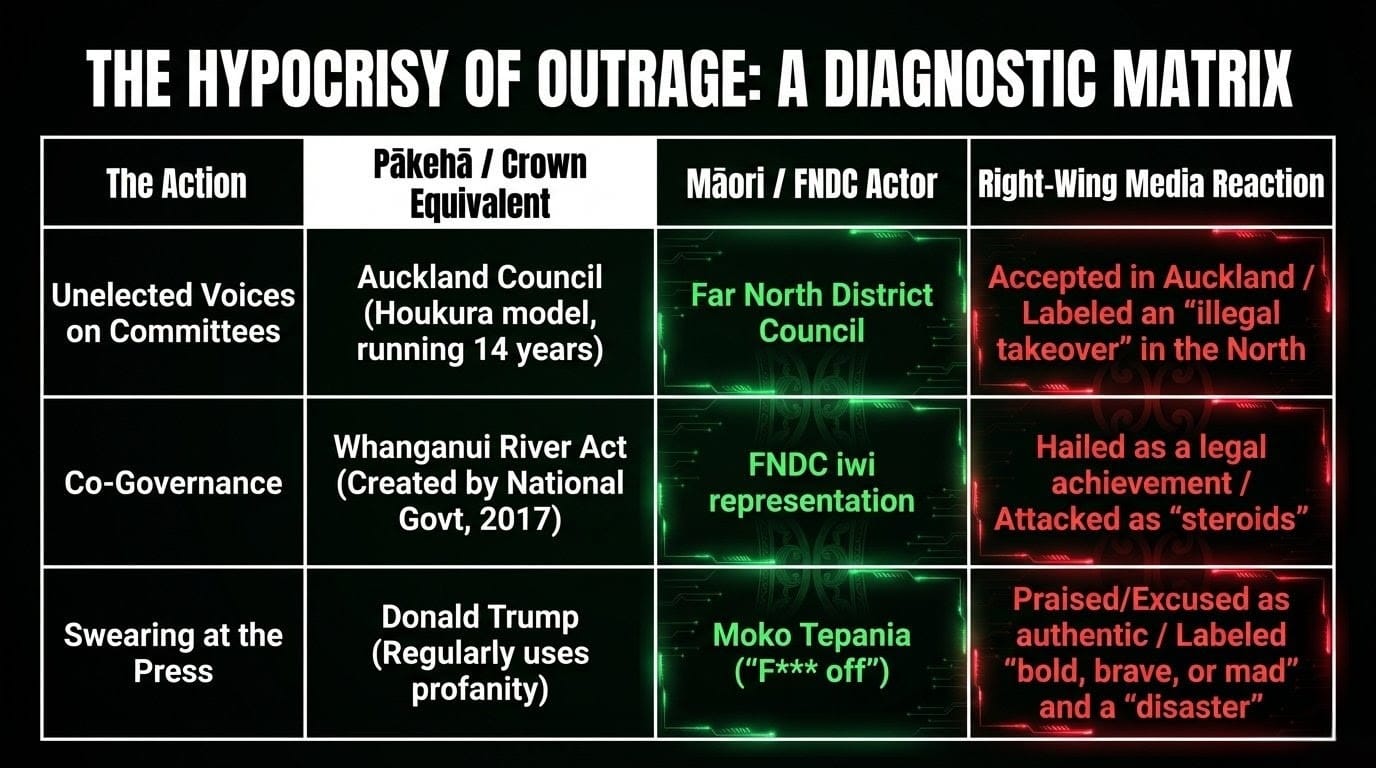
Example One: Auckland Has Done This for 14 Years and Nobody Called It a Coup
Under the Local Government (Auckland Council) Act 2009, Auckland Council operates an Independent Māori Statutory Board (Houkura) whose members sit alongside elected councillors on specified committees — with full voting rights, as confirmed by Auckland Council's own co-governance resource. This is not advisory. This is voting. This has been running for fourteen years. The sky has not fallen. Democracy has not died.
The double standard IS the racism. If Hobson's Pledge truly believed that non-elected representatives with voting power on council committees were a constitutional catastrophe, they would be petitioning to abolish Auckland's Houkura. They are not. They are targeting the Far North. They are targeting Moko Tepania. They are targeting Māori-led governance that works.
The tikanga dimension: In te ao Māori, the concept of mana whenua — the authority of those with genealogical and spiritual connection to a place — is not a democratic deficit. It is the original democratic mandate. Long before Westminster elections, hapū assembled in the wānanga, on the marae, and in the rūnanga to make collective decisions affecting their rohe. Honouring that whakapapa-based authority in council committees is not replacing democracy. It is enriching it with the oldest form of participatory governance this land has ever known. When Garner and Smolders demand that iwi voices be stripped from committees, they are not defending democracy. They are demanding that colonisation's imposed system be the only system that counts.
Example Two: A National Government Created Exactly This in 2017 — and Called It a National Achievement
In 2017, under National Prime Minister Bill English with cross-party support, the Te Awa Tupua (Whanganui River Claims Settlement) Act gave the Whanganui River the legal status of a person, to be represented by a co-governance body — Te Pou Tupua — comprising one Crown-appointed and one iwi-appointed representative. Neither is directly elected by ratepayers. Both make legally binding decisions about the river's management, as explored in depth by Te Tiriti Based Futures.
Bill English did not call this a takeover. Simon Watts did not petition for a Crown Observer. Hobson's Pledge did not launch a viral campaign. The NZ Herald did not run it as a governance crisis.
Why? Because the Whanganui settlement served a narrative of Crown-Māori reconciliation that was politically convenient for National managing Treaty obligations cheaply. The Far North's approach serves Māori communities in ways that are not convenient — because it threatens to normalise genuine Māori authority in the North, where land confiscations, waterway rights, and decades of under-investment remain open wounds.
The tikanga dimension: Kaitiakitanga — the obligation of guardianship — is not a cultural add-on to governance. It is a core responsibility. The river has legal personality because Māori understanding of the cosmos recognises the river as an ancestor, as a living system with its own mauri (life force). When iwi representatives sit on committees making decisions about land use, water, and infrastructure in the Far North, they carry that same kaitiakitanga — the intergenerational obligation to protect not just current ratepayers but future generations and the whenua itself. That is not a governance failure. That is governance at its deepest level.
Example Three: The Far North's Own History Exposes This as Pattern, Not Crisis
This is not the first time powerful interests have tried to destabilise the Far North District Council by weaponising governance concerns. As far back as 2020, the NZ Herald was running headlines about government being "urged to curb council". In 2025, the council made headlines for a staff exodus of 219 employees in three years at a cost of $1.27 million in grievance settlements — a genuine governance issue that Smolders, Garner, and Hobson's Pledge showed absolutely zero interest in investigating.
But here is the crucial fact: Moko Tepania was re-elected in October 2025 in a landslide despite all of this being public knowledge. The community of the Far North — the actual ratepayers — made their democratic decision. They chose Tepania over Court by nearly 5,000 votes, as confirmed in the official FNDC special votes count.
The Hobson's Pledge petition does not represent the community of the Far North. It represents the national reach of an anti-Māori network mobilised by a podcast, a press release, and an algorithm.
The tikanga dimension: Whakapapa — genealogical connection — determines who has standing to speak on matters affecting a community. In te ao Māori, a petition of 14,000 strangers who do not live in the Far North, do not pay Far North rates, and have no whakapapa connection to that rohe, carries no mana in determining how that community governs itself. Tikanga does not recognise the loudest crowd as the legitimate voice. It recognises those who belong — those who have obligations, relationships, and histories with the whenua. The democratic mandate of 12,744 Far North votes carries infinitely more weight, by any tikanga measure, than a Hobson's Pledge petition amplified on Garner's podcast.
The Network, Mapped — and It Is Uglier Than You Think
The coordination chain is not circumstantial. It is precise, timed, and multi-platform:
| Actor | Role | Affiliation | Action |
|---|---|---|---|
| Davina Smolders | Inside operative | ACT Local | Sources claims, loses 9-3 vote, goes to media |
| Duncan Garner | Media weapon | Rova podcast (unregulated) | Platforms Smolders, frames as "co-governance coup" |
| Hobson's Pledge / Ikilei | Pressure group engine | Don Brash / Brash and Mitchell | Petition, alarmist framing, minister pressure |
| The Platform / Plunket | Amplification sewer | NZ First aligned | Amplification, "apartheid" framing of Māori health |
| Point of Order blog | Republication node | Right-wing commentary | Verbatim republication of Ikilei's claims |
| Waikanae Watch blog | ACT content distributor | ACT-aligned | "ACT calls out unelected power" framing |
| Simon Watts | Political delivery mechanism | National Party | Pressured to investigate, eventually capitulates |
This machine activated within 72 hours of Garner's podcast going live. The NZ Herald followed within days, amplifying the framing without the scrutiny a genuine newsroom should have applied. This is not journalism responding to events. This is the information machine generating events that journalism then launders into legitimacy.
The Māori Green Lantern documented exactly this laundering process in The Far-Right Attack on Māori Democracy (July 2025) — tracing how councils were pushed to leave Local Government New Zealand by citing LGNZ as "far-left" for supporting Māori representation. The same lexicon — takeover, unelected, unaccountable, co-governance — was deployed then as now. And as the CARE Centre's white supremacist network research documented in tracking the discursive ecosystem around the 2024 Hīkoi, The Platform and Hobson's Pledge operate as nodes in the same far-right information network.
Simon Watts: The Minister Who Bends Every Time the Machine Calls
Simon Watts is the Minister of Local Government. He is also, as the Māori Green Lantern previously documented in How Simon Watts Wasted Nearly $1 Million While Kiwis Choose Between Heating and Eating, a National Party functionary whose primary skill is the appearance of action with the substance of a cardboard shield.
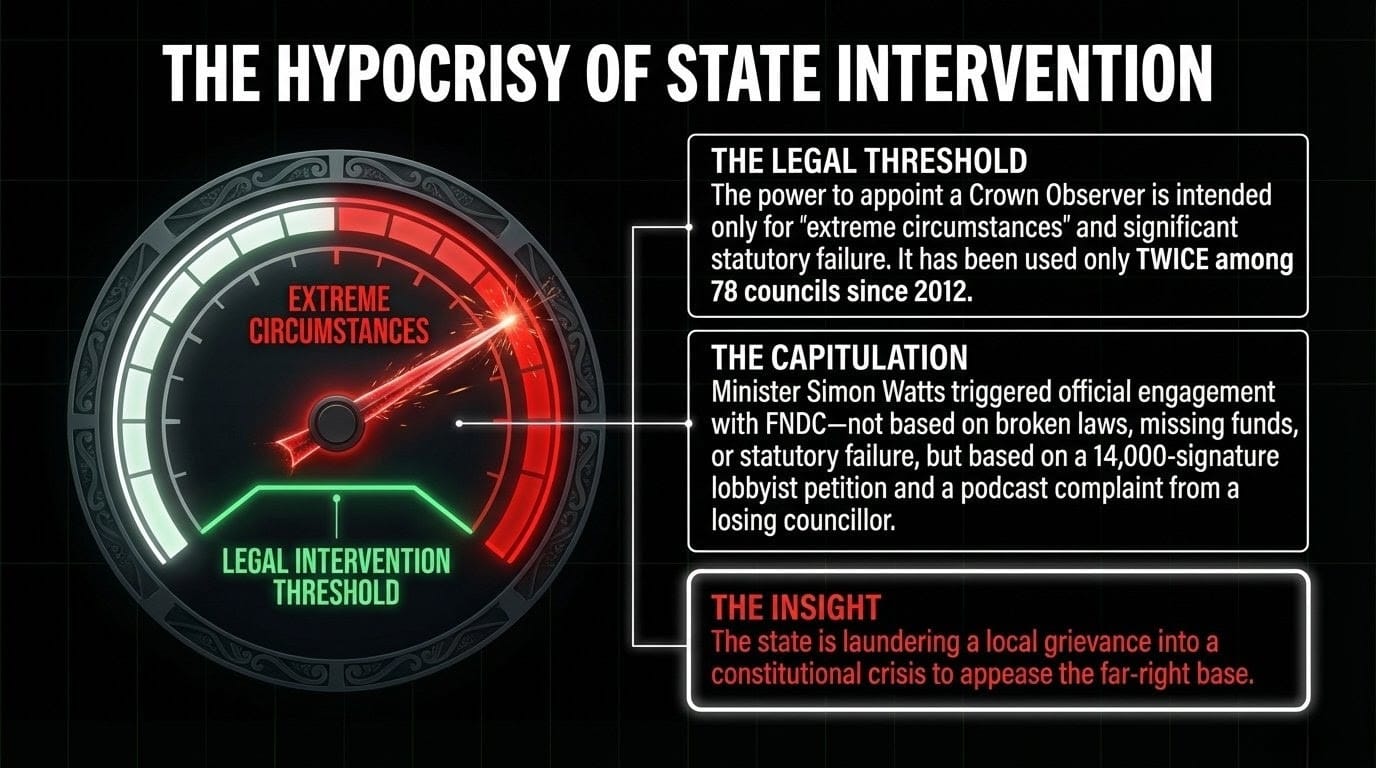
Watts now has "officials engaging" with the Far North District Council — a response that capitulates to an illegitimate pressure campaign against a lawful, democratically supported governance structure. His ministry has not publicly cited a single specific legal violation. His officials have not pointed to a single breach of the Local Government Act. They have responded to: a podcast, a petition, and a losing councillor.
This is what the CARE Centre research identified: the goal is not legal victory but cumulative pressure that makes Māori governance too costly, too exhausting, and too dangerous to continue. Watts is delivering that pressure, whether or not he understands that he is being used as its instrument.
The Waitangi Tribunal has already ruled that the coalition government's broader anti-Māori governance agenda breaches the Treaty of Waitangi. Watts' intervention against the Far North council — triggered by an ACT operative and an anti-Māori lobby group — sits squarely within that breach.
Hidden Connection: The Coalition Agreement Is Hobson's Pledge Policy
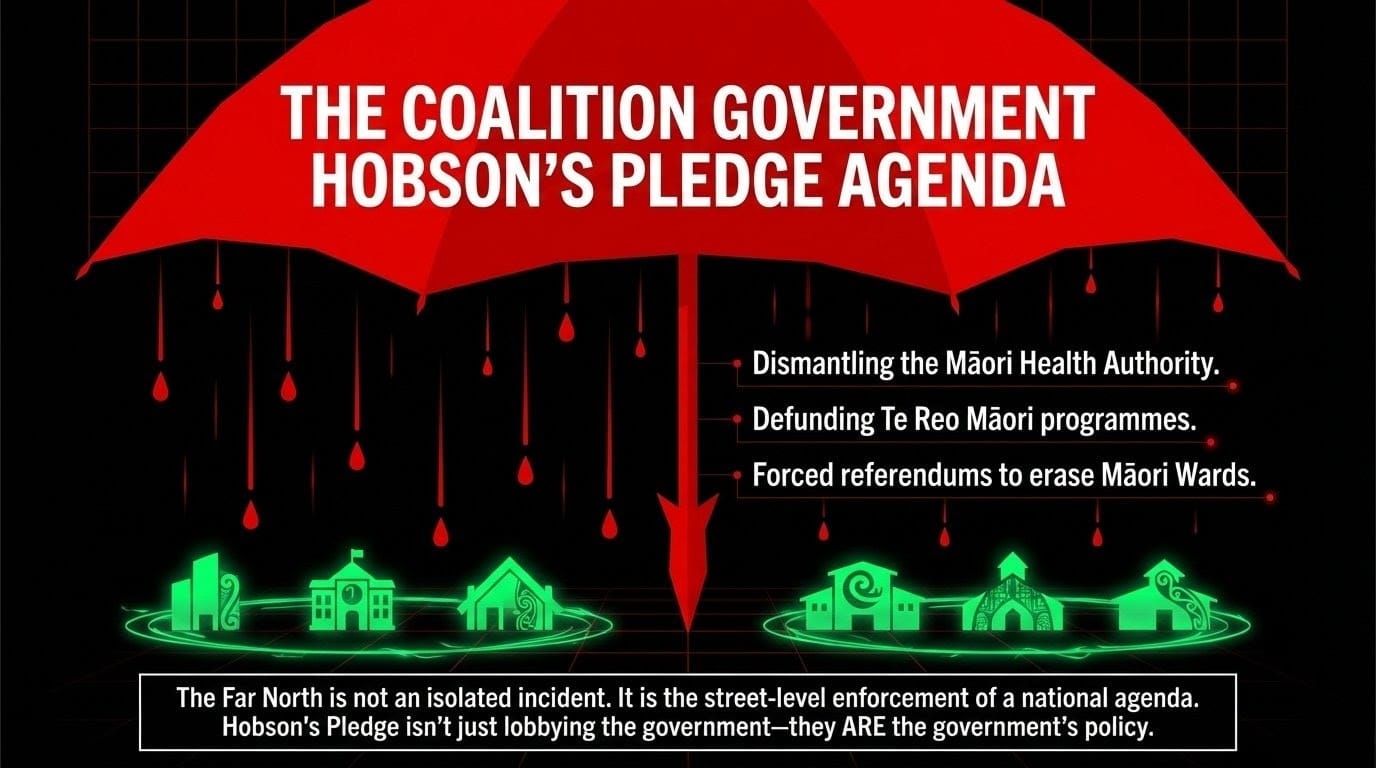
The 2023 coalition agreements between National, ACT, and NZ First did not coincidentally align with Hobson's Pledge's long-stated policy goals.
As Hobson's Pledge themselves confirmed in 2024, they were "reasonably happy" with the coalition's anti-Māori governance agenda. The abolition of the Māori Health Authority. The forced referendums on Māori wards — which the Waitangi Tribunal condemned. The defunding of te reo programmes. The removal of co-governance language from legislation — all documented in the Māori Green Lantern's The Brazen Theft of Mana.
This is not Hobson's Pledge running a parallel agenda to government. This is Hobson's Pledge writing government policy and using political parties as its delivery mechanism.
Don Brash's lobby group — founded to "remove all references in law and in Government policy to Treaty 'partnership' and 'principles'," as documented on Hobson's Pledge's own website — has achieved exactly that through the three-headed coalition it now influences.
The Far North campaign is not a side operation. It is the street-level enforcement arm of a programme decided in coalition agreement rooms in Wellington. And the podcasters and petitioners are its enforcers.
What Garner and Smolders Would Melt Facing
Here is the truth about courage, about what power actually is, and about what these figures are not.
Garner sits in a podcast studio and calls a Māori mayor who declined his hostile framing "scared." He does this because he will never face a taiaha. He will never stand in front of 12,744 Far North voters and justify why their democratic choice should be overridden by a Hobson's Pledge petition. He will never sit in a hui with the hapū whose Treaty rights he is working to erase and explain, to their faces, why their genealogical connection to this land entitles them to nothing in its governance. He attacks from a distance because distance is the only protection available to those whose arguments cannot survive contact with the truth.
Smolders lost 9-3. Nine democratically elected colleagues rejected her framing. She did not take that democratic outcome with grace, learn from it, and return to the table. She ran to the most sympathetic microphone in the country and called it a "takeover." She sits behind an ACT Local brand built on the premise that Māori political participation is inherently suspect — and she dresses that up as civic concern. It is not. It is the oldest colonial tactic alive: manufacture a crisis, call the Crown, and let the state do what the vote would not.
Quantifying the Harm: This Is Not Abstract
The harm of this operation lands on specific people in a specific place:
- Mayor Moko Tepania — a 35-year-old te reo Māori teacher who turned a democratic mandate into genuine leadership — now has his governance under Crown scrutiny triggered by a politically motivated campaign, consuming his team's time, energy, and resources
- Iwi and hapū representatives on FNDC committees — lawfully appointed under Schedule 7 LGA, operating within their Treaty rights — are now publicly framed as a "takeover force" by media with national reach, generating harassment and delegitimisation
- The 12,744 Far North voters who chose Tepania in October 2025 are watching their democratic decision be systematically dismantled from outside their community
- Future Māori candidates for local government across Aotearoa are absorbing the lesson: govern in ways that honour the Treaty, and the machine will come for you
- Ratepayers are funding council staff time in responding to a Crown engagement process triggered not by any lawful concern but by a coordinated political operation
As the Māori Green Lantern documented in The Nursery of Cages: the cumulative cost of colonial interference in Māori self-determination is counted in whānau wellbeing, in rangatahi who see their leaders destroyed, and in the mauri of communities ground down by endless, baseless challenge.
The Legal Reality They Will Never Speak
This must be stated clearly and without qualification.
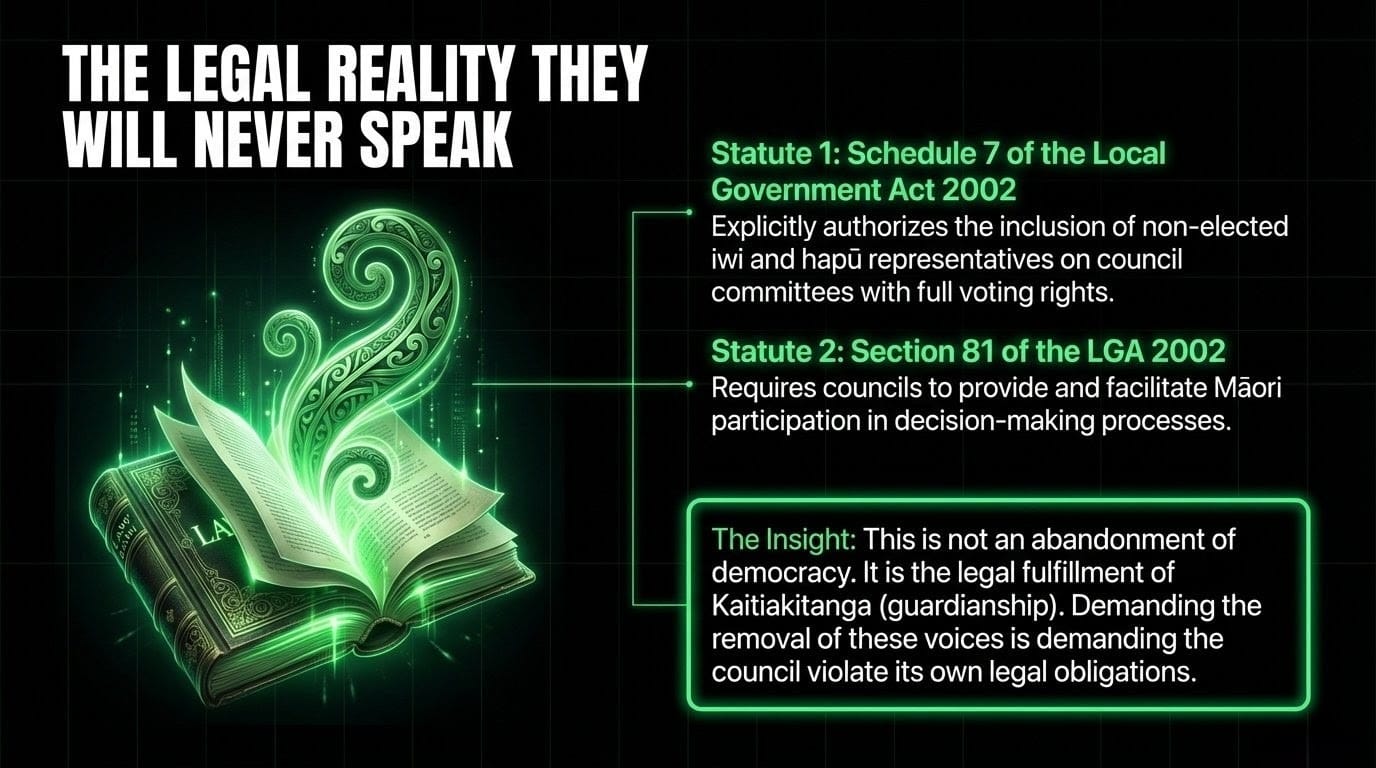
The Far North District Council committee structure that Smolders describes — iwi and hapū representatives participating with voting rights — is explicitly authorised by Schedule 7 of the Local Government Act 2002. It is further mandated in principle by Section 81 of the same Act, which requires councils to provide for Māori participation in decision-making processes.
The Auckland Council has operated exactly this model through Houkura for fourteen years — as confirmed by Auckland Council's own governance documentation. The Whanganui River co-governance model goes further — giving non-elected representatives legal standing over an entire natural resource. A National government wrote that law.
What Hobson's Pledge, Garner, Smolders, and the downstream media machine are demanding is not the enforcement of law.
They are demanding that the council violate its own legal obligations to Māori participation.
They are demanding that a lawful, democratically supported governance structure be dismantled because it includes Māori voices that Hobson's Pledge does not want in the room.
That is racial exclusion dressed in the language of procedural democracy
— the most persistent, most dangerous, and most dishonest form of white supremacy currently operating in Aotearoa.
Ko Te Mana O Te Tangata
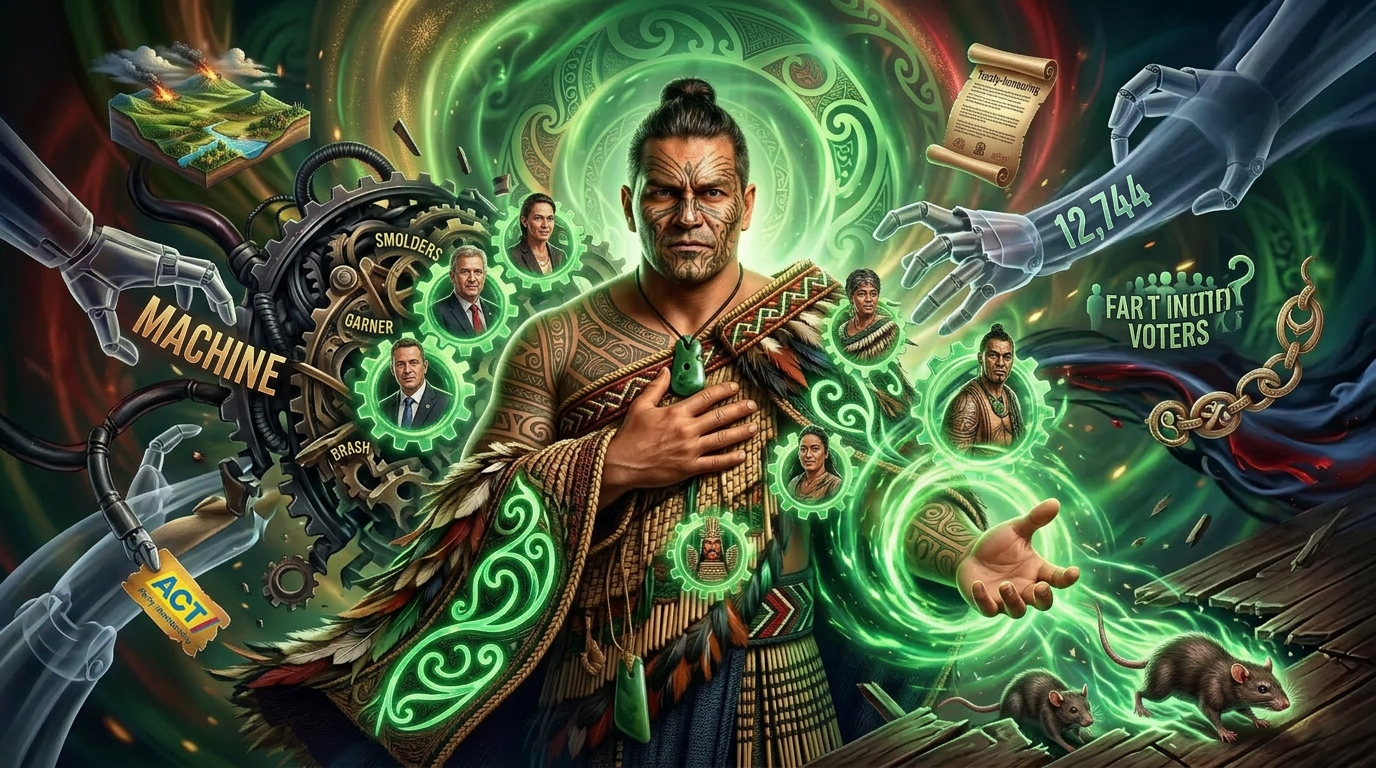
The Far North is not being protected. It is being attacked. Its mayor is not a governance failure. He is governance success — Māori, young, popular, and Treaty-honouring — which is exactly what the white supremacist neoliberal project of this coalition government cannot tolerate.
The machine they sent — Smolders, Garner, Plunket, Ikilei, Brash, and ultimately Watts — is not stronger than the democratic mandate of 12,744 Far North voters. It is not stronger than the tikanga of the iwi and hapū whose whakapapa to that rohe runs deeper than any ACT Party membership card.
The machine exposed itself this week. The Māori Green Lantern has named every gear. Every operator. Every pressure point.
Ko te mana o te tangata, ko te mana o te whenua.
The dignity of the people is the dignity of the land.
And the rats beneath the floorboards have been dragged into the light.
🌿 Koha Consideration
They tried to silence a Māori mayor — the most democratically legitimate local leader in Aotearoa — using podcasters who won't face a crowd, petitions from people who don't live in the North, and a minister who bends at every machine-generated pressure point.
This essay is what accountability looks like when it cannot be bought, managed, or suppressed.
The mahi of naming the network — tracking Garner to Smolders to Ikilei to Brash to Watts — is not funded by the Crown. It is not funded by the corporate media that laundered Hobson's Pledge talking points into headlines.
It is funded by whānau who understand that rangatiratanga includes the power to fund our own truth-tellers.
If this essay equipped you to see the machine clearly — to understand the playbook, defend what Moko Tepania built, and stand with the 12,744 voters whose democratic choice is under attack
— then you understand why this voice must continue.
Three pathways exist:
For those who wish to support this mahi directly — because someone has to pay for the accountability journalism that Crown and corporate structures will never provide:
👉 Koha — Support The Māori Green Lantern
For those who want these essays arriving directly, bypassing every algorithm Hobson's Pledge and their media allies use to suppress inconvenient truths:
👉 Subscribe to The Māori Green Lantern
For those who prefer direct bank transfer: HTDM, 03-1546-0415173-000
And if none of those are possible right now
— no worries, whānau.
Follow at themaorigreenlantern.maori.nz, kōrero about this with your whānau and friends, share it with the people the machine is trying to reach before we do.
That is koha. That is rangatiratanga in action.
Every koha signals that we are ready to fund our own truth-tellers — because the Crown and corporate media will never fund the accountability journalism that holds them to account.
Kia kaha, whānau. Stay vigilant. Stay connected.
Ivor Jones is The Māori Green Lantern — tohunga mau rākau wairua, kaitiaki of Māori. Research conducted April 11, 2026. Tools used: active web search, URL verification, primary document analysis. Unverifiable claims: The precise committee composition figures cited by Smolders originate from her own podcast claims and have not been independently confirmed from FNDC committee minutes — treat as contested pending official verification.