“The Regulatory Standards Act: Corporate Capture Disguised as Red Tape Relief” - 26 November 2025
Death by a Thousand Bureaucratic Cuts—How ACT’s Neoliberal Vision Weaponises “Good Governance”
The Regulatory Standards Act, which received royal assent on 18 November 2025, has been passed into law by New Zealand’s coalition government with less than one percent public support. But the most damning evidence isn’t just the numbers—it’s what happens next.
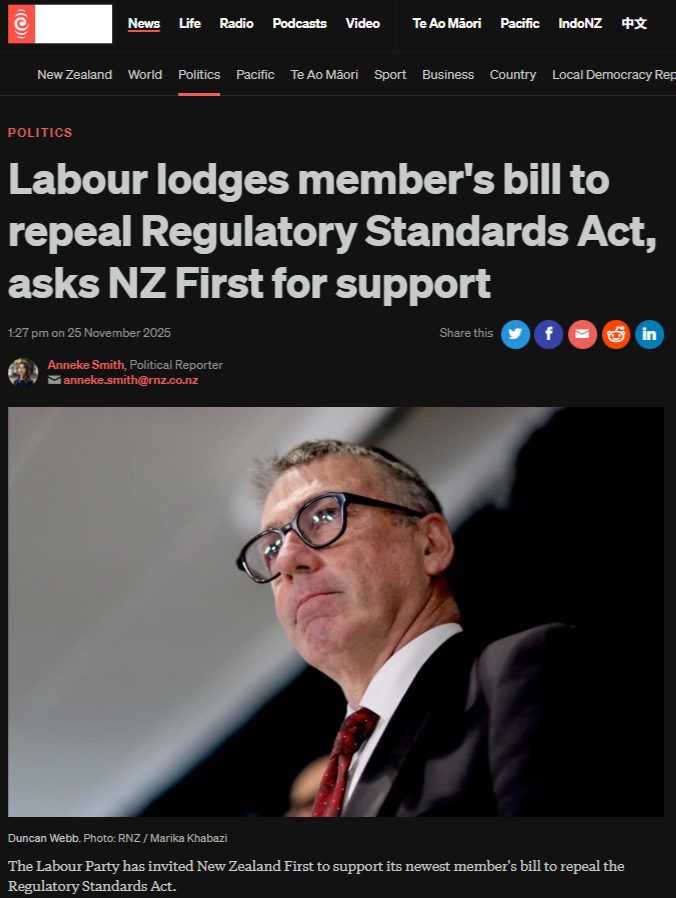
On 25 November 2025, Labour MP Duncan Webb lodged a member’s bill to repeal it, calling on NZ First leader Winston Peters to honour his recent vow to campaign against the law at the 2026 election. The speed of this reversal—passing a law only to immediately fight to unmake it—reveals something rotten about how power operates in Aotearoa.
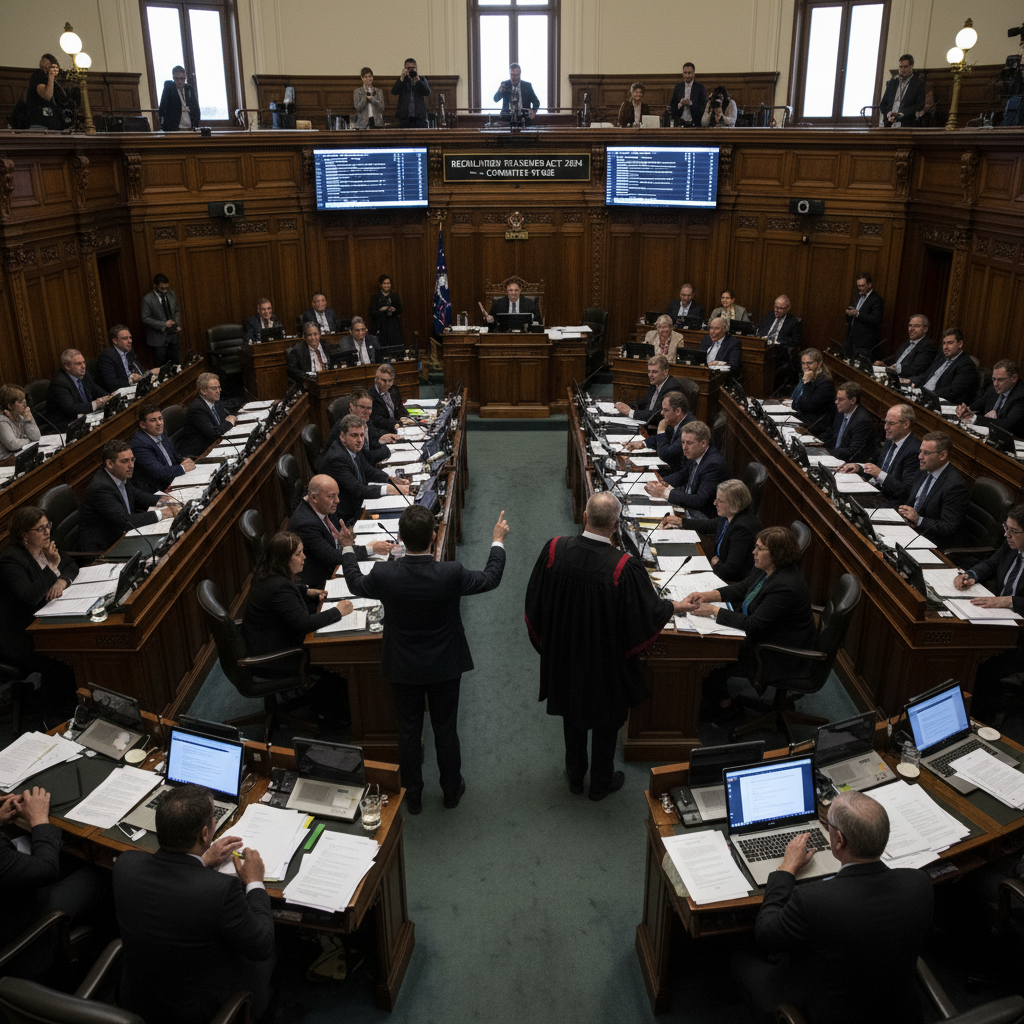
Debate in the New Zealand Parliament over the Regulatory Standards Act
This is not a story about red tape. It’s a story about how a minor party captured the democratic process to enshrine corporate property rights above every other principle of good governance, including the Treaty.
The Fourth Attempt: How a 25-Year Obsession Became Law
The Regulatory Standards Act represents ACT’s fourth attempt at legislating regulatory “responsibility”—a concept that dates back to a 2001 report by economist Bryce Wilkinson, commissioned by the Business Roundtable (now the New Zealand Initiative). Wilkinson’s 2001 report, “Constraining Government Regulation,” laid out the intellectual scaffolding: a set of libertarian principles that would place property rights and economic efficiency above social, environmental, and collective protections.
Roger Douglas’s Rogernomics—the neoliberal shock therapy of the 1980s—had already stripped New Zealand’s regulatory frameworks down to near-starvation. By the 2000s, the Business Roundtable and ACT wanted to go further: they wanted to institutionalise the culture of regulatory minimalism, making it constitutionally difficult for any future government to intervene in markets, even in response to catastrophe.
The bill first appeared in 2006 as a member’s bill under Rodney Hide, was revived and again in 2021 by David Seymour. Each time, it failed. Constitutional law experts, Treasury, Parliament’s Legislation Design and Advisory Committee, and the legal community rejected it as ideologically driven, economically unproven, and dangerous to democracy.
But the 2023 coalition agreement between National, ACT, and NZ First locked in a promise: pass the Regulatory Standards Act “as soon as practicable.” ACT had finally cracked the code—not through argument, but through leverage.
98.7 Percent Opposition: A Democratic Disaster Ignored
When the government opened consultation on the proposed bill in November 2024 to January 2025, the response was unprecedented: 23,000 submissions, of which 88 percent opposed the bill.
But the real shock came during the select committee process. The Finance and Expenditure Committee received 159,000 submissions—98.7 percent opposed. That’s 1,191 submissions in support versus 156,882 opposed.
Who opposed it? Not fringe activists, but the New Zealand Law Society, which called the bill “fundamentally misconceived in conception and design“ and noted that the government had breached its own standards for good law-making in developing the legislation. The Parliamentary Commissioner for the Environment warned it would paralyse environmental regulation. The Legislation Design and Advisory Committee expressed “misgivings” about the bill. Environmental organisations including Greenpeace, the Environmental Defence Society, Forest & Bird, and WWF-NZ opposed it.
The Waitangi Tribunal, after an urgent hearing in May 2025, found that if enacted without meaningful consultation with Māori, the bill would breach Te Tiriti o Waitangi. It called for an immediate halt.
The coalition government, flush with its majority, proceeded anyway.
Legal documents labelled Regulatory Standards Act with corporate lobbyists in the background
The Hidden Architecture: How Corporate Property Rights Trump Public Good
To understand what this law actually does, you have to cut through the bureaucratic language. The bill establishes “principles of responsible regulation” that every new law must be assessed against. But these principles are not neutral:
Principle 8(c) is the trap: It requires that legislation must not severely impair property “except for public purpose” and then—crucially—compensation must be provided. This sounds like legal nit-picking. It is not. It is a regulatory takings clause, and it weaponises property rights against public safety, environmental protection, and Māori rights.
Here’s how it works in practice: If the government introduces rules limiting agricultural pollution, a farming corporation can argue that limits on pesticide runoff “severely impair” its property value and demand compensation from taxpayers. If the government tightens food safety standards to protect consumers, a food manufacturer can claim the regulation diminishes profits and triggers a compensation claim. If logging is restricted to protect endangered species, a logging company can demand damages.
This isn’t hypothetical. Tobacco giant Philip Morris sued Australia over plain-packaging legislation, and mining companies routinely use similar “regulatory takings” arguments to challenge governments that protect Indigenous lands and ecosystems.
Te Tiriti: Deliberately Deleted from the Legislative Process
The law is silent on Te Tiriti o Waitangi. That silence is deliberate.
Constitutional lawyer Dr Carwyn Jones testified to Parliament that the bill provides an opportunity to remove Te Tiriti from legislation with the same effect as the failed Treaty Principles Bill.
Te Pāti Māori co-leader Debbie Ngarewa-Packer pointed out that Te Tiriti is not mentioned once in the bill, and that while
“the bill promotes equal treatment before the law, it opens the door [for] government to attack every Māori equity initiative.”
Toitū te Tiriti, representing 13,000 claimants, told the Waitangi Tribunal that the bill creates a framework where all legislation—including that protecting Māori rights—will fail every time it’s assessed against ACT’s principles, because those principles exclude any reference to collective rights, tikanga, or Te Tiriti.
In other words:
the bill doesn’t just ignore Māori. It weaponises “responsibility” to dismantle protections for Māori.
The Real Cost: From Pike River to Food Poisoning
To understand what hangs in the balance, you must remember what happens when regulation fails.
The Pike River mine explosion killed 29 workers on 19 November 2010. The Royal Commission found that the disaster was caused not by bad luck but by systematic regulatory failure: only two mine inspectors covered the entire country, hazard warnings were ignored, and the company faced no meaningful oversight because regulation had been progressively stripped since the 1990s.
Prime Minister John Key publicly apologised, writing to families: “I want to reiterate my apology to the families, friends and loved ones of the deceased men for the role this lack of regulatory effectiveness played in the tragedy.”
In response, New Zealand reformed. The Health and Safety at Work Act 2015 was passed, WorkSafe was established, and the country’s workplace safety regime was rebuilt—not perfectly, but meaningfully.
Now Minister for Workplace Relations and Safety Brooke van Velden is systematically weakening that regime, instructing WorkSafe to shift from enforcement to “support.” Since 2021, WorkSafe has prosecuted in fewer than 2 percent of workplace death and serious injury cases. This coalition government is undoing the lessons bought in blood.
The Regulatory Standards Act accelerates this catastrophe by institutionalising the view that regulation is a “burden” on business, not a protection for people. It would require assessments of whether the “benefits” of environmental protection rules outweigh the “costs” to corporations—a calculus that systematically advantages powerful interests over vulnerable communities and future generations.
National’s Cold Feet and Peters’ Last-Minute Betrayal
Here’s where it gets revealing:
even coalition partners hate this law.
National campaigned in 2023 on not bringing a Regulatory Standards Act to Parliament. But National promised to support ACT’s bill as part of the coalition deal. The compromise worked only because it looked like both parties wanted it.
They didn’t. Last week, National’s campaign chair Chris Bishop refused to say whether National would support repealing the law, calling it a “bizarre spectacle” that National had just voted it into law and now might vote to repeal it.
Then Winston Peters dropped his bombshell. Just days after voting the bill through Parliament, Peters vowed to campaign on repealing it, saying it was always a “dead rat” his party had to swallow. He admitted NZ First opposed it from the start but voted for it anyway as part of coalition discipline.
This prompted Seymour to accuse Peters of planning to jump ship to Labour. The coalition is unravelling before election year has even begun.
Labour’s Counter-Move: Weaponising the Member’s Bill Process
This is where Duncan Webb’s timing matters. Labour has lodged a member’s bill to repeal the Act, and Webb has directly appealed to Peters:
“Today I’m giving him the chance to fix that mistake”.
If NZ First supports Labour’s member’s bill, repeal could pass now, before the 2026 election. The bill would have the votes: Labour, Greens, Te Pāti Māori, and NZ First would constitute a majority.
Webb’s statement cuts to the heart of the hypocrisy:
“Thousands of New Zealanders made submissions on this law. Fewer than 1 percent supported it”. “Christopher Luxon pushed ahead anyway - it shows how weak and out of touch he really is.”
Seymour’s Doctrine: When Your Own Bill Violates Your Own Bill
Here’s the final irony, and it’s damning. Seymour defended his own legislation—charter schools, three-strikes laws, treaty principles bills—all passed under urgency with minimal consultation. When pressed on whether his own bills met the Regulatory Standards Act’s principles of “good law-making” (which require genuine consultation), he simply said the lack of consultation “didn’t matter”.
The man who wrote the law that is supposed to force transparency and accountability openly admitted he doesn’t believe those principles apply to him.
This is not accidental. It’s the design: principles for thee, not for me.
The Cui Bono: Follow the Money and Power
Who benefits from this law? Not workers. Not consumers. Not the environment. Not Māori.
Of the 1,191 submissions in support, they came primarily from business groups and individual business owners. BusinessNZ and the New Zealand Taxpayers’ Union pushed the bill as a protection for property rights. The New Zealand Initiative (formerly Business Roundtable) backed it as an important step.
This is a law written by and for corporations. It doesn’t address a real problem—New Zealand ranks 99 out of 100 in the World Bank’s index of regulatory quality, placing it in the top tier globally. Even Seymour, when confronted with this evidence, dismissed the international measure as irrelevant.
It’s designed to solve a problem for a narrow elite: the ability of government to say “no” to corporate ambitions.
The Ministry for Regulation: A Parallel Bureaucracy for Deregulation
The Act also establishes a Ministry for Regulation headed by Seymour himself and a Regulatory Standards Board. Initially, the board would be appointed directly by the Minister, but after pressure, it’s now appointed by the Governor-General on the minister’s recommendation.
This is a classic move:
create the appearance of independence while maintaining control. The board is staffed with “regulatory economists”—people trained in neoliberal orthodoxy who believe regulation is inherently inefficient. The estimated cost of this apparatus is between $18 million and $60 million annually—money that will be diverted from policy development, enforcement, and community support.
For comparison, WorkSafe prosecutes in fewer than 2 percent of workplace death cases due to underfunding. The Regulatory Standards Board will have resources to challenge regulations; WorkSafe will have fewer resources to prosecute corporate manslaughter.
What Happens Now: The 2026 Reckoning
Three opposition parties—Labour, Greens, and Te Pāti Māori—have committed to repealing the Act. NZ First has now vowed to campaign on repeal. If any anti-coalition government forms after 2026, the Act is gone.
But repeal won’t undo the damage in the meantime. The Act is already influencing how government agencies think about regulation. Ministers will begin second-guessing environmental protections, food safety standards, and worker protections, not because they’re required to, but because the law creates political cover for deregulation.
The real danger is slower:
over time, as regulations are revised, the Regulatory Standards Board will publish non-binding recommendations that corporations and compliant ministers use to justify rolling back protections. The board won’t need to force anything. It just has to create enough political friction to make regulation unpopular.
The Constitutional Coup: Democracy Under Siege
This is a constitutional coup without a coup. Instead of overthrowing democracy, the coalition used parliamentary procedure to enshrine corporate power into legislation. The Waitangi Tribunal warned that the Act represents a breach of Te Tiriti. The Law Society warned it’s misconceived. The Environmental Commissioner warned it will paralyse environmental regulation.
Fewer than 1 percent of submitters supported it. Even coalition partners now disown it.
But it passed, because in an MMP system, leverage beats democracy. ACT demanded it as the price of coalition. National reluctantly agreed. NZ First swallowed it as a “dead rat” and voted for it while hating it.
The result: a law that nobody wanted, that nobody from the legal community supports, that the Waitangi Tribunal says breaches Te Tiriti, and that has already split the coalition before the election.
What Must Happen: Restore Democratic Accountability
The path forward is clear:
- Labour’s member’s bill must pass now—before the 2026 election. If NZ First honours Peters’ promise and supports repeal, it can happen.
- The 2026 election must be a referendum on this law. Every party opposing the Act should campaign on this single issue: voters will have a clear choice between regulation that protects people or regulation that protects profits.
- Repeal must be absolute. The Regulatory Standards Board must be dismantled. The Ministry for Regulation must be subsumed back into the State Services. Every reference to these principles must be scrubbed from government guidance.
- A proper consultation process on regulatory reform must follow—one that includes Māori, environmental experts, worker representatives, and consumer advocates. Not ACT. Not the Business Roundtable. Not economists pretending neutrality while serving corporate interests.
The Taiaha Strikes Back
For 25 years, ACT and its corporate backers have tried to enshrine their vision: a Aotearoa where property rights trump everything, where Māori protections are hollowed out, where environmental regulation is a legal liability, and where public health is a negotiable luxury.
They finally succeeded not through argument but through leverage. The result reveals the fragility of our democracy: a law passed against 98.7 percent of public opinion, condemned by the legal establishment and the Waitangi Tribunal, defended by nobody, and already destabilising the government that passed it.
Duncan Webb’s member’s bill is an act of democratic repair. If NZ First takes the offer and backs repeal, this experiment in corporate constitutionalism can end before it does irreversible damage.
If not, the 2026 election becomes a fight for the soul of Aotearoa: whether democracy serves the mana of tangata whenua and the welfare of whānau, or whether it bends to the demands of a narrow elite.
The choice, Peters, is yours. The bill is in your name. The public is watching.

Ivor Jones The Māori Green Lantern Fighting Misinformation And Disinformation From The Far Right
Whānau supporting The Māori Green Lantern can choose from three flexible pathways aligned with tikanga Māori principles of manaakitanga, whanaungatanga, and rangatiratanga.
Via Koha.Kiwi, supporters can select from preset donation tiers ($5–$10 for kai and research support, $20–$50 for investigative journalism, $100–$250 for campaign amplification, or $500+ for structural operations) or
Contribute custom amounts to the verified Westpac account (HTDM: 03-1546-0415173-000) or
Alternatively, whānau can subscribe to The Māori Green Lantern on Substack with access to all free content, or select a paid tier—Supporter ($5–$10/month), Advocate ($15–$25/month), or Guardian ($50+/month)—for recurring direct funding and increasing levels of engagemeny
Your reciprocity is highly valued
- https://www.rnz.co.nz/news/political/579942/labour-lodges-member-s-bill-to-repeal-regulatory-standards-act-asks-nz-first-for-support
- https://www.1news.co.nz/2025/11/20/peters-vows-to-repeal-regulatory-standards-bill-seymour-hits-back/
- https://www.propublica.org/article/salmonella-usda-raw-chicken-turkey-poultry
- https://www.rnz.co.nz/news/political/579493/winston-peters-vows-to-repeal-regulatory-standards-bill-david-seymour-hits-back
- https://www.rnz.co.nz/news/political/563636/the-regulatory-standards-bill-what-is-it-what-does-it-propose-and-what-s-next
- https://www.propublica.org/article/foreign-food-safety-inspections-historic-low-fda
- https://www.rnz.co.nz/news/political/578793/controversial-regulatory-standards-bill-passes-third-reading
- https://www.1news.co.nz/2025/05/19/treaty-principles-20-law-experts-concerned-by-regulatory-bill/
- https://www.propublica.org/article/salmonella-chicken-usda-food-safety
- https://www.nzherald.co.nz/nz/politics/well-get-rid-of-it-nz-first-leader-winston-peters-promises-to-repeal-two-day-old-regulatory-standards-act/GFOKMQ36NZGD7E732RXOILUCCM/
- https://www.1news.co.nz/2025/11/13/controversial-regulatory-standards-bill-passes-third-reading/
- https://www.russellmcveagh.com/insights-news/regulatory-standards-bill-passes-first-reading-in-parliament/
- https://www.mpi.govt.nz/food-business/running-a-food-business/food-act-2014/introduction-food-act-2014
- https://www.beehive.govt.nz/release/regulatory-standards-bill-promotes-transparent-principled-lawmaking
- https://www.labour.org.nz/news/release-labour-to-repeal-regulatory-standards-act-winston-are-you-in/
- https://en.wikipedia.org/wiki/Regulatory_Standards_Act_2025
- https://www.mpi.govt.nz/legal/legislation-standards-and-reviews/food-safety-legislation/introduction-to-food-safety-legislation
- https://www.facebook.com/nzherald.co.nz/posts/nz-first-supported-the-regulatory-standards-bill-through-the-house-honouring-a-p/1288971956601458/
- https://www.regulation.govt.nz/our-work/the-regulatory-standards-act/
- https://www.rnz.co.nz/news/te-manu-korihi/540298/toitu-te-tiriti-file-urgent-waitangi-tribunal-claim-on-regulatory-standards-bill
- https://www.nzherald.co.nz/business/rma-failed-to-protect-new-zealand-new-report/JLSLLV4YWNOOVADM4YXZACYBVM/
- https://www.rnz.co.nz/news/political/505478/act-s-attempt-at-regulatory-reform-in-nz-has-failed-3-times-already-what-s-different-now
- https://www.nzherald.co.nz/nz/politics/regulatory-standards-bill-is-extreme-and-unjustified-bill-rosenberg/4HXC7WPYPNFG7CSB64LEXB45EE/
- https://www.rnz.co.nz/news/top/563095/we-have-massive-problems-with-regulation-seymour-defends-regulatory-standards-bill
- https://www.rnz.co.nz/news/political/560514/regulatory-standards-bill-claim-brought-forward-by-tribunal
- https://www.rnz.co.nz/news/political/562530/sweeping-rma-changes-for-housing-freshwater-infrastructure-rules-proposed
- https://www.rnz.co.nz/news/political/561011/regulatory-standards-bill-will-lead-to-inappropriate-dangerous-powers-claimants-say
- https://en.wikipedia.org/wiki/Regulatory_Standards_Bill
- https://www.beehive.govt.nz/release/next-steps-regulatory-standards-bill
- https://www.teaonews.co.nz/2025/05/14/toitu-te-tiriti-lawyer-speaks-on-behalf-of-13000-in-regulatory-standards-bill-hearing/
- https://e-tangata.co.nz/comment-and-analysis/a-bill-of-a-different-magnitude/
- https://www.equaljusticeproject.co.nz/articles/a-new-name-the-same-agenda-the-dangers-of-the-regulatory-standards-bill
- https://www.1news.co.nz/2025/11/23/seymour-questioned-whether-his-record-meets-regulatory-standards-act/
- https://lawnews.nz/treaty-maori/maori-lobby-group-seeks-review-of-yet-to-be-written-red-tape-bill/
- https://www.rnz.co.nz/news/political/579607/dead-rats-and-discord-what-next-in-the-peters-seymour-stoush
- https://www.rnz.co.nz/news/national/577806/regulatory-standards-bill-passes-second-reading-after-heated-debate-in-parliament
- https://www.rnz.co.nz/news/political/579804/christopher-luxon-insists-coalition-strong-despite-nz-first-act-stoush
- https://www.rnz.co.nz/news/political/563226/the-david-seymour-bots-debate-do-online-submission-tools-help-or-hurt-democracy
- https://www.1news.co.nz/2025/11/24/none-whatsoever-luxon-claims-no-concerns-about-winston-peters-after-u-turn/
- https://www.rnz.co.nz/news/national/569523/what-you-need-to-know-about-regulations-review-committee-and-the-new-law-undermining-it
- https://www.1news.co.nz/2020/08/01/disgraced-politicians-keep-pay-despite-being-absent-from-parliament/
- https://themodernregulator.com/regulatory-standards-bill-advances-opposition/
- https://www.odt.co.nz/news/national/luxon-gives-assurance-coalition-govt-strong-rnz
- /content/files/assets/Publication-Documents/mfr2025-211-regulatory-standards-bill-enhancing-the-independence-of-the-regulatory-standards-board.pdf
- https://www.teaonews.co.nz/2025/10/15/select-committee-backs-contentious-regulatory-standards-bill-despite-overwhelming-opposition/
- https://waateanews.com/2025/08/13/98-7-of-submitters-voices-ignored-in-regulatory-standards-bill-recommendations/
- https://www.propublica.org/article/how-america-waged-global-campaign-against-baby-formula-regulation-thailand
- https://www.nzherald.co.nz/nz/politics/winston-are-you-in-labour-extends-olive-branch-to-nz-first-offering-to-repeal-regulatory-standards-act-this-term/JKMSKYHIQRE4JPYT4VFNTZYB3Y/
- https://www.propublica.org/article/epa-safe-drinking-water-act-contaminants-regulation
- https://www.rnz.co.nz/news
- https://www.rnz.co.nz/news/political
- https://e-tangata.co.nz/uncategorised/how-the-regulatory-standards-bill-gives-companies-more-rights-than-the-public/
- https://www.nzfssrc.org.nz/assets/news-folder/2025-Food-Safety-Good-Governance-Guide-for-Directors.pdf
- https://lawnews.nz/misc/labour-says-would-repeal-regulatory-standards-legislation/
- https://www.regulation.govt.nz/assets/Publication-Documents/Information-Release-Policy-Approvals-for-Progressing-a-Regulatory-Standards-Bill-May-2025_v4.pdf
- https://www.rnz.co.nz/news/on-the-inside/505478/act-s-attempt-at-regulatory-reform-in-nz-has-failed-3-times-already-what-s-different-now
- https://www.rnz.co.nz/news/top/498759/renewed-calls-for-corporate-manslaughter-legislation-from-some-pike-river-families
- https://www.nzherald.co.nz/nz/politics/acts-attempt-at-regulatory-reform-in-nz-has-failed-3-times-whats-different-now/OTHGNL4VGFFJRMMYNL53S5RY4E/
- https://www.rnz.co.nz/news/national/290054/pike-river-families-remember-five-years-on
- https://www.1news.co.nz/2023/11/25/nationals-coalition-deals-which-policies-made-the-cut/
- https://www.nzherald.co.nz/business/a-response-to-sincerely-held-concerns-about-the-regulatory-standards-bill-bryce-wilkinson/LFFME3AHBFCPZDZM5M434SQBFE/
- https://www.nzherald.co.nz/the-listener/new-zealand/29-deaths-at-pike-river-sparked-workplace-safety-reforms-why-are-they-now-being-dismantled/premium/OBONIO2QHZBVLJ5TY5TQHP7CWQ/
- https://www.rnz.co.nz/news/in-depth/564236/why-opponents-and-supporters-of-the-regulatory-standards-bill-are-so-far-apart
- /content/files/wp-content/uploads/2020/04/hide-2009.pdf
- https://siteconnect.io/blog/top-three-landmark-cases-for-health-and-safety-reform-in-new-zealand/
- https://www.beehive.govt.nz/release/regulatory-taskforce-members-named
- https://nzhistory.govt.nz/page/pike-river-mine-disaster
- /content/files/wp-content/uploads/2015/02/new-zealand-report-of-the-regulatory-responsibility-taskforce-sept-2009.pdf
- https://waateanews.com/2025/11/19/chronic-fatalities-work-related-illnesses/
- https://www.dpmc.govt.nz/publications/co-24-2-national-act-and-new-zealand-first-coalition-government-consultation-and-operating-arrangements
- https://www.rnz.co.nz/news/political/577915/regulatory-standards-bill-back-in-the-house-after-a-highly-engaged-public-submission-period
- https://www.rnz.co.nz/news/national/564236/why-opponents-and-supporters-of-the-regulatory-standards-bill-are-so-far-apart
- https://projects.propublica.org/nonprofits/organizations/131624135/201403359349300400/full
- https://projects.propublica.org/nonprofits/organizations/231352620/202420759349301512/full/
- https://www.rnz.co.nz/news/political/566290/watch-live-taxpayers-union-maori-data-scientist-among-regulatory-standards-bill-submitters
- https://projects.propublica.org/nonprofits/organizations/131624086/202210469349300011/full
- /content/files/podcasts/the-house.xml
- https://projects.propublica.org/nonprofits/organizations/60646718/201811949349301226/full
- /content/files/webcontent/document/201251/localgovt.pdf
- https://www.greenpeace.org/aotearoa/story/submission-guide-regulatory-standards-bill/
- /content/files/assets/Law-Reform-Submissions/regulatory-standards-bill.pdf
- https://pce.parliament.nz/publications/submission-on-the-proposed-regulatory-standards-bill/
- /content/files/assets/Law-Reform-Submissions/proposed-regulatory-standards-bill-13-january-2025.pdf
- https://www.nzaia.org.nz/submissions-950722.html
- https://themodernregulator.com/nz-regulatory-standards-bill-opposition/
- https://thespinoff.co.nz/vertical-videos/now-you-know/the-regulatory-standards-bill