“The Regulatory Standards Bill: A Corporate Coup Against Te Tiriti o Waitangi” - 12 July 2025
A Neoliberal Trojan Horse Wrapped in Atlas Network Ideology
Kia ora e te whānau. Hello, family.
The Regulatory Standards Bill represents nothing less than a corporate coup against the democratic will of tangata whenua and the people of Aotearoa. This piece of legislation - the fourth failed attempt by ACT Party leader David Seymour to embed neoliberal ideology into our legal framework - is a direct attack on Te Tiriti o Waitangi, Māori sovereignty, and the collective good.
What we are witnessing is the latest manifestation of the global Atlas Network's anti-democratic agenda, orchestrated by think tanks and corporate interests that seek to prioritise profit over people, property rights over indigenous rights, and corporate freedom over collective wellbeing.
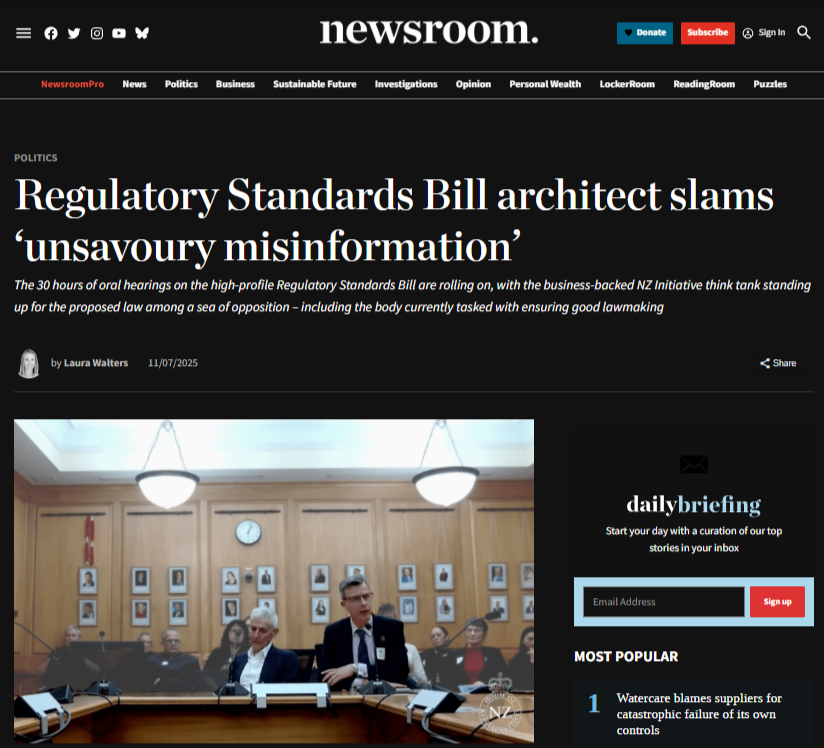
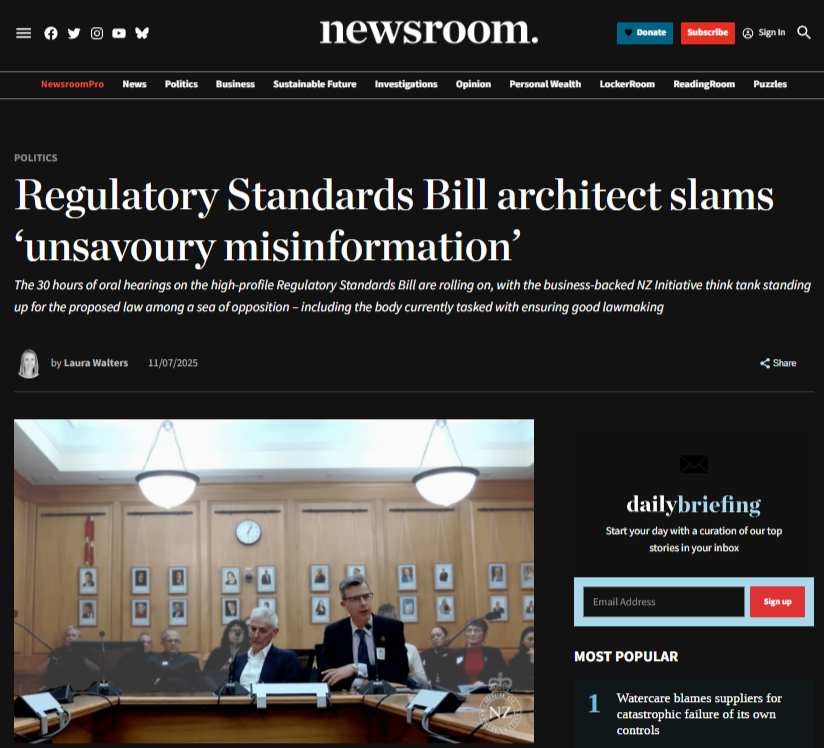
The arrogance of economist Dr Bryce Wilkinson, senior fellow at The New Zealand Initiative, in dismissing the overwhelming opposition to this bill as "unsavoury misinformation" and "group think" exposes the colonial mindset that continues to drive neoliberal policy in Aotearoa.
Background: The Colonial Context of Regulatory Capture
The Regulatory Standards Bill emerges from a long history of colonial attempts to subordinate Māori interests to settler economic priorities. This bill, championed by David Seymour and his ACT Party, represents the culmination of decades of neoliberal restructuring designed to embed market fundamentalism into the legal architecture of New Zealand.
The bill proposes to establish a set of "regulatory principles" that would govern all future and existing legislation. These principles - focused on property rights, individual liberty, and economic efficiency - conspicuously exclude any reference to Te Tiriti o Waitangi despite its foundational role in New Zealand's legal system.
At its core, this legislation represents what Professor Jane Kelsey describes as an attempt to create an "economic constitution" that would bind future governments to a neoliberal framework, preventing political slippage from free-market orthodoxy.
Corporate Power Versus Democratic Sovereignty
The Regulatory Standards Bill is fundamentally about power - who has it, who exercises it, and in whose interests. The bill would establish a Regulatory Standards Board, appointed by the Minister for Regulation (currently David Seymour), to review all legislation against its narrow set of principles.
While proponents claim these principles are "non-binding," critics have identified multiple ways the bill would exercise what Victoria University law professor Dean Knight calls "soft power" to influence policy making and potentially create legal obligations through judicial interpretation.
For Māori, this represents a direct threat to tino rangatiratanga and the Crown's Treaty obligations. The bill's principles make no allowance for collective rights, indigenous sovereignty, or the special relationship between Māori and the Crown established through Te Tiriti. Instead, they privilege individual property rights and market mechanisms that have historically been used to dispossess Māori of land and resources.
The Atlas Network Connection: Global Corporate Ideology in Action
The intellectual architecture of the Regulatory Standards Bill cannot be understood without examining its connection to the Atlas Network, a global consortium of neoliberal think tanks funded by fossil fuel interests, tobacco companies, and billionaire donors.
The Atlas Network, founded in 1981 by Antony Fisher, operates what researcher Richard Meagher calls "a think tank that creates think tanks". With nearly 600 affiliated organisations across 100 countries, Atlas promotes what it calls the principles of "individual liberty, property rights, limited government, and free markets."
In New Zealand, the Atlas Network's key affiliates include The New Zealand Initiative (formed from the merger of the Business Roundtable and New Zealand Institute) and the Taxpayers' Union. These organisations have been instrumental in promoting the Regulatory Standards Bill and defending it against criticism.
Dr Bryce Wilkinson, the bill's chief architect, has deep connections to Atlas Network ideology. His work at The New Zealand Initiative has consistently promoted deregulation, privatisation, and market fundamentalism. His dismissal of opposition to the bill as misinformation reveals the colonial arrogance that characterises Atlas Network thinking.
The Atlas Network's funding sources reveal its true agenda. Major donors include ExxonMobil ($1.08 million), the Koch Foundation ($348,560), and Philip Morris ($475,000 in 1995 alone). These are the same corporate interests that have spent decades funding climate denial, opposing tobacco regulation, and fighting against environmental protection.

Bryce Wilkinson: The Neoliberal Ideologue Behind the Bill
Dr Bryce Wilkinson represents the worst of neoliberal thinking in Aotearoa. His career spanning Treasury during the 1980s reforms, his role at The New Zealand Initiative, and his advocacy for the Regulatory Standards Bill reveals a consistent pattern of prioritising corporate interests over democratic governance and indigenous rights.
Wilkinson's response to the overwhelming opposition to the bill - over 150,000 submissions with 88 percent opposing it - demonstrates his fundamental contempt for democratic participation. His characterisation of critics as engaging in "group think" and spreading "misinformation" reveals the authoritarian impulses that lie beneath neoliberal rhetoric about freedom and choice.
During parliamentary hearings, Wilkinson dismissed respected legal experts, constitutional scholars, and iwi leaders as being motivated by "false motives" rather than genuine concerns about the bill's impact. This arrogance is characteristic of the Atlas Network's approach to democratic opposition - any criticism is dismissed as ideological while their own deeply ideological agenda is presented as neutral expertise.
Wilkinson's academic background in economics and chemistry may provide technical expertise, but his ideological commitment to market fundamentalism blinds him to the social, cultural, and political dimensions of regulation. His work on inequality consistently downplays structural factors while promoting individual responsibility narratives that ignore systemic discrimination.

The New Zealand Initiative: Corporate Lobby Group Masquerading as Research
The New Zealand Initiative, where Wilkinson serves as senior fellow, is an official partner of the Atlas Network. Founded in 2012 from the merger of the Business Roundtable and New Zealand Institute, it represents the interests of its corporate members rather than independent research.
The Initiative's board includes prominent business leaders like Barbara Chapman (former CEO of ASB Bank and current chair of Genesis Energy) and Roger Partridge (former chairman of law firm Bell Gully). These are not independent academics but corporate executives with direct financial interests in deregulation and market liberalisation.
The Initiative's role in promoting the Regulatory Standards Bill represents a clear conflict of interest. Its corporate members would benefit directly from legislation that prioritises property rights and limits government regulation, yet the organisation presents itself as providing independent policy analysis.
This corporate capture of policy research is a hallmark of the Atlas Network model. Organisations like The New Zealand Initiative provide academic credibility to corporate interests while maintaining the fiction of independence. Their "research" consistently supports positions that benefit their funders while opposing policies that would protect workers, communities, and the environment.
Undermining Māori Rights and Democratic Governance
The Regulatory Standards Bill represents a systematic attack on Māori rights and democratic governance. By establishing a framework that prioritises individual property rights over collective rights, the bill undermines the constitutional foundation of Te Tiriti o Waitangi.
Colonial Logic and Property Rights
The bill's emphasis on property rights reflects the colonial logic that has driven dispossession of Māori land since 1840. The Native Land Court system, established in 1865, used individual property rights to break up collective Māori ownership and facilitate land sales to settlers. The Regulatory Standards Bill would embed similar logic into contemporary legislation.
The bill's principle requiring compensation for regulatory takings would make it extremely difficult for governments to implement policies that protect Māori rights or collective interests. Environmental regulations, heritage protections, and Treaty settlement provisions could all be challenged as "takings" requiring compensation to property owners.
Attacking Te Tiriti o Waitangi
The bill's complete exclusion of Te Tiriti o Waitangi from its principles represents a direct attack on the constitutional foundation of New Zealand. Iwi submissions have highlighted how the bill would undermine Treaty settlements, co-governance arrangements, and Māori customary rights.
The Tūwharetoa Māori Trust Board submission warns that the bill "risks compromising Ngāti Tūwharetoa's unique legal rights over Taupō Waters" and threatens to "destabilise the governance framework" established under Treaty legislation. This is not accidental - it reflects the Atlas Network's opposition to indigenous rights globally.
Corporate Capture of Democratic Institutions
The bill would create a Regulatory Standards Board appointed by the Minister for Regulation, effectively giving corporate interests a veto over democratic decision-making. This represents a form of corporate capture that would insulate market ideology from democratic accountability.
The bill's "soft power" effects would incentivise public servants to design policies that conform to its narrow principles, creating a chilling effect on progressive policy development. Union submissions have highlighted how this could undermine workers' rights and environmental protections.
The Atlas Network's Anti-Democratic Agenda
The Regulatory Standards Bill reflects the Atlas Network's broader anti-democratic agenda. Project 2025, the Heritage Foundation's blueprint for authoritarian government in the United States, shows how Atlas Network thinking leads to the capture of democratic institutions by corporate interests.
The network's funding by fossil fuel companies and opposition to climate action reveals its true agenda. By embedding market fundamentalism into legal frameworks, the Atlas Network seeks to prevent democratic governments from responding to climate change, inequality, and other collective challenges.
Implications: A Future of Corporate Domination
If enacted, the Regulatory Standards Bill would fundamentally reshape New Zealand's political economy in favour of corporate interests. The bill's principles would create a legal framework that prioritises profit over people, individual rights over collective wellbeing, and market efficiency over democratic governance.
For Māori, this represents an existential threat to tino rangatiratanga and the gains achieved through decades of struggle. The bill would make it virtually impossible to implement policies that recognise Māori rights, protect indigenous resources, or address historical injustices.
The bill's impact would extend far beyond Māori communities. Environmental groups, trade unions, and social justice organisations have all identified how the bill would undermine their ability to advocate for collective interests.
The broader implications are even more concerning. By embedding Atlas Network ideology into New Zealand's legal framework, the bill would create a constitutional lock-in that would be extremely difficult to reverse. Future governments would find themselves constrained by principles that prioritise corporate interests over democratic governance.
Resisting Corporate Colonisation
The Regulatory Standards Bill represents a moment of reckoning for Aotearoa. We face a choice between corporate colonisation and democratic sovereignty, between market fundamentalism and collective wellbeing, between Atlas Network ideology and indigenous rights.
The overwhelming opposition to the bill - over 150,000 submissions with 88 percent opposing it - demonstrates that the people of Aotearoa reject this corporate coup. We must build on this opposition to create a sustained resistance movement.
We must expose the Atlas Network's role in promoting this legislation and demand transparency about the corporate interests behind it. We must challenge the fiction that The New Zealand Initiative represents independent research rather than corporate lobbying. We must reject the colonial logic that prioritises property rights over indigenous rights.
Most importantly, we must assert our commitment to Te Tiriti o Waitangi, democratic governance, and collective wellbeing. The Regulatory Standards Bill represents everything that is wrong with neoliberal politics - its corporate capture, its anti-democratic impulses, and its contempt for indigenous rights.
The battle over this bill is part of a larger struggle for the soul of Aotearoa. We must choose between David Seymour's vision of a corporate playground and a future based on justice, sustainability, and respect for tangata whenua.
The stakes could not be higher. The Regulatory Standards Bill is not just bad policy - it is a direct threat to democracy, indigenous rights, and the collective good. We must resist it with everything we have.
Kia kaha, whānau. The fight continues.
Readers who find value in my content are invited to consider a donation/koha to support the cause: HTDM: 03-1546-0415173-000. The MGL understands these tough economic times for whānau so please only contribute a koha if you have capacity and wish to do so.
Aroha nui,
Ivor Jones
The Māori Green Lantern