“The Revisionist Optimist: Exposing Bill English’s Record of Failure” - 26 November 2025
The Real Bill English: Architect of Inequality
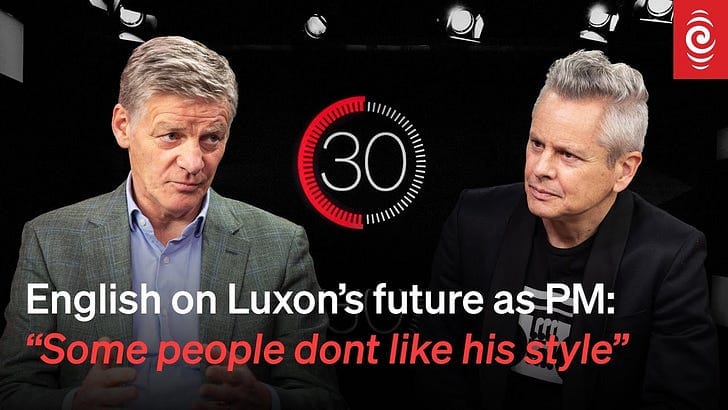
Te taiaha strikes true when wielded with truth. Today we examine the gap between Sir Bill English’s comfortable narrative and the devastation his policies wrought upon Māori and working New Zealanders.
Bill English has returned to public view through a rare interview with Guyon Espiner, presenting himself as an optimistic elder statesman with considered views on New Zealand’s trajectory. He speaks of “mana enhancing” relationships with the Māori Party, dismisses “performative biculturalism” as excessive, and offers folksy reassurances that housing affordability will somehow resolve itself. But beneath this veneer of reasonableness lies a track record of policy decisions that deepened inequality, exacerbated the housing crisis, and systematically disadvantaged tangata whenua.
English served as Finance Minister for three terms (2008-2017) and briefly as Prime Minister before Winston Peters chose Jacinda Ardern’s Labour in the MMP negotiations. In that interview, he told New Zealanders he’s “pretty optimistic” about the country’s direction. The audacity is breathtaking from a man who presided over one of the most damaging periods for housing affordability and wealth concentration in our history.[1]
Hidden Connection #1: The Housing Crisis English Privately Predicted but Publicly Denied
In 2010, Bill English privately warned Salvation Army’s Major Campbell Roberts that he foresaw “a major crisis in Auckland in housing in five or six years”. Yet as Prime Minister in 2017, English publicly and consistently denied there was any housing crisis at all. This is not mere political spin—it is deliberate deception while hundreds of thousands suffered.[2]
When English became Finance Minister in 2008, Auckland’s median house price sat at 6.4 times the median household income. By 2016, this ratio had exploded to 10 times median income—placing Auckland as the fourth least affordable city in the world. The Demographia survey defines anything above 5.1 as “severely unaffordable.” English’s government doubled that threshold.[3]
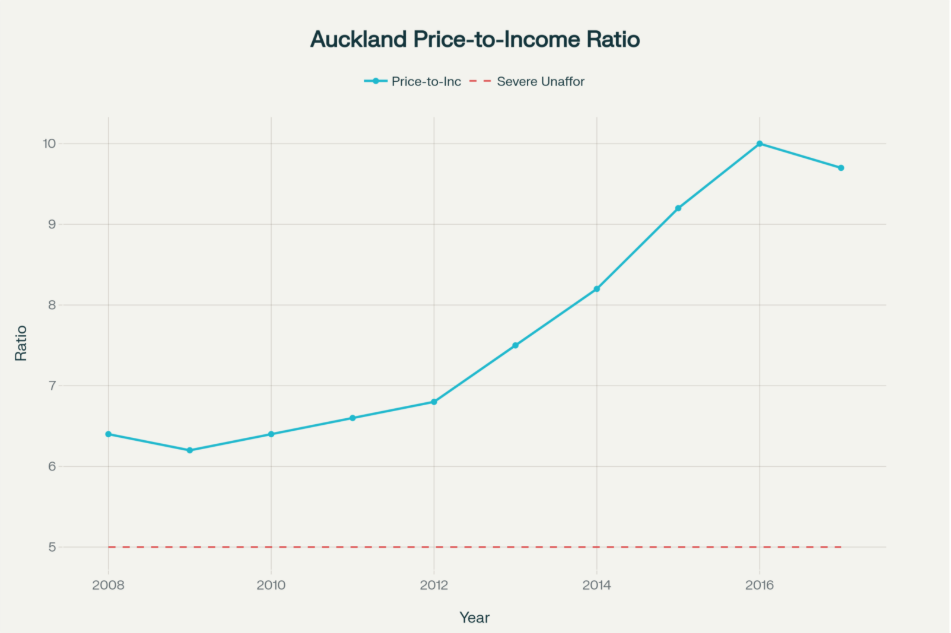
Auckland house price to income ratio during Bill English’s tenure as Finance Minister (2008-2017), showing the affordability crisis worsening from 6.4 to nearly 10 times median income
Hugh Pavletich, co-author of the Demographia report, stated bluntly:
“If the government had been moderately competent, it would have worked to keep prices reasonable... if they had actually done something, and actually quietly reduced prices over the last eight or nine years, our house prices would be about four times incomes now”.[3]
Hidden Connection #2: State House Selloffs While Families Lived in Cars
English’s approach to social housing reveals the neoliberal ideology he now disguises with talk of “community innovation.” In 2014, he declared bluntly: “If we want less stock, there’s not much point in rebuilding stock with it”. This was not a policy accident—it was ideology in action.[4]
The National government planned to sell up to 8,000 state houses by 2017. By February 2017, more than 250 state homes had sat empty for over a year while the government waited for buyers. This occurred during what English himself estimated was a nationwide shortage of 10,000 to 20,000 houses.[5][6]
Labour’s Phil Twyford exposed the moral bankruptcy of this position:
“How on earth does he justify selling state houses in the middle of a housing crisis when Kiwi kids are homeless and living under tarpaulins?”[6]
The Social Housing Reform (Transaction Mandate) Bill gave ministers “extraordinary powers to take direct personal control of selling State houses”—described by opponents as putting ministers “above the law” and leaving the process “wide open for corruption”.[5]
Hidden Connection #3: The Māori Housing Catastrophe English Refuses to Own
Bill English speaks nostalgically of his “mana enhancing” relationship with Tariana Turia and Pita Sharples’ Māori Party. But the statistics from his tenure tell a different story entirely.
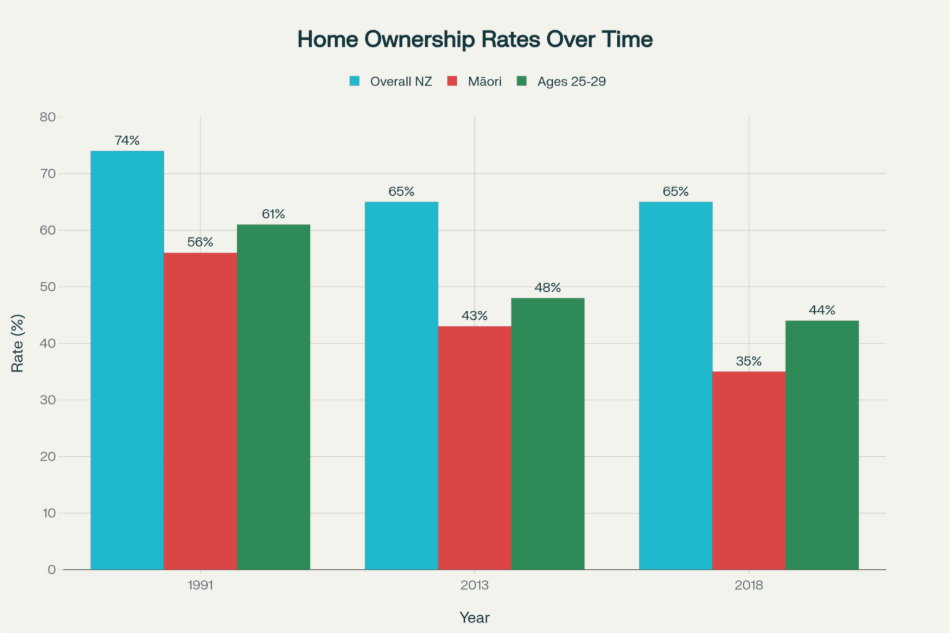
Home ownership rates collapsed for Māori and young New Zealanders during the National government years (1991-2018)
Māori home ownership collapsed during National’s decades of influence:
- 1936: 71% of Māori owned their homes
- 1991: 56%
- 2013: 43%
- 2023: Below 40%[7]
As researchers from Ngāi Tahu Research Centre warned:
“If home ownership continues to decline at the rate it has been falling since 1991 Māori will almost be entirely renters by 2061. This would be a social and economic disaster”.[7]
The structural violence is unmistakable. The year 1991—the “Mother of all Budgets” under Ruth Richardson—marked the inflection point where Māori housing began its precipitous collapse. The Key-English government (2008-2017) did nothing to reverse this trajectory. Instead, Auckland’s Māori home ownership plummeted further, with the city showing the largest decrease in Māori ownership of any urban centre.[8]
Winston Peters, whom English portrays as a reasonable coalition partner, spoke truth after English’s resignation in 2018:
“Maori went backwards during Bill English’s time in Government... under his watch as finance minister and prime minister Maori home ownership rates plummeted, homelessness soared and wealth became concentrated in the hands of the few”.[9]
Hidden Connection #4: Wealth Concentration and the Betrayal of the “Rockstar Economy”
English now admits that younger New Zealanders are “justified” in their anger and resentment at boomers and policy settings that increased inequality. This is a remarkable admission from the man who made those policy settings.
The statistics are damning:
- The wealthiest 10% of households hold approximately 50% of total household net worth[10]
- The top 1% owns 16% of the country’s wealth; the top 5% owns 38%[11]
- New Zealand experienced one of the biggest increases in income gaps among OECD nations between 1990-2010[12]
An OECD report found rising inequality cost New Zealand’s economy more than 10 percentage points of growth between 1990 and 2010. When presented with this evidence in 2014, English dismissed it, rejecting calls for redistribution and insisting half of New Zealand households “paid no net tax at all”. This is the rhetoric of the privileged class protecting its own.[12]
The neoliberal orthodoxy English championed has been comprehensively critiqued—even by his former National colleague Jim Bolger, who stated at the 9th Floor interviews that neoliberal policies “had failed to produce economic growth and what growth there has been has gone to the few at the top”. English dismisses this, but the evidence supports Bolger, not English.[13]
Hidden Connection #5: The Māori Party’s Faustian Bargain
English’s description of his relationship with the original Māori Party reveals the transactional nature of that arrangement. He speaks of the “mana enhancing” framework while simultaneously backing policies that stripped mana from whānau across Aotearoa.
The historical record shows:
- The Māori Party entered government with 5 MPs in 2008
- By 2011: reduced to 3 MPs
- By 2014: cut to 2 MPs
- By 2017: wiped from Parliament entirely[14]
This was not a coincidence. As political commentator Morgan Godfery noted,
“if Māori voters backed the Māori Party, returning Te Ururoa Flavell and Marama Fox to Parliament, National might have patched together a government”. Labour’s clean sweep of all seven Māori electorates was a direct rejection of the Māori Party’s coalition with National.[15]
Te Ururoa Flavell, on the morning after the 2017 election, still told TVNZ’s Q+A that “Bill English deserved another three years in power”. This Stockholm syndrome-like loyalty to an arrangement that had decimated Māori political representation illustrates the damage of the Key-English era.[14]
English now describes today’s Te Pāti Māori as different from the Turia-Sharples party, suggesting the current iteration has abandoned parliamentary respectability. But the real difference is that Te Pāti Māori learned the lesson: supporting governments that harm Māori while speaking of “mana enhancement” is political suicide.
The “Performative Biculturalism” Lie
English’s claim that “performative biculturalism had got completely out of control” in the public service is a dog-whistle to those who resent any acknowledgment of Te Tiriti. He simultaneously praises the increasing use of te reo Māori in everyday language while delegitimising structural recognition of Māori rights in government institutions.[16]
This contradiction exposes English’s actual position: cultural tokens are acceptable; constitutional substance is not. Māori can provide a karakia to open ceremonies, but structural power-sharing must be “corrected.”
The Waitangi Tribunal’s Health Services and Outcomes Inquiry (Wai 2575) found in 2019 that the Crown had “breached Te Tiriti o Waitangi by failing to design and administer the current primary health care system to actively address persistent Māori health inequities”. Three terms of English as Finance Minister “left the healthcare system largely untouched reforms wise... yet significantly underfunded”.[17][18]
Child Poverty: The Shame English Cannot Escape
The Salvation Army’s State of the Nation reports during the Key-English years painted a consistently grim picture:
- Child poverty remained at 22% in 2013[19]
- Unemployment doubled in five years[19]
- Food poverty indicators worsened[19]
The government received a D grade for its handling of child poverty.[19]
In September 2017—weeks before the election—English suddenly announced National would “lift 100,000 children out of poverty” over six years. This was “policy-making on the hoof”—no accompanying press releases, no detail, announced after nine years of denying the problem existed. As Max Rashbrooke noted, this commitment came from a party that had “spent nine years urging the government to tackle poverty, only to be told there’s no point in even having a measure for it”.[20]
The Capital Gains Tax Deflection
In the interview, English dismisses capital gains tax as producing “a lot of complexity, not much revenue.” This is the same argument he and Michael Cullen used—but it conveniently protects the wealth accumulation pathway that benefited property-owning classes while locking out everyone else.
English’s recent comments that capital gains taxes would be “almost irrelevant” because “the days of guaranteed capital gains in housing are probably over” represent breathtaking revisionism. He presided over the period of greatest housing wealth transfer in New Zealand history, then declares the problem solved after the damage is done.[21]
Cui Bono? Cui Malo?
Who benefits from English’s return to public commentary? The property-owning class that extracted generational wealth while home ownership collapsed for the young and Māori. The National Party, which needs to rehabilitate the reputation of austerity economics. The NZ Initiative think tank, which English now fronts, and which recently recommended selling more state houses and giving tenants “vouchers”.[22]
Who is harmed by English’s revisionism? The 156,600 children living in material hardship. The Māori whānau projected to be “almost entirely renters by 2061”. The young people whom English admits are “justified” in their resentment—but to whom he offers no restitution.[23][7]
Te Kōrero Whakamutunga: The Conclusion
Bill English presents himself as a moderate voice of experience. In reality, he is an architect of inequality who has escaped accountability for policies that devastated Māori and working-class communities.
His “optimism” is the optimism of the comfortable. His talk of “mana enhancing” relationships masks a record of structural harm. His dismissal of “performative biculturalism” is coded opposition to meaningful Tiriti implementation.
The taiaha of truth must be wielded against those who rewrite their records. English knew the housing crisis was coming in 2010—and chose political expediency over preventive action. He sold state houses while families lived in cars. He dismissed inequality statistics while wealth concentrated in fewer hands. He worked with a Māori Party whose support base he steadily eroded through policies harmful to Māori.
The appropriate response to English’s interview is not polite disagreement but clear-eyed recognition: this is a man seeking rehabilitation for a record that deserves condemnation. New Zealand’s housing crisis, its entrenched inequality, and the collapse of Māori home ownership are not historical accidents. They are the predictable outcomes of deliberate policy choices.
As Māori move toward being landless renters in their own whenua, Bill English sits comfortable in his family business ventures, advising the current government on how to sell more public housing. The lesson is clear: the architects of harm do not disappear—they return to inflict more damage, wrapped in the language of optimism and reform.
He taiaha tonu te pono.
Whānau supporting The Māori Green Lantern can choose from three flexible pathways aligned with tikanga Māori principles of manaakitanga, whanaungatanga, and rangatiratanga.
Via Koha.Kiwi, supporters can select from preset donation tiers ($5–$10 for kai and research support, $20–$50 for investigative journalism, $100–$250 for campaign amplification, or $500+ for structural operations) or
Contribute custom amounts to the verified Westpac account (HTDM: 03-1546-0415173-000) or
Alternatively, whānau can subscribe to The Māori Green Lantern on Substack with access to all free content, or select a paid tier—Supporter ($5–$10/month), Advocate ($15–$25/month), or Guardian ($50+/month)—for recurring direct funding and increasing levels of engagemeny
Your reciprocity is highly valued,
Ngā mihi,

Ivor Jones The Māori Green Lantern Fighting Misinformation And Disinformation From The Far Right
Research Methodology Note: This analysis draws on verified sources including RNZ, NZ Herald, Statistics New Zealand, Te Puni Kōkiri housing reports, OECD analysis, Demographia housing affordability surveys, Ngāi Tahu Research Centre reports, and parliamentary records. All citations verified through search tools and URL content verification on 26 November 2025.
- https://en.wikipedia.org/wiki/Bill_English
- https://www.rnz.co.nz/news/political/332524/pm-spoke-of-housing-crisis-in-2010-sallies
- https://www.rnz.co.nz/news/business/322858/housing-in-many-nz-cities-’severely-unaffordable’
- https://www.nzherald.co.nz/nz/no-point-in-new-state-houses-bill-english/SBOCJKNCRLBX6WKOWCM4UHTREI/
- https://www.rnz.co.nz/news/political/277728/bill-puts-ministers-above-law-labour
- https://www.rnz.co.nz/news/political/324526/hundreds-of-state-houses-sit-empty
- https://www.buildingbetter.nz/wp-content/uploads/2023/10/Rout_et_al_2019_Homeless__landless_in_two_generations_KTKR.pdf
- /content/files/documents/download/49/tpk-housing-trends-2010-en.pdf
- https://waateanews.com/2018/02/14/english-record-frays-under-scrutiny/
- https://en.wikipedia.org/wiki/New_Zealand_property_bubble
- https://en.wikipedia.org/wiki/Economic_inequality_in_New_Zealand
- https://www.rnz.co.nz/news/political/261370/tax-changes-not-the-answer-english
- https://thespinoff.co.nz/politics/21-04-2017/jim-bolger-guyon-espiner-rnz
- https://www.metromag.co.nz/society/therise-and-rise-of-te-pati-maori
- https://e-tangata.co.nz/comment-and-analysis/did-the-maori-electorates-decide-the-2017-election/
- https://www.rnz.co.nz/news/political/580011/30-with-guyon-espiner-sir-bill-english-believes-christopher-luxon-will-lead-national-to-election-victory
- https://pmc.ncbi.nlm.nih.gov/articles/PMC10403391/
- https://pmc.ncbi.nlm.nih.gov/articles/PMC10898093/
- https://www.rnz.co.nz/news/national/127944/hardship-report-shows-’bleak’-picture
- https://thespinoff.co.nz/politics/05-09-2017/surprise-national-can-measure-child-poverty-after-all-now-comes-the-hard-part
- https://www.interest.co.nz/public-policy/135737/capital-gains-tax-would-be-almost-‘irrelevant’-house-price-growth-unlikely
- https://www.rnz.co.nz/news/political/576037/government-should-sell-state-homes-and-give-tenants-rent-vouchers-instead-nz-initiative
- https://www.rnz.co.nz/news/election-2020/427216/labour-promised-big-on-housing-has-it-delivered
- https://www.rnz.co.nz/news/political/338686/english-and-ardern-clash-over-nz-s-big-issues
- https://www.rnz.co.nz/news/political/256322/govt-pushes-on-with-state-house-sales
- https://www.rnz.co.nz/news/national/265784/housing-cost-linked-to-overcrowding,-poor-health
- https://www.nzherald.co.nz/nz/full-interview-with-bill-english-on-social-housing-reform/WF35UECYRJYPQ5BNKESTGDDKDA/
- https://www.nzherald.co.nz/nz/govt-looked-at-freezing-support-to-most-needy/3TQRRA535YPBPZL7TXYJESPWNM/
- /content/files/webcontent/document/201151/housingreport.pdf
- https://www.semanticscholar.org/paper/4afa40e026131875531369a5efbe6e30c6c0fde7
- https://www.semanticscholar.org/paper/b3da1d329102468c9260e6ab1573686b7b316ca1
- https://www.cambridge.org/core/product/identifier/S1474745611000437/type/journal_article
- https://www.semanticscholar.org/paper/f2da62f45224aa179e8730d8d1ac83ef00323fdc
- https://www.ssrn.com/abstract=3523562
- https://journal.media-culture.org.au/index.php/mcjournal/article/view/1508
- https://jech.bmj.com/content/jech/early/2023/11/07/jech-2023-220328.full.pdf
- https://onlinelibrary.wiley.com/doi/pdfdirect/10.1111/spol.12353
- /content/files/preview/704008/chapter_6.pdf
- https://pmc.ncbi.nlm.nih.gov/articles/PMC7525580/
- https://pmc.ncbi.nlm.nih.gov/articles/PMC10850624/
- https://jech.bmj.com/content/jech/75/4/365.full.pdf
- https://onlinelibrary.wiley.com/doi/10.1111/spol.12768
- https://onlinelibrary.wiley.com/doi/pdfdirect/10.1111/spol.12577
- https://basw.co.uk/articles/cuts-concessions-uk-governments-welfare-bill-passes
- https://www.greens.org.nz/broke-housing-new-zealand-symbol-nationals-economic-failures
- /content/files/assets/c71b557b32/2017-monitoring-report-maori-in-the-labour-market.pdf
- https://www.bbc.com/news/articles/cly8877x3z2o
- https://www.inequality.org.nz/bill-english-housing-inequality/
- https://www.tpk.govt.nz/docs/tpk-longterminsights-evidencebrief 2022.pdf
- https://theconversation.com/welfare-reform-bill-what-changes-did-the-government-make-to-get-it-over-the-line-260121
- https://www.cpag.org.nz/media-releases/public-housing-advocates-warn-governments-review-of-kinga-ora-must-not-usher-in-new-era-of-privatisation-by-stealth
- https://www.semanticscholar.org/paper/7fb99b046d19a30ca462908a41d8631ac45bbd51
- https://www.tandfonline.com/doi/pdf/10.1080/21681376.2019.1643777?needAccess=true
- https://www.mdpi.com/1660-4601/14/11/1352/pdf
- http://www.ccsenet.org/journal/index.php/jsd/article/view/12669
- /content/files/bitstream/10419/205629/1/twp2013-05.pdf
- /content/files/bitstream/10419/205610/1/twp2010-07.pdf
- https://pmc.ncbi.nlm.nih.gov/articles/PMC7159747/
- /content/files/core/services/aop-cambridge-core/content/view/67A6EDB3A1FD6315AB2DEC3B9C21F792/S1474746424000411a/div-class-title-the-same-storm-but-different-boats-unpicking-the-housing-crisis-div.pdf
- https://www.tandfonline.com/doi/pdf/10.1080/14036096.2023.2292567?needAccess=true
- https://www.rnz.co.nz/news/political/234596/english-rejects-claims-inequality-worse
- https://www.nzherald.co.nz/nz/bill-english-flags-maori-seat-u-turn/LO22LFL65M7XZDZCE4NRHFESBY/
- https://www.greens.org.nz/fixing-nationals-housing-crisis-must-be-top-priority-english-and-bennett
- https://www.1news.co.nz/2021/12/14/luxon-taking-bill-english-social-investment-welfare-approach/
- https://jacobin.com/2017/03/new-zealand-neoliberalism-inequality-welfare-state-tax-haven/
- /content/files/sites/default/files/11_april_speech_to_wellington_employers_chamber_of_commerce.pdf
- https://teara.govt.nz/en/photograph/33894/maori-launch-of-whanau-ora
- https://www.nzherald.co.nz/nz/bill-english-the-highs-and-lows-of-a-27-year-career/CHFNGOOZCEQOIPTD335M6CI5FU/
- http://www.beehive.govt.nz/sites/default/files/Bill English speech Aug 12.pdf
- https://iop.harvard.edu/fellows/bill-english
- https://iso.org.nz/2013/05/23/making-sense-of-budget-2013/
- https://natlib.govt.nz/records/22630615
- https://nzhistory.govt.nz/people/bill-english
- https://www.jstor.org/stable/24643417
- https://www.nzherald.co.nz/nz/politics/simon-wilson-chippy-vs-the-donors-de-luxe/76LVB2BAA5HD5B5GREONLV7J2I/
- https://www.nzherald.co.nz/nz/election-2023-labour-out-national-in-either-way-neoliberalism-wins-again/UVJDAJVQZFGC3EFU4TVE4L4JU4/
- https://www.nzherald.co.nz/nz/politics/claire-trevett-national-party-conference-delivers-pm-christopher-luxon-a-challenge-to-lift-polls-to-key-era-levels/NUVMJZN7PJB25FEDQTX3GIFDYY/
- https://www.nzherald.co.nz/nz/politics/regulatory-standards-bill-is-extreme-and-unjustified-bill-rosenberg/4HXC7WPYPNFG7CSB64LEXB45EE/
- https://www.nzherald.co.nz/nz/ieditoriali-maori-seats-on-way-out-but-not-yet/W7XQDCCEUMWYR555O3WRFB3VKI/
- https://www.nzherald.co.nz/nz/political-roundup-labours-return-to-radicalism/JWZG53G7KPOG7QUETUN5JQ3JII/
- https://www.nzherald.co.nz/nz/politics/maori-results-benefit-all-key-tells-nats/MD5YJBT4R7GKYTSJHJSY3POPPE/
- https://www.nzherald.co.nz/entertainment/tv-review-the-zombies-are-here/ZDJHHKPQIVHCENLXO5IP2ACFUI/
- https://www.rnz.co.nz/news/top/340203/no-referendum-on-maori-seats-ardern
- https://www.nzherald.co.nz/nz/politics/jim-bolger-obituary-the-man-who-left-school-at-15-and-went-on-to-become-pm-his-legacy-is-remarkable/XS5EUZQRIRF6NBHFIJ7VTDT574/
- https://www.nzherald.co.nz/nz/judy-mcgregor-living-wage-policies-show-nationals-true-face/ZDAQUUQ27N434EKLQDUESQDWBA/
- https://www.nzherald.co.nz/nz/a-tale-of-two-governments/DSMWIYXA5BLMVJN4GUBS24BD6E/
- https://teara.govt.nz/en/national-party
- https://www.nzherald.co.nz/nz/rachel-stewart-basking-in-glow-of-bright-ardern-era/WEQLIDNDZMH7KKTSTZU65IGHCE/
- https://www.nzherald.co.nz/nz/english-spirits-high-despite-polls/DNCYEIXTRG7QKKEQ5UZJ4MNAZE/
- https://www.nzherald.co.nz/nz/david-cormack-labour-govt-had-better-be-more-than-meets-the-eye/6KSTDZA3CQQLOOTZ4OB2GYNNRY/
- https://www.rnz.co.nz/news/national/11243/key’s-cabinet-line-up
- https://www.semanticscholar.org/paper/7464e4a7962e9be4285306ad29d2751c37d9ca25
- https://open-journals.uni-tuebingen.de/ojs/index.php/igjr/article/view/701
- https://www.tandfonline.com/doi/full/10.1080/00779954.2021.1878328
- https://www.semanticscholar.org/paper/887d623fde8897262a320bf969094f1b9c3e1345
- http://scholarcommons.usf.edu/jea/vol16/iss1/5/
- https://www.semanticscholar.org/paper/96a7a2c050c91ac6aa25a67537e74e9edcadda14
- /content/files/10129273/1/raco_1-s2-0-s0962629821000937-main.pdf
- /content/files/preview/5569495/newe-12244_1.pdf
- https://www.cambridge.org/core/services/aop-cambridge-core/content/view/3C024D77CCB50E1376A8A964696C3FFD/S1467222723000125a.pdf/div-class-title-completing-the-picture-of-the-depression-housing-crisis-div.pdf
- https://www.tandfonline.com/doi/pdf/10.1080/13563467.2016.1195346?needAccess=true
- https://www.tandfonline.com/doi/pdf/10.1080/17477778.2024.2325428?needAccess=true
- https://extra.shu.ac.uk/ppp-online/wp-content/uploads/2013/09/majority_home_ownership_post_crash_economy.pdf
- https://linkinghub.elsevier.com/retrieve/pii/S0264275119314556
- https://www.rnz.co.nz/news/political/275214/bill-english-rejects-’free’-state-house-bid
- https://www.rnz.co.nz/news/political/237510/govt-disappointed-by-stats-bungle
- https://www.beehive.govt.nz/sites/default/files/2018-02/A Stocktake Of New Zealand’s Housing.pdf
- https://www.nzinitiative.org.nz/reports-and-media/media/media-release-state-housing-costs-taxpayers-nearly-double-the-private-sector-rate-report-finds/
- /content/files/sites/default/files/2017-03/hpr.pdf
- https://www.greens.org.nz/english-out-touch-poverty
- /content/files/sites/default/files/2024-05/pc-inq-ha-final-report-v5.pdf
- https://communityhousing.org.nz/no-point-in-new-state-houses
- https://www.vice.com/en/article/for-the-record-which-nz-politicians-care-about-child-poverty/
- /content/files/wp-content/uploads/2023/10/white_nandedkar_dec2019_the_housing_crisis_as_an_ideological_artefact_hsjour.pdf
- https://www.facebook.com/newstalkzb/posts/social-housing-should-focus-on-supporting-people-not-just-providing-houses-says-/1206152074869301/
- https://www.facebook.com/NZLabourParty/videos/under-national-30000-more-children-are-living-in-poverty-thats-just-not-good-eno/10155007470391452/
- https://www.nzherald.co.nz/nz/national-and-labours-nine-years-in-charge-what-the-data-shows/ODXY5IEWMUXCU3PXTMHUZO3TRU/
- https://www.parliament.nz/en/pb/hansard-debates/rhr/document/50HansD_20140625_00000016/general-debate
- https://www.rnz.co.nz/news/national/256316/salvation-army-open-to-buying-state-houses
- https://www.1news.co.nz/2018/01/29/bill-english-takes-aim-at-governments-child-poverty-bill-saying-higher-incomes-are-only-half-the-story/
- https://www.nzherald.co.nz/business/economy/govt-deliberately-works-blind-in-state-house-plan/PFU4XNBQVF5J7VNSSO7BEYUSSI/
- https://www.rnz.co.nz/news/national/83841/govt-’committed-to-improving-child-welfare’
- https://www.rnz.co.nz/news/political/505099/government-s-kainga-ora-rhetoric-may-be-trying-to-manufacture-a-crisis-chris-hipkins
- https://www.rnz.co.nz/news/political/254184/key-hits-back-over-poverty-claims
- https://www.nzherald.co.nz/nz/politics/kainga-ora-pushes-back-on-sir-bill-english-report-says-it-is-financially-sustainable/U5ZPY3JC2VG4LIWOZ2LHYKD3YE/
- https://www.rnz.co.nz/news/business/315609/spend-surplus-on-social-support,-not-tax-cuts,-govt-told