“The Revolving Door Spins Again” - 29 August 2025
Crown Negotiators and the Neoliberal Boys Club
Kia ora whānau. He mihi aroha ki a koutou katoa.
The audacity is breathtaking. In a move that would make even the most shameless crony capitalists blush, this coalition government has appointed three former National Party figures as Crown negotiators for regional deals, creating a revolving door so brazen it could power the entire South Island grid. Steven Joyce, Wayne Eagleson, and Malcolm Alexander - all beneficiaries of the neoliberal gravy train - have been handed the keys to negotiate multi-billion dollar partnerships on behalf of Te Tiriti partner, the Crown, while maintaining extensive business interests that directly conflict with their new roles.
This is not governance. This is corporate capture dressed up in the respectable language of "regional development." It is the systematic theft of democratic accountability, wrapped in the colonial mythology of "expertise" and "delivering Crown objectives." For Māori watching this unfold, the message is crystal clear: the Crown's negotiating position will be shaped not by Te Tiriti principles or genuine partnership, but by the commercial interests of National Party insiders who view our regions as investment opportunities rather than living communities with inherent mana and tino rangatiratanga.
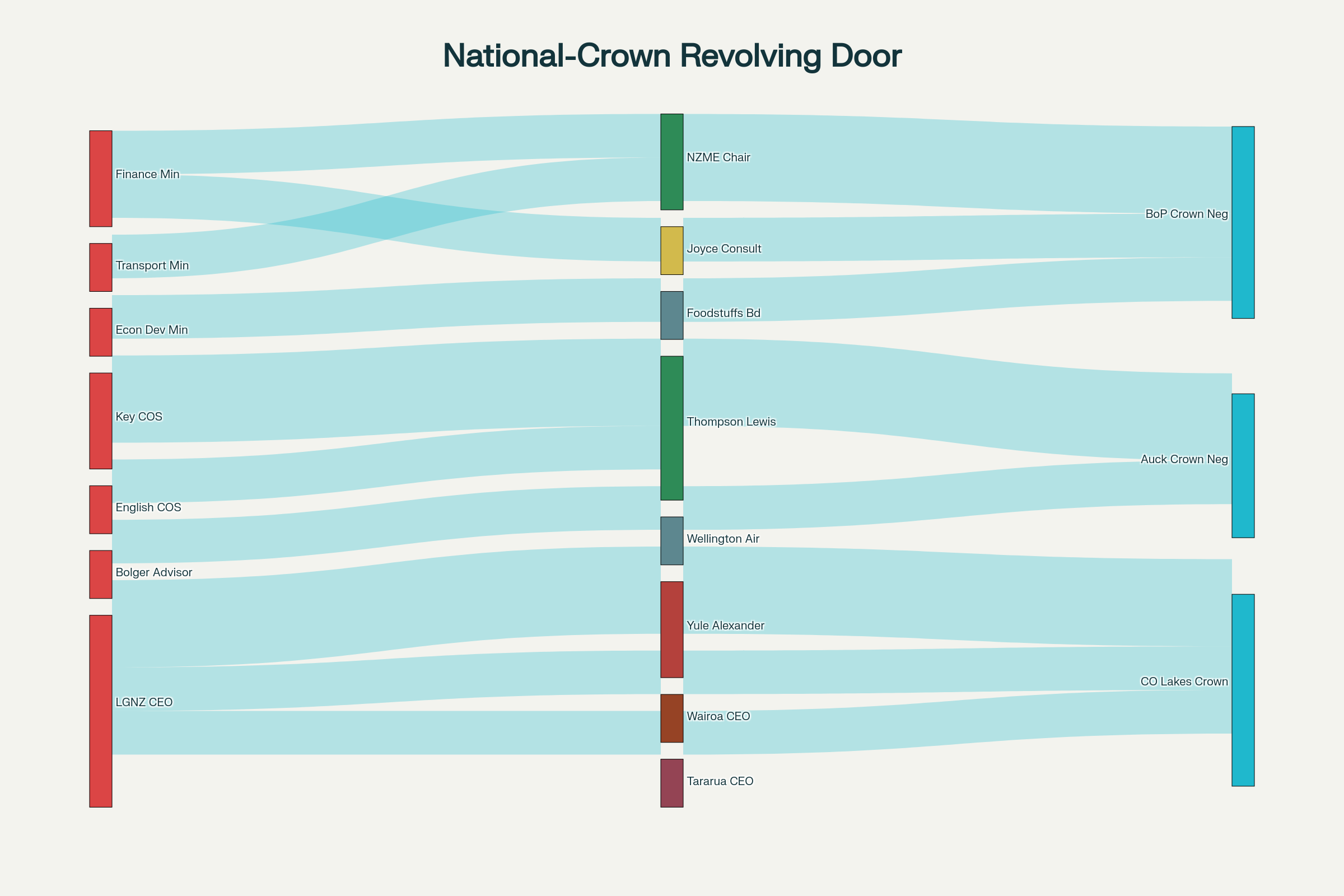
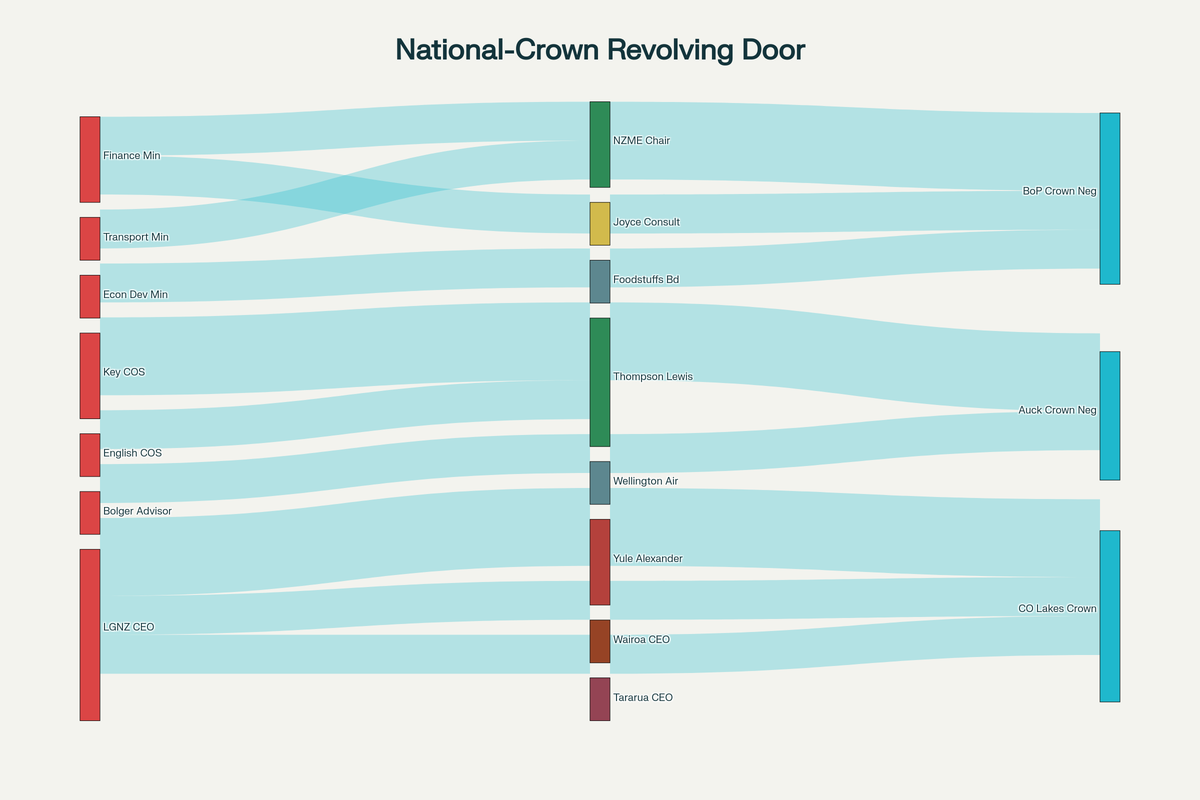
Network of Crown Negotiator Appointments Showing Revolving Door Between National Party and Government Roles
Background: The Regional Deals Deception
Regional deals represent the latest iteration of neoliberal governance - long-term partnerships between central and local government designed to unlock "economic potential" through infrastructure investment and regulatory reform. The government's own strategic framework reveals the true agenda: creating competition between regions for growth, promoting "planning liberalisation," and ensuring "the right incentives drive growth" - code for dismantling environmental protections and community consultation processes that might interfere with profit maximisation.
These deals, modeled on similar schemes in Britain and Australia, promise 30-year visions with 10-year strategic plans. But crucially, central government is not providing new funding. Instead, they are "considering other funding and financing tools" - neoliberal speak for debt financing, user-pays models, and public-private partnerships that will saddle communities with debt while delivering profits to private investors.
The selection process itself exposes the colonial arrogance at play. Eighteen regions submitted "light-touch proposals," but only three were chosen: Auckland, Bay of Plenty, and Central Otago Lakes. These regions were not selected for their need or their commitment to Te Tiriti principles, but for their capacity to generate returns for capital. Meanwhile, regions with significant Māori populations and genuine development needs were ignored.
The Issue: Cronyism as Colonial Violence
The appointment of these three men represents more than simple corruption - it is a form of colonial violence that perpetuates the systematic exclusion of Māori from decision-making processes that affect our whenua, our communities, and our future. When the Crown negotiates regional deals through former National Party figures with extensive commercial interests, it signals that Māori partnership under Te Tiriti is subordinate to Pākehā commercial networks.
Steven Joyce's appointment to negotiate Bay of Plenty deals is particularly egregious. As The Post revealed, Joyce's consultancy received $9,297.50 from Bay of Plenty Regional Council in 2023/24 for advisory services relating to the potential divestment of council assets, including Port of Tauranga shares. Now he will negotiate on behalf of the Crown with the same council that paid his consultancy firm. This is not a conflict of interest - it is a predetermined outcome designed to benefit his business network.
Wayne Eagleson's role is equally compromised. As NBR reported, he rejoined Wellington Airport's board in August 2025, just days before his Crown negotiator appointment was announced. His consulting firm Thompson Lewis specialises in political lobbying, and he played a key role in interviewing candidates for key jobs in the incoming coalition government in 2023. He is not negotiating for the Crown - he is negotiating for the network of corporate interests that brought this government to power.
Malcolm Alexander completes the trinity of neoliberal capture. His Yule Alexander lobbying firm partners with former National MP Lawrence Yule and explicitly describes itself as facilitating "change-making connections between local and central government, private businesses, and not-for-profit organisations." The firm boasts of being "political lobbyists" who understand "how the game works" and can "figure out the best strategy to move the dial." This is the man now negotiating regional deals on behalf of the Crown - a professional lobbyist whose business model depends on leveraging political connections for commercial advantage.
Corporate Capture and the Neoliberal Project
The broader context reveals this appointment scandal as symptomatic of New Zealand's embrace of what scholars term "corporate capture" - the systematic colonisation of democratic institutions by business interests. Research on neoliberalism and regional development in New Zealand shows how market-oriented policies have transformed regional governance from community-centered development to profit-driven investment schemes.
The government's own procurement guidance requires that appointments be made based on merit and that potential conflicts of interest be identified and managed. Yet Infrastructure Minister Chris Bishop dismissed concerns about cronyism, claiming negotiators were selected for their "ability to secure the best deals for the Crown" and their capacity to "navigate across multiple areas of work." This defense reveals the neoliberal mindset perfectly - the assumption that corporate experience automatically translates to public benefit, regardless of conflicts of interest or democratic accountability.
The secrecy surrounding these appointments compounds the democratic deficit. The negotiators' pay rates and terms of appointment will not be made public, despite their roles involving billions of dollars in public assets and commitments. This opacity is not accidental - it serves to insulate the appointments from scrutiny while ensuring the negotiators can pursue outcomes favorable to their business networks without public accountability.
Hidden Connections and Networks of Power
The interconnected nature of these appointments reveals the tight networks that characterise New Zealand's neoliberal elite. Joyce served as National's finance minister from 2016-2017 and managed five elections for the party. Eagleson was chief of staff to both John Key and Bill English from 2008-2017, and also worked for Jim Bolger in the 1990s. Alexander, while not directly employed by National governments, ran Local Government New Zealand during the Key-English years and now partners with former National MP Lawrence Yule.
These men do not represent diverse perspectives or independent expertise. They represent a single ideological project - the transformation of New Zealand's economy and governance structures to serve corporate interests rather than community needs. Their appointments ensure that regional deals will prioritise infrastructure projects that benefit private investors, regulatory changes that reduce environmental protections, and financing mechanisms that shift costs from central government to local communities.
The timing of these appointments, coming just as the coalition government faces criticism for its broader pattern of political appointments, suggests a deliberate strategy to reward National Party loyalists while advancing the neoliberal agenda through ostensibly technical negotiations.
Te Tiriti Implications and Māori Exclusion
From a Te Tiriti perspective, these appointments represent a fundamental breach of the Crown's partnership obligations. The principle of partnership requires that Māori have meaningful input into decisions affecting our territories and resources. Yet these regional deals will be negotiated by men with no demonstrated commitment to Te Tiriti principles and extensive conflicts of interest that prioritise corporate profit over indigenous rights.
The principle of protection requires the Crown to actively safeguard Māori interests in all its dealings. However, these negotiators' business backgrounds suggest they will prioritise deregulation and private profit over the protection of whenua, whakapapa connections, and community wellbeing that are central to Māori values.
The principle of participation is completely undermined when Crown negotiators are selected from a narrow pool of Pākehā corporate interests without any meaningful Māori representation or input. These appointments signal that regional development will proceed according to colonial models of extraction and exploitation rather than tikanga-based approaches that recognize the inherent mana of communities and environments.
The government's claim that negotiators were chosen for their "ability to deliver Crown objectives" reveals the colonial mindset at work. These are not Crown objectives in any meaningful sense - they are corporate objectives dressed up in the language of Crown responsibility. The real Crown has treaty obligations to Māori that cannot be discharged through negotiations conducted by conflicted corporate representatives.
Implications: Democracy for Sale
The broader implications of these appointments extend far beyond the specific individuals involved. They represent the systematic corporatisation of democratic governance, where public decisions are increasingly made by private interests operating through captured state institutions.
The secretive nature of the appointment process, combined with the refusal to disclose pay rates and terms, creates a parallel system of governance that operates beyond democratic accountability. Regional deals worth billions of dollars will be negotiated behind closed doors by individuals whose primary loyalties lie with their business networks rather than public interest.
For Māori communities in the affected regions, these appointments signal that their voices will be marginalised in favour of corporate interests. Regional development that should strengthen community resilience and cultural expression will instead prioritise infrastructure projects and regulatory changes that serve external investors.
The environmental implications are equally concerning. All three negotiators come from business backgrounds that prioritise economic growth over environmental protection. Their negotiations are likely to weaken environmental safeguards, accelerate resource extraction, and increase carbon emissions - outcomes that directly contradict both Te Tiriti obligations and climate commitments.
The precedent set by these appointments will encourage further corporate capture across government. If former politicians and their associates can be rewarded with lucrative negotiating roles regardless of obvious conflicts of interest, the incentive structure of the political system becomes completely corrupted. Democracy becomes a pathway to personal enrichment rather than public service.

The Māori Green Lantern fighting misinformation and disinformation from the far right
The Neoliberal Endgame
The appointment of Joyce, Eagleson, and Alexander as Crown negotiators represents the logical endpoint of four decades of neoliberal transformation in New Zealand. What began in the 1980s as economic reform has become complete corporate capture of the state apparatus. Democratic institutions now serve as vehicles for private profit rather than public good.
The coalition government's defense of these appointments - claiming they represent expertise rather than cronyism - reveals how thoroughly neoliberal ideology has colonised political discourse. The assumption that corporate experience automatically translates to public benefit is so embedded that obvious conflicts of interest are dismissed as irrelevant technicalities.
For tangata whenua, these appointments are particularly insulting because they demonstrate the Crown's contempt for genuine partnership. At a time when Māori are asserting tino rangatiratanga and demanding meaningful participation in decisions affecting our territories, the Crown responds by appointing Pākehā corporate representatives to negotiate on its behalf.
The path forward requires more than replacing these particular negotiators. It demands a fundamental transformation of how regional development decisions are made, ensuring that communities - and particularly Māori communities - have genuine control over their own futures. Regional deals should strengthen local democracy and indigenous sovereignty, not create new opportunities for corporate exploitation.
But make no mistake - this government will not voluntarily abandon its corporate capture agenda. Change will come only through sustained pressure from communities who refuse to accept that their regions are investment opportunities for National Party cronies. The revolving door between politics and business must be permanently locked, and democratic decision-making restored to its rightful place at the centre of governance.
The neoliberal experiment has failed. These appointments are symptoms of its terminal illness. The question now is whether we will allow it to drag our democracy and our communities down with it, or whether we will build something better based on genuine partnership, community control, and respect for both tangata whenua and all who call these islands home.
Kia kaha, kia maia, kia manawanui.
Ivor Jones
The Māori Green Lantern
Readers who find value in my work exposing misinformation, white supremacy, racism, and neoliberalism are welcome to consider a donation/koha to support this important mahi: HTDM: 03-1546-0415173-000. The MGL understands these are tough economic times for whānau, so please only contribute if you have capacity and wish to do so.