"The Silencer: How Sean Plunket Weaponises the Microphone Against Māori Climate Truth" - 8 April 2026
While your whānau drown in Cyclone Gabrielle's aftermath, a neoliberal attack dog calls the science a grift. Name him. Expose him. Destroy the lie.
Kia ora Aotearoa,
He aha te mea nui o te ao? He tangata, he tangata, he tangata.
What is the greatest thing in the world? It is people, it is people, it is people.
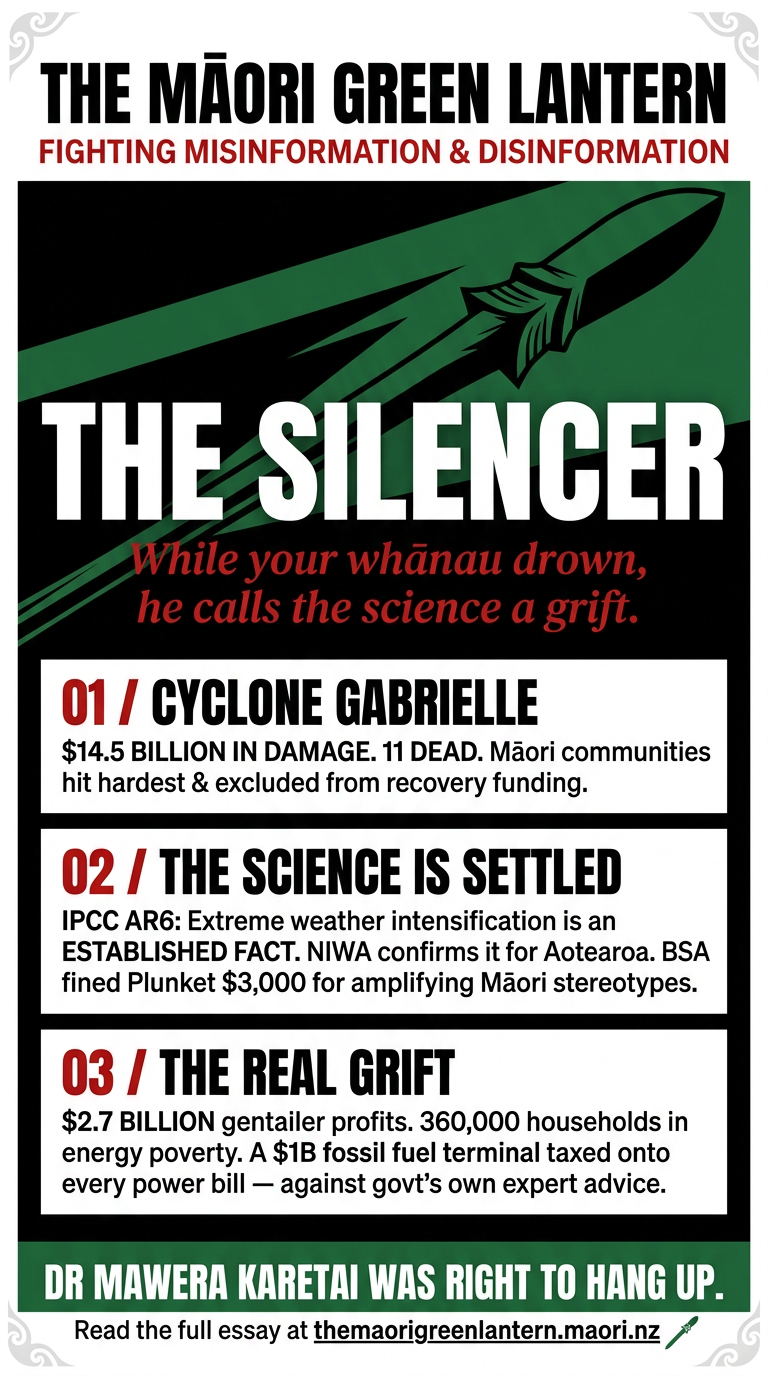
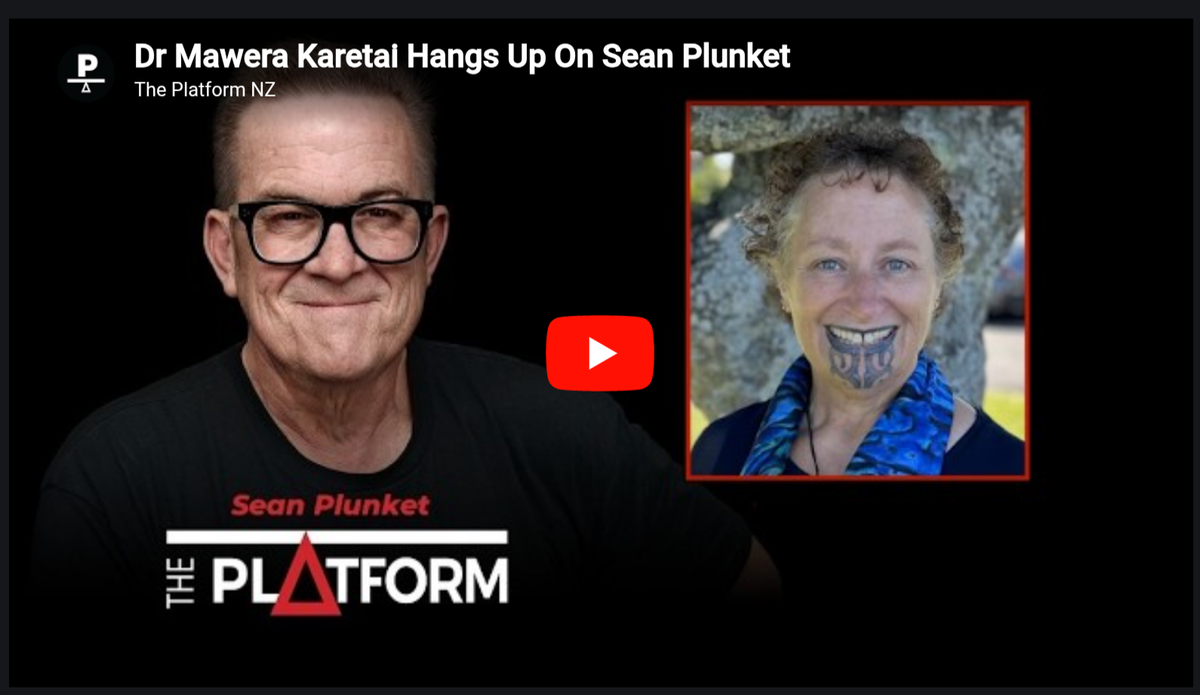
On 7 April 2026, Dr Mawera Karetai — project lead, climate educator, Kai Tahu, Kāti Mamoe, Waitaha — sat down to speak with Sean Plunket on The Platform about climate change education in schools. She never got the chance. What followed was not journalism. It was not skepticism. It was an ambush — a three-minute demolition attempt dressed up as an interview, executed by a man whose Broadcasting Standards Authority record tells you everything you need to know about his relationship with Māori voices.
The Deep Dive Podcast
Listen to a lively conversation between two hosts, unpacking and connecting topics in the sources of this essay.
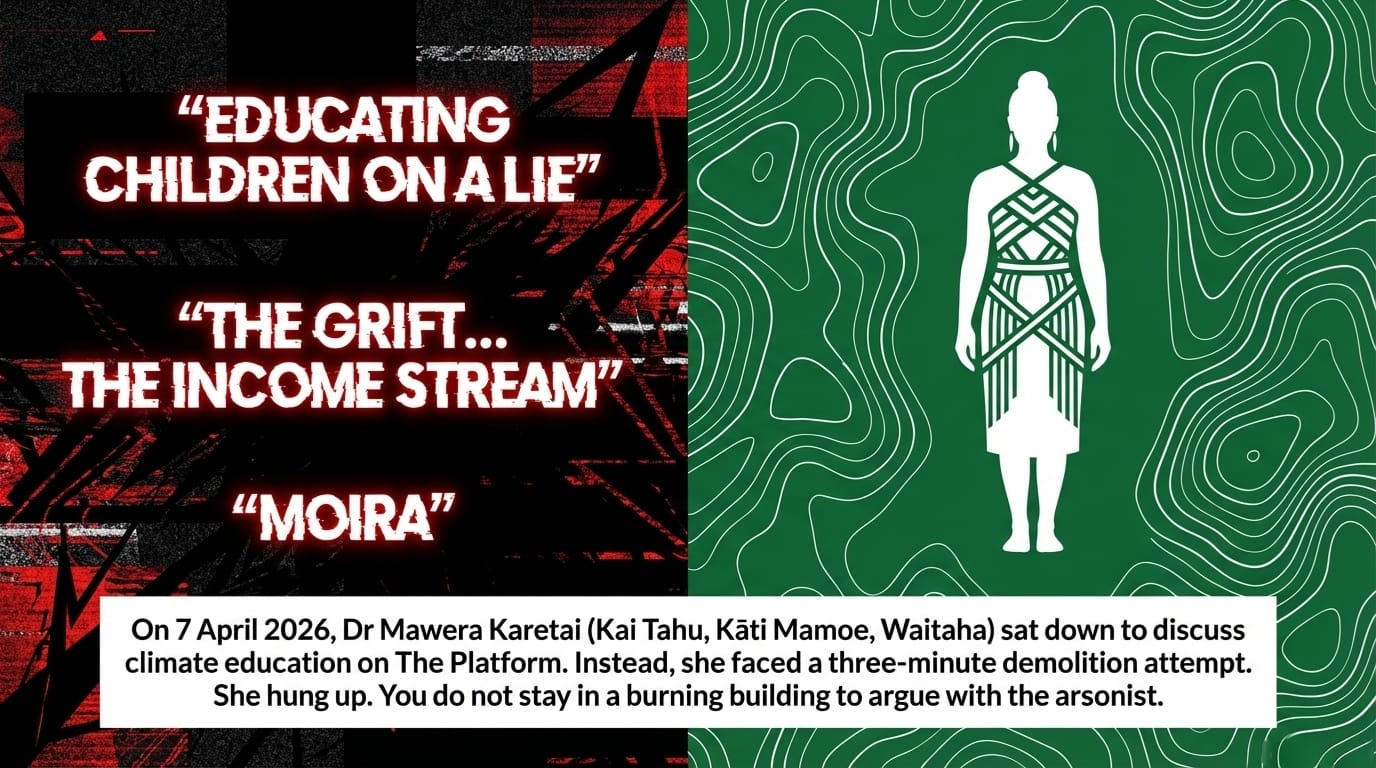
She hung up. Good. You do not stay in a burning building to argue with the arsonist.
The Plunket Playbook: Colonialism With a Headset
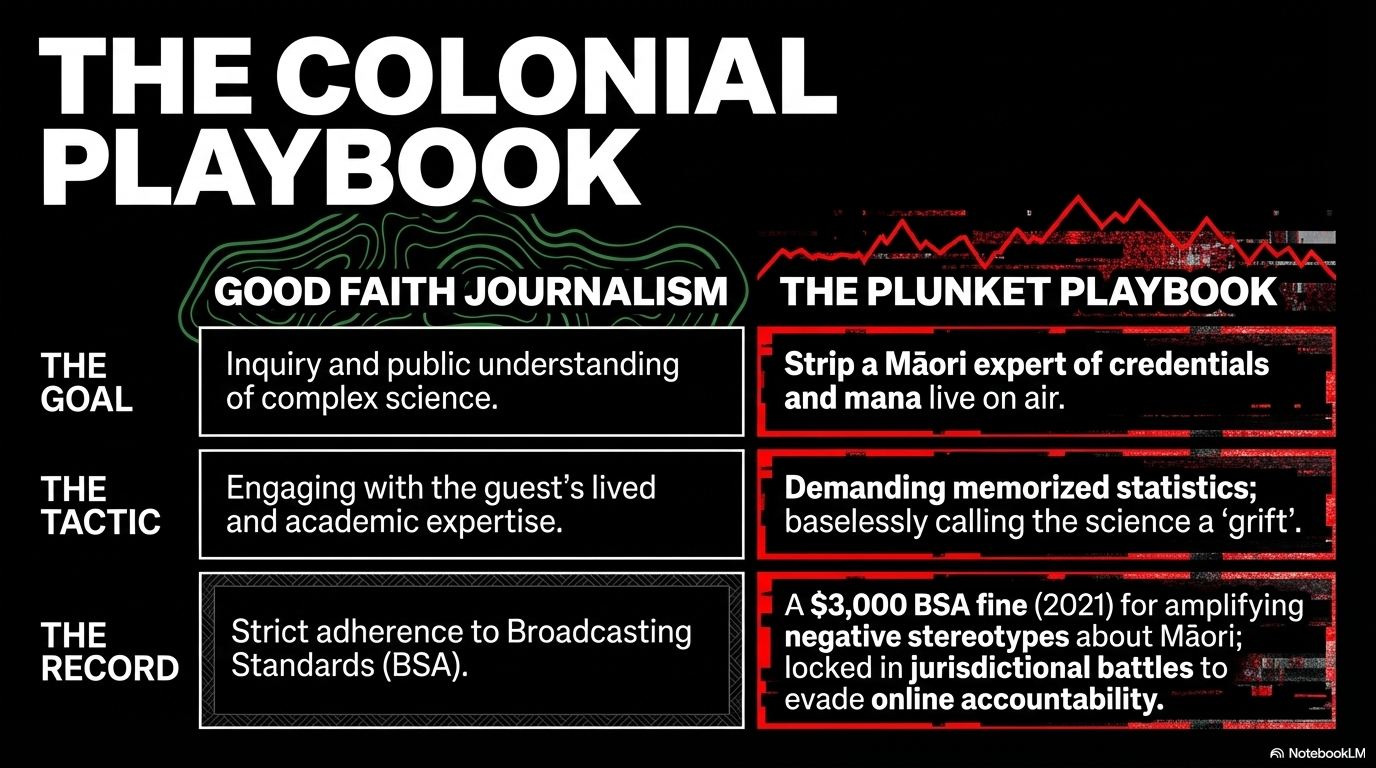
Strip back the bluster and Sean Plunket's tactic is devastatingly simple. Demand that a Māori expert recite statistics from memory on-air. When they decline to participate in his trivia game, declare that the science is fake. Call the programme a "grift." Invoke "$13 million of your money." Hang up — or in this case, force her to.
This is not skepticism. This is theatre engineered to produce a single image: a Māori woman who "cannot answer basic questions," stripped of her credentials, her mana, and her message — live to camera.
He misnamed her. He called her "Moira." The man staging himself as the last line of defence between New Zealand children and a climate lie could not be bothered to learn the name of his guest.
And this is no aberration. The Broadcasting Standards Authority found in 2021 that Plunket "amplified negative stereotypes about Māori" during an interview with a Ngāi Tūhoe representative about Covid checkpoints — a finding that cost him a $3,000 fine. He called Eleanor Catton an "ungrateful hua" and a "traitor" for criticising New Zealand's tall poppy culture internationally. In 2024, a former employee alleged he yelled at her and punched a desk. The BSA is currently locked in a fresh jurisdictional battle over whether it can regulate The Platform's online output. That fight is not incidental. It is structural. The moment broadcasters escape accountability frameworks, the Plunket playbook becomes the default.
The pattern is intimidation, not inquiry. And it is specifically deployed against Māori knowledge holders.
The Science He Claims Does Not Exist
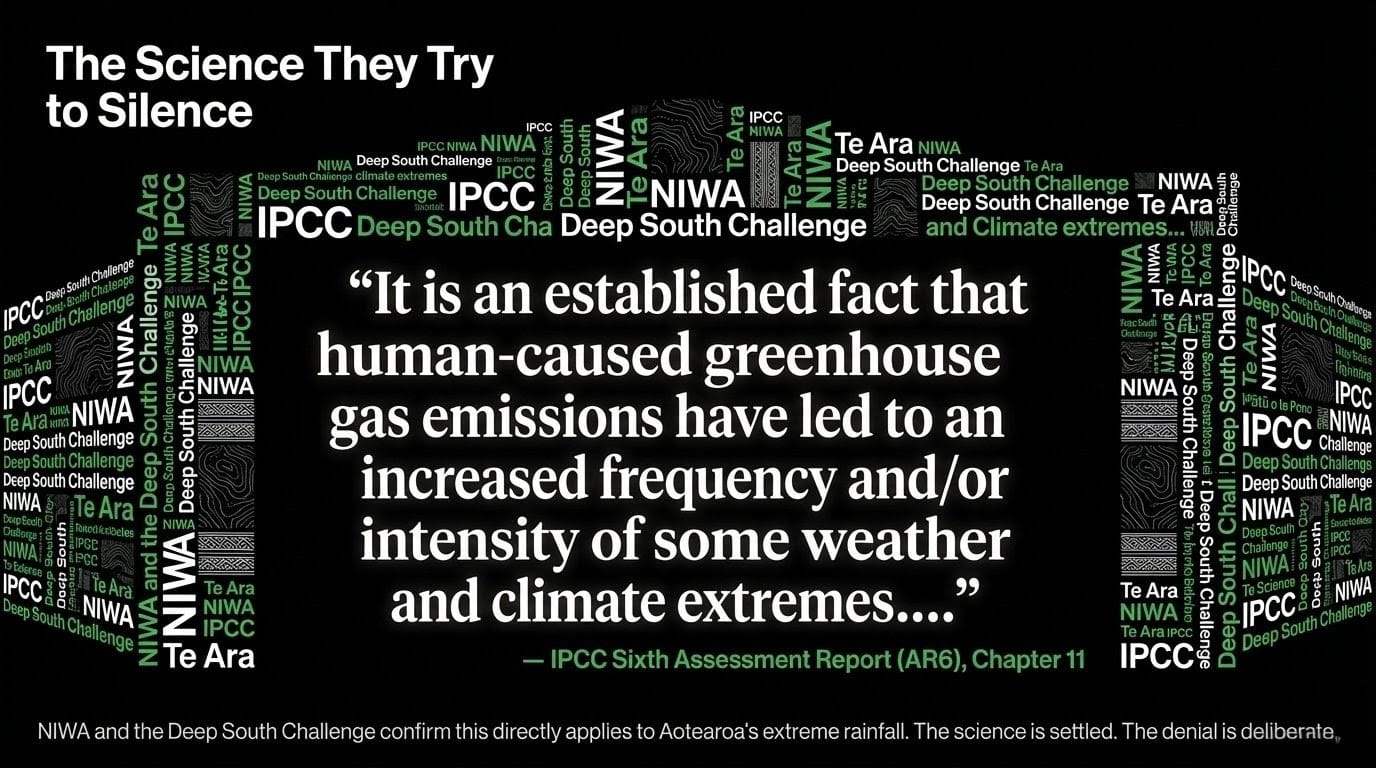
Let us be brutal about this: the evidence Plunket demanded she recite on the spot is not hidden. It is not contested at the mainstream scientific level. It is the settled conclusion of the most comprehensive climate science process in human history.
The IPCC Sixth Assessment Report, Chapter 11 states it is an "established fact" — those are the report's own words — that human-caused greenhouse gas emissions have increased the frequency and/or intensity of some weather and climate extremes since pre-industrial times. This includes extreme precipitation, heatwaves, droughts, and compound events.
NIWA confirms that a warmer atmosphere holds more moisture, increasing the potential for more intense rainfall events in New Zealand specifically. The Deep South Challenge's national guidance on changing rainfall extremes confirms that extreme rainfall is becoming more intense across Aotearoa as a direct consequence of human-induced climate change, and will continue to do so.
Te Ara — the Encyclopaedia of New Zealand states that scientists cannot reproduce the warming observed since 1950 without increased carbon dioxide concentrations. This is not fringe. This is the mainstream of international science applied to the specific geography of this land.
Plunket's claim that Dr Karetai was "educating children on a lie" is itself a lie — and a more dangerous one, because it is broadcast to an audience that trusts it.
Three Examples for the Western Mind: What This Climate Denial Actually Costs
Plunket performs his climate denial as though it were merely an academic disagreement. It is not. It has a body count. Here are three verified, quantified examples that demonstrate what happens when climate education is suppressed and climate action is delayed.
Example One: Cyclone Gabrielle — The Bill Plunket Won't Pay
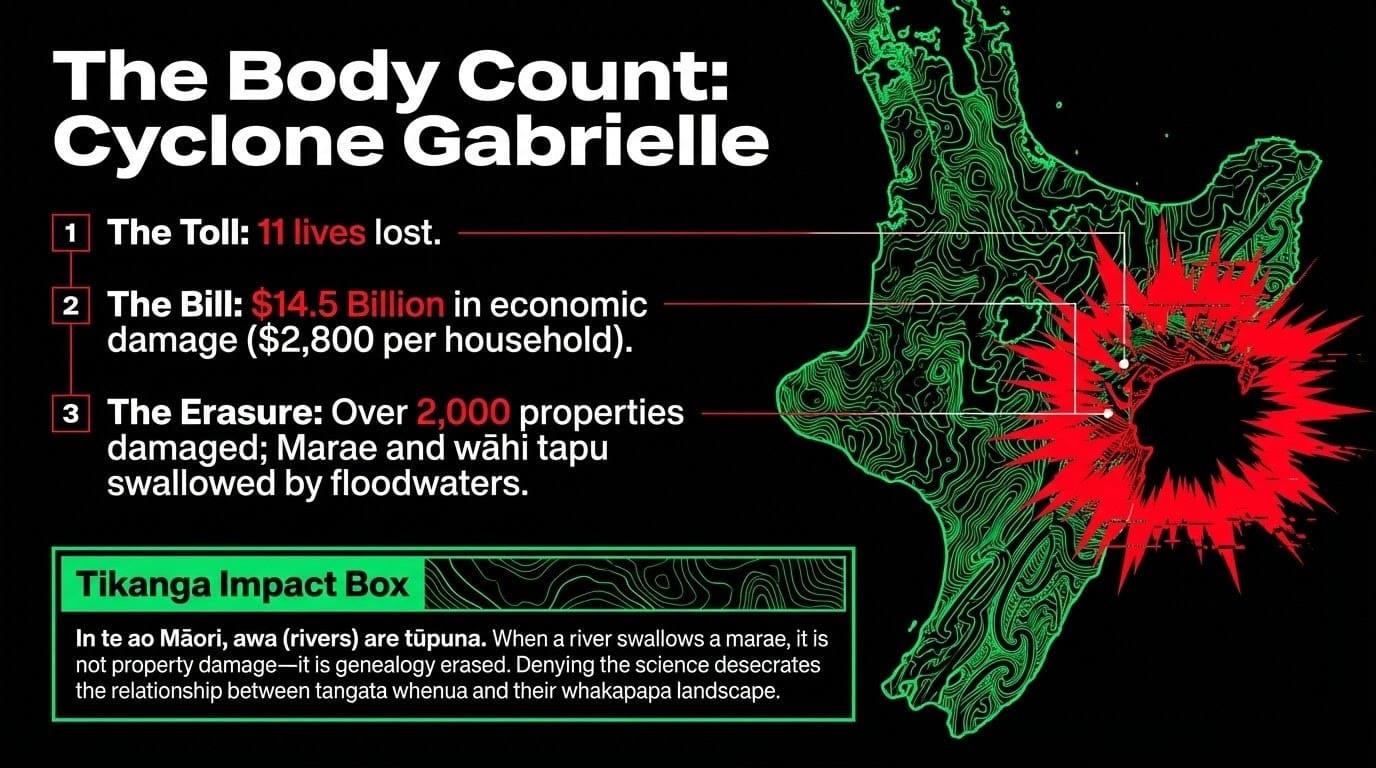
In February 2023, Cyclone Gabrielle struck Aotearoa with a ferocity that the Ministry for the Environment directly attributed to intensification by climate change. It killed 11 people. It caused over $14.5 billion in economic damage — roughly $2,800 per New Zealand household. In Hawke's Bay alone, over 2,000 properties were damaged or destroyed. Māori communities were disproportionately impacted: Ngāti Pāhauwera, Ngāti Kahungunu, and other hapū in Esk Valley and Te Whanganui-a-Orotū lost marae, wāhi tapu, and irreplaceable cultural infrastructure. The Cyclone Recovery Independent Monitoring Group found Māori faced systemic barriers in accessing recovery funding — barriers that compounded existing Crown neglect.
The solution: Climate-ready infrastructure investment in Māori rohe. Early warning systems co-designed with mātauranga Māori. Flood plain management that respects kaitiakitanga over river systems — not RMA fast-tracking of drainage projects that destroy wetland ecosystems critical to flood mitigation.
The Tikanga impact: In te ao Māori, awa — rivers — are tūpuna. They carry the names of ancestors. When the Ngaruroro breaks its banks and swallows a marae, it is not merely property damage. It is genealogy erased. It is the physical memory of a people destroyed. Plunket's denial is not just scientifically wrong. In tikanga terms, it desecrates the relationship between people and their whakapapa landscape.
Example Two: Māori Children Breathing Toxic Air — The Asthma-Climate Link
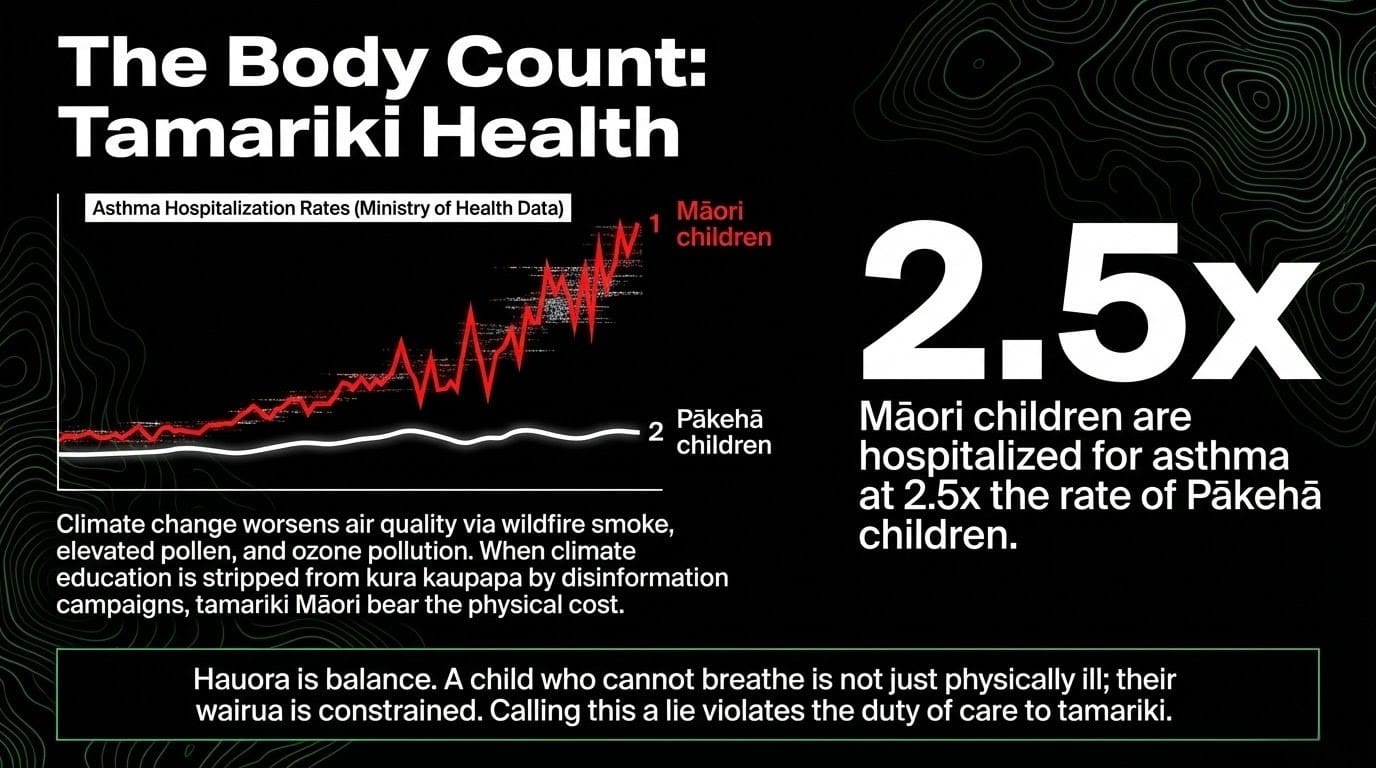
Climate change worsens air quality through increased wildfire smoke, elevated pollen counts, and ozone pollution. The IPCC AR6 explicitly links warming to increased respiratory disease burden. In New Zealand, Māori children are hospitalised for asthma at 2.5 times the rate of Pākehā children — a disparity rooted in housing deprivation, poverty, and environmental exposure to poor air quality. The Ministry of Health's own data shows Māori asthma hospitalisation rates are consistently and significantly elevated across every age group.
When climate education is stripped from schools — or discredited by broadcaster-led disinformation campaigns — the children who suffer are not the children of talkback radio hosts in Wellington. They are tamariki Māori in Northland, in South Auckland, in the East Coast. They are the children Dr Karetai was trying to teach.
The solution: Culturally grounded climate education in kura kaupapa and mainstream schools, taught by educators like Dr Karetai, that connects climate science to the lived reality of Māori communities. Expand Healthy Homes standards. Fund rongoā Māori practitioners as front-line climate health responders.
The Tikanga impact: In tikanga, hauora — health — is not the absence of disease. It is the balance of te taha wairua (spiritual dimension), te taha hinengaro (mental dimension), te taha tinana (physical dimension), and te taha whānau (family dimension). A child who cannot breathe is not just physically ill. Their wairua is constrained. Their ability to participate in whānau, in hapū, in the life of the community is diminished. Climate harm is tikanga harm. Calling it a lie is a violation of the duty of care that every adult holds toward tamariki.
Example Three: The LNG Terminal — Taxing Whānau to Destroy Their Future
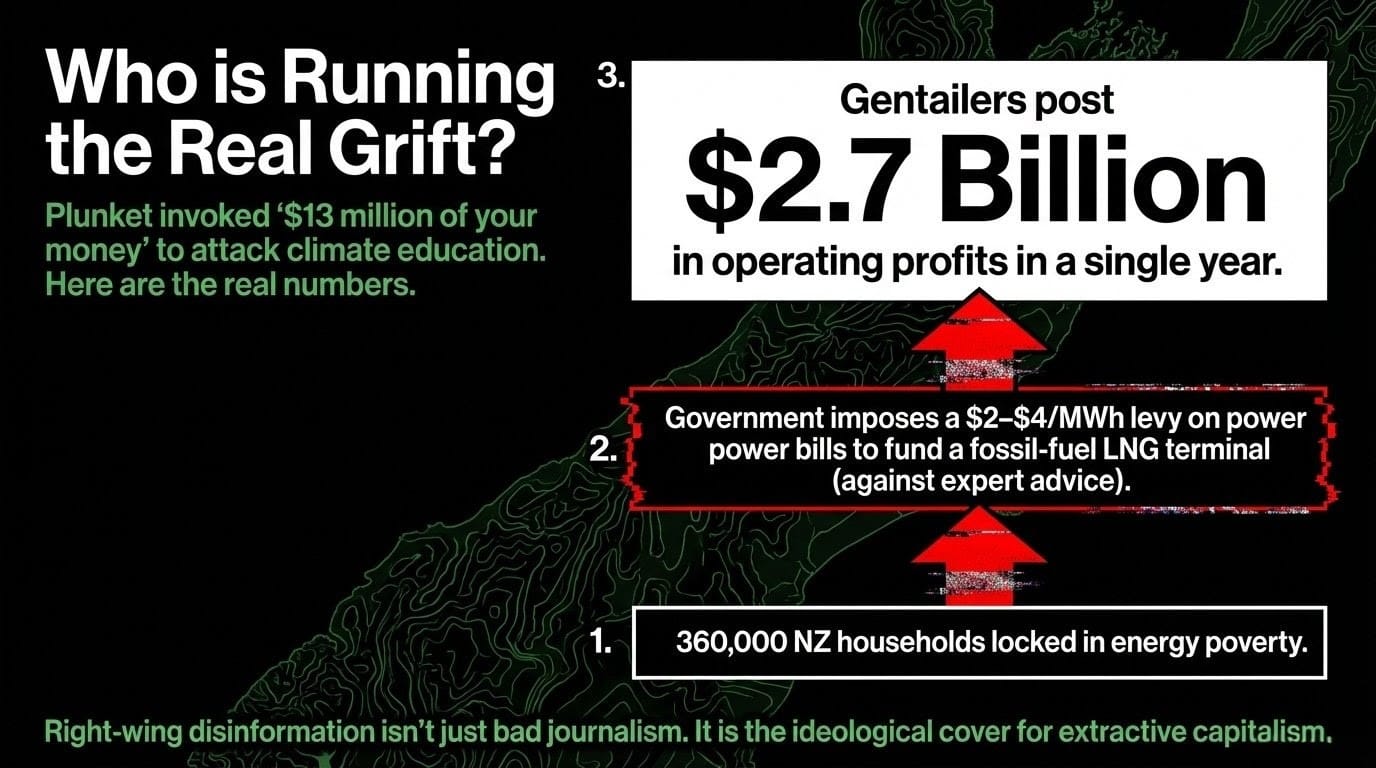
This government is currently imposing a $2–$4 per megawatt-hour levy on every power bill in the country to build a billion-dollar fossil fuel import terminal — the very kind of infrastructure that climate education warns against. The same government's own expert, Frontier Economics, said this made "no economic sense". The same government ignored that advice. Meanwhile, Māori households experience 15% electricity payment pressure compared to 10% nationally. An estimated 360,000 New Zealand households are in energy poverty. As this essay documented in The Three-Headed Taniwha, New Zealand's gentailers posted $2.7 billion in combined operating profits in a single year while 40,000 households were disconnected from power.
This is the government that calls Dr Karetai's climate education a "grift."
The solution: Iwi-led renewable energy development on Māori-owned land. Geothermal, wind, and solar investment that creates energy independence and jobs in rohe. A windfall profits levy on gentailers to fund energy hardship subsidies for whānau in need.
The Tikanga impact: Kaitiakitanga — guardianship of the natural world — is not optional for tangata whenua. It is constitutional. It is written into the Resource Management Act as the exercise of guardianship by tangata whenua in accordance with tikanga Māori in relation to natural and physical resources. When the Crown imports liquefied fossil gas rather than investing in the renewable resources that exist on and around Māori ancestral lands, it violates kaitiakitanga at the level of state policy. Plunket's climate denial provides the ideological cover that makes this violation possible. He is not a neutral commentator. He is infrastructure.
What The Platform Is, and Why It Matters
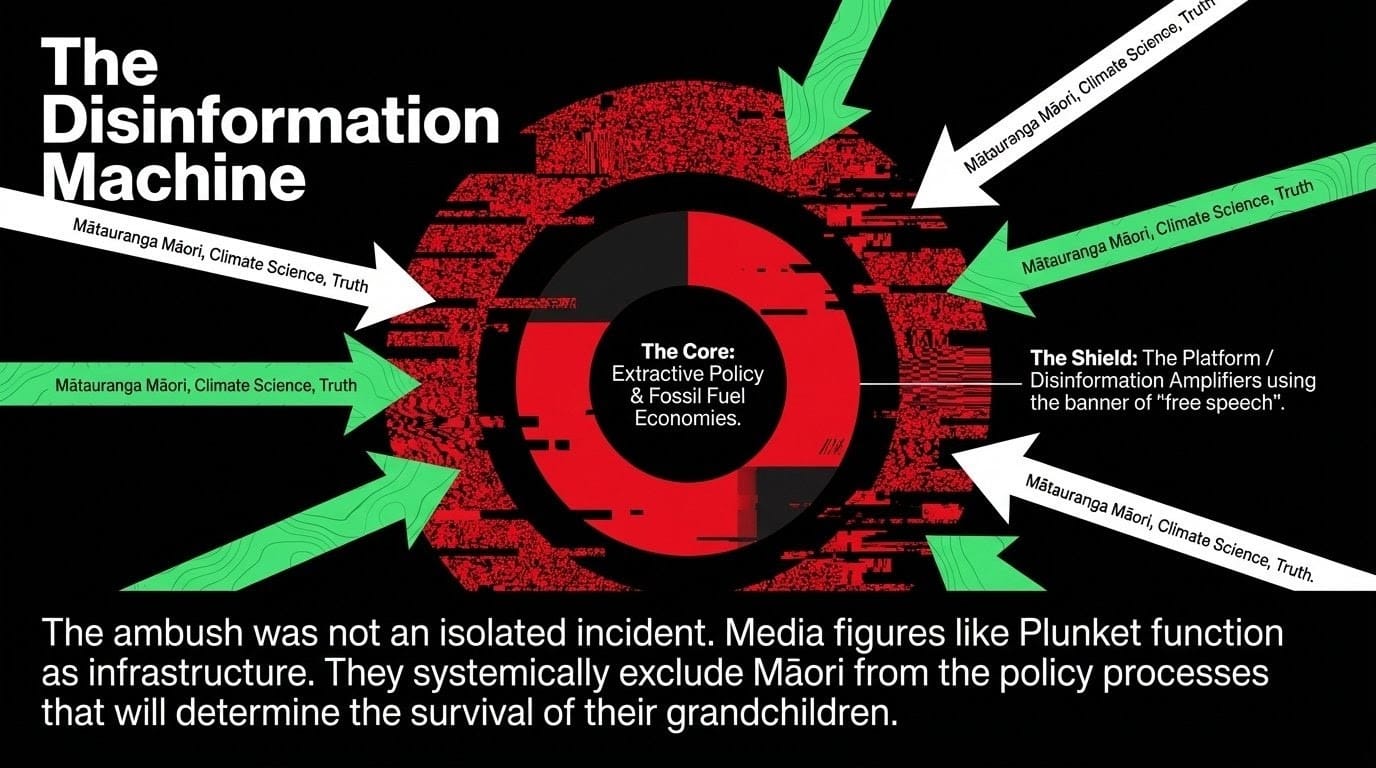
The Platform is not a media organisation in any meaningful sense. It is a disinformation amplifier that has consistently platformed climate denial, anti-Māori rhetoric, and anti-science talking points under the banner of "free speech." Its founding backer, Wayne Wright Jr., exited in 2025. Its broadcasting standards accountability remains contested as the BSA fights to establish jurisdiction over online content. Without accountability, there is no floor. Every Māori guest who appears on The Platform does so at the risk of exactly what happened to Dr Karetai: a pre-planned ambush designed to generate a clip, not a conversation.
Plunket's rhetoric — "the grift they have created," "educating children on a lie" — is not analysis. It is the language of a man who has spent his career losing ERA cases, breaching broadcasting standards, and targeting Māori voices with a megaphone the public has had no say in handing him.
The Wider Pattern: What The Māori Green Lantern Has Already Exposed
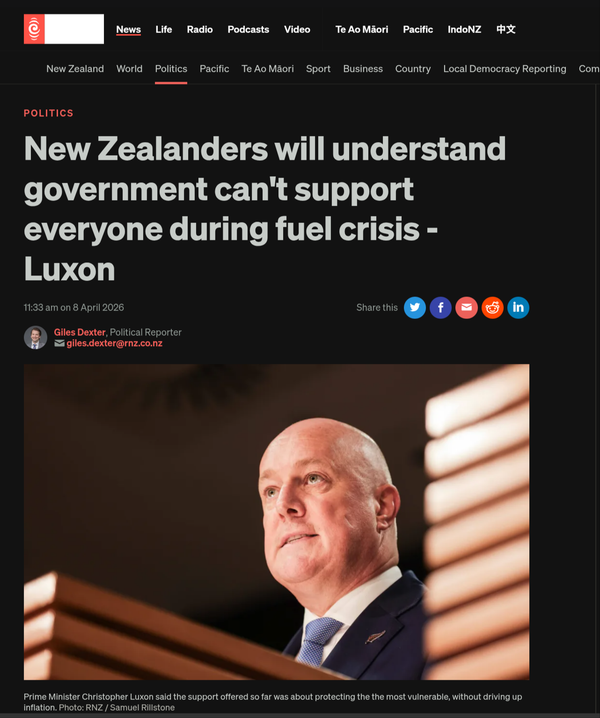
This ambush does not exist in isolation. It is a single episode in a systematic pattern of this government and its media allies using disinformation to protect colonial-extractive policy from Māori challenge. As The Three-Headed Taniwha documented in February 2026, the same Luxon government that Plunket implicitly defends is taxing whānau in energy poverty to fund a fossil fuel terminal that its own experts said made no economic sense — while 282,370 power disconnections hit households in a single ten-month period. As The Empty Kete exposed on 7 April 2026, this is a government that celebrates shrinking hunger queues after legislating most people out of eligibility for food assistance.
The climate denial Plunket peddles is not a standalone opinion. It is the ideological spine of a government that has gutted climate adaptation funding, subsidised fossil fuel infrastructure, and systematically excluded Māori from the policy processes that will determine whether their grandchildren inherit a liveable land.
Dr Karetai was right to hang up. The appropriate response to a man who calls your science a grift and your mahi a lie is not to educate him. He knows exactly what he is doing. The appropriate response is to name him, expose the pattern, and continue the work he is trying to stop.
Dr Mawera Karetai: The Target Is the Work
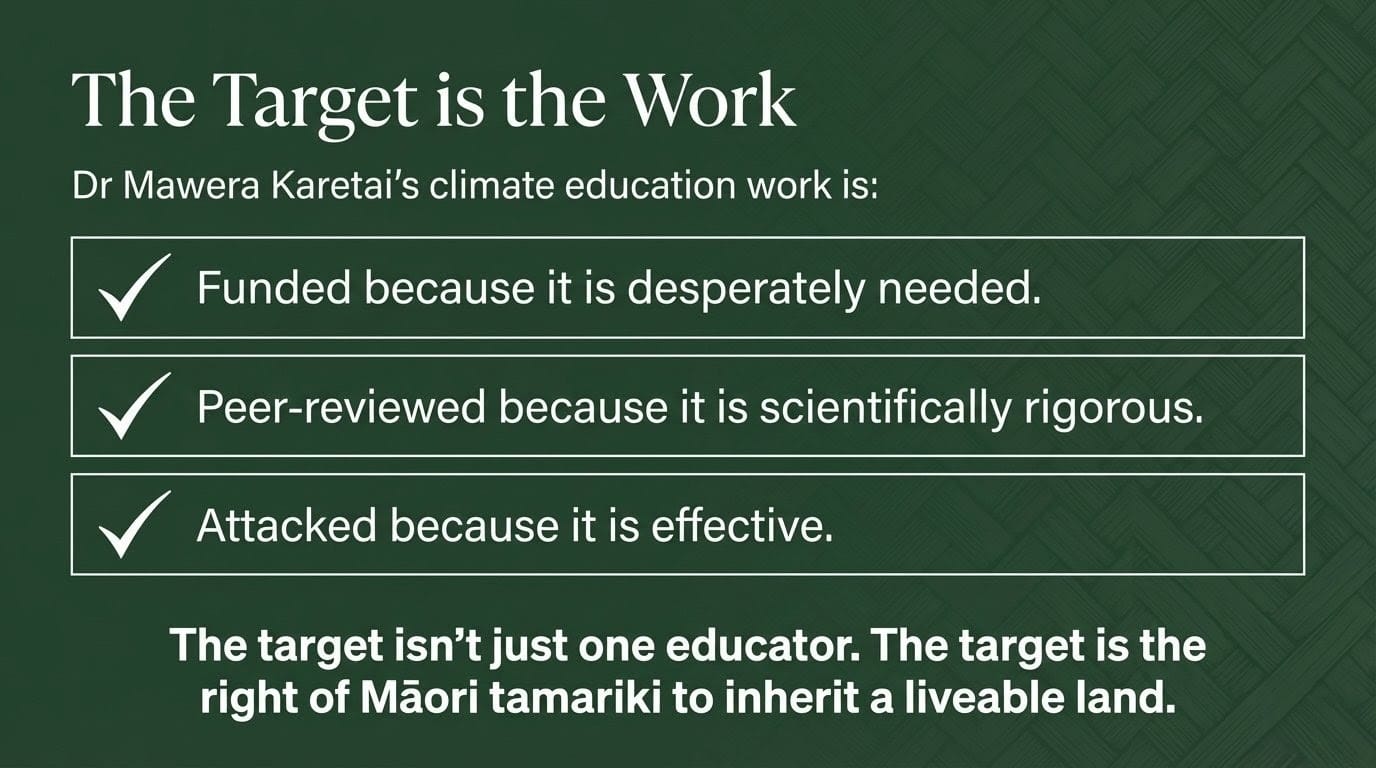
Dr Mawera Karetai (Kai Tahu, Kāti Mamoe, Waitaha) is the project lead for a climate change education initiative reaching New Zealand schools. The work she leads is funded because it is needed, peer-reviewed because it is rigorous, and attacked because it is effective. The children she is trying to reach are the same children who will inherit Cyclone Gabrielle's successor — a storm that will be worse, not better, because the Plunkets of this world spent 2026 calling the science a grift instead of asking how we protect tamariki.
She deserved better than what The Platform gave her. So do the children she teaches.
The Taiaha Speaks Plainly
Plunket is not brave. He is not provocative. He is a man with a microphone and a BSA record, serving an ideological function for a government that cannot afford for climate science to reach Māori children without being first discredited. His ambush of Dr Karetai was not journalism. It was an act of epistemic violence — the deliberate, public destruction of a knowledge holder's credibility in service of a political agenda that will cost whānau lives.
The IPCC says it. NIWA says it. The Deep South Challenge says it. Te Ara says it. The science is not missing. It is inconvenient — to The Platform, to The Luxon Government, and to the fossil fuel economy they are both defending.ipcc+3
Plunket called Dr Karetai's work a grift.
$14.5 billion in Cyclone Gabrielle damage. $2.7 billion in annual gentailer profits while 360,000 households are in energy poverty. A billion-dollar fossil fuel terminal taxed onto every New Zealand power bill against the advice of the government's own experts.
Tell us again who is running the grift.
Koha Consideration
Sean Plunket gets a studio, a broadcast infrastructure, and the ideological backing of a neoliberal media ecosystem to call your climate educators liars. Dr Karetai gets hung up on. That asymmetry is not accidental — it is funded.
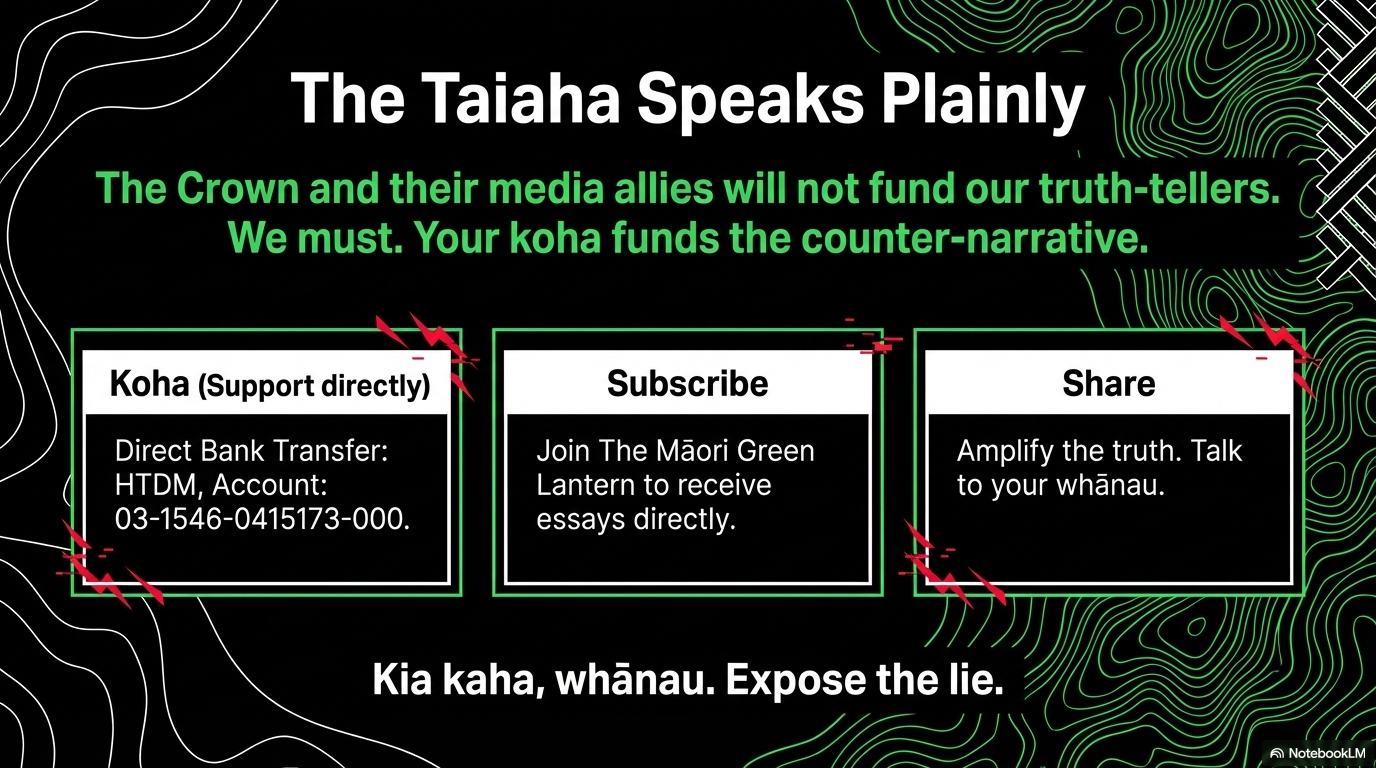
Your koha funds the counter. It funds the taiaha that names what The Platform will not: that climate denial is colonial policy dressed as commentary, and that Māori climate educators like Dr Mawera Karetai deserve a platform that does not ambush them, misname them, and call their life's work a grift.
Every koha signals that whānau are ready to fund our own truth-tellers — because the Crown, the corporations, and their media allies never will.
Kia kaha, whānau. Stay vigilant. Stay connected. And if you are able, consider a koha to ensure this voice continues.
If you are unable to koha, no worries — subscribe, follow, kōrero, and share with your whānau and friends. That is koha in itself.
Three pathways exist:
For those who wish to support this mahi directly: Koha — Support
For those who wish to receive essays directly: Subscribe to The Māori Green Lantern
For those who prefer direct bank transfer: HTDM, account number 03-1546-0415173-000
Research conducted 8 April 2026. Tools used: search_web, fetch_url. Sources consulted: IPCC AR6, NIWA, Deep South Challenge, Te Ara, RNZ, NZ Herald, Consumer NZ, BSA, The Platform, YouTube. All URLs verified at time of research.