"The Sinking Waka: How a $1.8 Million Retail Crime Theatre Collapsed Under the Weight of Its Own Scones" - 11 February 2025
They built a stage. They catered the performance - Then the actors walked out—and left the bill for whānau to pay

Tēnā koutou katoa e te whānau. Kia ora tātou. Thank you for trusting me to continue to tell you the truth on our new kainga ghost.org.
The Smoking Gun
Picture this: a waka, freshly carved and gleaming, launched with great fanfare onto waters the government promised were safe. The Justice Minister stands at the prow, pointing toward a horizon labelled "Law and Order." The chairman sits amidst platters of rock melon, goat's cheese, and prosciutto crostini. The crew—five retail professionals who actually know these waters—are told to paddle in whatever direction the chairman dictates.
Within months, three of the five crew members jump overboard. The waka lists badly. And the captain declares this a "pragmatic" decision to come ashore early.
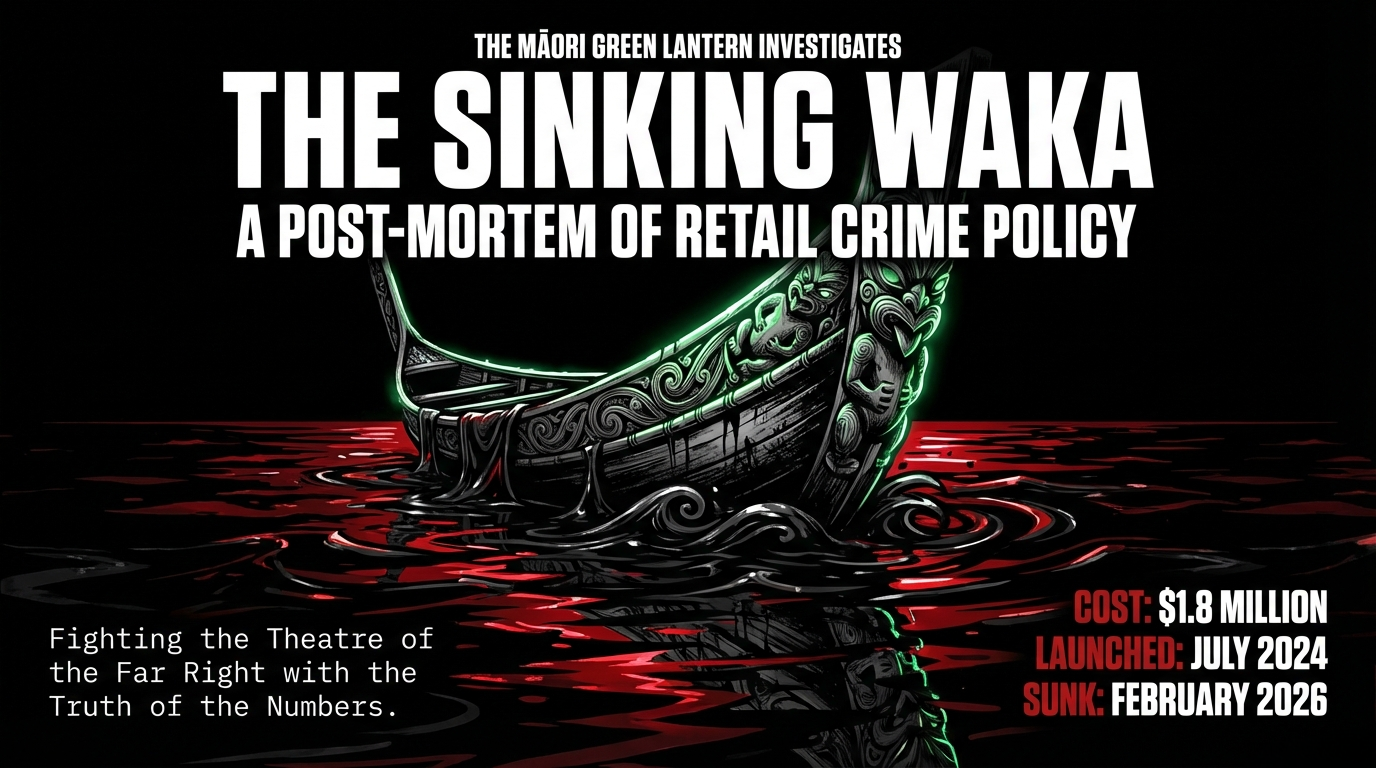
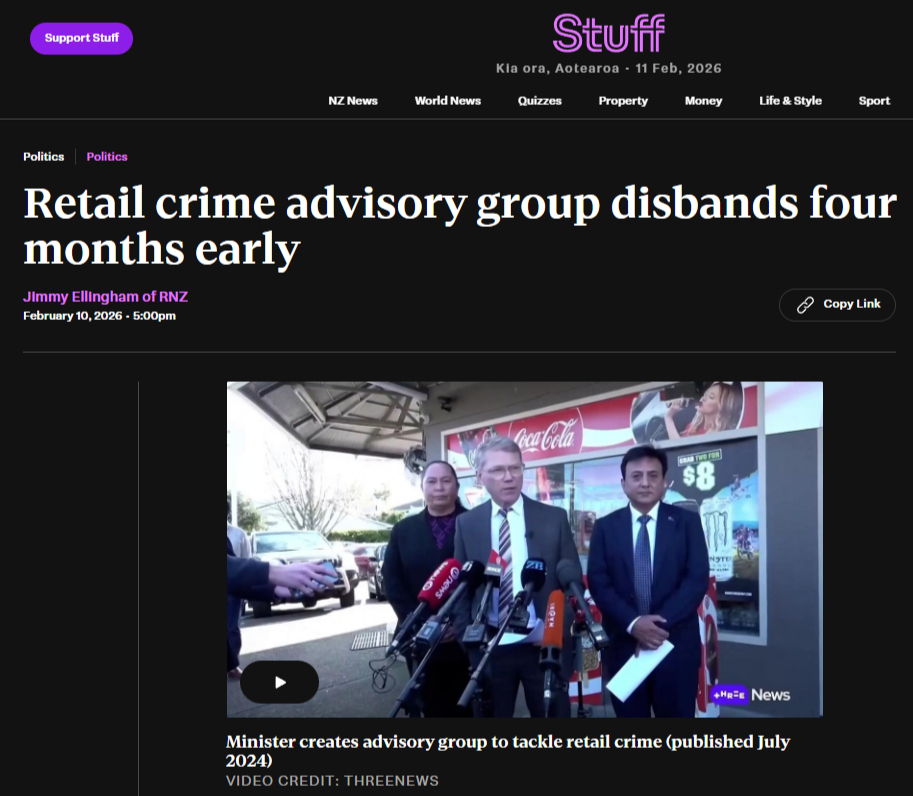
On 9 February 2026, Justice Minister Paul Goldsmith confirmed that the Ministerial Advisory Group for Victims of Retail Crime would disband four months early, after three of its five members resigned in what can only be described as a professional exodus from a sinking ship. The group, established in July 2024 with a $1.8 million annual budget drawn from the Proceeds of Crime Fund, was supposed to run for two years until September 2026. It couldn't even survive eighteen months.
This wasn't a group that "completed its work early," as Goldsmith and chairman Sunny Kaushal would have you believe. This was a political vanity project that cost $507,468.71 in just its first 100 days, produced policy recommendations that the government's own Ministry of Justice said were "unlikely to materially improve public safety", and created an environment so toxic that the nation's leading retail voice called it "a very unpleasant environment" and walked away.
This essay traces the rot—from the catered crostini to the pepper spray proposals—and exposes the five hidden connections this government does not want you to see.
Background: The Stage Was Set Before the Curtain Rose
The Architecture of a Performance
In July 2024, the coalition government announced the creation of the Ministerial Advisory Group with the solemnity of a tangi, as though retail crime were a force of nature that had descended upon innocent Aotearoa from nowhere. The stated purpose: provide "expert advice" on combating retail crime.
The cast:
- Chair: Sunny Kaushal — former head of the Dairy and Business Owners Group, a man who had been pitching the same ideas to Labour for free and been told they were dangerous
- Carolyn Young — Retail NZ chief executive (resigned January 2026)
- Lindsay Rowles — Foodstuffs North Island senior manager (resigned early 2026)
- Michael Bell — Michael Hill national retail manager (resigned late 2025)
- Ash Parmar — Hamilton liquor retailer (remained)
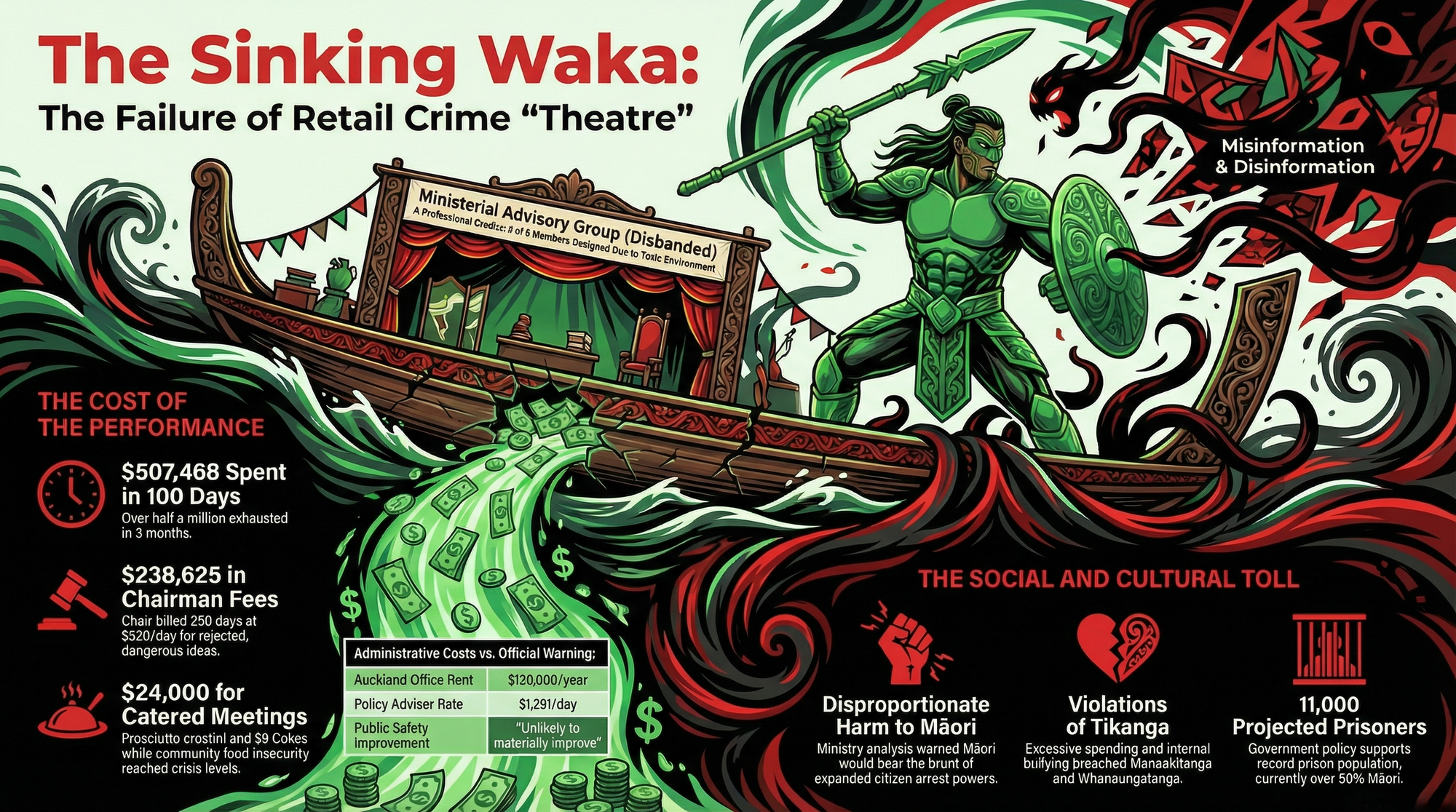
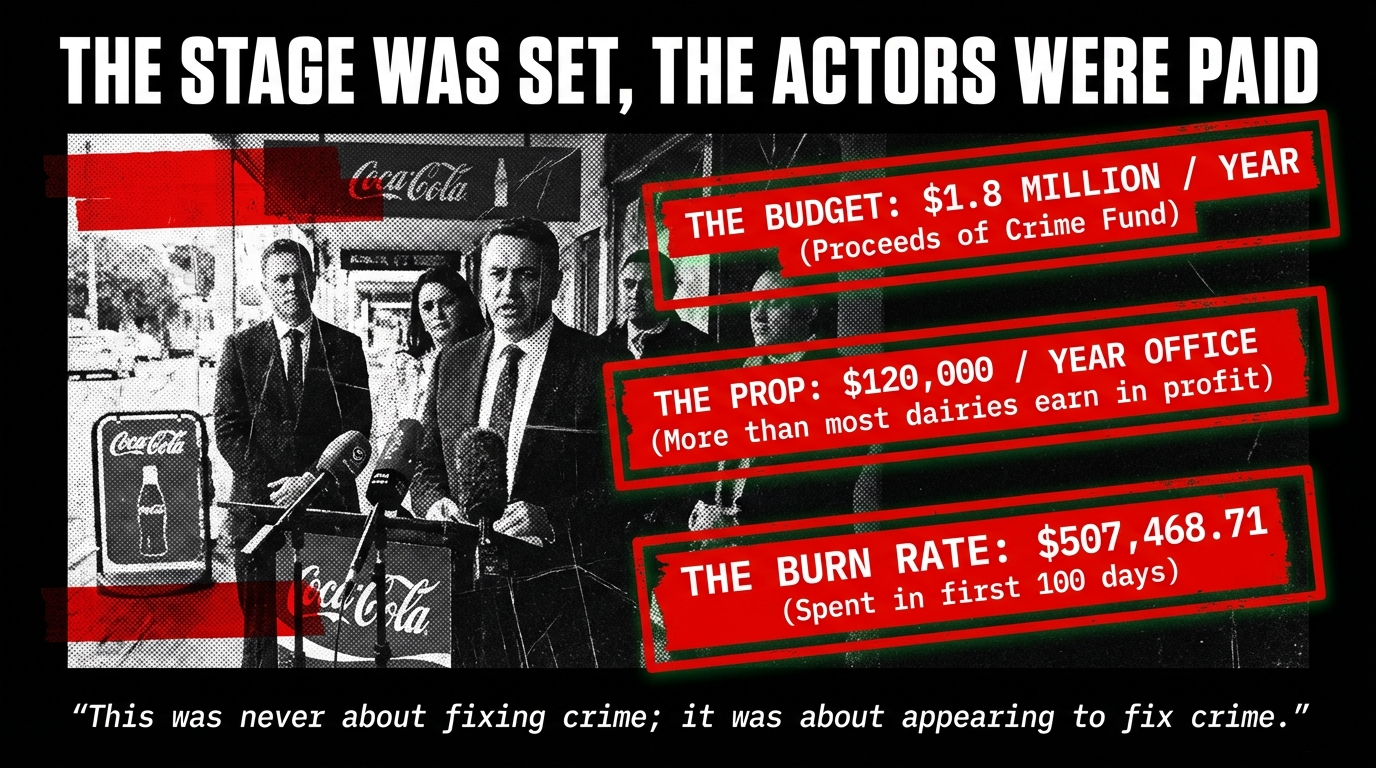
Five people. $1.8 million a year. A 389-square-metre inner-city Auckland office rented for $120,000 annually. Three principal policy advisers on contracts exceeding $1,000 per day each. A social media adviser. An administrator. A data analyst.
Example of the absurdity: A group supposedly fighting for dairy owners and small retailers operated from an office that cost more per year than most dairies earn in profit. The irony is a pūrākau in itself—the medicine costing more than the disease.
This was never about fixing retail crime. This was about manufacturing the appearance of fixing retail crime while the actual waka of community safety drifted further from shore.
The Issue: Deconstructing the Charade Through Mātauranga
The Metaphor: Treating a Broken Leg With a Taiaha
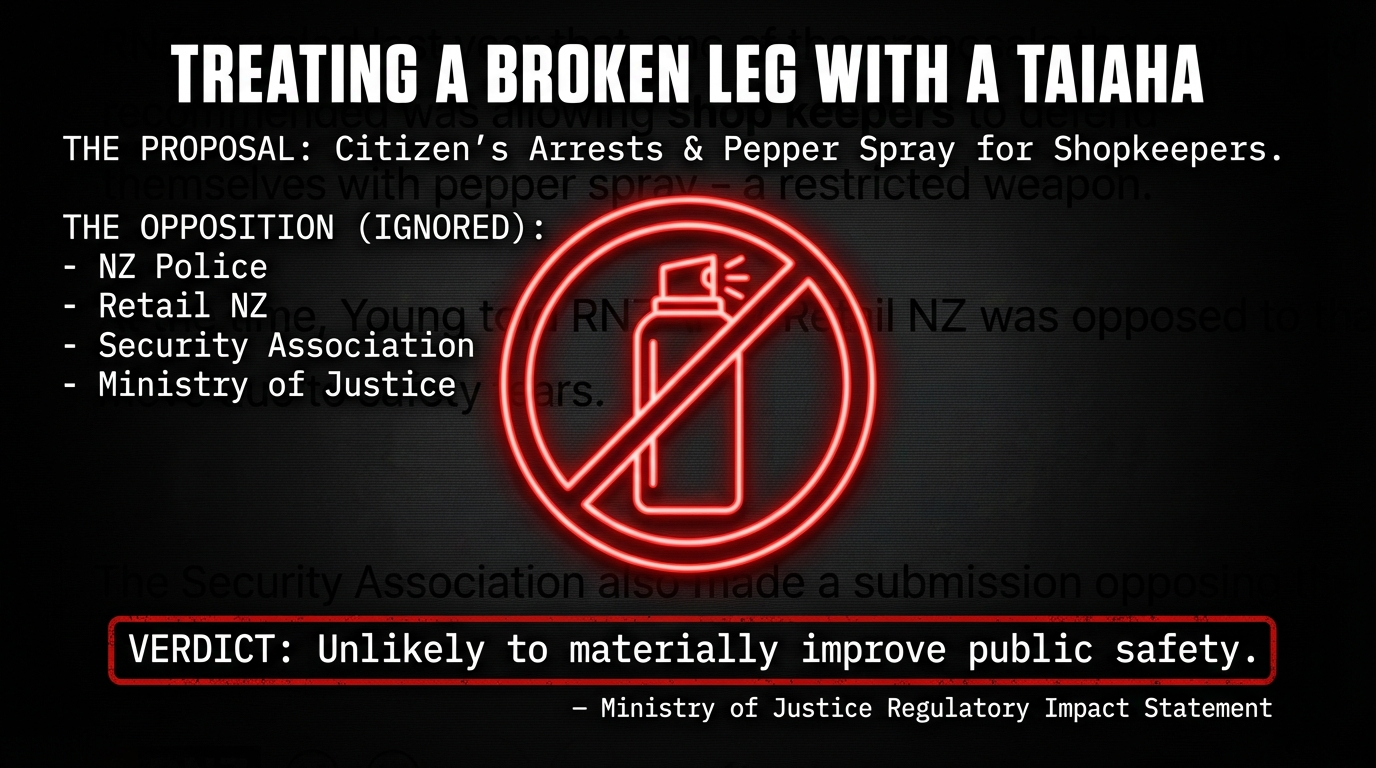
Imagine a whānau member collapses with a broken leg. The tohunga arrives, examines the patient, and prescribes: a taiaha for the neighbours to beat anyone who walks too close to the house.
This is the coalition government's retail crime strategy in its entirety.
Retail crime in Aotearoa costs an estimated $2.6 billion annually, affecting 92 percent of retailers. Those numbers are devastating. The question this government refuses to ask is: why?
The answer is poverty. The answer is a cost-of-living crisis so severe that New Zealand households have cut fruit and vegetable spending while supermarket duopolies post record profits. The answer is a food crisis that Waatea News described as "out of control", disproportionately devastating Māori and Pasifika whānau.
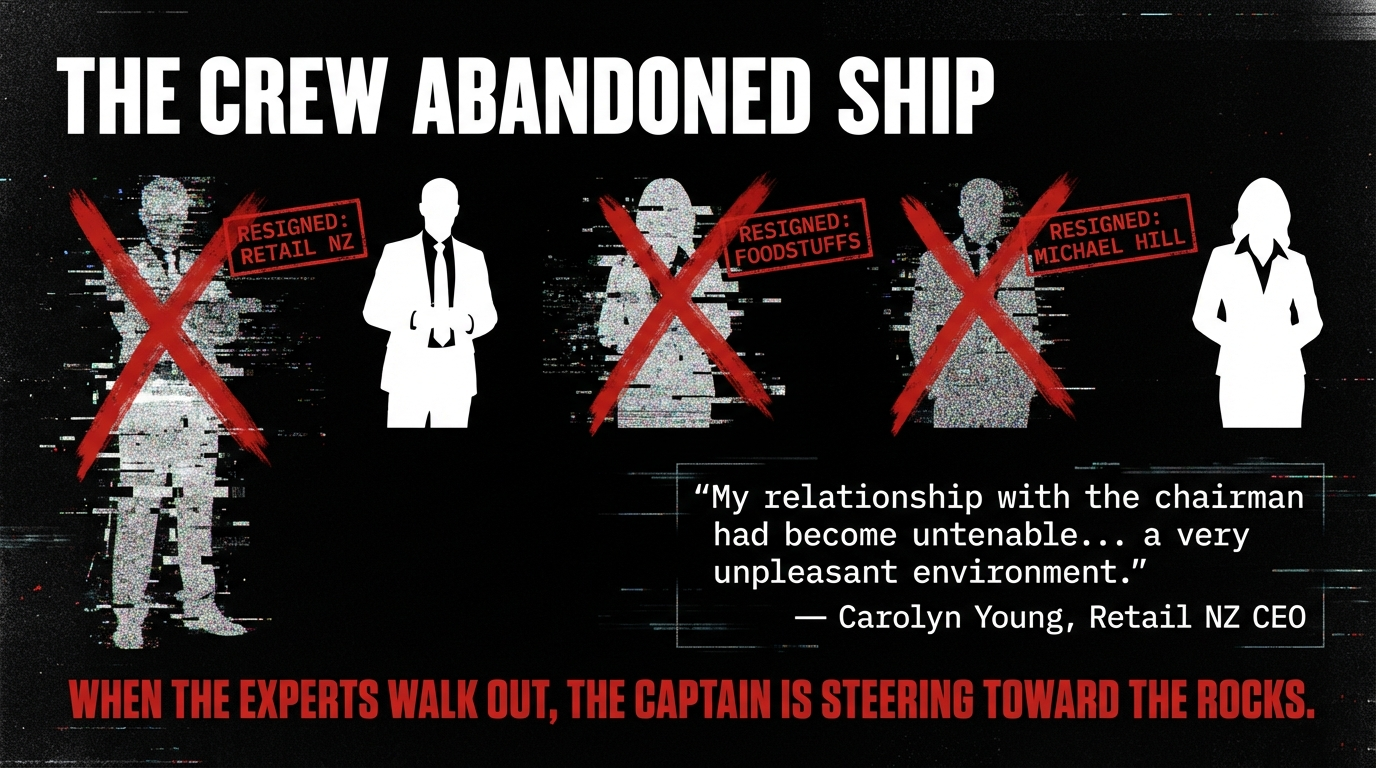
Even Retail NZ acknowledged that effective solutions required addressing "all aspects of a young person's life from attendance at school, access to healthcare when needed, appropriate housing and nutrition"—Carolyn Young's own words to the advisory group before she was driven out.
Youth advocate Aaron Hendry said it plainly: "We are leaving workers and poor people to fight it out on the street rather than actually responding appropriately".
But poverty doesn't make good headlines at election time. Pepper spray does.
Analysis: The Five Hidden Connections
Hidden Connection 1: The Chairman's $230,000 Pre-Scripted Performance
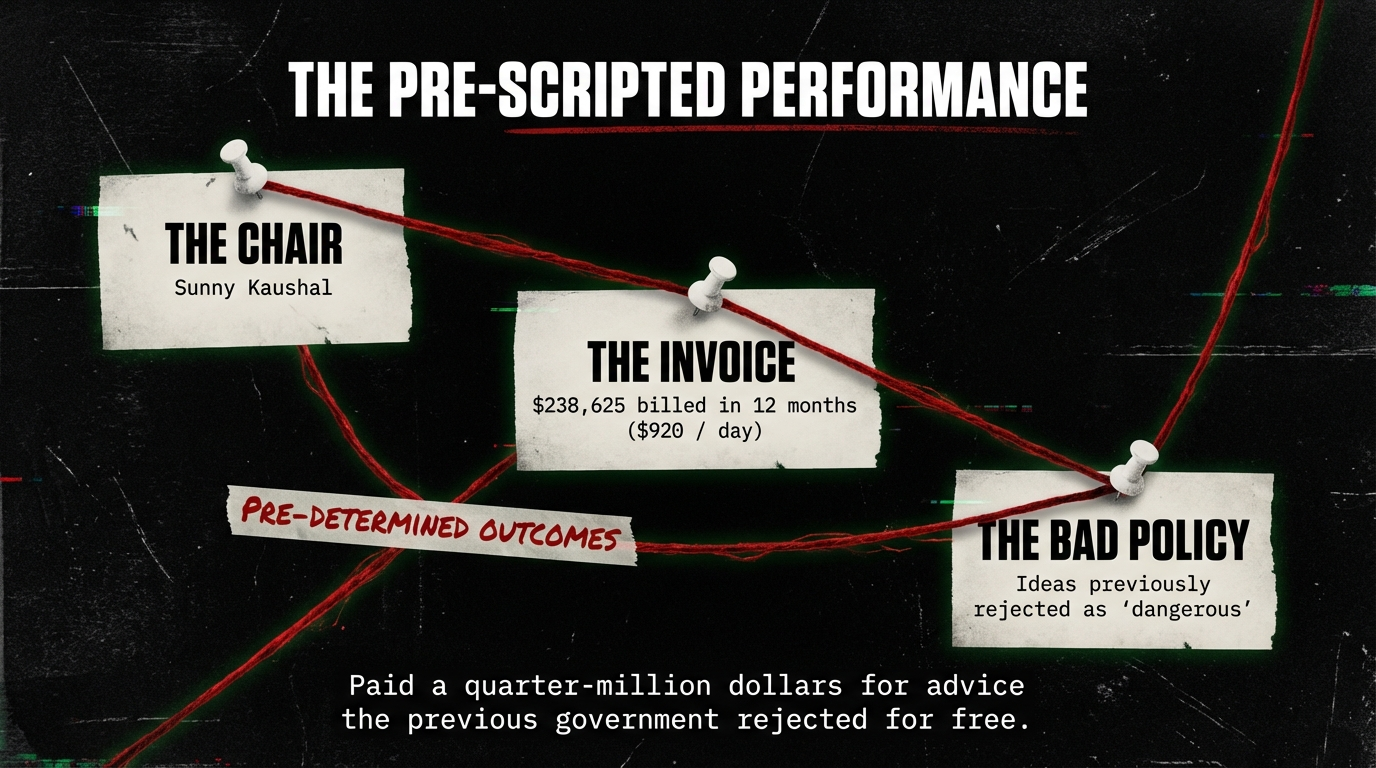
Kaushal invoiced $238,625 in his first 12 months as chair—billing for the maximum 250 days at $920 per day. He was paid a quarter of a million dollars to recommend ideas he had already been offering governments for free.
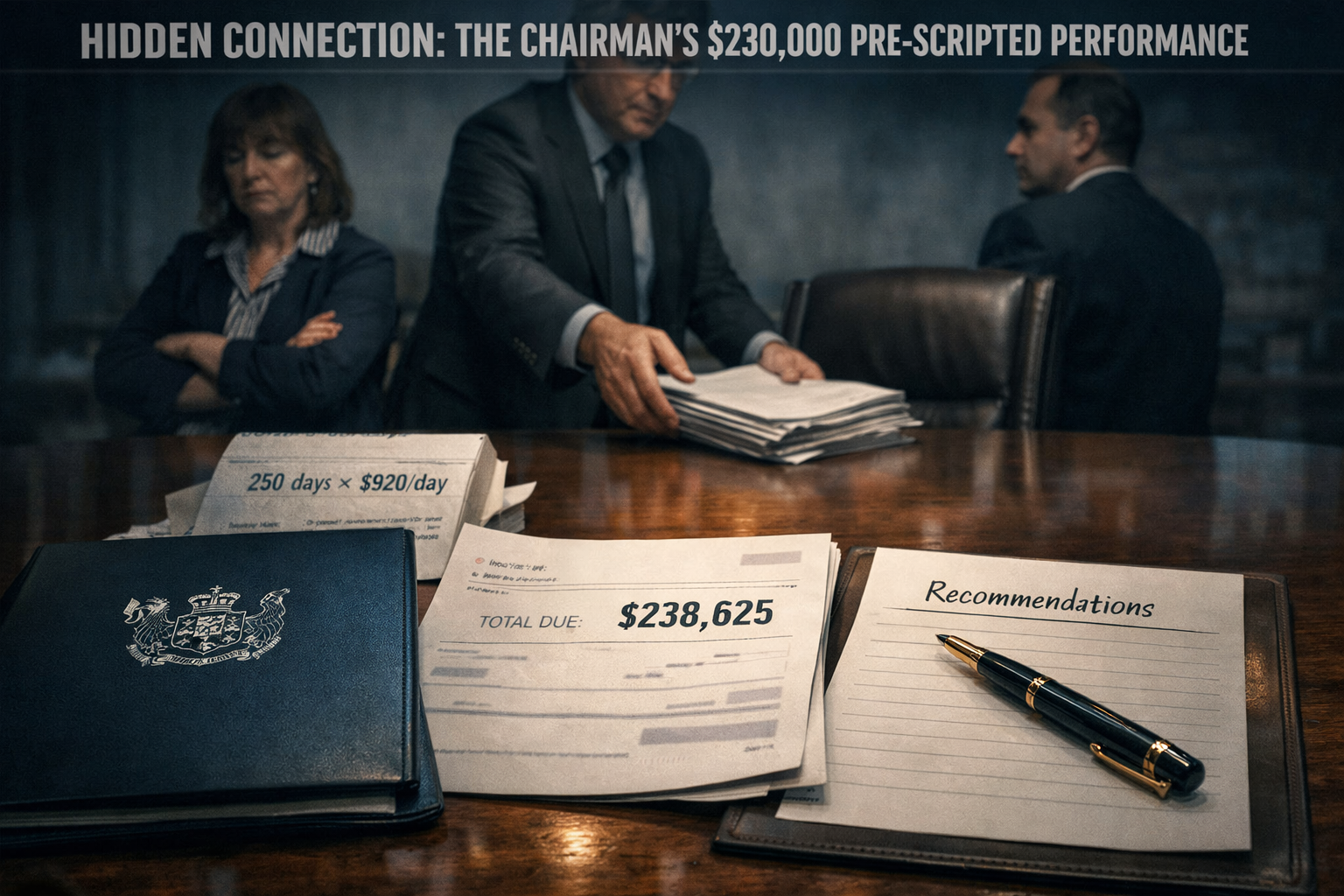
Example: Labour's police spokesperson Ginny Andersen confirmed Kaushal approached her when she was police minister with the same citizen's arrest proposals. Police advised they were dangerous. She rejected them. This government paid him $238,625 to write them down on government letterhead.
Carolyn Young, the woman who actually represented New Zealand's retail sector, said the group's outcomes were "pre-determined": "I think it's clear that a number of the majority of the pieces that were put forward to the group came from some pre-determined areas that Sunny wanted to have covered."
When Goldsmith was asked whether it was "uncharitable" to say Kaushal was being paid for ideas he'd given away for free, the minister actually used the word "uncharitable". The only thing uncharitable here is billing the Proceeds of Crime Fund a quarter of a million dollars for a predetermined script.
Quantified harm: $238,625 in chair fees alone. From a fund that is supposed to support victims of crime. Spent on a man whose behaviour prompted the Ministry of Justice to send secret advice to the minister about "concerning behaviour"—advice Goldsmith refuses to release, citing "legal privilege."
Hidden Connection 2: The Government's Own Analysis Says Its Policy Won't Work
This is the connection they bury deepest.
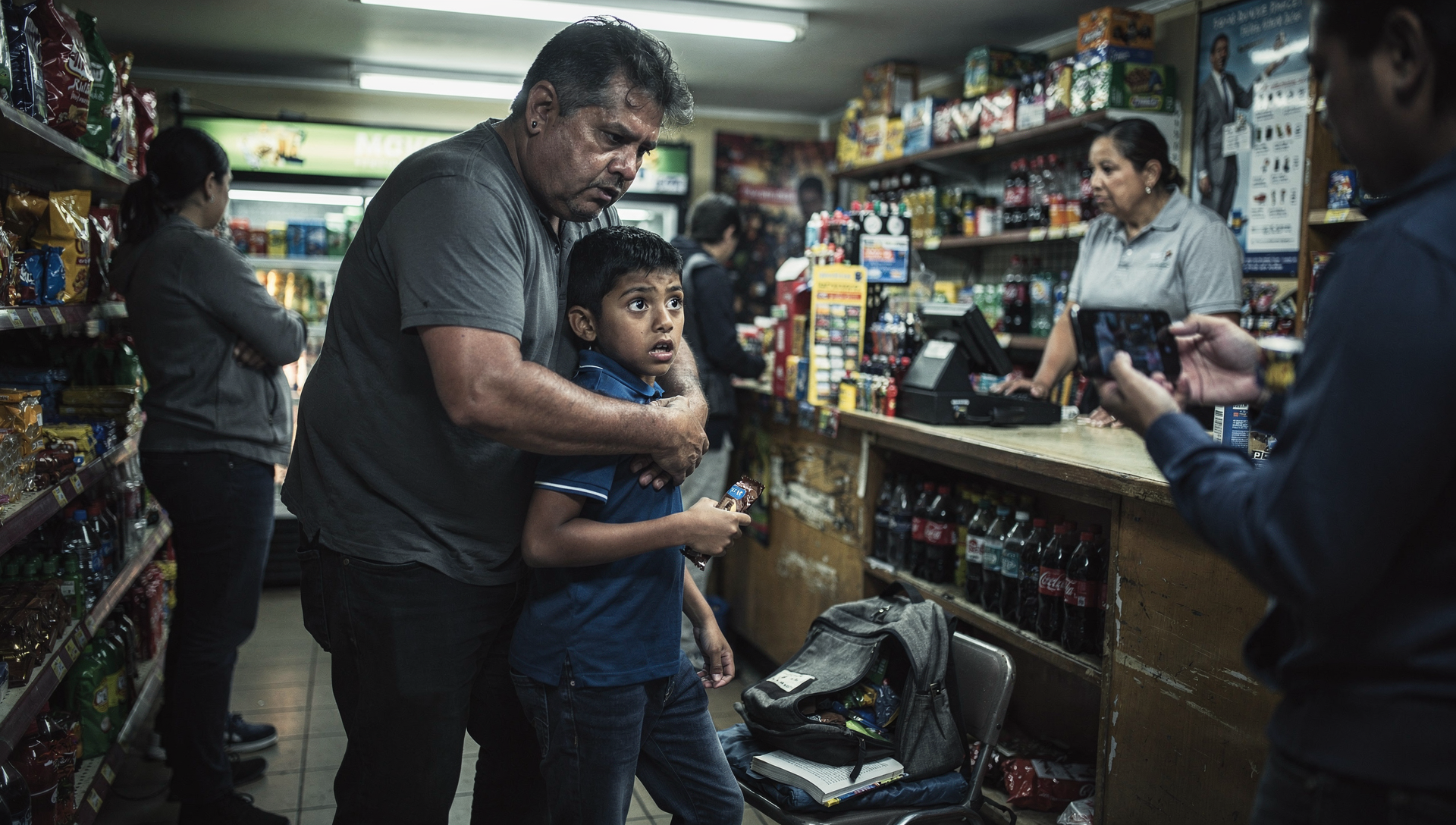
The Ministry of Justice's own Regulatory Impact Statement found the citizen's arrest changes were "unlikely to materially improve public safety". Not "might not." Not "could potentially not." Unlikely to materially improve public safety. The government's own analysts said the quiet part out loud, and the government bulldozed ahead anyway.
The same analysis warned that the changes "may lead to unreasonable use of force and unlawful detention" and flagged that children would be particularly vulnerable because they are "physically easier to restrain."
Example: Picture a 12-year-old Māori boy in a South Auckland dairy. He picks up a chocolate bar. Under this government's legislation, an untrained adult can now physically restrain that child—use "reasonable force"—detain him, and apply restraints. The Ministry of Justice itself warned this is "inconsistent with laws regulating the use of force on children and young people".
Police raised six specific concerns: inconsistent use of arrest powers, risk of unreasonable force, vulnerability of children, criminals targeting less-secure stores, citizens performing arrests where police wouldn't, and low-level theft escalating into serious violence. Six warnings. All ignored.
Police Association president Chris Cahill said: "It's not worth getting hurt, or even killed, for a few dollars or some cigarettes".
Quantified harm: The ministry's analysis was conducted under "limited time, a narrow scope, few options to consider and a lack of broader consultation"—meaning the government deliberately constrained the analysis to avoid hearing what it didn't want to know.
Hidden Connection 3: Māori Will Bear the Brunt—By Design
The Ministry of Justice stated explicitly: "Māori are more likely to be disproportionately impacted by these changes (if more arrests occur)".

This is not speculation. This is the Crown's own officials telling the Crown that its policy will disproportionately harm tangata whenua. And the Crown proceeded regardless.
Hāpai Te Hauora, the Māori public health organisation, laid out the devastating evidence:
- Māori are 11% more likely to be prosecuted than Pākehā for the same offences
- Police use force against Māori in 54% of cases, despite Māori making up only 16% of the population
- 72% of Māori believe there is racism within the New Zealand Police force
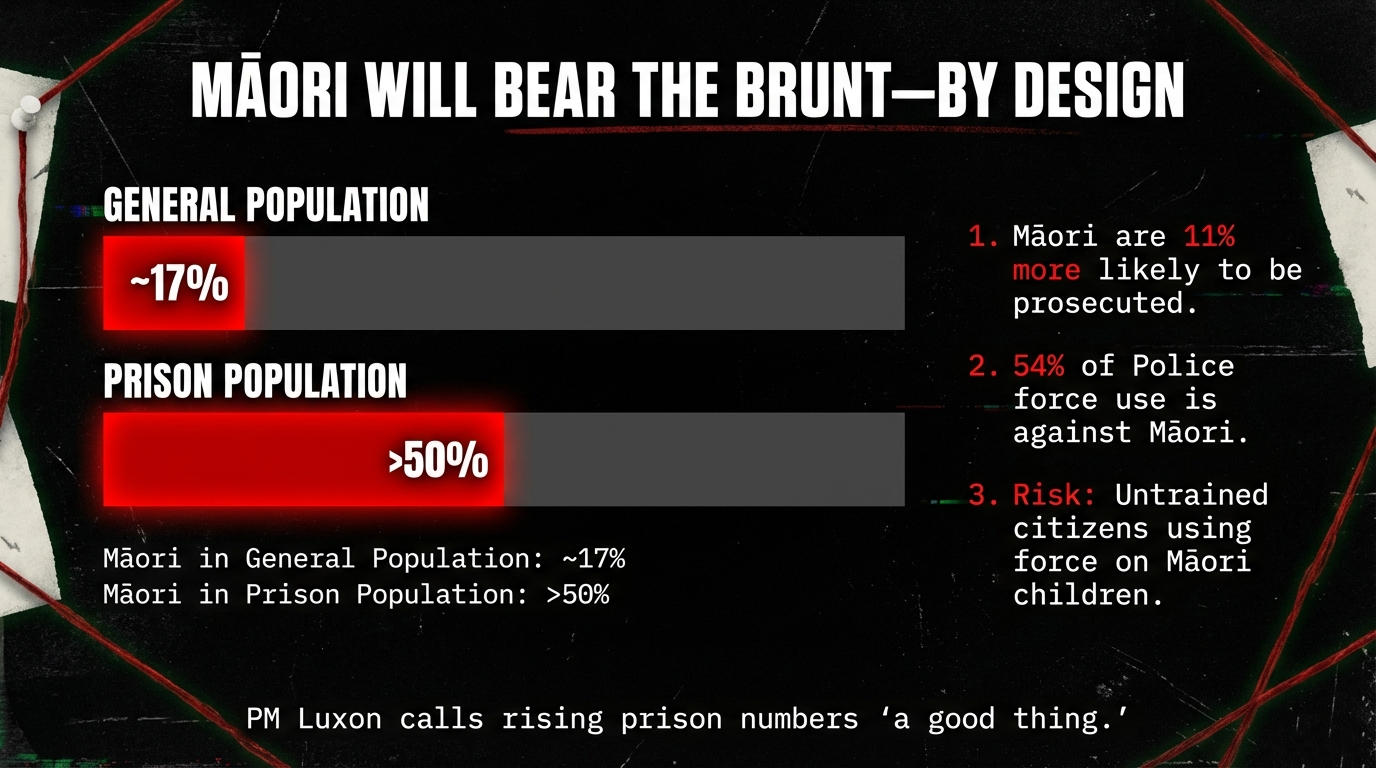
Now imagine those biases transferred from trained police officers to untrained civilians with no accountability, no de-escalation training, and legal cover to use "reasonable force." The University of Otago TIAKI study found Māori are already undercounted in prison data by approximately 405 people, and make up 52.3% of the prison population—rising to 56% when all reported ethnicities are counted—despite being only 17.8% of the general population.
Example: A Māori mother sends her teenager to the local supermarket. The teenager puts items in a bag, forgetting to scan one at the self-checkout. Under this government's regime, a store employee—armed with implicit bias and legal immunity for "reasonable force"—can physically detain that child. No police training. No de-escalation skills. No cultural competency. Just a green light from Paul Goldsmith and Sunny Kaushal.
Prime Minister Christopher Luxon called the resulting surge in prisoner numbers "a good thing". A prison population nearing 11,000—more than half Māori—and the Prime Minister celebrates. Former PM Bill English called mass incarceration "a moral and fiscal failure." This government calls it a campaign promise delivered.
Hidden Connection 4: The Crostini-to-Pepper Spray Pipeline
Follow the money and the menu.
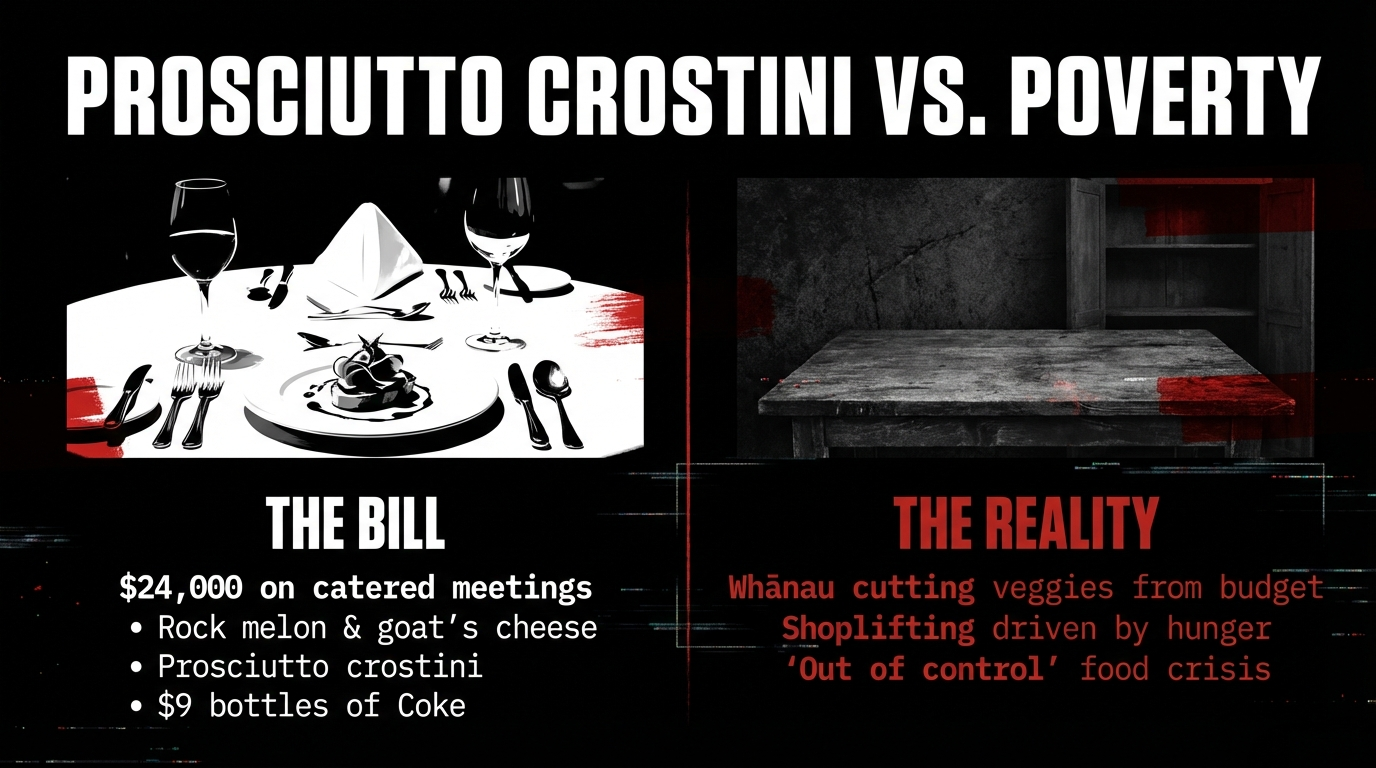
The advisory group spent $24,000 on catered meetings across 22 "stakeholder engagement" events. Two Auckland meetings cost more than $4,000 each. The menu featured rock melon, goat's cheese and prosciutto crostini, mini chicken and leek savouries, and $9 bottles of Coke.
Goldsmith himself admitted one event was "clearly over-catered" and "probably had too many scones".
Example: While the advisory group dined on prosciutto crostini, the Salvation Army reported a food crisis devastating whānau across the country. Children in South Auckland go to school hungry. Mothers choose between rent and kai. And the government's retail crime response team spends $9 on a single bottle of Coke from the Proceeds of Crime Fund.
But here's the pipeline nobody wants you to trace: those catered meetings produced a recommendation that shopkeepers should be allowed to defend themselves with pepper spray—a restricted weapon. Retail NZ opposed it. The New Zealand Security Association opposed it. Carolyn Young told RNZ the proposals would "put retailers in harm's way". The Employers and Manufacturers Association warned it "goes against the Health and Safety at Work Act".
From crostini to pepper spray. From $9 Cokes to restricted weapons in the hands of untrained retail workers. The waka wasn't just sinking—it was being deliberately steered onto rocks.
Hidden Connection 5: The Mass Exodus Was a Verdict
Three of five members resigned. This wasn't "normal leadership movement," as Kaushal claimed. This was a professional verdict on a broken process.
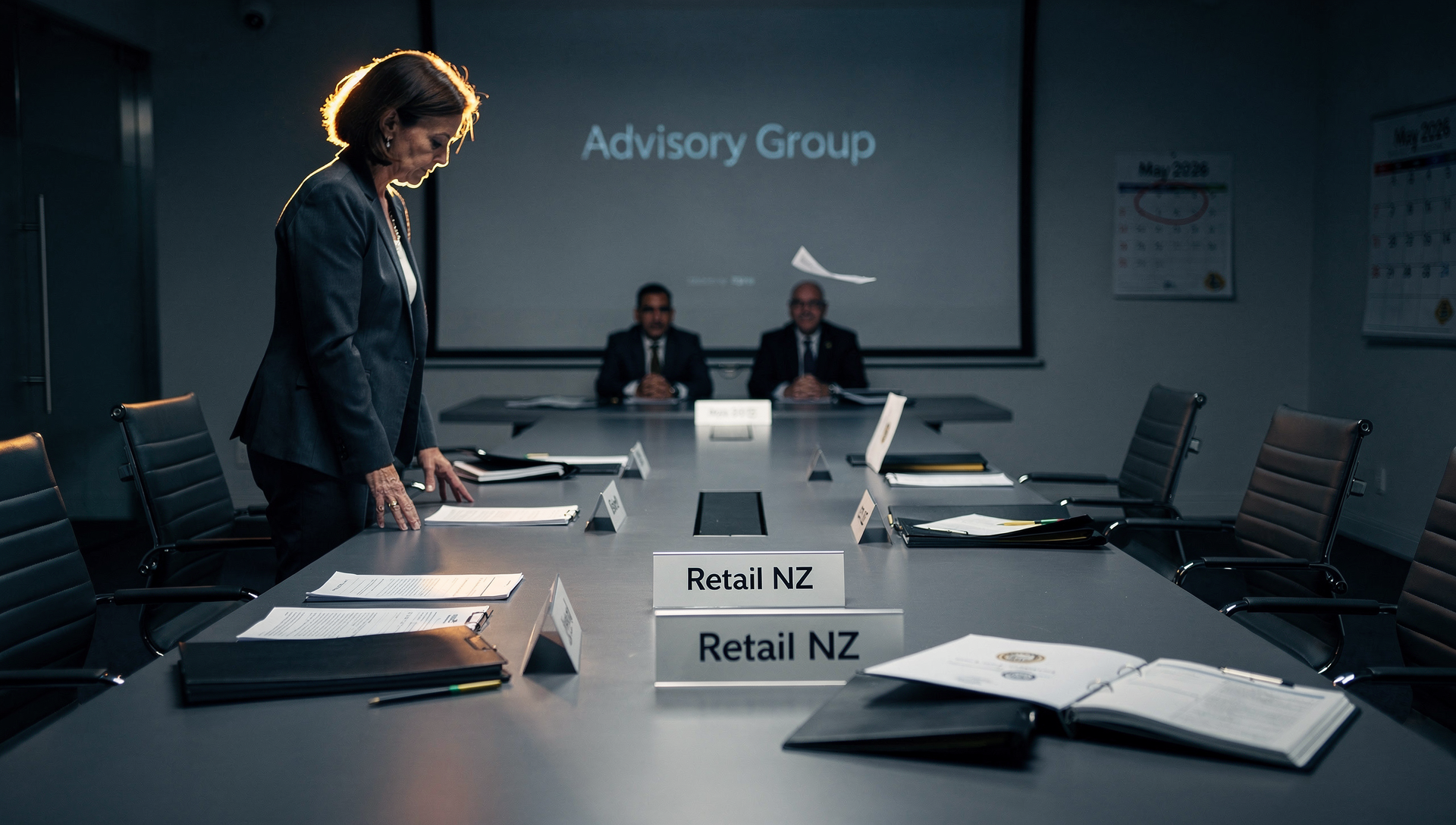
Carolyn Young—the chief executive of Retail NZ, the person who actually represents retailers—said her relationship with Kaushal was "untenable". She said she received "ongoing, persistent communication from Sunny, trying to get me off the group" and that the way she "was being treated in the meetings was not at a level that anybody else would expect."
The dairy owners sector group, previously led by Kaushal, made a "personal attack" on Young.
Example: Imagine being Carolyn Young. You represent 9,600 retail businesses. You bring decades of expertise. You tell the group that expanded citizen's arrest powers will get retail workers killed. You are systematically bullied, undermined, and personally attacked until you resign. Then the chairman declares himself "relaxed" about the group winding up because he got exactly what he wanted all along.
Labour's Ginny Andersen called it plainly: "This was a political stunt from day one, and it's backfired".
Quantified harm: The remaining two members—Kaushal and Parmar, representing only the "small end of town" according to Young—now represent an advisory group with zero diversity, zero major retail representation, and full access to the remaining budget through May 2026.
Tikanga Violations: What the Western Mind Must Understand
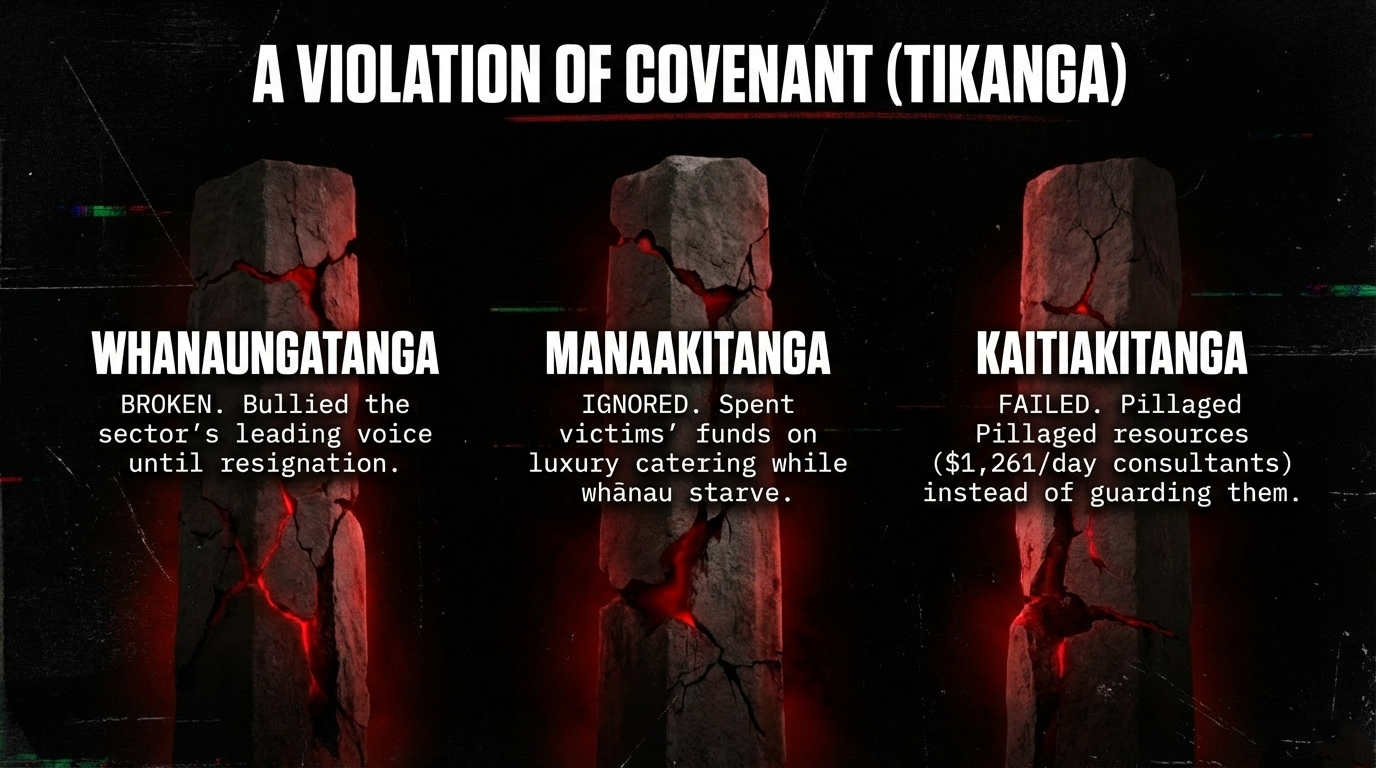
For the Pākehā reader, understand this: tikanga is not a quaint cultural decoration. It is a constitutional framework older than Magna Carta, a system of law, ethics, and accountability that governed millions of decisions across centuries before any European ship appeared on the horizon. When this government violates tikanga, it isn't breaking a custom—it is breaking a covenant.
Whanaungatanga (Relationships, Kinship, Responsibility)
Whanaungatanga means that relationships carry obligations. In the Western mind, think of it as fiduciary duty combined with community covenant. When the government created an advisory group and then allowed its chair to bully the sector's leading professional voice until she resigned, it severed whanaungatanga. It broke the relationship between Crown and community. In Western terms: imagine appointing a board of directors, allowing the chairman to harass the most qualified member until she quits, then declaring the board a success. No corporate governance framework in the world would accept this.
Manaakitanga (Hospitality, Care, Generosity of Spirit)
Manaakitanga requires that those with power extend care to those who are vulnerable. Spending $24,000 on prosciutto crostini from a fund designed to help crime victims while whānau cannot afford vegetables is an obscenity against manaakitanga. In Western terms: this is like a charity for homeless people spending its budget on executive catering while the people it serves starve. The Proceeds of Crime Fund exists because crime causes harm. Using it for $9 Cokes while the root causes of crime—poverty, food insecurity, housing crisis—go unaddressed is the ultimate betrayal of the fund's purpose.
Kaitiakitanga (Guardianship, Stewardship)
Kaitiakitanga requires responsible stewardship of resources for future generations. $1.8 million per year from the Proceeds of Crime Fund was not guarded—it was pillaged. Policy advisers billing $1,261 per day. An office costing $120,000 per year for a five-person group. A chairman billing $238,625 for pre-determined ideas. In Western terms: this is fiduciary breach on an industrial scale, funded by public money designated for crime victims.
Rangatiratanga (Self-Determination, Sovereignty, Authority)
Rangatiratanga means the right of communities to determine their own futures. This advisory group had no Māori representation despite Māori being disproportionately affected by both retail crime (as workers in affected stores) and the proposed solutions (as targets of expanded citizen's arrest powers). In Western terms: this is taxation without representation. A policy that the government's own ministry says will disproportionately impact Māori, designed entirely without Māori input.
Aroha (Compassion, Empathy, Love)
There is no aroha in pepper spray. There is no aroha in physically restraining a 12-year-old shoplifter. There is no aroha in celebrating a prison population approaching 11,000, more than half of whom are Māori. In Western terms: a society that responds to poverty-driven crime with vigilante powers and restricted weapons has abandoned compassion as a governing principle.
Implications: The Harm Quantified
Financial Reckoning
| Category | Amount | Source |
|---|---|---|
| Annual MAG budget | $1.8 million | Proceeds of Crime Fund |
| First 100 days spending | $507,468 | Parliamentary answer |
| Chair's first 12-month billing | $238,625 | RNZ investigation |
| Auckland office rent (annual) | $120,000 | RNZ |
| Catered meeting costs | $24,000 | RNZ |
| Top policy adviser daily rate | $1,261/day | RNZ |
| Material improvement to public safety | Zero | Ministry of Justice RIS |
Human Cost
- Prison population approaching 11,000 — PM calls this "a good thing"
- Māori 52.3% of prisoners — despite being 17.8% of population
- Māori women 61-63% of women's prison population — TIAKI study
- 92% of retailers affected by crime — none safer after $1.8 million spent
- 500 extra police still not delivered — deadline blown, Luxon says "it'll be what it will be"
Solutions: What Actually Works
What This Government Should Have Done
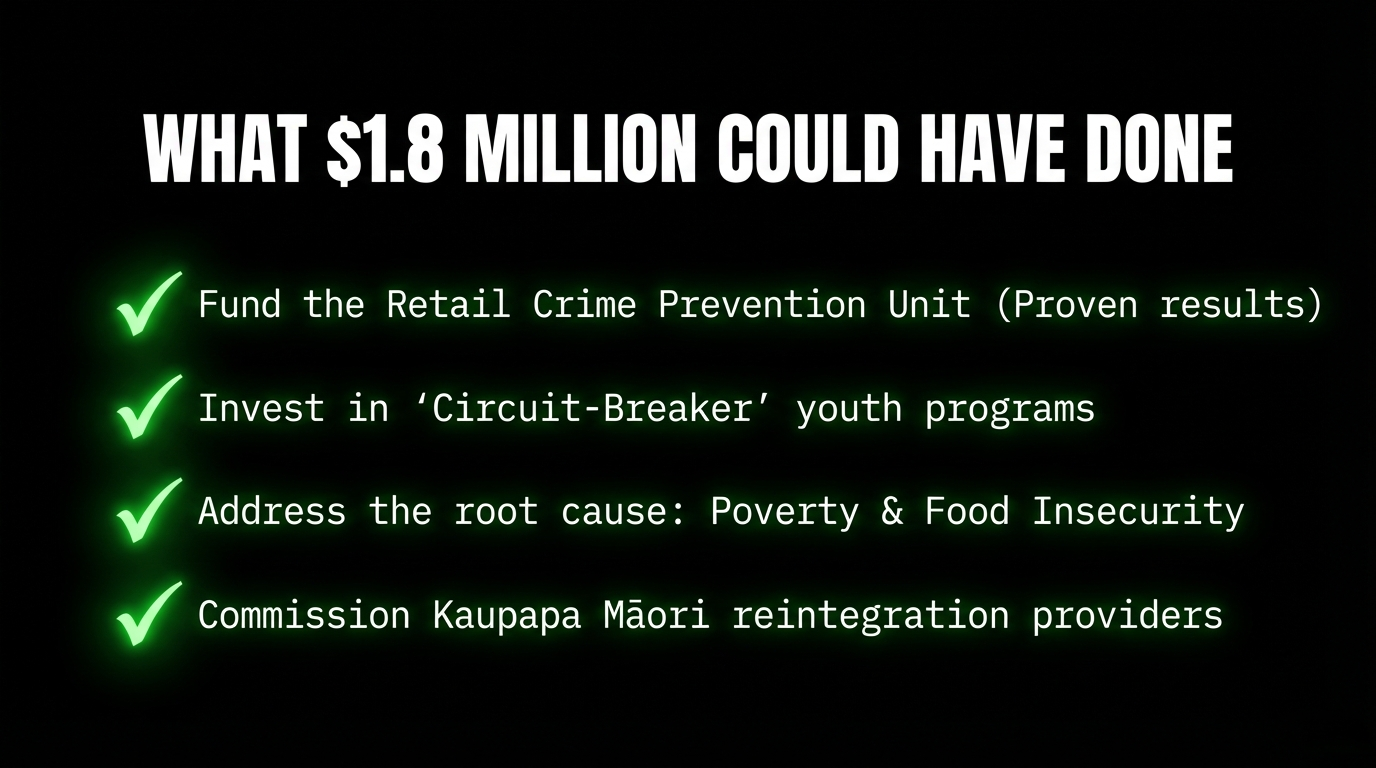
- Fund the Retail Crime Prevention Unit properly — Police established a dedicated unit that produced actual results targeting prolific offenders. Fund it with the $1.8 million instead.
- Invest in Circuit-Breaker programmes — Labour's previous youth intervention programme addressed repeat offending by children and young people. Andersen suggested the leftover MAG money go here.
- Address root causes — Carolyn Young herself advocated for a "holistic approach" targeting "all aspects of a young person's life from attendance at school, access to healthcare when needed, appropriate housing and nutrition". She was the government's own appointee. They ignored her.
- Include Māori in policy design — Hāpai Te Hauora, kaupapa Māori researchers, and iwi were excluded from the advisory group entirely, despite Māori being most affected by both the problem and the proposed solutions.
- Commission kaupapa Māori reintegration providers — Associate Professor Paula King asked the question the government refuses to answer: "If the highest proportion of people in prison are Māori, then why aren't kaupapa Māori providers being commissioned to support re-entry?"
- Address the food crisis — People are shoplifting kai because they cannot afford to eat. Address the supermarket duopoly, fund food banks properly, and raise benefits above the poverty line.
The Waka Has Sunk

The Retail Crime Advisory Group is the coalition government in miniature: expensive, performative, dominated by a single voice drowning out expertise, hostile to those who disagree, and catastrophically ineffective at its stated purpose.
They spent $507,468 in 100 days and produced policy the Ministry of Justice says won't improve public safety. They drove out the nation's leading retail voice through bullying. They recommended pepper spray for shop workers while opposing every evidence-based intervention that might actually reduce crime. They celebrated a prison population of 11,000—majority Māori—as "a good thing."
The waka has sunk. But the whānau standing on the shore, the retail workers who will face escalating violence, the Māori tamariki who will be disproportionately restrained and detained—they are still here, still exposed, still waiting for a government that treats their safety as something more than a line item between the crostini and the Coke.
Ka whawhai tonu mātou. Āke, āke, āke.
Koha Consideration
Every koha signals that whānau are ready to fund the accountability that neither Crown ministries nor $1,261-a-day consultants will provide. When a government spends $238,625 to have one man write pre-determined ideas on letterhead, and $24,000 on catered meetings while families skip meals—your koha funds the truth they tried to bury under prosciutto and policy papers.
It signals that rangatiratanga includes the power to fund our own truth-tellers when the Proceeds of Crime Fund is spent on crostini instead of communities.
Kia kaha, whānau. Stay vigilant. Stay connected. And if you are able, consider a koha to ensure this voice continues.
If you are unable to koha, no worries! Subscribe or follow The Māori Green Lantern on Substack, kōrero and share with your whānau and friends—that is koha in itself.
Three pathways exist:
For those who wish to support this mahi directly with a koha (voluntary contribution), please visit the Koha platform:
Koha — Support - https://app.koha.kiwi/events/the-maori-green-lantern-fighting-misinformation-and-disinformation-ivor-jones
For those who wish to receive essays directly and support through subscription:
Subscribe to the Māori Green Lantern
For those who prefer direct bank transfer, account details are:
HTDM, account number 03-1546-0415173-000.
Research tools used: search_web, get_url_content. Sources consulted: RNZ, 1News, Ministry of Justice, Hāpai Te Hauora, NZ Police, Te Ao Māori News, University of Otago TIAKI study, NZ Herald, Beehive.govt.nz, Retail NZ, Waatea News. Research date: 11 February 2026. All URLs verified at time of publication.
Unverifiable claims: The content of the Ministry of Justice advice to Goldsmith about Kaushal's "concerning behaviour" remains secret. The full breakdown of individual contractor invoices has been requested under the Official Information Act by RNZ but was not available at time of writing.

Ivor Jones The Māori Green Lantern Fighting Misinformation And Disinformation From The Far Right