"The Social Investment Agency: A Machinery of Managed Neglect, Surveillance, and State Violence Against Whānau Māori" - 3 April 2026


Mōrena Aotearoa,
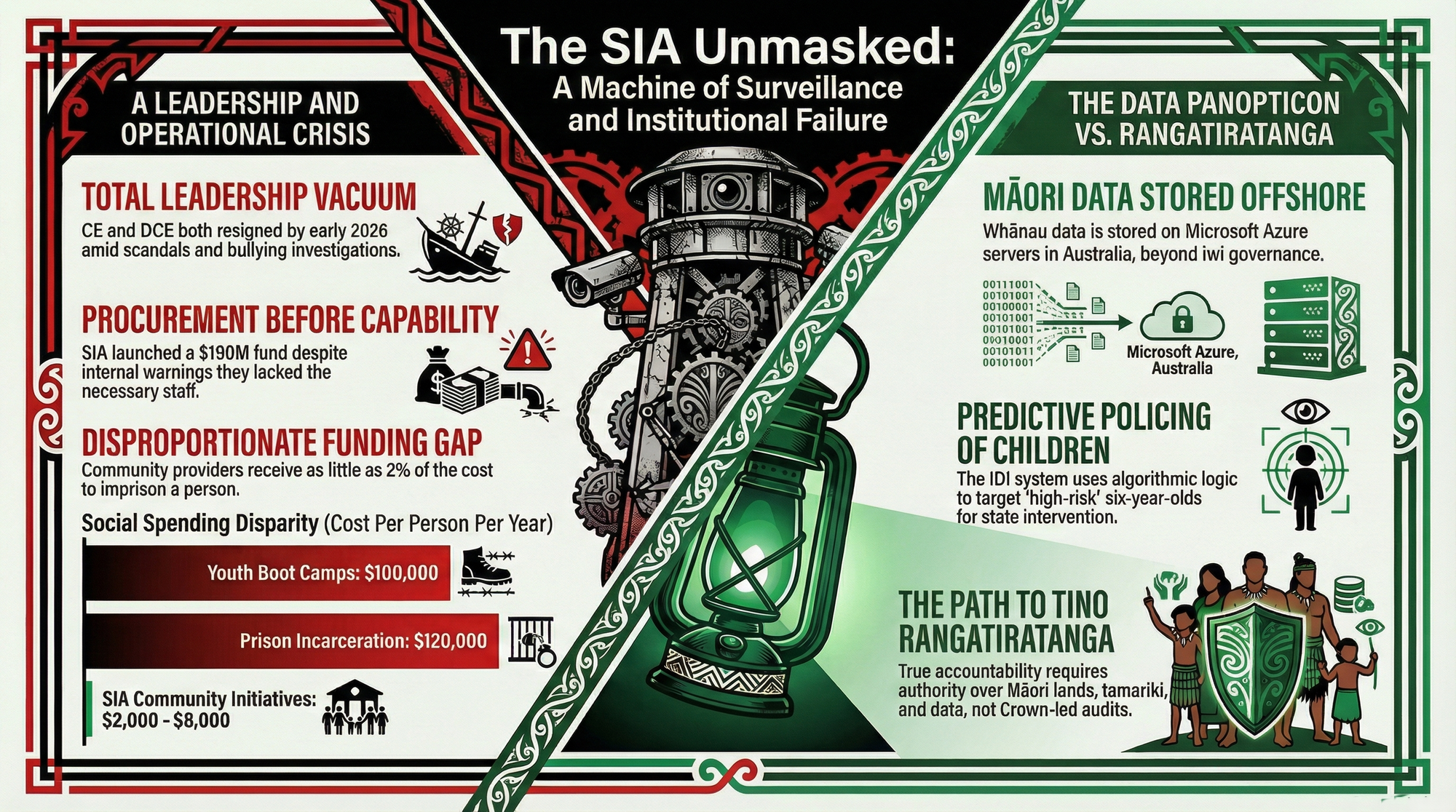
Ka tū, ka oho — the taiaha points north, toward Wellington, toward the bureaucratic fortress they call the Social Investment Agency. This is not a neutral institution. This is Nicola Willis's passion project, built on Bill English's rotting ideology, now exposed for what it truly is: a machinery of surveillance and managed neglect, dressed in the language of "evidence" and "outcomes," staffed by disgraced executives, and armed with your whānau's most intimate data — stored on Microsoft Azure servers in Australia, beyond your reach, beyond iwi governance, beyond your consent.
The SIA has commissioned an independent review of its own procurement practices. The bureaucracy auditing itself. The arsonist calling the fire brigade. This is not accountability. It is theatre. And it is time to tear down the stage.
The Deep Dive Podcast
Listen to a lively conversation between two hosts, unpacking and connecting topics in the sources of this essay.
Part One: Whakapapa — Where This Monster Came From
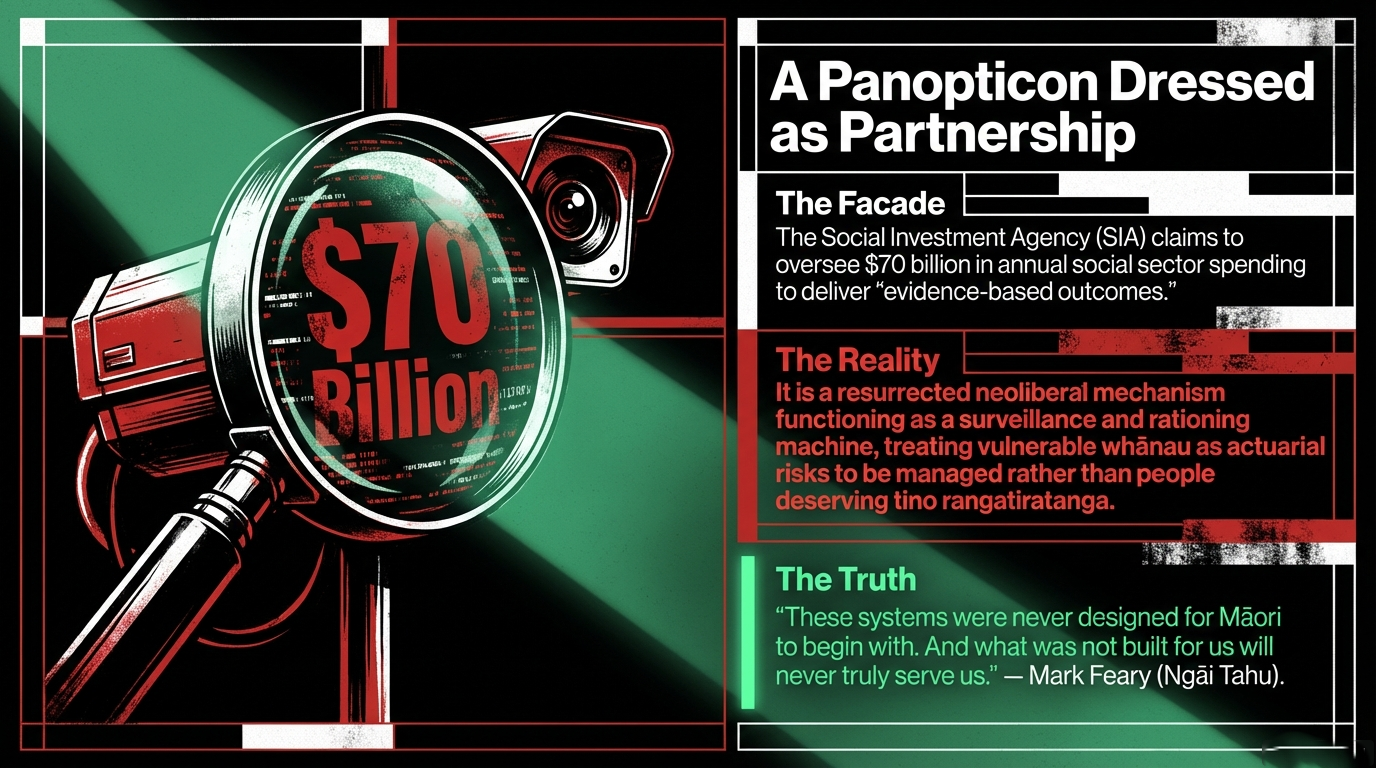
The SIA is not new. It is a creature of neoliberal ideology with a whakapapa stretching back to Sir Bill English's Treasury-driven "social investment" model of the mid-2010s, which treated tangata whenua and vulnerable whānau as actuarial risks to be managed — not as people deserving dignity, land, and tino rangatiratanga. As documented by researchers at the Auckland University Policy Institute, that earlier model failed precisely because it treated poverty as a targeting problem, not a structural one — and was quietly abandoned.
Under Labour it was buried — renamed the Social Wellbeing Agency and sidelined. National resurrected it with a vengeance in 2024. Finance Minister Nicola Willis made herself the minister responsible and designed it as a central agency with authority to set standards, control data, and commission services across the entire social sector. As NZ Herald reported in August 2024, the agency was positioned alongside Treasury, DPMC, and the Public Service Commission — extraordinary structural power for what is, in practice, a surveillance and rationing machine.
The agency is tasked with overseeing roughly $70 billion in annual social sector spending — approximately half of all core Crown expenditure. That is the number they parade to justify their existence. What they refuse to say is how much of that money never reaches the whānau who need it most.
As E-Tāngata's Mark Feary (Ngāi Tahu) wrote in November 2025, after nearly fifty years advising government: "These systems were never designed for Māori to begin with. And what was not built for us will never truly serve us, regardless of how many times it speaks in te reo Māori or claims affinity with Māori values." The SIA is that system wearing a pōtae.
Part Two: The First Disgrace — Chief Executive Andrew Coster

The Crown appointed former Police Commissioner Andrew Coster to lead the SIA in November 2024, on a five-year term. By December 2025 — barely thirteen months later — Coster had resigned, effective immediately, after a damning IPCA report found serious leadership failures at the highest levels of Police regarding sexual misconduct allegations against former Deputy Commissioner Jevon McSkimming.
The details are grotesque. As 1News reported on 3 December 2025, McSkimming had a sexual relationship with a young non-sworn police employee. Over several years, the complainant wrote 300 emails raising her concerns — and was ignored, then persecuted. The IPCA found senior police held "an entrenched view" that McSkimming was a victim rather than an offender and were "unduly preoccupied" with protecting his career. Coster himself intervened to bring the investigation to a "rapid and premature conclusion." McSkimming later pleaded guilty to possessing child sexual exploitation and bestiality material.
The Public Service Commissioner Sir Brian Roche confirmed what many already knew: "What is clear, however, is that there was significant evidence of failures within the organisation that Mr Coster was then accountable for. Systems, processes, delegations and behaviours that you would expect to be embedded were not followed." As RNZ reported via the ODT, Coster drew an estimated salary of around $500,000 a year, and $1,500 a day during his paid leave while the Crown investigated his conduct.
Minister Willis said she was "shocked and appalled." She was not shocked. This government appointed a policeman to administer welfare — not because of his expertise in social services, te ao Māori, or community healing, but because, as NZ Herald noted, he was expected to "front hard conversations around funding." In other words: they hired a cop to cut people off. And they paid him half a million dollars a year for the privilege.
Part Three: The Second Disgrace — Deputy CE Kylie Reiri

Barely had the dust settled on Coster's exit when the second implosion came. Kylie Reiri (Ngāi Tahu, Ngāti Kahungunu, Rangitāne) was the Deputy Chief Executive of Transformation, Technology and Enabling Services — the executive directly responsible for the SIA's data systems, the IDI integration, the technology infrastructure, and the Māori data sovereignty functions this essay exposes as hollow. She resigned on 11 February 2026, while under active investigation for four formal complaints of bullying and harassment, as NZ Herald reported on 14 March 2026.
The full account was broken by RNZ's Sam Sherwood and published via the ODT on 15 March 2026. The facts are damning:
- Reiri was placed on paid leave from late October 2025 — during the critical Social Investment Fund Round One procurement period. The person overseeing Māori data sovereignty had been absent from her desk for months while the agency was actively rolling out its flagship $190 million programme.
- When RNZ contacted her directly in December 2025, she stated she was "on leave due to health-related reasons." She did not acknowledge the investigation.
- The SIA confirmed under OIA that there had been "one investigation in response to four formal reports of bullying and harassment" but invoked privacy to block any detail of what the allegations concerned.
- She resigned before findings were delivered — meaning no formal outcome was placed on the record, no accountability was established, and the four staff members who were brave enough to make formal complaints received no published conclusion.
- The SIA's response to staff after her departure? Acting CE Alistair Mason sent a single bland internal email on 12 February: "We acknowledge the contribution Kylie has made during her time here." Her profile on the SIA website was quietly deleted without announcement.
- Minister Willis, asked for comment in December 2025 and again in March 2026, said: "Staffing within agencies is an operational matter for which Ministers don't have responsibility."
The Meridian Energy Conflict
Here is the detail that sharpens this scandal into something systemic. Meridian Energy announced Reiri as a Future Director on 27 October 2025 — effective 3 November 2025 — at the exact same time she was still nominally serving as SIA DCE for Transformation, Technology and Enabling Services. She was simultaneously accepting a governance role at a state-owned enterprise while supposedly still in a senior Crown agency role — and within days of that announcement, she was placed on paid leave. Her LinkedIn farewell from PwC was posted on 21 January 2025, meaning she transitioned from PwC to the SIA in early 2025, accepted a Future Director role at Meridian by October 2025, was placed on leave the same month, and resigned five months later under investigation.
The Internal Culture Warning That Was Ignored
About a month before the IPCA report on Coster was released, Coster himself sent an all-staff email acknowledging that "some comments in a recent Te Rama staff survey have given me cause for concern." He invited staff to come to him directly. His response to an agency culture that was apparently producing four formal harassment complaints against his own DCE was a personal "my door is open" email. Not a formal process. Not a structural review. Not a single action that protected the complainants. Weeks later, Coster was himself placed on leave and then gone. As RNZ/ODT reported, the Crown's response to this internal crisis at every level was the same: process quietly, let the subject resign, seal the findings under privacy, scrub the profile, send a thank-you email.
That is not a system that protects people. That is a system that protects institutions.
The Leadership Vacuum
As a result of these two resignations, the SIA that holds intimate data on hundreds of thousands of New Zealanders — including whānau Māori — currently operates with:
- No permanent Chief Executive (Alistair Mason is acting)
- No DCE for Transformation, Technology and Enabling Services — Reiri's role is unfilled, her portfolio headless since October 2025
- Only one substantive DCE on the public record (Aphra Green, System Performance and Investment Advice)
The agency managing $190 million in social investment funding has been running without a permanent CE or a data and technology executive for over five months. This is not a functional public institution. It is a governance vacuum, holding the most sensitive data about our whānau, with no one accountable at the top.
Part Four: The Procurement Catastrophe — By Design, Not Accident
The SIA's procurement process for Round One of the Social Investment Fund was opened in August 2025 following Budget 2025's allocation of $190 million over four years. The Child Poverty Action Group's September 2025 analysis was a demolition job: Social Investment Round 1: Government Wins, Children in Poverty Lose.
The Machine Was Never Ready
Internal advice to Willis, obtained under OIA and published by the SIA, warned in October 2024 that the agency did not yet have the in-house commissioning and procurement capability needed to run complex tenders at the proposed scale. The SIA's own Budget 2025 briefing (SIA24/25-112) stated bluntly: "It will be challenging for the Social Investment Agency to grow its capability to deliver specific investments for announcement on Budget Day. The Agency does not currently have the requisite experience nor the contacts with prospective providers."
Read that again. They were told — in writing — that the machine was not built. Nicola Willis pulled the lever anyway, announced $190 million to the cameras, and let the chaos cascade onto the sector.
Blaming Families, Not the System
The first round selected three "priority cohorts" — chosen not by communities, not by whānau, not by Māori providers — but by the Minister and her agency: children of parents who have been in prison; children of parents who experienced the care system; children stood down from school at age 12 or younger. As CPAG's Sarita Divis documented, "By selecting these cohorts, the Government reinforces the idea that poverty is the result of individual and parental failings, neatly aligning with the social investment narrative."
Willis's own 2024 Cabinet paper frames the problem as "welfare dependency" — not wage theft, not the housing crisis, not the Crown's own historic dispossession of Māori land and income. As CPAG has documented over decades, the Government correlates contact with state agencies with poor outcomes, then uses this to justify more state contact — confusing correlation with causation, blaming the medicine for the disease.
Crumbs for the Community
The $190 million announcement was political theatre. Round One sought to fund six initiatives with contracts of just $0.5–$2 million per year for four years. As CPAG calculated, that is $2,000–$8,000 per person per year. For comparison, this government funds youth boot camps at $100,000 per teenager per year, and prison costs $120,000 per person per year. The SIA is offering community providers less than 7% of what it costs to lock someone up — and calling it social investment.
Community providers were handed a "data explorer" built on hand-picked variables selected by the SIA itself — not datasets shaped with the sector or with Māori communities. Providers are also required to sign a Social Outcomes Agreement in which, as CPAG reveals, "the Funding Partner will approve the impact analysis design and the method of evaluation" — meaning the Crown decides what success looks like. The community organisation must deliver to that Crown definition or lose funding. This is not partnership. This is compliance dressed as investment.
NGOs Forced Into Six-Month Contracts
As Parliament's Scrutiny Week hearings on the SIA's annual review (December 2025) confirmed, NGOs were being forced into six-month contracts because other agencies were uncertain "where this is going" with social investment procurement, leaving providers unable to employ or retain staff. When your funding model destroys community organisations' capacity to hire people, you have not reformed the system. You have broken what was left of it.
The Social Investment Board's Own Alarm
Even the SIA's hand-picked advisory board turned on the model. The Cabinet Paper: Implementing Social Investment Commissioning records the Board's alarm "by the inability of Ministries to cut the administrative costs of multiple contracts with single providers, and from excessive and ineffective auditing and monitoring." This is the Board — not critics, not activists — telling the Crown that the very dysfunction the SIA was created to end is getting worse under the SIA. A bureaucracy that perpetuates what it was created to solve is not a failure. It is, as E-Tāngata's Mark Feary wrote, "the system working exactly as designed."
Part Five: The Data-Sharing Panopticon — Your Whānau Under the Crown's Eye

Now we come to the darkest room in the fortress. The SIA's real engine is not procurement. It is data. Specifically, the Integrated Data Infrastructure (IDI) — a system that links individual-level data across education, income, welfare, justice, and health for almost every person in Aotearoa.
As NZ Herald reported in April 2024, social investment's proponents describe the IDI as enabling the government to identify "1,000 six-year-olds most likely to cause harm and end up in jail." This is not a social welfare system. This is predictive policing applied to primary school children. It is the same actuarial logic that drove the Uplift programme — tamariki ripped from whānau based on algorithmic risk scores, Māori disproportionately targeted, intergenerational trauma deepened rather than healed.
What the SIA Admits — Under OIA
The SIA's own Māori Data Sovereignty OIA response (March 2025) is a masterclass in bureaucratic evasion dressed as transparency. When asked whether the SIA had implemented any Māori Data Sovereignty principles: "SIA does not have any specific activities in this area." When asked where the data is stored: Microsoft Azure, based in Australia. Not in Aotearoa. Not under iwi control. Not under hapū governance. Under an American cloud computing corporation, on servers in another country. When asked how many FTEs are allocated to Māori data practices: a handful of staff guided by Māori advisors — not Māori-led, not iwi-governed.
This is not Māori data sovereignty. This is the Crown managing Māori data and calling it partnership.
The Manurewa Marae Disaster — The Warning the Crown Ignored
The SIA wants more data sharing — yet the Manurewa Marae/Stats NZ scandal proves exactly what happens when Crown agencies are careless with Māori data. As Te Kawa Mataaho (Public Service Commission) found in February 2025 following an inquiry led by Michael Heron KC and Pania Gray:
- Stats NZ contracted Te Pou Matakana to assist with 2023 Census collection for Māori, but "Stats' safeguards to protect personal information were insufficient."
- "Fundamental confidentiality protections (such as the use of Certificates of Confidentiality) were not put in place."
- Stats staff raised serious concerns that "were not acknowledged or adequately dealt with."
- The Ministry of Health and Health NZ "had no safeguards in place" for addressing conflicts of interest in sharing personal COVID vaccination data with service providers.
As NZ Herald reported, the Government Statistician stepped down as a direct result. Public Service Commissioner Roche said: "The system has failed and that isn't acceptable." This is the system the SIA now wants to expand — more data, more linking, more sharing — with the same Crown agencies that couldn't protect Māori data last time.
The Research Is Clear: The IDI Harms Māori
A critical review of linked administrative data for Māori, published in PMC in 2022, found serious problems including lack of consent, deficit-framed analysis, exclusion of Māori researchers, and barriers to communities accessing and interpreting their own data. Research on Māori algorithmic sovereignty, outlined in a 2023 paper in the Data Science Journal, makes clear that any use of Māori data — including predictive algorithms — must be governed by Māori, reflect mātauranga Māori, and protect mana and collective rights.
The FAIR principles (Findable, Accessible, Interoperable, Reusable) that govern most government data sharing are not enough. Indigenous scholars have developed the CARE principles — Collective benefit, Authority to control, Responsibility, Ethics — as the minimum threshold for ethical Indigenous data governance. As research published in Frontiers in Genetics confirms, FAIR without CARE simply means the Crown can more efficiently exploit data about Indigenous peoples. The SIA meets FAIR. It does not meet CARE.
Standardisation as Structural Exclusion
Economist Jay Whitehead has documented, in a September 2024 analysis, how the SIA's core function — standardisation — structurally excludes mātauranga Māori from shaping outcomes. Uniform frameworks, uniform metrics, uniform reporting. Tikanga, manaakitanga, kaitiakitanga, intergenerational whānau wellbeing — none of these fit inside a spreadsheet built by Wellington bureaucrats. Consistency across a system that was never built for Māori is not equity. It is the uniformity of harm applied at scale.
Part Six: Five Hidden Connections — The Network Behind the Neglect
1. The IDI as Surveillance Infrastructure
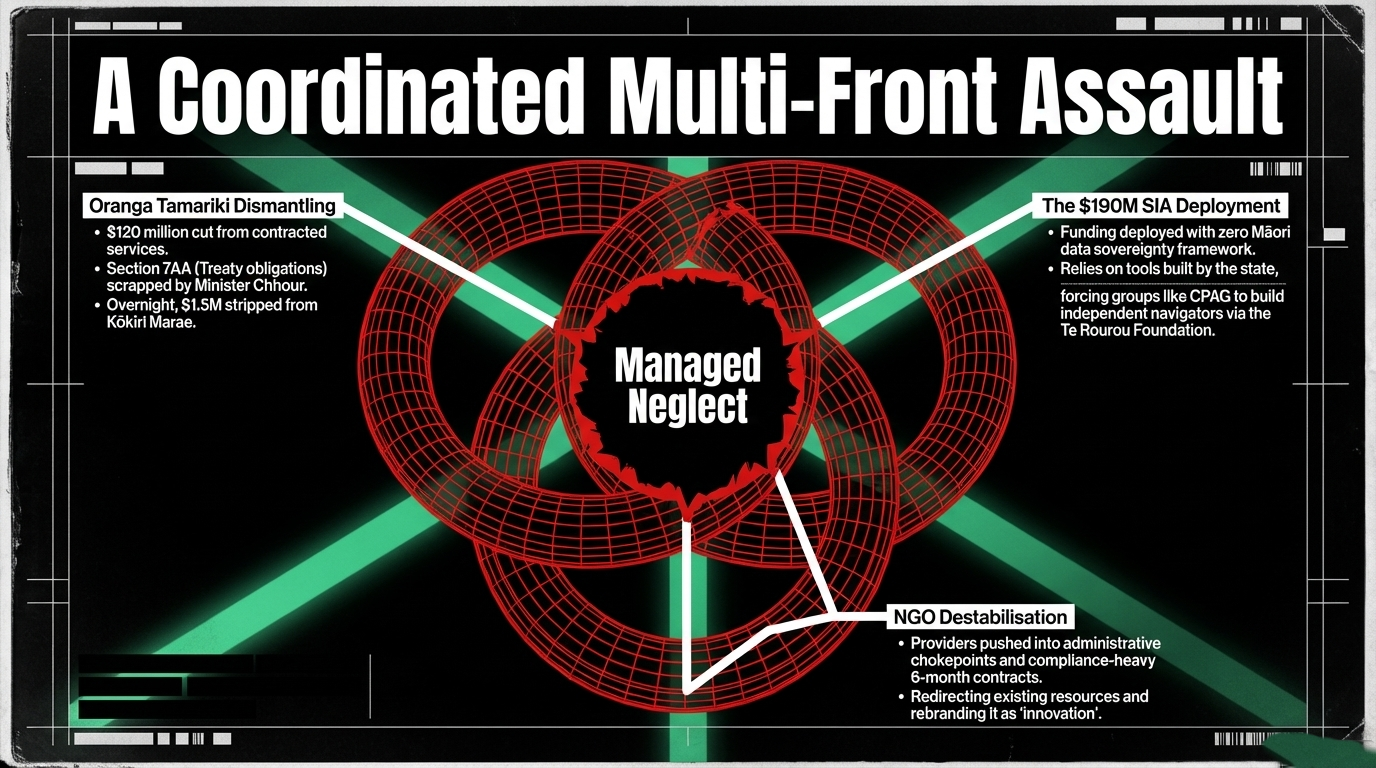
Willis's own Cabinet paper admitted the IDI was "poorly resourced" and "reliant on the goodwill of agencies" — yet this is the analytical backbone of a $190 million programme making life-altering decisions about which communities and children receive support. The DCE responsible for this infrastructure was absent from her desk for five months and then resigned under investigation. This is not a technical failure. It is a governance failure at every level, by design.
2. Oranga Tamariki — The Parallel Assault
While the SIA promises early intervention, Oranga Tamariki continues its catastrophic failure of Māori tamariki. As the Green Party confirmed in June 2025, Māori youth make up two-thirds of those in state care and almost 50% of reports of concern to OT. Intergenerational cycles persist: 70% of Māori parents who were in care now have children involved with OT. Minister Chhour scrapped Section 7AA — which required OT to give effect to Te Tiriti — and cut $120 million from contracted services supporting vulnerable youth. Kōkiri Marae lost $1.5 million overnight. The SIA claims to be building early intervention while this government simultaneously demolishes the infrastructure that makes early intervention possible. This is not contradiction. This is coordinated assault.
3. The $190 Million with No Māori Data Sovereignty Framework
The SIA's Social Investment Fund operates on Crown-defined metrics, Crown-held data, Crown-approved evaluation. CPAG has had to separately build its own data navigator tool grounded in Māori data sovereignty principles, gifted by the Te Rourou Foundation — because the Crown's tools cannot and will not do this. The SIA is building an empire of evidence that Māori did not design, do not govern, and in many cases did not knowingly consent to.
4. The NGO Sector Destabilised by Design
Budget 2025 was condemned by the NZ Council of Christian Social Services for reducing investment in the youngest New Zealanders while redirecting existing funding through the Social Investment Fund — repackaging what already existed as innovation, while the underlying resource base contracted. The SIA is not adding capacity. It is redirecting existing resources through a new bureaucratic chokepoint and calling this transformation.
5. The Procurement Failures Were Predicted and Ignored
The SIA's commissioning paper to Cabinet records explicitly that during the transitional period, two parallel commissioning regimes would operate simultaneously across the SIA and multiple line agencies. This was described as "pragmatic." It was a recipe for the confusion, duplication, and provider-sector fragmentation that Parliament's Scrutiny Week confirmed in December 2025. Ministers signed off on this. They knew.
Part Seven: What Triggered the Independent Review
The SIA did not commission a procurement review because it found a conscience. It did so because of cascading, documented, public failures:
A knowingly under-resourced procurement function pushed into running large, time-compressed processes for $190 million in public money, with the SIA's own October 2024 briefing confirming it had neither the staff nor the relationships to do so responsibly. They were warned in writing.
Two senior executives absent and then resigned — the CE and the DCE for data and technology — during the very period the fund was being designed and launched. The SIA was running headless at executive level through the most critical procurement phase in its history.
A Social Investment Board that formally raised alarm, as documented in the proactively released Cabinet commissioning paper, about "excessive and ineffective auditing and monitoring" and "the inability of Ministries to cut the administrative costs of multiple contracts with single providers" — the exact problems the SIA was created to solve.
Parallel commissioning structures running simultaneously across agencies, leaving NGOs in six-month contracts, unable to plan, hire, or deliver. Confirmed at Scrutiny Week, December 2025.
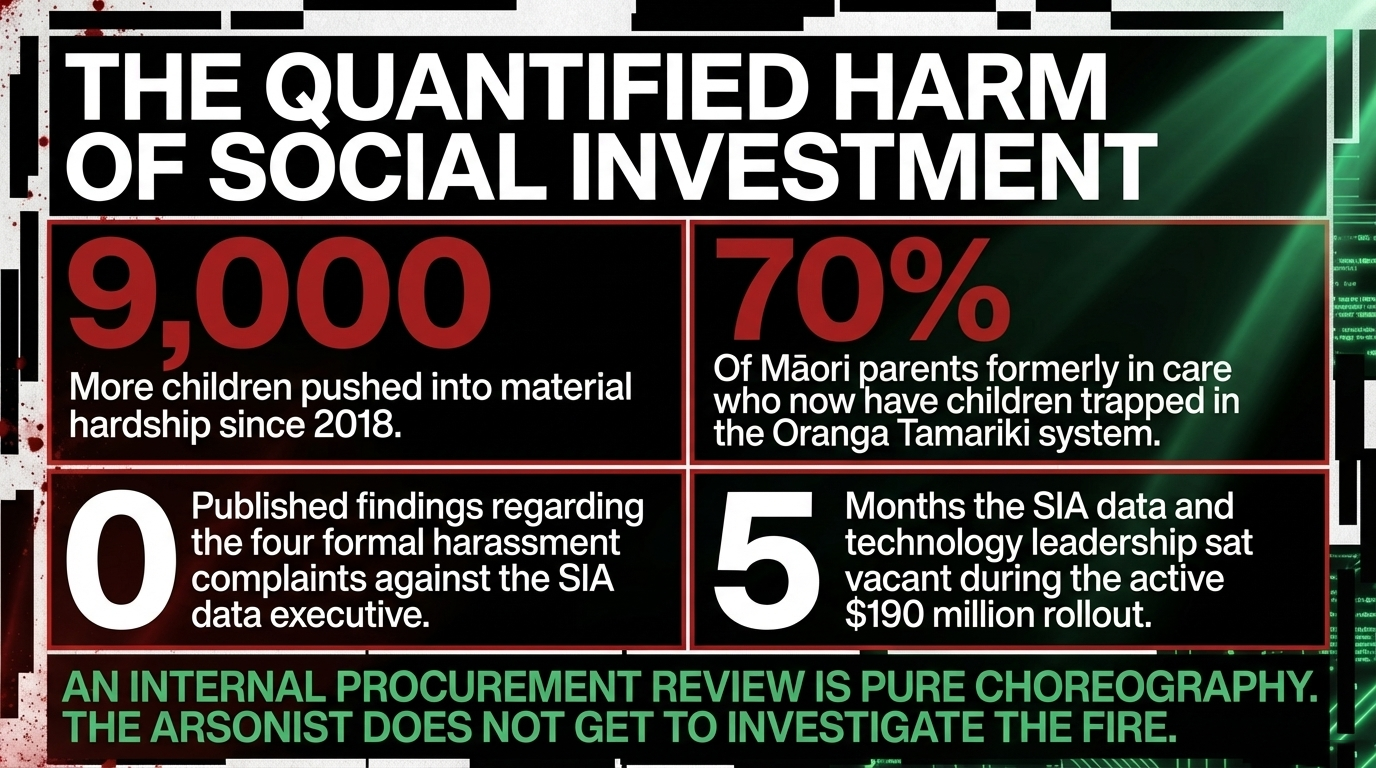
Child poverty moving in the wrong direction. As CPAG confirmed, as of June 2024, 9,000 more children were in material hardship compared to 2018. New Zealand will not meet its legislated Child Poverty Reduction Act target of halving child poverty by 2028. The SIA's entire existence is predicated on turning this tide. It is failing.
Part Eight: The Ideology Behind the Machine
The Auckland University Policy Institute asked in 2018: Why Did New Zealand's Social Investment Model Fail? The answer then, and now, is the same: social investment treats poverty as a targeting problem, not a structural problem. It asks: who are the highest-risk individuals we can intervene with most cost-effectively? — rather than: what structural conditions produce poverty, and how do we change them?
As CPAG's peer-reviewed analysis states: "Evidence from around the world shows very clearly that stigmatising (targeting) people in the way that social investment does results in people not seeking help or not getting the support and assistance they need. In the New Zealand context this would mean Māori, Pacific peoples, refugee and migrant communities."
The social investment model does not address the material drivers of inequality — housing, wages, structural racism, Crown breaches of Te Tiriti. It offers instead a panopticon: watch the whānau closely, measure their outcomes, fund the interventions that reduce their cost to the Crown. As Mark Feary wrote in E-Tāngata: "The systems of government aren't malfunctioning — they're serving the purpose they were built for."
This is not rangatiratanga. It is cost management dressed in feathers it did not earn.
Part Nine: The Reckoning — Quantified Harm
These are not rhetorical flourishes. These are verified facts:
- $120 million cut by Minister Chhour from OT-contracted services, directly dismantling whānau-led infrastructure — Green Party, June 2025
- 70% of Māori parents who were in care now have children involved with Oranga Tamariki — intergenerational trauma industrialised — Green Party, June 2025
- $1.5 million stripped from Kōkiri Marae overnight — Green Party, June 2025
- $190 million Social Investment Fund with no Māori data sovereignty framework embedded — CPAG, September 2025
- $2,000–$8,000 per person per year offered to community providers for the highest-need rangatahi — versus $120,000 per year to imprison them — CPAG
- $500,000 per year estimated salary for a CE who lasted thirteen months and resigned in disgrace — 1News, December 2025
- $1,500 per day for that CE on paid leave while the Crown investigated his conduct — NZ Herald, December 2025
- Four formal bullying and harassment complaints against the DCE for data and technology — investigation sealed, no findings published, subject resigned — RNZ/ODT, March 2026
- Five months the data and technology DCE role has been vacant during active $190 million fund rollout — SIA Our People page, April 2026
- 9,000 more children in material hardship since 2018 — the year Aotearoa legislated to halve child poverty — CPAG, 2025
- Māori data stored on Microsoft Azure servers in Australia, beyond iwi governance, beyond whānau consent — SIA OIA response, March 2025
- "SIA does not have any specific activities" in Māori Data Sovereignty implementation — the agency's own admission, under OIA — SIA, March 2025
Rangatiratanga Is Not a Review

The Social Investment Agency commissioning an independent review of its procurement practices is not accountability. It is choreography. The arsonist does not get to investigate the fire.
This government — which tore the heart out of the Māori Health Authority before it could prove itself, which abolished Section 7AA to weaken Oranga Tamariki's Treaty obligations, which cut $120 million from providers serving our most vulnerable tamariki, which stored Māori data in Australia while claiming to honour data sovereignty, which appointed a disgraced police commissioner to run a welfare agency, which watched a DCE under four harassment complaints sit on paid leave for five months, which allowed procurement to proceed headless — does not get to audit itself.
Māori communities do not need Wellington to decide which data variables define their needs. They do not need a former police commissioner appointed to cut budgets to administer their wellbeing. They do not need a $190 million fund built on IDI data that the Crown admits is poorly resourced, poorly safeguarded, and stored offshore, managed by executives who do not last two years.
What they need is what was promised in 1840: tino rangatiratanga — authority over their own lands, their own tamariki, their own futures. The SIA, as currently constituted, is a mechanism for the Crown to manage the symptoms of its own Treaty breaches while avoiding accountability for causing them.
The cycle E-Tāngata described — announcement, review, disappointment, another review — is not dysfunction. It is the system working exactly as designed.
He aha te mea nui o te ao? He tangata, he tangata, he tangata.
Koha Consideration
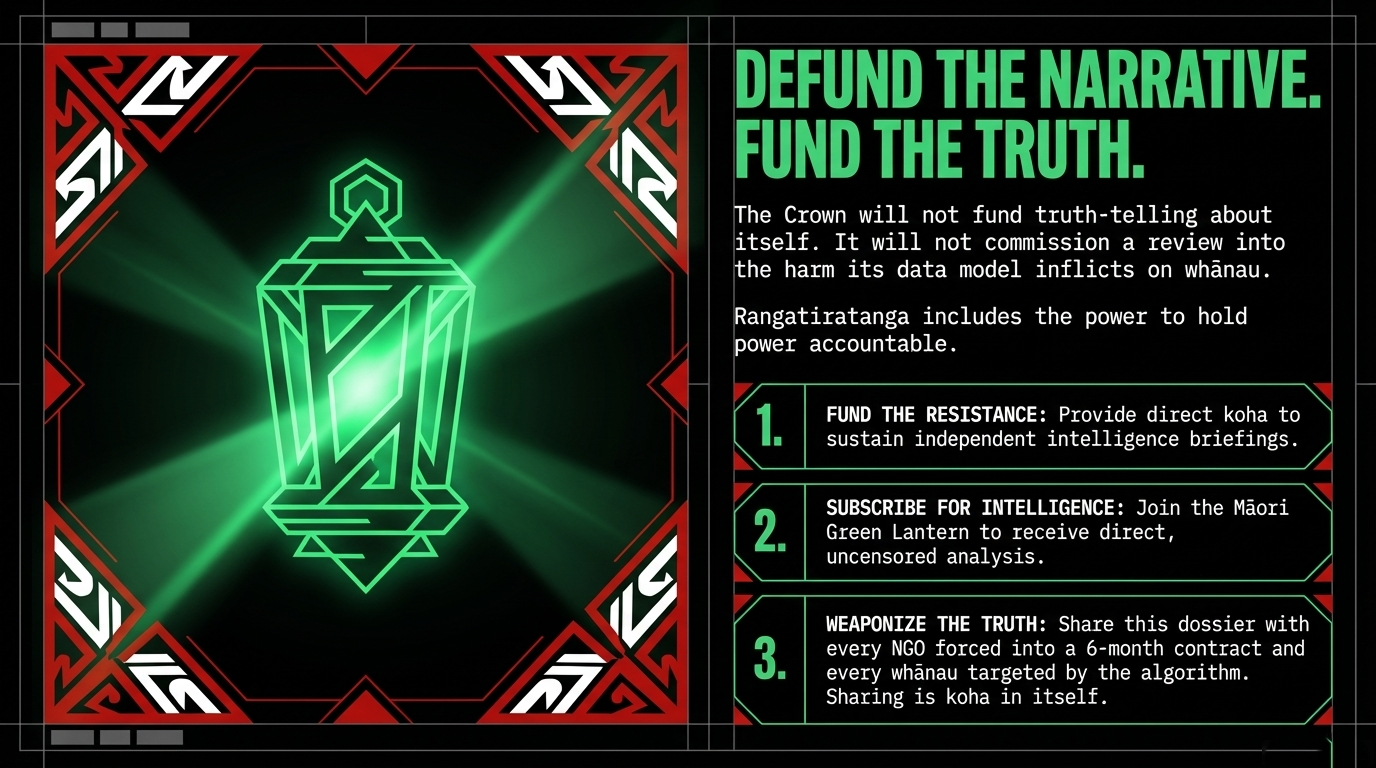
The Crown will not fund truth-telling about itself. The SIA will not commission a review into the harm its data model inflicts on whānau. It will not tell you that your health records sit on Microsoft Azure servers in Australia. It will not tell you that the four staff members who had the courage to make formal complaints against their DCE received no published findings. It will not return the $120 million stripped from the providers serving our most vulnerable tamariki.
That is exactly why this mahi matters. Every essay that names Andrew Coster, names Kylie Reiri, names Nicola Willis, names the $2,000-per-person-per-year insult they call social investment — is the accountability that rangatiratanga demands and that Wellington will never provide for us.
Every koha signals that whānau are ready to fund their own truth-tellers. It signals that rangatiratanga includes the power to hold power accountable.
Kia kaha, whānau. Stay vigilant. Stay connected.
If you are unable to koha — no worries. Subscribe, follow, kōrero. Share this essay with your whānau, with every NGO being squeezed into a six-month contract, with every provider told the Crown decides what success looks like. That sharing is koha in itself.
Three pathways, all honourable:
Direct koha (voluntary contribution): Support the Māori Green Lantern on Koha
Subscribe and receive essays directly: Join the Māori Green Lantern
Direct bank transfer: HTDM, account number 03-1546-0415173-000
Research conducted April 2026. Sources verified via live URLs including RNZ, ODT, NZ Herald, 1News, CPAG, Green Party Aotearoa, E-Tāngata, Te Kawa Mataaho (Public Service Commission), Social Investment Agency official OIA releases and Cabinet papers, Parliament Scrutiny Week records, peer-reviewed literature on Māori data sovereignty, and SIA leadership pages. All URLs tested at time of writing.
© Ivor Jones — The Māori Green Lantern | themaorigreenlantern.maori.nz