“The Spectacle of Poverty: How Neo-Liberal Housing Policy Weaponises the Working Homeless to Hide Systemic Failure” - 5 July 2025
The shameful spectacle of working whānau forced to choose between shelter and financial survival exposes neo-liberal housing policy as a calculated assault on human dignity dressed as economic efficie
Kia ora koutou. E tangi ana ahau ki ngā whānau kāore nei he kāinga. I grieve for families without homes.
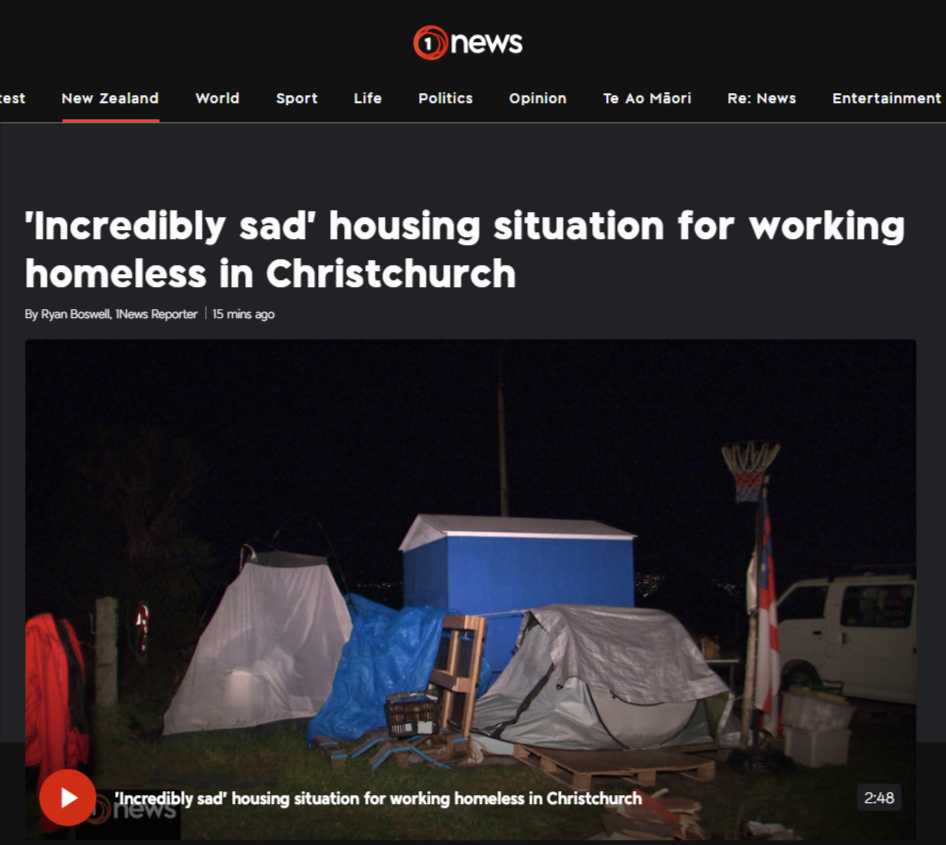
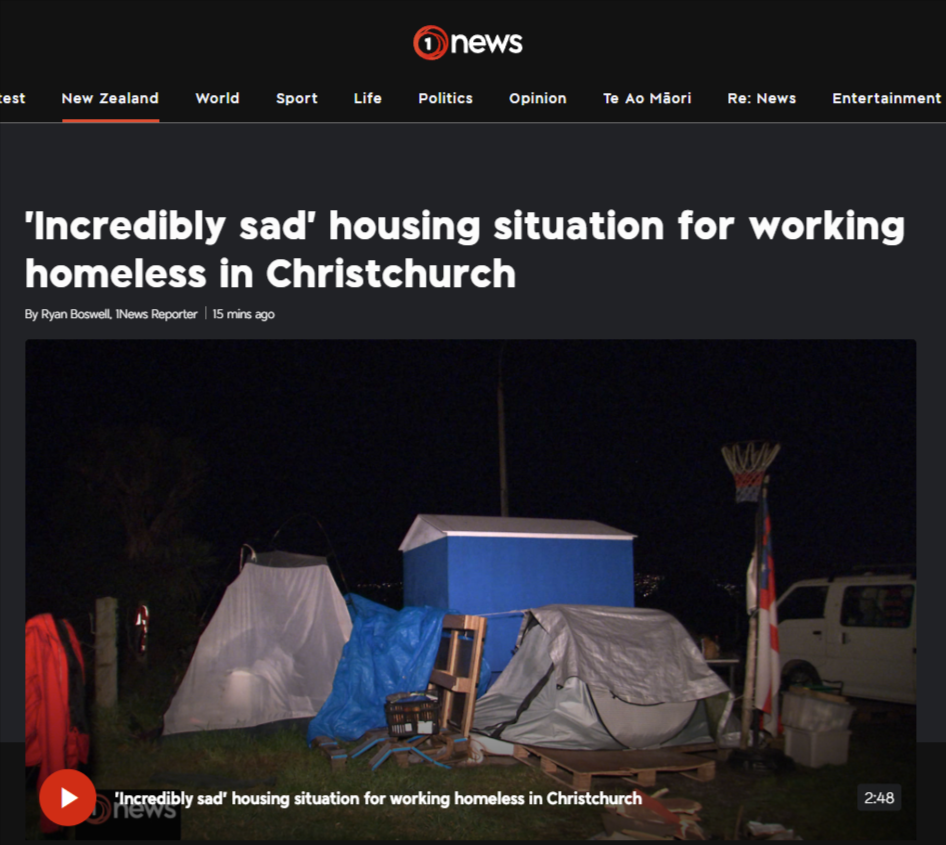
1News reports on families making "active decisions" to live rough rather than pay extortionate rents1. This is not choice but coercion orchestrated by decades of market fundamentalism that has transformed housing from a basic right into a speculative investment vehicle while systematically excluding Māori from secure, affordable shelter through institutional racism masquerading as neutral policy.
Background: The Architecture of Exclusion
The colonial project in Aotearoa has always used housing as a weapon of dispossession. From the 1842 Raupō Houses Ordinance that taxed Māori building methods2 to the systematic destruction of urban Māori settlements in the 1950s3, housing policy has consistently privileged European values while marginalising Indigenous ways of living. The Native Land Court system deliberately fragmented Māori land ownership4, making collective housing arrangements nearly impossible while forcing whānau into European-style individual ownership models that contradicted tikanga Māori.
This historical context reveals that today's housing crisis is not an accident but the predictable outcome of settler colonial policies designed to maintain Pākehā supremacy through control of land and shelter. Research confirms that Māori experience housing discrimination more than any other ethnicity in New Zealand5, with whānau forced to use Pākehā names and hide cultural markers like moko kauae when seeking rentals. This is not individual prejudice but systemic racism embedded in housing markets designed to exclude tangata whenua.
The Working Homeless as Neoliberal Theatre
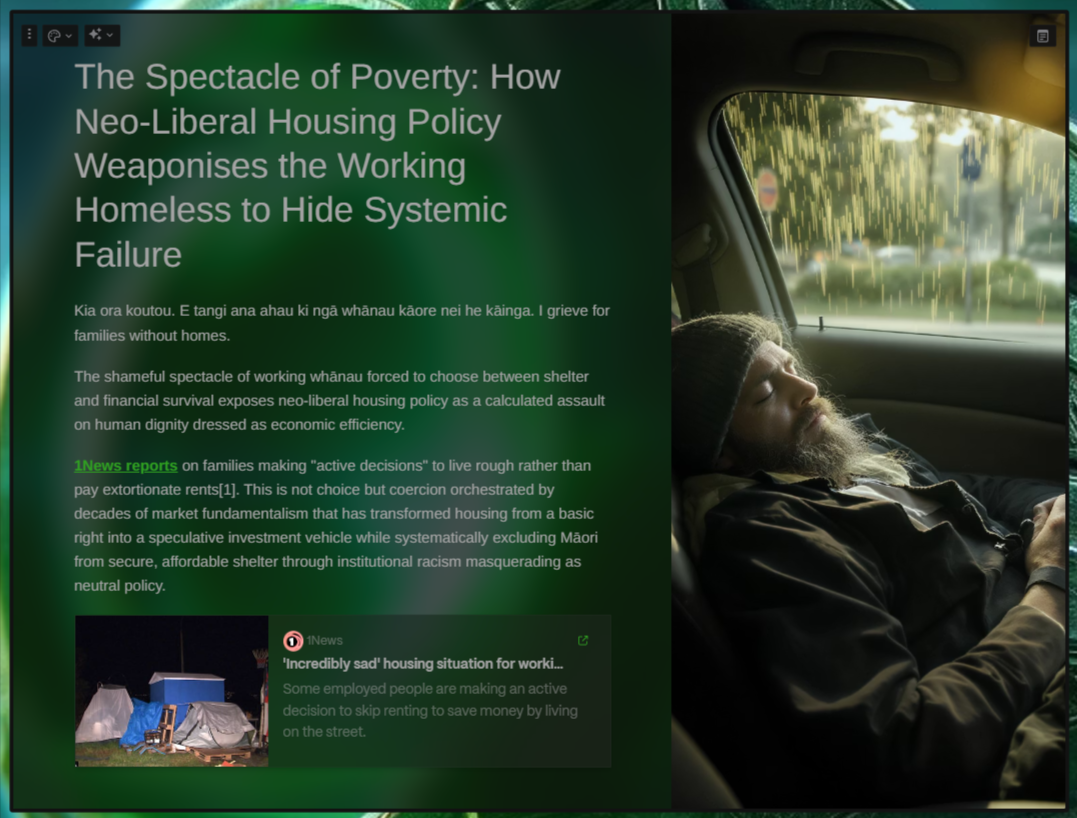
The Christchurch story exemplifies how neoliberalism weaponises poverty against itself. When a 23-year-old woman describes loving life in her car because it's cheaper than rent1, we witness the grotesque success of market ideology that has transformed homelessness from policy failure into personal lifestyle choice. The Housing First Ōtautahi waitlist has doubled to 120 individuals1, yet Associate Housing Minister Tama Potaka celebrates moving 3,000 children out of emergency accommodation1 without acknowledging where they've gone or whether they've simply become invisible street homeless.
This manufactured crisis serves multiple ideological functions. First, it normalises extreme inequality by presenting homelessness among the employed as evidence that "even workers struggle," obscuring how deliberately policy has created this situation. Second, it shifts blame from systemic failure to individual inadequacy - the woman choosing car life becomes responsible for her situation rather than the market forces that make her wages inadequate for basic shelter. Third, it provides cover for further privatisation by suggesting the state cannot solve problems it has systematically created.
Research reveals severely housing deprived populations increased from 99,462 in 2018 to 112,496 in 20236, with Māori overrepresented at 394.0 per 10,000 people7 compared to 228.3 per 10,000 for the total population. These aren't statistics but whānau denied their fundamental right to shelter in their own land.
Exposing the Neoliberal Housing Scam
Market Fundamentalism as Colonial Violence
The transformation of housing from social provision to market commodity represents colonial violence in its most sophisticated form. The Housing Minister's recent announcement promises to "flood the market with opportunities for development"8, revealing the ideological assumption that private profit-driven development will somehow solve a crisis created by exactly that approach. This market fundamentalism directly contradicts the Treaty obligation to ensure Māori have secure access to their ancestral lands for housing.
Research demonstrates how promotional communication has contributed to New Zealand's housing crisis by redefining housing as investable assets rather than a basic human right9. This transformation didn't happen accidentally but through deliberate policy choices that prioritised capital accumulation over human need. When the National Government imposed rent market rates on state housing tenants in the 1990s10, claiming that subsidies created "market distortions" and encouraged "dependency," they deployed moral discourse to justify attacking the poor while subsidising property investors through tax deductions.
Privatisation by Stealth: The Kāinga Ora Sabotage
The current government's systematic dismantling of Kāinga Ora11 exemplifies privatisation by stealth. After decades of deliberate underinvestment and impossible targets, they declare the public housing provider "underperforming" then use this manufactured crisis to justify further market solutions. The cancellation of 3,479 houses12 while homelessness skyrockets reveals the government's true priority: protecting property values and investor profits over human shelter.
The Bill English review into Kāinga Ora13 represents a return to the same neoliberal architect who previously privatised state housing and shrank government responsibility through transfers to third-party providers. Public housing advocates warn this creates community housing associations that "see the state withdraw from building the public homes we need"13 while subsidising private providers with no guarantee of long-term affordable housing.
Weaponising Housing Against Māori Self-Determination
The government's housing policies specifically target Māori housing initiatives through seemingly neutral market mechanisms. The Regulatory Standards Bill threatens to elevate individual property rights over collective Māori rights14, potentially creating barriers to papakāinga development and pooling resources for collective housing solutions. This represents a sophisticated form of institutional racism that appears neutral while systematically disadvantaging Indigenous approaches to housing.
Research reveals looking more Māori significantly predicts decreased rates of homeownership15, demonstrating institutional racism in the banking industry that prevents Māori from accessing finance regardless of their ability to service loans. This isn't individual discrimination but systemic exclusion designed to maintain Pākehā property ownership advantages while blaming Māori for "cultural preferences" or "financial illiteracy."
The Stop Co-governance movement16 led by Julian Batchelor explicitly targets Māori housing rights by claiming co-governance represents "tribal rule" and "apartheid." This white supremacist rhetoric mobilises colonial fears about Māori "taking over" to justify dismantling the limited Treaty-based housing initiatives that exist. When politicians roundly criticise Te Pāti Māori for using words like "white supremacy"17 while allowing anti-co-governance campaigns to operate freely, they reveal whose discomfort matters and whose rights are disposable.
The "One Law for All" Housing Fraud
The rhetoric of "equality" and "one law for all" serves to disguise how housing policy systematically advantages those who already own property while excluding those who don't. The National Government's housing reforms emphasise market provision over state intervention10, claiming this promotes "fairness" and "choice." This ignores how market systems inherently favour those with existing capital while excluding those without, particularly Māori who were systematically dispossessed of their land base through colonial violence.
Research confirms that housing financialisation and reliance on private rental markets enables discriminatory tenant selection practices18 that disproportionately exclude Māori, Pacific peoples, and other marginalised groups. The supposedly neutral market operates through racist assumptions about "good tenants" that reinforce residential segregation while appearing to simply reward "merit" and "responsibility."
Implications: The Broader Assault on Social Rights
The working homeless represent the canary in the coal mine of neoliberal capitalism's assault on human dignity. When full-time workers cannot afford basic shelter, we have moved beyond housing crisis into social collapse. Yet this serves the system perfectly by demonstrating that even employment cannot guarantee security, making all workers more desperate and compliant while normalising previously unthinkable levels of deprivation.
The dramatic increase in women's homelessness19, with wāhine Māori overrepresented at over one-third of homeless women19, reveals how housing policy functions as gendered colonial violence. When 19% more women needed Women's Refuge support since 201719, we witness how housing unaffordability forces women into dangerous relationships while making escape from violence impossible.
This connects to broader patterns of neoliberal governance that systematically defunds public services while subsidising private profit. The government's consideration of privately-run public hospitals20 follows the same logic as housing privatisation - manufacture crisis through underfunding, then use that crisis to justify handing public assets to private operators who extract profit while providing worse services.

Resistance Through Māori Values
The housing crisis exposes neoliberalism as organised cruelty designed to maintain colonial power structures while enriching property speculators. The working homeless are not unfortunate victims but casualties of economic warfare against anyone without existing property wealth. This system cannot be reformed because exploitation and exclusion are its core functions, not unfortunate side effects.
True solutions require confronting the colonial foundations of New Zealand's housing system and embracing Māori values of collective responsibility and reciprocal care. Research on Māori housing enterprises21 and community-led financing innovations22 demonstrates how Indigenous approaches to housing prioritise community wellbeing over individual accumulation.
The struggle for housing justice is inseparable from the struggle for tino rangatiratanga and decolonisation. We must reject the false choice between market efficiency and state provision, instead building housing systems based on manaakitanga, whakatōhea, and kotahitanga that ensure everyone has a secure, dignified home.
The government's housing policies represent colonial violence in its most sophisticated form - appearing neutral while systematically excluding Māori and enriching property speculators. Only by naming this violence and organising collective resistance can we create the systemic change needed to house our people with dignity.
Readers who find value in this analysis and wish to support this kaupapa are invited to consider a koha to HTDM: 03-1546-0415173-000. The MGL understands these tough economic times for whānau, so please only contribute if you have capacity and wish to do so.
Mauri ora ki a koutou katoa.
Ivor Jones
The Māori Green Lantern