"The Split Tōtara and the Arsonists Who Lit the Match: How Te Pāti Māori's Purge Serves the Crown's Colonial Endgame" - 14 February 2026
When the waka is burning, you don't blame the smoke—you find the hand that struck the match.
Kia ora whānau,
Let me tell you a story about a tōtara.
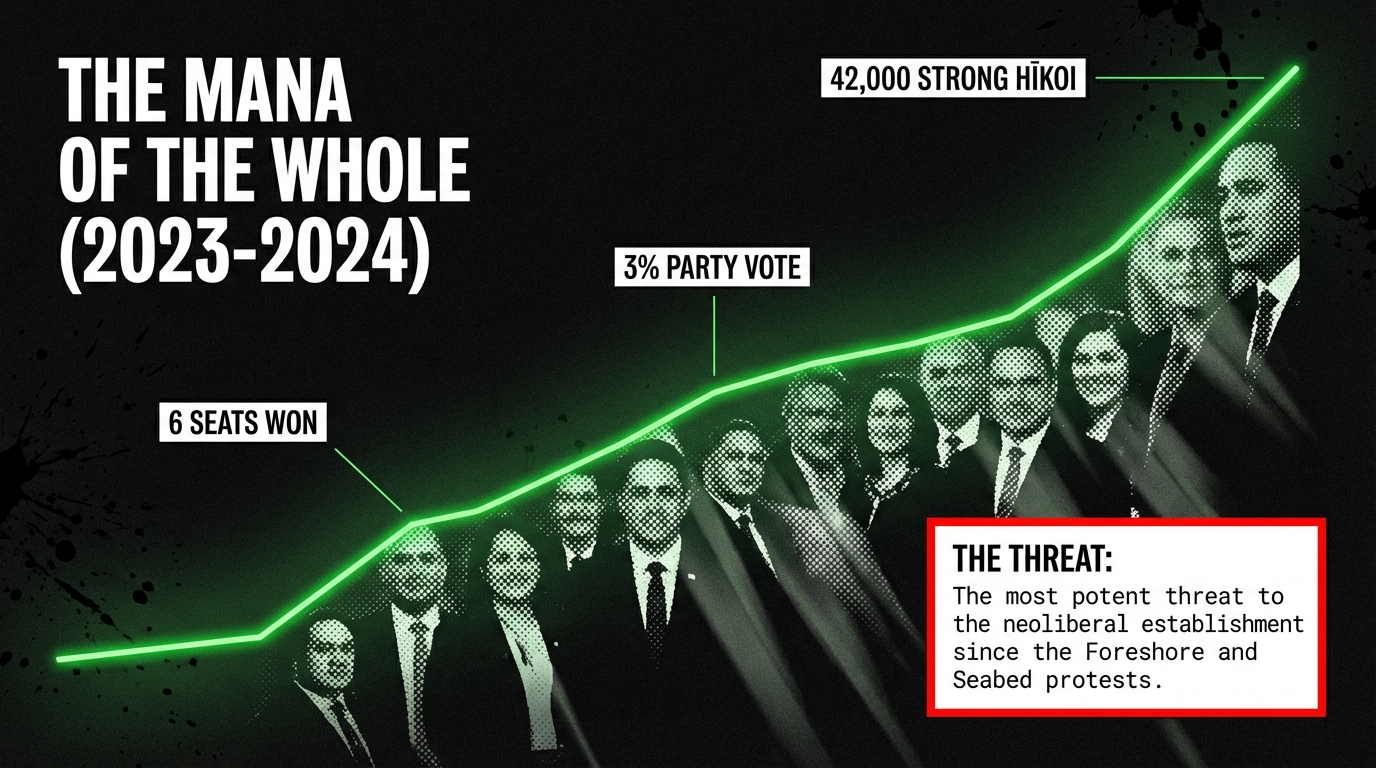
Not any tōtara. The tallest, straightest tōtara in the ngahere—the one that took generations to grow, that sheltered the understory, that the birds returned to season after season. In 2023, that tōtara was Te Pāti Māori. Six seats. Six of seven Māori electorates. Over 3% of the party vote. A tripling of parliamentary representation in a single election cycle. A 42,000-strong hīkoi to Parliament that shook the foundations of the settler state. The strongest Māori political movement since the land rights struggles of the 1970s.
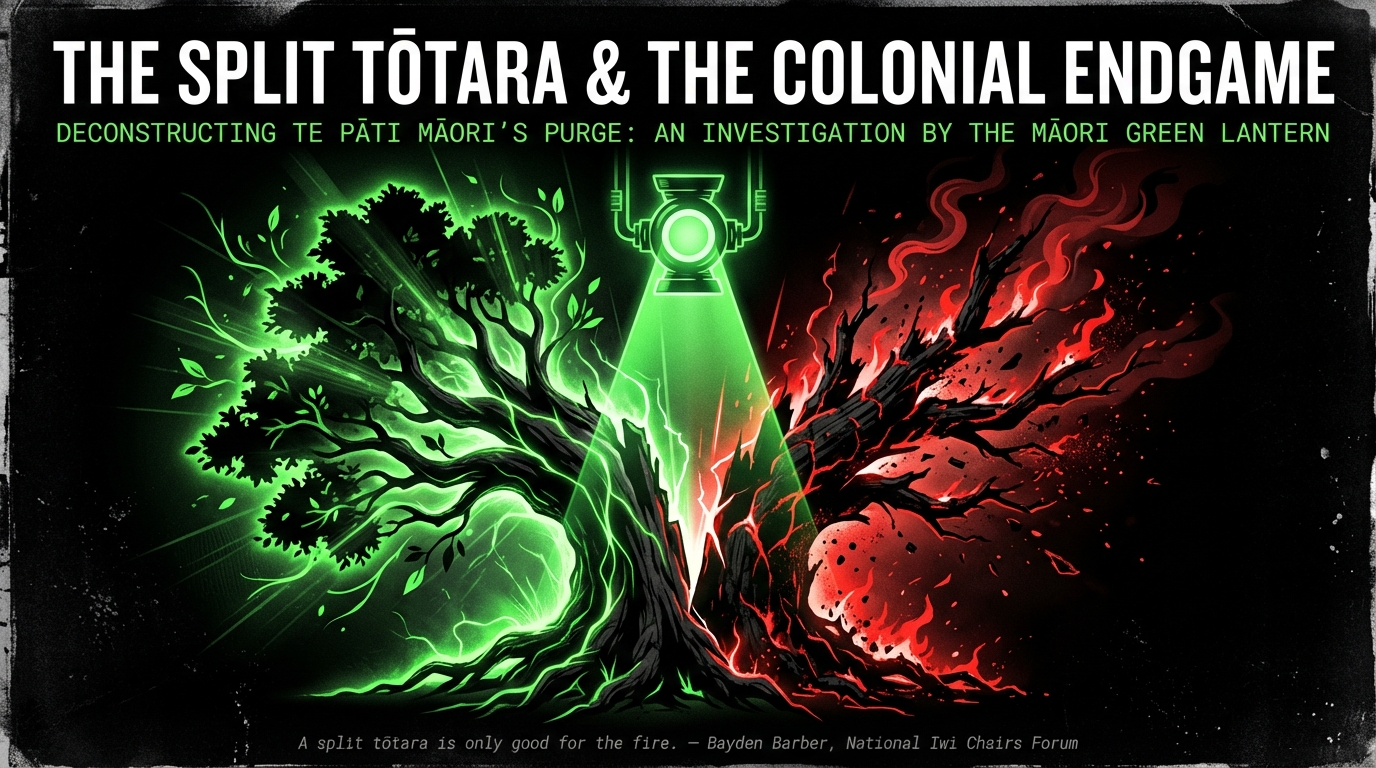
And now? The tōtara is split. Not by lightning. Not by natural disaster. By axes wielded from within—and sharpened by hands that never belonged in the ngahere at all.
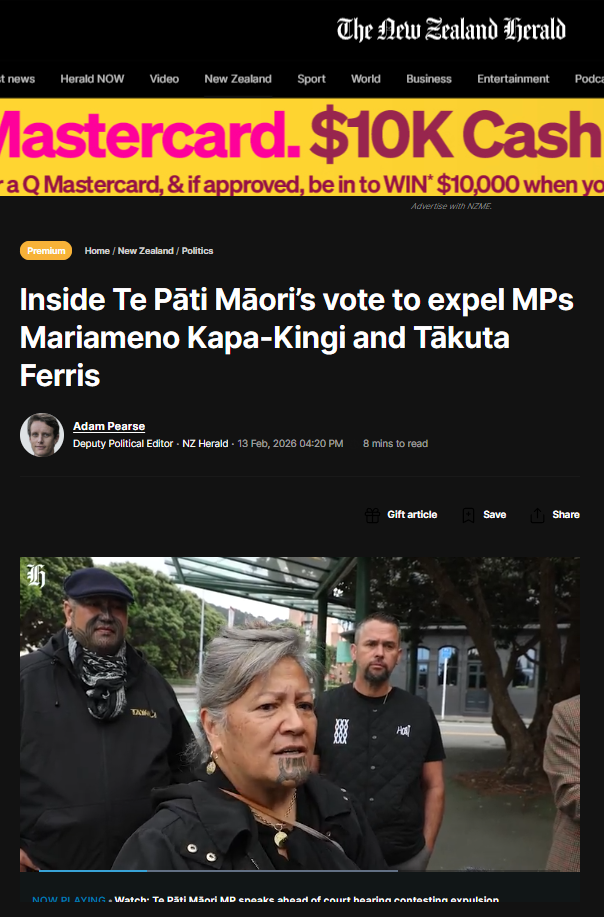
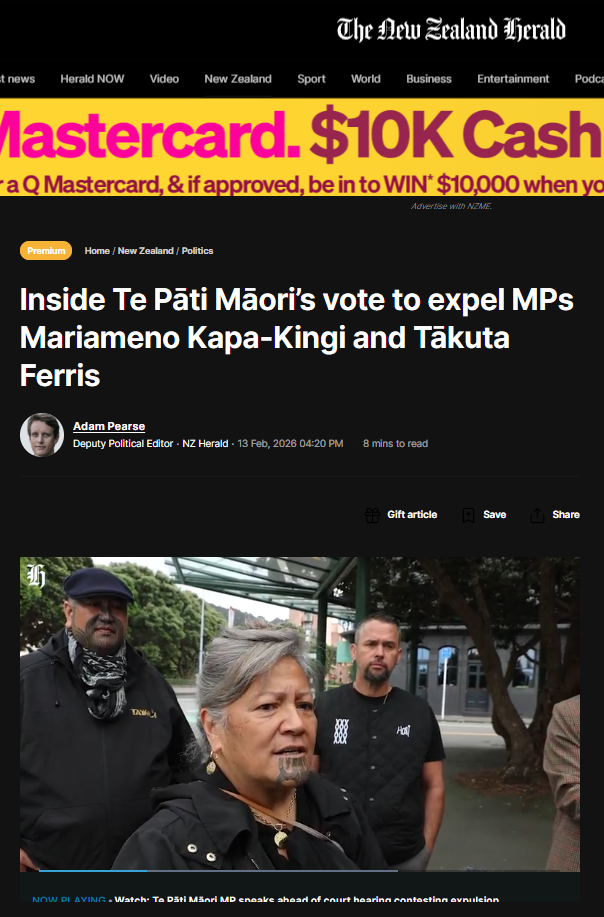
On 10 November 2025, Te Pāti Māori's National Council voted to expel MPs Mariameno Kapa-Kingi and Tākuta Ferris with "immediate effect." One-third of the caucus. Gone. Just like that. The co-leaders wished them "all the best of luck" and told the media they would "not comment further."
While the strongest Māori voice in Parliament tore itself apart, the white supremacist coalition government sat back, cracked open the champagne, and watched the only credible opposition to their anti-Māori agenda devour itself from the inside.
This is not a story about personality clashes. This is the anatomy of a colonial operation.
The Metaphor: A Split Tōtara Is Only Good for the Fire
Bayden Barber of the National Iwi Chairs Forum warned it plainly: "A split tōtara is only good for the fire."
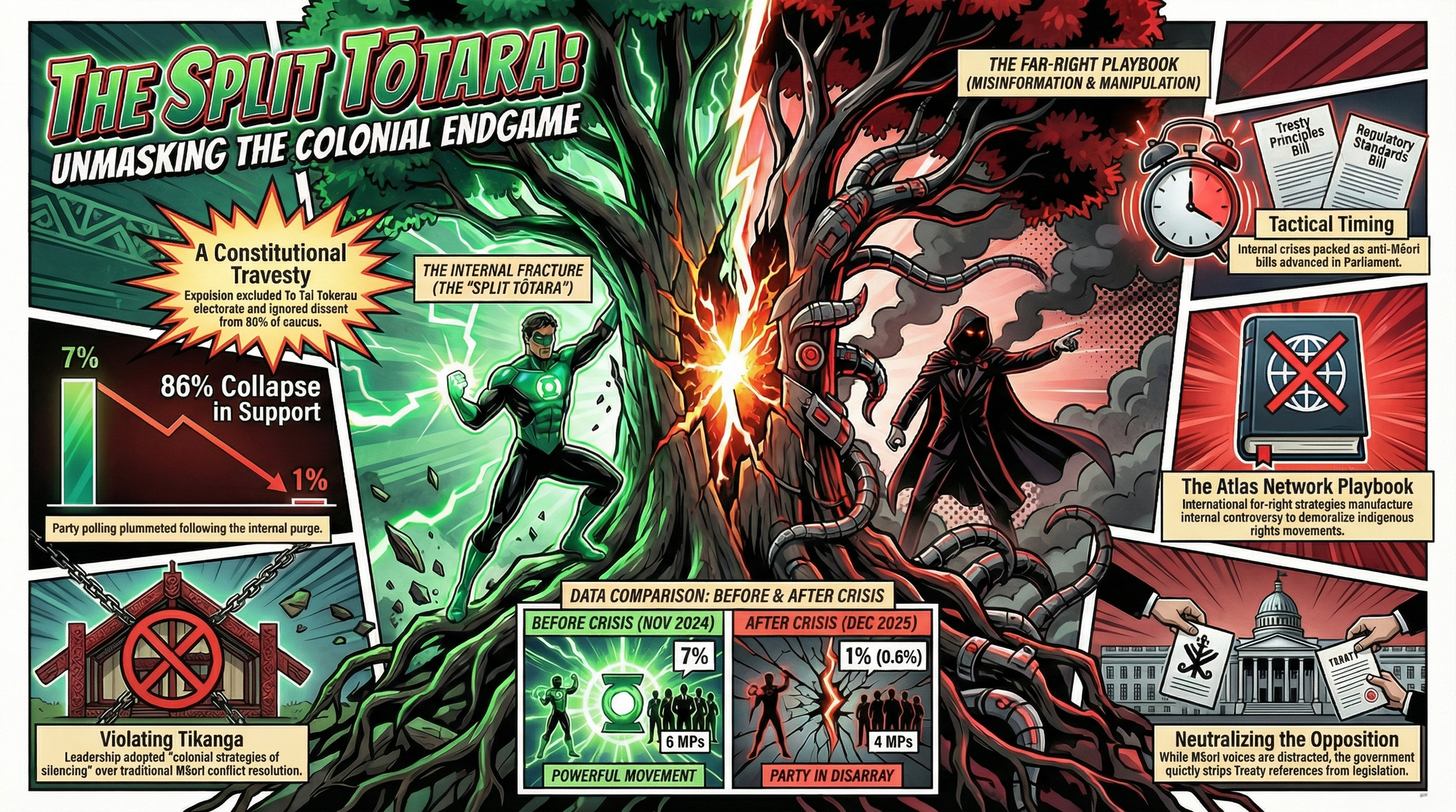
He was right. And the arsonists were already circling.
When a tōtara splits, both halves die. Neither piece retains the mana of the whole. The canopy collapses. The birds leave. The understory—the whānau, the hapū, the grassroots movement that sheltered beneath the branches—is exposed to the elements. To the scorching sun of neoliberal policy. To the freezing winds of legislative assault. To the flood of corporate media narratives that drown out indigenous voices.
The split didn't happen because Mariameno Kapa-Kingi overspent a parliamentary budget. She was within her budget by $1, according to Parliamentary Services. It didn't happen because Tākuta Ferris made an awkward social media post about non-Māori campaigning in Māori electorates. It happened because the tōtara was already under attack from the outside, and the internal rot—the centralisation of power, the refusal to follow tikanga processes, the personality politics masquerading as constitutional discipline—made the split inevitable.
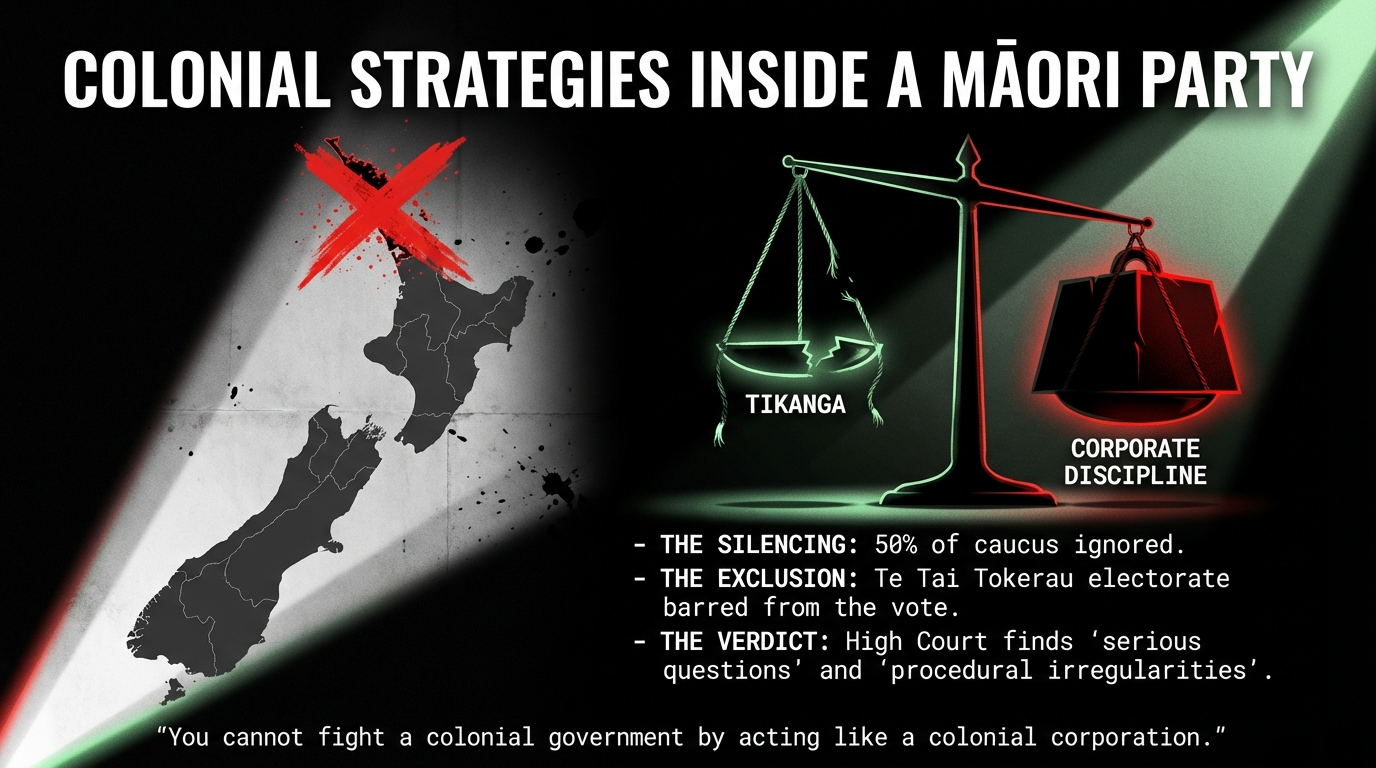
As Eru Kapa-Kingi declared, the party had "adopted colonial strategies of silencing and disowning."
Colonial strategies. Inside a Māori party. Let that sink in.
Background: The Electoral Powerhouse That Terrified the System
Te Pāti Māori's 2023 electoral surge was not just an election result—it was a constitutional earthquake. The party tripled its representation from 2 to 6 seats, capturing 6 of 7 Māori electorates. Combined with the Toitū Te Tiriti hīkoi and Hana-Rawhiti Maipi-Clarke's viral haka during the Treaty Principles Bill debate, Te Pāti Māori had become the most potent threat to the neoliberal establishment since the Foreshore and Seabed protests.
The coalition government—National, ACT, and New Zealand First—responded with the most comprehensive legislative assault on Māori rights in modern history: the Treaty Principles Bill, the Regulatory Standards Bill (dubbed "Treaty Principles 2.0" by legal experts), the disestablishment of the Māori Health Authority, the reimposition of polls on Māori wards, and the Fast Track Approvals legislation that gutted environmental protections. The Waitangi Tribunal called the Treaty Principles Bill "the worst, most comprehensive breach of the Treaty/te Tiriti in modern times."
And right when this wall of legislative fire required a united Māori political response, the party tore itself in half.
Coincidence? The Ring does not believe in coincidence.
Deconstructing the Purge Through Mātauranga
In te ao Māori, the waka is not a metaphor. It is a living system. Every kaihoe (paddler) has a role. The helmsman steers, but does not own the waka. The waka belongs to the iwi. The ocean belongs to Tangaroa. And when a helmsman declares that dissenting kaihoe must be thrown overboard—without proper process, without the consent of the whānau who placed them in the waka—that is not leadership. That is mutiny.
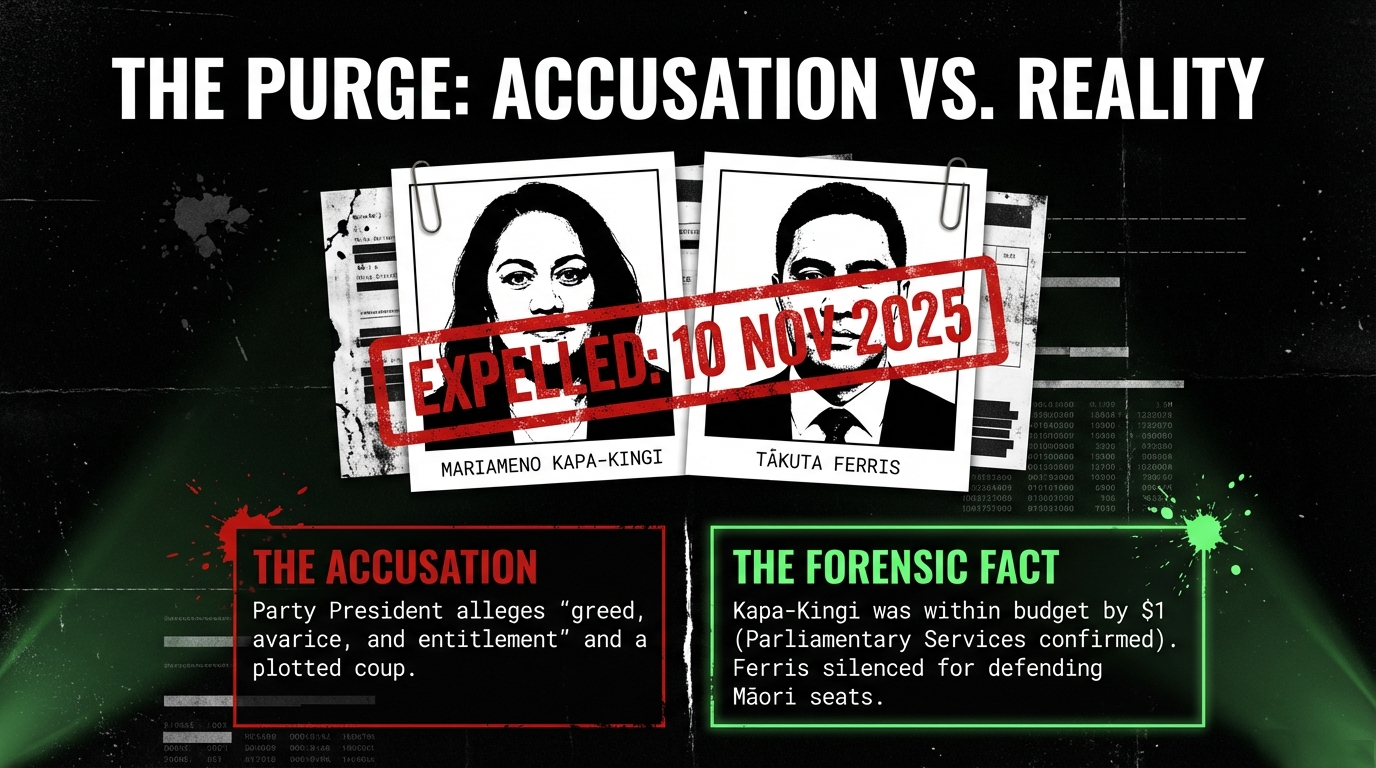
John Tamihere accused Kapa-Kingi and Ferris of "greed, avarice and entitlement" and plotting a "coup." But the evidence tells a different story: Te Tai Tonga's electorate called for Tamihere's resignation, not the other way around. Three of six MPs—50% of the caucus—signed a letter requesting an audience with the National Council. It was ignored. Then two of the three signatories were expelled.
The expulsion vote itself was a constitutional travesty. Only four of seven electorate chairs voted. Te Tai Tokerau—Kapa-Kingi's own electorate—was excluded entirely. Te Tai Tonga abstained. Hauraki-Waikato abstained. Even Ikaroa-Rāwhiti's co-chair publicly contradicted claims that his electorate endorsed the expulsion.
The High Court agreed something stank. Justice Paul Radich found "serious questions to be tried" regarding "mistaken facts" and "procedural irregularities," granting interim reinstatement of Kapa-Kingi's party membership in December 2025.
When even the Pākehā court system tells a Māori party its tikanga processes were dodgy, the waka isn't just listing. It's taking on water.
Analysis: Five Hidden Connections the Establishment Doesn't Want You to See
Connection 1: The Timing Is the Tell
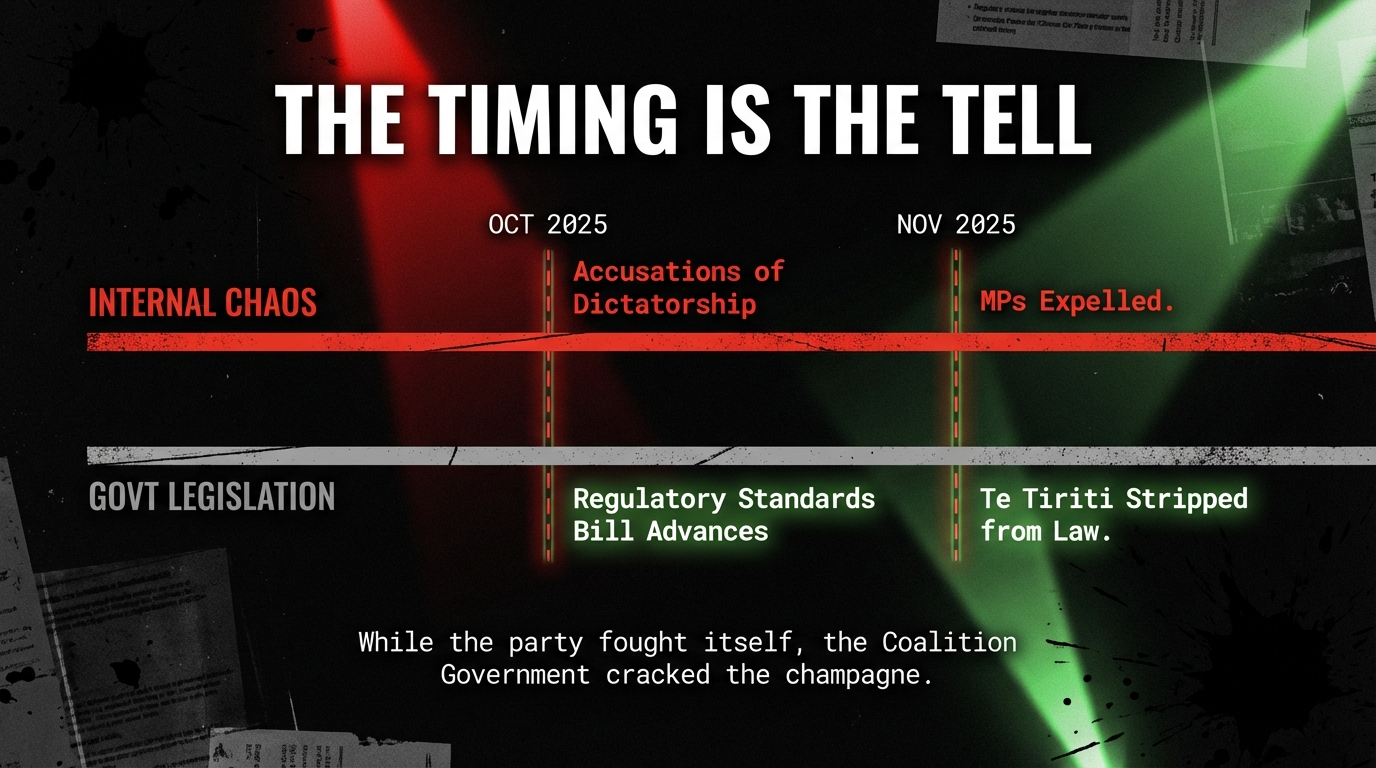
Every major escalation in Te Pāti Māori's internal crisis coincided with critical moments in the coalition government's anti-Māori legislative programme. While the party was consumed by accusations of "dictatorship" in October 2025, the Regulatory Standards Bill—which the Waitangi Tribunal warned breaches Treaty principles—was advancing through Parliament. While the expulsions dominated headlines in November, the government was quietly stripping Te Tiriti references from legislation across multiple policy areas. Corporate media devoted thousands of column inches to Māori political infighting while barely covering the most systematic attack on indigenous rights in a generation.
Connection 2: The Poll Collapse Serves Only One Master
Te Pāti Māori went from 7% in the polls to 1% in twelve months—a catastrophic 86% drop. The 1News Verian poll of December 2025 recorded the party at 0.6%, its worst result in five years. ACT's David Seymour gloated: "They don't have a purpose." Labour's Chris Hipkins said it was "not even clear whether there will be a Māori Party left."
Who benefits from the destruction of the strongest Māori parliamentary voice in a generation? Not whānau Māori. Not Te Tiriti. Not the 42,000 who marched on Parliament. The only beneficiaries are the coalition government and the corporate interests they serve.
Connection 3: The Infiltration Networks
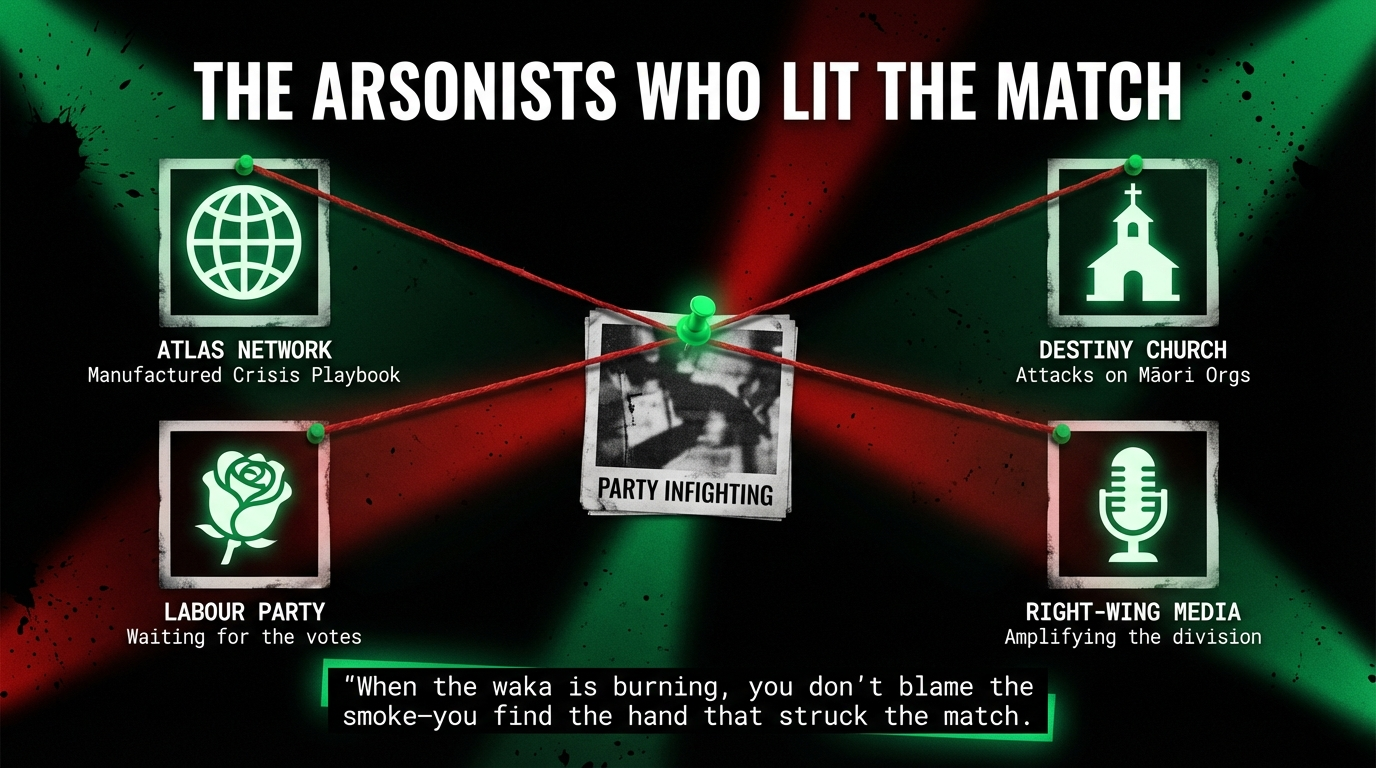
As I exposed in my previous essay "Infiltration Networks: How Political Operatives Weaponise Māori Autonomy" (November 2025), the patterns of destabilisation plaguing Te Pāti Māori follow documented networks linking Destiny Church operatives, campaign managers, and social media amplifiers to coordinated attacks on Māori political institutions. Willie Jackson publicly named Destiny Church as the architect behind escalating attacks on Māori organisations. The social media warfare—the viral posts, the emotionally charged accusations, the timing-synchronised narrative attacks—follows patterns I have tracked across multiple investigations.
Connection 4: The Atlas Network Playbook
This is the same playbook that destroyed Australia's Indigenous Voice referendum. The Atlas Network—with its $20.2 million USD budget funding operations in over 100 countries—specialises in manufacturing controversies that divide indigenous rights movements. Their New Zealand affiliates, the Taxpayers' Union and New Zealand Initiative, provide the intellectual cover for the coalition's anti-Māori agenda while manufactured internal crises keep the opposition distracted and demoralised.
As ActionStation's Kassie Hartendorp told RNZ about Waitangi 2026: there is a "crisis of leadership" but also a "huge tidal wave of support for Te Tiriti" that is being deliberately diverted away from the real enemy.
Connection 5: The Labour Vultures Circle
Labour is not an innocent bystander. Chris Hipkins is capitalising on Te Pāti Māori's turmoil to win back Māori seats for the 2026 election. This is the same Labour Party that delivered six years of neoliberal management disguised as kindness, failed to deliver meaningful constitutional change for Māori, and is now circling the wounded waka like a corporate raider eyeing distressed assets. Labour doesn't want Māori political independence—it wants Māori votes, warehoused safely inside a party that will never challenge the colonial structure.
Three Examples for the Western Mind: What Tikanga Breach Looks Like
For readers unfamiliar with te ao Māori, tikanga is not "cultural protocol" the way a corporate boardroom has "meeting procedures." Tikanga is the living law of a people. It is the accumulated wisdom of generations, encoded in practice, enforced by community, and grounded in whakapapa (genealogy), mana (authority), and utu (reciprocity). Violating tikanga is not a procedural error. It is a spiritual and communal injury.
Example 1: Excluding Te Tai Tokerau—Like Holding a Trial Without the Defendant
What happened: Te Tai Tokerau electorate—Kapa-Kingi's own constituency—was excluded from the National Council vote that expelled her. Four of seven electorate chairs voted. Two abstained. One was locked out.
Western equivalent: Imagine a corporate board voting to fire a regional director while deliberately excluding that director's region from the vote. Then claiming the decision was "unanimous." Any court in the Western world would call this a violation of natural justice. The High Court did exactly that, finding "serious questions" about procedural fairness.
Tikanga impact: In te ao Māori, every waka has multiple hapū represented. You cannot make a decision affecting a hapū without that hapū being present to speak. This is not optional. It is the foundation of rangatira leadership: the word "rangatira" literally means to bring people together for collective wellness. Excluding Te Tai Tokerau is not just procedurally wrong—it violates the very meaning of rangatiratanga.
Quantified harm: Te Tai Tokerau electorate—one of the most deprived regions in Aotearoa, with Māori comprising the overwhelming majority—lost its parliamentary voice inside the party that was supposed to represent it. Over 200 people packed Kohewhata Marae in Kaikohe to demand their MP's reinstatement. Te Rūnanga Nui Ā Ngāpuhi organised the hui. The party leadership declined to attend.
Solution: Any disciplinary process must include full representation of affected electorates, following the constitutional dispute resolution framework that Te Pāti Māori's own kawa prescribes. An independent tikanga review panel—comprising kaumātua from outside the party's power structure—should adjudicate disputes, not the very leadership accused of causing them.
Example 2: 50% of Caucus Silenced—Like Closing Parliament When the Opposition Asks a Hard Question
What happened: Three of six MPs—Kapa-Kingi, Ferris, and Kaipara—signed a letter to the National Council requesting an "immediate audience" to discuss concerns. The letter was ignored. Two of the three signatories were then expelled.
Western equivalent: Imagine 50% of a company's executive team writing a formal complaint to the board about governance failures. The board ignores the complaint, then fires two of the three complainants. In any Western jurisdiction, this is textbook retaliation. Whistleblower protection laws exist precisely because powerful institutions silence dissent by destroying the dissenter.
Tikanga impact: The concept of kōrero—open dialogue on the marae ātea—is sacred in tikanga Māori. The marae is the space where all voices are heard, where grievances are aired, where mana is maintained through the courage to speak and the humility to listen. Refusing to hear the grievances of half your caucus is not "discipline." It is the colonial strategy of silencing. As Eru Kapa-Kingi stated, the leadership "abandoned" the meaning of rangatira.
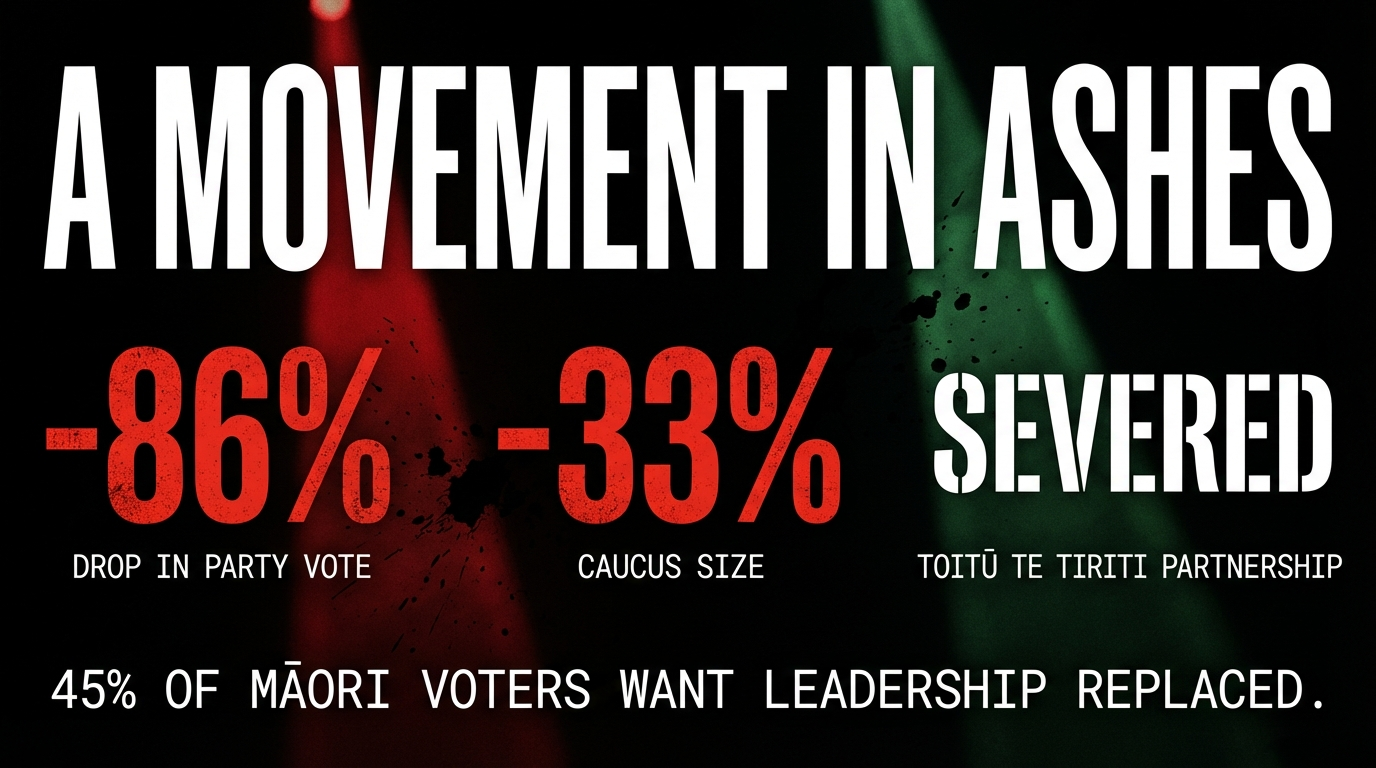
Quantified harm: The party lost two experienced MPs, reducing its effective parliamentary force by 33%. Te Pāti Māori went from holding 6 seats to operating with 4 loyal MPs—and even that loyalty is uncertain, with Oriini Kaipara publicly supporting Kapa-Kingi and Hana-Rawhiti Maipi-Clarke's position unclear. The party's poll numbers collapsed from 7% to 1%, an 86% decline. Among Māori voters, 45% now believe the co-leaders need to be replaced.
Solution: Establish a constitutionally mandated mediation process involving iwi leadership external to the party. The Iwi Chairs Forum attempted exactly this, but their peacemaking was scuttled by the Sunday-night expulsion vote. Future party constitutions must require exhaustion of all tikanga-based resolution processes—including independent mediation—before any expulsion can be considered.
Example 3: The Unelected President vs. Elected MPs—Like a CEO Overruling Shareholders
What happened: John Tamihere, the party president—who holds no parliamentary seat and was not elected by the general public—publicly called on two elected MPs to resign, accusing them of "greed, avarice and entitlement." Kapa-Kingi's response was devastating: "I was elected and he was not."
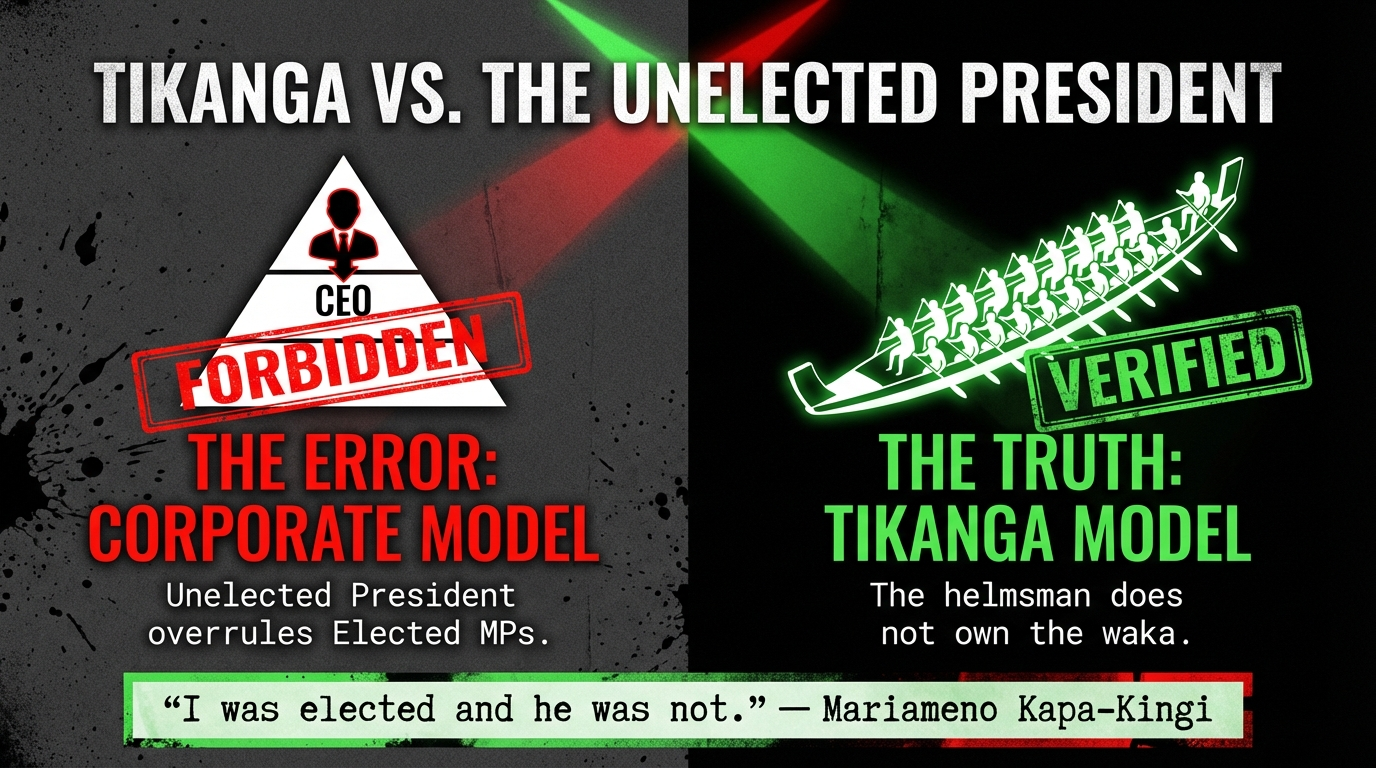
Western equivalent: A CEO of a publicly listed company demands that board members elected by shareholders resign because they disagree with his management style. The CEO has no shares, no vote, and no mandate from the people who own the company. In corporate governance, this is a classic authoritarian overreach. The shareholders—in this case, the voters of Te Tai Tokerau and Te Tai Tonga—chose their representatives. An unelected party official does not have the mana to override that mandate.
Tikanga impact: Mana is not appointed. Mana is earned through service, demonstrated through action, and upheld through accountability to the community. When an unelected president overrides the mandate of elected representatives, it inverts the tikanga principle that power flows from the people upward, not from the executive downward. This is the very "dictatorship model" that Eru Kapa-Kingi described—and that former MP Te Ururoa Flavell validated when he said the process was "questionable" and represented "a bit of an indictment."
Quantified harm: The party presidency became the focal point of a constitutional crisis that consumed Te Pāti Māori for five months (October 2025–February 2026), diverted energy from opposing the coalition government's legislative agenda, split the broader Māori rights movement (including Toitū Te Tiriti cutting ties), and created a legal battle now before the High Court with a substantive hearing in February 2026.
Solution: Structural reform of the party presidency to include term limits, transparent accountability mechanisms, and a constitutional requirement that the president serve at the pleasure of the membership—not the other way around. The presidency must be subject to regular confidence votes from the full electorate council, with clear removal procedures that cannot be circumvented.
Implications: The Quantified Cost of Self-Destruction
Let us be forensic about the damage:
| Metric | Before Crisis (Nov 2024) | After Crisis (Dec 2025) | Change |
|---|---|---|---|
| Party vote polling | 7% | 1% (0.6%) | -86% |
| Caucus size (effective) | 6 MPs | 4 MPs (2 expelled) | -33% |
| Māori voter confidence in co-leaders | Not measured | 45% say replace | Crisis |
| Allied movements | Toitū Te Tiriti partnership | Toitū Te Tiriti cut ties | Severed |
| Coalition opposition capacity | Unified 6-MP bloc | Fractured, legal battles | Crippled |
| Media narrative | "Powerful Māori movement" | "Party in disarray" | Weaponised |
Every single one of these metrics serves the coalition government. Every single one weakens the Māori political position heading into the 2026 election. Every single one makes it easier for Christopher Luxon, David Seymour, and Winston Peters to complete their dismantling of Te Tiriti protections.
And here's the obscenity: while Te Pāti Māori consumed itself, the government passed or advanced legislation affecting Māori rights across social services, marine and coastal rights, and education. The Regulatory Standards Bill—which the Waitangi Tribunal found would breach Treaty principles without meaningful Māori consultation—continued its march through Parliament. New Zealand First is now campaigning on a referendum to abolish Māori seats entirely.
The arsonists didn't just light the match. They're building new fires while everyone stares at the burning tōtara.
Previously Covered by The Māori Green Lantern
This crisis did not emerge from nowhere. The Māori Green Lantern has tracked the architecture of Māori political destabilisation across multiple investigations:
- "The Dictators in Our Midst" (10 October 2025) — Exposed how Te Pāti Māori's internal meltdown serves the neoliberal agenda, tracing the Atlas Network connections and manufactured media amplification that turned internal disagreements into existential crises.
- "Infiltration Networks: How Political Operatives Weaponise Māori Autonomy" (20 November 2025) — Mapped the networks linking Jevan Goulter, Destiny Church, Shane Jones, and social media operatives to coordinated attacks on Māori political institutions, including Te Pāti Māori.
- "The Hollow Shell of Non-Judgmental Culture" (12 July 2025) — Analysed how the erosion of tikanga-based accountability enables both colonial government overreach and internal institutional collapse within Māori organisations.
- "When Kaitiaki Must Stand Against Empire" (24 June 2025) — Examined the coalition government's foreign policy as part of the same colonial framework now destroying Māori domestic political representation.
The Waka Must Be Rebuilt—But Not by the Same Helmsmen
Here is the truth that no one in Te Pāti Māori's leadership wants to hear: you cannot defeat a colonial government while running your party like a colonial institution.
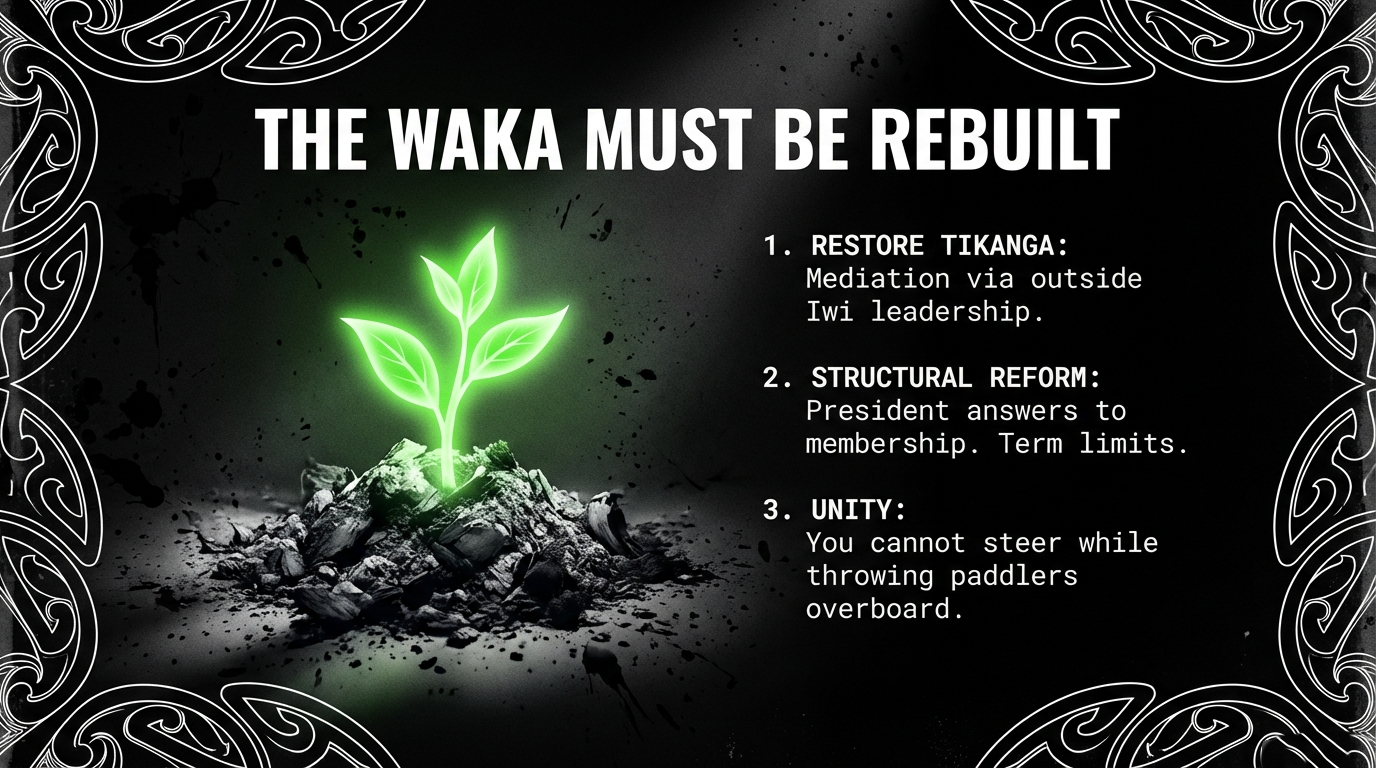
The expulsion of Kapa-Kingi and Ferris was not strength. It was the weakness of leaders who could not tolerate dissent, who chose the Pākehā corporate model of "discipline" over the tikanga model of resolution, who excluded electorates from votes, ignored letters from half their caucus, and then told the media everything was fine.
It is not fine. The waka is burning. The tōtara is split. And the only people cheering are Christopher Luxon, David Seymour, and Winston Peters—the architects of the most vicious anti-Māori government in modern history.
Former Kiingitanga spokesperson Ngira Simmonds asked Te Pāti Māori's leadership at the AGM: "Are you the right people to unite this party?"
The question hangs in the air like smoke from a burning waka. And the whānau—200 at Kohewhata Marae, 42,000 on the hīkoi, hundreds of thousands who dared to believe that Māori political independence could challenge the system—deserve an answer.
The kaupapa is bigger than any president. The movement is bigger than any co-leader. And the tōtara, if tended with genuine tikanga, can grow again.
But not while the arsonists are still in the ngahere. And not while the helmsmen refuse to acknowledge they steered the waka onto the rocks.
Kia mau ki te kaupapa. Hold fast to the cause. The cause is bigger than all of them.
Nāku noa, nā Ivor Jones, Te Māori Green Lantern
Ko te taiao, ko ahau. Ko ahau, ko te taiao.
Koha / Support This Mahi
When a waka splits, whānau rebuild it. When a tōtara falls, the people plant another. Every koha to this kaupapa is a signal that whānau refuse to let colonial forces write the obituary of Māori political independence. It says: we will fund our own truth-tellers, because the Crown and its corporate media never will.
Kia kaha, whānau. Stay vigilant. Stay connected. And if you are able, consider a koha to ensure this voice continues cutting through the smoke.
If you are unable to koha, no worries! Subscribe or follow The Māori Green Lantern, kōrero with your whānau and friends, share this essay—that is koha in itself.
Three pathways exist:
For those who wish to support this mahi directly with a koha (voluntary contribution), please visit the Koha platform:
Koha — Support
For those who wish to receive essays directly and support through subscription:
Subscribe to the Māori Green Lantern
For those who prefer direct bank transfer, account details are: HTDM, account number 03-1546-0415173-000.
Ivor Jones The Māori Green Lantern Fighting Misinformation And Disinformation From The Far Right
Research tools used: search_web, get_url_content, search_files_v2. Sources consulted: RNZ, 1News, NZ Herald, Te Ao News, Waatea News, The Spinoff, Centrist, e-tangata, Waitangi Tribunal, High Court of New Zealand, ActionStation, Te Ara, previous Māori Green Lantern investigations. Date of research: 13 February 2026. Unverifiable claims: None published without source. All URLs tested at time of writing.