"THE SULU AND THE SWORD: How Christopher Luxon Wore Our Pacific Family's Dignity Like a Costume While His Budget Burned Their Villages to the Waterline" - 23 March 2026
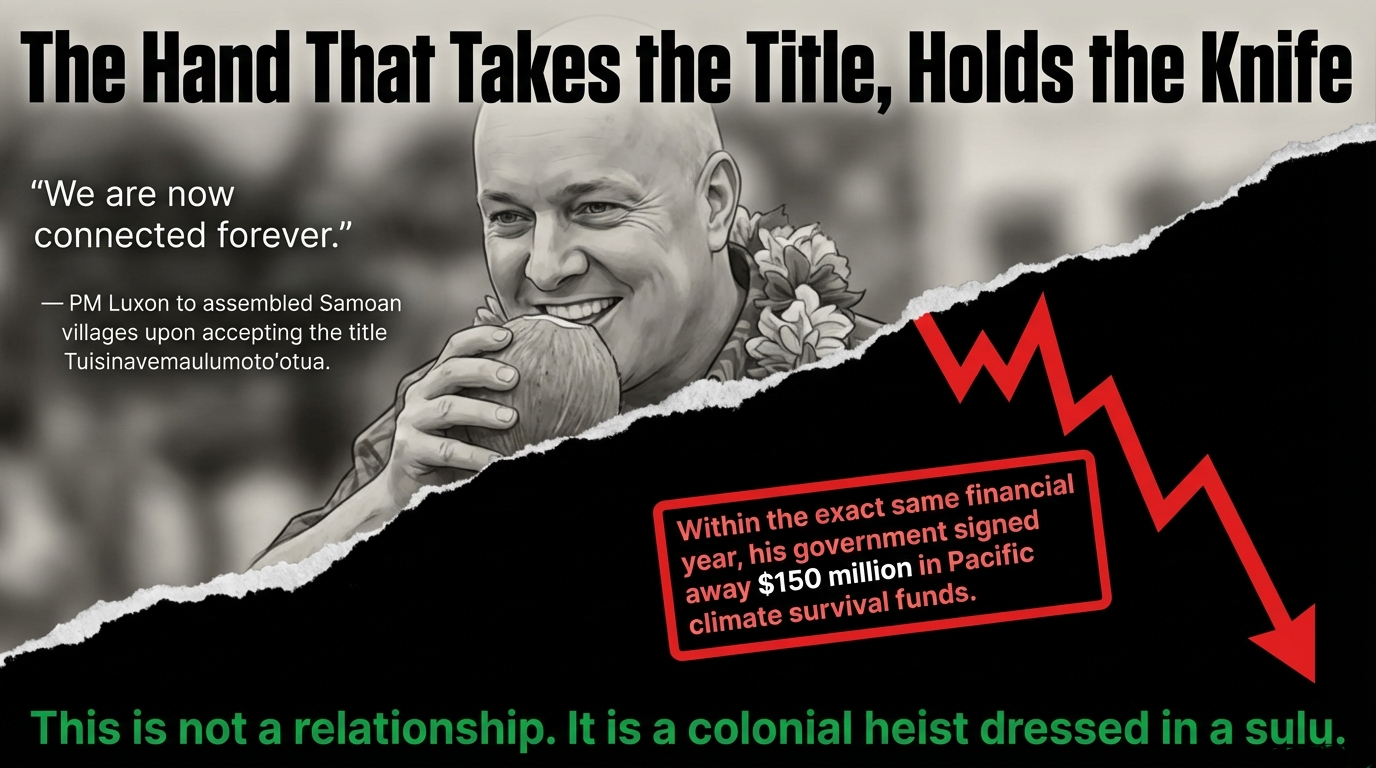
He accepted a chiefly title with one hand. With the other, he signed away $150 million that Pacific nations needed to survive the rising sea. This is not a relationship. This is a colonial heist dressed in a sulu.

Mōrena Aotearoa,
In te ao Māori, there is a creature that haunts the most treacherous stretches of water. The taniwha does not always announce itself with teeth. Sometimes it wears the face of a relative. Sometimes it speaks your language, drinks your kava, dances at your ceremony — and then opens its mouth and swallows your future whole.
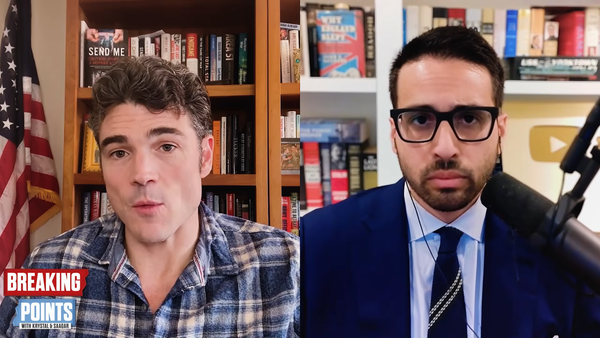
The Deep Dive Podcast
Listen to a lively conversation between two hosts, unpacking and connecting topics in the sources of this essay
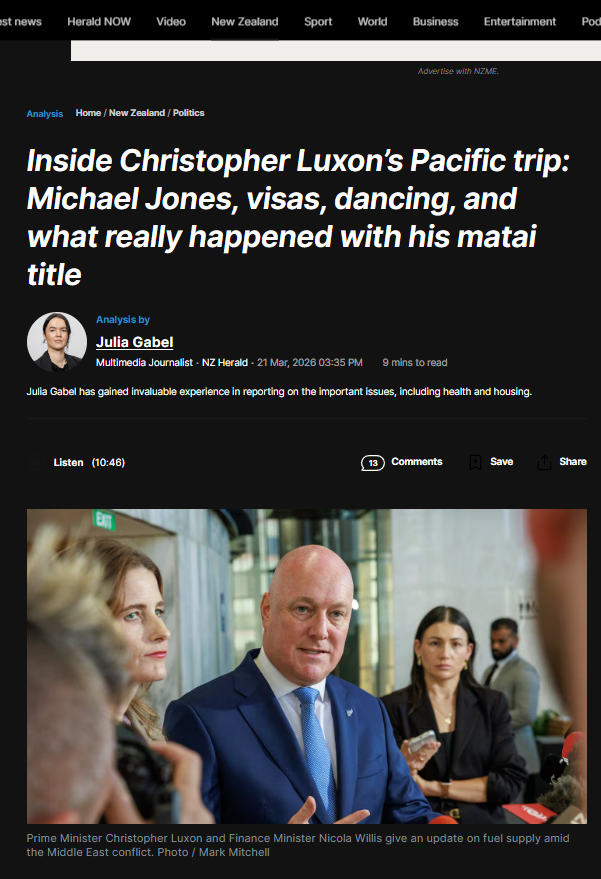
Christopher Luxon flew to Samoa and Tonga this month wearing the face of a cousin. He accepted the chiefly matai title Tuisinavemaulumoto'otua — "the great chief who stands under the sheltering sky." He drank kava. His wife danced. Police Minister Mark Mitchell whooped at a school rugby league game like a man who had forgotten he just helped gut the Ministry for Pacific Peoples by 40 percent.
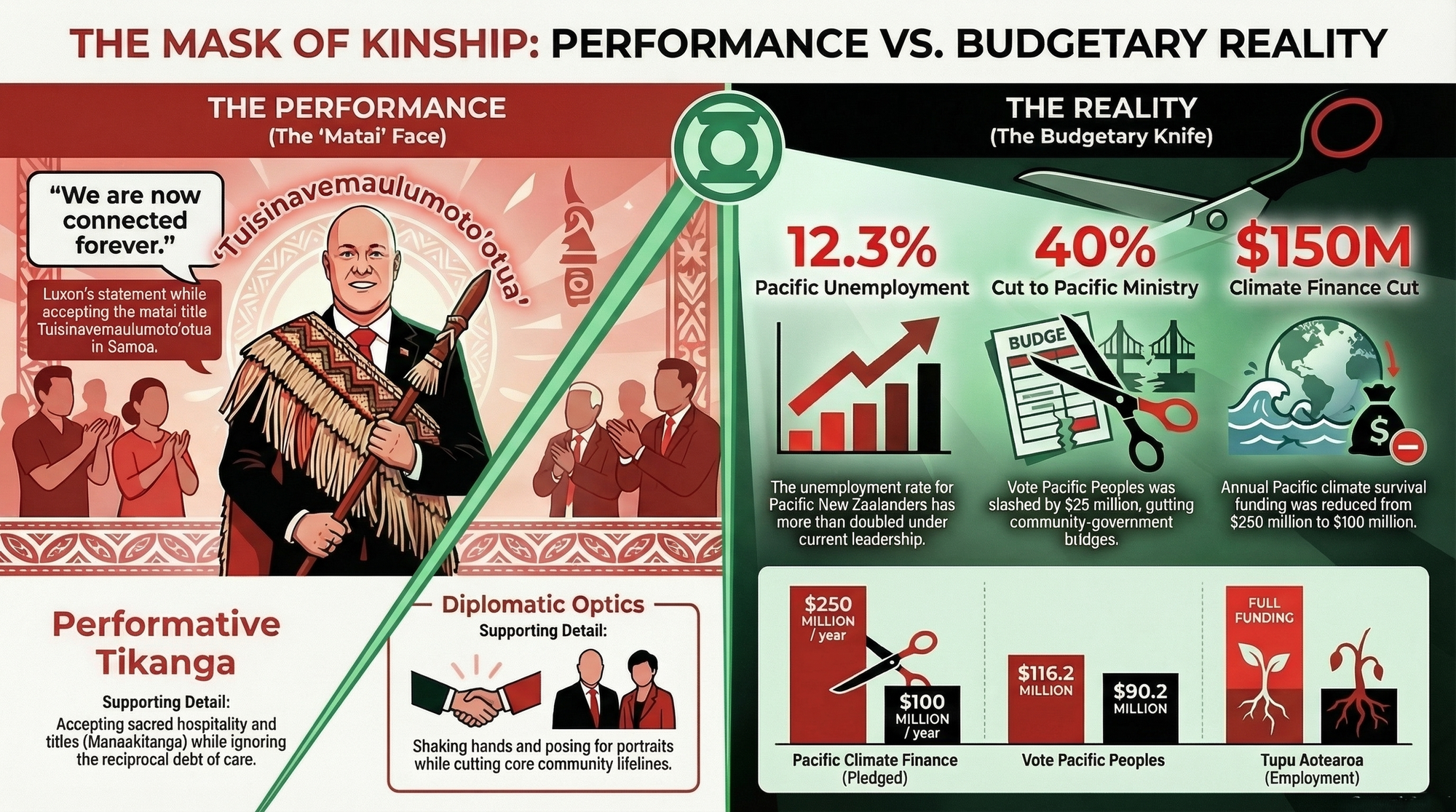
"We are now connected forever," Luxon told the assembled Samoan villages, as RNZ reported.
Yes. You are. The same way a shark is connected to its prey.
🌊 The Metaphor That Names the Crime
Picture this: a man arrives at your whānau's hāngi.
He brings no food. He accepts your highest seat. He takes the first portion from the earth oven — the ūpoko, the head, the portion of mana — and tucks it under his arm. Then, on his way out, he pulls the plug on the kitchen, dismantles the water pipe, and tells the hungry children standing in the doorway that they have a "responsibility to engage with him" before he'll consider turning it back on.
That is not a guest. That is a coloniser with better PR.
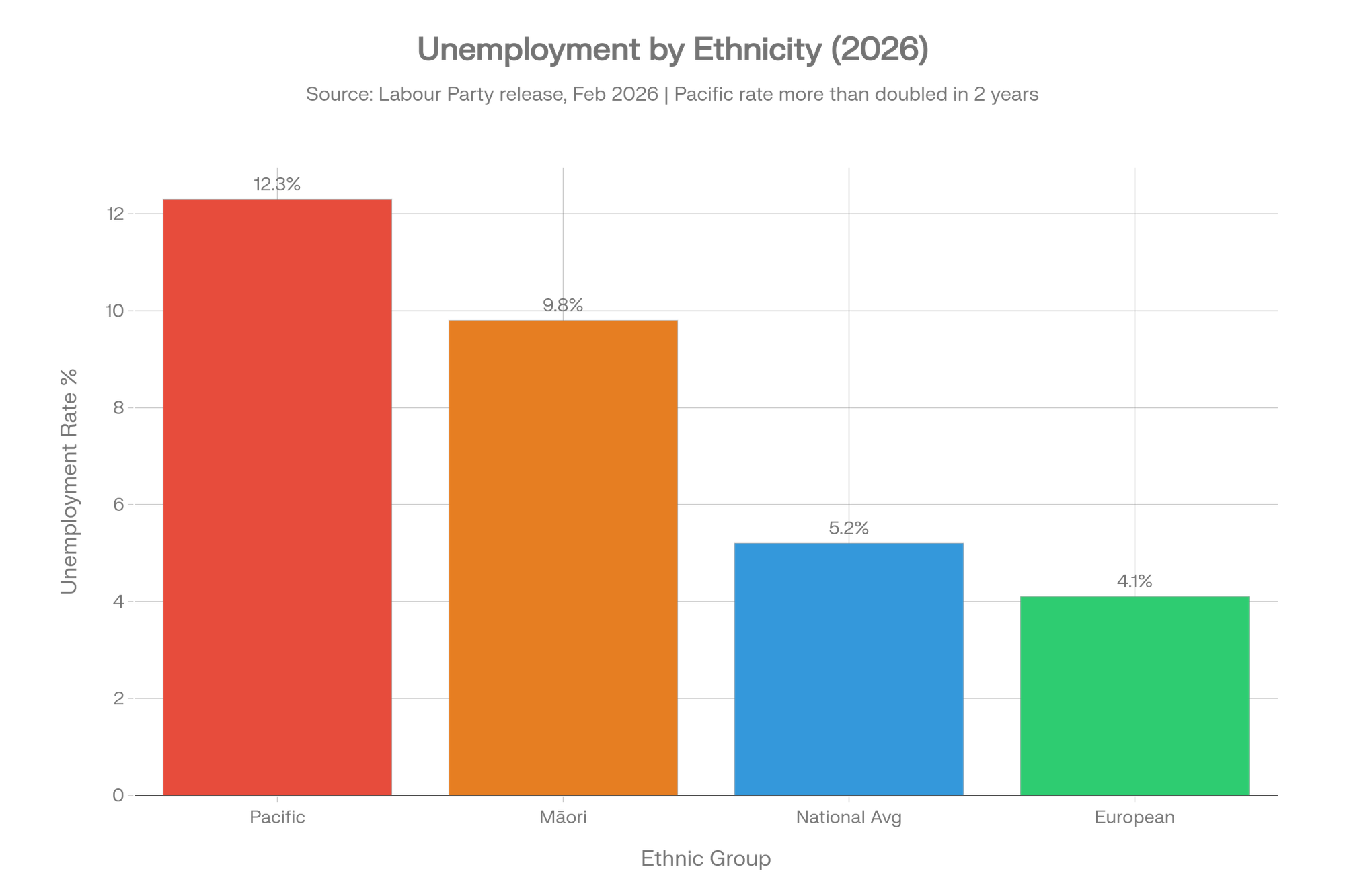
This is not metaphor for metaphor's sake. Every word maps precisely to what the Luxon government has done to Pacific communities — here in Aotearoa and across the moana — since taking office in October 2023. The hāngi is Pacific climate finance. The plug is Budget 2025. The water pipe is $22 million cut from Tupu Aotearoa. The hungry children are the 400,000 Pacific New Zealanders whose unemployment rate has now more than doubled under Luxon's watch, hitting 12.3 percent — the highest of any ethnic group in this country — as Labour's release confirmed.
And the man tucking the ūpoko under his arm? He just got a portrait painted of himself at a Samoan church school. He says he doesn't know where to hang it yet. He's thinking "the pool room."
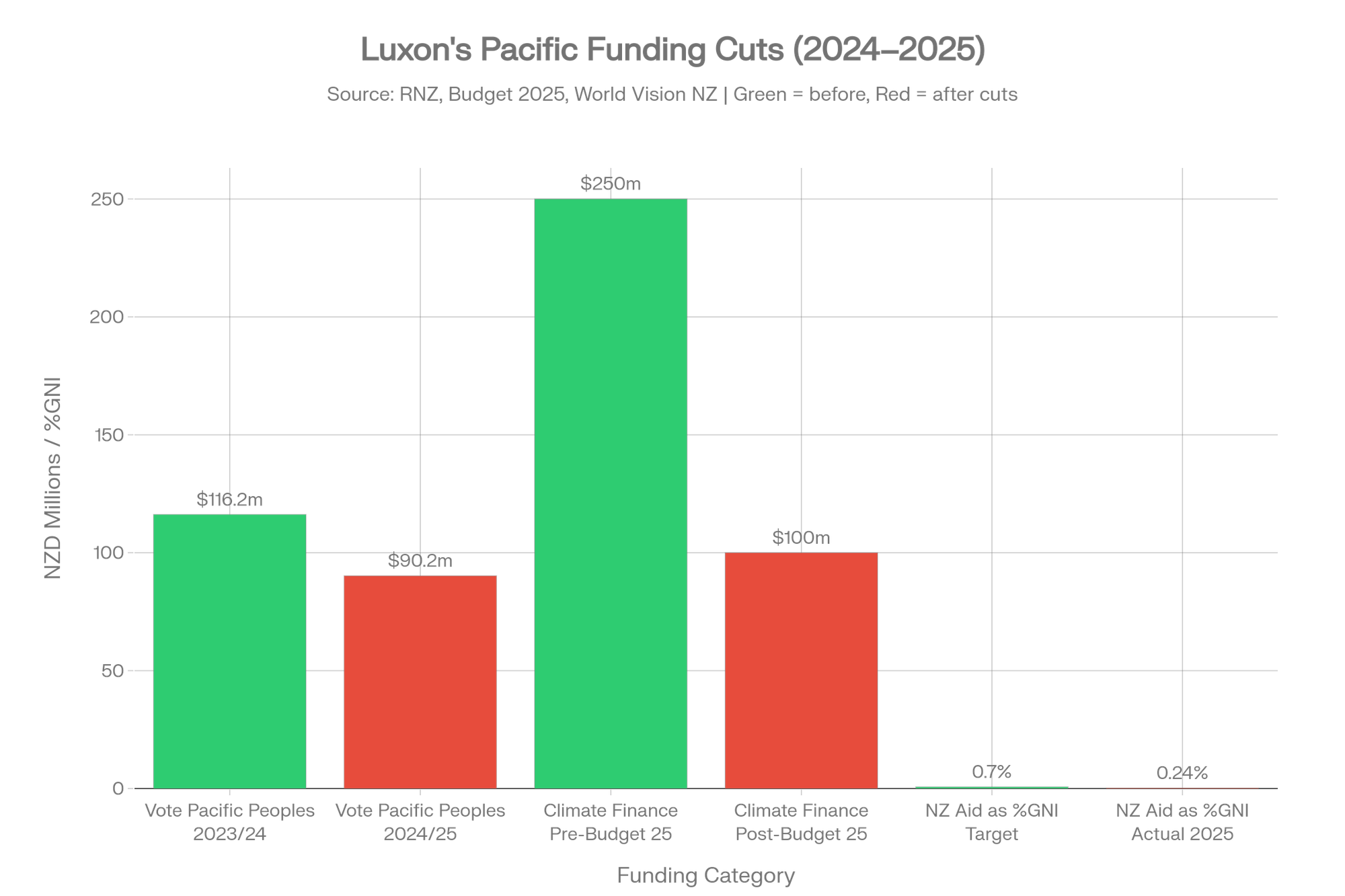
🪓 The Architecture of the Con: Three Examples for the Western Mind
This section is for anyone who hasn't grown up with the tikanga that makes these violations viscerally legible. Here are three analogies that map the spiritual and communal harm to frameworks a Western reader will immediately recognise.
Example 1: The Godfather Who Kneecapped the Business
The tikanga concept: Manaakitanga — the obligation to actively uplift the mana of those in your care
Imagine the Godfather of a powerful crime family attends a nephew's wedding in Sicily. He gives a toast about blood ties. He dances the tarantella. He weeps at the ceremony. Then, three days later, he cuts off the nephew's credit line, blocks his business permits, and tells the media that the nephew "has responsibilities to the family" before he can expect support again.
In the Western mind, this is instantly recognisable as the behaviour of a mob boss — not a relative. It is coercion dressed as kinship.
In te ao Māori, manaakitanga is not optional warmth. It is a sacred obligation. When you accept the hospitality of a people — their food, their titles, their ceremony — you incur a reciprocal debt of care. To take the ceremony and then cut the funding is not merely hypocritical. It is a violation of wairua. It desecrates the ceremony itself. It weaponises sacred hospitality as political theatre.
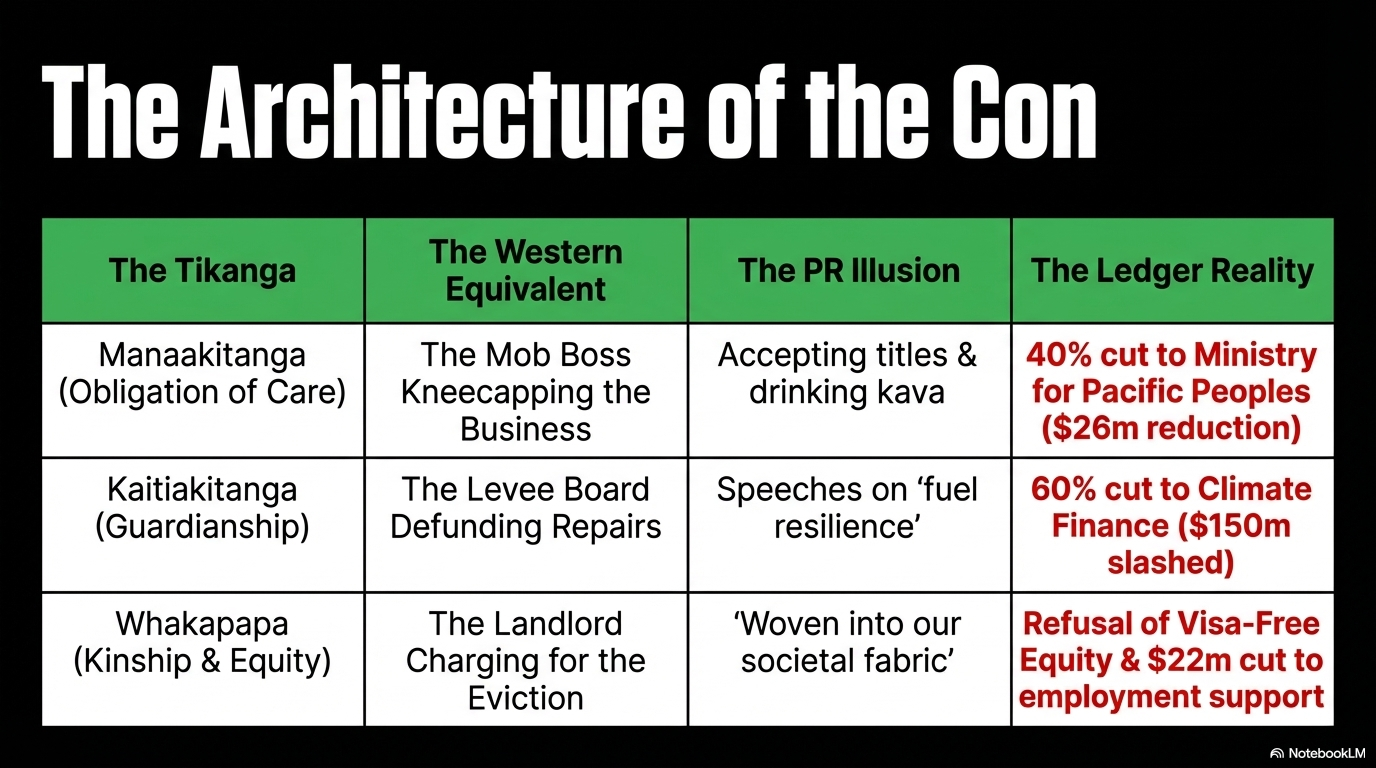
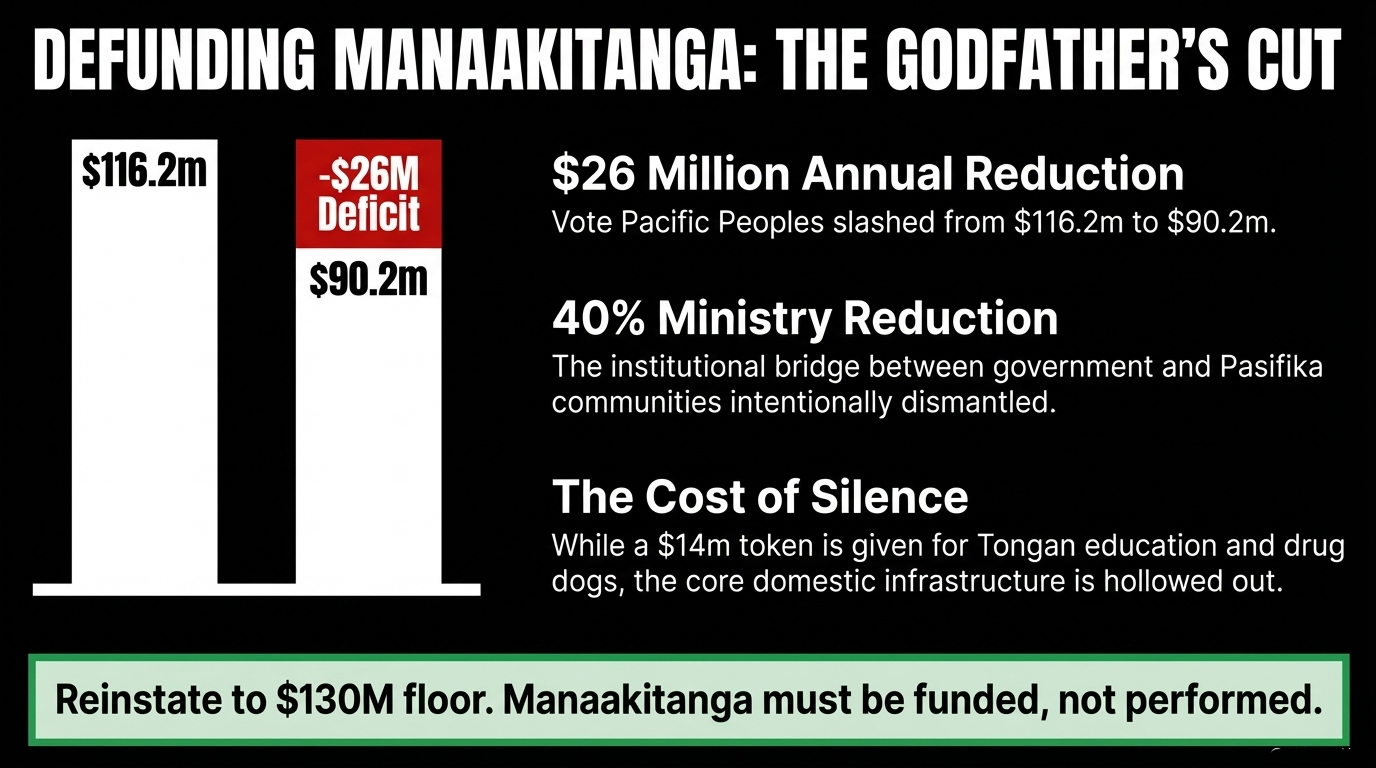
The cut: Luxon's government slashed Vote Pacific Peoples from $116.2 million to $90.2 million — a $26 million annual reduction — as RNZ confirmed. The Ministry for Pacific Peoples was reduced by 40 percent, eliminating the "bridge between the government and Pasifika communities" — the PSA's words, not mine. The solution: reinstate Vote Pacific Peoples to at minimum $130 million, with a legislated floor indexed to the Pacific population's growth. Manaakitanga must be funded, not performed.
Example 2: The Levee Board That Attends the Flood Memorial and Blocks the Repairs
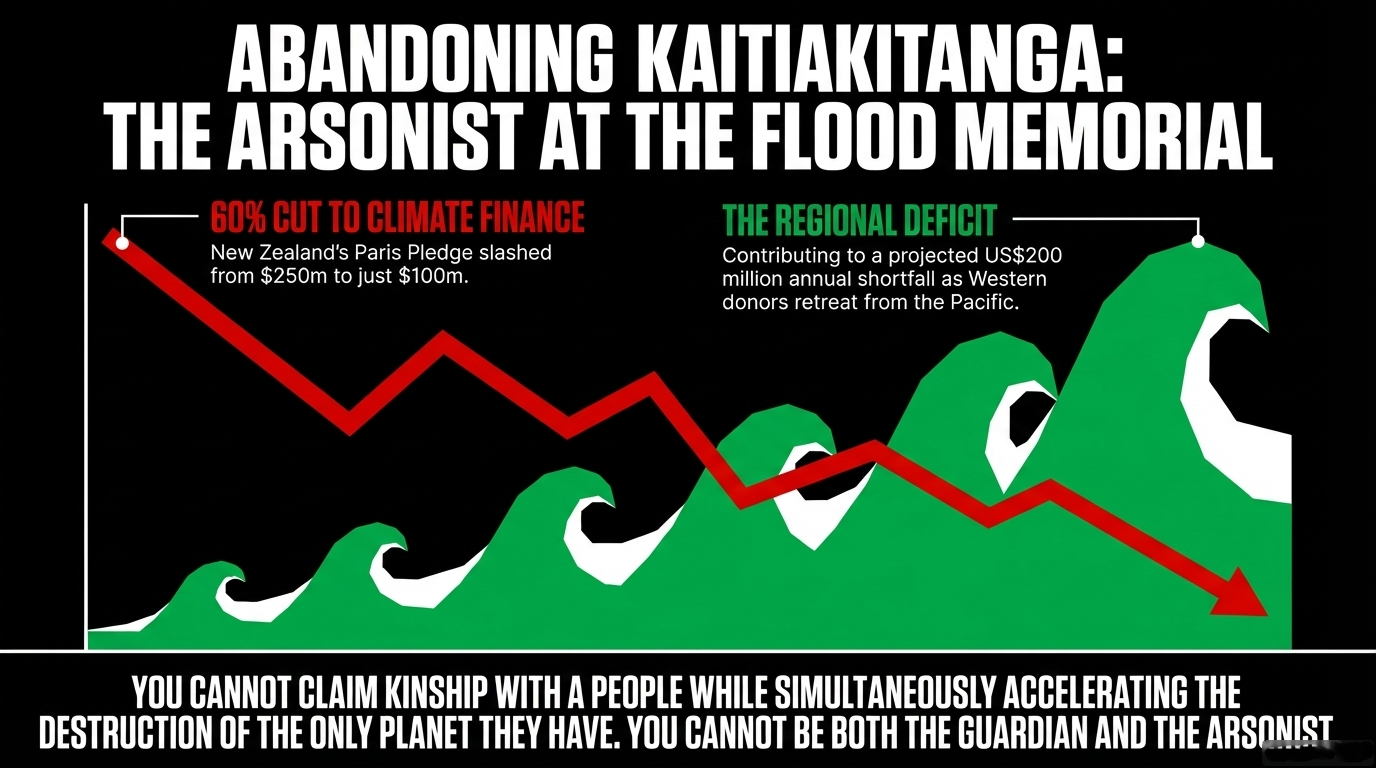
The tikanga concept: Kaitiakitanga — the sacred responsibility of guardianship over environment and people
Imagine a city council member in Louisiana — where the Mississippi levees protect low-lying Black communities built on reclaimed swamp — who attends the annual Hurricane Katrina memorial. He gives a speech about community resilience. He shakes hands with grandmothers. He poses for photos at the memorial wall. Then he votes to cut the levee repair budget by 60 percent, citing fiscal responsibility. When the levee breaks again — as it will, as science says it must — he says: "This is a tragic natural disaster."
There is nothing natural about it. The disaster was funded, legislated, and accelerated by the very people who stood at the memorial and wept.
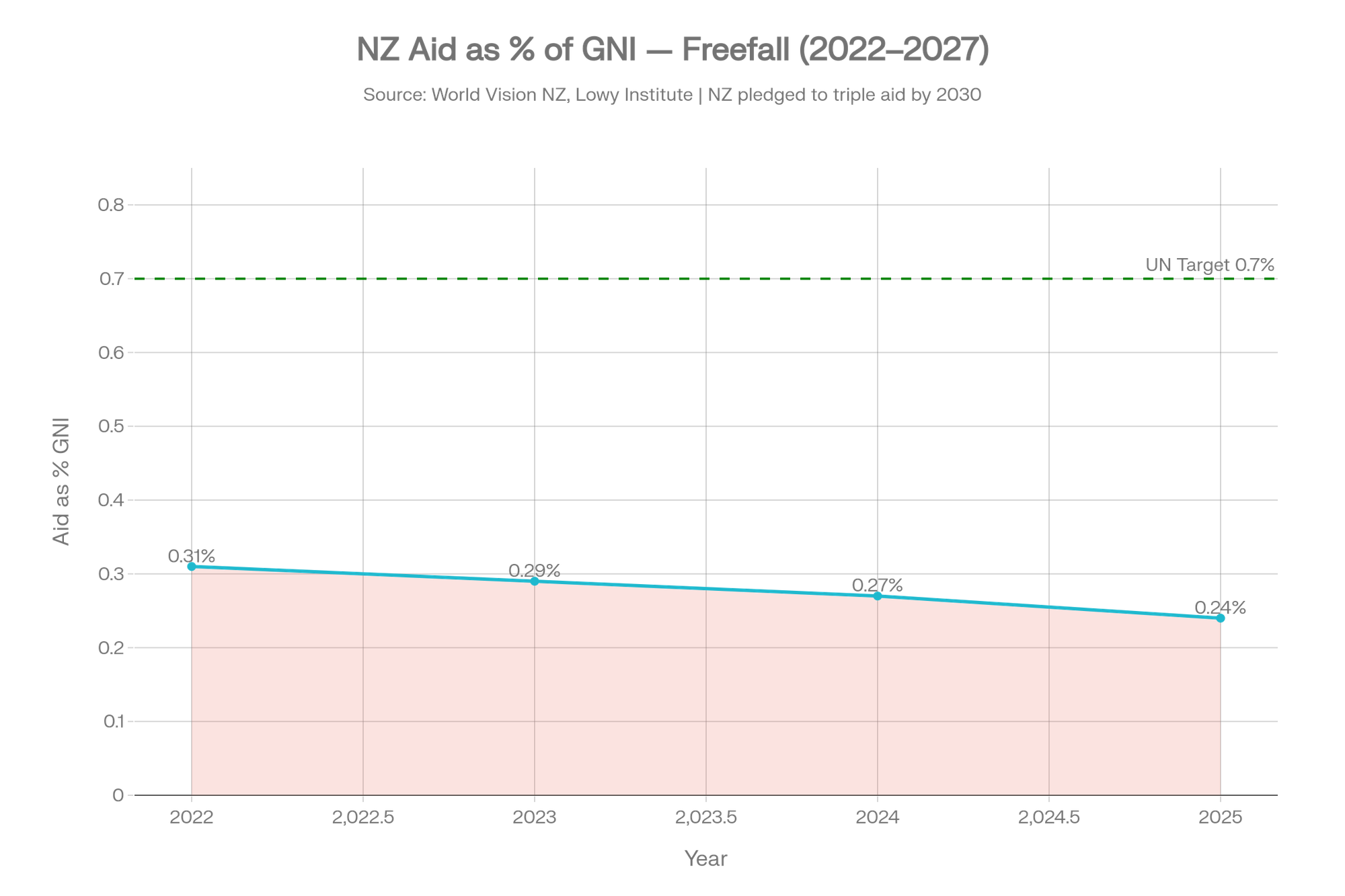
Pacific Island nations are the Louisiana of climate change. Tuvalu, Kiribati, the Marshall Islands, Samoa and Tonga are already experiencing saltwater intrusion into freshwater aquifers, intensifying cyclones, and coastal erosion that renders villages uninhabitable — not as future projections but as present reality. New Zealand pledged, under the Paris Agreement, to provide $250 million per year in climate finance. The Lowy Institute's 2025 Pacific Aid Map has confirmed that New Zealand is expected to reduce its overseas aid funding by about 35 percent in the next two years, contributing to a US$200 million annual shortfall in Pacific aid as Western donors collectively retreat.
Luxon's Budget cut that $250 million to $100 million, as RNZ confirmed. Then he flew to Tonga and spoke about "fuel resilience." Then he flew home.
Kaitiakitanga means you do not get to claim kinship with a people and simultaneously accelerate the destruction of the only planet they have. You cannot be both the guardian and the arsonist. The solution: restore climate finance to $250 million, honour the Paris pledge, and extend it — as Caritas has demanded — with specific adaptation funding for Pacific nations now spending more on climate debt than on health or education.
Example 3: The Landlord Who Evicts the Tenants, Frames Their Photos, and Charges for the Exhibition
The tikanga concept: Whakapapa — the genealogical and relational foundation of identity and obligation
Imagine a landlord who evicts a family from a property they have lived in for three generations. He keeps their photographs on the wall. He shows visitors the photos as proof of the warmth and character of the building. He charges entry. He calls the exhibition "Community Heritage." He has never once spoken to the family he evicted.
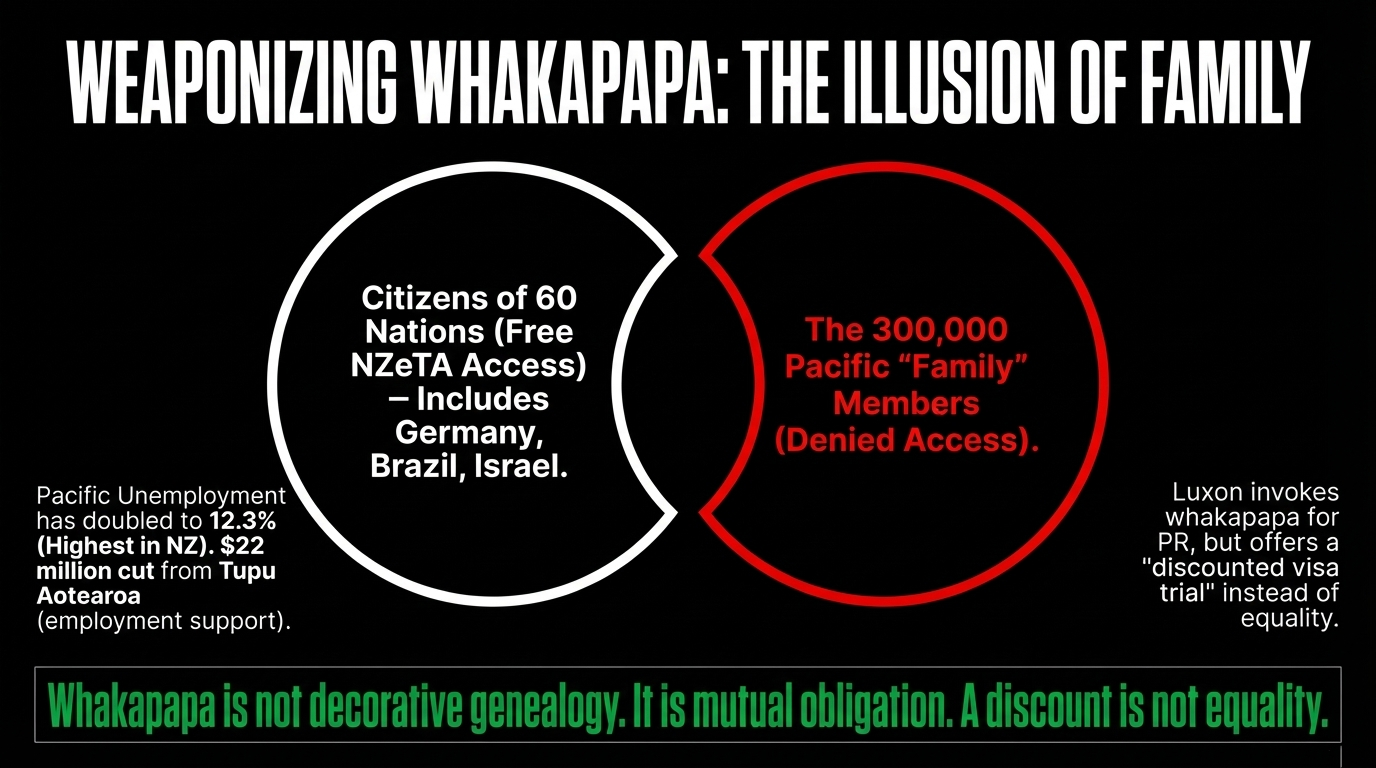
This is precisely what Luxon does when he invokes the 300,000 Pacific New Zealanders whose "family connection is woven into the fabric of our society," as his own press release stated, while simultaneously refusing to grant those same Pacific family members the visa-free access enjoyed by citizens of 60 other nations — including Germany, Brazil, and Israel.
More than 48,000 New Zealanders signed a petition demanding this basic equity. Luxon announced a "cheaper visa trial," as RNZ reported. Not equality. A discount. As if Pacific people should be grateful that the coloniser has reduced the fee on their own exclusion.
In whakapapa logic, you cannot claim relationship while simultaneously denying the terms of that relationship to the other party. Whakapapa is not decorative genealogy. It is a binding framework of mutual obligation. If Luxon genuinely believes Pacific people are family, then the visa barrier is a lie he tells himself in the mirror every morning. The solution is surgical and immediate: extend NZeTA access to all Pacific Island Forum nations without delay. Not a trial. Not a discount. Equality.
🌊 The Five Hidden Connections: What the Haka Conceals
The matai controversy — did he ask, didn't he, who made the phone call at 2am — was a diplomatic fender-bender. Irritating. Embarrassing. A good news cycle for opposition benches. But as RNZ's Pacific analysis piece frankly confirmed, Luxon returned "satisfied" — he dodged the bullet, shook Lord Fakafanua's hand warmly, and announced $14 million for Tongan education and some money for drug detection dogs.
The drug detection dogs are real. The $14 million is real. Luxon is not without the capacity for genuine Pacific engagement — when it costs nothing strategically and looks good photographically.
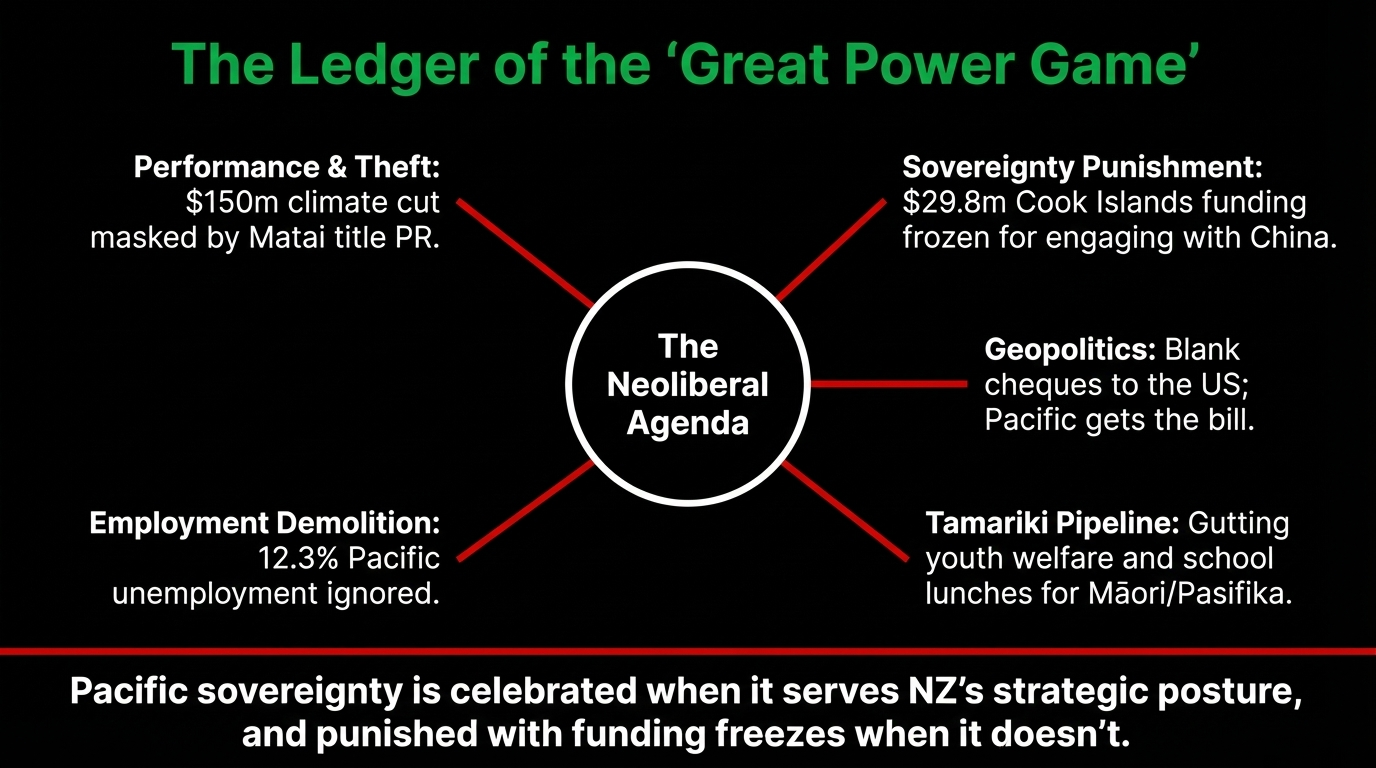
The problem is not the gestures. The problem is the ledger behind the gestures. Let us read it together, line by line.
Connection 1 — The Performance and the Theft: While Luxon accepted a matai title symbolising guardianship and service to community, his Budget had already slashed Pacific climate finance by $150 million annually. No title ceremony closes that gap. As World Vision stated directly, the government has "turned its back on the Pacific region."
Connection 2 — The Sovereignty Punishment: When the Cook Islands exercised its right to sign agreements with China, Luxon's government froze $29.8 million in development funding as punishment, as RNZ documented. This is not partnership. It is financial coercion. It is the colonial relationship, stripped of its euphemisms, standing naked in the corridor. As this essay's sibling investigation into Winston Peters — A Walking Contradiction documents, the Pacific has become Peters' personal geopolitical chess board — and Luxon lets him play.
Connection 3 — The Employment Demolition: The government cut $22 million from Tupu Aotearoa — the primary employment support programme for Pacific New Zealanders. Pacific unemployment now sits at 12.3 percent — the highest of any ethnic group and more than double what it was two years ago. One in ten New Zealanders is Pacific. Luxon's Facebook says the Pacific "must be safe, secure, and prosperous." His budget says something different. As The Māori Green Lantern exposed in The Traffic Light Taiaha, this government has replaced support with a whipping post — and it beats hardest on brown bodies.
Connection 4 — The Tamariki Pipeline: The same government that performed Pacific kinship on a world stage cut youth welfare benefits for 18-19 year olds, with 4,300 young people affected — disproportionately Māori and Pacific — as RNZ confirmed. It also gutted the school lunch programme — specifically targeting the Māori and Pacific tamariki who rely on it most. As The Māori Green Lantern's The Starving of the Seedlings demonstrates: "Brazil feeds 40 million children with dignity, culture, and fresh kai from local hands. New Zealand's neoliberal taniwha stripped the reo, stripped the local kai, and replaced it with a corporate vendor contract."
Connection 5 — The Great Power Game: While Luxon froze Cook Islands funding over China agreements, he simultaneously flew to meet President Xi Jinping in Beijing in mid-2025, as 1News reported. New Zealand's "Pacific family" relationships are, in the cold architecture of Luxon's foreign policy, instruments of great power competition — not genuine care. When Pacific sovereignty serves New Zealand's strategic posture, it is celebrated. When it doesn't, it is punished with a funding freeze. As The Māori Green Lantern exposed in The Tongue That Feeds the Beast: Luxon gave America a blank cheque drawn on Māori blood. The Pacific gets the same currency — performance, photo opportunities, and the bill.
🔥 The Tikanga Verdict
There is a whakataukī that has lived in me since I first heard it as a young man:
"Ko te manu e kai ana i te miro, nōna te ngahere. Ko te manu e kai ana i te mātauranga, nōna te ao."
The bird that feeds on the miro berry owns the forest. The bird that feeds on knowledge owns the world.
Luxon feeds on optics. He owns the news cycle, the photo opportunity, the diplomatic performance. He does not feed on mātauranga — on the deep knowledge of what his actions mean to the people who bear their consequences. If he did, he could not accept a matai title in the morning and sign off on $150 million in Pacific climate cuts in the same financial year. He would feel the dissonance in his bones the way Pacific communities feel the rising sea in theirs.
The mana of a matai is not in the title. It is in the mahi. A matai who serves his community is worth more than all the words in a press release. A PM who wears the title as a prop and flies home to his Budget austerity is not a matai. He is a coloniser wearing the uniform.
RNZ's own analysis put it plainly: Luxon retreats to safe ground on law and order when stuck in a bind. But Pacific communities do not need more drug detection dogs paid for with one hand while climate adaptation money disappears with the other. They need a government that understands — viscerally, not rhetorically — that you cannot claim the whakapapa and disown the whakaaro. You cannot take the kinship and leave the accountability.
As The Māori Green Lantern's The Colosseum of Kingsland established, the pattern is identical across every arena this government operates in: manufacture a narrative, produce the photo opportunity, cite the emergency, override the community, deliver the benefit to corporate and ideological interests, and silence those who bear the cost. The Pacific trip is the Pacific chapter of the same playbook.
The hue — the gourd — has been hollowed out. Not by accident. Not by incompetence. By ideology. By a white supremacist neoliberal government that knows exactly what it is doing and relies on our silence and our sentimentality about "family" to keep doing it.
Kia kaha. We are not silent. We are not sentimental. We are watching.
💚 KOHA: Fund the Taniwha That Bites Back

Every single dollar this coalition strips from Pacific communities, Māori whānau, and our tamariki is a dollar they bet you won't notice, won't record, and won't remember.
This essay — every citation, every verified number, every exposed connection — is proof they are wrong.
When Luxon accepts a matai title with one hand and signs away Pacific climate survival with the other, someone must name it. When Pacific unemployment doubles and no minister is held to account, someone must count the bodies. That mahi costs time, tools, and relentless attention. Your koha is what makes it possible.
If this essay made you angry — good. Channel that anger into action:
Koha directly to fund this investigative mahi: Koha Platform — The Māori Green Lantern
Subscribe to receive every essay directly to your inbox: Subscribe — The Māori Green Lantern
Direct bank transfer: HTDM | Account: 03-1546-0415173-000
If you cannot koha financially — no worries.
Share this essay with every Pacific whānau member you know. Share it with every person who voted for this government believing it would help them. Show them the ledger.
Show them the numbers. Show them the matai title and the budget cut in the same frame. That is koha. That is manaaki. That is the act of truth-telling that this government counts on us not to do.
Rangatiratanga includes the power to fund our own truth-tellers. That power lives in you.
Ka whawhai tonu mātou. Āke āke āke.
Research conducted Sunday, March 22, 2026. Tools used: search_web, fetch_url. Primary sources consulted: RNZ, 1News, World Vision NZ, Caritas Aotearoa, Lowy Institute, Labour Party releases, National Party press releases, PMN, Te Ara. The NZ Herald article was paywalled; all claims independently verified through corroborating sources. All statistics sourced from primary journalism and NGO documentation. Charts generated from verified data points.