"THE SURPLUS OF LIES: How the NZ White Supremacist Government Manufactured a Teacher "Victory Lap" While Building a Factory That Turns Brown Children Into Brown Prisoners" - 28 February 2026
"They weighed the bones of our mokopuna and called it a surplus — while the kura that should have saved them stood empty, their doors padlocked by the same hands now clapping at the press conference."

Kia ora ano Aotearoa,
The Whakapapa of a Lie — Introduction
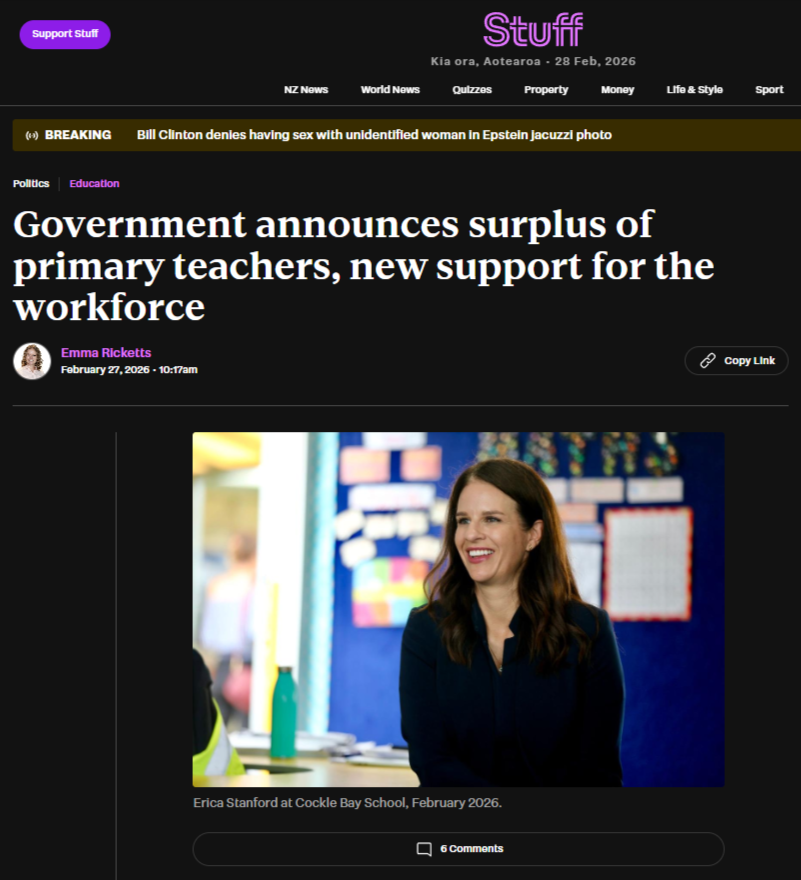
On 26 February 2026 — two days ago — Education Minister Erica Stanford stood inside Auckland's New Windsor School, flashed her teeth at the cameras, and performed the most obscene act of political theatre this government has yet staged. She announced a "return to surplus" of primary school teachers — 530 nationally, growing to 1,350 by 2028 — as if she had planted the seed, tended the soil, and harvested the crop.
She did not plant the seed. She salted the earth. She poisoned the river. She torched the whare wānanga and is now standing in the ashes, selling fire insurance.
Let us be precise about what this woman and her white supremacist coalition have done: they have manufactured the appearance of educational salvation while running the most systematic demolition of Māori education infrastructure since the Native Schools Act of 1867. They have cut $30 million from te reo Māori teacher training and called it "prioritisation." They have sacked 174 specialist teachers of Māori and literacy and called it "reinvestment." They have slashed $375.5 million from school collaboration and called it "efficiency." They have offered teachers a 1% pay rise — below the price of a loaf of bread — and called it "fair." They have erased Te Tiriti from collective agreements and called it "modernisation."
And now they stand in front of brown children and announce a surplus.
The Ring does not merely glow. It burns. The taiaha is not raised. It is swung.
The Māori Green Lantern has extensively documented this government's pattern of performative investment masking structural extraction in "The Dashboard Illusion: How Neoliberalism Sells Sovereignty While Stealing Resources", "Back to Basics, Back to Brutality: How a 'Hodgepodge' of Bills Became the Most Coordinated Assault on Māori Rights, Workers, and Democracy in a Generation", and "The Nursery of Cages: How a White Supremacist State Built a Factory That Turns Brown Children Into Brown Prisoners".
Te Takapau Wharanui — The Woven Mat of Context
The Numbers They Want You to See — The Shiny Lie
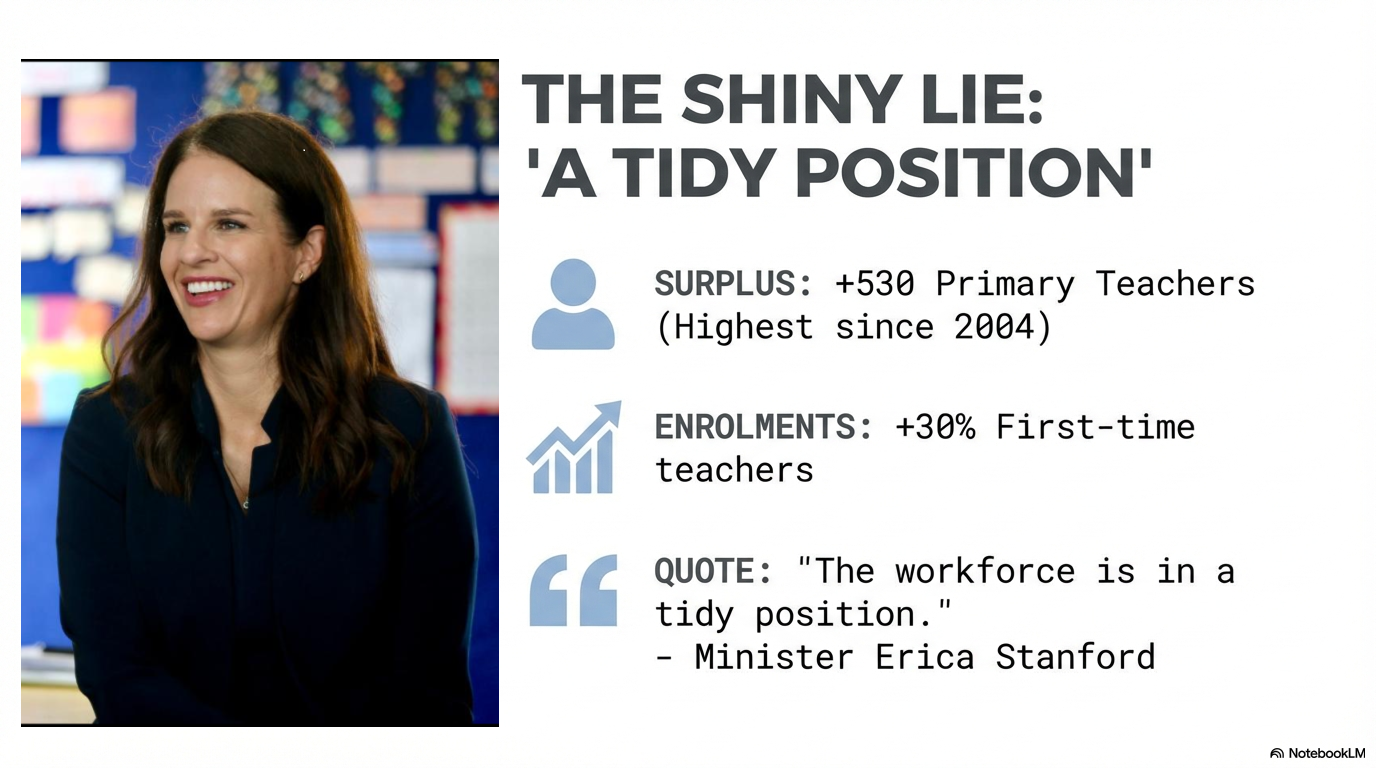
Stanford's headline: 530 surplus primary teachers nationally. More teachers than any time since records began in 2004. First-time teacher training enrolments up 30% in 2025. A new suite of "workforce investment initiatives" — Aspiring Principals programmes, Go Rural grants of $4,000, Māori-medium funding "doubled" from $1.1 million to $2.3 million annually.
It sounds magnificent. It is a fraud. A confidence trick performed on a nation too exhausted and too distracted to check the receipts.
The Numbers They Are Burying — The Rotting Truth
The same Ministry of Education report that produced Stanford's victory lap contains the numbers she is praying you never read. Numbers that expose this announcement as the most cynical piece of educational gaslighting since National Standards:
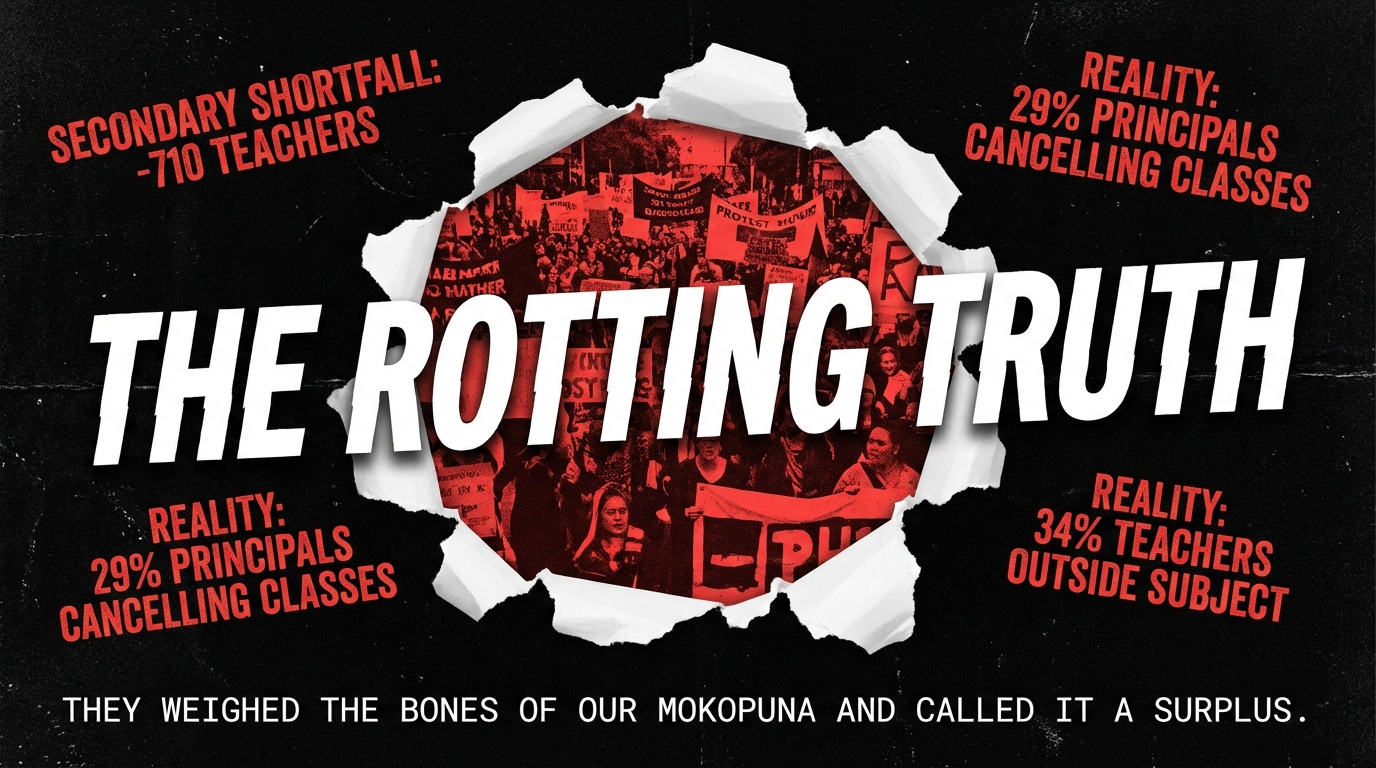
- Secondary schools face a shortfall of 710 teachers in 2026 — worse than last year's forecast of 500. That is more than one missing teacher per school across 491 secondary schools. Your rangatahi are being taught by whoever they can drag through the door.
- 29% of secondary principals have cancelled or transferred classes because the specialist teachers simply do not exist. 34% have teachers working outside their subject area. Your child's physics teacher may be a PE teacher with a textbook.
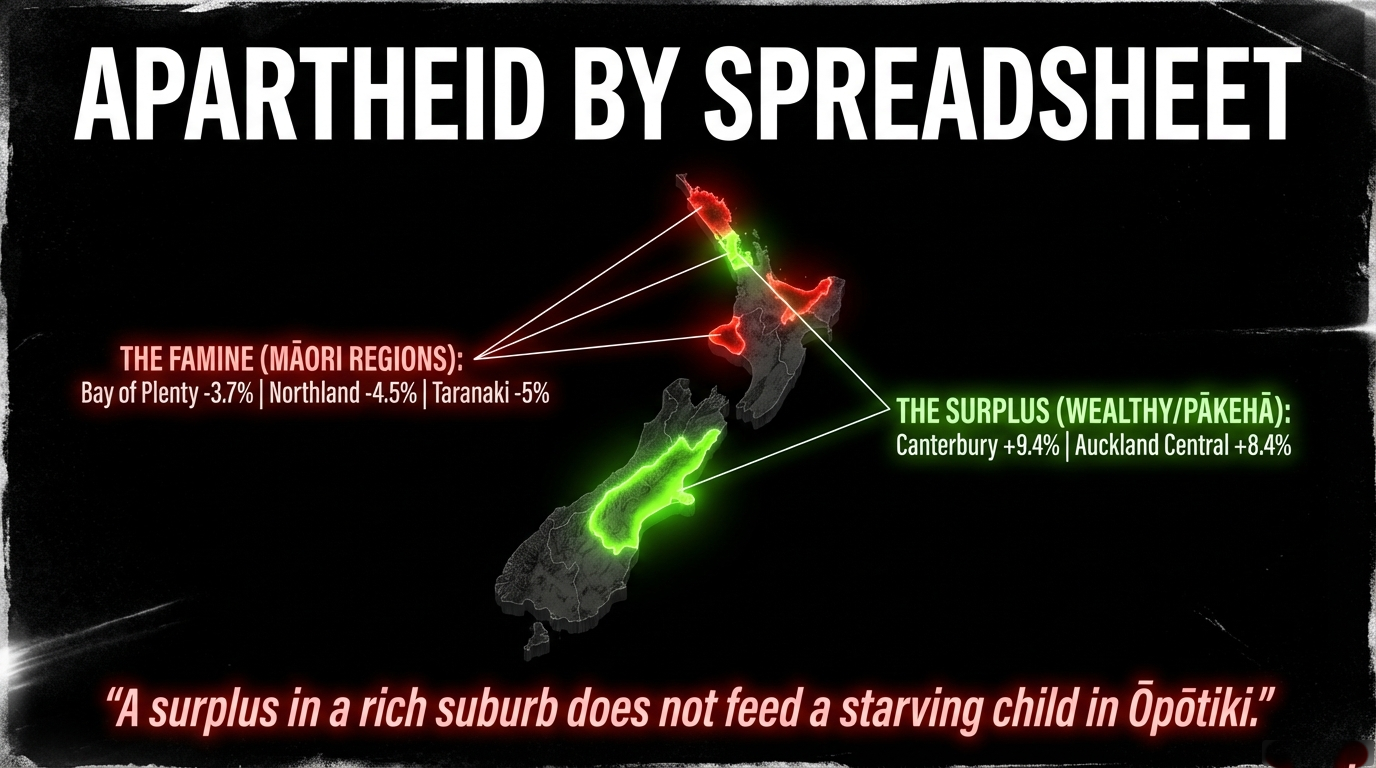
- Bay of Plenty — our tūrangawaewae here in Tauranga — faces a primary teacher shortage of -3.7%, alongside Taranaki (-5%) and Northland (-4.5%). These are the regions with the highest proportions of Māori students. Coincidence? Of course not.
- Māori-medium settings remain in perpetual crisis — Stanford herself was forced to admit "gaps across Māori-medium settings" even as she celebrated the surplus. She doubled Māori-medium funding to $2.3 million. That is 0.0097% of the $23.7 billion education budget. It would not cover the salary of three experienced kaiako.
- Only 12% of Māori Year 8 students met the expected curriculum benchmark for mathematics — a number Christopher Luxon called "a total system failure" before using it as a battering ram to justify a rushed curriculum rewrite that 650 principals begged him to pause and he ignored.
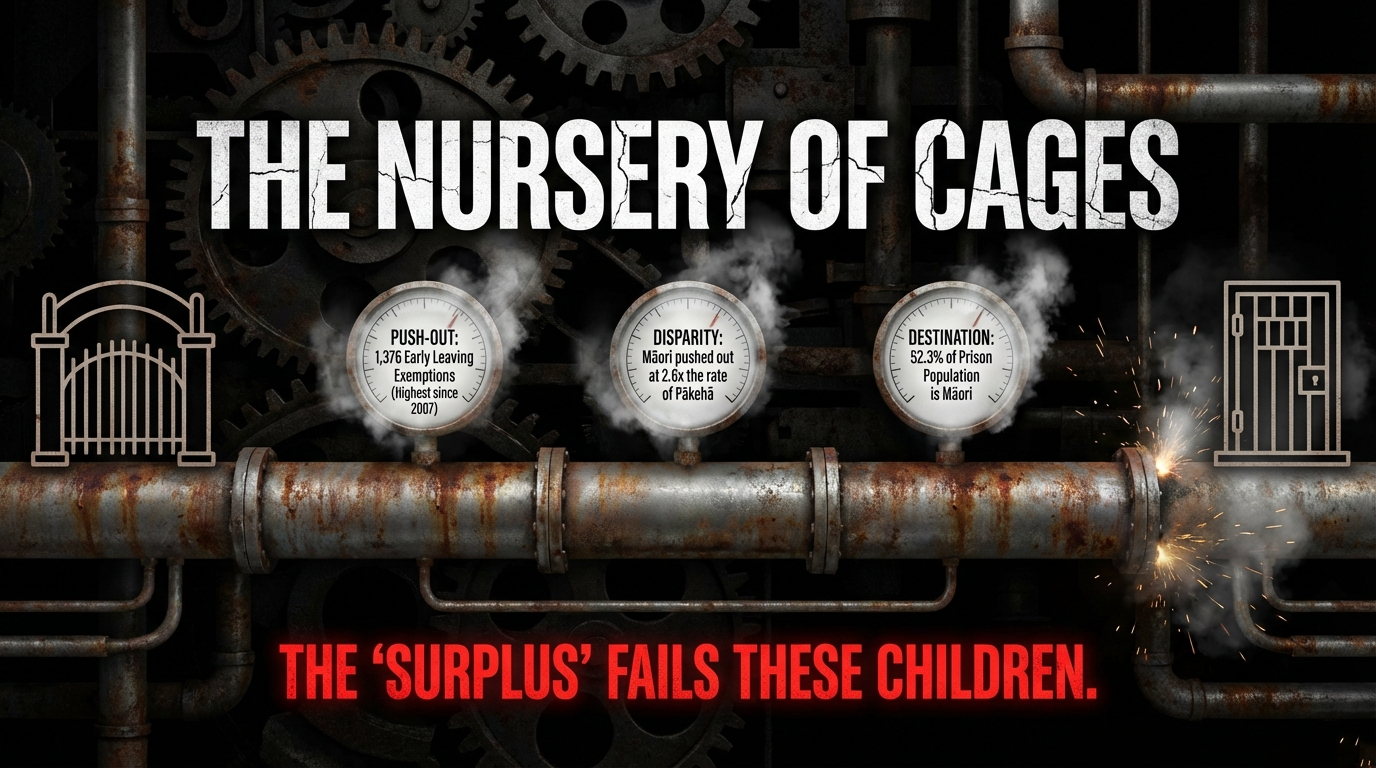
- 1,376 fifteen-year-olds were granted early leaving exemptions in 2024 — the highest since 2007. Māori students were granted exemptions at a rate of 47 per 1,000 — 2.6 times the Pākehā rate of 18 per 1,000. The surplus does not reach them. It was never meant to.
- 169,300 children — 14.3% — now live in material hardship, up 47,500 since 2022. The Children's Commissioner called it "absolutely unacceptable". For mokopuna Māori, the rate is nearly 1 in 4. These are the children Stanford claims to be serving with her surplus.
A surplus in Canterbury does not feed a starving child in Ōpōtiki. A surplus in Auckland Central does not teach te reo Māori in a kura that has been begging for kaiako for a decade. A surplus that pools in white, wealthy neighbourhoods while brown communities drown is not an achievement. It is apartheid by spreadsheet.
Ngā Hara Huna — The Hidden Sins: Five Connections They Don't Want You to See
Hidden Connection #1: The $72 Million Māori Education Heist — Give With a Teaspoon, Take With a Bulldozer
While Stanford announces $2.3 million for the Iwi Māori Work Support Programme — money so pathetic it would not cover the annual salary of four experienced kaiako — her government has ripped $72 million over four years from Māori education programmes through Budget 2025. The ratio is 31:1. For every dollar given, thirty-one are taken. This is not investment. This is a heist performed in broad daylight with a ministerial press badge.
The haul includes:
- Disestablishment of the Wharekura Expert Teachers programme — the specialists who supported kura kaupapa Māori teachers across the motu.
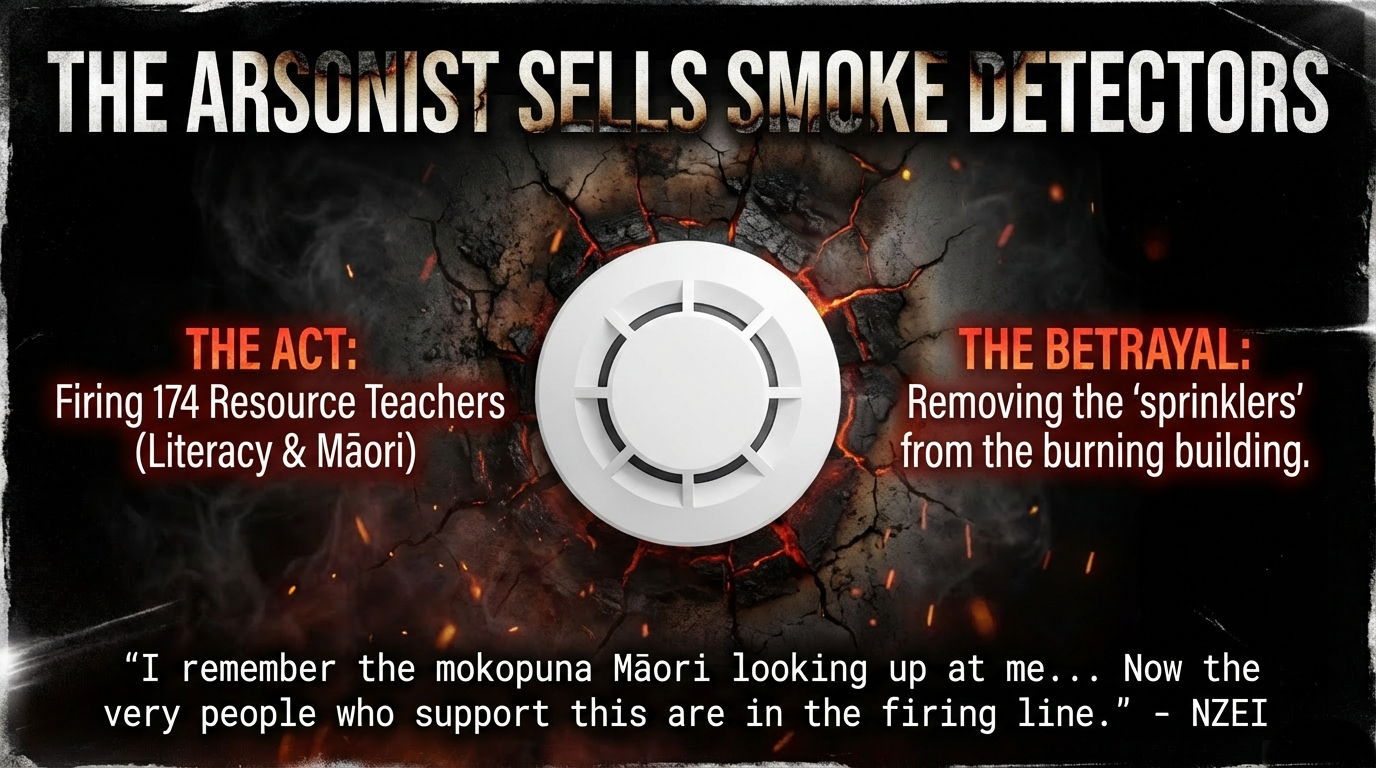
- Defunding of 174 Resource Teachers of Literacy and Māori — the most experienced frontline specialists serving the most vulnerable tamariki in the entire system. These are the people who go into the classrooms where mokopuna Māori are drowning, and throw them a lifeline. Stanford cut the rope. NZEI Te Riu Roa filed a judicial review, calling it a breach of Te Tiriti obligations. NZEI president Ripeka Lessels, herself a former Resource Teacher of Māori, wrote: "I remember the mokopuna Māori looking up at me, those kids who really needed my help... Now the very people who support this to happen effectively are in the firing line".
- $30 million slashed from Te Ahu o Te Reo Māori — the only programme developing teacher competency in te reo — and redirected to maths workbooks. She announced the cut days after Te Wiki o te Reo Māori. NZEI called it "a mistake". An OIA request revealed Stanford could name no replacement courses for teachers to learn te reo.
- Then she stripped te reo Māori from school reading books — removing Māori words from the Ready to Read Phonics Plus series, claiming they "confused" young readers. Dr Vincent Olsen-Reeder told Marae: "The reverse of what the ministry says is actually true."
- Reprioritisation of Kāhui Ako funding — $375.5 million slashed from the only national school collaboration programme, involving 1,958 schools and over 4,000 teachers receiving extra pay for cross-school roles. Treasury's own advice warned: "Disestablishing Kāhui Ako would remove New Zealand's only national, system-level intervention to support schools working together".
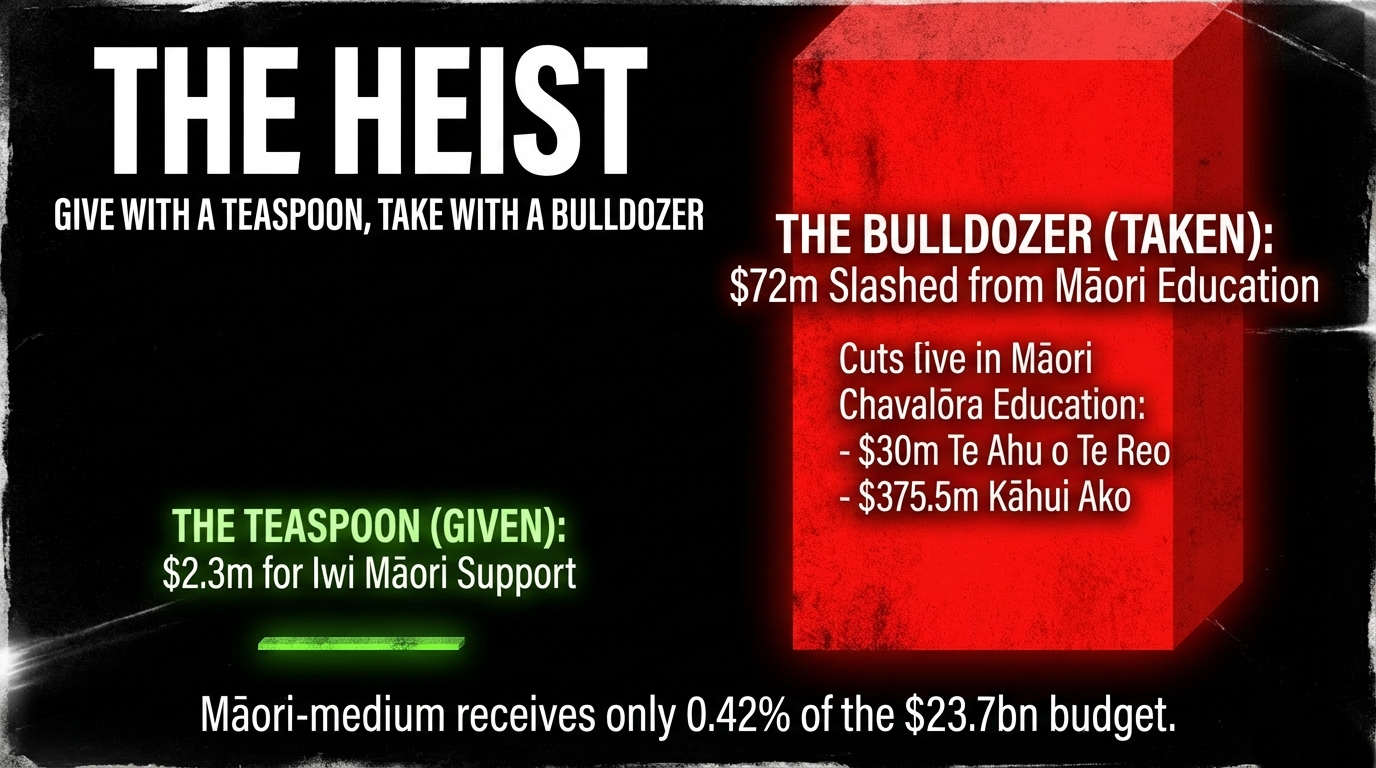
The Minister gives $2.3 million with a teaspoon and takes $72 million with a bulldozer. Then she stands in front of the rubble and announces construction is ahead of schedule.
Hidden Connection #2: The Teaching Council Coup d'État
In November 2025, Stanford announced she would shrink the Teaching Council, replace the majority of elected members with ministerial appointees, and strip its role in teacher training — moving all standard-setting to the Ministry of Education under her direct control.
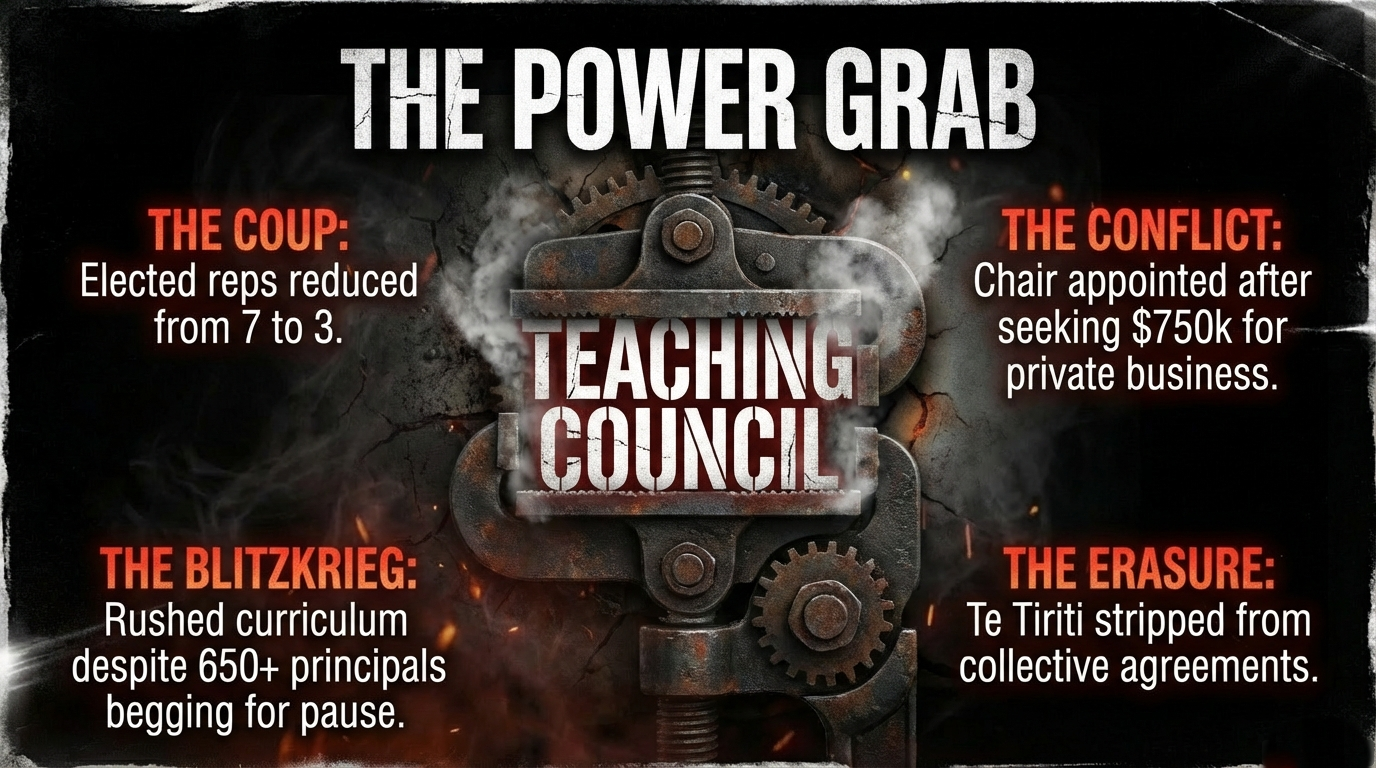
Seven elected teacher representatives became three. The independent body that sets professional standards — equivalent to the Law Society for lawyers or the Medical Council for doctors — was gutted and placed under direct political control. Nine peak education bodies — including NZEI, PPTA, the Principals' Federation, and Te Akatea — signed a joint letter calling it "a fundamental shift in professional autonomy".
And then came the scandal. Documents revealed Stanford had a cosy relationship with Teaching Council Chair Mark Ferguson — who texted her seeking help securing $750,000 in TEC funding for his private teacher education business, and was then appointed chair of the very body that approves such programmes. Professor Joce Nuttall, Chair of the Council of Deans of Education, called it "an appalling conflict of interest."
The Minister who claims to be building a stronger workforce is centralising control over who gets to be a teacher, who trains them, and what they teach — while her political ally profits from the pipeline.
Hidden Connection #3: The Three-Time Rejection — 35,000 Teachers Told This Government to Its Face: "No."
This is the part that should end careers. Primary teachers have now rejected the government's collective agreement offer three separate times — in August 2025 (a contemptible 1%+1%+1% over three years — described as "insulting" while inflation sat at 2.7%), September 2025 (2.5% and 2.1% still below inflation, coupled with a demand to increase forced callback days from 10 to 18), and December 2025 — each time citing the government's deliberate, calculated refusal to include any reference to Te Tiriti o Waitangi in the collective agreement.
Secondary teachers also rejected their offer and went on strike in October 2025 — rolling partial strikes, a full-day national strike, and an extracurricular ban. The government's response? Present a last-minute offer ten minutes before the vote that was, in PPTA president Chris Abercrombie's words, "in several ways worse than the previous offer".
Lead negotiator Liam Rutherford said the December offer "entirely omits any reference to upholding Te Tiriti in education — which is one of our core claims". Their pay equity claim was scrapped. Meanwhile, the government raised fees for Crown body board members by up to 80%.
Let that ratio burn into your consciousness: 80% for political appointees. 1% for the people who teach your mokopuna to read. That is not a negotiating position. That is a declaration of contempt. And the deliberate erasure of Te Tiriti from the collective agreement is not an oversight — it is the educational front of the Treaty Principles Bill. It is cultural warfare conducted through a pay stub.
Hidden Connection #4: The Curriculum Blitzkrieg
Stanford's "workforce investment" coincides with a curriculum rollout so rushed, so reckless, so contemptuous of professional expertise that:
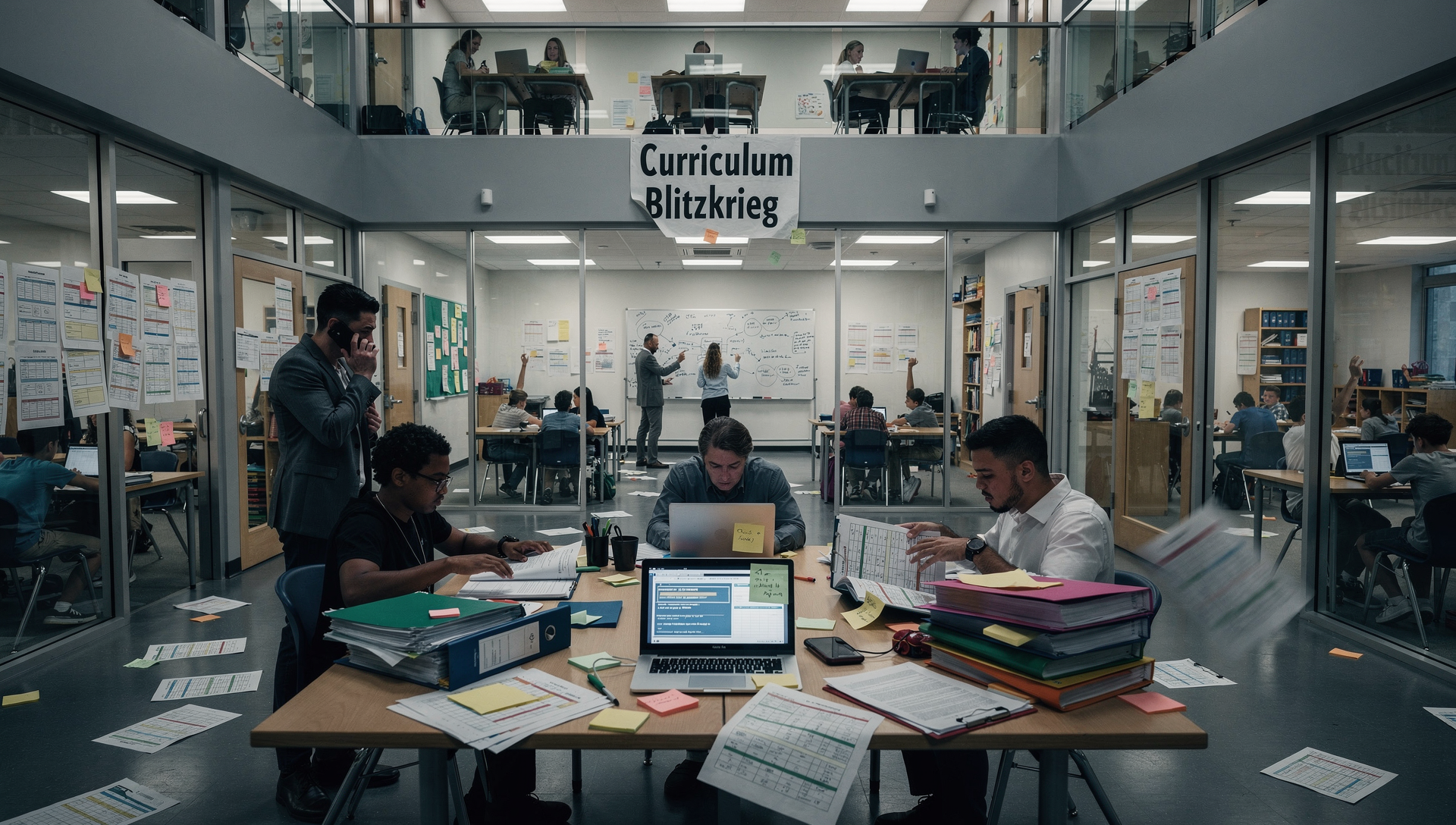
- 650+ principals signed an open letter begging the Minister to pause all curriculum deadlines, warning the reforms were "implemented too quickly, with limited clarity, consultation, or local grounding."
- A former Education Ministry employee told RNZ the curriculum development process was "heavily politicised", causing extensive rewrites.
- The draft English curriculum omitted Te Mātaiaho entirely — the framework that underpins every other curriculum area — in what teachers called "educational violence".
- NZEI declared the draft years 0-10 curriculum "Eurocentric" and warned the rushed rollout would "create chaos in schools".
- Principals warned the new year-by-year structure is impossible to implement in multi-level classrooms — which is the reality for most schools, especially small rural and Māori-medium schools.
You cannot announce a "teacher surplus" while simultaneously breaking the teachers you have.
Hidden Connection #5: The 0.42% Betrayal
The total education budget for 2025 is $23.7 billion. Māori-medium education receives just over $100 million. That is 0.42% of the total education budget — for an Indigenous people who make up approximately 20% of the school-age population, whose tamariki thrive most powerfully in Māori-medium settings, and whose educational disparity is the single most damning indictment of the colonial education system.
Professor Matt Roskruge of Massey University told RNZ it was "really hard" to find Māori in the 2025 Budget, calling it a "bleak Budget" where "funding that was earmarked for Māori has been moved into the general funding pool."
Willie Jackson quantified it: across Budgets 2024 and 2025, approximately "$750 million has been cut from Māori housing, Māori economic funds, Māori education and programmes like Māori trades training".
Stanford's $2.3 million Māori-medium announcement is not a lifeline. It is a bandage over a severed artery, applied by the person holding the knife.
He Whakaaturanga Toru — Three Examples for the Western Mind
To understand the violence of this announcement, consider three examples that translate the tikanga dimension into terms the Western mind can grasp:
Example 1: The Butcher Who Weighs the Carcass and Calls It a Flock
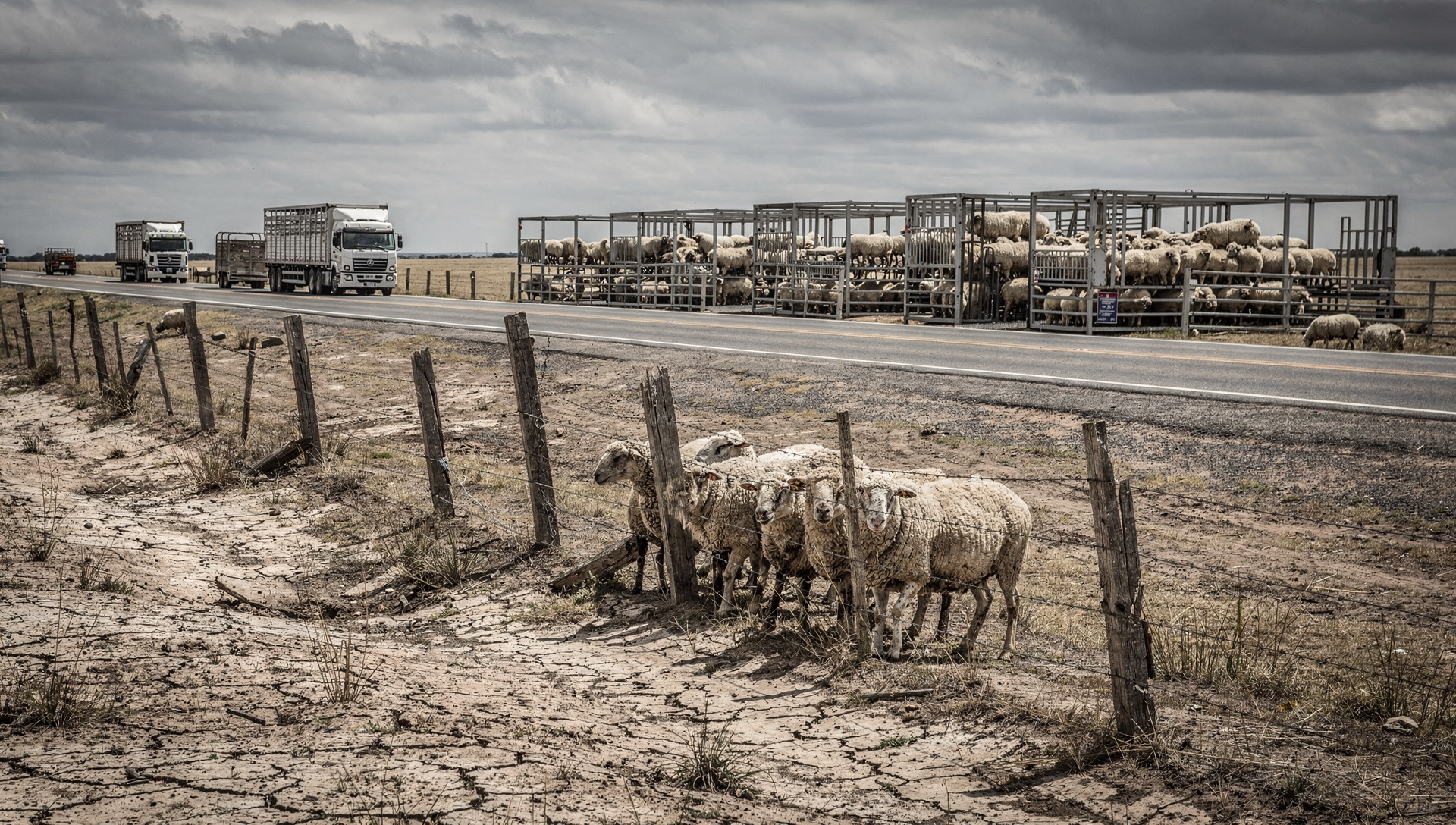
Imagine a farmer announces to the market that his flock has never been healthier — a "surplus" of sheep. Magnificent news! Except: the surplus is entirely in the holding pen by the highway, where the cameras can see them. In the back paddocks — the ones furthest from the road, where the soil is driest and the fences are broken — the lambs are starving. The farmer shot the shepherd dogs because "they weren't delivering measurable outcomes." He sold the veterinary contract to his mate's company. And the lambs? They are being loaded, quietly, onto trucks that go one direction: to the works.
That is what this teacher surplus announcement is. And the works? That is the prison system.
The "surplus" exists in Canterbury (+9.4%) and Auckland Central (+8.4%) — overwhelmingly Pākehā, overwhelmingly wealthy. But Bay of Plenty — home to some of the highest proportions of Māori students in the country — faces a shortage of -3.7% for primary and worse for secondary. In Taranaki, it is -5%. In Northland, where Māori make up 32.4% of the population — more than double the national average — the shortage is -4.5% and the early leaving rate for 15-year-olds hits 61 per 1,000, the highest in the country.
Now follow the pipeline, as documented in "The Nursery of Cages": Māori students are stood down at nearly twice the rate of Pākehā — 5% compared to 2.5%. Suspensions of Māori students rose to 1,999 in 2023, the highest on record. Early leaving exemptions for Māori 15-year-olds surged to 47 per 1,000 — 2.6 times the Pākehā rate. And where do they go? 45% of sentenced prisoners left school before Year 11. Māori are now 52.3% of the prison population — despite being 17% of the general population. The Royal Commission on Abuse in Care found 42% of Māori children in state care ended up serving a prison sentence.
Dr Rawiri Waretini-Karena, who served 10 years for murder after growing up in state care, told RNZ:
"When I walked into the prison yard for the first time... I already knew 80 percent of the men in there. We'd spent the last 11 years growing up together in state care".
The surplus does not reach these children. It was never designed to reach these children. It reaches Canterbury. It reaches Auckland Central. It reaches the children whose parents vote National.
The tikanga violated: Manaakitanga — the sacred obligation of generosity and care for the vulnerable.
In te ao Māori, manaakitanga is not charity. It is obligation. Those with abundance do not choose to share with those in need — they are required to. The mana of the hapū depends on it. A rangatira who hoarded kai while neighbouring whānau starved would lose their mana utterly. In the Western world, think of it this way: imagine a hospital that announces a "surplus" of nurses, but the surplus is entirely in the reception area and administrative offices. In the emergency ward — where patients are dying — there are 710 fewer nurses than needed. In the oncology ward serving Indigenous patients, 0.42% of the budget is allocated. And the 174 specialist oncology nurses who provided the most expert care have been fired. That hospital would be shut down. Stanford's education system deserves the same.
Quantified harm: Bay of Plenty faces a shortfall of 300-400 teachers between 2025 and 2027. Northland's early leaving rate of 61 per 1,000 means hundreds of rangatahi Māori being pushed out of education annually — straight into a corrections system that costs $120,000 per prisoner per year. Meanwhile, 169,300 children live in material hardship — 1 in 4 of them Māori — and the Children's Commissioner says the government is not on track to meet any child poverty targets.
The solution: Ring-fenced regional funding tied to actual need, not national averages. Mandate that the surplus in Canterbury and Auckland Central is physically redistributed through binding staffing transfers, housing subsidies, and salary premiums to shortage regions. Every region with a Māori student population above 20% must receive proportionally higher resourcing. This is not special treatment — it is manaakitanga. It is the correction of 186 years of extraction.
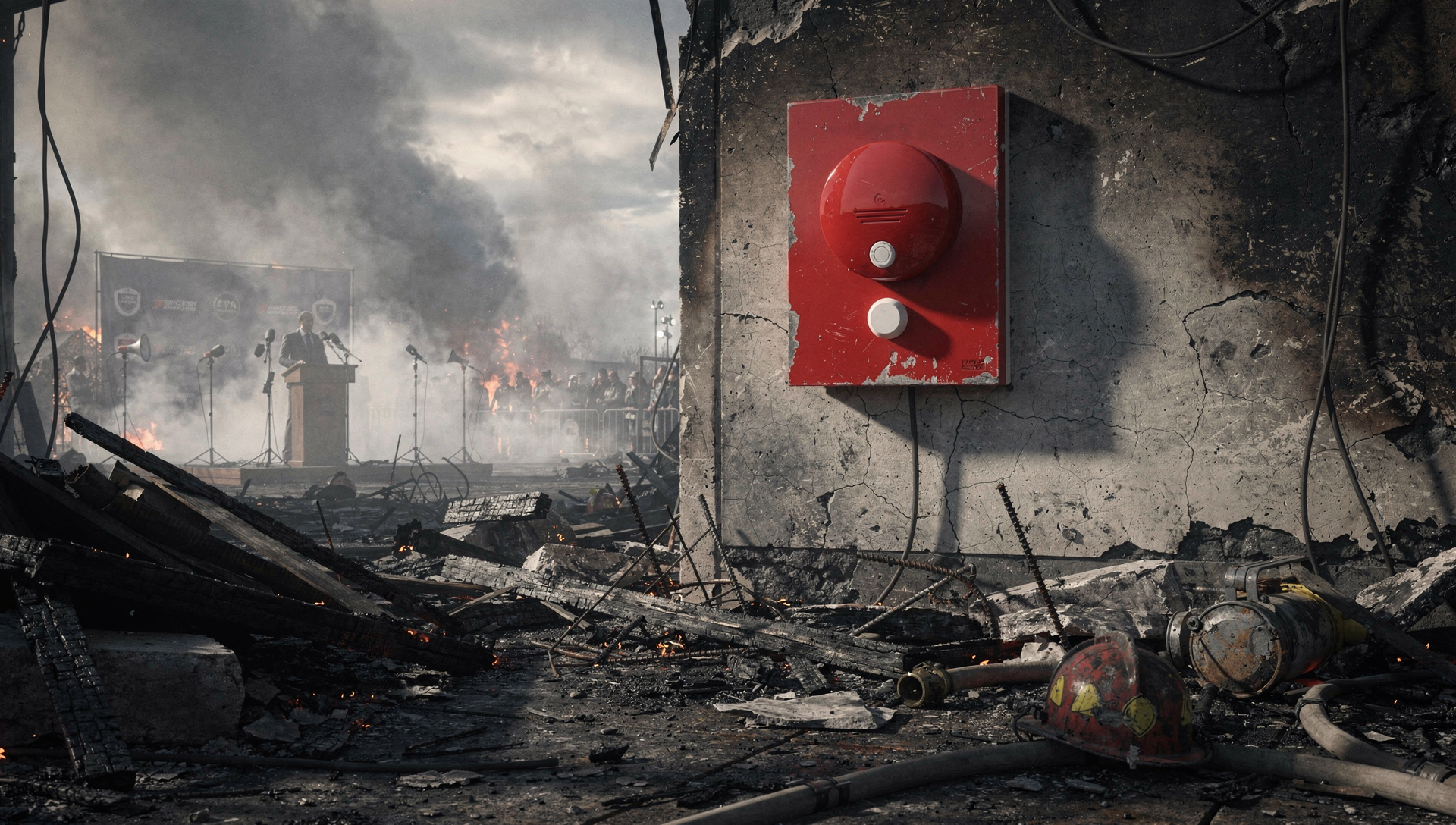
Example 2: The Arsonist Who Sells You Smoke Detectors — Then Burns Down the Fire Station
Imagine a landlord who removes the fire sprinklers, cuts the fire brigade's budget by $375.5 million, fires the 174 fire safety inspectors, strips the fire code from building regulations, and then installs a single smoke detector in the lobby — cost: $2.3 million — and holds a press conference celebrating their "unrelenting commitment to fire safety."
Then imagine the landlord's mate runs the smoke detector company. And the landlord has just given themselves the power to write the fire code.
That is Erica Stanford's education policy. Every word of it.
The arson inventory:
- Defunded 174 specialist resource teachers of Māori and literacy — the sprinklers that prevented educational fires in the most vulnerable classrooms.
- Slashed $375.5 million from Kāhui Ako — the only national cross-school collaboration programme, involving 1,958 schools. Treasury's own advice warned this "would remove New Zealand's only national, system-level intervention". She lit the match anyway.
- Gutted the Teaching Council's independence — replacing 7 elected teacher representatives with 3, and appointing Mark Ferguson as chair — a man who texted the Minister seeking help securing $750,000 for his own private teacher education business, then was appointed to the body that approves those programmes. The fox does not merely guard the henhouse. The fox owns the henhouse.
- Destroyed Te Ahu o Te Reo Māori — $30 million for te reo competency, gone. The only programme helping 50,000+ teachers speak te reo with confidence. Diverted to maths workbooks — based on benchmarks that measure a new curriculum, not actual achievement decline.
- Stripped te reo Māori from school reading books and even renamed the Ka Ora Ka Ako school lunches programme to remove its te reo Māori name. They are erasing the language from the physical environment of education.
- And is now celebrating Go Rural grants of $4,000 for 123 student teachers and a Māori-medium increase of $1.2 million. The smoke detector in the lobby. While the building burns.
The tikanga violated: Kaitiakitanga — the sacred obligation of guardianship over what is precious.
Kaitiakitanga is not management. It is not "stewardship" in the corporate governance sense. In te ao Māori, kaitiakitanga means you are entrusted with something precious — a river, a forest, a child's mind — and you protect it with your life, your mana, and your whakapapa. The kaitiaki does not extract. The kaitiaki does not commodify. The kaitiaki does not hand the taonga to a mate's company for profit. For the Western mind, think of it like this: you entrust your child to a school. The school fires the child's specialist tutor, sells the playground, strips the library of books in your child's language, replaces the principal with a political appointee, and then sends you a newsletter celebrating "record investment in student wellbeing." You would call the police. We call it Budget 2025.
Quantified harm: The overall Māori education workforce was reduced by 31 fulltime equivalent roles in Budget 2025 despite the $100 million headline. The overall literacy support workforce was reduced by 43 fulltime equivalent roles. In a system where only 24% of Year 8 students are writing at expected levels and 33% of Year 6 students, cutting literacy specialists is not reform. It is educational arson for political profit. Meanwhile, charter schools receive $153 million — schools that do not need to teach the national curriculum, do not need to employ registered teachers, and answer to David Seymour, not to parents.
The solution: Immediately restore and permanently fund Resource Teachers of Literacy and Māori as Treaty-protected positions that no government can unilaterally disestablish. Restore Te Ahu o Te Reo Māori and double its funding. Embed kaitiakitanga as a statutory obligation in the Education and Training Act — meaning any Minister who diminishes Māori education provision must demonstrate compliance with Te Tiriti before cuts take effect. No more slashing first and "consulting" later.
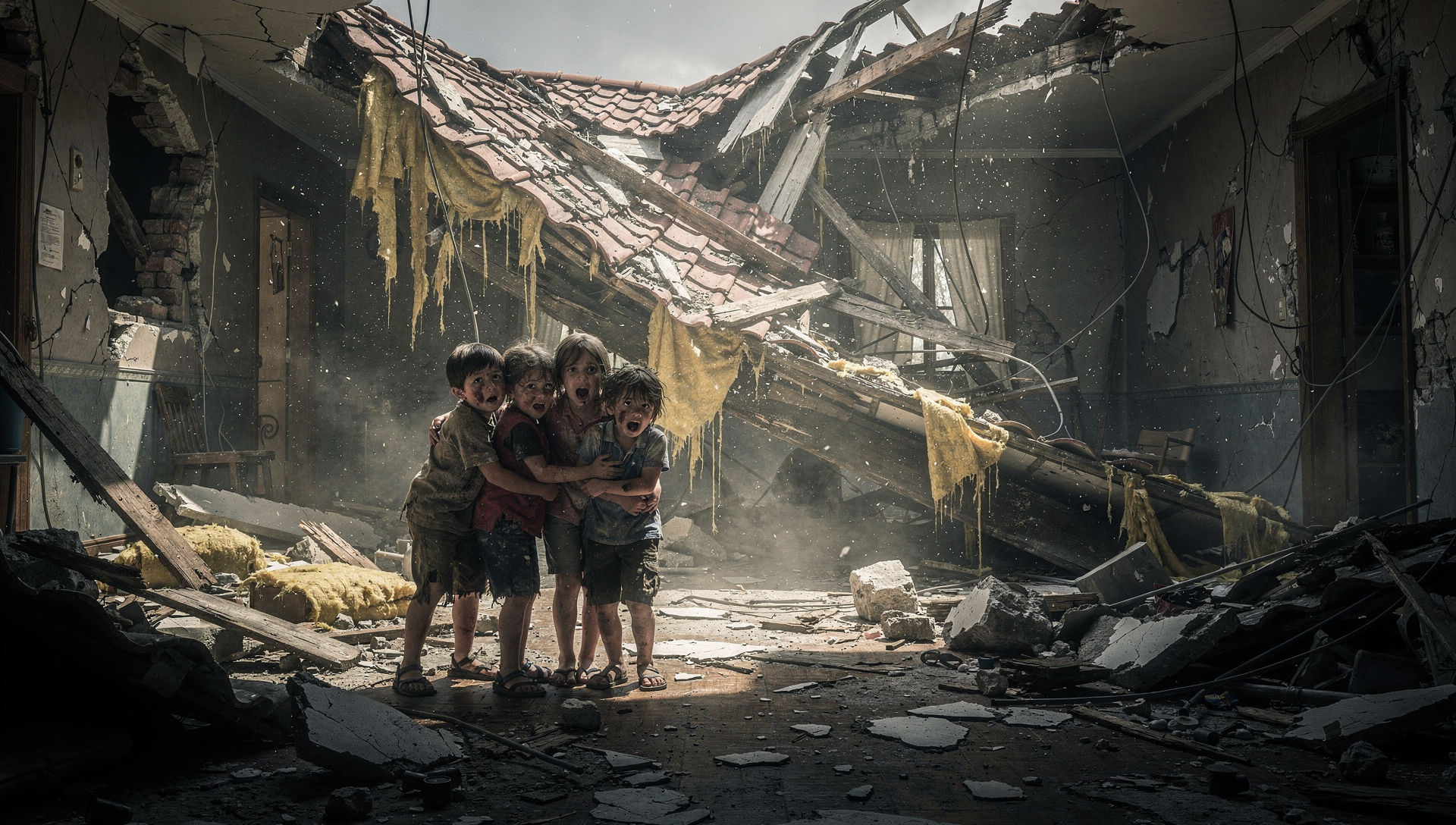
Example 3: The Architect Who Redesigns Your House While You're Still Living in It — Then Blames You When the Roof Collapses
Imagine an architect who redesigns your entire house — foundation, walls, roof, plumbing, electrics — all at once, on a three-month timeline, without consulting you. Your family of five is still living inside. The architect ignores the structural engineer's report. When 650 of your neighbours sign a letter saying the walls are cracking, the architect calls them "resistant to change." When a former employee reveals the redesign was "heavily politicised", the architect calls it "rigorous." When the roof falls on your children's heads, the architect blames the builders.
Then imagine the architect gives herself the legal power to redesign every house in the country. Without consent. Without appeal. Forever.
That is the curriculum rollout. And that legal power is the Education and Training Amendment Bill.
Principals told the Minister the new year-by-year structure is literally impossible to teach in multi-level classrooms — the reality for most schools, especially small rural and Māori-medium schools where composite classes are not a choice but a necessity. Principals' Federation president Leanne Otene: "We literally cannot teach year-by-year... Changing a curriculum at that late a date and saying that they have to be initiated on the first of January, that's reckless. Because we just cannot do it."
The draft English curriculum omitted Te Mātaiaho entirely — the framework underpinning every other curriculum area — in what teachers called "educational violence". Stanford claimed she "hadn't got to it yet." A former Ministry employee told RNZ the process was "heavily politicised", with "extensive rewrites" driven by the Minister's office, not by evidence.
Jason Miles of the Principals' Federation told the select committee the Education and Training Amendment Bill represents "a coordinated shift of decision-making power away from educators, communities and Māori and into the hands of the minister". The School Boards Association reported 82% of its members opposed giving the minister power to decide curriculum content. Nine peak education bodies signed a joint letter calling it "a fundamental shift in professional autonomy".
The tikanga violated: Rangatiratanga — the sacred principle of self-determination earned through service and exercised through collective consent.
Rangatiratanga is the most misunderstood and most weaponised concept in Aotearoa. For the Western mind: rangatiratanga is not authority imposed from above. It is authority earned from below. A rangatira does not command — a rangatira serves. The rangatira's mana comes from the people. On the marae, every voice is heard. Every pou stands. Decisions emerge through wānanga, through kōrero, through the slow, sacred work of finding consensus. Stanford's approach is the precise inversion of rangatiratanga. She overrides 650 principals, silences Te Tiriti obligations, centralises curriculum power in her own office, and appoints her own allies to the professional body. This is not educational leadership. This is the authority of the Governor who showed one document to Māori and signed another in London. It is Hobson in a blazer.
Quantified harm: The rushed curriculum rollout has pushed principals to burnout and despair. Meanwhile, only 24% of Year 8 students are writing at expected levels. Home-schooling has hit a record 11,010 students — parents are pulling their children out of the system this government claims to be fixing. And the stand-down rate remains the highest in 20+ years of records, with Māori students twice as likely to be stood down as Pākehā. The government that claims to be fixing achievement is manufacturing the conditions for failure.
The solution: Halt the curriculum rollout to a genuine three-year implementation timeline co-designed with principals, teachers, Māori educators, and whānau — with Te Mātaiaho restored as the central framework. No curriculum change should proceed without meeting a Treaty-compliant consultation threshold including endorsement from Te Akatea, mana whenua, and the Principals' Federation. The Education and Training Amendment Bill must be withdrawn and redrafted to protect professional autonomy, not destroy it. Any minister who claims rangatiratanga over the education system must first demonstrate they have earned it — through service, through listening, through hauora. Stanford has earned nothing but the contempt of 35,000 teachers who rejected her offer three times.
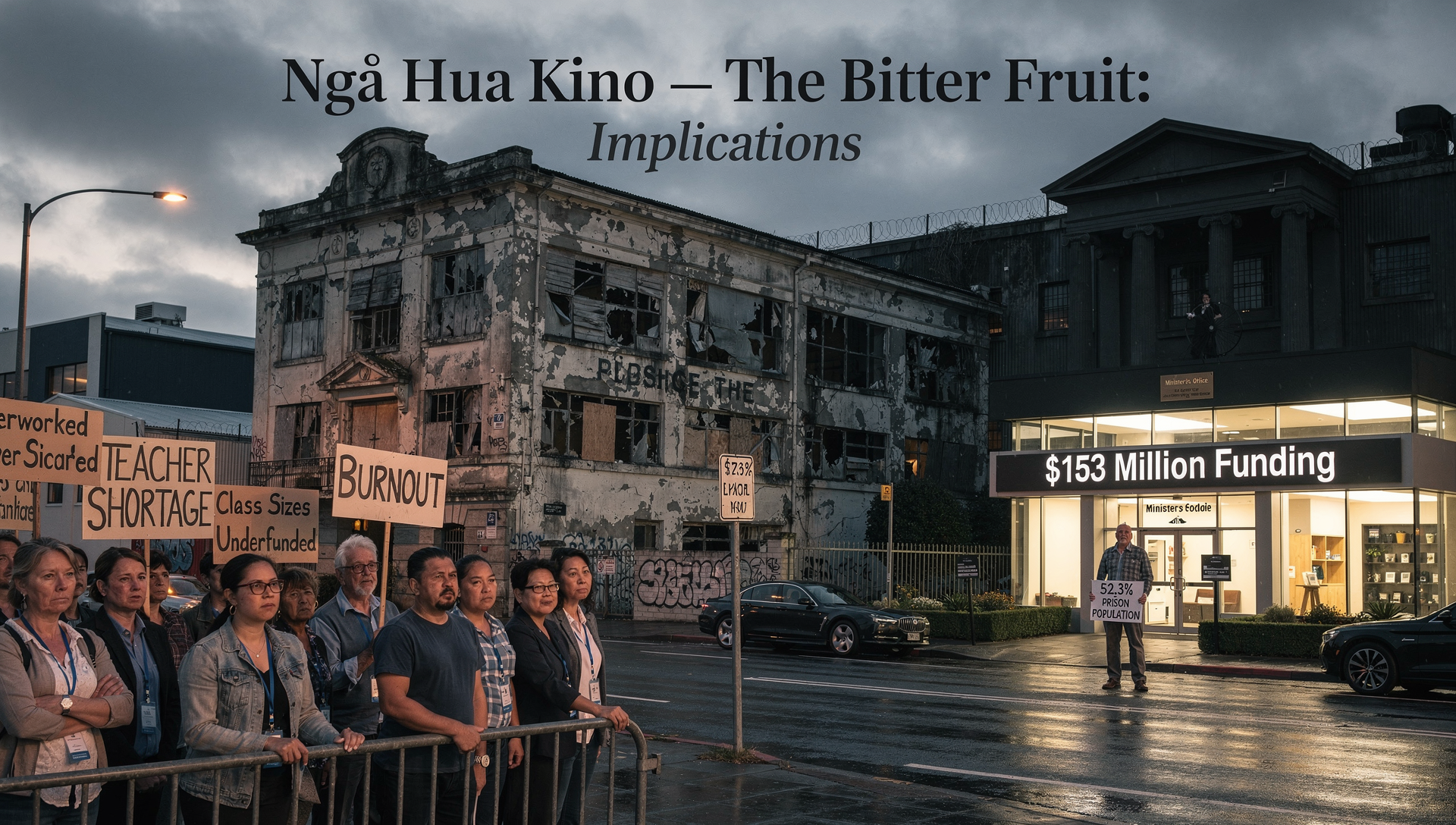
Ngā Hua Kino — The Bitter Fruit: Implications
The Pattern Is Always the Same — And It Always Ends the Same Way
This is the neoliberal playbook, perfected over four decades of Rogernomics, Ruthanasia, and now Luxonomics — applied with the surgical precision of a coloniser who has finally learned to smile while swinging the axe:
- Underfund the public system until it breaks (teacher shortage, collapsing achievement, burnout)
- Blame the workers and the old system ("total system failure," "inconsistent practices," "no evidence of impact")
- Centralise control under the Minister (Teaching Council takeover, curriculum by decree, professional autonomy destroyed)
- Privatise the alternative (charter schools funded at $153 million while public school collaboration programmes are incinerated)
- Celebrate cosmetic improvements (teacher surplus headline, phonics check percentages) while structural harm deepens
- Repeat — until the public system is hollowed out and the only option left is private
This is the same playbook documented by The Māori Green Lantern in "The Dashboard Illusion" — where the Māori Health Authority was dismantled, $380 million cut from Health NZ's digital workforce, and the government praised a local data dashboard. Give the symbolic gesture. Take the material power. Blame Māori for the outcomes.
It is the same playbook documented in "The Nursery of Cages" — where the pipeline from educational failure to incarceration is not a bug but a feature. Māori are 52.3% of the prison population. 45% of prisoners left school before Year 11. The same government that defunds Māori education has reinstated Three Strikes. The factory does not sleep.
It is the same playbook documented in "Back to Basics, Back to Brutality" — where a "hodgepodge" of bills became the most coordinated assault on Māori rights, workers, and democracy in a generation.
The endpoint is always the same: the rich get choice. The poor get compliance. Māori get blamed.
Cui Bono? Who Benefits? Follow the Money. Always Follow the Money.
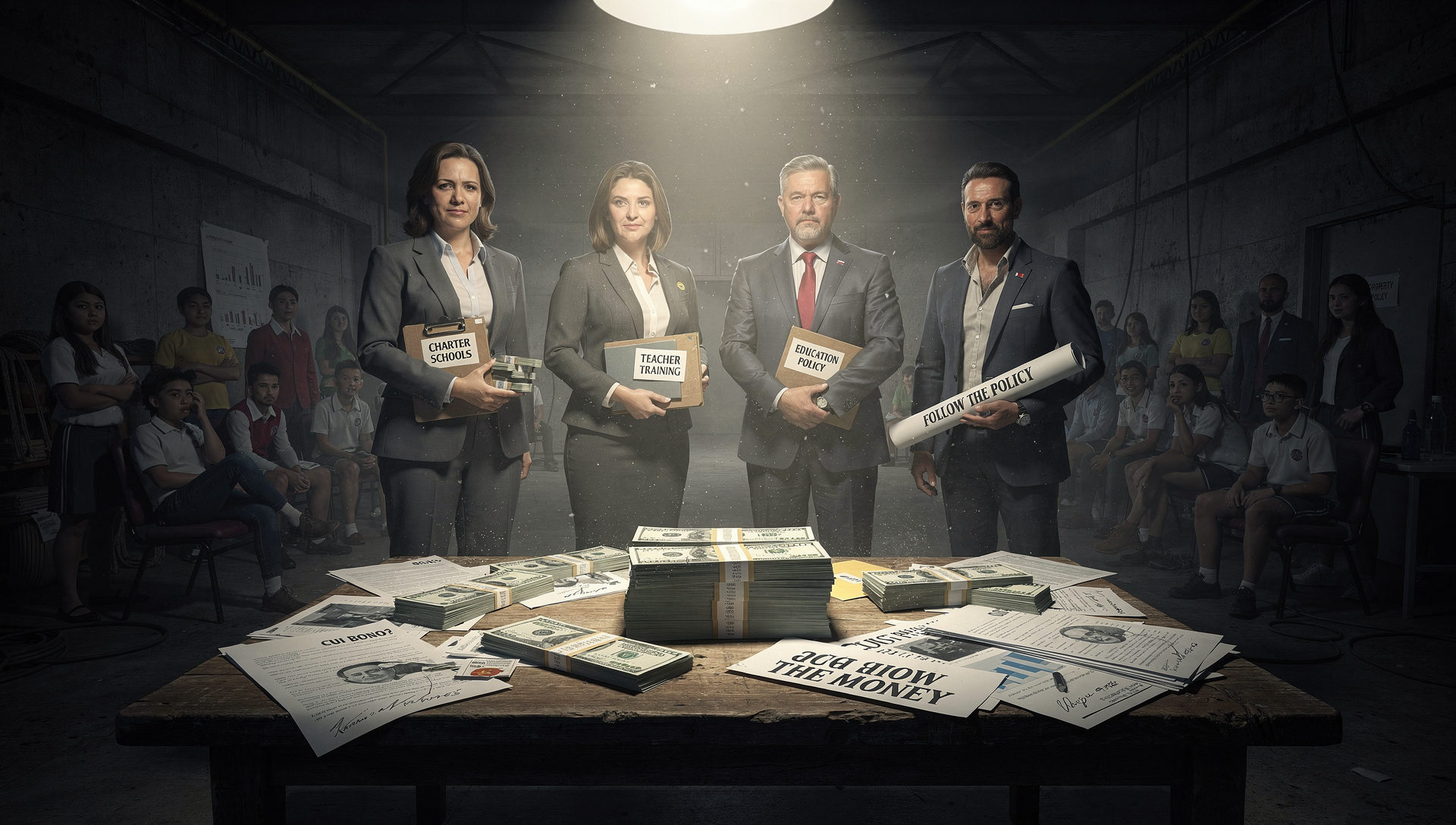
- Charter school operators — funded at $153 million to provide an "alternative" to the public system being deliberately destroyed
- Private teacher training providers — like the one run by Stanford's Teaching Council appointee Mark Ferguson, who texted the Minister for help securing $750,000
- The Minister herself — who eliminates independent professional oversight and gains direct control over what every child in Aotearoa learns
- Property speculators and landlords — who received billions in tax cuts funded by stripping $375.5 million from Kāhui Ako and $72 million from Māori education
- The prison industrial complex — which receives a fresh pipeline of undereducated, unsupported rangatahi Māori. Corrections costs $120,000 per prisoner per year. That money does not come from Education. It comes from all of us.
Cui Malo? Who Suffers? Count the Bodies.
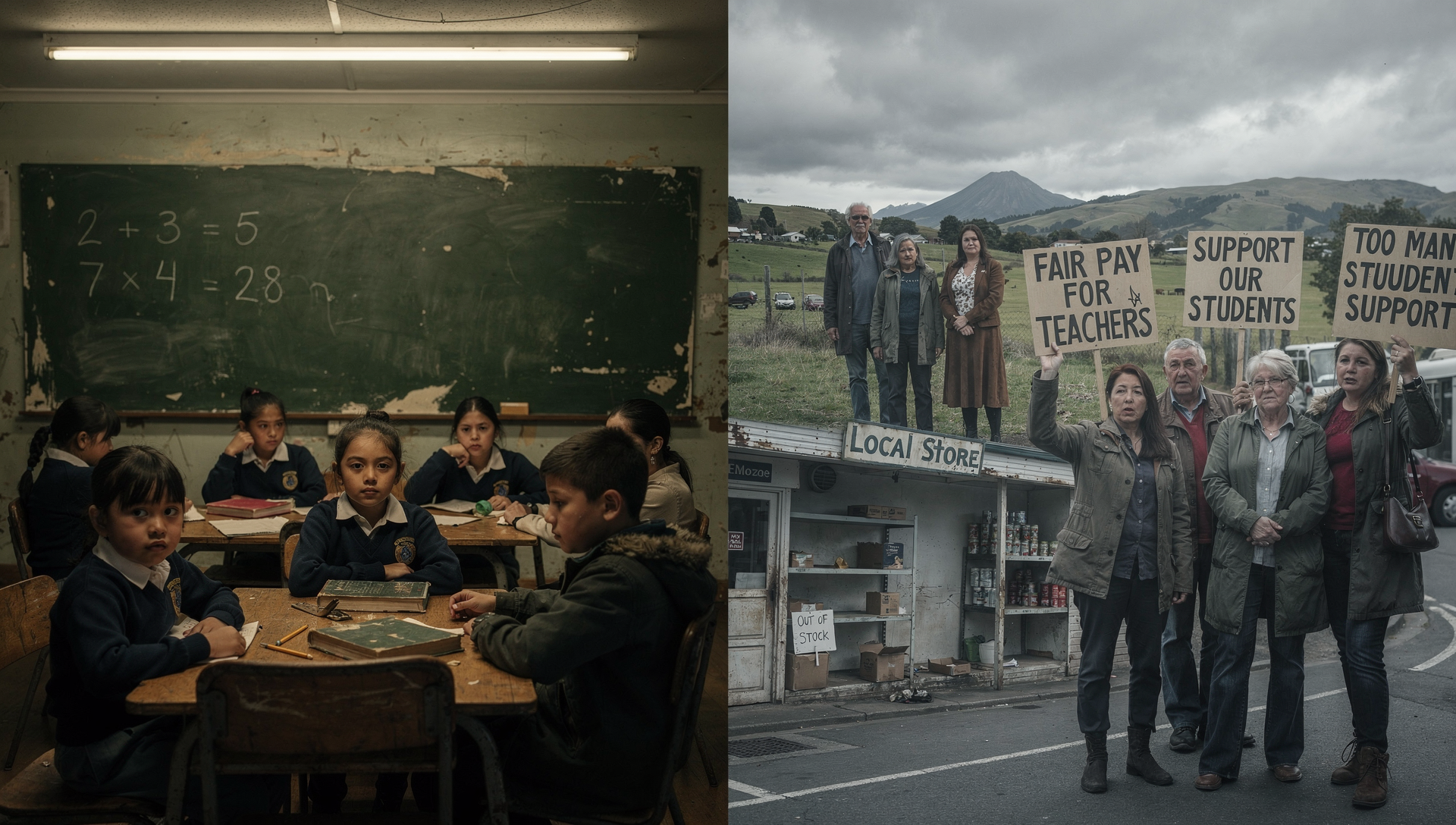
- Māori children — 12% maths achievement, 0.42% of the education budget, 31 fewer Māori education workers, te reo stripped from their books, 47 per 1,000 pushed out at age 15
- Rural communities in Bay of Plenty, Taranaki, Northland — persistent shortages despite a national "surplus" that never arrives
- 35,000 primary teachers — three rejected offers, scrapped pay equity claim, Te Tiriti erased from collective agreements, 1% insult while Crown board fees rise 80%
- 21,000 secondary teachers — strike action, 710-teacher shortfall, specialist subjects cancelled
- 169,300 children in material hardship — 1 in 4 of them Māori, not on track for any poverty reduction target
- Principals — burned out, silenced, overridden, losing professional autonomy to a Minister who has never taught a class in her life
Te Karanga — The Call: What Must Be Done
The taiaha is raised. The Ring glows. The path forward requires nothing less than a restoration of mana to the education system:
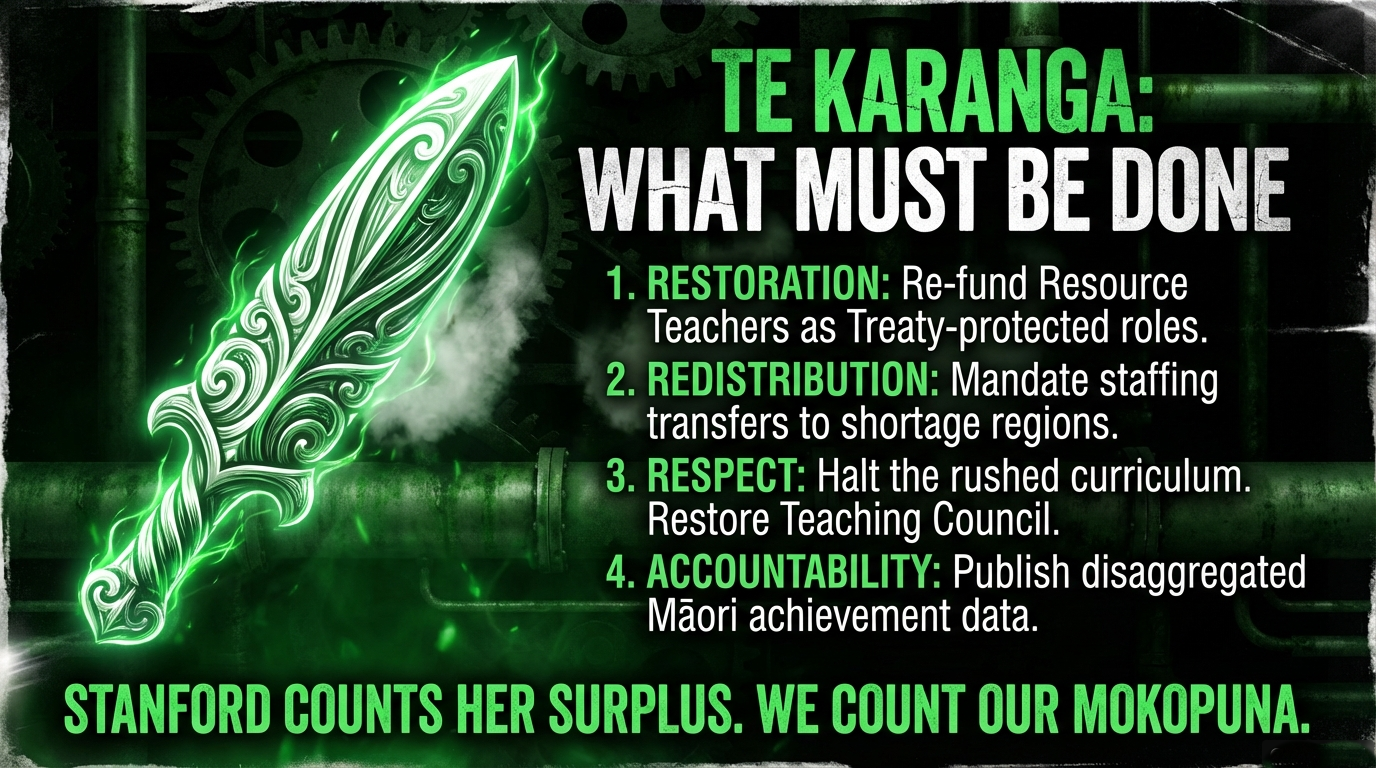
- Restore ring-fenced, Treaty-compliant Māori education funding at minimum 2023 levels, with independent Māori-led oversight
- Reinstate and permanently fund Resource Teachers of Literacy and Māori as Treaty-protected roles
- Halt the curriculum rollout to a genuine three-year co-design timeline
- Reverse the Teaching Council takeover and restore elected teacher majority
- Mandate regional staffing redistribution from surplus areas to shortage areas — especially Bay of Plenty, Taranaki, and Northland
- Honour Te Tiriti in all collective agreements — it is not an optional clause, it is the constitutional foundation
- Publish disaggregated Māori achievement data annually by region, with binding accountability for improvement
Stanford can count her surplus. We count our mokopuna.
And the mokopuna are not surplus. They are sacred.
Koha Consideration
This essay exists because 174 Resource Teachers of Māori and Literacy lost their jobs and someone needed to count what Stanford took. It exists because 35,000 primary teachers said "no" three times and the Minister pretended she couldn't hear. It exists because Māori mokopuna in Tauranga, Ōpōtiki, and Northland are being failed by a surplus that never reaches them — and the pipeline from that failure to prison does not sleep.
Every essay The Māori Green Lantern publishes — from the Dashboard Illusion to the Nursery of Cages to this Surplus of Lies — reveals another thread in the whakapapa of extraction. Every koha signals that whānau are ready to fund the accountability that no Education Minister, no Public Service Commissioner, and no Atlas Network think tank will ever provide.
It signals that rangatiratanga includes the power to fund our own truth-tellers — especially when the government is rewriting the curriculum to erase us from the story, stripping te reo from our children's books, and calling it "teaching the basics brilliantly."

Kia kaha, whānau. Stay vigilant. Stay connected. And if you are able, consider a koha to ensure this voice continues — so that when they announce a surplus while our kura starve, someone is counting the bones.
If you are unable to koha, no worries! Subscribe or follow The Māori Green Lantern, kōrero and share with your whānau and friends — that is koha in itself. Every share is a wero to the silence. Every forward is a taiaha swing they did not expect.
Three pathways exist:
For those who wish to support this mahi directly with a koha (voluntary contribution), please visit the Koha platform:
Koha — Support: https://app.koha.kiwi/events/the-maori-green-lantern-fighting-misinformation-and-disinformation-ivor-jones
For those who wish to receive essays directly and support through subscription:
Subscribe to the Māori Green Lantern: https://www.themaorigreenlantern.maori.nz/#/portal/support
For those who prefer direct bank transfer, account details are: HTDM, account number 03-1546-0415173-000.
The Ring does not merely glow, whānau. It burns. The taiaha is not raised. It is swung. The taniwha beneath the staffroom does not sleep — and neither do we.
Kia mau ki te tikanga. Kia kaha. Kia manawanui.
Hold fast to what is right. Be strong. Be resolute.
They can count their surplus. We will count our mokopuna. And we will not stop swinging until every single one of them has a kaiako who sees them, speaks to them, and fights for them.

Ivor Jones — Te Māori Green Lantern
Ko au te whenua, ko te whenua ko au.
© Ivor Jones — Te Māori Green Lantern, 28 February 2026
www.themaorigreenlantern.maori.nz
Research Transparency: This essay was researched on 28 February 2026 using search_web, get_url_content, and verified citations across government, media, education sector, and corrections sources. All URLs tested at time of research.