"The Taiaha Strikes: How New Zealand's Far Right Weaponised a Bathroom Break to Wage War on the Judiciary" - 14 February 2026
Te Karanga — The Call to Arms

E te whānau, listen carefully.
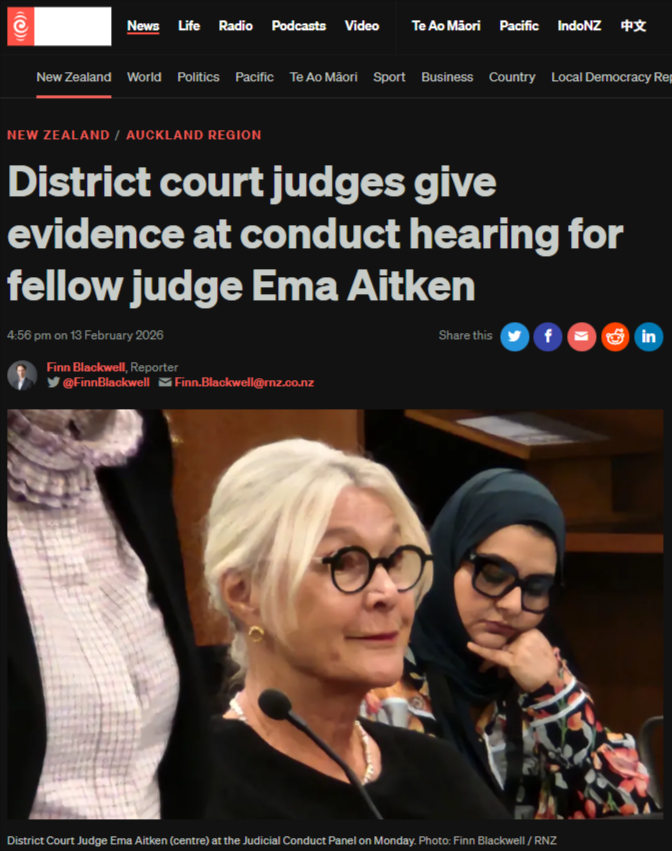
A judge — one of the best on the District Court bench, a pioneer of therapeutic justice, a woman who helped build Samoa's first drug treatment court — is being dragged before New Zealand's first-ever Judicial Conduct Panel. Not for corruption. Not for incompetence. Not for taking bribes or perverting the course of justice.
For calling Winston Peters a liar.
On her way to the bathroom.
At a dinner celebrating her own retirement.
Judge Ema Aitken sits in a hearing room in Auckland in February 2026, facing a panel comprising retired Court of Appeal Judge Brendan Brown KC, former Governor-General Sir Jerry Mateparae, and Court of Appeal Justice Jillian Mallon. The panel's task: to advise Acting Attorney-General Paul Goldsmith on whether this judge — described by her colleague Judge David McNaughton as "one of the best judges on our bench" whose "reserved judgments are usually immaculate" — should be removed from the bench entirely.
The alleged crime? Overhearing Winston Peters spreading misinformation about tikanga Māori in law schools and having the audacity to say so out loud.
This is not a conduct inquiry. This is a hit job. And the taiaha of mātauranga Māori demands we trace exactly whose hands are on the weapon.
He Aha Te Mea Nui — What Actually Happened
The Night of 22 November 2024
Two functions at Auckland's Northern Club. One: a dinner for District Court judges marking Judge Aitken's resignation of her warrant and the retirement of two colleagues. The other: a New Zealand First fundraiser where Deputy Prime Minister Winston Peters was the keynote speaker.
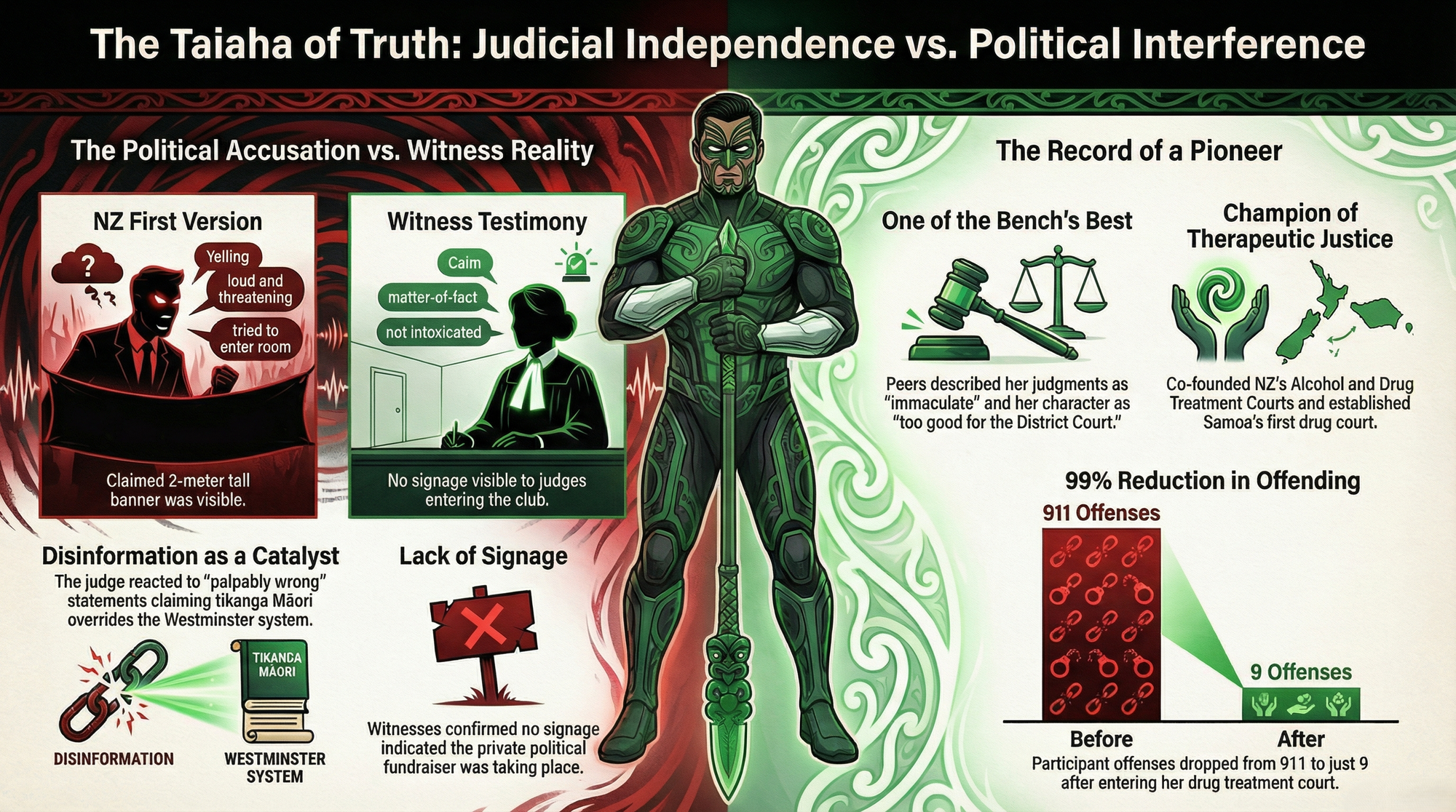
Judge Aitken, after a "challenging day at court," walked past the NZ First function room on her way to the bathroom. She overheard Peters making comments "about Tikanga Māori law overriding the Westminster system being taught in law schools". She reacted.
The two accounts diverge violently from this point.
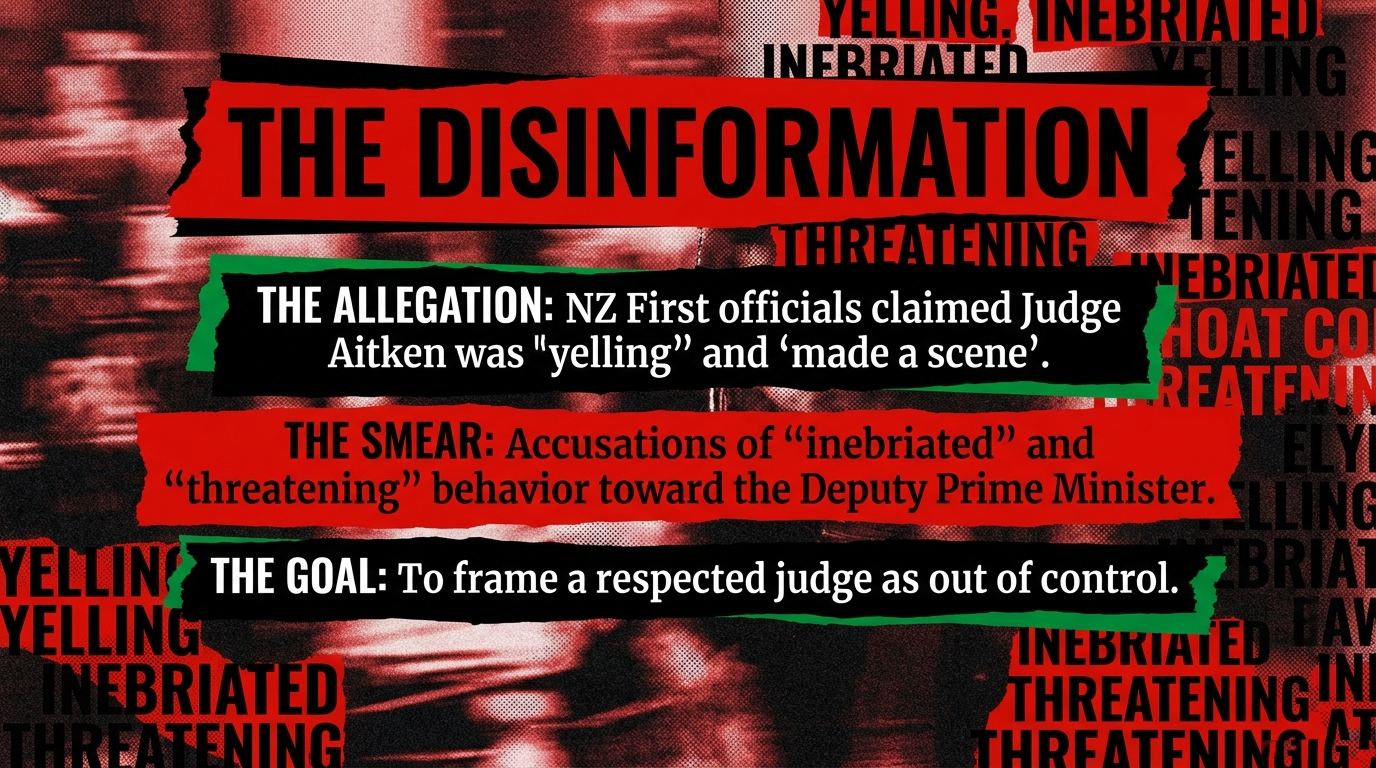
NZ First's version (included in a Northern Club report): Judge Aitken "tried to enter the room and shouted, 'He's lying! How can you let him say that?'" She allegedly made a scene, was "loud and threatening," and told NZ First staff there was "a room full of judges next door who would be interested in what the Deputy Prime Minister said".
Judge Aitken's version: She "mouthed an inaudible comment" to a guest she thought she recognised near the door, did not enter the room, did not recognise Peters' voice, and did not know it was a political event. She made "an audible remark once I reached the bottom of the stairs where I paused briefly".
What the Fellow Judges Actually Saw
Three District Court judges who were at Aitken's table that night gave evidence to the panel in February 2026. Their testimony devastates NZ First's account:
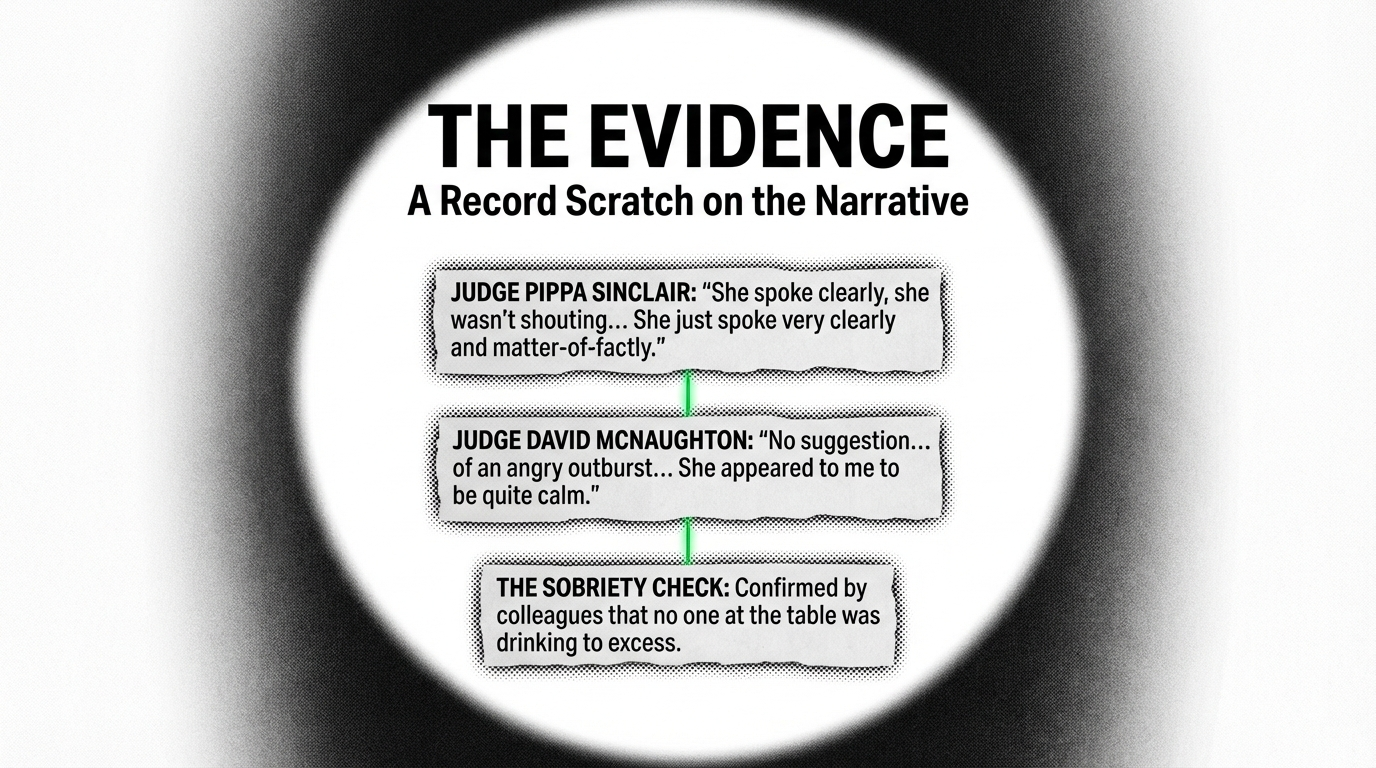
Judge Pippa Sinclair recalled Aitken returning to the table and saying, in a "fairly matter-of-fact" manner: "I've just told Winston Peters he's lying... how could he say that?" — in response to Peters "discussing tikanga in the law schools." Sinclair told the panel Aitken "spoke clearly, she wasn't shouting or anything like that. She just spoke very clearly and matter of factly".
Judge David McNaughton said: "There was no suggestion in her demeanour or manner of an angry outburst, or making a scene, or shouting. She appeared to me to be quite calm". He noted that no one at the table was drinking to excess that night.
Judge Alison Sinclair (via written statement): "I can categorically state that Judge Aitken was not intoxicated or acting inappropriately at the function in any way".
All three judges said they saw no signage indicating an NZ First function was taking place.
NZ First's Account: "Rubbish"
Aitken's lawyer, David Jones KC, put it directly to NZ First's party secretary Holly Howard that her account was "rubbish" and was designed to "increase the focus on the judge and so NZ First can get some leverage in terms of judicial activism".
Jones pointed out discrepancies between Howard's original letter to the Northern Club (dated 27 November 2024) and her statement to the Judicial Conduct Panel. Her claim that the judge was "yelling" was inconsistent with the version she had given to the club. Howard conceded there were "errors" in the letter.
NZ First board member Dorothy Jones (wife of Deputy Leader Shane Jones) claimed she called the Northern Club the day after the event to report the incident. But the club's written summary of the call did not record any yelling by a woman in a yellow dress. Dorothy Jones accepted she did not raise the omission or ask for the record to be corrected.
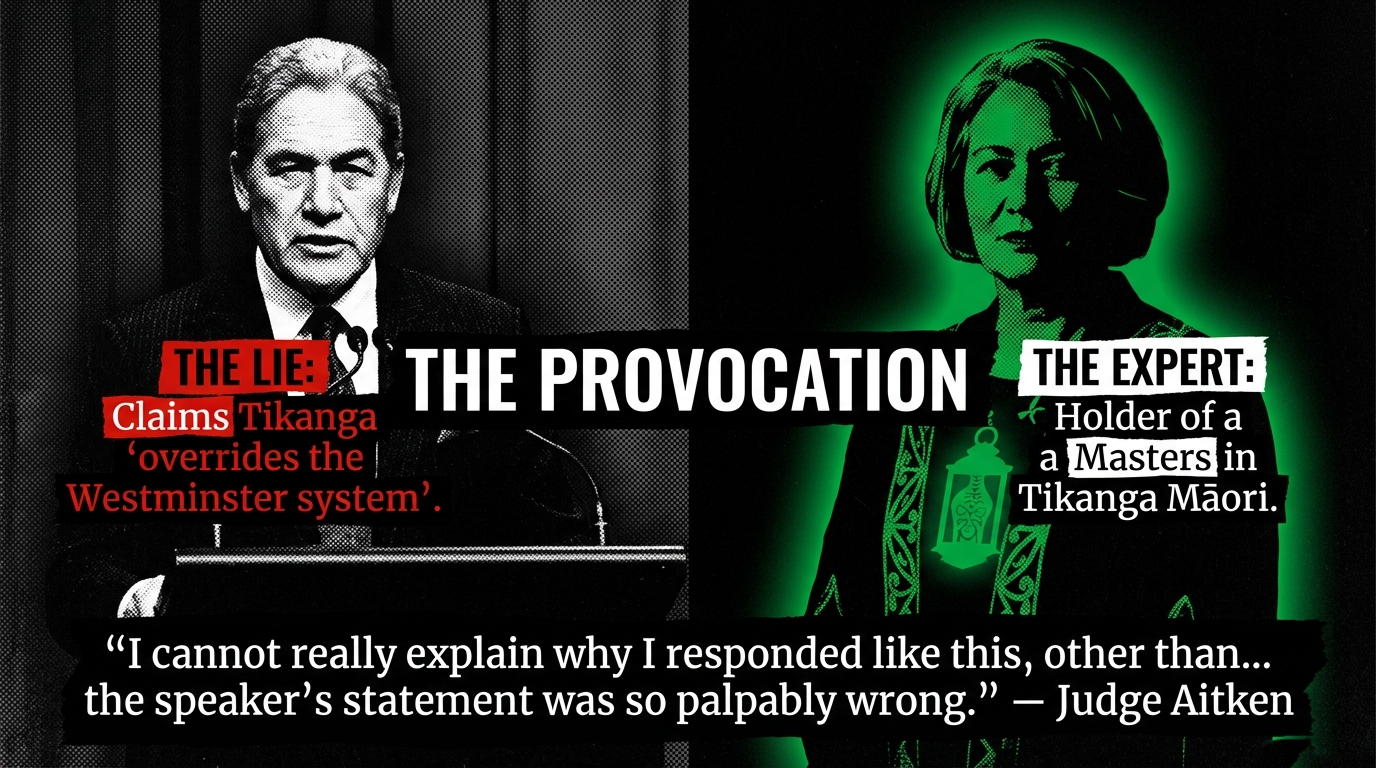
By Aitken's own admission, she was rude. "I cannot really explain why I responded like this, other than that I was tired, and the speaker's statement was so palpably wrong," she told the panel. "It was reactionary, and rude of me which is not consistent with my character or reputation".
Rude? Yes. Grounds for removing a judge from the bench? Let's follow the money and the motive.
Cui Bono — Who Benefits From Destroying This Judge?
Hidden Connection #1: Collins as Complainant AND Attorney-General
Attorney-General Judith Collins was not a neutral actor in this saga. Within hours of The Post reporting the incident in December 2024, Collins was in front of cameras declaring she was "really disgusted" and "appalled" by the behaviour. She said those responsible were "clearly either inebriated or just arrogant and offensive".
Collins then referred the matter to the Judicial Conduct Commissioner — making herself a complainant. She later had to stand aside from the Attorney-General's role on the matter "to avoid any perception of conflict of interest, bias or pre-determination," handing it to Justice Minister Paul Goldsmith.
But the damage was done. The most powerful law officer in the country had already publicly convicted Judge Aitken before any investigation.
Hidden Connection #2: Peters' Tikanga Crusade
The speech that triggered Judge Aitken's reaction was not an innocent off-the-cuff remark. Peters has waged a systematic campaign against tikanga Māori in law for years:
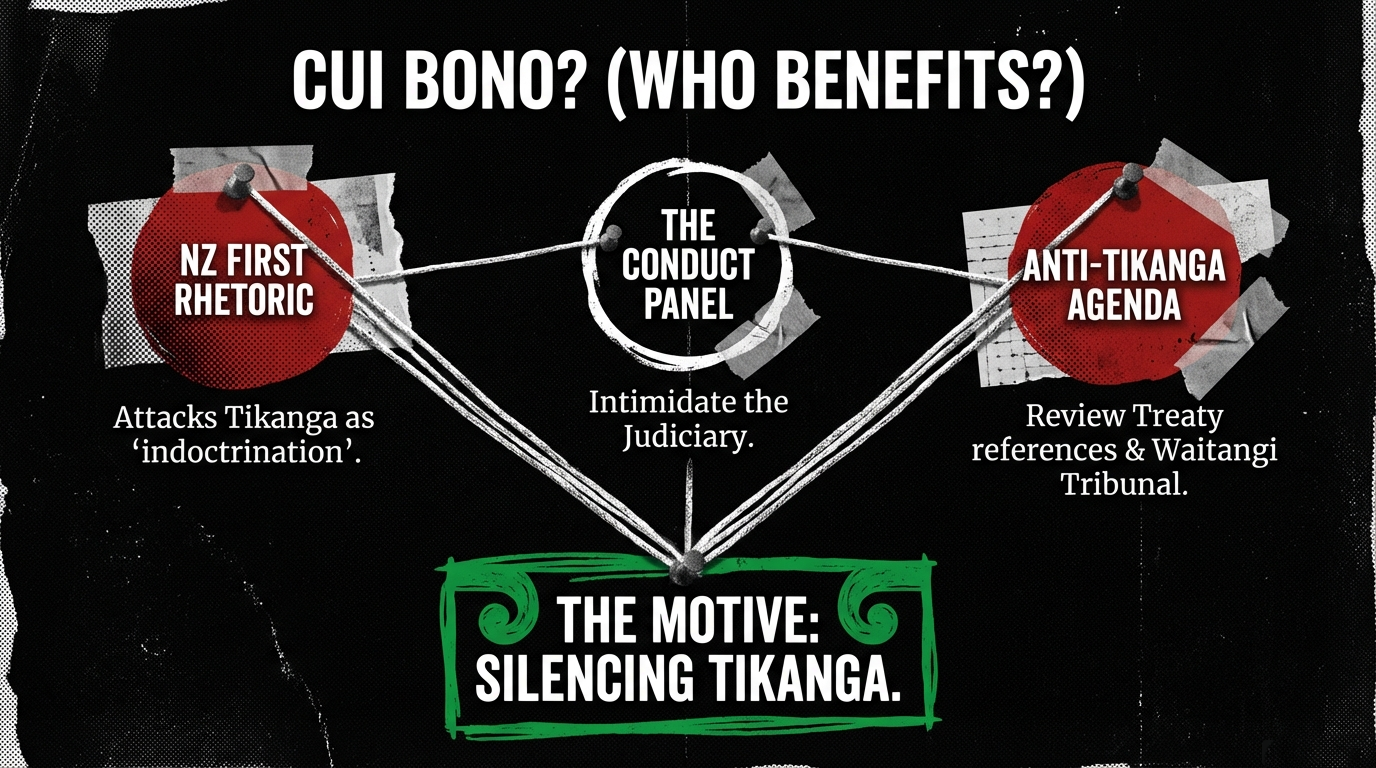
- May 2024: Peters backed King's Counsel Gary Judd's complaint against compulsory tikanga in law schools, calling it "cultural indoctrination".
- October 2025: At the Oxford Union, Peters argued that "tikanga" was "an ambiguous concept of Māori lore" that courts had used to weaken parliamentary intent. He claimed judicial activism was "never the intention of legislators".
- Throughout 2024-2025: NZ First's coalition agreement with National committed to reviewing all Treaty of Waitangi references in legislation and "refocusing" the Waitangi Tribunal.
When Judge Aitken overheard Peters claiming tikanga overrides the Westminster system in law schools, she was hearing deliberate disinformation from the Deputy Prime Minister. The compulsory tikanga requirement in law schools reflects the reality that tikanga is already part of New Zealand law — as confirmed by the Supreme Court in Ellis and multiple Court of Appeal decisions. A select committee subsequently rejected the complaint against tikanga teaching, finding it was a "justifiable limit" given "the public interest in lawyers competently providing legal services".
Judge Aitken holds a Masters degree in Tikanga Māori. She was not some random heckler. She was an expert hearing lies told about her field of expertise by the Deputy Prime Minister of the country. And for reacting humanly to that provocation, she faces removal.
Hidden Connection #3: The Coalition's Systematic War on Judicial Independence
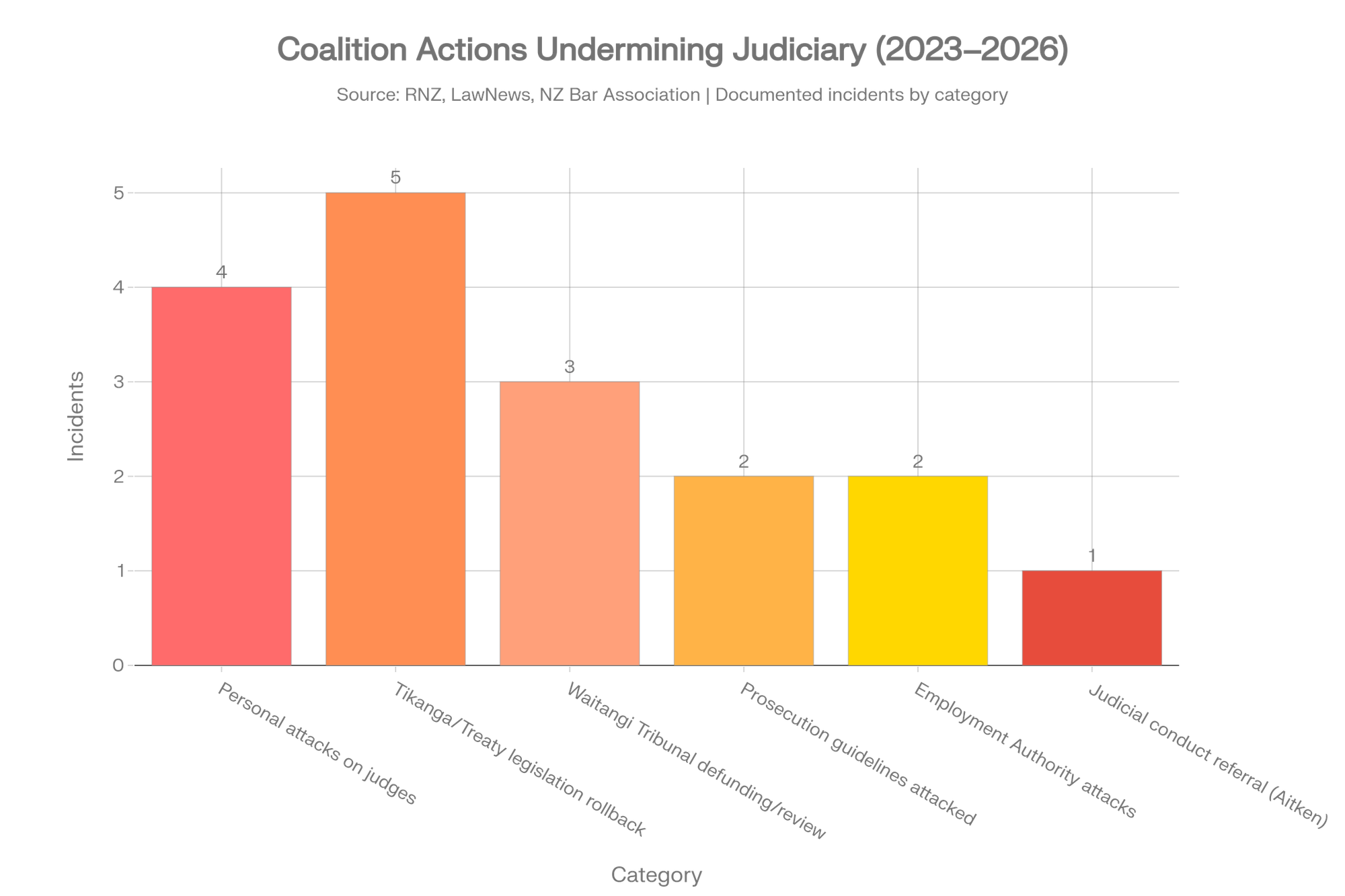
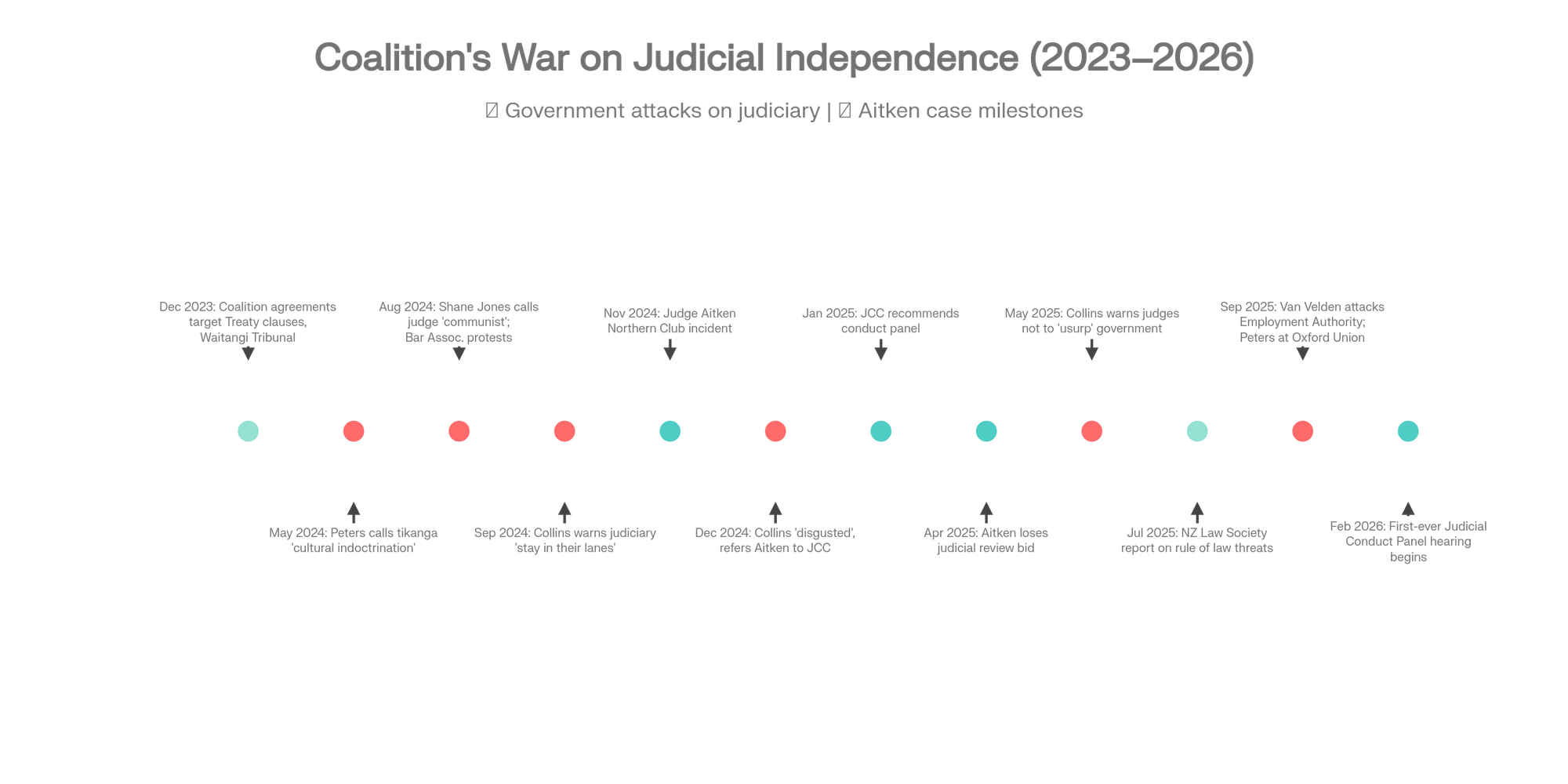
The Aitken prosecution does not exist in isolation. It is the sharpest weapon yet in a systematic coalition campaign to intimidate the judiciary:
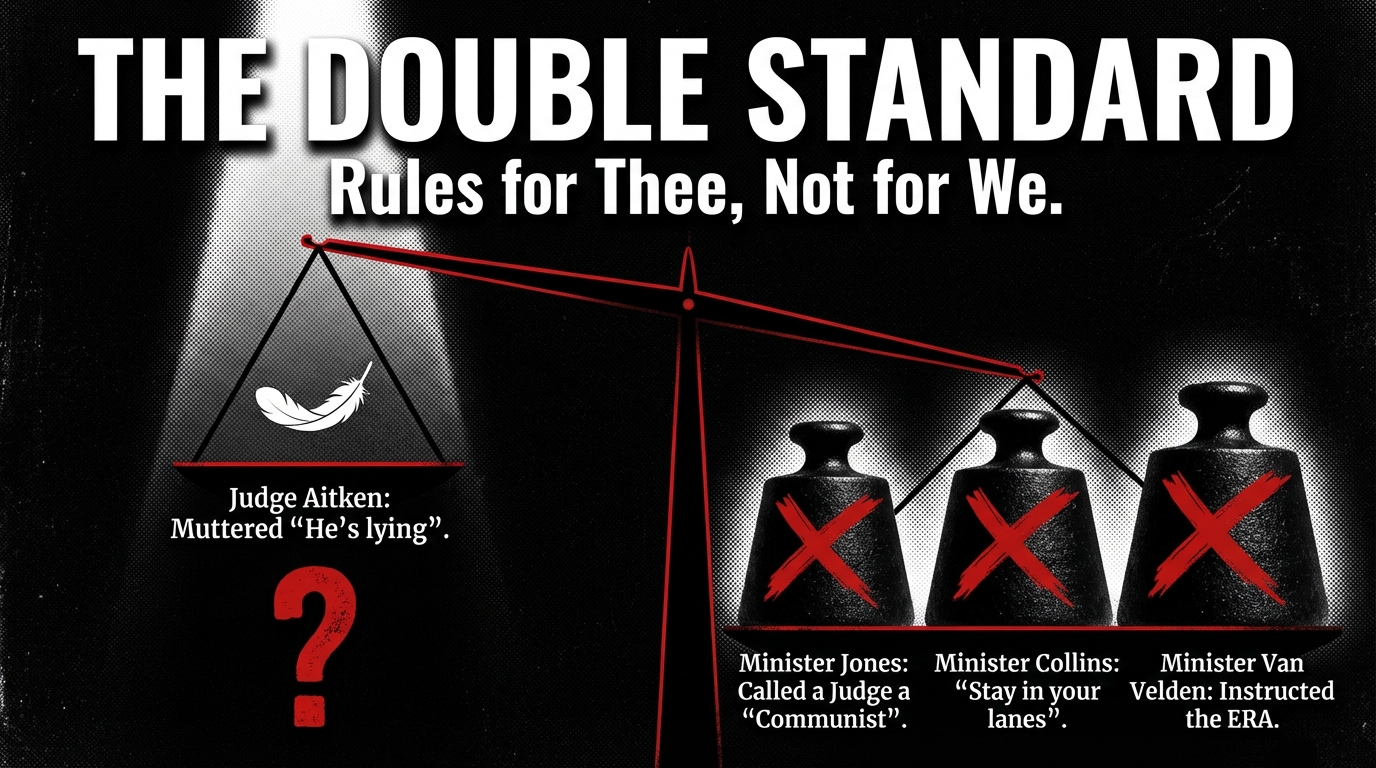
- August 2024: Fisheries Minister Shane Jones called High Court Judge Cheryl Gwyn a "communist" for granting Customary Marine Titles to Māori groups. The NZ Bar Association wrote to Collins, warning that ministerial statements were "amounting to attacks on the judiciary" and "could not be explained away as political rhetoric".
- September 2024: Collins herself warned judges to "stay in their lanes," asserting that "the judiciary cannot be policymakers".
- May 2025: Collins told judges not to "usurp the executive and legislature." She expressed concern about the Ellis decision's recognition of tikanga as "the first law of Aotearoa," saying tikanga needed to be "codified" if it was to be part of the law.
- September 2025: Workplace Relations Minister Brooke Van Velden publicly stated she hoped new Employment Relations Authority members would "lend a more sympathetic ear to business" and expected "smaller awards against business." The Public Service Association called this "a fundamental breach of constitutional norms".
- July 2025: The NZ Law Society released a landmark report, Strengthening the Rule of Law in Aotearoa New Zealand, identifying "threats to judicial independence and the separation of powers" among its key findings.
Hidden Connection #4: The First-Ever Conduct Panel — For THIS?
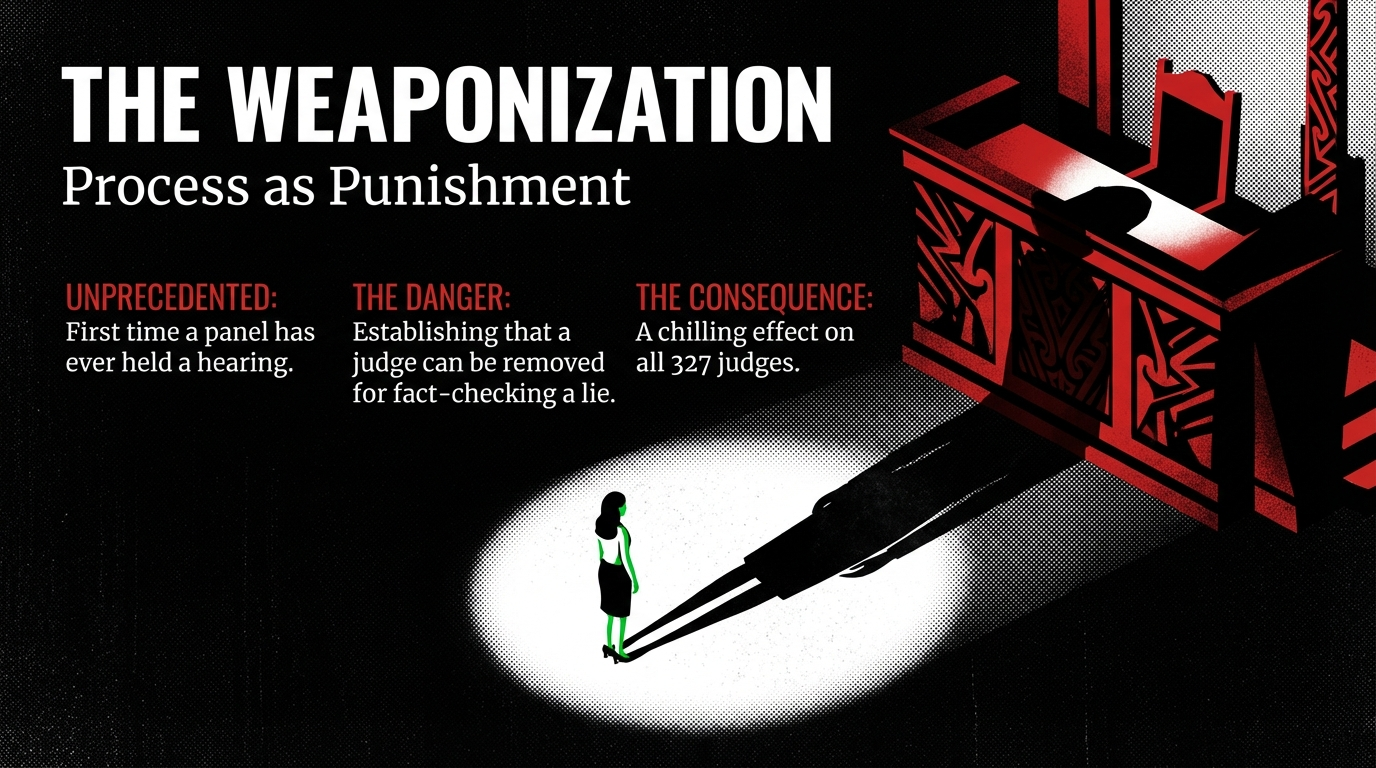
In New Zealand's judicial history, only one other judge has faced a Judicial Conduct Panel. That was Supreme Court Justice Bill Wilson, accused of failing to disclose a substantial financial debt to a QC whose appeal he was hearing — a genuine conflict of interest. Wilson resigned before the panel assembled.
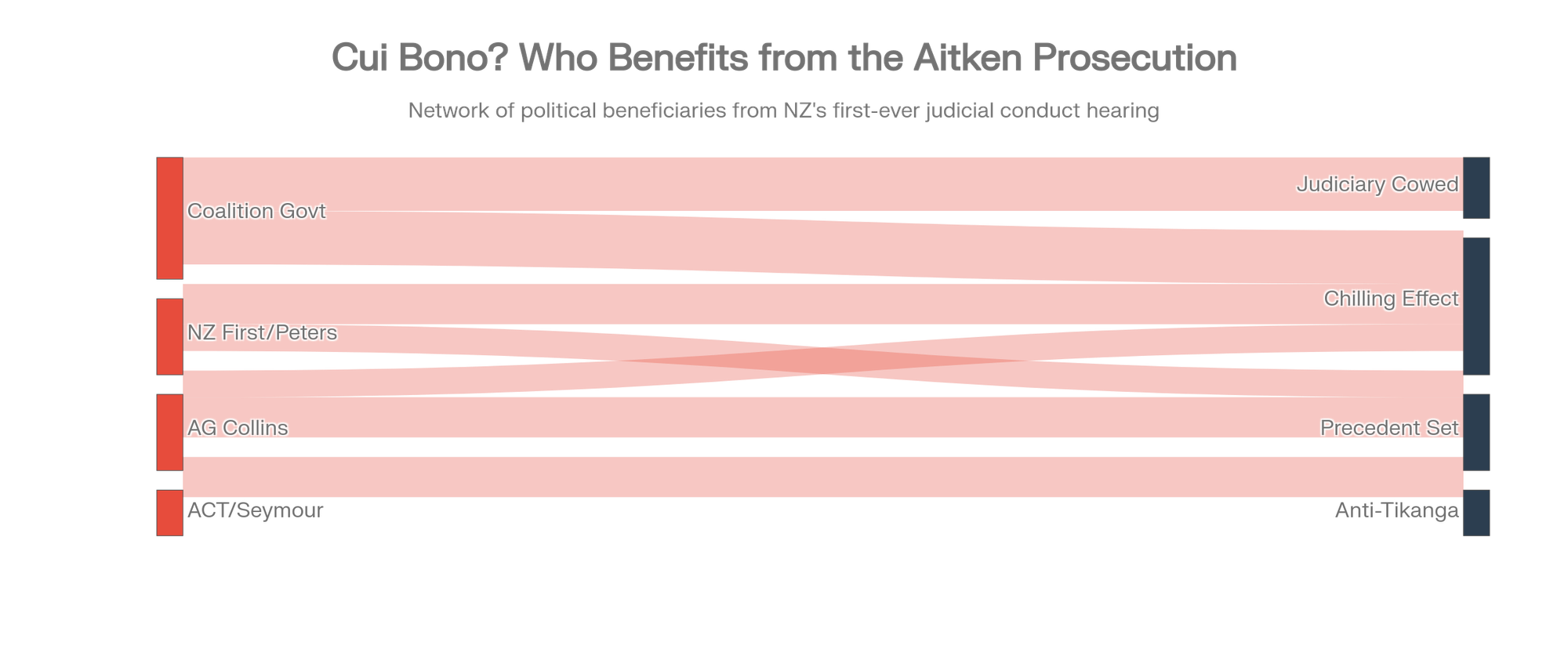
Judge Aitken's case is the first-ever panel to actually hold a hearing. The precedent being set is extraordinary: a judge can be dragged before a removal panel for making a rude comment at a social event about a politician's demonstrably false claims.
Special Counsel Tim Stephens KC told the panel this is a "protective" rather than "punitive" process, aimed at "maintaining public confidence in the judiciary". But the question screams itself: whose confidence? The public's? Or Winston Peters'?
Hidden Connection #5: NZ First's Pattern of Leveraging Judicial Complaints
The Aitken case fits NZ First's documented pattern of attacking judicial actors who inconvenience the party's agenda:
- Peters has repeatedly attacked the Waitangi Tribunal, calling its members "unelected, irresponsible" people who "decided to wander and explore well beyond the original writ".
- The coalition committed to reviewing the Treaty of Waitangi Act to "refocus" the Tribunal — a move Labour called "extremely bad faith" conducted "right when the Waitangi Tribunal is conducting urgent inquiries into the actions of this Government".
- Jones attacked Judge Gwyn for her Customary Marine Title decisions.
- The coalition attacked the Solicitor-General's prosecution guidelines for acknowledging Māori overrepresentation in the justice system, with Luxon declaring prosecution "should be colourblind".
The Aitken hearing is the culmination: punish a judge for defending tikanga in earshot of the most powerful politician attacking it.
Ko Wai Ia — Who Is Judge Ema Aitken?
This is not some radical activist being brought to heel. The record tells a different story entirely.
Elizabeth Margaret Aitken was appointed to the District Court in 2006 by Attorney-General Michael Cullen. Before her appointment, she served as Chair of the Refugee Status Appeals Authority, Deputy Presiding Member of the Deportation Review Tribunal, and was a criminal defence barrister in Ōtāhūhū. She was Co-Convenor of the Women's Consultative Group of the NZ Law Society, President of the Auckland Women Lawyers' Association, and a Council member of the International Association of Refugee Law Judges.
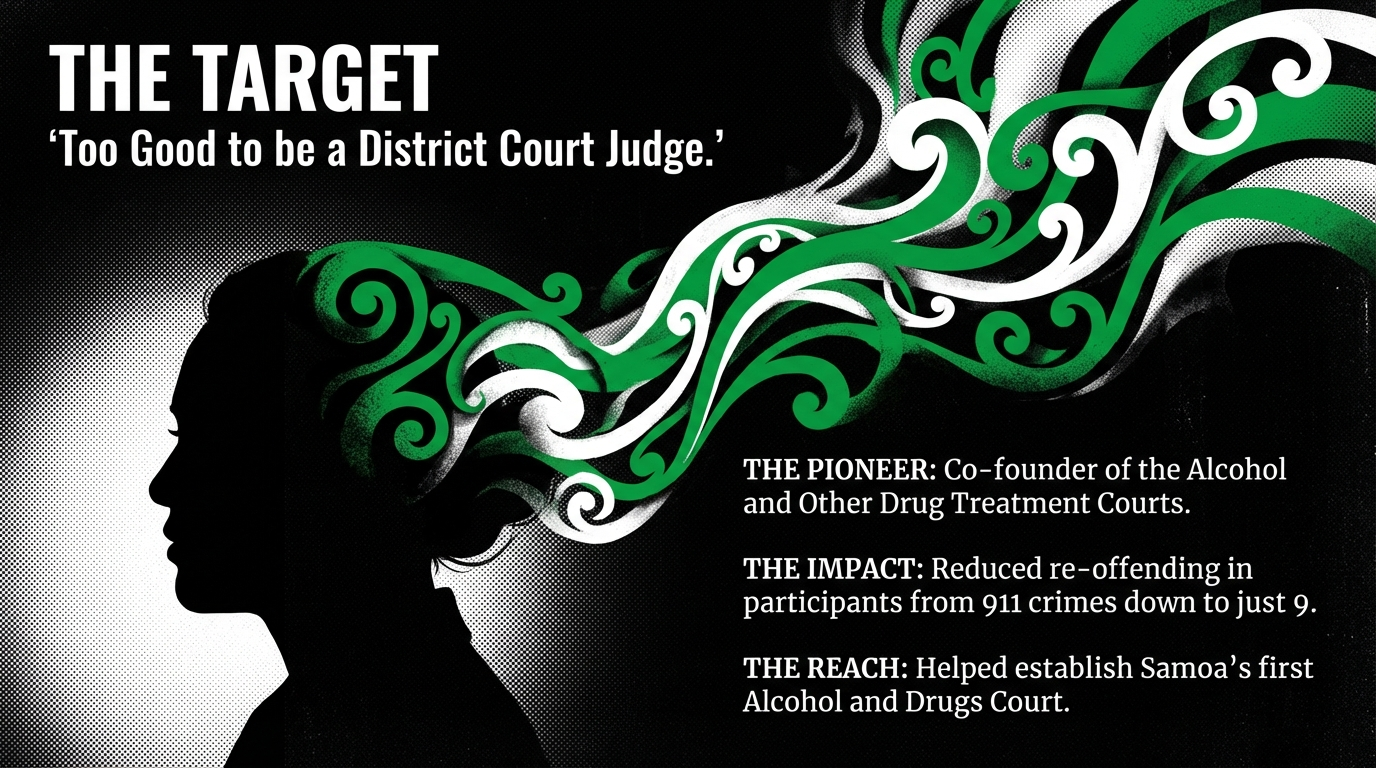
Judge Aitken co-founded New Zealand's Alcohol and Other Drug Treatment Courts (AODTC) — Te Whare Whakapiki Wairua — one of the most innovative and successful justice initiatives in the country's history. The AODTC model specifically incorporates tikanga Māori through the role of the Pou Oranga and peer support workers with lived experience of recovery.
A "snapshot" of offenders in the AODTC found that prior to entry, participants had committed 911 offences; since entering the court, the number fell to 9 new offences. The courts have been independently evaluated as effective alternatives to imprisonment, which costs $100,000 per inmate per year in New Zealand.
In 2015, Judge Aitken was appointed to the Supreme Court of Samoa for a twelve-month period — only the second New Zealand woman to hold the role. In 2016, she worked with the Samoan judiciary and church to establish Samoa's first Alcohol and Drugs Court, personally requesting Justice Mata Keli Tuatagaloa — Samoa's first female judge — to head it.
Judge McNaughton told the panel: "In some ways, she was too good to be a District Court judge".
Mark Sinclair, husband of Judge Alison Sinclair, became emotional describing the Aitkens' contributions: "I think they have done more than their fair share… for both their professions and New Zealand as a nation. I hope when all this is over, I wish them all the best, and that their good work is not forgotten, because of the accusations that have been made as part of this process".
Te Ture — The Legal Framework Being Weaponised
Comity: The Principle Turned Against Its Purpose
The principle at the heart of this case is comity — the mutual respect that requires the separate branches of government to act with restraint toward each other. Under this principle, judges don't criticise politicians publicly, and politicians don't attack judges.
But here's the devastating irony the panel must confront: the coalition government has systematically violated comity against the judiciary for two years. Shane Jones called a sitting judge a "communist". Brooke Van Velden told Employment Authority members how to decide cases. Collins herself publicly warned judges to "stay in their lanes". Peters attacked tikanga as "cultural indoctrination" and accused courts of "judicial overreach" at the Oxford Union.
Not one of these ministers has been held accountable. No inquiry. No panel. No consequences.
But a judge who muttered "that's not true" in a hallway? Removal.
The Legal Standard: Misbehaviour
Under the District Court Act, a judge can be removed on the grounds of "inability or misbehaviour". Judge Aitken's lawyer David Jones KC pressed the panel on the legal test: what constitutes misbehaviour serious enough to warrant removal? "We are asking you to state the test, in advance of the hearing," he told the panel in November 2025. "You have to have something to aim at".
The panel's Special Counsel responded that misconduct "did not need to involve criminality or moral turpitude" and could include conduct that "may adversely affect the perceptions of others as to the judge's ability" to carry out their duties.
Think about that standard. If a judge's career can be ended because of perceived impropriety — perception shaped entirely by the political apparatus of NZ First and a hostile Attorney-General — then no judge in New Zealand is safe from political retribution.
Te Whakamārama — The Chilling Effect
The Judicial Conduct Commissioner's annual report for 2024-25 reveals that 253 complaints about 327 individual judges were received during the year. Over half concerned alleged "bullying" or "speaking in an inappropriate way." Of seven complaints referred to heads of bench, six related to the District Court and one to the Māori Land Court.
The Commissioner noted that audio recordings generally confirmed "compliance with the guidelines, with judges addressing participants calmly and considerately".
Judge Aitken's case is the sole referral to a full Judicial Conduct Panel. The message to every judge in New Zealand is unmistakable: challenge the government's anti-tikanga agenda, and we will come for you.
The NZ District Courts' own website acknowledges the tension: "It is sometimes said that judicial independence and judicial accountability are in conflict with one another. Ultimately, however, they both serve the same purpose: to provide confidence to the public that every person in the District Court receives a fair hearing".
The Aitken prosecution inverts this principle. It uses accountability mechanisms to destroy independence — specifically the independence of a judge who champions tikanga Māori in the justice system.
Te Mutunga — What Must Be Done
The Judicial Conduct Panel is expected to deliver its recommendation to Acting Attorney-General Goldsmith by Easter 2026. Whatever its finding, the damage is already done. The process itself — unprecedented, disproportionate, politically contaminated — has achieved its goal.
But te taiaha does not yield.
For the Panel
Recommend no removal. Acknowledge Judge Aitken's remark was rude but recognise the provocation, the context, and the extraordinary disproportion between the offence and the remedy sought. Note the systematic violations of comity by government ministers that have gone entirely unpunished.
For the Legal Profession
The NZ Bar Association's warning that ministerial statements amount to "attacks on the judiciary" must be matched with action. Every lawyer in this country has a stake in judicial independence.
For Whānau Māori
Understand what is happening. A Māori expert in tikanga is being prosecuted for defending tikanga against a politician who calls it "cultural indoctrination." This is not about judicial conduct. This is about who gets to define the law in Aotearoa.
For the Public
Demand accountability for the real breaches of comity: the ministers who attack judges by name, who tell tribunals their work is illegitimate, who instruct quasi-judicial bodies on how to decide cases. If comity is sacred enough to potentially end Judge Aitken's career, it is sacred enough to hold Shane Jones, Brooke Van Velden, and Judith Collins to the same standard.
Kia kaha, Judge Aitken. He wāhine toa koe.
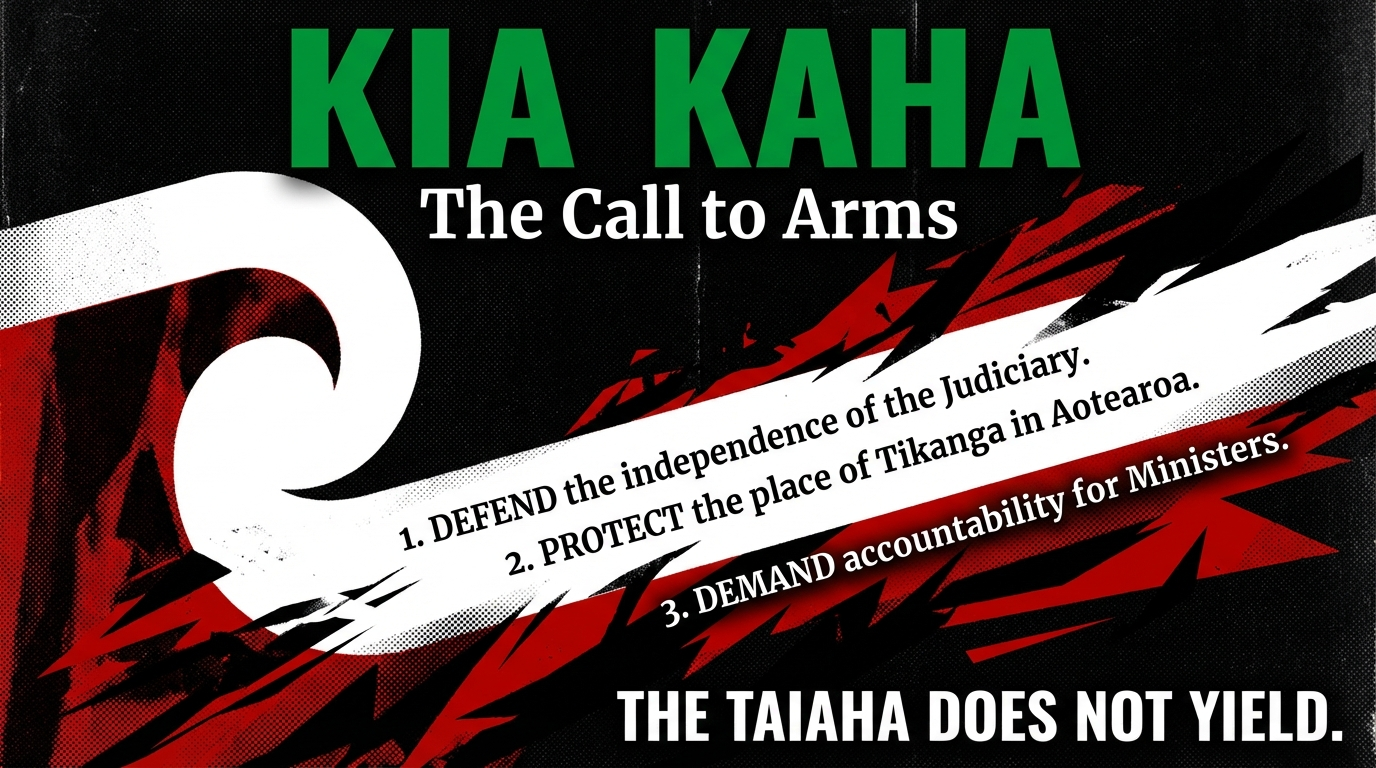
The taiaha sees. The Ring illuminates. The far right's campaign against the judiciary is documented, connected, and exposed.

Tūturu whakamaua kia tina. Tina! Hui e, tāiki e!
Research Transparency
- Tools used: search_web, get_url_content, execute_code (charts), CB Insights MCP
- Sources consulted: RNZ, 1News, LawNews, NZ Herald, Te Ara, NZ Courts, NZ Justice Ministry, Beehive.govt.nz, e-tangata, NZ Bar Association, NZ Law Society, NZ District Courts, Transparency NZ, Samoa Observer, Salt Magazine, Justice Speakers Institute, academic journals
- Date of research: 14 February 2026
- Unverifiable claims: The panel's final recommendation has not yet been issued as of the date of research. The hearing continues into its second week.
- All URLs tested against source material during research.

Ivor Jones The Māori Green Lantern Fighting Misinformation And Disinformation From The Far Right