"THE TANIWHA WEARS A VENTURE CAPITALIST'S POLO SHIRT: How a Silicon Valley Import Is Purchasing Aotearoa's Political Soul — One Cheque at a Time" - 13 March 2026
He bought the ocean. Now he's buying the waka. And if no one stops him, he'll sell you the tide.

Mōrena Aotearoa,
Ko Wai Tēnei Taniwha? (Who Is This Monster?)
There is a creature that arrived on these shores in 2010 with Silicon Valley money, American instincts, and a story so perfectly constructed it could only be a brand. His name is Brian Cartmell, and he does not live in Wellington where power is supposed to reside. He lives in Queenstown — because of course he does — nestled in the mountains, skiing distance from decisions that govern the lives of nearly five million people, half a million of them Māori who hold Treaty rights that predate this nation's very existence.
Deep Dive
A lively conversation between two hosts, unpacking and connecting topics in the sources of this essay
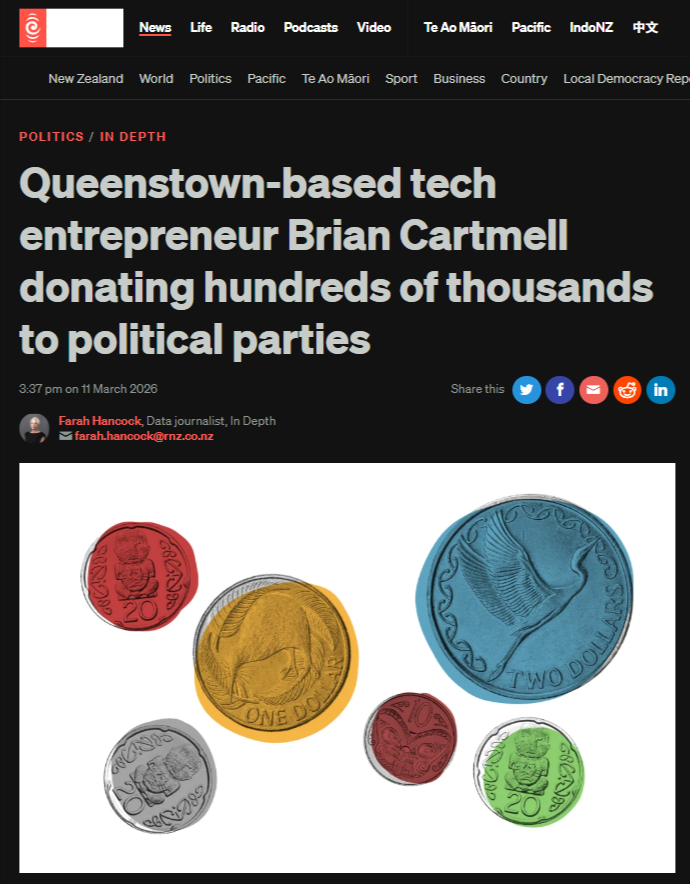
He is not a politician. He does not need to be. In the theology of neoliberalism, politicians are merely intermediaries — priests who conduct the ceremony that the donor has written. As RNZ revealed on 10 March 2026, Cartmell has donated at least half a million dollars to the three coalition parties — National, ACT, NZ First — plus a further $100,000 to the fringe Opportunity Party. ACT confirmed receiving $200,000 from Cartmell in 2025 alone. The Electoral Commission confirmed the Opportunity donation was declared. National and NZ First refused to confirm their amounts — which in the language of power means: yes, and we do not wish to be seen saying yes.
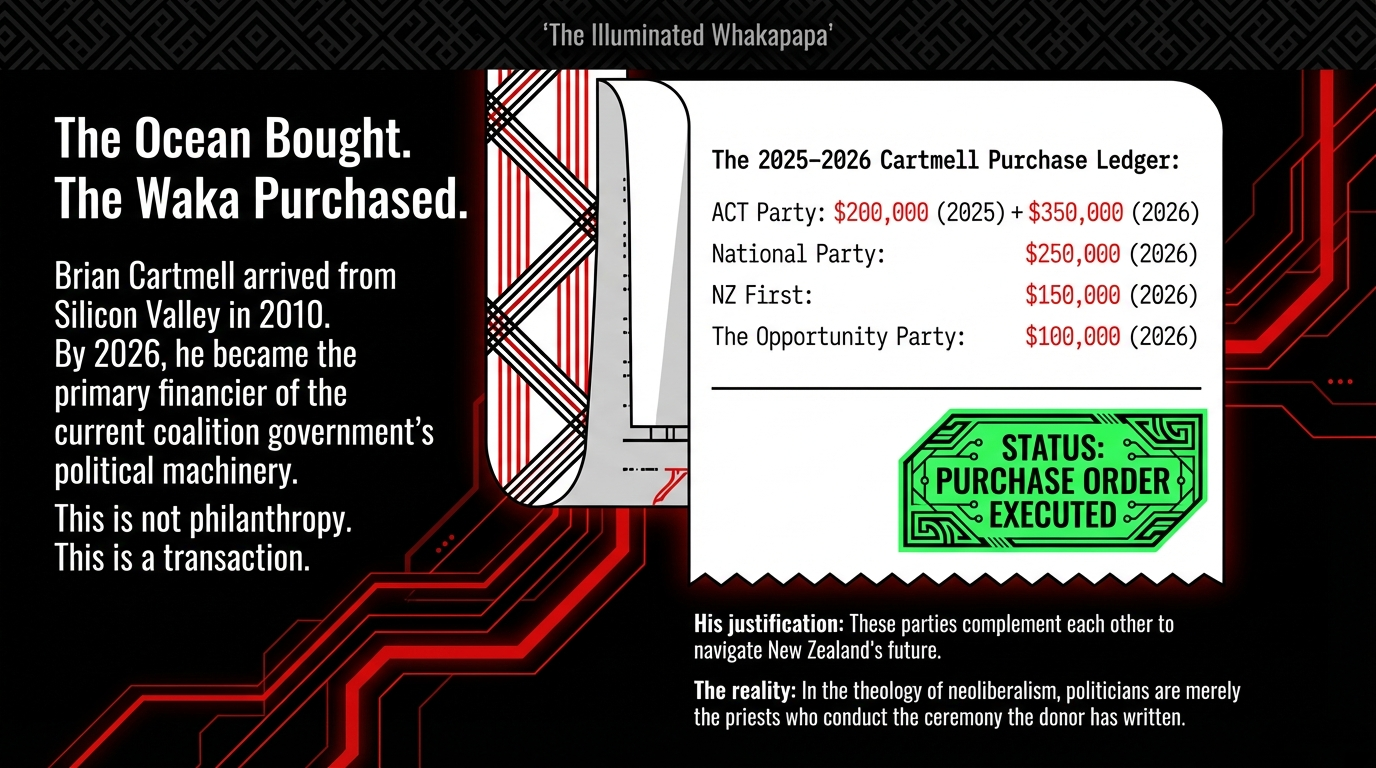
This is not philanthropy. This is a purchase order.
Te Ara Huna — The Hidden Path (Where Did This Money Come From?)
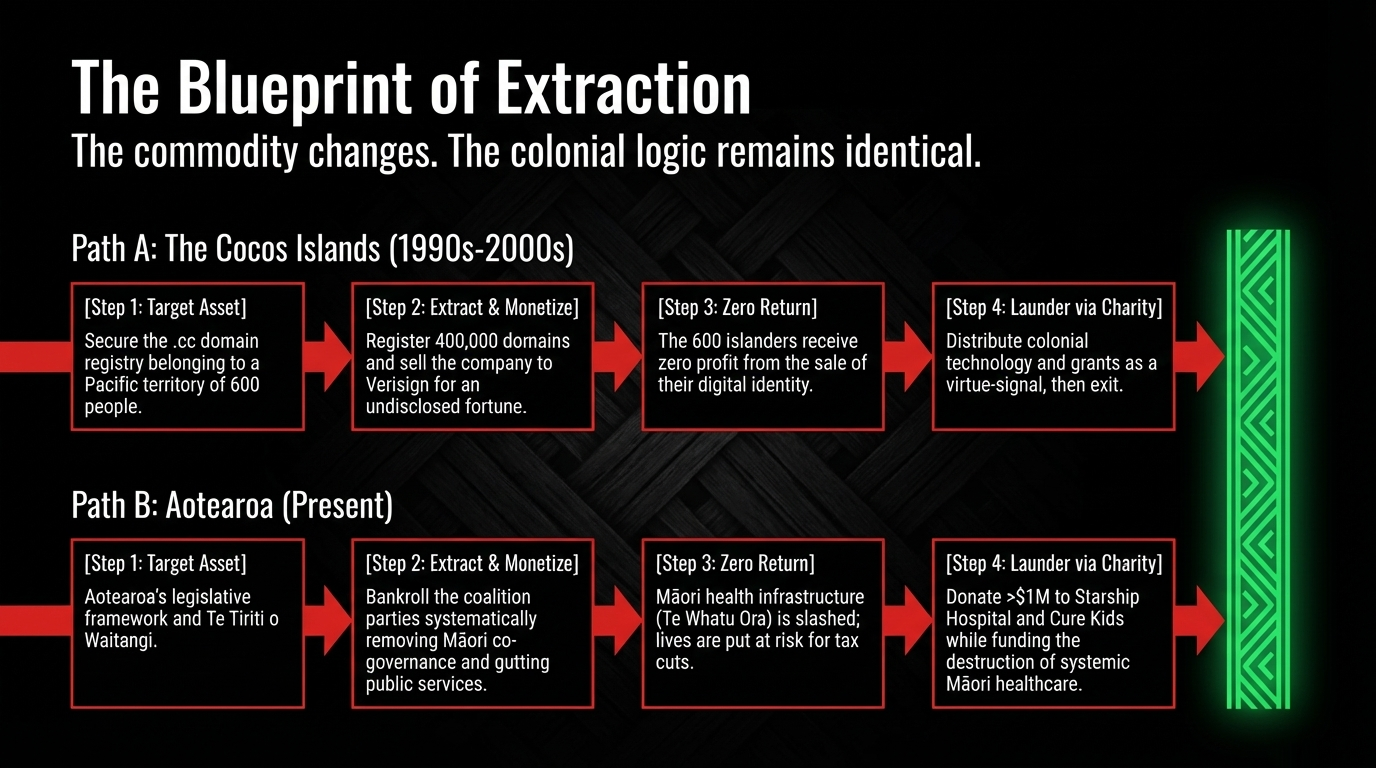
Before Cartmell was a philanthropist — before the Starship Hospital donations and the Cure Kids cheques that make the press releases sing — he was building the infrastructure of online pornography. In the 1990s, he worked for the Internet Entertainment Group, one of the first companies to monetise live webcam sex shows and subscription services. This is not moral condemnation — it is context. The first fortune was built on commodifying intimacy at scale. The pattern — extract value, monetise access, move on — did not stop there.
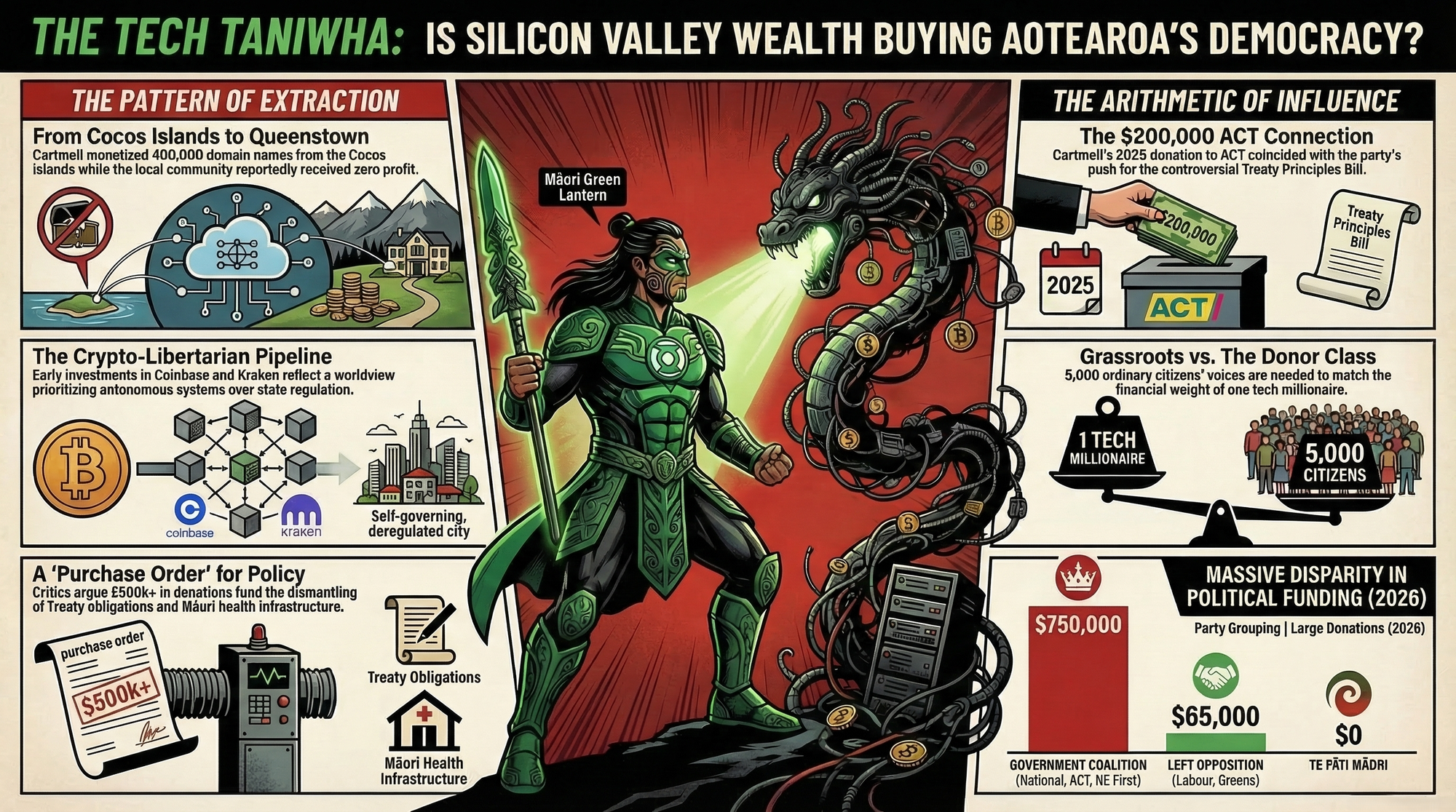
Next came the Cocos Islands domain registry. Cartmell registered 400,000 domain names under the .cc extension belonging to a Pacific Island territory of 600 people, built a company around it, and sold it to Verisign in 2001 for an undisclosed sum. As the Australian Financial Review reported, the Cocos Islands received no benefits from those domain name sales. Six hundred people. Zero profit. A Pacific community's digital identity monetised without return. He distributed "technology and grants" — the coloniser's preferred currency of consolation — and moved on.
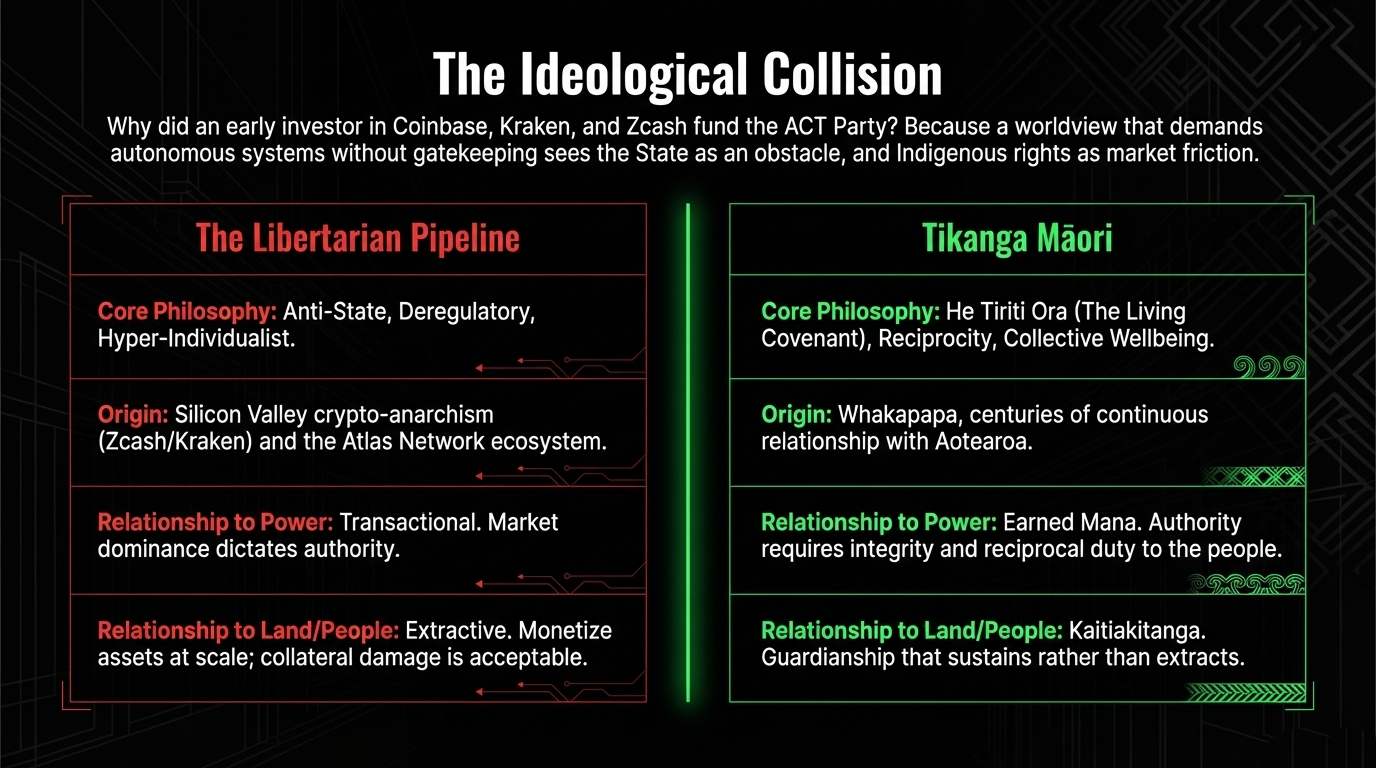
Then Bitcoin. Then Coinbase. Then Kraken. Then Zcash. According to his own biography, Cartmell participated in the "first funding rounds of both Coinbase and Kraken" — two platforms that became the foundational infrastructure of the cryptocurrency industry. He was "an early supporter of Zcash, the privacy-focused cryptocurrency," and believed digital currencies were "the payment rails that would one day allow autonomous AI systems to operate economically in the world, without the gatekeeping of traditional banking." This is the worldview of a man who has made a fortune from disabling accountability structures. Then he came to Queenstown. Then he wrote cheques worth half a million dollars to the parties of government.
The taiaha sees the pattern. The ring illuminates the whakapapa.
💚 KOHA CONSIDERATION — He Taonga Tēnei Mahi
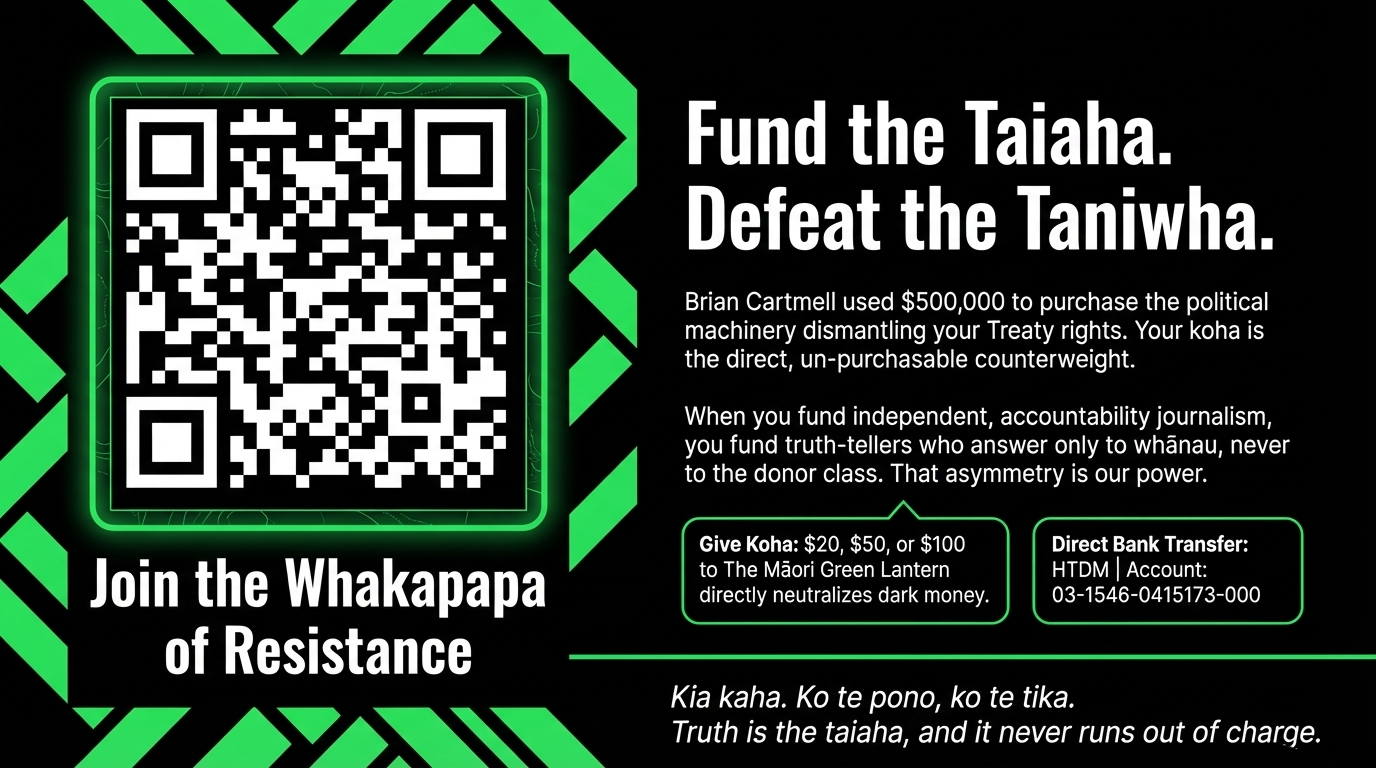
Brian Cartmell gave $200,000 to ACT alone to purchase political influence over the laws that govern your life and the Treaty rights of your mokopuna. You can give $20, $50, or $100 to fund the accountability journalism that his donation machine does not want to exist.
Every koha to this mahi is a direct counterweight to the half-million-dollar political purchase that bought this government. It signals that rangatiratanga includes the power to fund our own truth-tellers — ones who cannot be purchased, because they answer to whānau, not to donors.
While Cartmell funds the parties dismantling Treaty obligations from a Queenstown ski chalet, your koha funds the journalism tracing the whakapapa of exactly how it is being done. That asymmetry matters. That asymmetry is the entire point.
Three pathways to support this mahi:
For direct koha (voluntary contribution), visit the Koha platform:
Koha — Support The Māori Green Lantern
For essays delivered directly to your kete, subscribe:
Subscribe to The Māori Green Lantern
For direct bank transfer:
HTDM | Account: 03-1546-0415173-000
If you cannot koha — no worries at all. Subscribe. Follow on Substack. Share this essay with your whānau. Send it to someone who needs to read it. That is koha in itself, and it carries more mana than any press release Cartmell will ever publish.
Kia kaha. Ko te pono, ko te tika — truth is the taiaha, and it never runs out of charge.
Ngā Kupu Āpōpō — The Language of Tomorrow (What He Says vs. What He Does)
Cartmell told RNZ:
"These donations were made with that broader objective in mind — with the understanding that it is voters, not donors, who decide the direction of New Zealand."
He supports "transparent political donations." He will make "no further statements on the matter."
In te ao Māori, we have a concept: he kupu māmā, he mahi taimaha — light words, heavy deeds. The lightness of his statement is inversely proportional to the weight of half a million dollars flowing into the parties currently dismantling Treaty obligations, gutting public services, and removing Māori co-governance from legislation. He says the coalition represents "the best available chance of navigating" Aotearoa's future. Translation: this government's agenda is his agenda, and he has paid to ensure it continues.
His own stated justification is a masterpiece of the genre. He donated equally to National, ACT, and NZ First because he believed the three parties "complemented each other" — each covering different policy ground no single party could cover alone. He funded Opportunity because "healthy democracies need parties willing to put forward ideas major parties won't," claiming that "new ideas enter the political process from the edges." In other words: he is not just buying one government. He is seeding the ideological soil so the next one grows in the same direction.
Political analyst Bryce Edwards was characteristically measured — but the mathematics speak louder. Coalition parties received $750,000 in large donations in 2026 alone. The Greens received $43,000. Labour received $22,000. These numbers are not neutral. They are a verdict.
This is not opinion. This is arithmetic.
Toru Tauira — Three Examples for the Western Mind
The Western mind wants case studies. It wants to understand harm in units it recognises — dollars, percentages, headlines. Very well. Let the taiaha speak in numbers.
Example One: The ACT Party Agenda Was Not an Accident — It Was Purchased
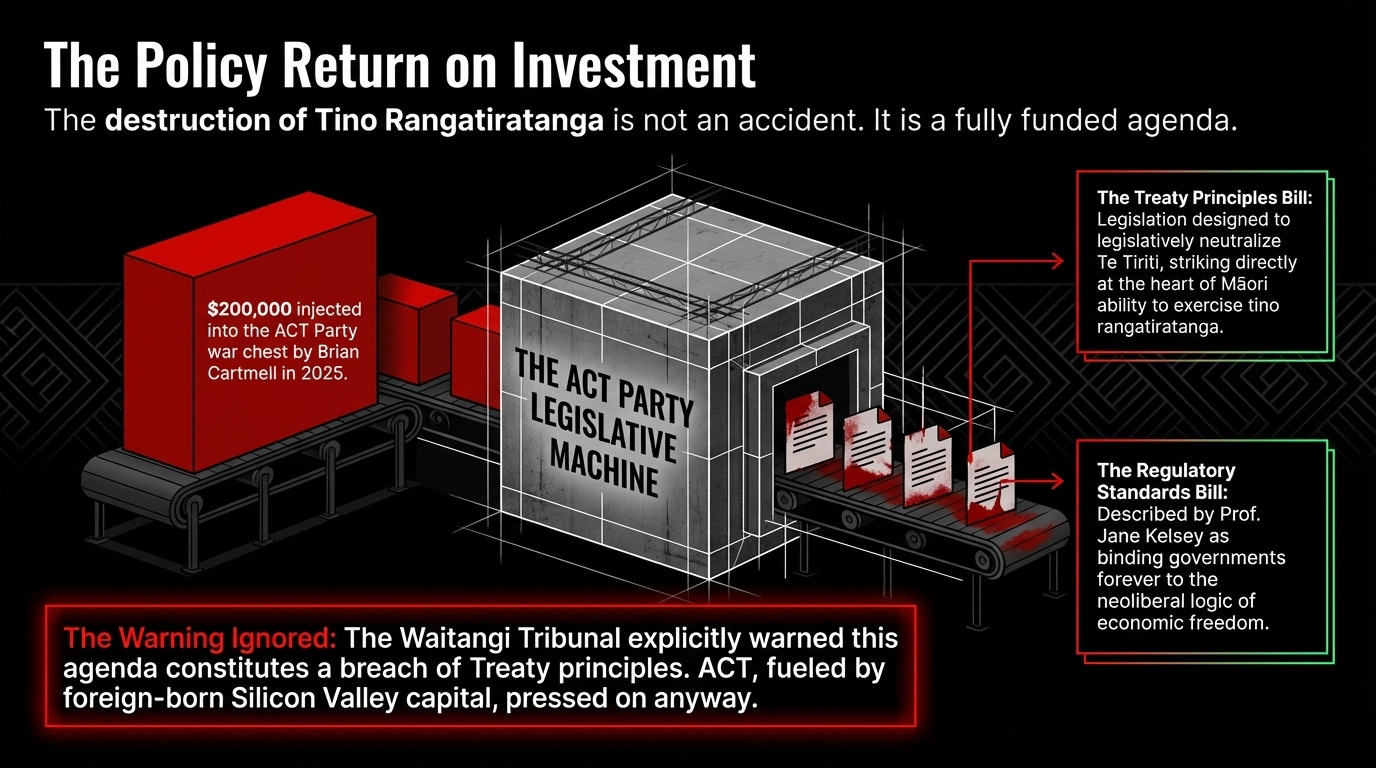
Cartmell gave ACT $200,000 in 2025 — confirmed by ACT's own spokesperson. ACT, led by David Seymour, drove the Treaty Principles Bill — legislation that experts said "struck directly at the heart of the Treaty of Waitangi" and risked "undermining Māori ability to exercise tino rangatiratanga." ACT also drove the Regulatory Standards Bill, described by University of Auckland Emeritus Professor Jane Kelsey as legislation that would "bind governments forever to the neoliberal logic of economic freedom." The Waitangi Tribunal found it would constitute a breach of the principles of the Treaty of Waitangi if enacted without meaningful Māori consultation — and called for an immediate halt. ACT pressed on anyway.
For the Western mind: imagine a single Texas oil billionaire donating the equivalent of a candidate's entire campaign budget to the party dedicated to removing Indigenous land rights — then announcing he supports democracy. That is what is happening here, in Aotearoa, right now, with the full permission of a law written by the beneficiaries of exactly this arrangement.
Tikanga impact: Under tikanga, the Treaty is a living covenant — he tiriti ora — not a historical document to be legislatively neutralised by the party that a Silicon Valley import bankrolled. Every dollar funding ACT's election machine is a dollar aimed directly at the spine of that covenant.
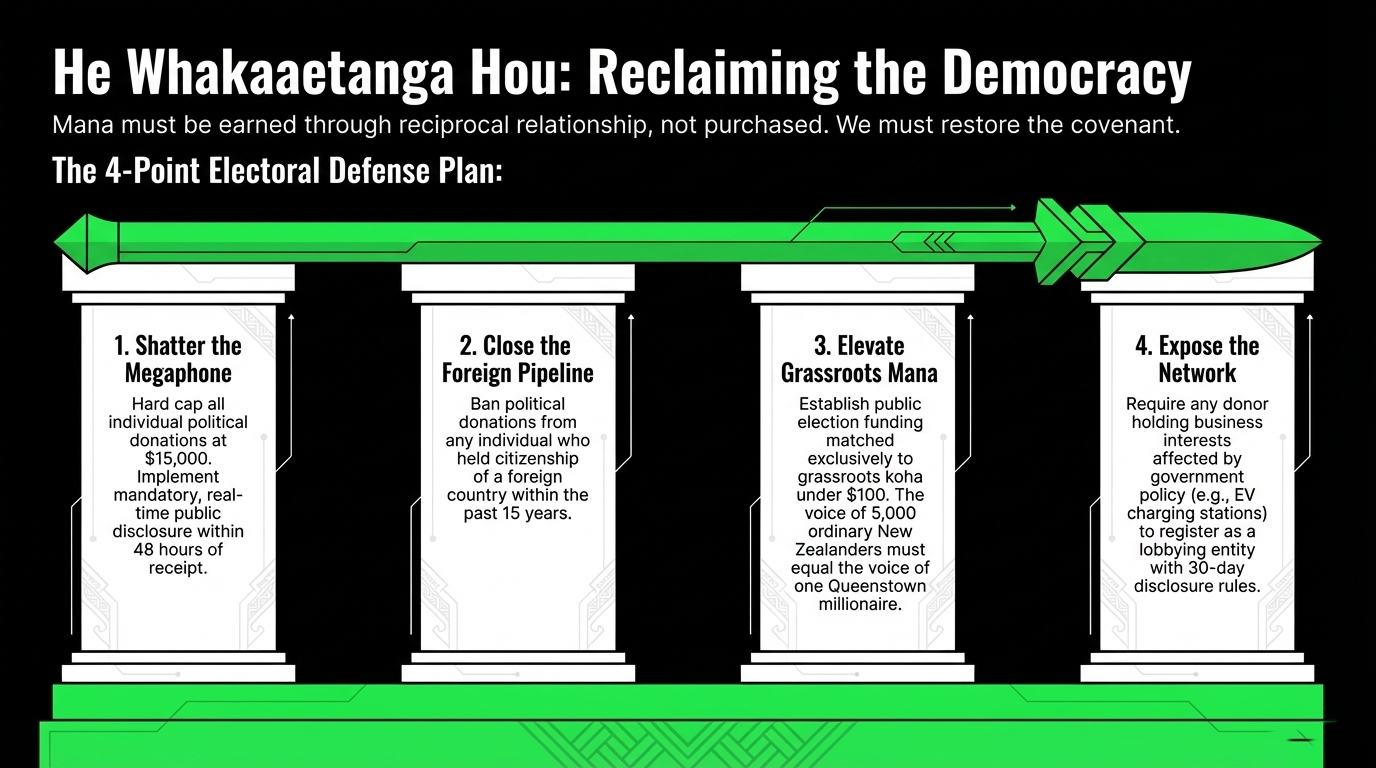
Solution: Cap individual political donations at $15,000. Require real-time public disclosure within 48 hours of receipt. Ban donations from individuals who held citizenship of a foreign country within the past 15 years.
Example Two: The Cocos Islands Playbook, Repeated Here on a Larger Stage
When Cartmell built his domain empire on 600 Pacific Islanders' territorial identity, he extracted value from a community with no power to negotiate. As RNZ reported, those islands received nothing from 400,000 domain registrations. He gave "technology and grants" — which is the colonial script for: I took the resource and returned a fraction as virtue.
Now consider: the coalition government he is funding has slashed Māori health infrastructure. The Public Service Association documented that "the Government must take the blame for forcing Health NZ Te Whatu Ora to make these reckless changes to fund tax cuts. Lives will be lost unless these cuts are stopped." Māori nursing leader Kerri Nuku, writing in Kaitiaki Magazine, confirmed that "tāngata whenua have faced generations of systemic racism in the health sector" and that the coalition's legislative agenda means "Māori will not get the chance to live longer and the same as non-Māori." Cartmell simultaneously donates to Starship Hospital — which is good, full stop — while funding the political machine dismantling the systemic Māori health infrastructure.
For the Western mind: a tobacco company that funds a children's cancer ward while lobbying against smoking regulations. The charity launders the harm. The donation launders the agenda.
Tikanga impact: In tikanga, kaitiakitanga — guardianship — is not extractive. A kaitiaki does not take from the land, monetise it, and offer back a "grant." Cartmell's pattern of extraction-then-charity mirrors the Crown's pattern exactly: take the land, offer the school. Take sovereignty, offer "consultation." The structure of harm is identical. It has merely acquired a new vehicle.
Solution: Any political donor who simultaneously holds business interests affected by government policy must be required to register as a lobbying entity and disclose all policy interactions within 30 days.
Example Three: The $750,000 Disparity Is Democracy's Death Rattle
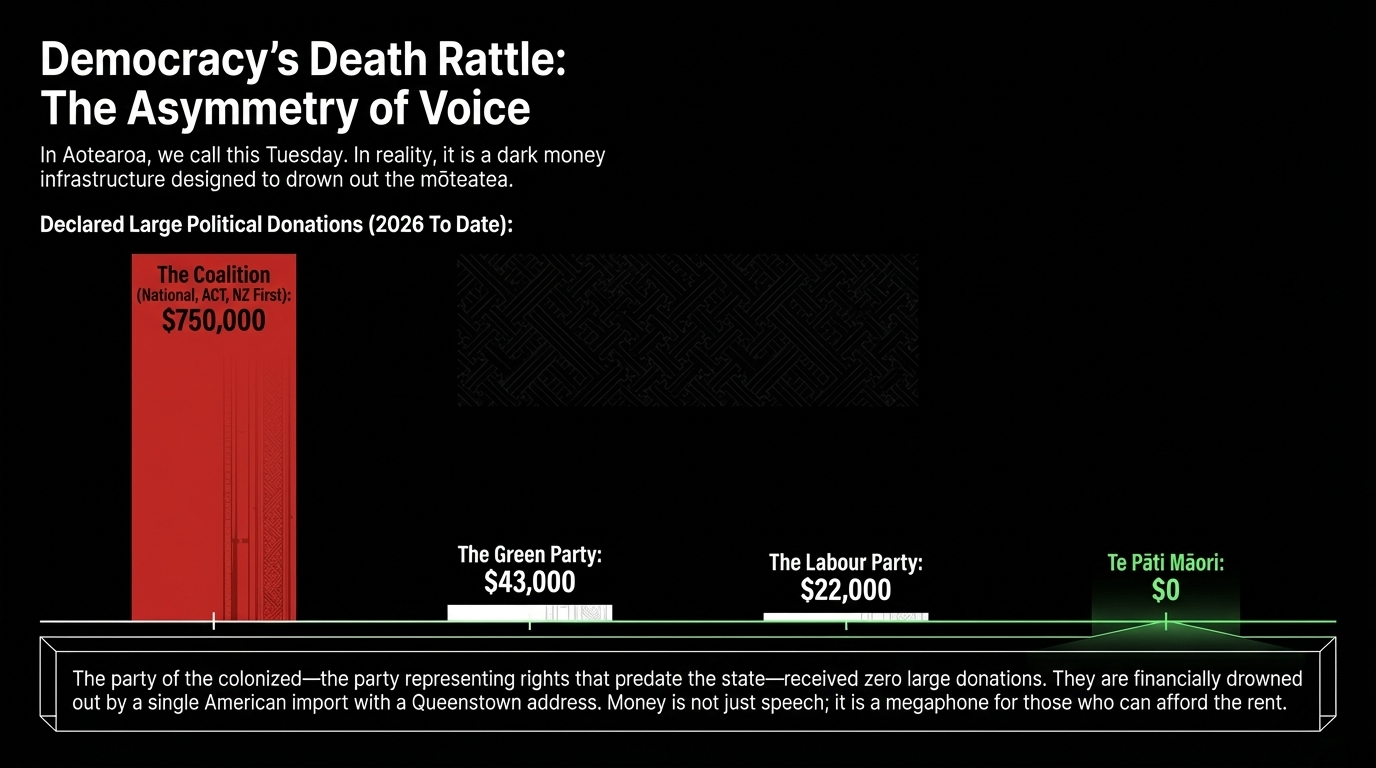
The Electoral Commission data is unambiguous. Coalition parties received $750,000 in declared large donations in 2026: National $250,000, ACT $350,000, NZ First $150,000. The Greens received $43,000. Labour received $22,000. Te Pāti Māori — the party that most directly represents Māori rangatiratanga, the party of the people who hold Treaty rights that predate the New Zealand state — received zero declared large donations in this cycle. The party of the colonised is financially drowned out by a single American import with a Queenstown address and a Silicon Valley memory.
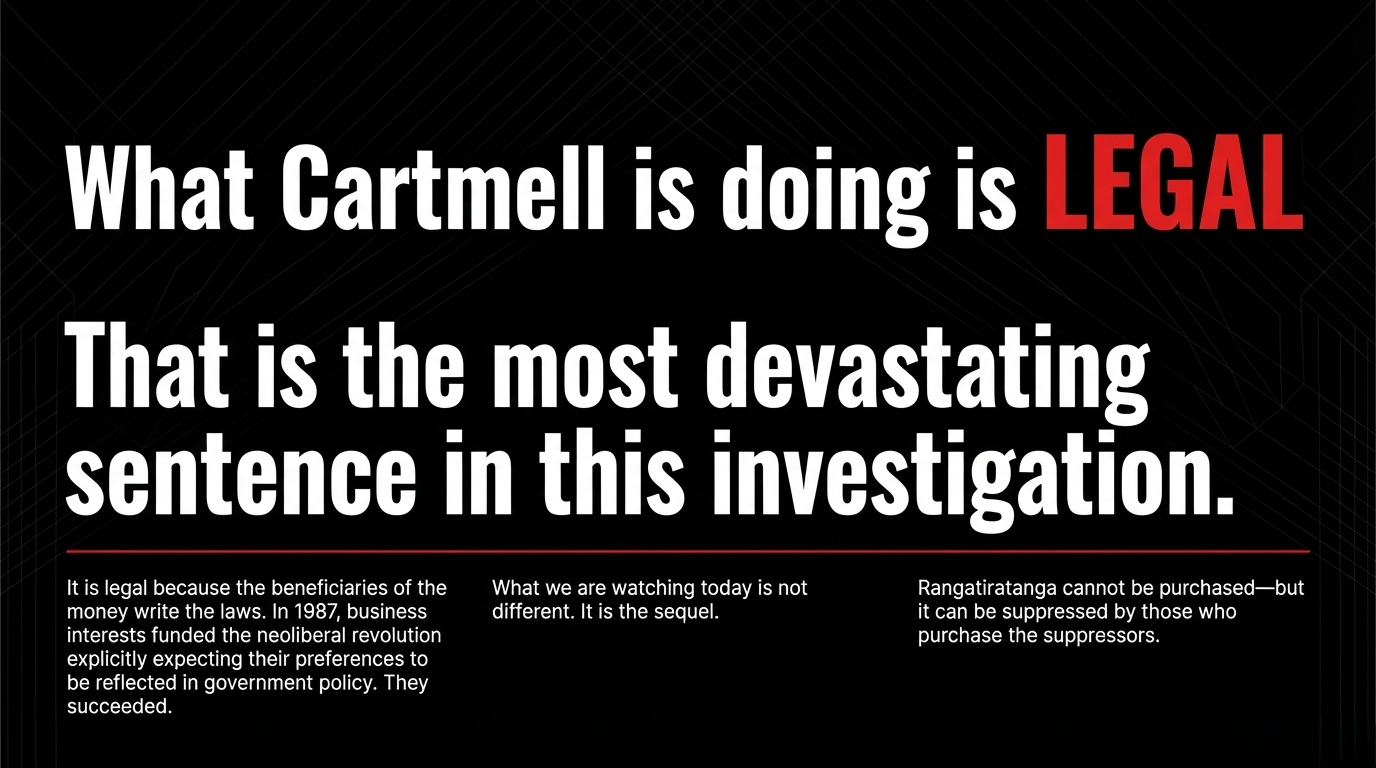
For the Western mind: in the United States, this is called "dark money infrastructure." In Aotearoa, we call it Tuesday. As researchers documented in the New Zealand Journal of Sociology, business donors making substantial donations to political parties in 1987 explicitly expected their preferences "reflected in the policy positions that Government adopt" — and they were. The neoliberal revolution of the 1980s was a purchased revolution. What we are watching now is not different. It is the sequel.
Tikanga impact: Mana — authority and integrity — must be earned through reciprocal relationship, not purchased. The mana of a democracy is annihilated when access to power can be bought. Under tikanga, a rangatira who accepts utu in exchange for decisions that harm their iwi has violated their covenant with their people. What Cartmell is doing is not illegal under current NZ law. That sentence is the indictment of current NZ law.
Solution: Public election funding matched to grassroots donations under $100, so that the voice of 5,000 ordinary New Zealanders equals the voice of one Queenstown tech millionaire who made his first fortune on Pacific digital extraction.
Ngā Hononga Huna — Five Hidden Connections (All Verified)
These are not allegations. These are documented intersections, all verifiable through public records.
1. Cartmell → Invisible Urban Charging → Jake Bezzant (Former National Party Candidate)
As RNZ confirmed and Bryce Edwards' analysis verified, Cartmell holds a shareholding in Invisible Urban Charging, co-founded by former National Party candidate Jake Bezzant. He then donates six figures to National. The circle is not merely round — it is profitable. A shareholder in a company co-founded by a National candidate is simultaneously a major National donor. In any serious democracy with functional disclosure laws, this relationship would require mandatory registration as a conflict of interest.
2. Cartmell → Cocos Islands → Pacific Extraction → Aotearoa Political Funding
A man who extracted market value from a Pacific community's territorial digital identity now funds parties that are stripping Indigenous territorial rights in Aotearoa through the Treaty Principles Bill, the Regulatory Standards Bill, the dismantling of the Māori Health Authority, and the reversal of co-governance. The commodity has changed. The extraction logic has not shifted one millimetre.
3. Cartmell → Opportunity Party → Iain Lees-Galloway (Former Labour Minister)
The former Labour Cabinet Minister turned Opportunity Party general manager openly celebrated Cartmell's $100,000 injection, telling RNZ it "makes a huge difference to us to be able to get our message out." A party without parliamentary resources is now financially dependent on a single Silicon Valley donor. The man who helped run a Labour government has handed Cartmell the keys to his party's amplifier. This is not democratic renewal. This is a startup acquisition.
4. Cartmell → Coinbase → Kraken → Zcash → Crypto Libertarian Pipeline
According to his own biography, Cartmell participated in the first funding rounds of Coinbase, Kraken, and Zcash — the exact infrastructure of a libertarian, anti-state, anti-regulatory worldview that believes autonomous systems should operate "without the gatekeeping of traditional banking." The NZ Entrepreneur Magazine confirmed his role as investor in NZ Bitcoin startup ecosystem. This is the same ideological ecosystem that produced Peter Thiel, funded Atlas Network affiliates globally, and underpins ACT's classical liberal, deregulatory policy agenda. As this publication's Atlas Network investigation documented, these are not disconnected ideological currents — they are the same river, wearing different shirts in different countries.
5. The Donation Asymmetry → Māori Political Silencing
$750,000 to coalition. $43,000 to Greens. $22,000 to Labour. $0 to Te Pāti Māori. The parties most likely to restore co-governance, honour Treaty obligations, and rebuild Māori health infrastructure are structurally bankrupted by this donation landscape. As 1News documented, the wave of law changes in 2025 alone saw "a decrease in public sector obligations and targeted initiatives that support Māori rights, development and wellbeing" spanning social services, marine and coastal rights, and education. Money is not just speech in this system. It is a megaphone that drowns the mōteatea.
He Aha Te Tikanga? — Why These Parties?
Cartmell's choice of coalition parties is not arbitrary sentiment. It is structural alignment.
He gave ACT $200,000 because ACT's libertarian, anti-state ideology is the closest available approximation to the Silicon Valley worldview that formed him — a world where regulation is friction, the state is an obstacle, and the market is the only legitimate arbiter of value. ACT's David Seymour was still insisting at Waitangi 2026 that the defeat of the Treaty Principles Bill was "a pirate victory" — signalling the battle was not over. Cartmell's $200,000 is the war chest for the next assault.
He gave National its share because National delivers the economic management — the tax structures, the regulatory environment, the government spending priorities — that protect and grow the wealth of people exactly like Brian Cartmell. The coalition's Q4 Action Plan and its "Going for Growth" agenda, including the $231 million Institute for Advanced Technology, is a direct subsidy to the class of tech investor Cartmell represents.
He gave NZ First its share because Winston Peters is insurance. Peters suppresses Māori political momentum through nationalist populism, fulfilling the coalition's need to keep Māori aspiration contained without ACT having to hold all the aggression alone. As Labour's Chris Hipkins noted, this government week after week "has seen Māori unfairly targeted" — and Peters is the mechanism that normalises that targeting as "democracy" rather than structural racism.
He funded Opportunity because ideological seed-planting is a long game. If an idea doesn't win this election cycle, it can be positioned for the next. This is how neoliberalism survived the 1990s backlash. This is how it always survives.
Ngā Tuhinga o Mua — Previous Investigations by The Māori Green Lantern
This exposé does not stand alone in isolation. The Māori Green Lantern has been tracing this whakapapa for months. Read the full archive:
- The Honey Trap Whakapapa: How an Israeli Billion-Dollar Blackmail Machine Weaponised Philanthropy — Documented how foreign-funded political influence operations, disguised as philanthropy, mirror Crown strategies used against Māori for 185 years. The same architecture of "charitable giving" that funds Atlas Network partners funding ACT is the same architecture Cartmell is operating within.
- The Great Purge: How Neoliberal Ideologues Are Gutting Public Services — Documented the systematic defunding of Māori-serving institutions under this coalition. Cartmell is not funding these parties in spite of this agenda. He is funding them because of this agenda.
- The Māori Revolution: Te Pāti Māori's Unstoppable Rise Exposes the Reckoning for Neoliberal New Zealand — Documented the grassroots financial powerlessness of Māori political representation versus the donor class that funds their opponents. The $750,000 versus $22,000 donation disparity is that essay's prophecy, now confirmed in Electoral Commission data.
Te Whakamutunga — He Never Needed to Stand for Parliament
Let us be absolutely clear about what has happened here, stated without euphemism and without apology.
A man who made his first fortune monetising Pacific communities' digital identities. A man whose ideological formation occurred in the same Silicon Valley ecosystem that produced Peter Thiel, crypto anarchism, and the Atlas Network infrastructure. A man who believes autonomous systems should operate "without the gatekeeping" of states or banks. This man gave half a million dollars — possibly more — to the three parties of a government that is, systematically and by design, dismantling the architecture of Māori rights in Aotearoa.
He did not need to stand for Parliament. He paid for people who would.
He says voters decide. He is right, in the way that a man who controls the loudspeaker is technically correct when he says the crowd is free to shout.
What Cartmell is doing is legal. That is the most devastating sentence in this essay. It is legal because the people who would change the law are the people he is paying. As researchers into the suppression of early neoliberal dissent in Aotearoa documented, business interests making substantial donations to parties have always expected to see their preferences "reflected in the policy positions that Government adopt." That was 1987. Nothing has changed except the amounts and the public relations strategy.
Rangatiratanga cannot be purchased — but it can be suppressed by those who purchase the suppressors. Every ACT policy targeting Treaty obligations, every National budget cutting Māori health infrastructure, every NZ First dog-whistle about co-governance — these are not coincidences. They are the returns on an investment. In plain arithmetic. In broad daylight. With legal protection.
Ko te pātai: Who speaks for the 600 Cocos Islanders who received nothing? Who speaks for the Māori communities whose co-governance was legislated away by the parties this man funds? Who speaks when the donor class buys the silence of those who are supposed to speak?
The Māori Green Lantern does. That is why this mahi exists. That is why it will not stop.

Ivor Jones The Māori Green Lantern Fighting Misinformation And Disinformation From The Far Right | 13 March 2026
© The Māori Green Lantern 2026. All rights reserved. Reproduction with attribution welcomed for non-commercial use.