“The Theatre of Accountability” - 26 August 2025
Dirty Deeds Done Dirt Cheap - When the Minister's "Quick and Dirty" Data Reveals a Rotten System
Tēnā koutou katoa (Greetings to you all).
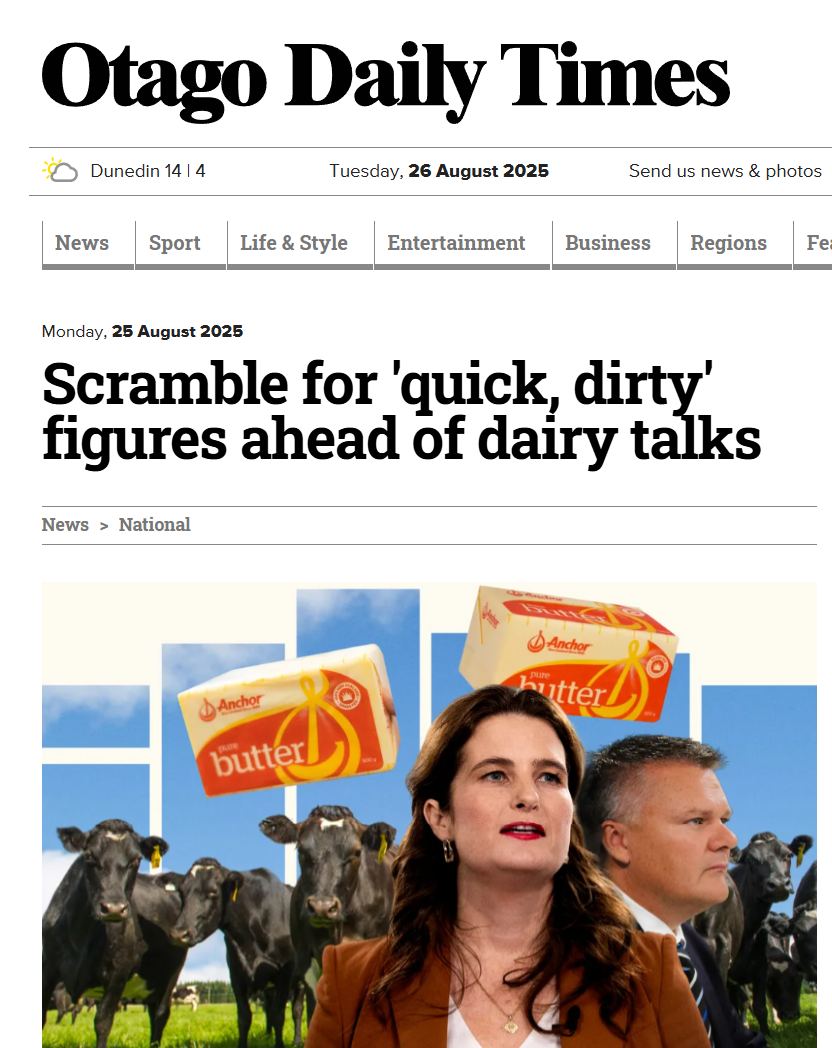
When governments scramble for "quick and dirty" figures mere hours before meetings with corporate giants, we witness not incompetence but theatre—a performance designed to obscure the reality that our ministers already know exactly where their loyalties lie.
The Charade of Ignorance When Expertise Runs Deep
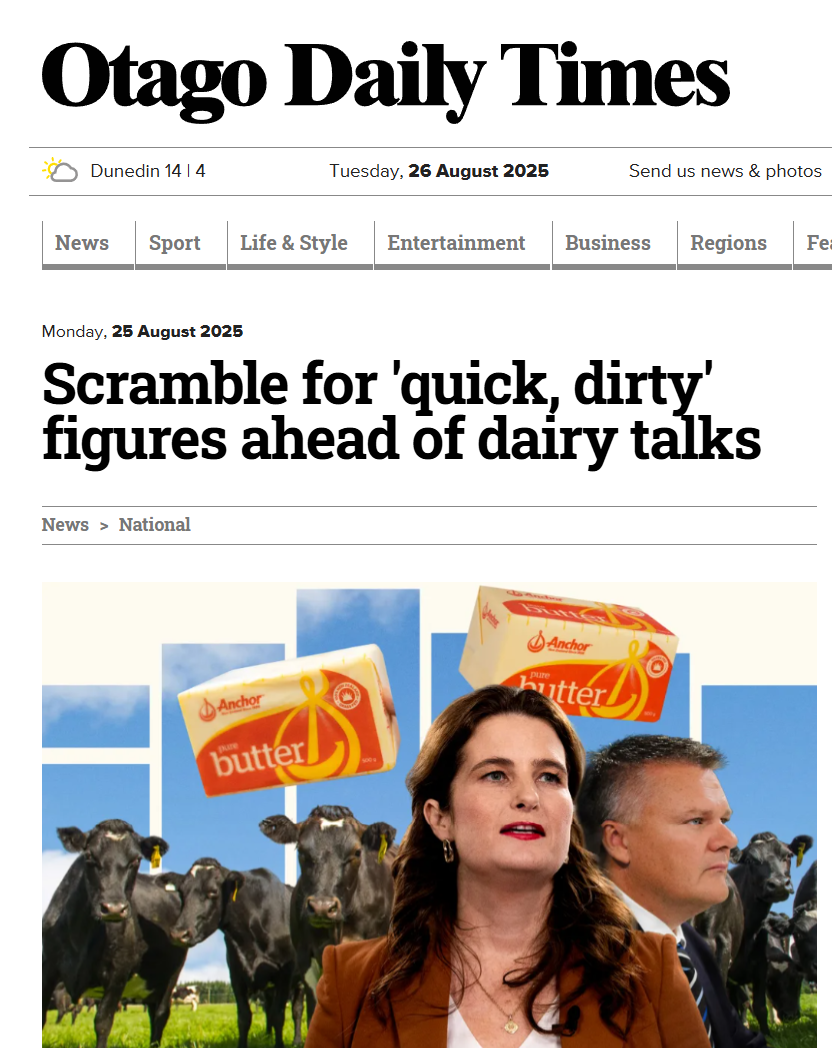
The documents released under the Official Information Act expose something far more sinister than ministerial incompetence regarding dairy pricing. Finance Minister Nicola Willis' frantic last-minute requests for international dairy price comparisons just hours before meeting Fonterra CEO Miles Hurrell reveal a calculated performance designed to maintain plausible deniability while serving corporate interests.
The manufactured urgency is telling. On July 21, Willis' private secretary John Creech pressed MBIE officials for "some facts and figures... so that the Minister has solid info," requesting price comparisons between New Zealand and Australia with "quantitative info if possible". By the following morning, this became desperate: "Looks like the minister will need something in hand about this by the time she goes to Caucus this morning (10am). Can you please get me whatever you can in an hour (by 9:40am)?"
This theatrical scramble becomes obscene when we understand Willis' background. She worked at Fonterra for six years from 2012-2018, rising from a government relations role to Director of Global Stakeholder Affairs, then General Manager of Nutrient Management. She was literally the person responsible for Fonterra's trade strategy and government relationships. The notion that she needed "quick and dirty" figures about dairy pricing is as believable as a poacher claiming ignorance about where the rabbits live.
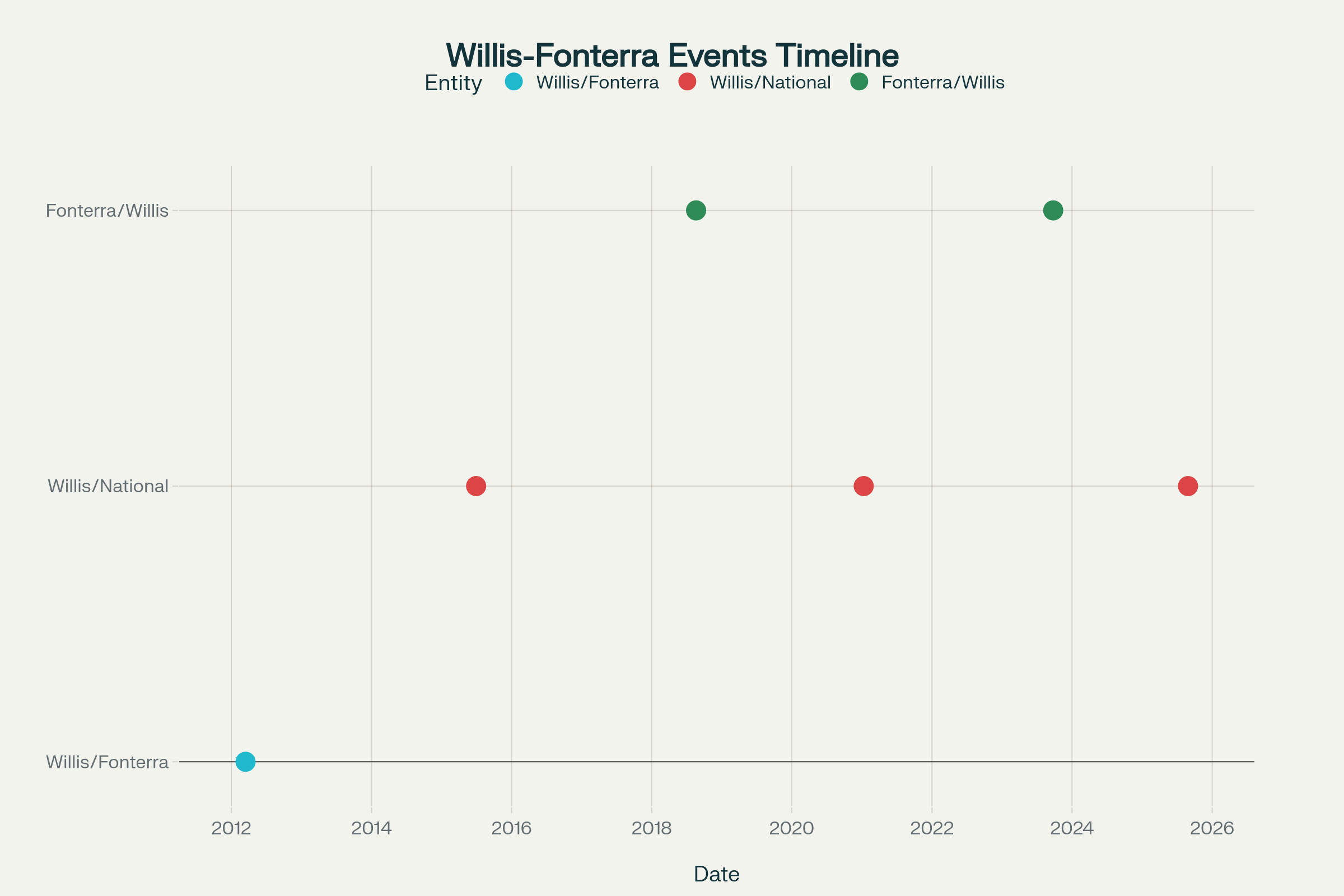
Timeline of Nicola Willis-Fonterra connections revealing the revolving door between dairy industry and government
Background: The Revolving Door's Perfect Spin
The dairy industry's capture of New Zealand's political system represents colonisation's modern face—corporate colonisation. Fonterra, controlling 78-80 percent of New Zealand's milk supply, operates as what international observers have described as a "cartel". This near-monopoly exists not through natural market forces but through government legislation—the Dairy Industry Restructuring Act 2001—that created Fonterra while implementing token regulatory constraints.
Willis embodies the revolving door between corporate power and political authority that characterises our captured state. After serving as a senior advisor to Prime Minister John Key, she joined Fonterra in 2012 specifically in a "lobbyist role". Her trajectory through Fonterra's ranks—from government relations to directing global stakeholder affairs to managing nutrient policy—provided her with intimate knowledge of how New Zealand's dairy monopoly operates both domestically and internationally.
When Willis entered Parliament in 2018, she brought with her not just expertise but allegiances. Her appointment as Finance Minister in 2023 placed a former Fonterra executive in charge of economic policy, creating a direct pipeline from corporate boardroom to cabinet room. This represents the maturation of neoliberal capture—where the distinction between regulator and regulated dissolves entirely.
Theatre of the Absurd Meets Corporate Capture
The July 2025 meeting between Willis and Fonterra CEO Miles Hurrell exposes how our political system has become pure performance art. The meeting was requested by Fonterra on June 19 to discuss "financial outlook and planned consumer divestment". By July 14, Willis' office confirmed she would "discuss retail diary [sic] pricing in New Zealand"—the typo itself suggesting the casual nature of what should be rigorous economic oversight.
The "quick and dirty" data scramble that followed reveals multiple layers of deception. MBIE officials, given impossible timeframes, cobbled together price comparisons they themselves described as "not the most scientific" and cautioned had "not been robustly verified". Senior policy adviser Andrew Palmer warned: "Our feel... is that milk is more expensive in NZ," but added the work was "quite quick and dirty".
This manufactured incompetence serves a purpose. By creating artificial urgency and relying on inadequate data, Willis could claim she was "seeking information" rather than coordinating with former colleagues. The theatricality provides cover for what is essentially regulatory capture in action—a minister with deep industry ties meeting with industry leaders while maintaining the pretense of objective oversight.
The timing proves crucial. Fonterra announced its $3.8 billion sale of consumer brands to French company Lactalis shortly after this meeting. This represents one of New Zealand's largest corporate transactions, transferring iconic brands like Anchor and Mainland to foreign ownership. The proximity of Willis' meeting to this announcement suggests coordination rather than coincidence.
The Whakapapa of Capture: How Māori Values Expose Colonial Economics
From te ao Māori, we understand whakapapa—the interconnectedness of all relationships. The Willis-Fonterra relationship demonstrates how colonial capitalism creates whakapapa of exploitation, where corporate interests and political power become indistinguishable whānau serving the same ancestors of extraction.
Manaakitanga demands we care for all people, yet New Zealand dairy prices are 30 percent higher than the OECD average, forcing whānau to choose between basic nutrition and other necessities. When Willis claims she doesn't believe New Zealanders are getting "a raw deal" on butter, she reveals how her corporate whakapapa overrides her obligations to the people she claims to serve.
Kaitiakitanga requires stewardship of resources for future generations. Instead, we witness the foreign sale of assets built by generations of New Zealand farmers, with Lactalis paying $3.8 billion for brands that will continue using New Zealand milk while profits flow overseas. This represents colonisation's logical endpoint—where even the companies that colonised Māori land are themselves colonised by foreign capital.
Rangatiratanga demands self-determination, yet Fonterra operates under legislation that grants it monopoly power while requiring only token competition. The Dairy Industry Restructuring Act forces Fonterra to make only 3 percent of its milk available to competitors at cost, ensuring competition remains theatrical rather than genuine.
The Performance of Democratic Process
The Willis-Fonterra meeting exemplifies how neoliberal democracy functions as elaborate theatre where predetermined outcomes are wrapped in the language of consultation and oversight. Willis could easily have obtained dairy pricing information from her six years of industry experience or through routine ministerial briefings. Instead, she orchestrated a frantic information-gathering exercise that created the appearance of due diligence while ensuring the data would be inadequate for genuine analysis.
Consider the absurdity: MBIE officials scrambling to provide price comparisons to a minister who previously managed Fonterra's global stakeholder affairs. It's equivalent to asking a former All Blacks captain to explain the rules of rugby—except this performance serves to obscure rather than educate.
The "quick and dirty" nature of the data becomes strategically useful. Poor-quality information provides perfect cover for policy decisions that favor corporate interests. When challenged on dairy pricing, Willis can point to the MBIE briefings as evidence she "sought expert advice," while the inadequate quality of that advice ensures it won't constrain her preferred outcomes.
This pattern extends beyond Willis personally. MBIE, the ministry providing this "quick and dirty" data, spends nearly $100 million annually on contractors and consultants, often to external firms with their own industry connections. The revolving door operates at every level, ensuring that supposedly independent advice comes from the same network of corporate interests.
Following the Money: How Regulatory Capture Pays
The Commerce Commission's annual reviews of Fonterra's milk pricing reveal regulatory theatre at its finest. Despite identifying problems with Fonterra's cost calculations—including finding that Fonterra's risk estimates are "too low," resulting in higher milk prices than competitors would calculate—the Commission consistently concludes that Fonterra's pricing is "likely to be consistent with" legislation.
This regulatory capture extends to the oversight mechanisms themselves. The Milk Price Panel that supposedly provides independent oversight of Fonterra's pricing includes a chair that was "Fonterra-promoted" despite legislation requiring "full independence". When the regulator's supposedly independent oversight is staffed by industry appointees, we witness capture so complete it doesn't even bother hiding.
The Lactalis sale demonstrates how this captured system serves foreign corporate interests over domestic ones. Fonterra's sale of its consumer brands to the French multinational for $3.8 billion will generate a $3.2 billion tax-free windfall for Fonterra shareholders—a massive wealth transfer that occurs while ordinary New Zealanders pay some of the world's highest dairy prices.
The timing reveals the coordination. Fonterra approached Willis in June about its "planned consumer divestment". The theatrical July meeting provided political cover for a predetermined outcome. By August, the Lactalis sale was announced as fait accompli. The sequence suggests not consultation but coordination—a choreographed transfer of New Zealand assets to foreign ownership with government blessing.
The Colonial Logic of Free Market Fundamentalism
Willis' response to butter pricing concerns perfectly encapsulates neoliberal ideology's colonial logic. Rather than addressing Fonterra's monopoly pricing power, she focuses on "supermarket competition" as "the most powerful lever that the government has". This deflects attention from the dairy monopoly to retail competition—treating symptoms while protecting the disease.
The supermarket competition narrative serves multiple colonial functions. First, it individualizes a structural problem—suggesting that if consumers just had more shopping choices, monopoly pricing would somehow resolve itself. Second, it protects Fonterra from scrutiny by redirecting analysis to retailers who have limited power over commodity pricing. Third, it maintains the fiction that market solutions exist for market failures caused by monopolization.
Willis' declaration that she doesn't believe New Zealanders are getting "a raw deal" demonstrates how corporate capture distorts perception itself. When someone who spent six years inside Fonterra claims that New Zealanders paying 30 percent more than the OECD average isn't exploitation, we witness ideological capture so complete it resembles Stockholm syndrome.
The foreign sale to Lactalis reveals the logical endpoint of this captured system. New Zealand's dairy resources, developed over generations, will now generate profits for French shareholders while New Zealand consumers continue paying monopoly prices. This represents colonisation's perfection—where colonizers become colonized, and the extraction continues under new management.
Implications: When Theatre Becomes Governance
The Willis-Fonterra episode illuminates how democratic institutions become vehicles for corporate interests while maintaining the appearance of public accountability. The "quick and dirty" data scramble wasn't bureaucratic failure but sophisticated political management—creating plausible deniability for predetermined outcomes.
For Māori communities already bearing the costs of colonial extraction, this captured system represents another layer of dispossession. High food prices disproportionately impact whānau with lower incomes, while the wealth generated by dairy monopolization flows to predominantly Pākehā shareholders and now foreign owners. The regulatory system that should protect consumers instead protects corporate profits, using the language of competition and efficiency to mask extraction and exploitation.
The broader pattern extends well beyond dairy pricing. When ministers with industry backgrounds meet with former colleagues while maintaining the fiction of objective oversight, we see how neoliberal governance operates as elaborate performance art. The forms of democratic process remain—meetings, briefings, official statements—while the substance serves corporate rather than public interests.
Young Māori watching this theatre should understand that it reveals the system working exactly as designed. The revolving door between corporate and political power isn't corruption—it's the system's normal operation. The "quick and dirty" data wasn't inadequate preparation—it was strategic theatre ensuring predetermined outcomes while maintaining democratic appearances.

The Māori Green Lantern fighting misinformation and disinformation from the far right
Reclaiming Truth from Performance
The Willis-Fonterra meeting exposes how regulatory capture operates through performance rather than coercion. When former industry executives become ministers, they don't need to be bought—they're already sold. When oversight bodies are staffed with industry appointees, they don't need to be corrupted—they're already captured. When data is deliberately kept "quick and dirty," it's not incompetence—it's strategy.
Māori values offer a path beyond this captured system. Manaakitanga demands we prioritize people's wellbeing over corporate profits. Kaitiakitanga requires protecting resources for future generations rather than selling them to foreign corporations. Rangatiratanga insists on genuine self-determination rather than the theatre of consultation.
The dairy pricing controversy reveals not policy failure but system success—a neoliberal state operating exactly as intended, serving corporate interests while maintaining democratic appearances. Until we understand this distinction, we'll continue demanding better performance from a system designed to perform rather than serve.
For those who find value in this analysis, please consider supporting this kaupapa with a koha to bank account 03-1546-0415173-000. In these challenging times, please only contribute if you have the capacity and desire to do so.
Mauri ora - may we find the strength to see through the performance and create systems that serve people rather than profits.
Nāku,
Ivor Jones - The Māori Green Lantern