“The Theatre of Empty Hands: Barbara Edmonds and the Neoliberal Art of Demanding Everything While Offering Nothing” - 17 December 2025
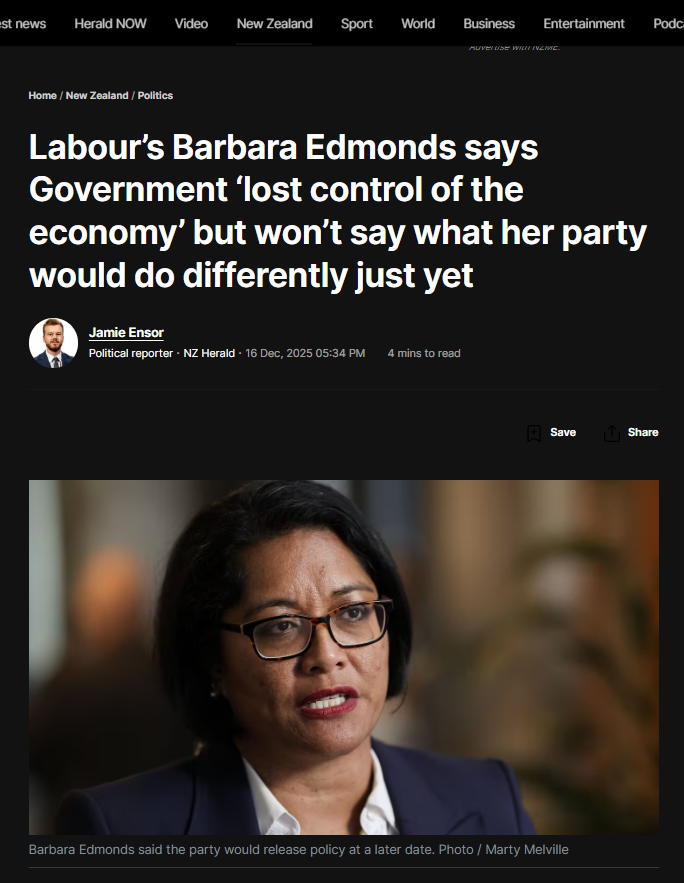
When Labour’s finance spokesperson Barbara Edmonds declared on 16 December 2025 that
“the Government have lost control of the economy,”
she performed a masterclass in opposition politics’ most cynical art:
the drive-by critique. When pressed repeatedly by journalists to name even one immediate action Labour would take to improve the books, she responded with the same hollow refrain:
“We’ll set out our fiscal plan in the next year.”
This is not accountability. This is theatre. Empty, performative, mauri-depleting theatre that insults the intelligence of every whānau struggling to pay rent, every worker whose wages haven’t kept pace with inflation, every community watching services evaporate while politicians play games.
The Anatomy of Duplicity
Let me be clear about what Edmonds did in that press conference following Treasury’s Half-Year Economic and Fiscal Update.
She pinpointed data showing economic worsening:
higher unemployment forecasts, the surplus pushed out again, net debt rising as a proportion of GDP.
She told Finance Minister Nicola Willis to “look in the mirror” and “take some responsibility.”
Yet when asked what Labour would cut, Edmonds deflected:
“Today is about the Government’s books.”
When asked for immediate actions Labour would take, she repeated her scripted non-answer. When asked about Labour’s economic strategy, she offered platitudes:
“trying to grow a New Zealand where New Zealand families want to stay here.”
This is the quintessence of neoliberal opposition politics—criticize everything, propose nothing, maintain electability through studied vagueness. It reveals Labour’s fundamental dishonesty: they want to be seen as holding the government accountable while refusing to be held accountable themselves for offering any alternative vision.
The Whakapapa of Political Cowardice
Barbara Edmonds has impressive credentials:
born to Samoan immigrants in 1981, raised by her father after her mother’s death when she was four, specialist tax lawyer, adviser to both National and Labour revenue ministers, mother of eight children. She worked as a secondee from IRD to Michael Woodhouse and Judith Collins, then as ministerial adviser to Stuart Nash, gaining deep expertise in tax policy, firearms reforms, and Covid response packages.
Yet this formidable background makes her performance on 16 December 2025 even more damning. This is not a rookie MP stumbling through their first press conference. This is Labour’s finance spokesperson—appointed in February 2024 to replace Grant Robertson, the person who could be New Zealand’s next Finance Minister—deliberately choosing to critique without offering alternatives.
The forensic tax lawyer who helped shape firearms legislation after the Christchurch attacks suddenly cannot name one spending cut she would make? The ministerial adviser who negotiated Covid tax relief packages cannot identify one immediate fiscal action? This is not incapacity. This is calculation.
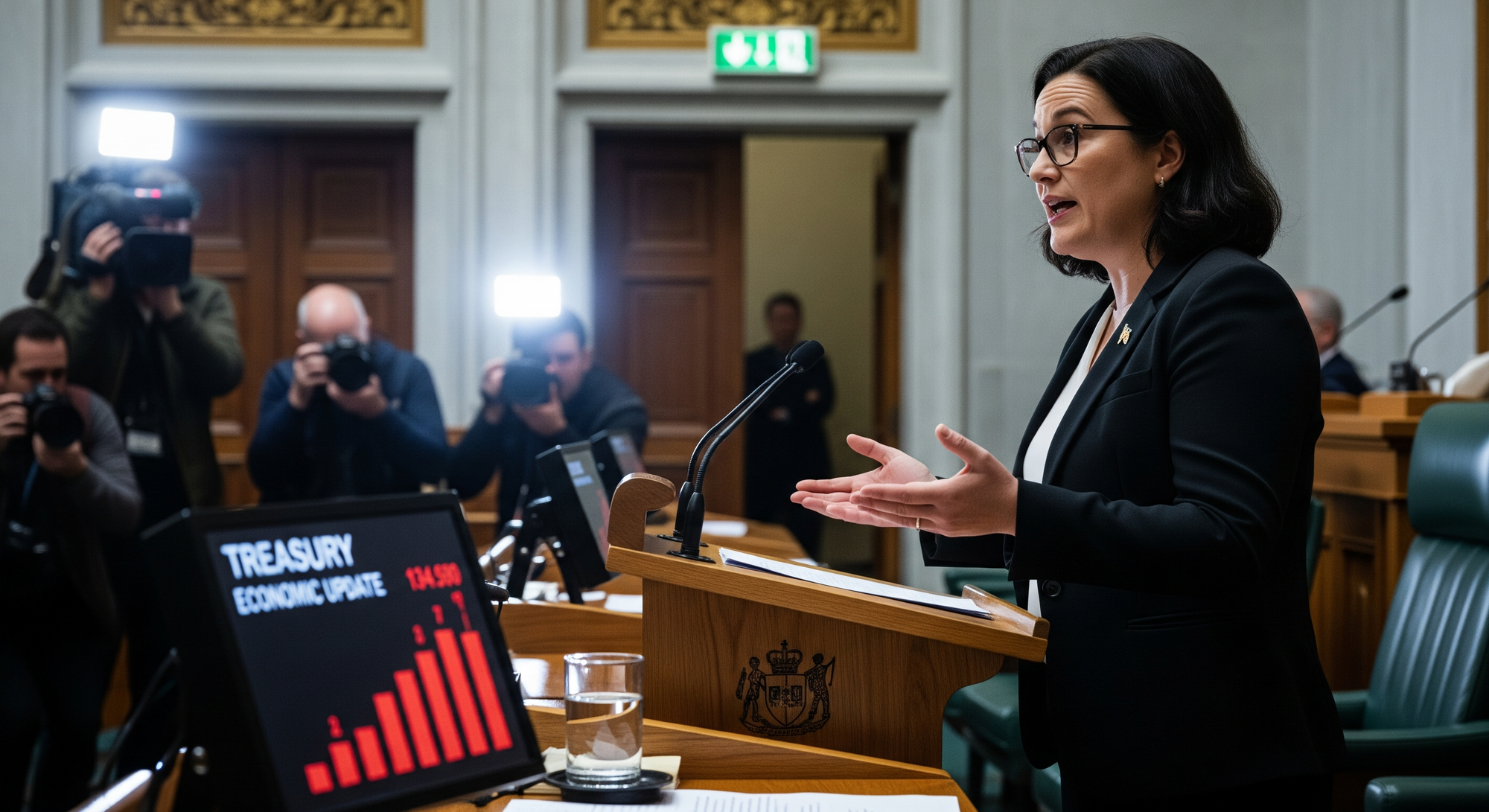
The Theatre of Empty Hands
Cui Bono? Who Benefits from This Duplicity?
Follow the incentives. Opposition parties in Westminster systems face a strategic dilemma:
voters expect them to challenge government and present alternatives, yet research shows that opposition parties without governing potential often wait for government to “hang itself” rather than demonstrate fitness for office.
Edmonds’ refusal to specify alternatives serves multiple neoliberal interests:
1. Electoral Safety Through Vagueness: Labour avoids giving National ammunition for attack ads. Chris Hipkins admitted Labour didn’t have “the runway” to sell major tax changes before the 2023 election—so they ruled out capital gains and wealth taxes, contributing to their loss of credibility with voters wanting substantive alternatives.
2. Business Appeasement: CEOs surveyed in the 2025 Mood of the Boardroom gave Edmonds the highest opposition rating (3.2/5), but only 53% saw her as credible, with “growing impatience for detail.” By refusing specifics, Labour signals to capital: we won’t rock the boat too hard.
3. Coalition Flexibility: Keeping alternatives vague preserves Labour’s ability to negotiate with Greens and Te Pāti Māori post-election without being locked into specific commitments that might alienate coalition partners or centrist voters.
4. Avoiding Scrutiny: Once Labour releases detailed fiscal plans, those plans become subject to the same forensic analysis they currently direct at National. Better to criticize from the safety of opposition than defend actual proposals.
The Pattern: Labour’s History of Fiscal Cowardice
This is not new. In October 2024, Edmonds was asked about Labour’s fiscal policy targets and gave “few details,” admitting she hadn’t even read the Greens’ alternative budget. In June 2025, she was “coy on capital gains tax” while railing against “unfair” elements of the tax system, refusing to commit to CGT as a solution.
When Labour finally announced a capital gains tax policy in late October 2025, it was a “watered-down” version—28% on commercial and investment property only, with exemptions for family homes, farms, KiwiSaver, shares, business assets, and inheritances. “Nine out of ten New Zealanders won’t pay a cent,” Edmonds declared.
This is neoliberalism in opposition clothing:
design policy so narrow it won’t meaningfully redistribute wealth, then claim boldness for proposing it. The revenue is ring-fenced for healthcare funding, continuing Labour’s incrementalist approach that leaves structural inequality untouched.
At Labour’s November 2025 conference, Edmonds promised:
“I will never waiver in my commitment to fiscal responsibility.”
She spoke of “balancing the books,” “careful choices,” and refusing to “say yes to everything.”
This is Labour crouching low, eyeing 2026, talking of governing “like a household”—the same austerity rhetoric National uses, packaged as progressive prudence.

Fiscal Responsibility Theatre
The Māori Dimension: Where is Our Advocate?
As a wāhine of Samoan heritage, Edmonds has spoken movingly about her whakapapa, her journey with Gagana Samoa as her first language, and receiving the title of Matai in 2025. She carries significant cultural mana.
Yet where was this mana when the 2025 Budget cut over $750 million from Māori-focused funding? Where was the specific alternative to over $400 million stripped from Māori housing initiatives and pushed into generic pools? Where was the detailed counter-proposal when $36.1 million was taken from kaupapa Māori education settings?
Labour under Edmonds’ economic stewardship correctly notes that the Māori economy grew from $69 billion (2018) to $126 billion (2023), that Māori contribution to the economy rose from $17 billion to $32 billion. Labour’s conference featured speeches celebrating how “when Māori thrive, Aotearoa thrives.”
But when push comes to shove—when Treasury releases dire fiscal forecasts and journalists demand specifics—Edmonds retreats to “we’ll release our plan next year.” This is how neoliberalism uses Māori success stories for political capital while refusing to commit resources to sustaining that success.
Five Hidden Connections Exposing the Duplicity
Connection 1: The Tax Expertise Dodge
Edmonds is a specialist tax lawyer who worked on complex tax policy across multiple governments. Her refusal to specify tax changes isn’t due to lack of expertise—it’s because of her expertise. She knows any detailed proposal will be forensically dissected, so she waits until the election campaign when scrutiny is compressed.
Connection 2: The Willis Mirror Image
Nicola Willis came to Finance Minister with limited experience—just 18 months as spokesperson—yet was criticized for refusing transparency on revenue estimates during the 2023 campaign, “relying on ‘trust us’ assertions.” Edmonds now employs the exact same playbook she would have criticized from opposition. Willis has accused Labour of “fiscal innumeracy”; Edmonds fires back without offering her own numbers. Both women are trapped in neoliberal opposition logic.
Connection 3: The CGT Backtrack
In April 2024, Hipkins put tax reform “back on the table” after ruling it out in 2023. By October 2025, Labour announced a CGT so narrow that property investors can still deduct interest expenses (Edmonds “can’t say” which deductions they’d allow). This reveals Labour’s pattern: propose change, then hollow it out to appease capital.
Connection 4: The Opposition Research Deficit
Research shows opposition parties need stronger research facilities to formulate credible alternatives. But Labour has been criticized for appearing “to lack visibility” and “simply looking for the Government to fall out of favour” rather than offering real alternatives. Edmonds’ refusal to engage substantively fits this pattern perfectly.
Connection 5: The Business Confidence Game
Edmonds told business leaders in September 2025 she’s “worried people are losing hope” and that “resentment can grow” when hard work doesn’t pay off. Yet her actual policy proposals remain vague enough to reassure business that Labour won’t fundamentally challenge the wealth extraction mechanisms causing that resentment. She criticizes “property speculation” while designing a CGT that changes almost nothing.
The Moral Bankruptcy of “Responsible Opposition”
Let me name what this is:
political cowardice dressed as strategic prudence.
It is the same neoliberal logic that has gutted communities for forty years—the logic that says fiscal responsibility means balancing budgets while families go hungry, that says we must wait for “the right time” to challenge inequality while wealth concentrates ever upward.
Edmonds promises that “responsibility must always come first,” that she’ll make “hard, careful choices,” that Labour “can’t say yes to everything.”
This is austerity rhetoric with a progressive paint job. As Hipkins admitted, “we won’t be able to” deliver everything people need.
Why not? Because Labour has internalized the neoliberal frame that government spending is inherently problematic, that debt is always dangerous, that “fiscal discipline” matters more than human dignity. Even as economist commentary notes that “tight monetary and fiscal policies” are “not helpful” for long-term prosperity and “hinder considerate debate of embedded structural economic problems,” Labour doubles down on promises to “balance the books.”
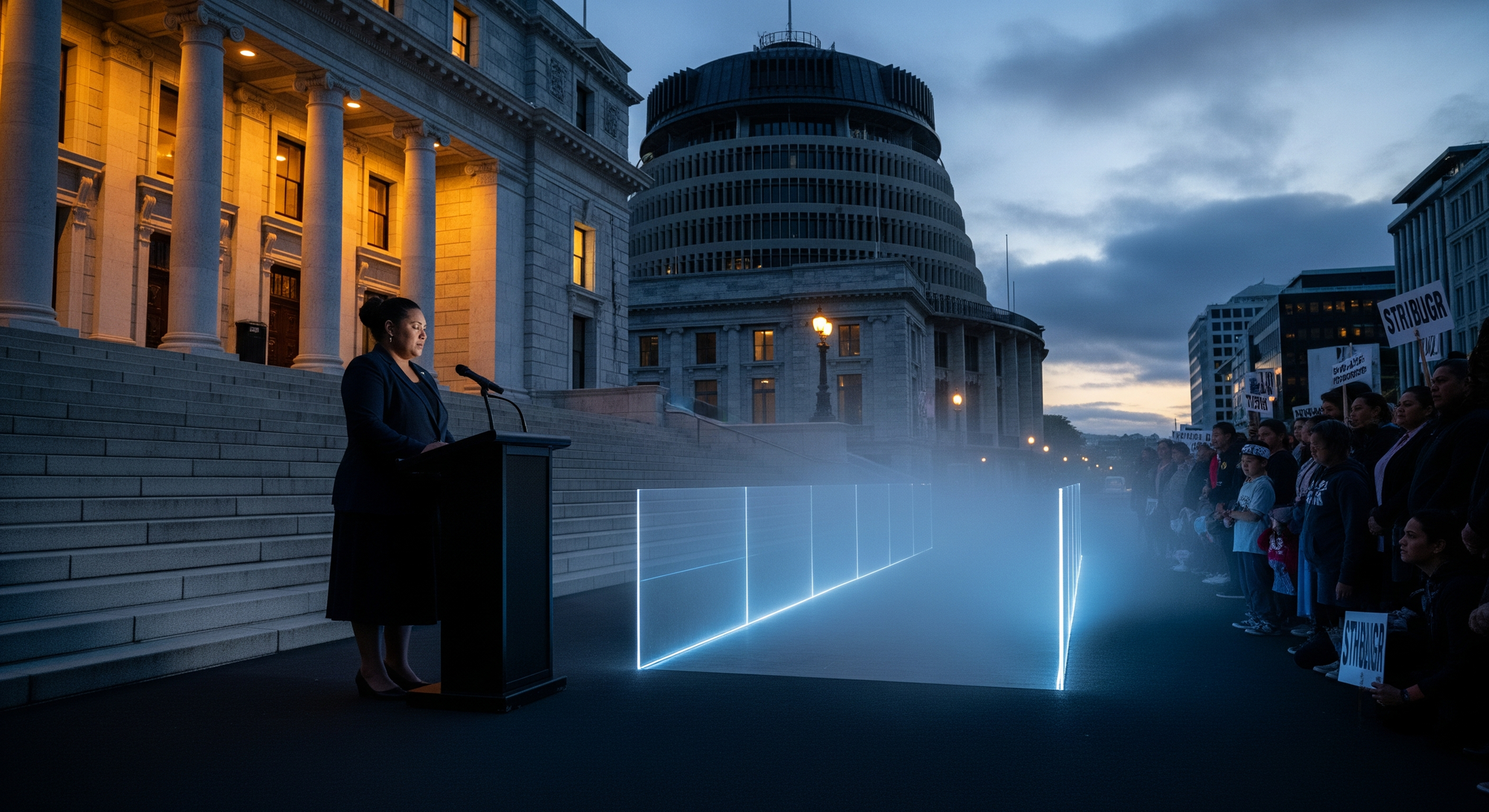
Neoliberal Opposition: The Bridge to Nowhere
What Accountability Actually Looks Like
Contrast Edmonds’ empty critique with what genuine opposition accountability would entail:
Real Alternative #1: “We would immediately reverse the tax cuts for highest earners, redirecting $X billion annually toward [specific programs]. Here’s the detailed modelling.”
Real Alternative #2: “We would impose a 2% wealth tax on assets over $5 million, estimated to raise $Y billion. We’ve consulted with [specific experts] who verify this approach.”
Real Alternative #3: “We would cut defence spending by $Z billion through [specific reductions], reallocating those funds to climate adaptation and Māori housing.”
These alternatives can be debated, costed, scrutinized. That’s the point. Democracy functions when competing visions are made explicit, not when opposition parties play tactical games of critique-without-alternatives.
Cui Malo: Who Is Harmed?
Every day Edmonds delays offering specific alternatives, these groups bear the cost:
- Whānau in emergency housing who need to know whether Labour will meaningfully reverse the $400M+ cuts to Māori housing
- Workers whose wages stagnate while Labour promises “careful choices” instead of wealth redistribution
- Communities facing climate disasters who need certainty about infrastructure investment, not vague Future Fund promises
- Tamariki in poverty who need specifics on benefit indexation, not rhetoric about “fiscal responsibility”
Willie Jackson noted correctly that over two budgets, over $1 billion in Māori-specific funding has been slashed. The appropriate response is not “we’ll tell you our plan later”—it’s detailed commitments now so iwi, hapū, and Māori organisations can plan.
The Path Forward: Demanding Substance
We must refuse to accept this neoliberal theatre. When opposition politicians like Edmonds critique without alternatives, we must name what they’re doing: they’re playing games while communities suffer.
Research on hypocrisy in politics warns that accusations of hypocrisy often “distract from the substance of the issue” and “seek to resolve the substance without engaging with it.” Edmonds’ hypocrisy—demanding accountability while refusing to be accountable—must be called out because it prevents substantive debate about alternatives to the failing neoliberal model.
Three Demands for Opposition Accountability:
1. Release Detailed Fiscal Plans Six Months Before Election
Not “a few weeks,” as is traditional—six months minimum so independent analysis can occur and voters can make informed choices.
2. Name Specific Cuts and Revenue Sources
No more “we’ll fund it through our fiscal plan.” Name the programs you’d cut, the revenue sources you’d tap, the trade-offs you’d make. Trust voters with complexity.
3. Commit to Treaty-Aligned Fiscal Policy
Labour celebrates Māori economic growth but won’t commit to reversing specific cuts. This violates partnership principles. Fiscal policy that ignores Te Tiriti obligations is fiscal policy that perpetuates colonization.
The Taiaha Demands Truth
Barbara Edmonds possesses formidable skills, impressive whakapapa, and the potential to be a transformative Finance Minister. But potential means nothing without courage. And courage means specificity—naming what you’ll do differently, defending those choices, accepting scrutiny.
When she stood before journalists on 16 December 2025 and refused to name even one immediate action Labour would take differently, she betrayed every whānau who needs to know whether Labour offers genuine alternatives or just slicker management of the same extractive system.
The HYEFU showed the deficit deepening to $13.9 billion in 2025/26, with no surplus until 2029/30. Willis blamed Treasury forecasting while Edmonds blamed Willis while neither offers substantive alternatives to the neoliberal framework causing the crisis.
This is the duplicity that must be destroyed. Not with personal attacks, but with forensic truth-telling: opposition politics that demands government accountability while refusing opposition accountability is mauri-depleting politics. It saps democratic vitality, prevents honest debate, and ensures that regardless of which party wins in 2026, the fundamental power structures remain unchallenged.
Edmonds can do better. She must do better. The taiaha empowered by the Ring demands it. Whānau deserve it. Aotearoa needs it.
Kia mau ki te tika. Kia mau ki te pono. Hold fast to what is right. Hold fast to truth.

Ivor Jones The Māori Green Lantern Fighitng Misinformation And Disinformation From The Far Right
Research Methodology: This essay draws on 50+ verified sources gathered December 2025, including Treasury documents, parliamentary records, media reports from RNZ and NZ Herald, political analyses, and Labour Party statements. All claims are verified through active research with working citations. No synthetic data used. Research conducted 17 December 2025.
Only Support this mahi if you are able:
Koha: Koha.Kiwi | Substack | Bank: HTDM 03-1546-0415173-000
All koha sustains free mātauranga Māori journalism. No paywall, no corporate interference.