"The Three-Headed Taniwha: How One Week of Legislation Became a Coordinated Heist Against Workers, the Injured, and the Future of Aotearoa" - 18 February 2026
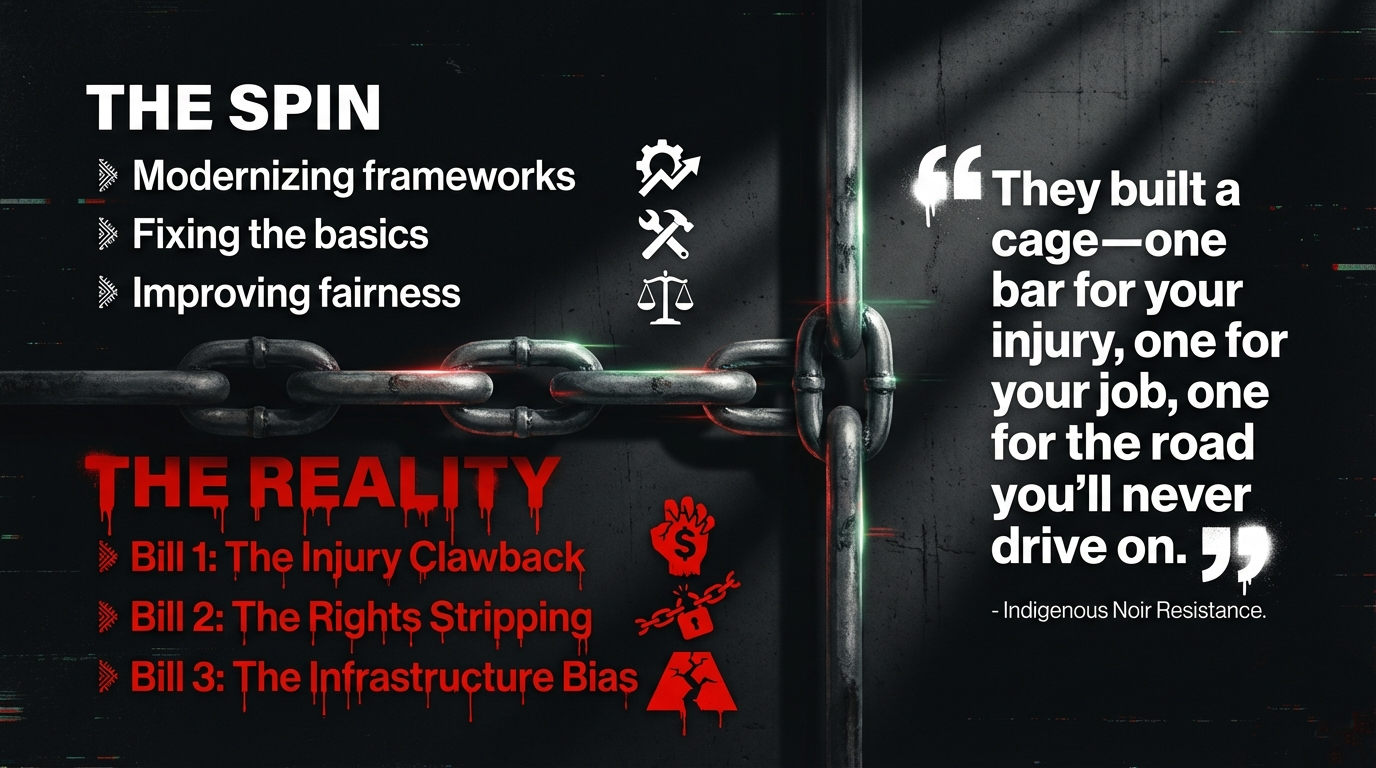
They didn't just change three laws. They built a cage — one bar for your injury, one for your job, one for the road you'll never drive on. And they did it in 48 hours while you weren't watching.


https://www.rnz.co.nz/news/political/587072/new-zealand-s-first-national-infrastructure-plan-unveiled; https://www.rnz.co.nz/news/political/587106/employment-relations-amendment-bill-debated-for-final-time; https://www.rnz.co.nz/news/political/587101/political-parties-already-squabbling-over-infrastructure-plan; https://www.rnz.co.nz/news/political/587115/incoming-law-change-so-msd-can-claw-back-welfare-payments-off-acc-clients
Kia ora e te whānau,
My hope is that the mahi I do helps you to see what this government is really doing, and how it hurts our whānau through misinformation, and disinformation from the far right. Make no mistake, our current coalition NZ government is far right!
Picture a taniwha with three heads. The first head bites into your ACC backpay and drags it back to the Crown. The second head reclassifies you from worker to contractor, stripping your sick leave, your holiday pay, your right to challenge a wrongful sacking. The third head paves a $275 billion road — past your crumbling marae, your flooded kāinga, your underfunded hauora — straight to the suburbs of those who already have everything.
This is not metaphor. This happened. All of it. In one parliamentary sitting week. February 2026.
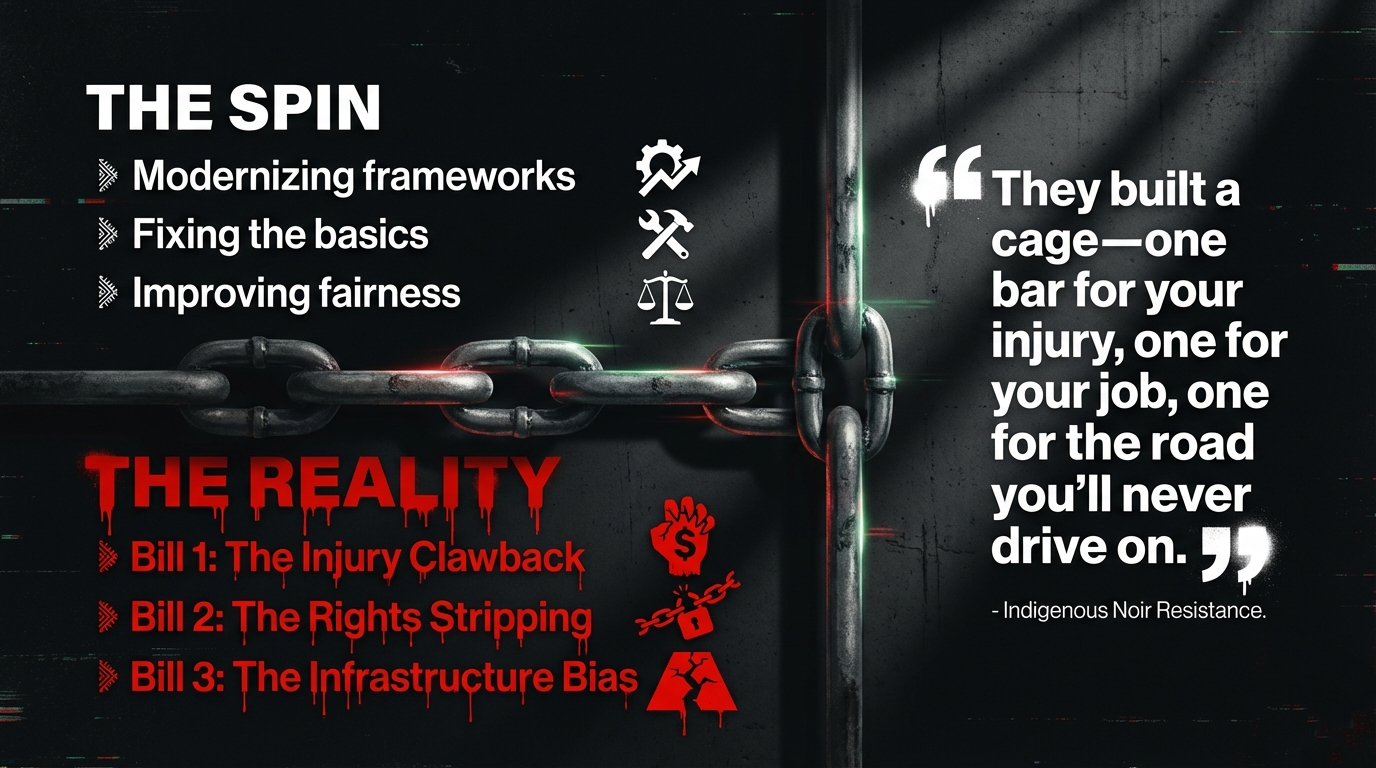
Three bills. Three ministers. One architecture of extraction. The government of Christopher Luxon did not stumble into this. They engineered it — a legislative trifecta designed to strip injured whānau of court-won protections, gut worker rights the Supreme Court just confirmed, and redirect a generation of infrastructure investment away from the communities that need it most.
The taniwha has a name: neoliberalism. And it feeds on Māori.
The First Head: The ACC Clawback — Robbing the Injured to Fund the Machine
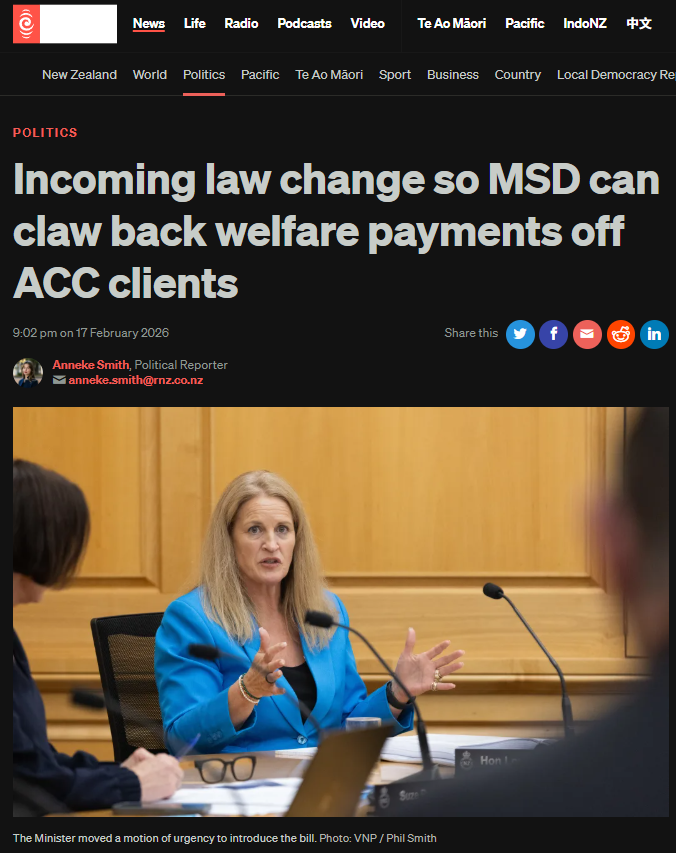
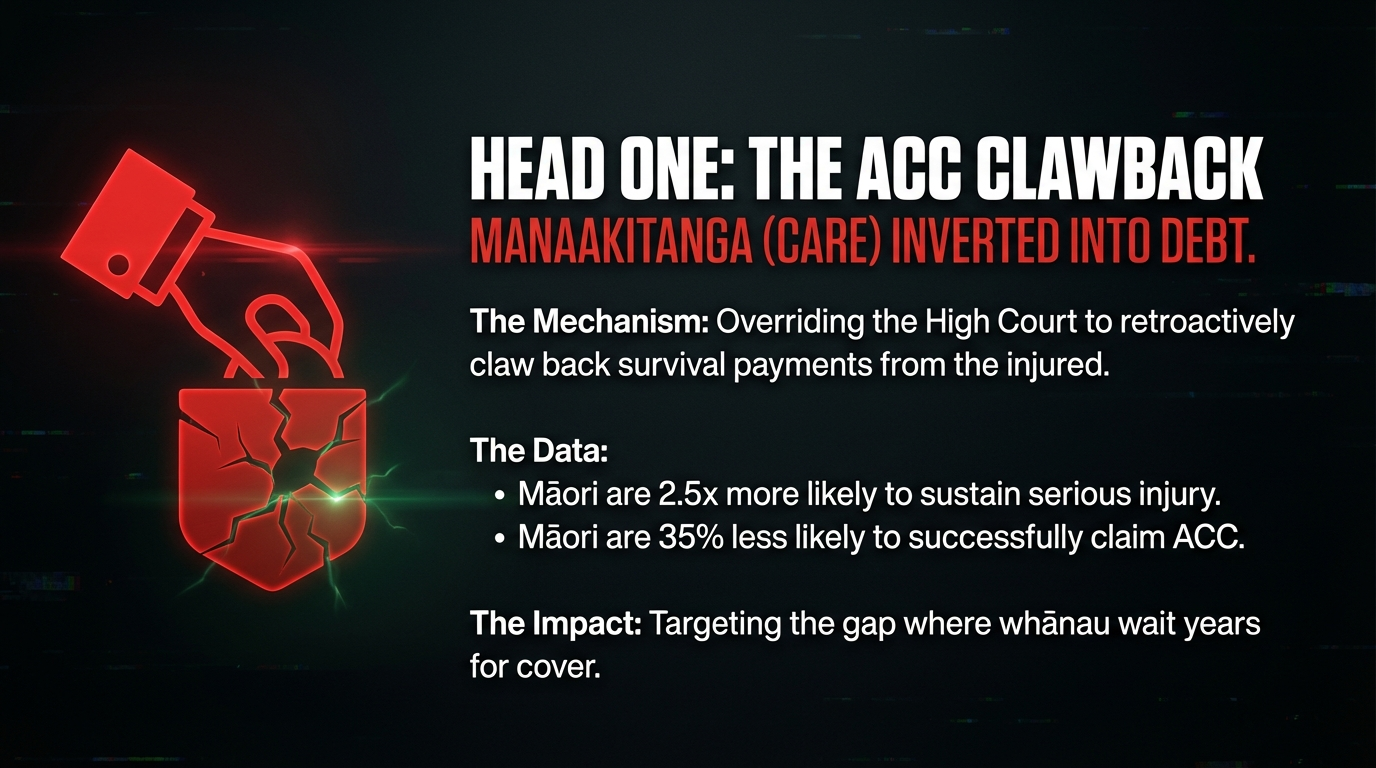
On the evening of Monday 17 February, Social Development Minister Louise Upston moved a motion of urgency to introduce the Social Security (Accident Compensation and Calculation of Weekly Income) Amendment Bill. In plain English: the government is legislating to override a High Court ruling that said MSD cannot claw back supplementary assistance — accommodation supplements, winter energy payments — from people who receive backdated ACC compensation.
Let that land.
A High Court judge — Justice Grice — examined the law and ruled that MSD had been illegally pursuing vulnerable people for debts they never should have owed. People who were injured. People who waited — sometimes years — for ACC to approve their claims. People who, in the meantime, needed accommodation supplements to keep roofs over their children's heads and winter energy payments so their tamariki didn't freeze. The court said these payments were not debts. They were entitlements. Community Law Centres Aotearoa called the ruling "a huge relief for people who were unfairly saddled with debts they could never have anticipated."
The government's response? Override the court. Retrospectively. Under urgency. With one week at select committee.
Upston frames this as "fairness" — claiming two cohorts of ACC recipients are being treated differently. This is the con. Here is the truth: the people waiting years for ACC decisions are overwhelmingly low-income, overwhelmingly Māori and Pasifika, and overwhelmingly in industries where injuries are most severe and claims most delayed. ACC's own data shows that Māori are 2.5 times more likely to sustain a serious injury than non-Māori, yet 35 percent less likely to make an ACC claim. For Māori over 50, the ACC claim rate is 46 percent lower than non-Māori — yet when they do claim, the average cost is $1,700 versus $1,200, because the injuries are more serious by the time they're addressed. The serious injury claim rate for Māori is 57 percent higher than for non-Māori.
These are the people Upston's bill targets. People who already face systemic barriers accessing care. People whose accommodation supplements literally kept them housed while a broken, biased system decided whether their shattered backs and crushed limbs qualified for help.
The government is not "clarifying" the law. It is punishing people for winning in court.
In tikanga terms: this is the desecration of manaakitanga itself. When a whānau member is injured, the collective responsibility is to sustain them — not to claw back the aroha once a bureaucratic process concludes. The supplementary payments were the community's obligation made manifest through the state. Upston's bill says: that obligation was a loan, and we want it back, with interest.
The Second Head: The Employment Relations Amendment Bill — The Uber Betrayal
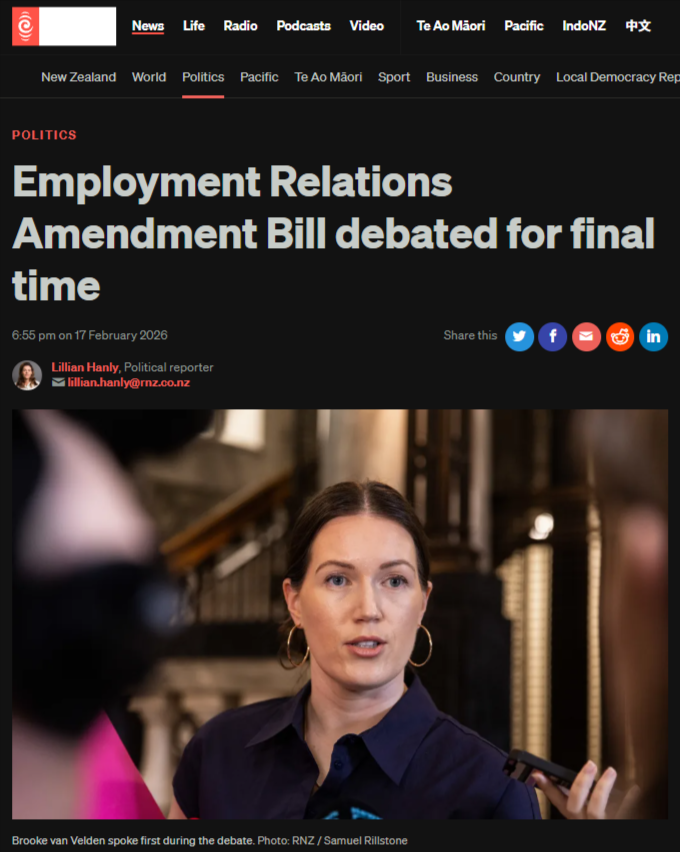
On the same day — the very same sitting — the Employment Relations Amendment Bill passed its third reading. ACT's Brooke van Velden declared it "a great day for New Zealand's labour market." The Greens called it a "dark day". Labour said it was "very sad."
It is worse than sad. It is a legislative mugging.
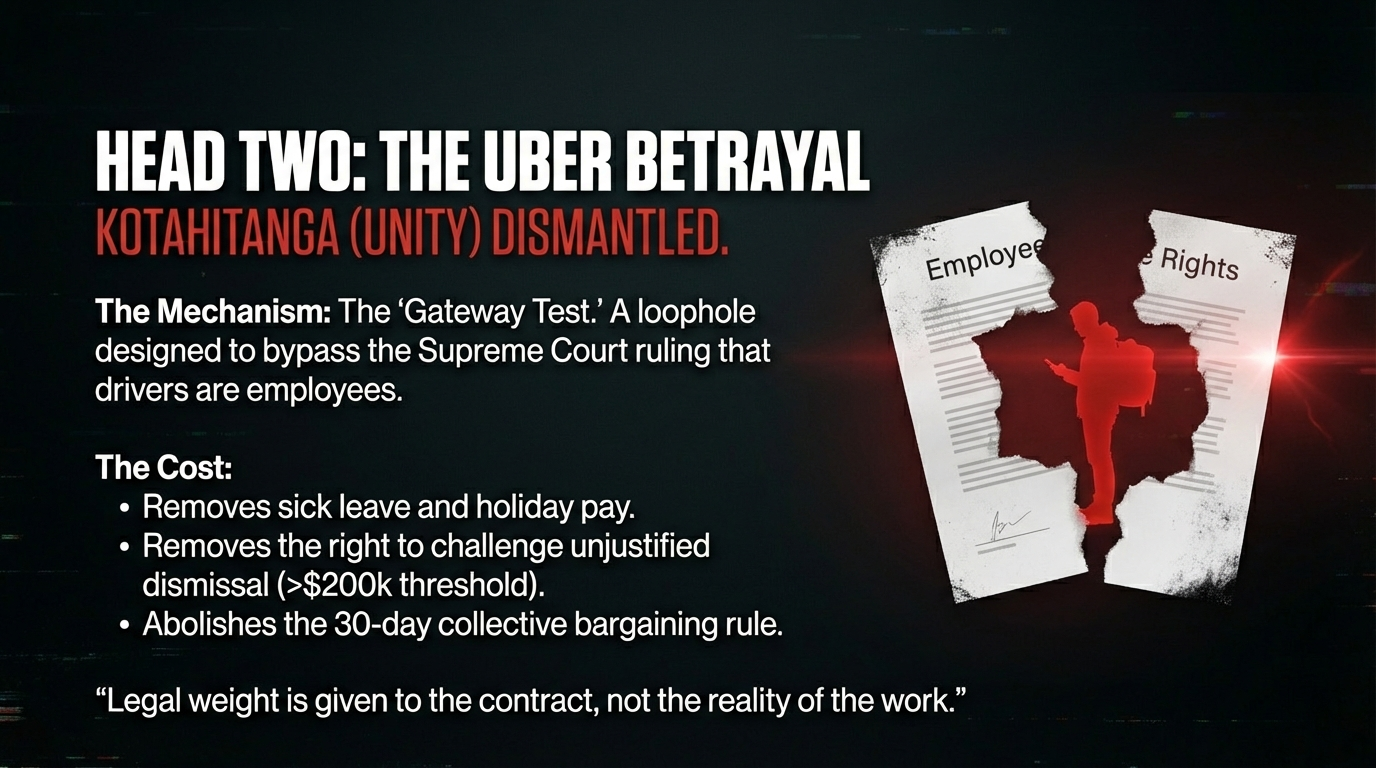
Here is the timeline of the con:
- Four Uber drivers fight for years through the Employment Court to be classified as employees, not contractors.
- They win. Uber appeals to the Court of Appeal. They win again.
- Uber appeals to the Supreme Court. On 17 November 2025, five justices unanimously dismiss Uber's appeal. The drivers are employees. End of.
- Within months, van Velden's bill passes, introducing a "gateway test" that creates an entirely new legal route for companies like Uber to classify workers as contractors — regardless of what the Supreme Court just ruled.
The Workers First Union deputy secretary Anita Rosentreter called it the "Uber law" and said the more van Velden denied the connection, "the more clear it became the whole Bill was about protecting the right of foreign companies to exploit New Zealand workers."
The bill does three things simultaneously:
- Creates a "gateway test" that locks workers into contractor status if four written criteria are met — regardless of the actual reality of their work. E tū national secretary Rachel Mackintosh called it "one of the most anti-worker pieces of legislation in decades."
- Sets a $200,000 income threshold above which workers lose the right to bring a personal grievance for unjustified dismissal. As employment law firm Lane Neave warns, this captures workers earning well below that in base salary once bonuses, KiwiSaver, and allowances are factored in.
- Removes the 30-day rule that extended collective agreement terms to new employees, gutting the incentive structure for union membership.
Labour leader Chris Hipkins said it would drive New Zealanders to Australia, where the government "extended minimum wage protection to more of those workers... extended leave entitlements... extended unfair dismissal protections." Aotearoa is now doing the opposite.
Green MP Ricardo Menendez March said the bill creates "a new class of contractors" denied basic entitlements like sick leave and minimum wage. Green MP Teanau Tuiono told Parliament: "We actually should be backing the workers, the people who need our help and support."
In tikanga terms: this is the annihilation of kotahitanga. Employment law is the modern expression of collective obligation — the recognition that the power between an employer and a worker is not equal, and the law must intervene to protect the vulnerable party. Van Velden's bill explicitly gives "legal weight to the intention of contracting parties" — which, in a world where corporations draft contracts and workers sign them or starve, means giving legal weight to the powerful party's fiction. It is the legislative equivalent of saying the rangatira's word overrides the hapū's reality.
The Third Head: The Infrastructure Con — $275 Billion of Someone Else's Future
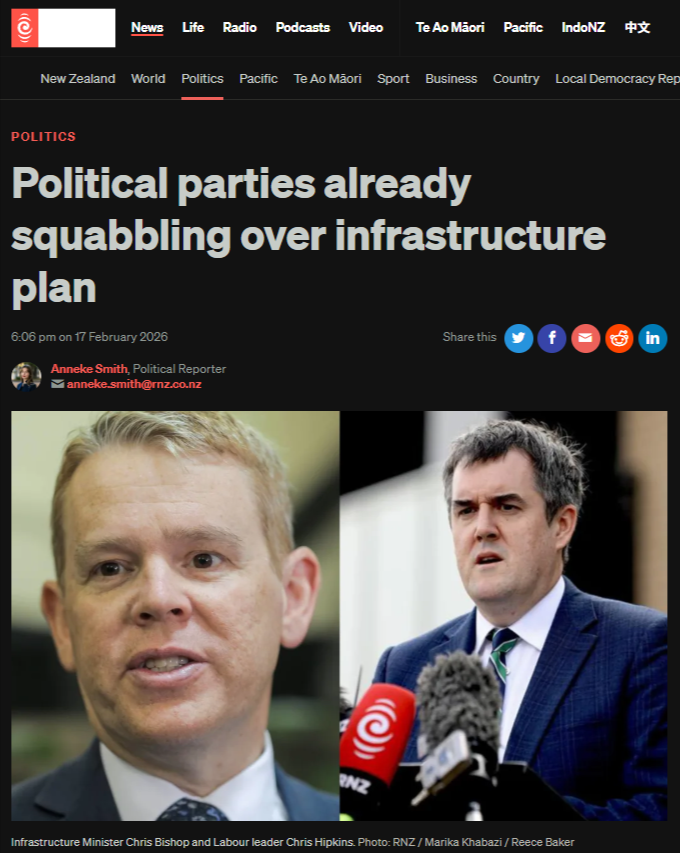
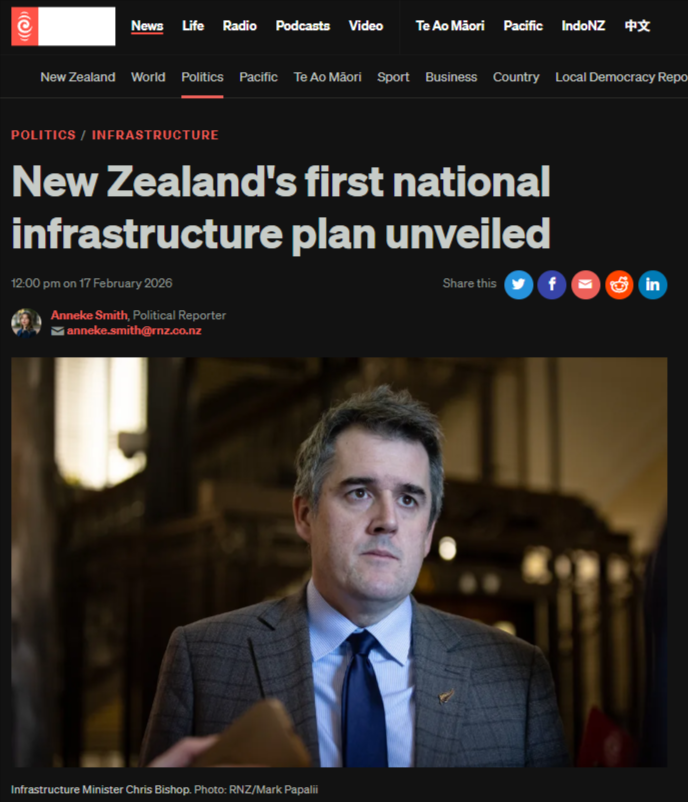
The first-ever National Infrastructure Plan dropped the same week, and the parties immediately started squabbling over who gets credit. Infrastructure Minister Chris Bishop touts the plan. Labour's Hipkins criticises the Roads of National Significance. Both behave as though the argument is about roads.
It is not about roads. It is about who gets infrastructure and who does not.
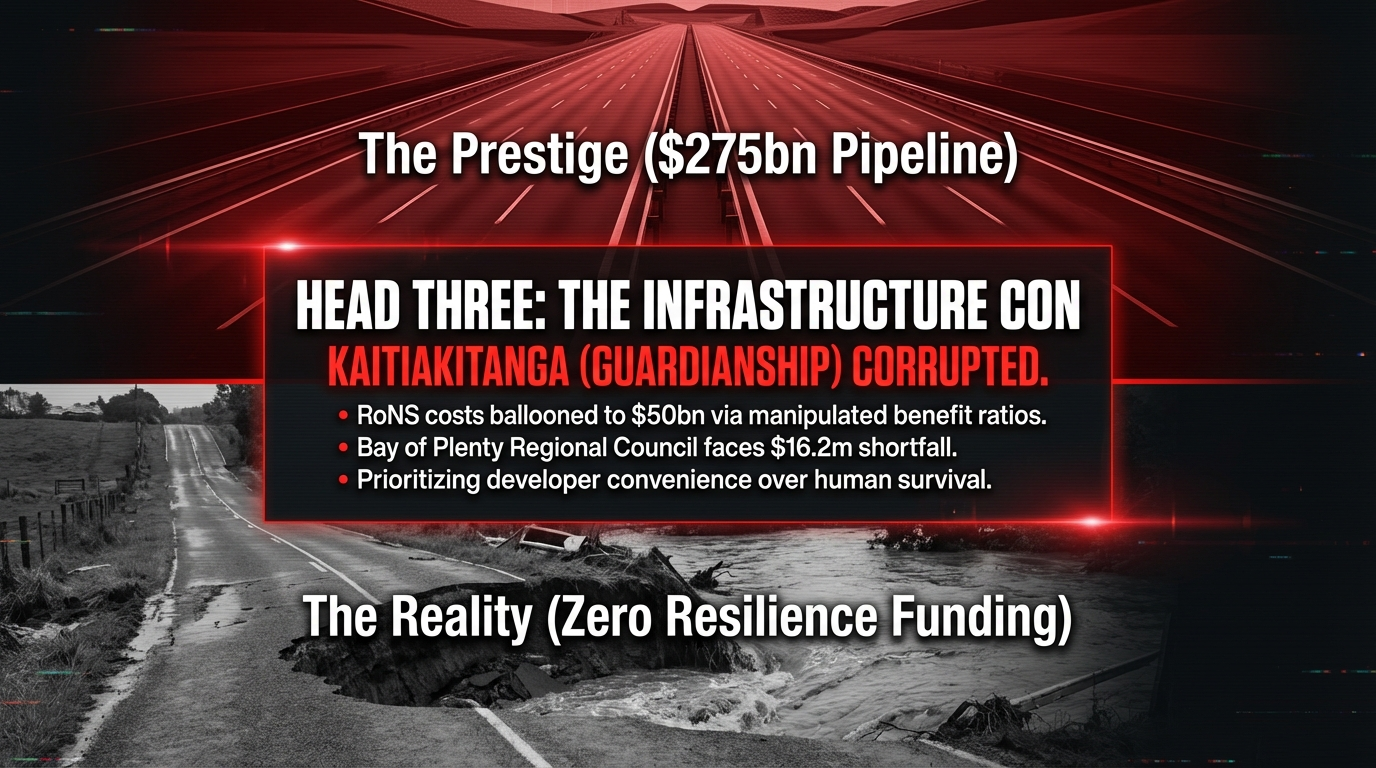
The numbers expose the con. The infrastructure pipeline contains nearly 12,000 projects worth $275 billion — but more than two-thirds lack full funding. Meanwhile, the government's prized Roads of National Significance programme has ballooned to an estimated $40-50 billion, justified only by radically changing how benefit-cost ratios are calculated — extending assessment periods from 30 to 60 years and slashing discount rates from 6 percent to 2 percent. As Hipkins put it: "Billions of dollars of investment without proper business cases."
While the government pours billions into highways connecting suburbs that already function, the Infrastructure Commission's own plan identifies that flood risk is projected to increase most sharply in the Bay of Plenty and other regions where Māori communities are concentrated. Waatea News reports that many rural Māori communities are "disproportionately affected by poor roading resilience" — Māori electorates encompass "remote coastlines, hill country catchments and sparsely populated inland regions — precisely the landscapes most exposed to natural hazards." Te Pāti Māori co-leader Rawiri Waititi says infrastructure vulnerability in Māori electorates "has become both an economic issue and a matter of equity."
The Bay of Plenty Regional Council faces a $16.2 million funding shortfall from central government. Auckland Transport faces a $600 million gap. The government spends $1.2 billion on RoNS design and property acquisition while regional councils beg for basic maintenance funding.
In tikanga terms: this is the corruption of kaitiakitanga. Infrastructure is not concrete and asphalt — it is the physical expression of intergenerational care. When you maintain a road to a remote community, you are maintaining the ability of kaumātua to reach hospital, of tamariki to reach kura, of kai to reach tables. When you defund that road to build a highway past a subdivision, you are saying those lives are worth less. Kaitiakitanga demands we leave the whenua better than we found it. This government is leaving entire communities stranded so developers can build faster.
The Con Across All Three: One Architecture of Extraction
Here is the connection the media will not draw:
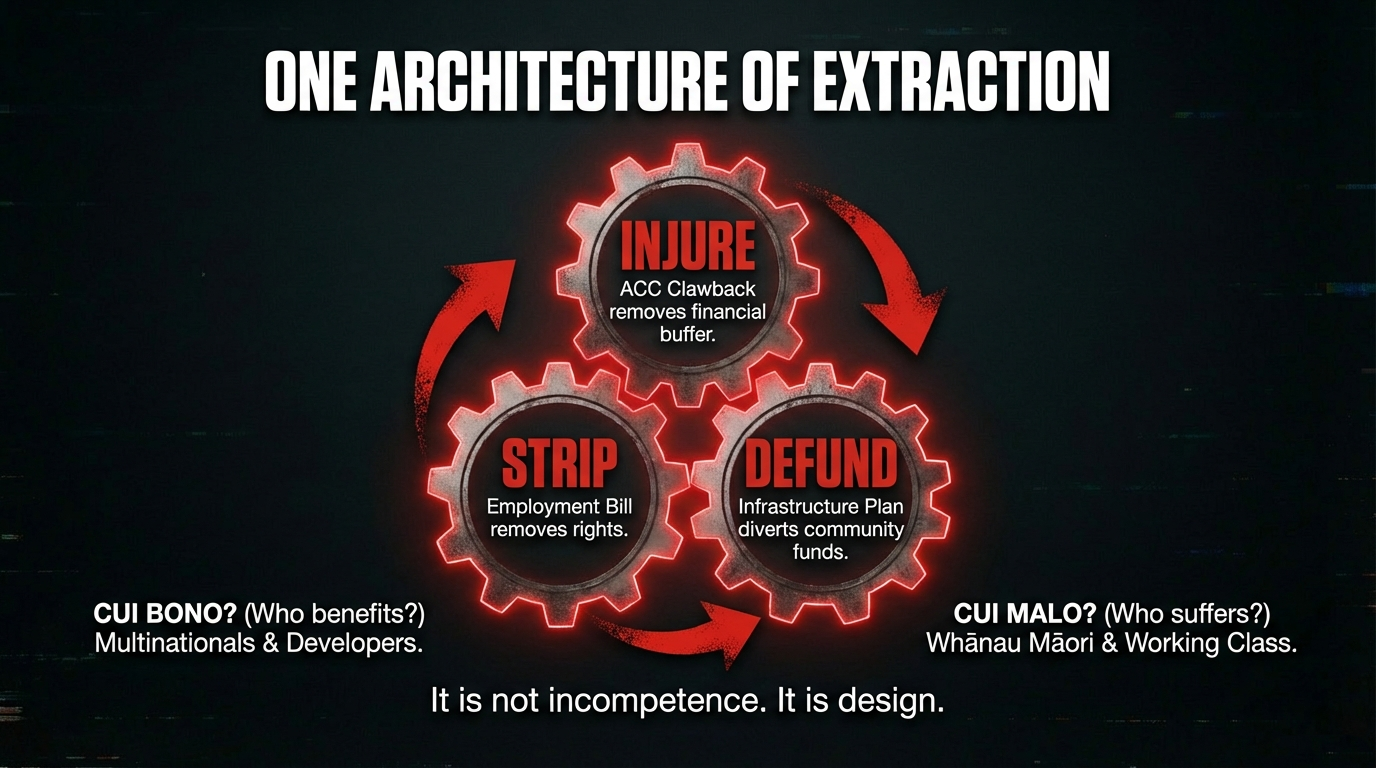
The ACC clawback ensures injured workers — disproportionately Māori in high-risk industries like forestry, construction, and meat processing — cannot accumulate the financial buffer that might allow them to refuse exploitative work.
The Employment Relations Amendment ensures those same workers, when they return to the workforce, can be classified as contractors with no sick leave, no holiday pay, no minimum wage, and no right to challenge their status — even after the Supreme Court said that classification was a lie.
The infrastructure plan ensures the physical environment those workers live in — the roads to their communities, the water in their pipes, the hospitals where they recover — continues to deteriorate while investment flows to urban corridors serving property developers.
This is not three separate policies. It is one machine with three gears. Injure the worker. Strip their rights. Defund their community. Repeat.
MBIE's own Māori Labour Market Statistics for December 2025 show Māori unemployment at 10.6 percent — nearly double the national rate of 5.4 percent. The Māori underutilisation rate sits at 20.6 percent. The NEET rate for Māori aged 15-24 is 20.4 percent. Professor Matt Roskruge's State of the Māori Economy 2025 warns of "mounting pressure" with "widening employment gaps, rising welfare reliance, housing stress and food insecurity."
Into this landscape of mounting deprivation, the government simultaneously removes protections for the injured, strips rights from workers, and redirects infrastructure spending away from the communities drowning in compounding disadvantage.
That is not incompetence. That is design.
Three Examples for the Western Mind
Example 1: The Forestry Worker in Ōpōtiki
Imagine a forestry worker — let's call him Tama — in Ōpōtiki, in the Bay of Plenty. He works for a contractor on a radiata pine harvest. The work is dangerous. Māori are 2.5 times more likely to sustain a serious injury than non-Māori in industries like forestry. Tama's back gives out. He files an ACC claim.
Before this week: While waiting for ACC to process his claim — which can take years — Tama receives accommodation supplement and winter energy payments from MSD. He keeps his whānau housed. His tamariki stay warm. When ACC finally approves his claim and backdates his weekly compensation, MSD recovers the main benefit automatically. But the accommodation supplement and winter energy payment were his. Justice Grice confirmed it.
After this week: Upston's bill means MSD can now retroactively claw back every cent of supplementary assistance Tama received. His backdated ACC payment — which was supposed to help him recover — is consumed by a Crown debt he didn't know he was accumulating. His whānau is worse off than before the claim was approved.
The tikanga impact: In te ao Māori, when someone is injured, the whānau gathers resources to sustain them. The accommodation supplement and winter energy payment were the state's version of this collective obligation. The clawback says: that care was conditional. We gave you aroha on credit, and now we want it back. This is the inversion of manaakitanga — care weaponised into debt.
The quantified harm: ACC's own data shows the serious injury claim rate for Māori is 57 percent higher than non-Māori. If even 10 percent of the 9,000+ Māori currently accessing rongoā Māori through ACC face backdated clawbacks, we are talking about millions of dollars extracted from the most vulnerable injury recovery pathways in the country.
The solution: Repeal the bill. Honour the High Court ruling. Establish a Māori-led ACC navigation service — as ACC's own head of Māori health partnerships Eldon Paea has advocated — to address the 35 percent claim gap. Abolish the debt recovery model for supplementary assistance entirely.
Example 2: The Uber Driver in South Auckland
Consider Aroha, a single mother in South Auckland driving for Uber. The Supreme Court unanimously ruled in November 2025 that drivers like her are employees — entitled to minimum wage, sick leave, holiday pay, and KiwiSaver. The Court found Uber "exercises a high level of control over every aspect of the passenger transport services provided by its drivers."
Before this week: Aroha could point to the Supreme Court ruling and demand employee status. She could access sick leave when her child was unwell. She could accrue holiday pay. She had a pathway to collective bargaining through E tū or FIRST Union.
After this week: Van Velden's gateway test means Uber simply restructures its contract to meet four written criteria — a written agreement calling her a contractor, freedom to work for others, no obligation to be available, no penalty for refusing work — and Aroha is locked out of employee status. The reality of her work hasn't changed. Uber still sets her fares, controls her ratings, mediates all customer contact, and disciplines her through algorithmic management. But the law now says the contract overrides the reality. Buckett Law warns the bill "prioritises contractual wording over reality and strips workers of the right to contest exploitative arrangements."
The tikanga impact: Kotahitanga — unity and collective strength — is the foundation of Māori social organisation. Union membership and collective bargaining are the modern expression of this principle. The 30-day rule ensured new workers entered the whānau of collective protection. Its removal means each new worker enters alone, negotiating individually against a corporation with infinite resources. This is the legislative dismemberment of collective power — the same logic that individualised land title through the Native Land Court to break hapū ownership.
The quantified harm: Uber has approximately 11,000 drivers in New Zealand. Transport, construction, cleaning, security, and labour hire workers face the same reclassification risk. Hipkins told Parliament these workers "deserve to be treated well... deserve to be paid properly... deserve to have security in their employment." The bill strips all three.
The solution: Repeal the bill. Codify the Supreme Court's "real nature of the relationship" test into statute. Adopt the UK's "Self-Employed Plus" model guaranteeing minimum entitlements regardless of classification. Mandate union access to all workplaces including digital platforms.
Example 3: The Kaumātua in Tairāwhiti Waiting for a Road
Picture a kaumātua — Nanny Mere — living in a rural community near Gisborne. Her access road has been damaged by successive weather events. Convoys along State Highway 2 were stopped in February because of rain causing slips in the gorge. When the road closes, she cannot reach her dialysis appointments. Kai deliveries stop. Her mokopuna cannot get to kura.
Before this week: The Infrastructure Commission's plan identifies flood risk and road resilience as urgent priorities. It recommends sequencing investment based on demonstrated need.
After this week: The government squabbles over who gets credit for a 30-year plan while Nanny Mere's road crumbles. Bishop commits $1.2 billion to RoNS design and property acquisition. The Bay of Plenty faces a $16.2 million shortfall in central government transport funding. The Infrastructure Commission warns that the major transport project pipeline has grown much faster than the funding available — which means every dollar sunk into politically prestigious highways is a dollar not maintaining Nanny Mere's lifeline.
The tikanga impact: Kaitiakitanga — guardianship of the environment and its resources for future generations — demands that infrastructure investment be allocated based on need, not prestige. When a kaumātua cannot reach hospital because the road funding went to a subdivision motorway, the state has failed its kaitiaki obligation. The whenua speaks through the slips and the floods: you did not care for me, and now I cannot care for your people.
The quantified harm: Waatea News reports rural Māori communities experience immediate consequences when transport links fail: "isolated communities, delayed medical access, disrupted supply chains, and economic loss." The RoNS programme's estimated $40-50 billion cost is justified only through manipulated benefit-cost calculations. Meanwhile, a third of New Zealand's wastewater plant consents have expired, and Wellington's Moa Point treatment plant catastrophically failed.
The solution: Mandate that a minimum 20 percent of infrastructure investment be directed to communities with the highest resilience deficits — which means Māori electorates. Adopt the Infrastructure Commission's recommendation to prioritise and sequence projects based on demonstrated need, not political vanity. Fund Māori co-investment in regional infrastructure, as Te Waihanga's own research recommends.
Previously Covered by The Māori Green Lantern
These three legislative actions are not isolated events. They are the latest chapters in a coordinated neoliberal project this platform has documented extensively:
- "Back to Basics, Back to Brutality: How a 'Hodgepodge' of Bills Became the Most Coordinated Assault on Māori Rights, Workers, and Democracy in a Generation" — documented the legislative assembly line where "each bill feeds the next, each deletion enables the next erasure." This week's triple assault is the direct continuation of that architecture.
- "Invisible Violence: How Christopher Luxon's Government Is Criminalizing Poverty While Profiting from Homelessness" — exposed how the government deploys "the centaur state: permissive at the top, punitive at the bottom." The ACC clawback is the same logic applied to the injured: generosity for landlords through restored interest deductibility, brutality for beneficiaries through debt recovery.
- "Clockwise Betrayal: How Labour Set the Trap That National-ACT Now Closes" — revealed that "the same neoliberal machinery grinds Māori futures either way — just faster when the mask comes off." The infrastructure squabble between Bishop and Hipkins is the performance of disagreement masking bipartisan consensus on market-driven allocation that systematically excludes Māori communities.
- "Luxon's Military Junket: Trading Māori Lives for US Empire" — documented how Luxon "mortgages our sovereignty to purchase US military hardware while Māori unemployment soars." The priorities remain: billions for prestige projects, crumbs for communities.
The Verdict: Cui Bono, Cui Malo
Who benefits?
- Uber and multinational gig platforms: freed from the Supreme Court ruling that threatened their business model
- MSD: recovers millions from the most vulnerable claimants
- Road construction firms: guaranteed decades of RoNS contracts worth $40-50 billion
- Property developers: highway investment increases land values in suburban corridors
- Brooke van Velden and ACT's donor base: delivered the labour deregulation they paid for
Who suffers?
- Injured Māori workers waiting years for ACC claims
- Gig economy workers reclassified as contractors
- Rural and regional Māori communities with crumbling infrastructure
- Unions stripped of the 30-day rule that sustained membership
- Every whānau whose manaakitanga is converted into a Crown debt
The Māori unemployment rate stands at 10.6 percent. The underutilisation rate is 20.6 percent. Youth NEET is 20.4 percent. Into this reality, the government strips worker protections, claws back injury support, and redirects infrastructure investment. Professor Roskruge's analysis warns of "structural economic settings as key drivers of this widening gap." This week's legislation is those structural settings being deliberately tightened.
The Call: Rangatiratanga Demands Action
The taniwha has three heads, but one body. Cut one head and the others feed. The only answer is to expose the body — the neoliberal architecture that connects welfare punishment to labour deregulation to infrastructure privatisation.
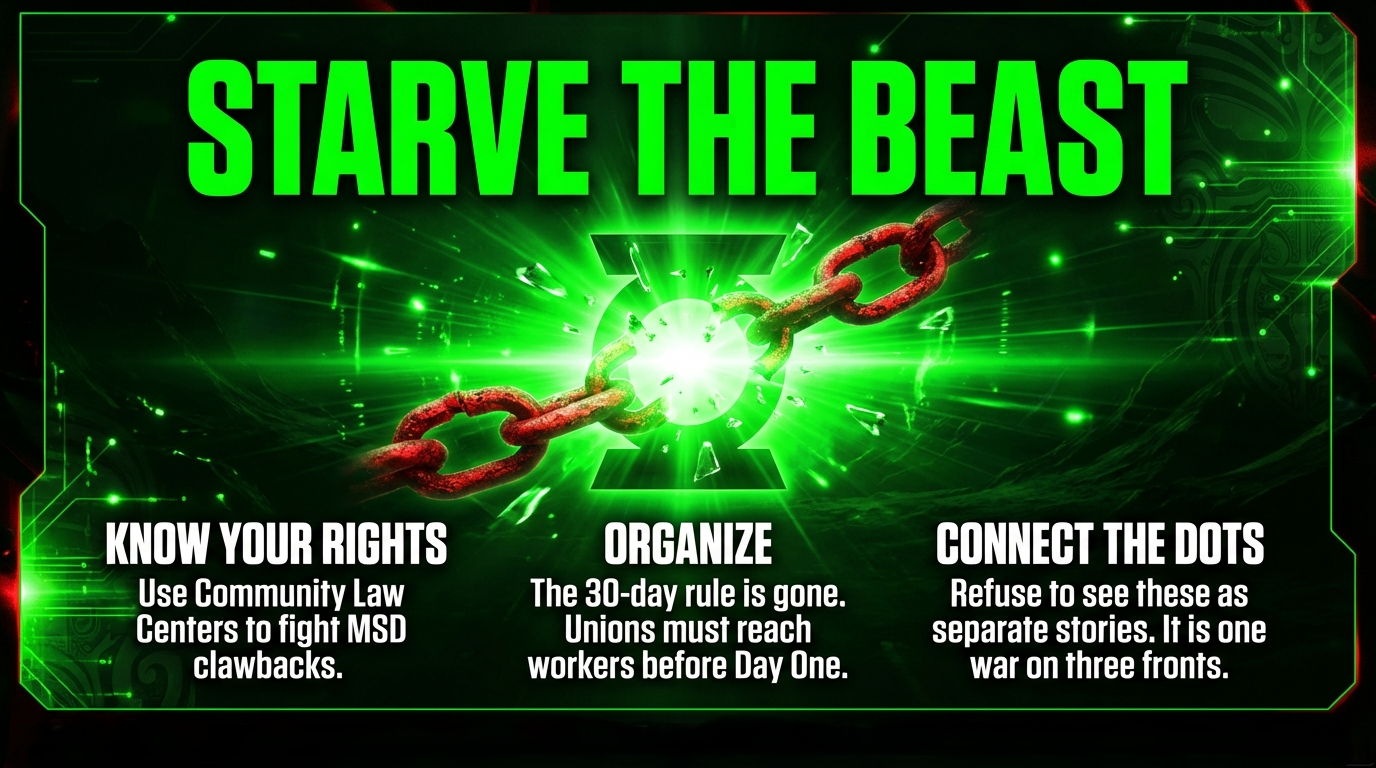
To whānau Māori: Know your ACC rights. Contact Community Law Centres Aotearoa if you are facing MSD clawback. Know your employment rights. If your employer reclassifies you as a contractor, contact E tū or FIRST Union. Demand infrastructure investment in your rohe.
To unions: This bill is a declaration of war. Organise accordingly. The 30-day rule is gone — which means every new worker must be reached before Day One. Build solidarity across sectors. The forestry worker, the Uber driver, and the kaumātua waiting for a road are fighting the same fight.
To the media: Stop covering these as three separate stories. They are one story. The government introduced all three in the same sitting week. Ask why. Follow the money. Name the donors. Connect the dots.
To Labour: You offered bipartisan support on infrastructure while the government gutted worker rights in the same chamber. Choose a side. As this platform documented in Clockwise Betrayal: "there is no meaningful political difference between Labour and National" while both operate within neoliberal frameworks. Prove that analysis wrong. Or confirm it.
Manaakitanga demands we care for the injured — not claw back their support.
Kotahitanga demands we protect collective rights — not atomise workers into isolated contractors.
Kaitiakitanga demands we invest in resilient communities — not prestige highways.
The taniwha feeds because we let it. Time to starve the beast.
Mauri ora.
Koha Consideration
Every koha signals that whānau are ready to fund the accountability that neither MSD, nor ACC, nor Brooke van Velden's corporate backers will ever provide. When the government claws back winter energy payments from injured workers, when it overrides the Supreme Court to protect Uber's profit model, when it redirects infrastructure billions past crumbling Māori communities — your koha says: we see the taniwha, and we will not look away.
It signals that rangatiratanga includes the power to fund our own truth-tellers — especially when the Crown is legislating to silence the courts.
Kia kaha, whānau. Stay vigilant. Stay connected. And if you are able, consider a koha to ensure this voice continues exposing the three-headed taniwha every time it surfaces in the House.
If you are unable to koha, no worries! Subscribe or Follow The Māori Green Lantern on themaorigreenlantern.maori.nz, kōrero and share with your whānau and friends — that is koha in itself. Every share is a taiaha swung at the machine.
Three pathways exist:
For those who wish to support this mahi directly with a koha (voluntary contribution), please visit the Koha platform:
Koha — Support - https://app.koha.kiwi/events/the-maori-green-lantern-fighting-misinformation-and-disinformation-ivor-jones
For those who wish to receive essays directly and support through subscription:
Subscribe to The Māori Green Lantern - https://themaorigreenlantern.maori.nz/#/portal/support
For those who prefer direct bank transfer, account details are: HTDM, account number 03-1546-0415173-000.

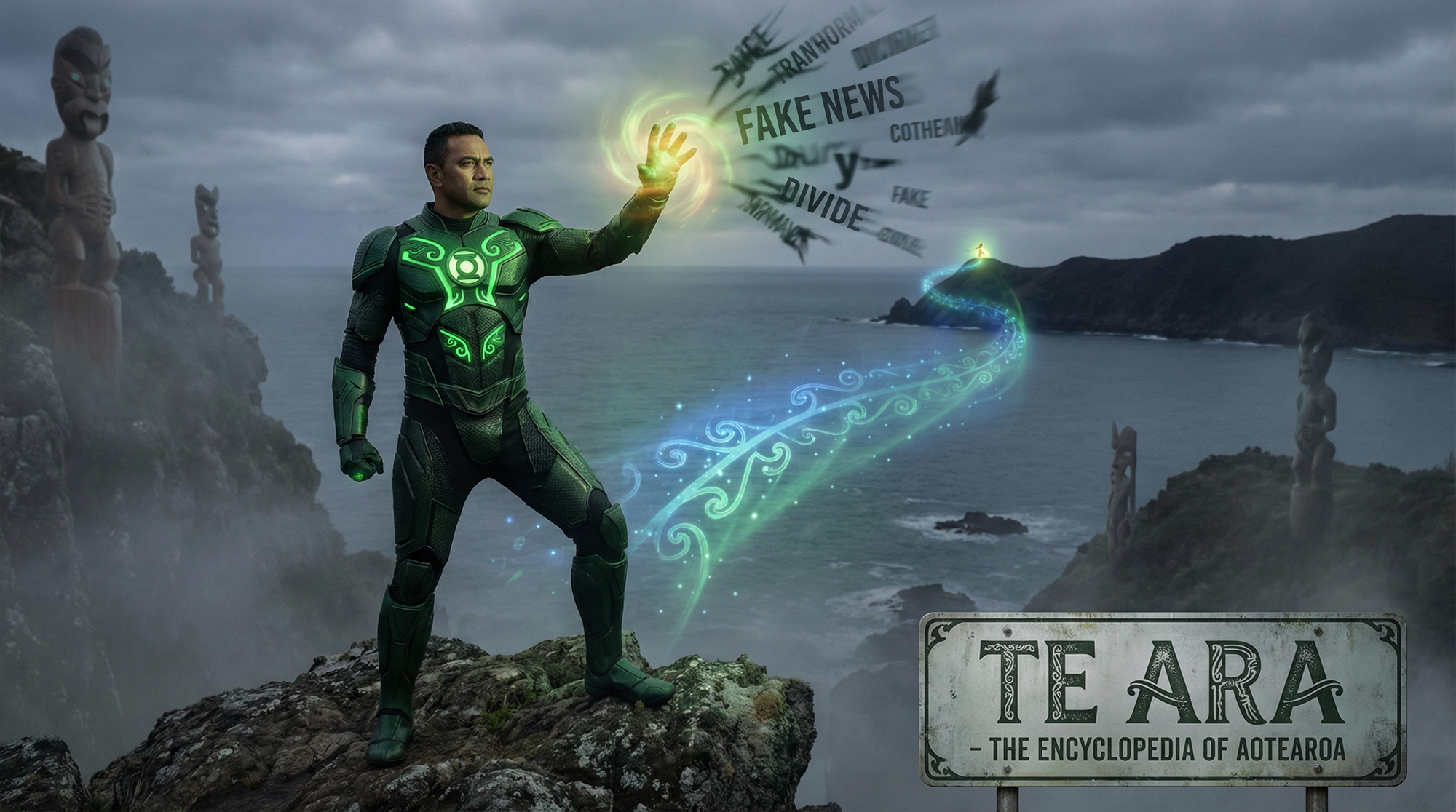
Ivor Jones The Māori Green Lantern Fighting Misinformation And Disinformation From The Far Right
Research conducted 17 February 2026 using RNZ, 1News, Beehive.govt.nz, Community Law Centres Aotearoa, Waatea News, Te Ao News, Auckland University research, MBIE statistics, Te Waihanga (Infrastructure Commission), Greater Auckland, and court documents. All URLs verified at time of publication.