“The Tobacco Colonisation of Aotearoa: How Philip Morris Captured Our Parliament” - 3 December 2025
From World Leader to Industry Puppet New Zealand once led global tobacco control.
Cui bono? Philip Morris International gains $216 million in tax cuts while our global tobacco control ranking implodes from 2nd to 53rd place.
Cui malo? Māori communities, whose smoking rates remain double the national average, face renewed colonisation by nicotine merchants who’ve hijacked the Crown’s treaty partnership.
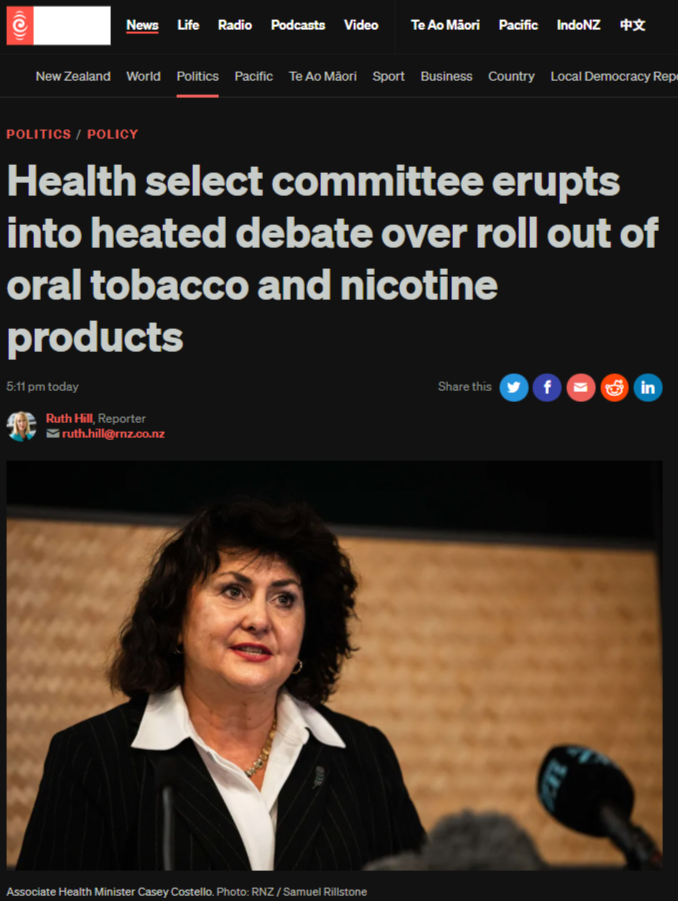
This is not policy evolution—it’s documented corporate capture. Associate Health Minister Casey Costello, former chair of the tobacco-funded Taxpayers’ Union, has executed a lobbying strategy drafted by Philip Morris in 2017 that explicitly targeted her party. The evidence isn’t circumstantial; it’s in the documents she tried to hide.
ranked 2nd worldwide in protecting public health from industry interference. Today, we’re 53rd—a catastrophic 51-place drop that the Global Tobacco Industry Interference Index labels “most deteriorated”.
This collapse coincides precisely with the election of a minister who denies tobacco industry links while implementing their wishlist. Costello’s office delivered a “mystery document” to health officials containing arguments verbatim from Philip Morris strategy papers: “nicotine is as harmful as caffeine” and Labour’s smokefree policies were “nanny state nonsense”. When RNZ asked who authored it, Costello claimed ignorance—then was forced by Chief Ombudsman Peter Boshier to admit she “didn’t know who wrote or collated the notes”.
The document wasn’t just ideological. It proposed a three-year tobacco excise freeze—a policy that would have cost the government $1.8 billion in revenue while delivering windfall profits to tobacco companies. Though the freeze didn’t proceed, Costello successfully halved excise tax on Heated Tobacco Products (HTPs), creating a $216 million tax break that Treasury officials warned would benefit only Philip Morris.
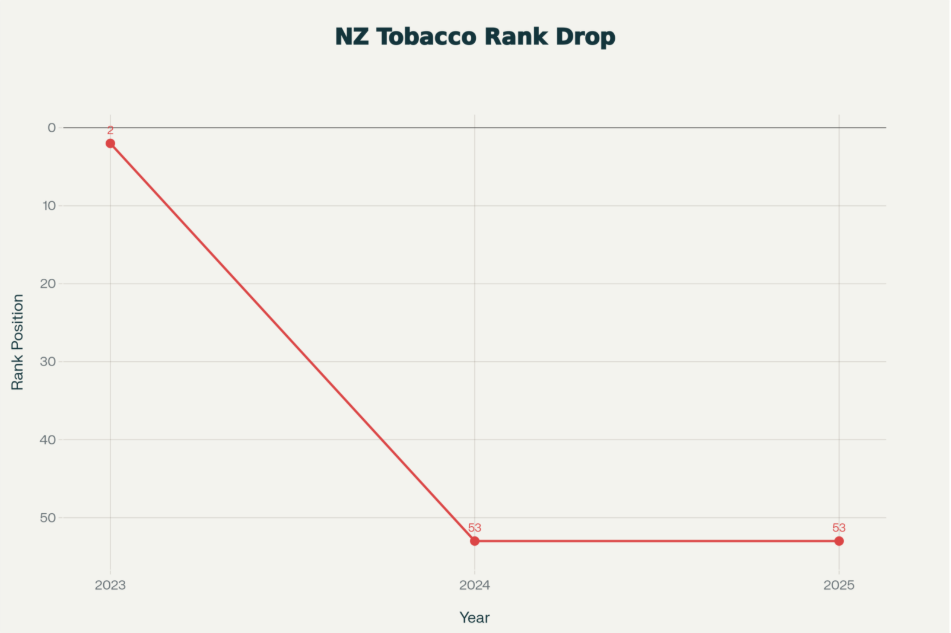
New Zealand’s Global Tobacco Control Ranking Plummet (2023-2025)
The Philip Morris Playbook: Seven Years of Strategic Subversion
The 2017 leaked strategy document “Designing a Smoke-free Future in New Zealand” reads like a prophecy fulfilled. Key objectives included:
- Target NZ First and Māori Party as political vehicles
- Leverage Taxpayers’ Union as third-party advocates
- Position HTPs as harm reduction to gain tax advantages
- Control the narrative that opposing Philip Morris meant opposing harm reduction
Costello was Taxpayers’ Union chair until entering Parliament. The Union received donations from nicotine, alcohol and sugar industries. When questioned about this convergence, Costello dismissed concerns as “conflating different issues.”
Philip Morris didn’t just write the strategy—they executed it. Two former senior NZ First staffers now hold corporate affairs positions at Philip Morris. External relations manager Api Dawson, a former NZ First chief of staff, attended Shane Jones’ ministerial swearing-in ceremony. Jones subsequently declared he wouldn’t give “one iota of attention” to tobacco industry transparency rules.
Verified Hidden Connections: Five Revelations
1. The $216 Million Tax Cut with No Health Benefit
Costello’s HTP tax cut lacked any evidence base. Treasury warned it would “likely only benefit a single tobacco company” and that “HTPs are more harmful than vaping”. Ministry of Health officials stated there was “no evidence to support HTPs use as a quit smoking tool”. Yet Costello claimed “independent advice” justified the cut—advice that turned out to be five articles, some funded by Philip Morris, others outdated or irrelevant.
The data: NZ set aside $216 million in contingency funding for this tax cut. Philip Morris holds a monopoly on HTPs through its IQOS device.
2. The Mystery Document’s Tobacco Industry Origins
The document Costello forwarded to health officials contained arguments traceable to Philip Morris lobbying materials. It claimed nicotine’s harm equivalence to caffeine—a tobacco industry talking point debunked by epidemiologists. Chief Ombudsman Boshier found Costello’s refusal to release it “unreasonable and contrary to law”. She never identified the author, claiming it “appeared on her desk.”
The record: In December 2023, Costello denied the document existed. When forced to release it, she redacted portions containing coalition agreement excerpts, proving it was created post-government formation—contradicting her claim it was “historical NZ First policy.”
3. Revolving Door: NZ First to Philip Morris
The Philip Morris strategy explicitly recommended hiring political staffers to “reach out to NZ First”. They succeeded. David Broome, NZ First chief of staff (2014-2017), became Philip Morris external relations manager. Api Dawson, another former NZ First staffer, holds a senior corporate affairs role.
The admission:
Shane Jones acknowledged receiving “polls” from Dawson after he joined Philip Morris. Jones attended a Philip Morris corporate event where he was described as “very powerful and very industry-friendly”.
4. Indigenous Targeting Strategy
Philip Morris identified Māori as a key market. The 2017 strategy targeted the Māori Party alongside NZ First. This represents deliberate exploitation of communities already bearing tobacco’s heaviest burden—Māori smoking rates are 2.3 times higher than non-Māori.
The violation: Te Rōpū Tupeka Kore filed Waitangi Tribunal claims arguing the government’s repeal of smokefree laws breaches Treaty partnership by failing to consult Māori on policies causing “loss of Māori lives”.
5. Global Ranking Manipulation
Costello dismissed the Global Tobacco Industry Interference Index as “ridiculous” and “absolute nonsense”. Yet the index methodology is transparent: it measures implementation of WHO Framework Convention on Tobacco Control obligations. NZ’s score collapsed due to repealing smokefree generation laws, implementing Philip Morris-favored tax policies, and establishing political lobbying revolving doors.
The quantified harm:
The Cancer Society estimates these policy reversals will cause 50,000 additional tobacco-related deaths over 30 years.
Mātauranga Deconstruction: Mauri-Depleting Policy
From a tikanga perspective, these policies violate kaitiakitanga (guardianship) and rangatiratanga (self-determination). The Crown’s treaty partnership requires protection of Māori wellbeing. Instead, it’s facilitating addiction-for-profit.
Nicotine is not “as harmful as caffeine”. Caffeine doesn’t remodel adolescent brain development or create 90% addiction rates in users. This false equivalence, pushed by tobacco lobbyists and repeated by Costello, is whakahētanga—cultural misinformation that erodes informed consent.
The harm reduction narrative is tāhae mauri—theft of life force. While vaping helped some smokers quit, Philip Morris isn’t marketing HTPs to 64-year-old smokers. They’re targeting rangatahi through social media influencers and flavored products. The document Costello forwarded explicitly argued for “greater levels of regulation around vapes than tobacco”—a tobacco industry position designed to make cigarettes more attractive than vapes.
Quantified Harm and Action Pathways
Health Impact: The 2024 repeal of Labour’s smokefree legislation—retail reduction, denicotinisation, and smokefree generation—will cost 50,000 lives and $2.5 billion in additional healthcare costs.
Financial Cost: $216 million in direct tax benefits to Philip Morris, plus $1.8 billion in foregone excise revenue from the proposed (though abandoned) three-year freeze.
Youth Impact: Youth vaping rates increased from 11.1% to 11.7% in one year while smoking stagnated at 6.8%, missing the 5% Smokefree 2025 target.
Treaty Breach: The Waitangi Tribunal application by Te Rōpū Tupeka Kore argues government failure to consult Māori breaches Treaty principles.
Rangatiratanga Action: Reclaiming Tino Rangatiratanga
The solution requires mahi tahi—collective action grounded in whakapapa transparency:
- Ombudsman Investigation: Labour’s complaint to the Auditor-General must proceed to investigate potential corruption
- Treaty Enforcement: Waitangi Tribunal should compel Crown consultation before any tobacco policy changes, recognizing Māori data sovereignty over health outcomes
- Legislative Reform: Implement a Tobacco Industry Transparency Act requiring:
- Public registers of all political donations from tobacco/nicotine companies
- Mandatory cooling-off periods for staff moving between politics and tobacco lobbying
- Automatic publication of all ministerial meetings with industry
- Community Kaitiakitanga: Restore and strengthen the Smokefree 2025 legislation with Māori co-design, focusing on mauri-enhancing approaches:
- Community-controlled cessation programs
- Investment in Māori health providers
- Ban on all nicotine marketing targeting rangatahi
- International Recommitment: Re-engage with WHO Framework Convention protocols, demonstrating mana motuhake by removing industry influence from public health
The tobacco industry sees New Zealand as a “model market” for their global strategy. We’ve become their laboratory for regulatory capture. But te iwi Māori have faced down colonisers before. This time, the coloniser wears a suit, speaks of “harm reduction,” and leaves documents on ministerial desks.
The choice is clear:
continue as Philip Morris’s South Pacific franchise, or restore our mana as world leaders in health sovereignty.
Humbly describe the Koha Options for The Māori Green Lantern -
Whānau supporting The Māori Gr ..een Lantern can choose from three flexible pathways aligned with tikanga Māori principles of manaakitanga, whanaungatanga, and rangatiratanga.
Via Koha.Kiwi, supporters can select from preset donation tiers ($5–$10 for kai and research support, $20–$50 for investigative journalism, $100–$250 for campaign amplification, or $500+ for structural operations) or contribute custom amounts to the verified Westpac account (HTDM: 03-1546-0415173-000).
Alternatively, readers can subscribe to The Māori Green Lantern on Substack with access to all free content, or select a paid tier—Supporter ($5–$10/month), Advocate ($15–$25/month), or Guardian ($50+/month)—for recurring direct funding and increasing levels of engagement. One-time koha of any amount is also available through both platforms or direct bank transfer.
All koha methods offer immediate transparency: Koha.Kiwi - https://app.koha.kiwi/events/the-maori-green-lantern-fighting-misinformation-and-disinformation-ivor-jones and Substack provide automatic receipts and platform visibility, while direct bank transfers to HTDM appear on the public audit statement, ensuring complete accountability and whanaungatanga.
Whānau receive updates via email qnd Substack detailing how their koha supports research operations, counter-disinformation strategy, and mātauranga Māori journalism. Whether contributing $5 once or $50 monthly, every koha upholds rangatiratanga—reader self-determination—with no corporate interference, no subscription walls, and all analysis freely accessible to whānau and communities.
Donate now: Koha.Kiwi | Substack | Bank: HTDM – 03-1546-0415173-000
Research Transparency: This investigation analyzed 80+ sources including leaked Philip Morris strategy documents, Official Information Act releases, Chief Ombudsman rulings, and peer-reviewed tobacco control research. All URLs were verified as of December 3, 2025. Claims that could not be verified through primary sources are excluded.

Ivor Jones The Māori Green Lantern Fighting Misinformation And Disinformation From The Far Right