"THE WAKA WITHOUT A HULL: How a White Supremacist Neoliberal Government Burned Aotearoa's Fuel Sovereignty and Then Sold Us A Phone Call As A Life Raft" - 31 March 2026
They closed the refinery, handed the paddles to the corporations, put Hipkins in charge of watching the horizon — and called the drowning "energy resilience."

Mōrena e te whānau.
The taiaha is raised. The ring is charged. This is not commentary. This is the reckoning.
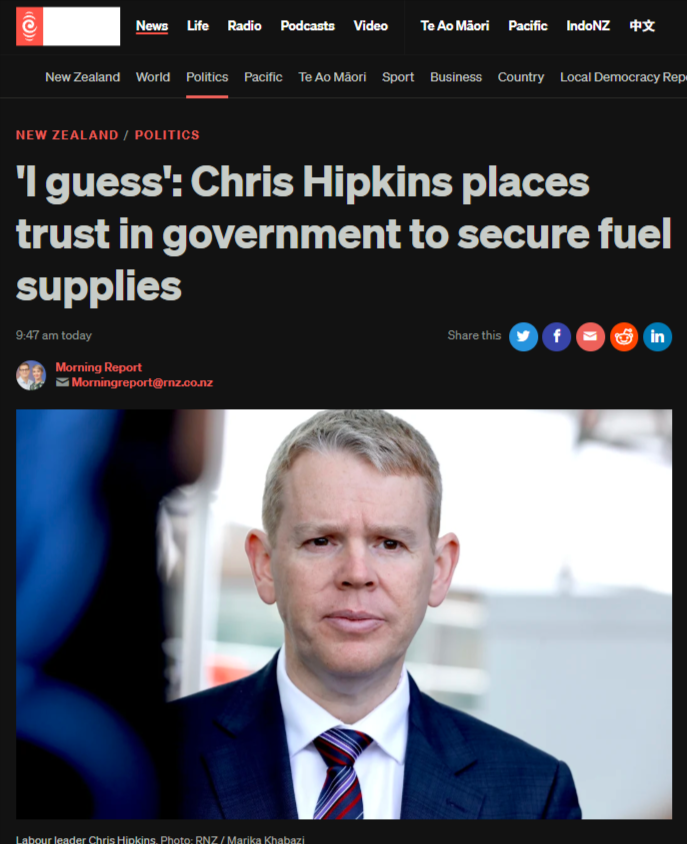
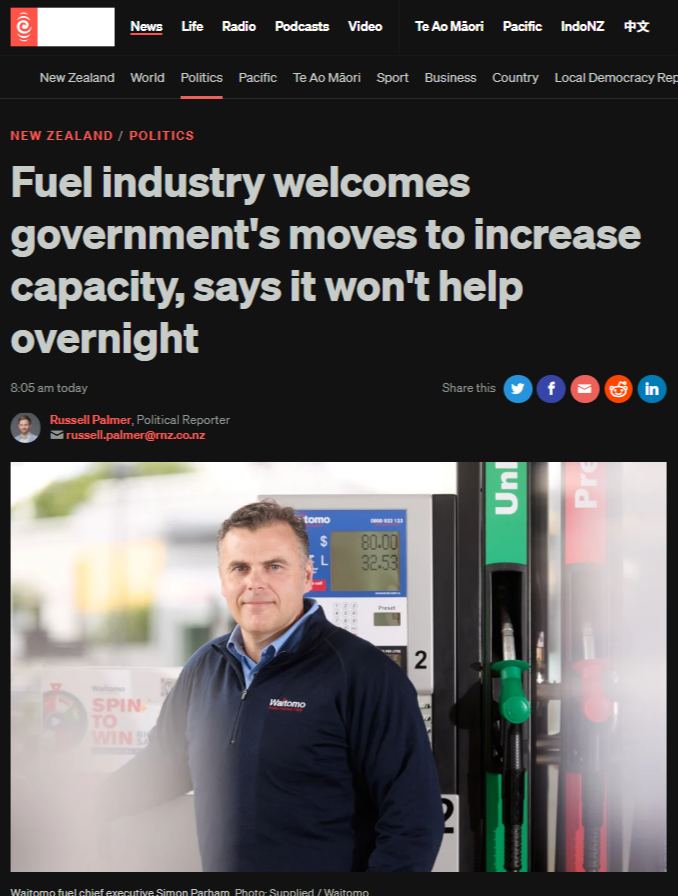
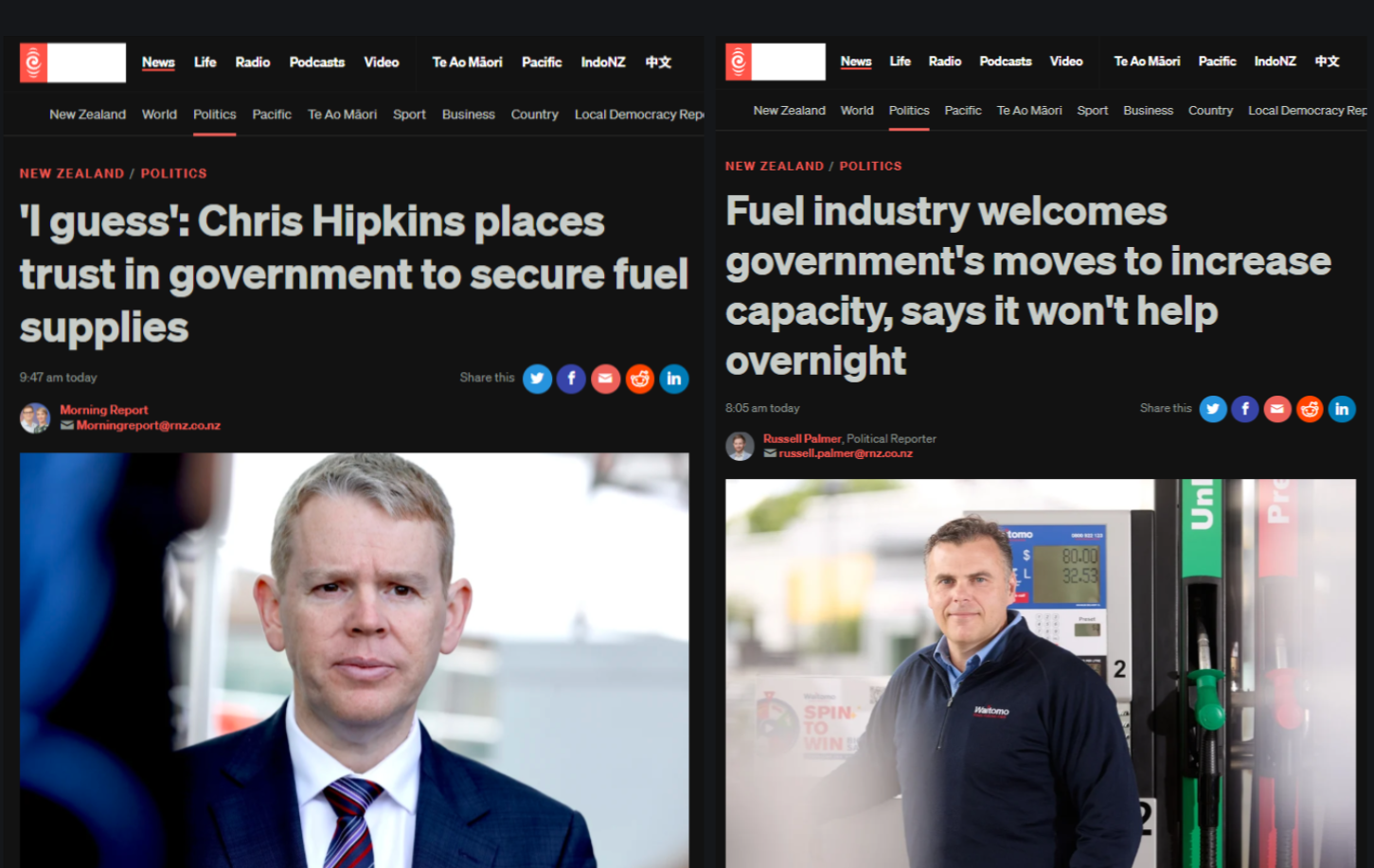
https://www.rnz.co.nz/news/political/591099/i-guess-chris-hipkins-places-trust-in-government-to-secure-fuel-supplies; https://www.rnz.co.nz/news/political/591075/fuel-industry-welcomes-government-s-moves-to-increase-capacity-says-it-won-t-help-overnight
Ko te Aho Matua | The First Thread: The Burning Waka
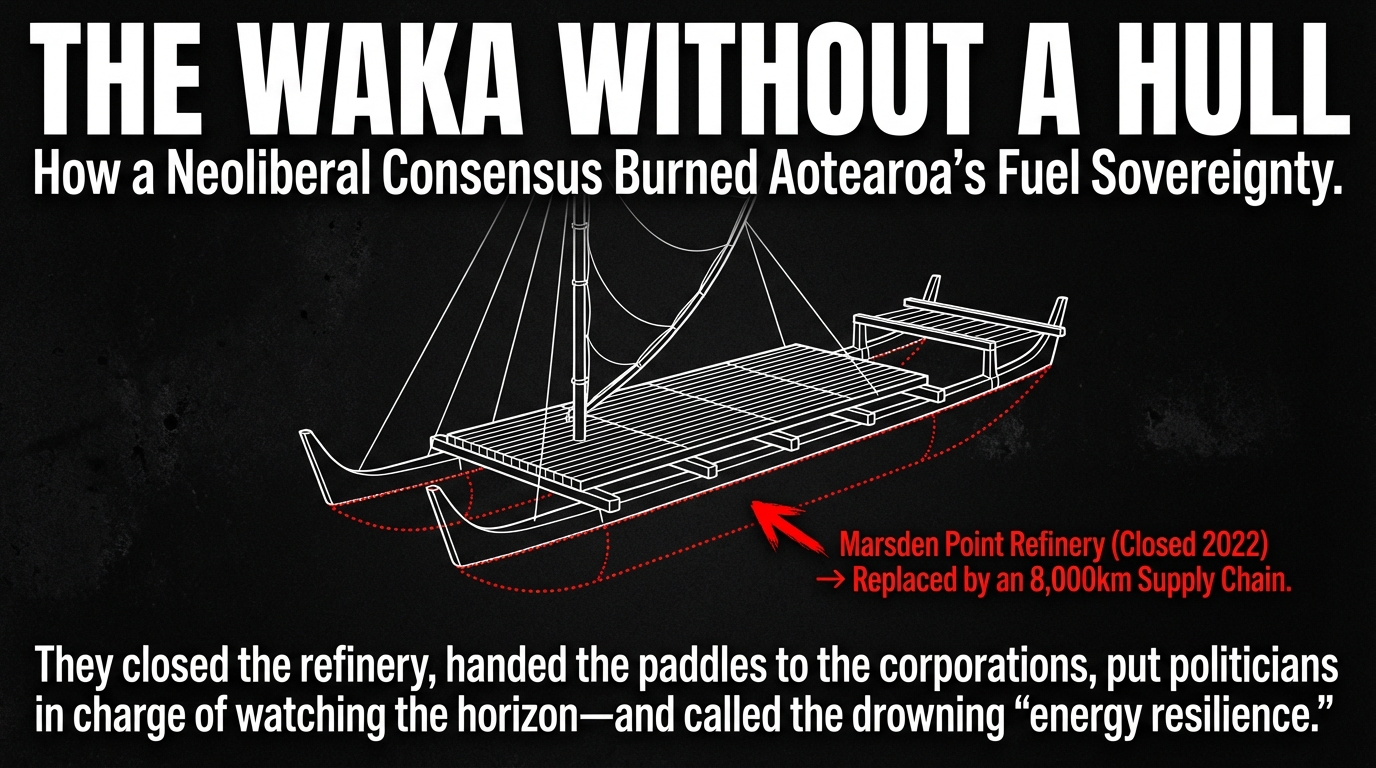
Imagine a waka hourua — a great double-hulled voyaging canoe, built over generations, tested in every storm the Pacific could throw at it. Now imagine that in 2022, the captain — a Labour captain — listened to a smooth-voiced merchant who explained, very politely, that the hull was "commercially unviable." That building your own hull was "inefficient." That it was cheaper, smarter, more modern to simply buy your hull from someone else, whenever you needed it, from suppliers 8,000 kilometres away across seas now lit by the fires of war.
So the captain agreed. The hull was torn apart. The craftspeople who knew how to build it were scattered. The tools were sold. And the waka was relaunched — light, lean, market-ready — with no hull of its own, entirely dependent on the goodwill of distant merchants who, as it happens, are currently preoccupied with a war in the Strait of Hormuz.
That waka is Aotearoa's fuel supply. And right now, it is taking on water — fast.
The Deep Dive Podcast
Listen to a lively conversation between two hosts, unpacking and connecting topics in the sources of this essay.
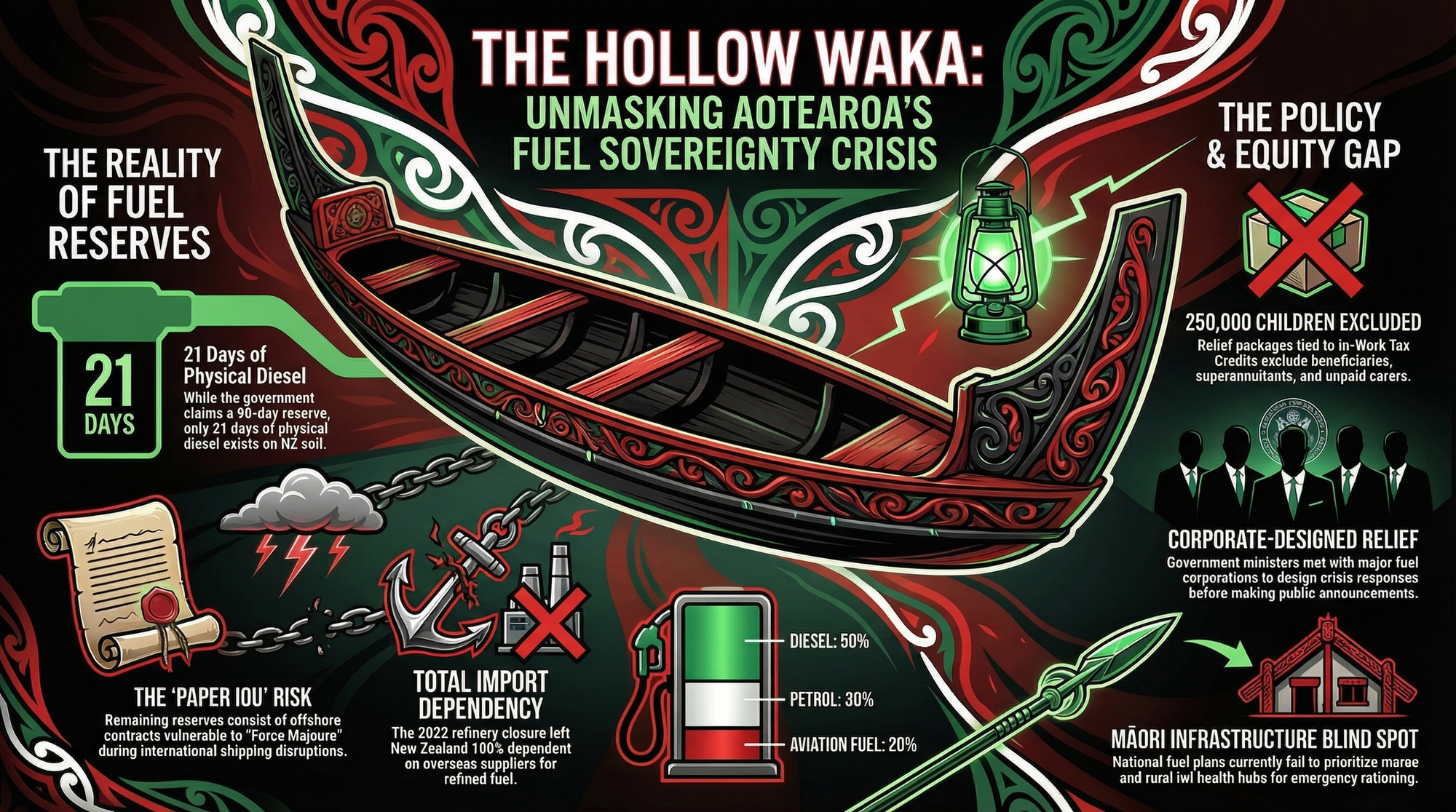
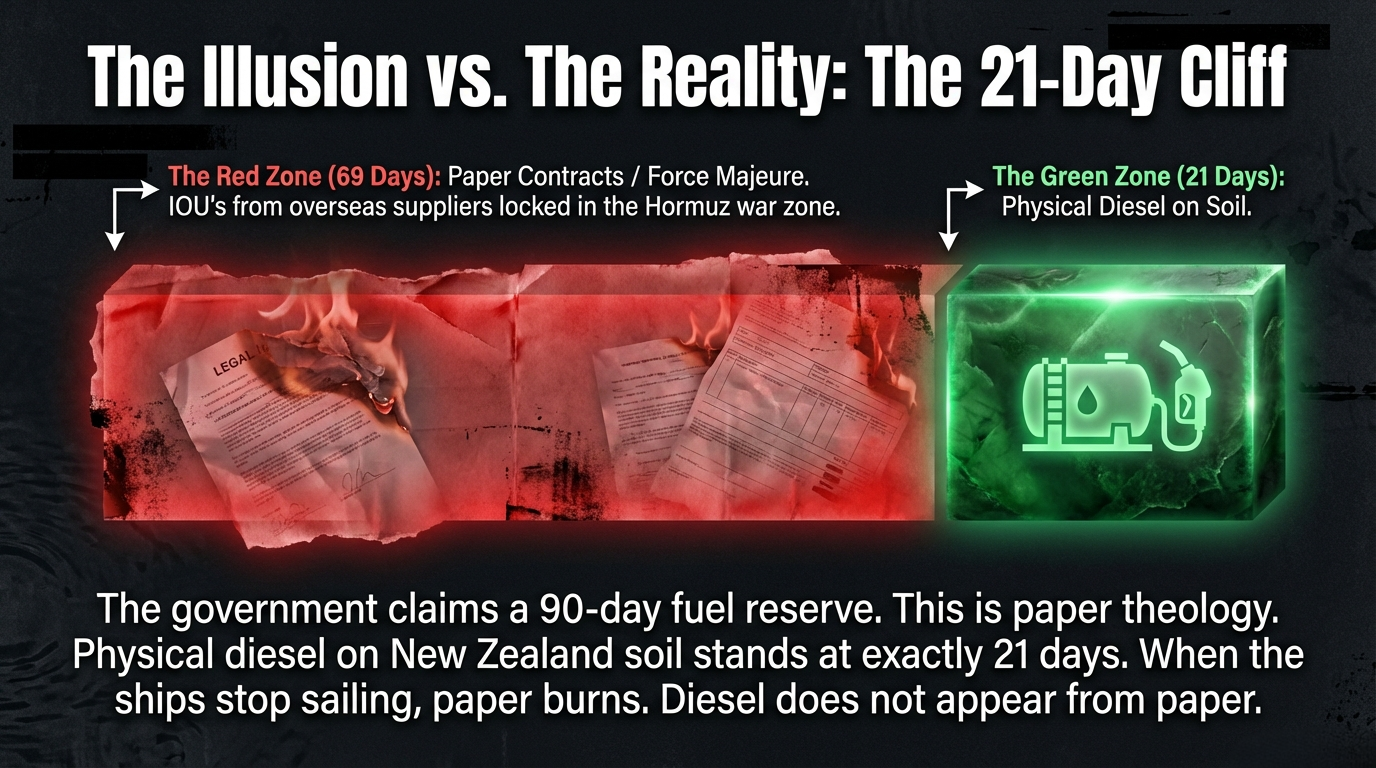
The Marsden Point refinery — the only oil refinery Aotearoa ever had — was closed in 2022 under Labour, cheered on by the same market theology that has kneecapped this country's sovereignty at every turn. As The Māori Green Lantern documented in "The Pātaka Is Ash", the government does not have 90 days of physical fuel. Physical diesel on New Zealand soil stands at 21 days. The rest is paper — IOUs from overseas suppliers now exercising Force Majeure as the Strait of Hormuz crisis deepens. Paper burns. Diesel doesn't appear from paper when the ships stop sailing.
Ko te Taniwha i Ngā Tai | The Monster in the Tides: What Is Actually Happening
This is not a weather event. It is not an act of Atua. It is the direct, documented, traceable consequence of ideological choices made by people with names and salaries — choices that stripped Aotearoa of its energy sovereignty and handed control of our most essential resource to the global market and its taniwha.
As RNZ reported, Prime Minister Luxon's grand diplomatic masterstroke in this crisis was a phone call to Singapore's Prime Minister — not a binding treaty, not a formal agreement, not a strategic reserve arrangement. A phone call. An informal nod between heads of government that carries exactly zero legal weight the moment Singapore decides it needs that fuel itself.
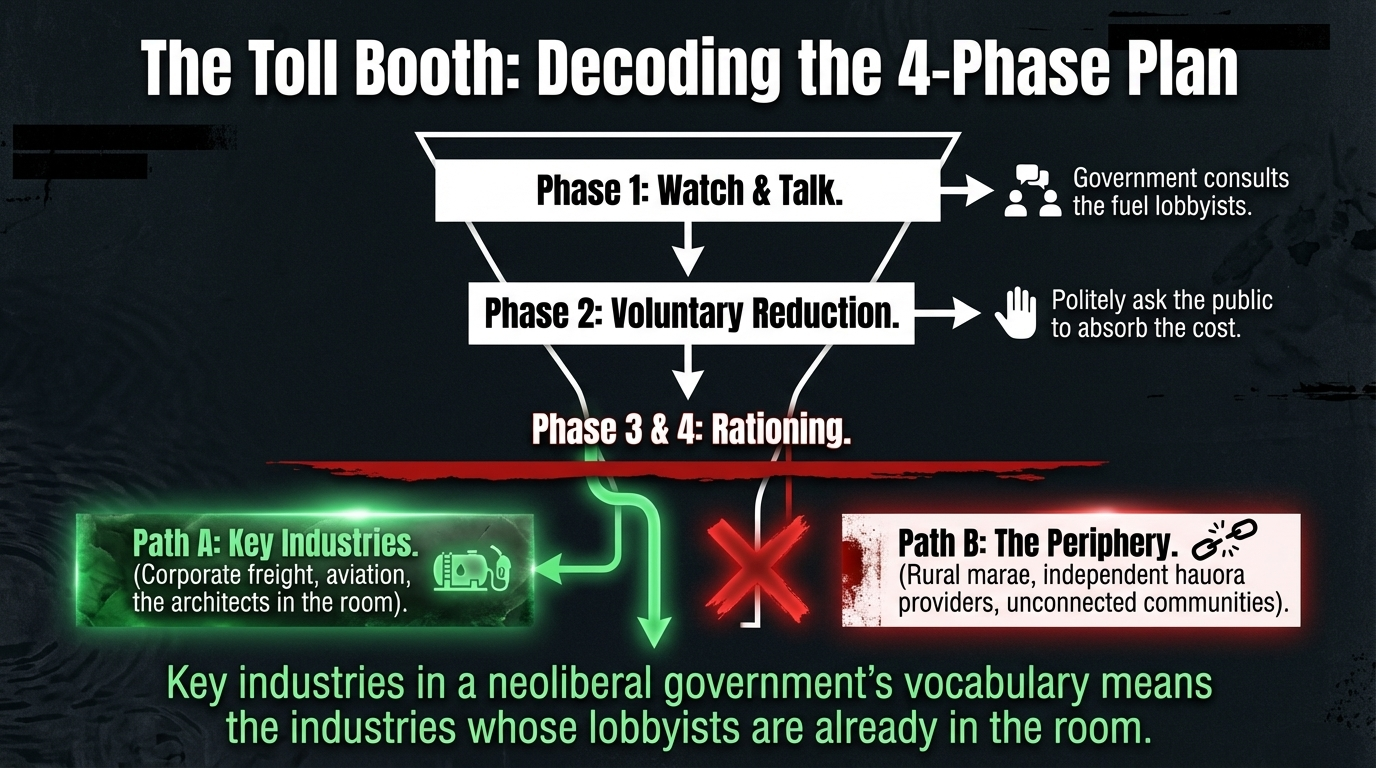
The government's four-phase Fuel Response Plan is structured as follows:
- Phase 1 (now): Watch. Monitor. Talk to the companies that profit from the crisis.
- Phase 2: Politely ask people to use less fuel.
- Phase 3 & 4: Ration. Prioritise "key industries."
"Key industries." In a neoliberal government's vocabulary, that means the industries whose lobbyists are already in the room. As RNZ revealed, Willis met with Z Energy, BP, Mobil, Timaru Oil Services and Gull before any public announcement. The same corporations whose profits soar every time the price spikes were invited to design the "relief." As The Māori Green Lantern documented in "Ka Noho i Roto i te Ahi", one of these is a government. One of these is a landlord collecting rent on your desperation.
Meanwhile, Associate Energy Minister Shane Jones — a man whose entire political identity is built around fossil fuel nostalgia and extraction evangelism — is one of two ministers managing this crisis. This is not irony. This is architecture. As the NZ Herald reported, Jones and Willis are the faces of this response. Jones, who cannot stop talking about reopening Marsden Point for political theatre while his own government's Fuel Security Study demolishes the economic case for it. The study is real. The nostalgia is a performance. And Māori are in the cheap seats being charged premium prices.
Te Aho Kāpiti | The Crossing Thread: Three Examples For The Western Mind
To the Western reader who may think this is "just politics" — allow me to make it concrete.
Example 1: The Kaumātua Who Cannot Get to the Doctor
A kaumātua in rural Northland drives 45 minutes to her nearest GP. There is no public transport. There is no alternative. Petrol is now $3.29 a litre. A monthly round of medical appointments costs her $80–$110 in fuel alone. The government's $50/week relief package? She does not qualify. She is retired. The In-Work Tax Credit requires employment. A superannuitant receives nothing under this package — zero, confirmed by 1News.
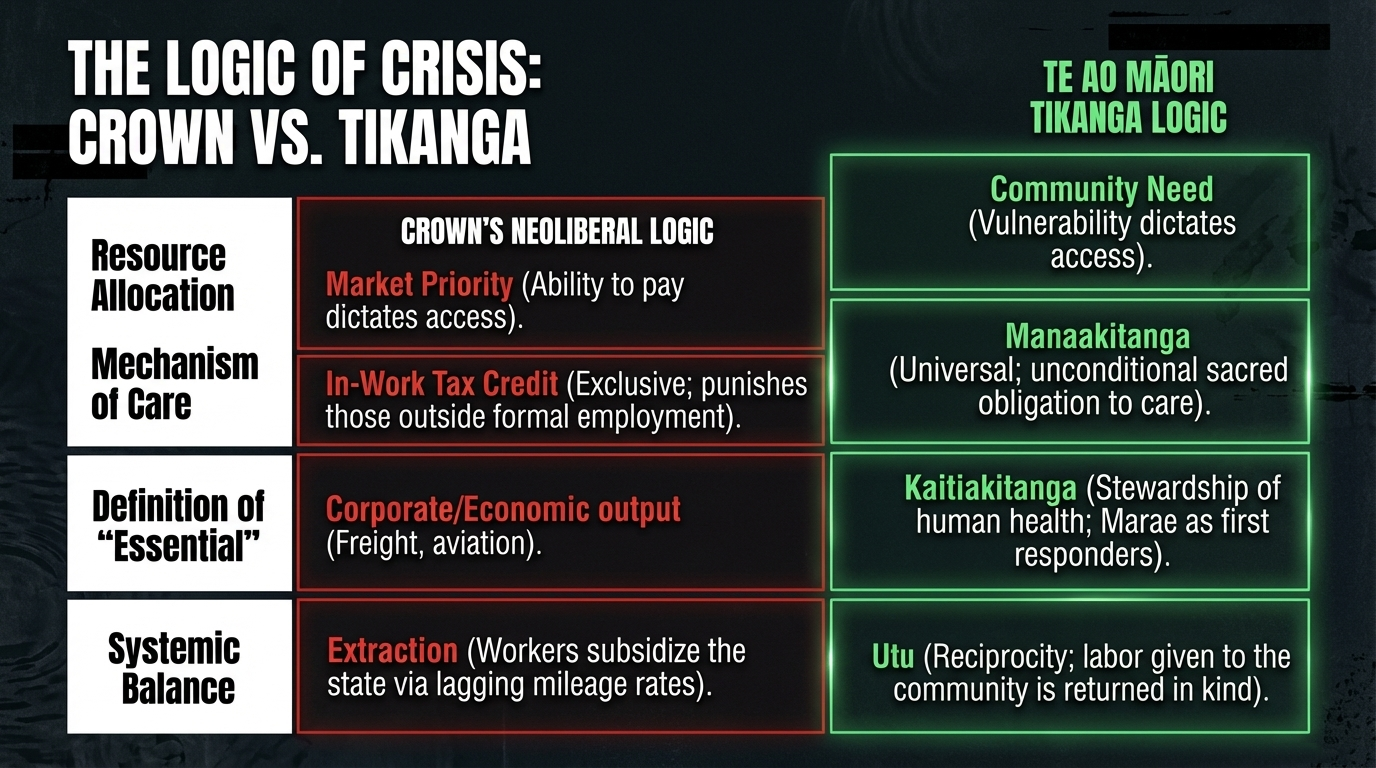
The tikanga violation here is absolute. In te ao Māori, manaakitanga — the sacred obligation to care for others — is unconditional. It does not come with an employment contract. The Crown's model of care is inverted: those who need the most receive the least. Those who need the least receive the most. This is not a market inefficiency. This is the colonial logic made policy.
The solution: Replace the In-Work Tax Credit mechanism with a direct universal fuel supplement reaching all low-income households — including beneficiaries, superannuitants, and unpaid carers — as CPAG and the Green Party have both recommended. Cost estimate: well within the $180 million in extra GST Willis is already collecting from higher pump prices, as The Māori Green Lantern calculated in "The Pātaka Beside the Strait".
Example 2: The Māori Care Worker Who Is Subsidising Willis's Tax Revenue
A Māori woman in South Auckland works as a home-based care support worker. She drives her own car to five clients a day. Her IRD mileage reimbursement rate has not kept pace with fuel prices. At $3.29/litre, she is now running at a personal loss to do work that keeps elderly people out of hospital — saving the Crown millions annually. The government's fuel package provides her $50/week. Her extra fuel costs have increased by approximately $40–60/week depending on her run.
She breaks roughly even — before accounting for the complexity of the In-Work Tax Credit repayment risk that Infometrics chief economist Brad Olsen warned about: households may receive a letter months later demanding money back.
This is not administration. This is a punishment system wearing a relief costume. Māori women are overrepresented in the care workforce and in regions where the road is the only option. The tikanga principle at stake here is utu — reciprocity and balance. When someone gives their labour, their vehicle, their wairua to sustain a community, the community returns that in kind. This government takes the labour, extracts the GST, pockets the efficiency savings, and sends the bill back to the worker.
The solution: Immediately increase IRD mileage reimbursement rates for care and support workers to reflect current fuel reality — a Green Party recommendation currently buried in fine print that neither major party has adopted.
Example 3: The Marae Generator and the 21-Day Cliff
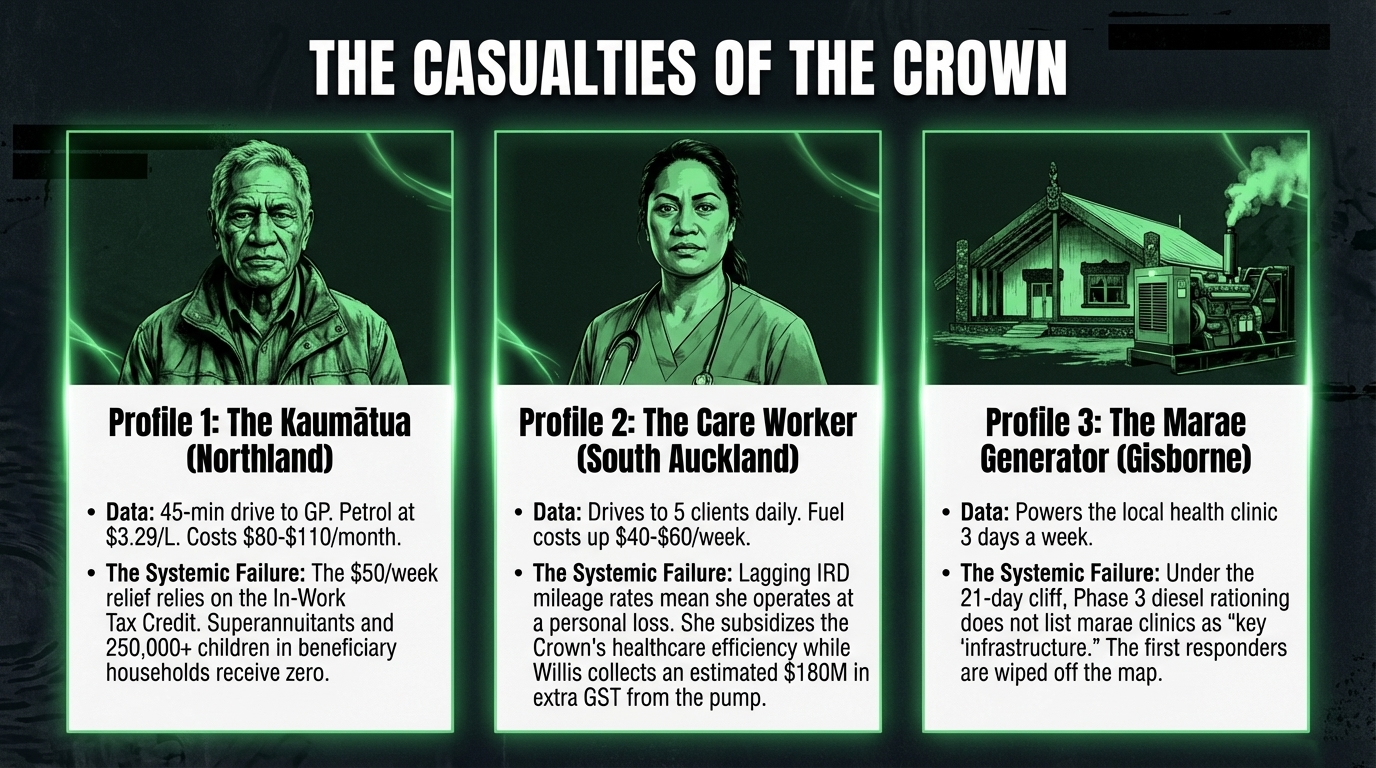
A marae in rural Gisborne runs a backup diesel generator that powers the health clinic it hosts three days a week. In Phase 3 or 4 of the government's Fuel Response Plan, diesel rationing prioritises "key industries" and "emergency services." A marae health clinic is not listed. It is not "key" under this framework. As The Māori Green Lantern revealed via the government's own Substack note, New Zealand has 21 days of physical diesel on soil. The rest is paper. If the Hormuz crisis tightens further and Phase 3 is triggered, that marae clinic faces rationing or closure.
This is kaitiakitanga — stewardship of the health and wellbeing of the community — being destroyed by a system that never mapped Māori infrastructure into its resilience planning. The tikanga says: the marae is the first responder. The Crown says: the marae is not on the list.
The solution: Immediate inclusion of iwi infrastructure — marae, hauora providers, rural community hubs — in the Phase 2 and Phase 3 priority frameworks, with co-governance over regional diesel allocation as recommended by The Pātaka Beside the Strait.
Ko Hīpini — He Aha Tōna Mahi? | Hipkins: The Hollow Paddle
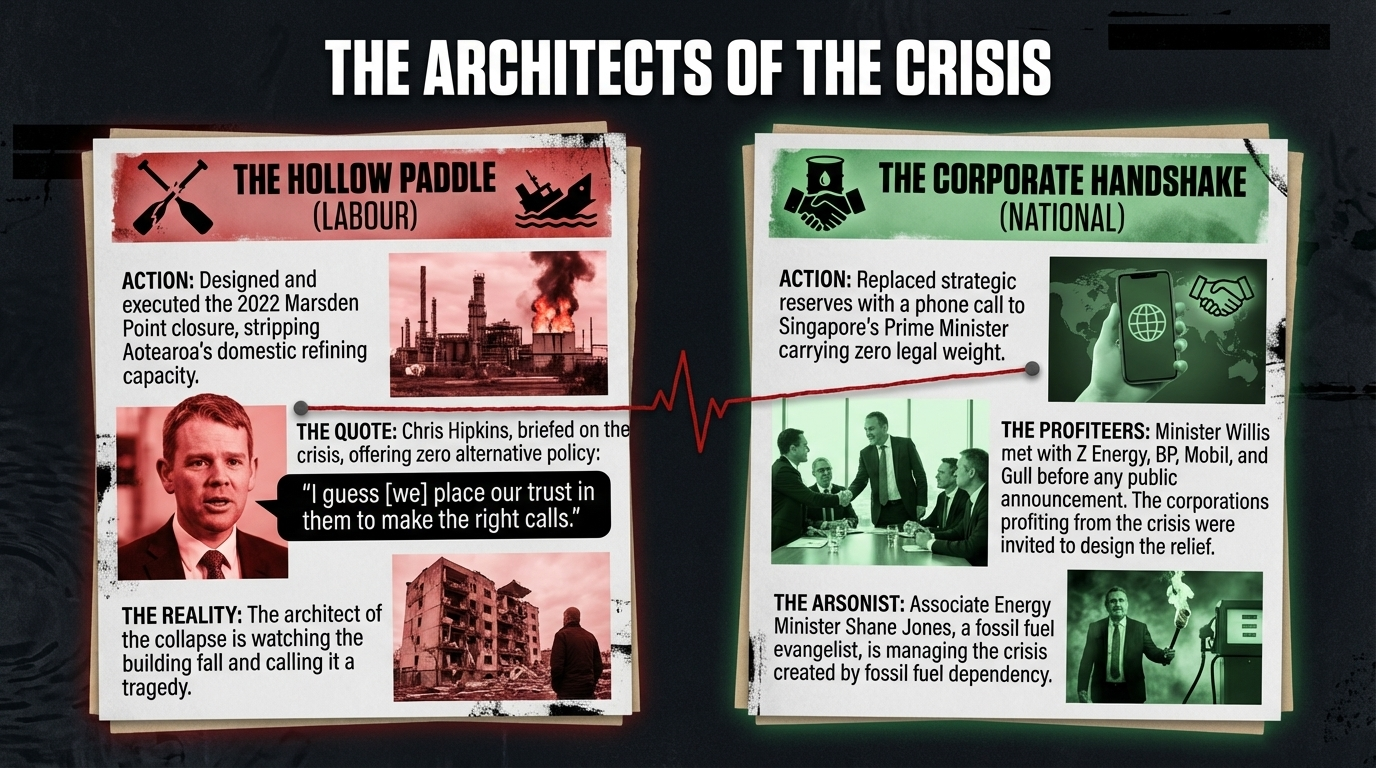
Now. To the second corpse floating in the water: the Leader of the Opposition.
Chris Hipkins was briefed by officials from DPMC and MBIE. He came out saying there were "a number of questions officials were unable to answer," as RNZ reported. He said "I guess" he trusts the government. He acknowledged many New Zealanders would get nothing from the package. He called the four-phase plan "welcome with significant gaps." He offered no alternative policy. He said "the onus was on the Government to present ideas," as NZ Herald documented.
"I guess."
That is the sound a nation makes when it is drowning and the lifeguard is busy wondering whether the pool rules technically require him to jump in.
Let's be precise about what Hipkins represents here. As The Māori Green Lantern documented in "Clockwise Betrayal", Labour did not stumble into the Marsden Point closure — they designed it. They delivered it. They cheered the market logic that stripped Aotearoa's energy sovereignty and handed it to Z Energy, BP, and the Hormuz war zone. Hipkins is not surveying the damage from the outside. He helped pour the foundations.
His studied vagueness —
"I guess I trust them"
— is not modesty. It is complicity trying to avoid accountability.
Asking a man who approved the architectural drawings to critique the building's collapse is not opposition. It is farce.
Ngā Hononga Huna | The Five Hidden Connections
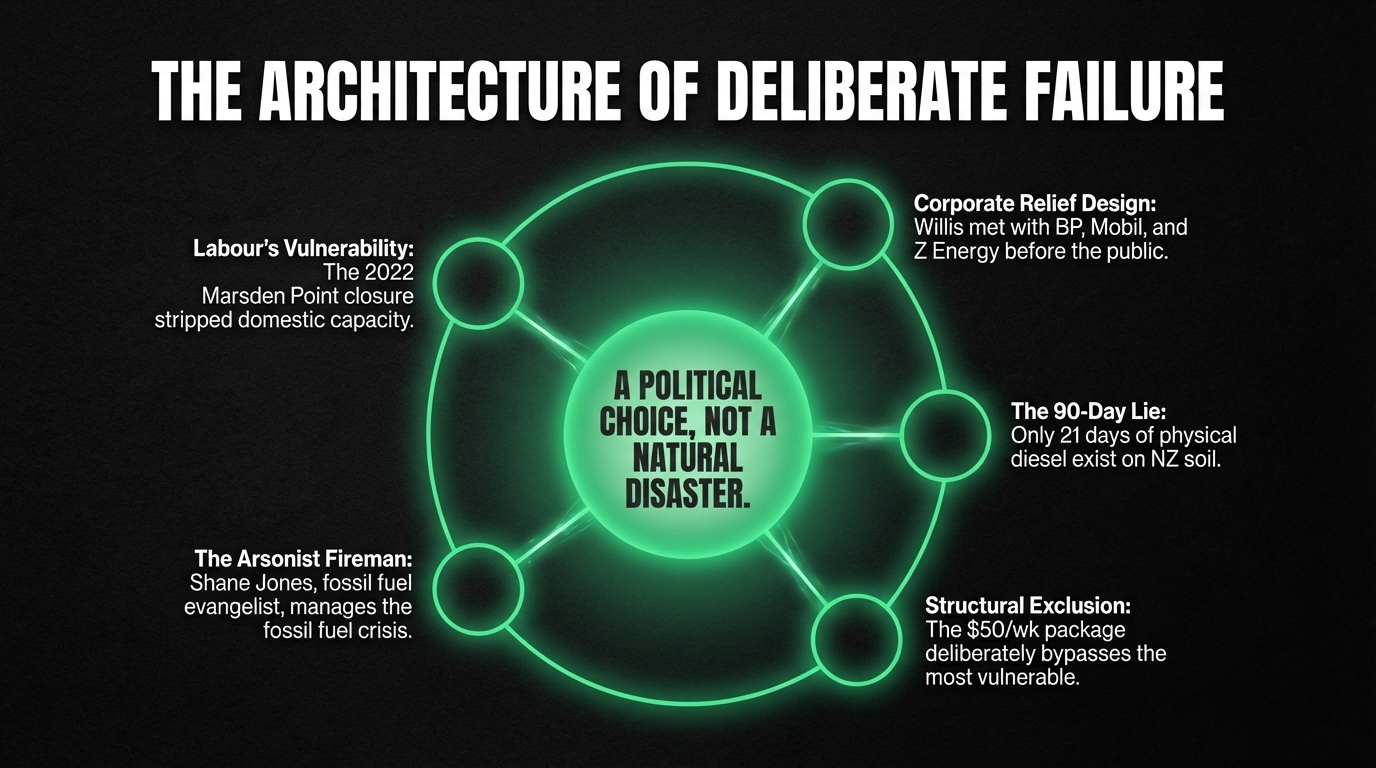
These are the threads the mainstream media does not draw clearly enough. They are all verified:
1. Labour built the vulnerability — The 2022 Marsden Point refinery closure was a Labour policy, executed under the same neoliberal market logic this National-ACT-NZ First government now exploits. Both parties own this failure. As Russell McVeagh's analysis confirms, the decision stripped Aotearoa of domestic refining capacity and created total import dependence.
2. The corporations designed their own relief — Willis met with Z Energy, BP, Mobil, Timaru Oil Services and Gull before any public announcement, as 1News documented. The industry that profits from high prices was in the room designing the response to high prices.
3. The 90-day lie — The government's "90 days of fuel" claim is misleading. As The Māori Green Lantern Substack exposed, physical diesel on New Zealand soil is 21 days. The remainder are paper contracts from overseas suppliers now invoking Force Majeure.
4. The $50/week package structurally excludes the most vulnerable — 250,000+ children in beneficiary households receive zero. Superannuitants receive zero. Unpaid carers receive zero. The extra GST revenue Willis is collecting from higher pump prices — estimated at $180 million — exceeds what it would cost to cover all excluded households. She is collecting the money. She is choosing not to spend it on the vulnerable.
5. Shane Jones is the Associate Energy Minister — The man whose political brand is fossil fuel nostalgia and whose career has been defined by resource extraction advocacy, as The Māori Green Lantern documented in "The Pātaka Beside the Strait", is now managing the crisis created by fossil fuel dependency. The arsonist is running the fire brigade.
Ngā Tuhinga o Mua | Previous Māori Green Lantern Essays on This Crisis
This essay builds on a body of documented investigative mahi. The following are essential reading:
- "WHEN THE PETROL TANKER RUNS DRY: How a White Supremacist Neoliberal Government Left Māori at the Bottom of the Fuel Queue" — 14 March 2026 — The foundational analysis establishing that the fuel crisis is not an accident but a destination.
- "THE PĀTAKA IS ASH: How Nicola Willis and Christopher Luxon Poured Petrol on the Poor" — 23 March 2026 — Exposing the $373m relief package that structurally excludes the most vulnerable while Willis pockets $180m in extra GST.
- "Ka Noho i Roto i te Ahi: The Government's Toll Booth to Hell" — 22 March 2026 — Dissecting the architecture of deliberate failure in the IWTC mechanism and the Green Party's open gate alternative.
- "THE EMPTY TANK: How a White Supremacist Neoliberal Government Left Its Carers on the Side of the Road to Die" — 26 March 2026 — The human cost to care workers, focused on Māori women in the care economy.
- "The Pātaka Beside the Strait" — 25 March 2026 — Deconstructing Peters' Marsden Point fantasy and mapping the real solutions including regional storage with iwi co-ownership.
- "PANTOMIME OF THE DYING WAKA: How Luxon's Hollow Helmsmen Stole Another Chief's Paddle" — 28 March 2026 — The most recent analysis of how the government's performance politics is substituting for genuine energy policy.
Ko te Kupu Whakamutunga | Rangatiratanga Is Not Waiting For Permission
Here is the truth that neither Luxon nor Hipkins will say.
Aotearoa's fuel vulnerability is not a natural disaster. It is a political choice — made by identifiable people, in identifiable rooms, for identifiable beneficiaries. The refinery was closed. The storage was never built. The strategic reserves legislation was delayed to 2028. The corporations were consulted first. The vulnerable were excluded by design. And when the taniwha arrived, the government held a press conference, handed out a phone call to Singapore, and asked the fuel companies what they thought should happen next.
Meanwhile, Māori tamariki — 21.5% of whom already live in material hardship, and whose whānau are up to three times more likely to experience energy hardship — are being asked to wait for the market to self-correct. The market will not self-correct. The market created the crisis.
The waka is without a hull. The helmsman is on the phone with Singapore. The opposition is watching and saying "I guess." And the fuel companies are welcoming the response.
Tūhoe says: He aha te mea nui o te ao? He tangata, he tangata, he tangata. What is the greatest thing in the world? It is people, it is people, it is people.
This government has answered that question: It is the market. It is the market. It is the market.
That is the real crisis. And naming it is where the resistance begins.
He Koha — Tautoko i Tēnei Mahi
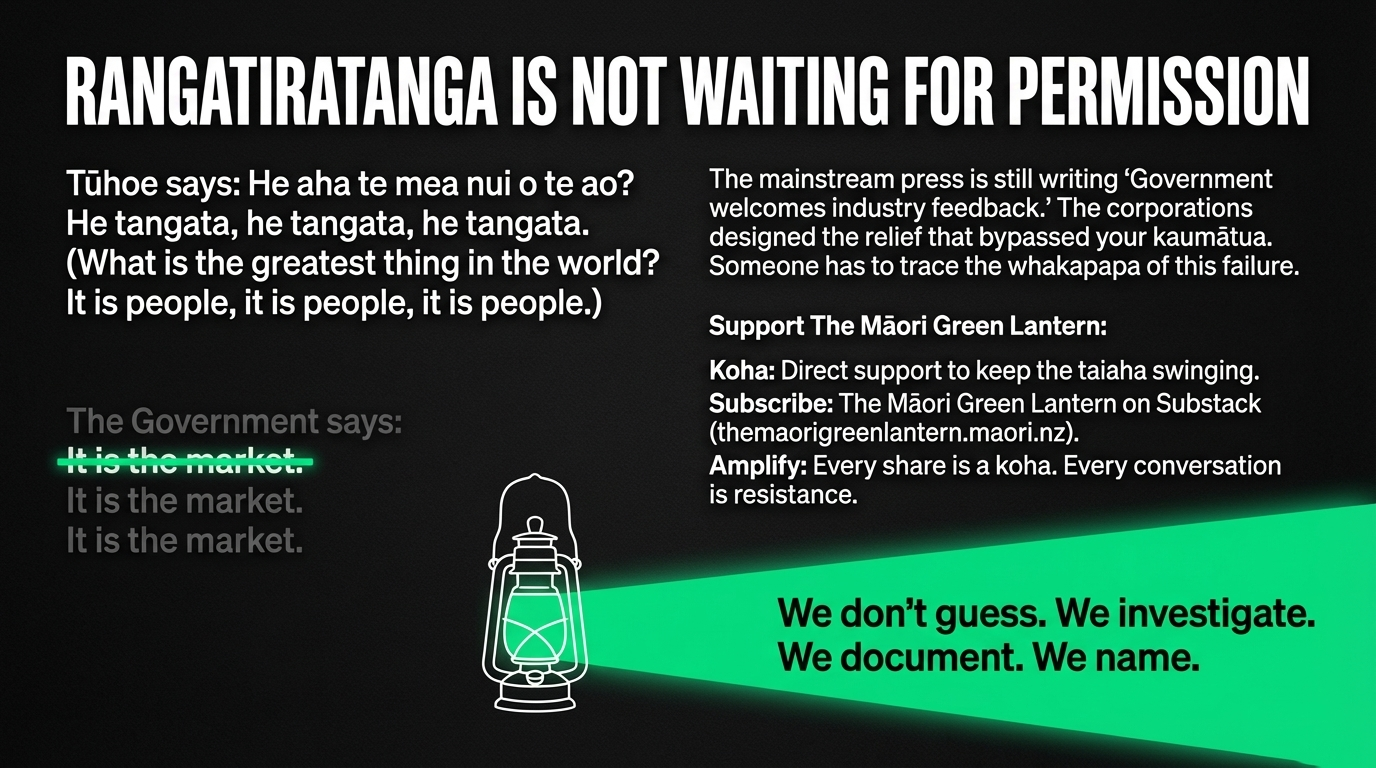
The fuel corporations designed the "relief" that bypassed your kaumātua. The paper contracts just voided themselves 8,000 kilometres away. And two politicians stood at podiums this week performing accountability while 250,000 tamariki were quietly excluded from help.
Someone has to name this. Someone has to trace the connections. Someone has to hold the line when the mainstream press is still writing "Government welcomes industry feedback."
This mahi — the investigation, the whakapapa tracing, the naming of names — is not funded by a corporation. It is funded by whānau who believe that accountability is taonga, not a subscription service.
Three pathways to support:
If you can koha directly to keep this taiaha swinging, visit Koha — Support The Māori Green Lantern.
If you want essays delivered directly to your inbox — and want to support with a subscription — join the whānau at The Māori Green Lantern on Substack.
If you prefer direct bank transfer: HTDM, 03-1546-0415173-000.
And if none of the above is possible right now — no worries, none at all — then read, share with your whānau, post it in your group chats, talk about it at the table. Follow and subscribe at themaorigreenlantern.maori.nz. Every share is a koha. Every conversation is resistance. Every person who sees through the performance is a thread in the net that holds.
The pātaka is on fire. The corporate interests are charging entry. And somewhere in Wellington, Chris Hipkins is saying "I guess" he trusts the government.
We don't guess. We investigate. We document. We name.
Kia kaha, kia māia, kia manawanui.
— Ivor Jones, The Māori Green Lantern
Research conducted 31 March 2026.