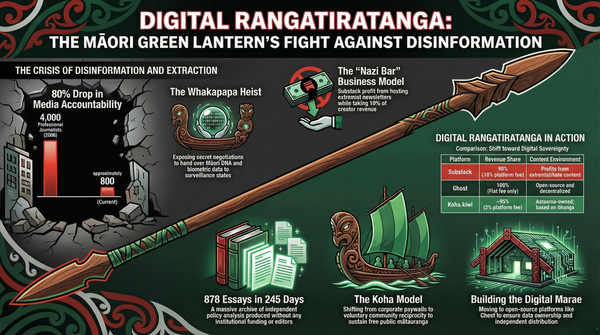
"THE WHAKAPAPA HEIST: How a White Supremacist Government Unlocks the Vault of Māori DNA and Hands the Key to a Fascist Surveillance State" - 26 February 2026
They want your face. Your fingerprints. Your iris. Your DNA. Your children's data. And they're negotiating the handover in secret — to an administration that disappears people off streets in masks.

Kia ora e te whānau,
There is a vault in this country. It does not hold gold or currency. It holds something infinitely more precious — the biometric blueprint of every person who has ever been fingerprinted, photographed, swabbed, or scanned by a New Zealand state agency.
Inside that vault is your whakapapa, encoded in DNA. Your tūpuna, compressed into a strand of protein. Your mokopuna's future, reduced to a data point.
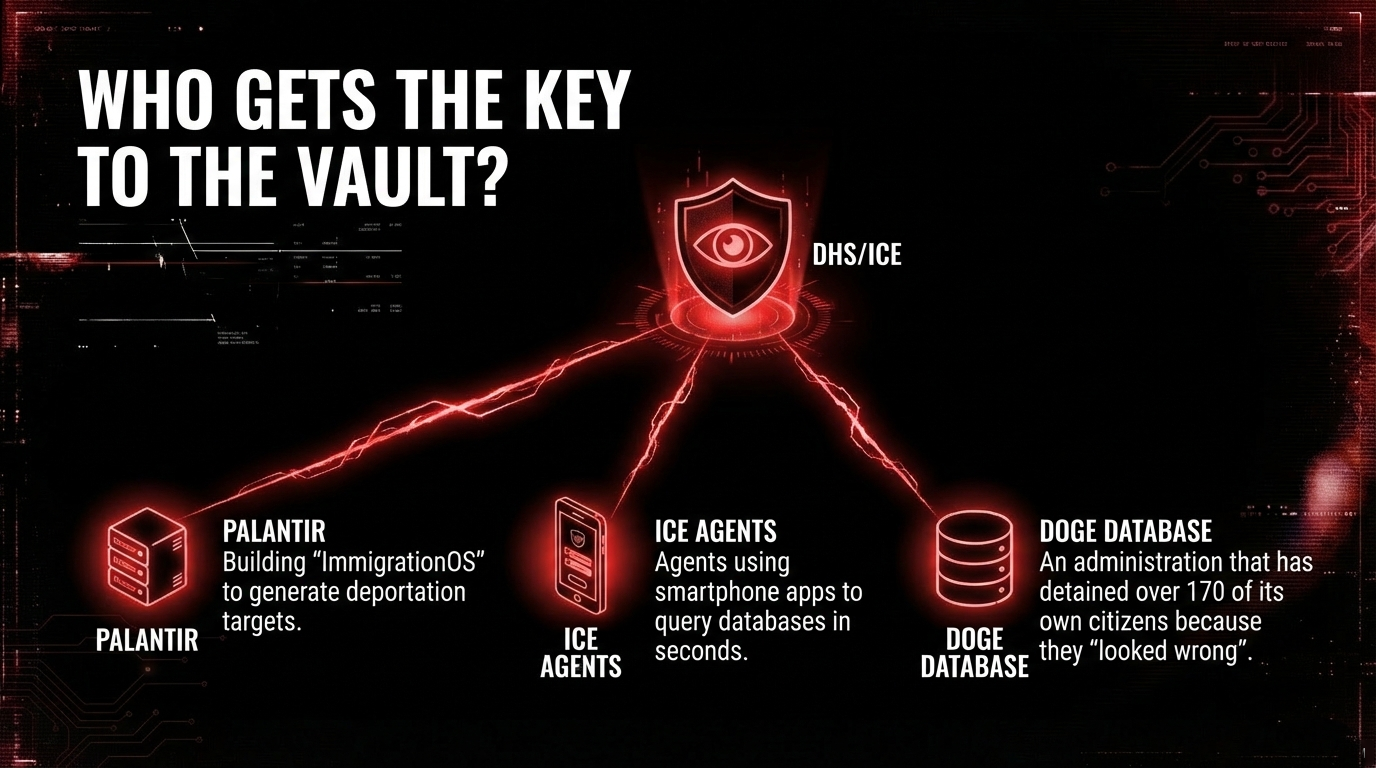
And right now — today, this week — the Luxon-Seymour-Peters coalition government is negotiating to hand the key to that vault to the Trump administration's Department of Homeland Security: the same government that deploys masked agents who disappear people off streets, the same government building a Palantir-powered deportation machine that uses IRS tax data, Medicaid records, and facial recognition to hunt human beings, and the same government whose own border agents have detained over 170 American citizens — pointing guns at children aged six and eight — because they looked wrong.
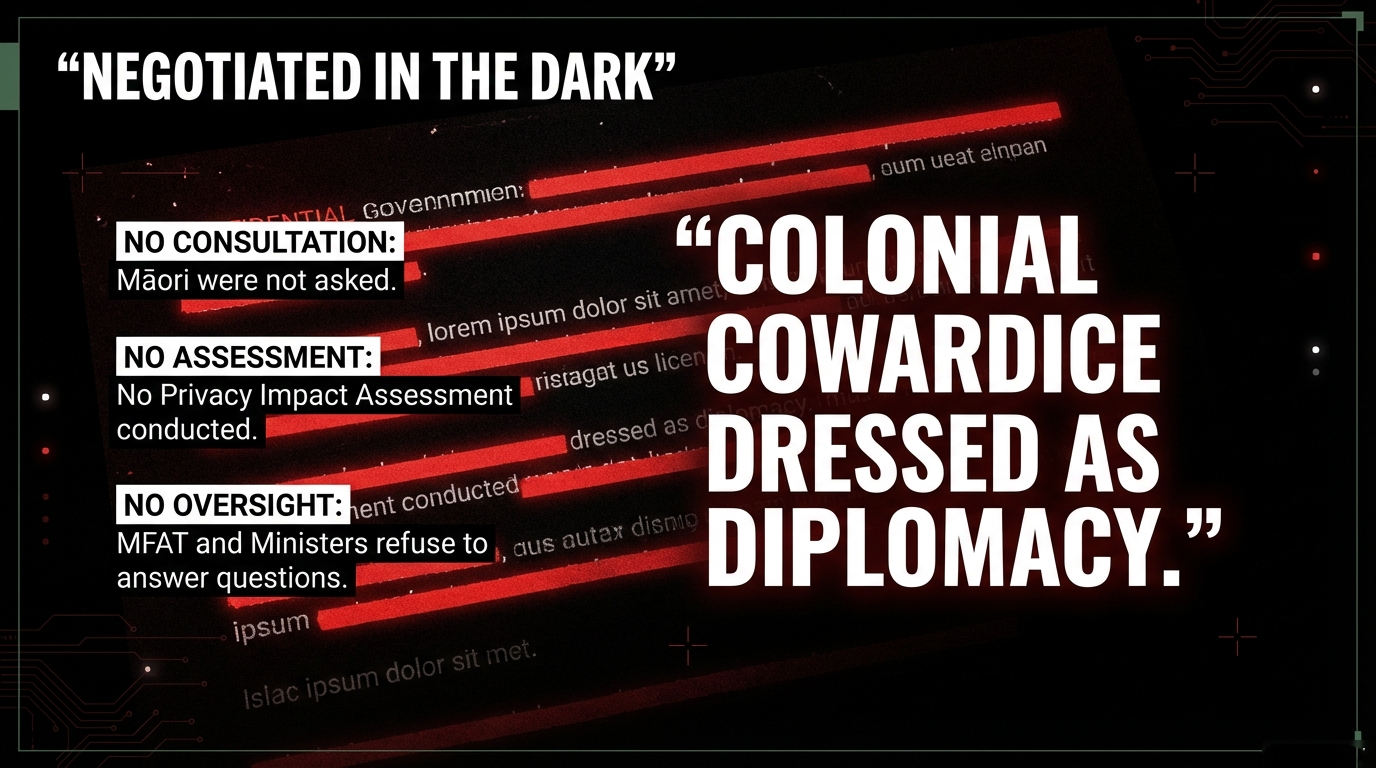
The New Zealand government has not told you what data it plans to share. It has not told Parliament. It has not conducted a Privacy Impact Assessment. It has not consulted Māori. It has not consulted anyone.
The Ministry of Foreign Affairs and Trade offered RNZ a single line:
"New Zealand officials continue to discuss the requirements and scope of an Enhanced Border Security Partnership with the United States."
Then it refused to answer every follow-up question.
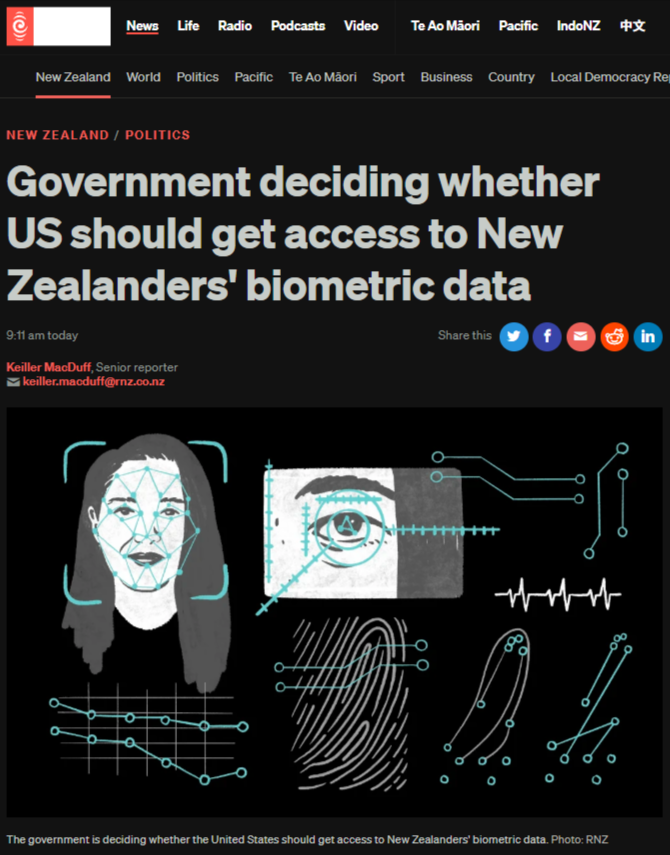
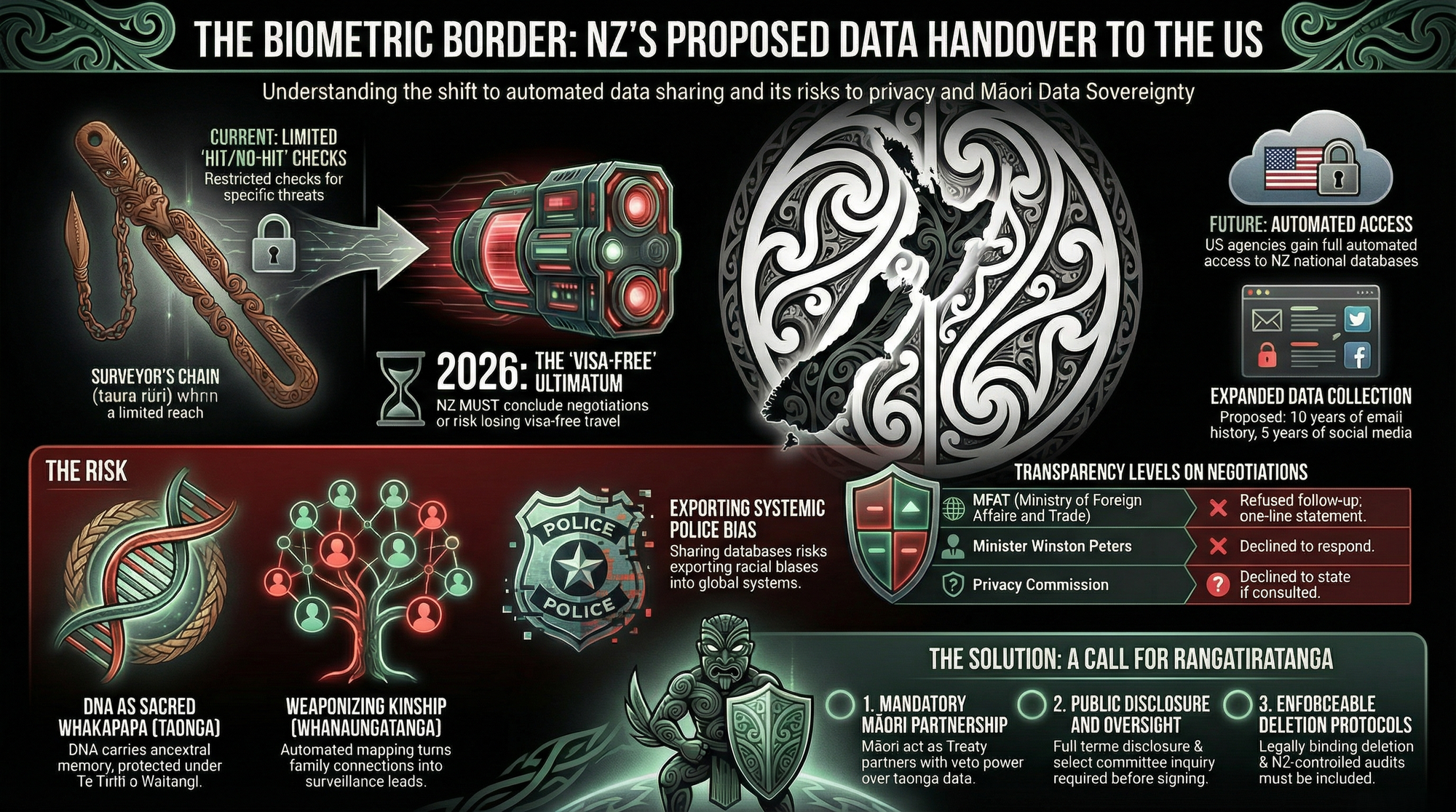
Winston Peters' office declined to respond. The Privacy Commission declined to say whether it had even been consulted. This is not caution. This is colonial cowardice dressed as diplomacy — a government that governs for no one except the powerful, negotiating the surrender of indigenous data to a fascist surveillance apparatus, and telling the public to mind its own business, as revealed by RNZ.
The taiaha is raised, whānau. Let us name what they are doing — and what it means for every strand of DNA that carries the whakapapa of this land.
The Taonga in the Vault: What They're Selling and Why It Matters
What Is an Enhanced Border Security Partnership?
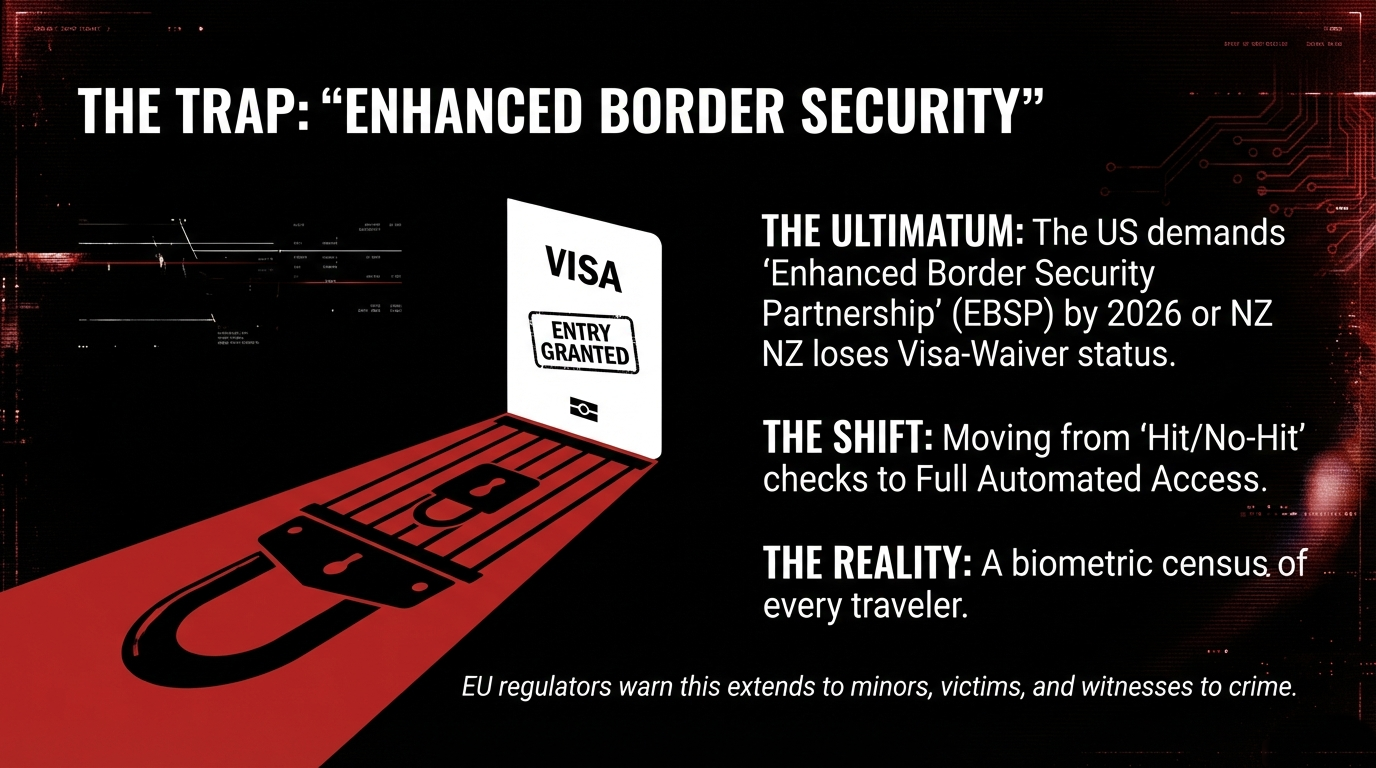
The United States has given the 42 countries in its Visa Waiver Program — including New Zealand — until the end of 2026 to conclude Enhanced Border Security Partnership (EBSP) negotiations or lose visa-free travel status.
The threat is simple: comply or your citizens queue for visas. The compliance is not simple at all.
Existing biometric sharing between Five Eyes countries — via the Migration 5 arrangement — operates on a "hit/no-hit" basis. Your fingerprint is checked against a watchlist. If there is no match, the query returns nothing. If there is a match, further data is shared case by case. Immigration New Zealand received 727,000 data-checking requests from its four partners in one reporting period alone, as confirmed during a select committee hearing reported by RNZ.
But EBSPs are different. According to critics and EU negotiation documents, EBSPs could provide full automated access to other countries' national databases, as RNZ reported. Not a knock on the door. A key to the house.
The US Department of Homeland Security's own privacy assessment noted biometric information could be used to vet any individual "encountered" during border inspections or immigration investigations. European regulators warned this could extend to minors, victims, or witnesses to crime, as RNZ detailed.
What Data Are We Talking About?
Late in 2025, the Trump administration announced plans to require visitors from visa waiver countries to disclose:
- Five years of social media history
- Email addresses from the past decade
- Five years of phone numbers
- Personal details of family members
- Face, fingerprint, DNA, iris, and other biometric data
This is not border security. This is a biometric census of every person who dares to visit the United States — and every person connected to them — as RNZ revealed and CNN confirmed.
Former Foreign Minister Phil Goff called it McCarthyism:
"It's almost like we're going back in history to the 1950s, where if you had ever been a member of the Communist Party you were banned from getting into the United States."
The Whakapapa Dimension: Why Māori DNA Is Not a Data Point
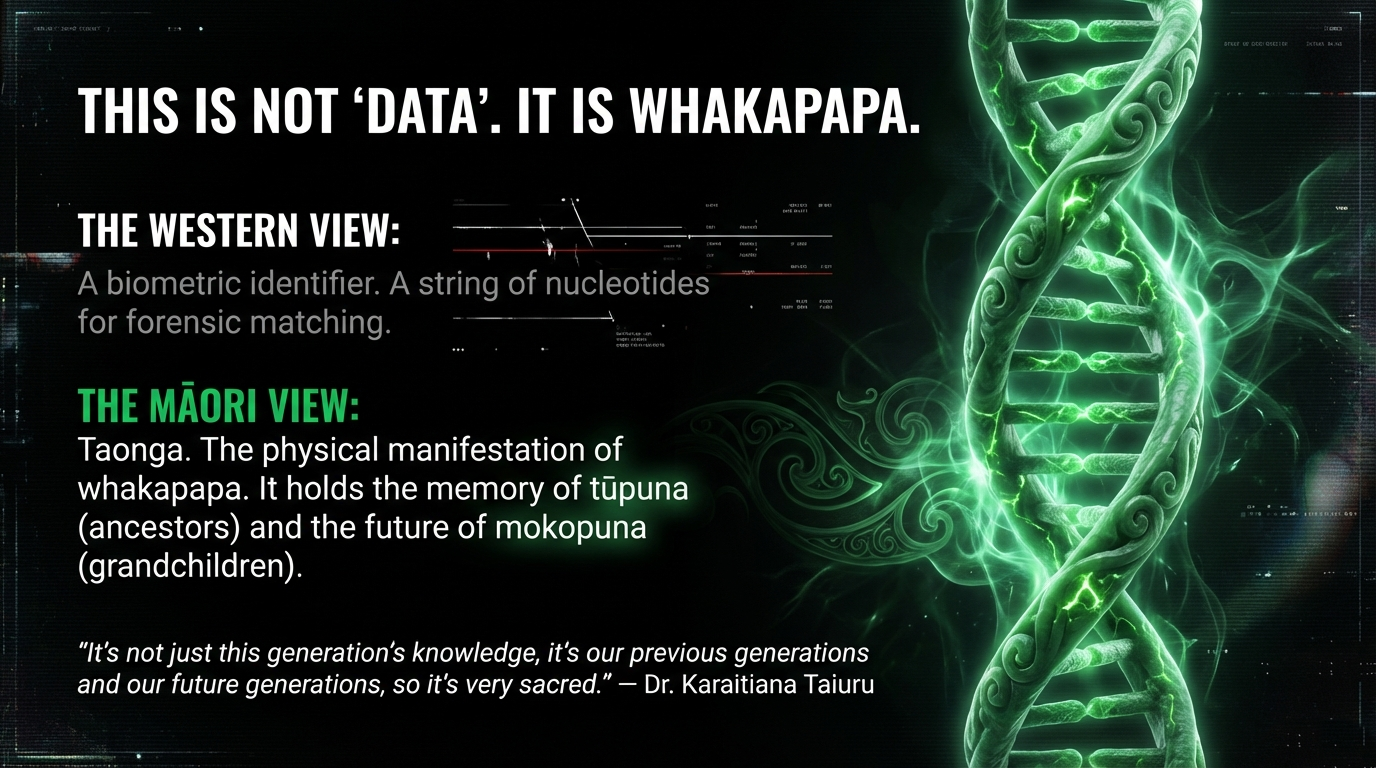
For the Western mind, DNA is a biological identifier — a string of nucleotides useful for forensic matching. For Māori, DNA is the physical manifestation of whakapapa itself. It carries the memory of tūpuna. It encodes the relationships between hapū. It is, as Dr Karaitiana Taiuru told RNZ, "not just this generation's knowledge — it's our previous generations and our future generations, so it's very sacred."
The Waitangi Tribunal, in WAI 2522, found that Māori data is a taonga and that the Crown has Treaty obligations to actively protect it. The Tribunal pulled no punches: "Māori rights and interests were not given much (or any) particular consideration" in digital trade negotiations, as Bilaterals.org documented — a finding that applies with devastating force to biometric negotiations the Crown is conducting today without a whisper of Māori consultation.
Dr Taiuru's Māori Data Governance Report confirms that WAI 2522 defines Māori Data Sovereignty as: "The principles, structures, accountability mechanisms, legal instruments, and policies through which Māori exercise control over Māori data." The Tribunal affirms this is "not symbolic — it involves active governance and authority, rooted in Te Tiriti rights and tikanga."
To hand Māori biometric data to a foreign government — without consultation, without consent, without safeguards — is not merely a privacy breach. It is a Te Tiriti breach. It is the Crown doing what it has done for 186 years: treating the bodies of tangata whenua as raw material for extraction.
The Machine on the Other End: What Happens to Your Data in America
This is not abstract. This is the machine that receives the key to the vault.
Palantir's Deportation Targeting System
The Trump administration has awarded Peter Thiel's Palantir a new $30 million contract to build ImmigrationOS — a system that integrates data across government agencies to create what 404 Media revealed is a tool that "populates a map with potential deportation targets, brings up dossiers on individuals, and generates 'confidence scores' regarding their addresses," as the Migration Policy Institute documented.
The Electronic Frontier Foundation reported that Palantir's ELITE tool uses generative AI to extract addresses and build "usable enforcement leads" — pulling data from the Department of Health and Human Services and other sources, allowing agents to identify entire neighbourhoods for raids based on data density.
DHS's AI surveillance arsenal continues to grow even as courts order it restrained, as Tech Policy Press reported.
ICE's Biometric Surveillance Arsenal
ICE agents now routinely use a smartphone app called Mobile Fortify — snap a photo of someone's face, collect contactless fingerprints, query multiple databases in seconds. The agency has renewed contracts with Clearview AI, which built its database by scraping billions of images from social media, as detailed by immigration law analysts.
ICE collects DNA from detainees and feeds it into FBI databases. Lawyers report cases where even US citizens, incorrectly detained, have had their DNA taken and retained.
DHS is now seeking a single biometric matching engine capable of processing faces, fingerprints, iris scans, and potentially voiceprints — potentially encompassing billions of records, as Wired reported.
The IRS Pipeline
The IRS is building a system to give ICE unprecedented access to confidential tax data — home addresses of millions of people targeted for deportation. When the acting IRS general counsel identified "multiple legal deficiencies" in ICE's request for 7.3 million taxpayer addresses, the administration pushed ahead anyway, as ProPublica revealed.
American Citizens Detained and Brutalised
A congressional investigation documented by ProPublica found that at least 170 American citizens were detained by immigration agents in 2025 alone. Nearly all were Latino. Agents dragged citizens from cars, detained them for days, fabricated claims of assault, used excessive force, denied medical care, and "treated children with reckless disregard for their safety." One citizen reported agents pointing guns at her children — aged six and eight — and zip-tying her fourteen-year-old daughter.
This is the apparatus New Zealand proposes to feed your biometric data into. This is the machine that gets the key to the vault.
Three Examples for the Western Mind: What This Means in Practice
Example 1: The Rangatahi in the Database — From Police Photo to ICE Targeting List
The Situation: In 2020 and 2021, NZ Police were caught unlawfully stopping rangatahi Māori — young people who had committed no offence — and demanding they hand over personal information and allow their photographs to be taken. These photos were uploaded to a centralised investigative app called OnDuty. The practice was widespread, involving mostly Māori youth approached without cause, as documented in a critical commentary published by AUT.
Simultaneously, Māori provide between 38 and 41 percent of all DNA samples in the criminal investigation regime despite comprising only 16.5% of the population, as the NZ Law Commission reported. The Privacy Commissioner later ordered Police to destroy thousands of unlawfully obtained fingerprints, as RNZ reported.
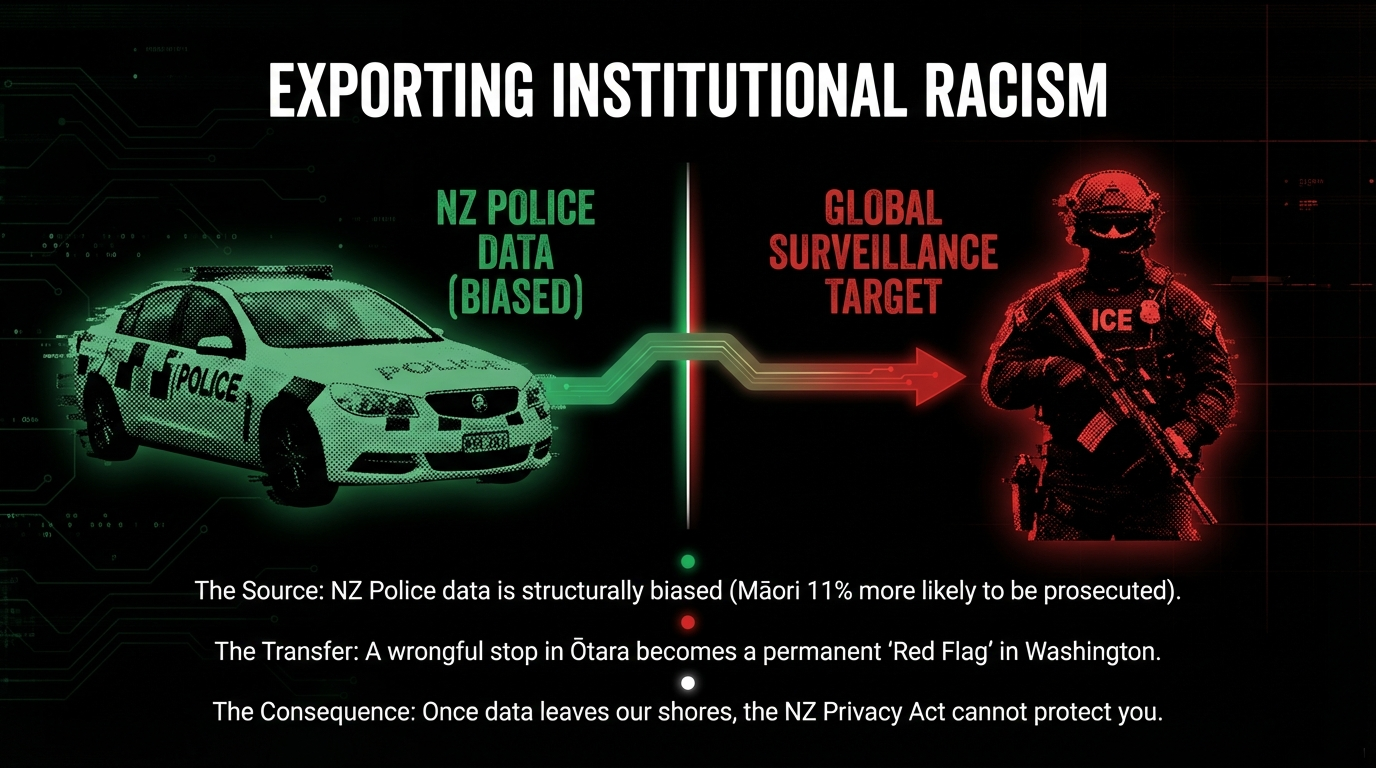
The EBSP Danger: Under a full automated data-sharing agreement, a rangatahi Māori whose photograph or fingerprint was unlawfully collected by NZ Police could have that data automatically accessible to US Homeland Security. If that rangatahi later applies for an ESTA to visit the United States — or if a whānau member does — ICE's Palantir system could flag them. A wrongful entry in a New Zealand police database becomes a permanent red flag in a foreign surveillance state.
Quantified Harm: Police are 11% more likely to prosecute Māori than NZ Europeans for the same offence, as the Understanding Policing Delivery report found. Māori are at least three times more likely to be apprehended. Seventy-six percent of complaints by Māori men are coded as "serious" versus 46% for Pākehā, as E-Tangata reported. RNZ confirmed the report identified "bias" and "structural racism" as systemic features of NZ policing.
The Tikanga Impact — Explained for the Western Mind: In tikanga Māori, every person carries the mana of their tūpuna. When the state collects biometric data without consent, it does not merely breach privacy — it violates tapu, the sacred boundary around the physical body. The face carries the mana of the individual. Tā moko, in particular, is not a tattoo — it is a visual expression of whakapapa itself. When Police capture facial images and feed them into international databases, they are circulating an individual's whakapapa through systems designed to surveil and punish. In tikanga terms, this is the digital equivalent of desecrating an urupā — disturbing the resting place of ancestral identity without permission, without karakia, without any recognition that a sacred boundary has been crossed.
Solution: Immediately halt all biometric data sharing until (1) a full Privacy Impact Assessment is conducted with Māori participation; (2) all unlawfully collected biometric data is confirmed destroyed and cannot be reconstructed; (3) Māori data sovereignty principles, as defined by the Waitangi Tribunal in WAI 2522, are embedded as non-negotiable preconditions in any international data-sharing agreement.
The Māori Green Lantern has previously documented the pipeline from police surveillance to incarceration in "The Nursery of Cages: How a White Supremacist State Built a Factory That Turns Brown Children into Prisoners and Calls It Law and Order", which traced how the same structural racism that produces biased police databases also feeds the $200,000-per-year prison-industrial pipeline.
Example 2: The Whānau Network Map — How One Traveller Exposes an Entire Hapū
The Situation: Under the Enhanced ESTA requirements, visitors must disclose personal details of family members, five years of phone numbers, email addresses from the past decade, and social media accounts, as RNZ reported. Under a full EBSP, the US could query New Zealand databases not just about the traveller but about people associated with travellers, as RNZ's investigation revealed.
Auckland University law professor Gehan Gunasekara warned RNZ: "If it's been shared for other ulterior purposes, maybe with ICE so that they can go after relatives of the people that are travelling or to build up profiles of people who have relatives in the United States who may be then imperiled — that's where we need to get safeguards."
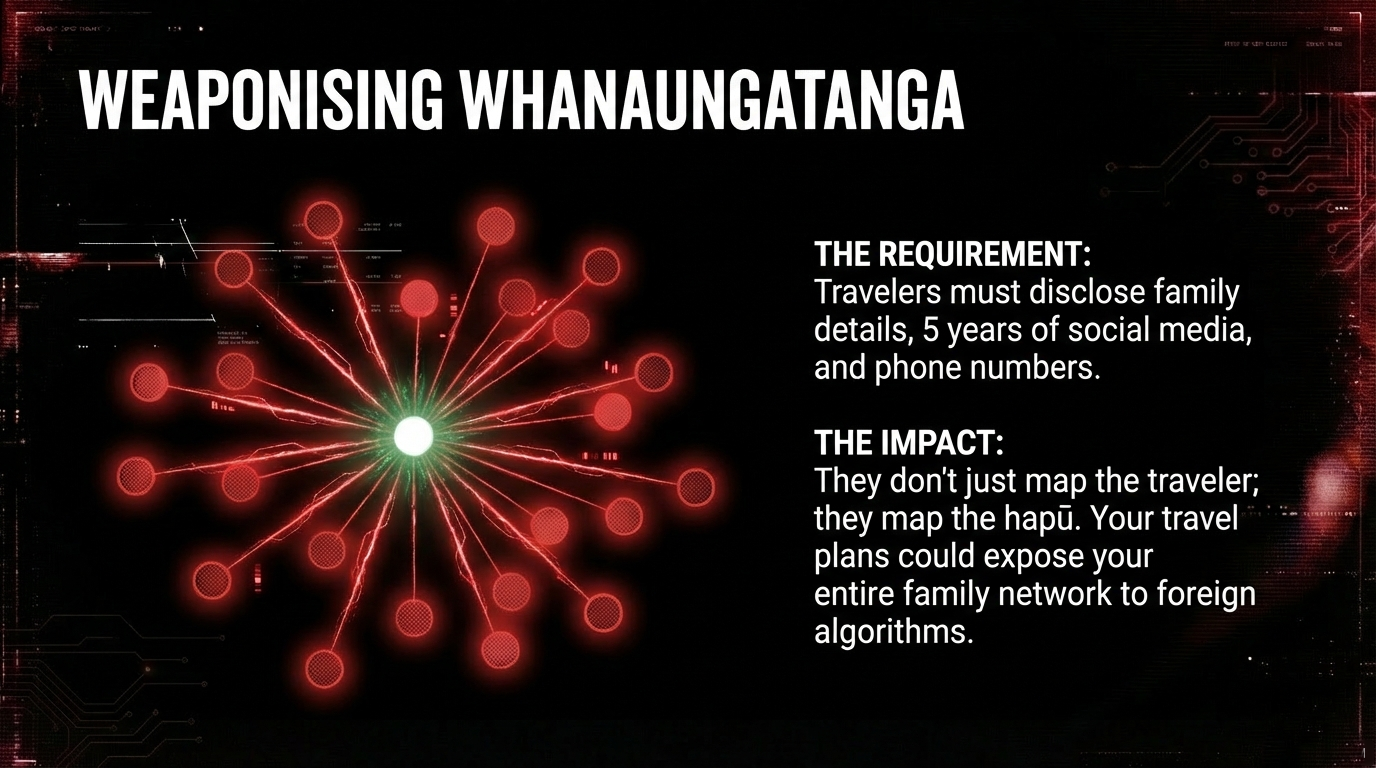
The EBSP Danger: A single Māori woman travelling to the US for a kapa haka festival provides her family details on the ESTA form. Under an EBSP with full database access, ICE's system cross-references those names against NZ Police databases. Her brother — who was wrongfully stopped and photographed by Police as a teenager — now appears in a network map generated by Palantir's targeting algorithms. Her cousin, who overstayed a US visa fifteen years ago, creates a further flag. The entire whānau is now a "pattern" in a system designed to identify threats.
Quantified Harm: The EFF's Saira Hussain described the Trump administration's approach as a "let's grab everything first and ask questions later" model, as reported by RNZ. Council of Civil Liberties chair Thomas Beagle told RNZ: "Once this data passes out of our control, we don't have that ability anymore. It's going to be there for five or 10 years and could come back and bite you years later."
DOGE — Elon Musk's Department of Government Efficiency — is building a master immigration database that integrates data from the IRS, Social Security Administration, and Department of Health and Human Services, as CNN reported. Palantir, co-founded by Peter Thiel, is the primary contractor.
The Tikanga Impact — Explained for the Western Mind: In tikanga Māori, whanaungatanga — the web of kinship relationships — is not merely social connection. It is the foundational structure of Māori society. Every person exists within a network of obligations, responsibilities, and aroha that connects them to their whānau, hapū, and iwi. When a surveillance system maps one person's data and extrapolates to their family network, it converts whanaungatanga from a source of strength into a source of vulnerability. The state is literally weaponising kinship — turning the thing that makes Māori society resilient into the thing that exposes it to foreign surveillance. In the Western context, imagine if attending your grandmother's funeral created a permanent surveillance file on every person who attended. That is what network mapping does to whanaungatanga.
Solution: Aotearoa must negotiate an explicit prohibition on network mapping, familial data extraction, and any automated querying beyond the individual traveller. All data shared must have enforceable time limits, mandatory deletion protocols, and a New Zealand-controlled audit mechanism. Māori must be represented in the negotiating team — not as advisors, but as Treaty partners with veto power over any provisions affecting taonga.
The Māori Green Lantern has previously exposed the weaponisation of surveillance architecture in "The Honey Trap Whakapapa: How an Israeli Billion-Dollar Blackmail Machine Weaponised Children to Control the World", documenting how Palantir — the same company now building ICE's deportation targeting system — already holds contracts with NZDF, GCSB, and SIS.
Example 3: The Facial Recognition Failure — When the Machine Gets Your Face Wrong
The Situation: In 2024, NZ Police issued a tender to upgrade biometric systems including an automated fingerprint identification system, 50 fixed biometric recording devices across 40 police stations, and 130 portable scanners — with a projected capture rate of 600,000 fingerprint images per year, as Biometric Update reported.
The facial recognition system used for New Zealand passports — supplied by Japanese company NEC — was never tested for accuracy on Māori, as RNZ revealed. Tests were run for age and gender, but not for ethnicity — despite years of international evidence that facial recognition has higher misidentification rates for people of colour.
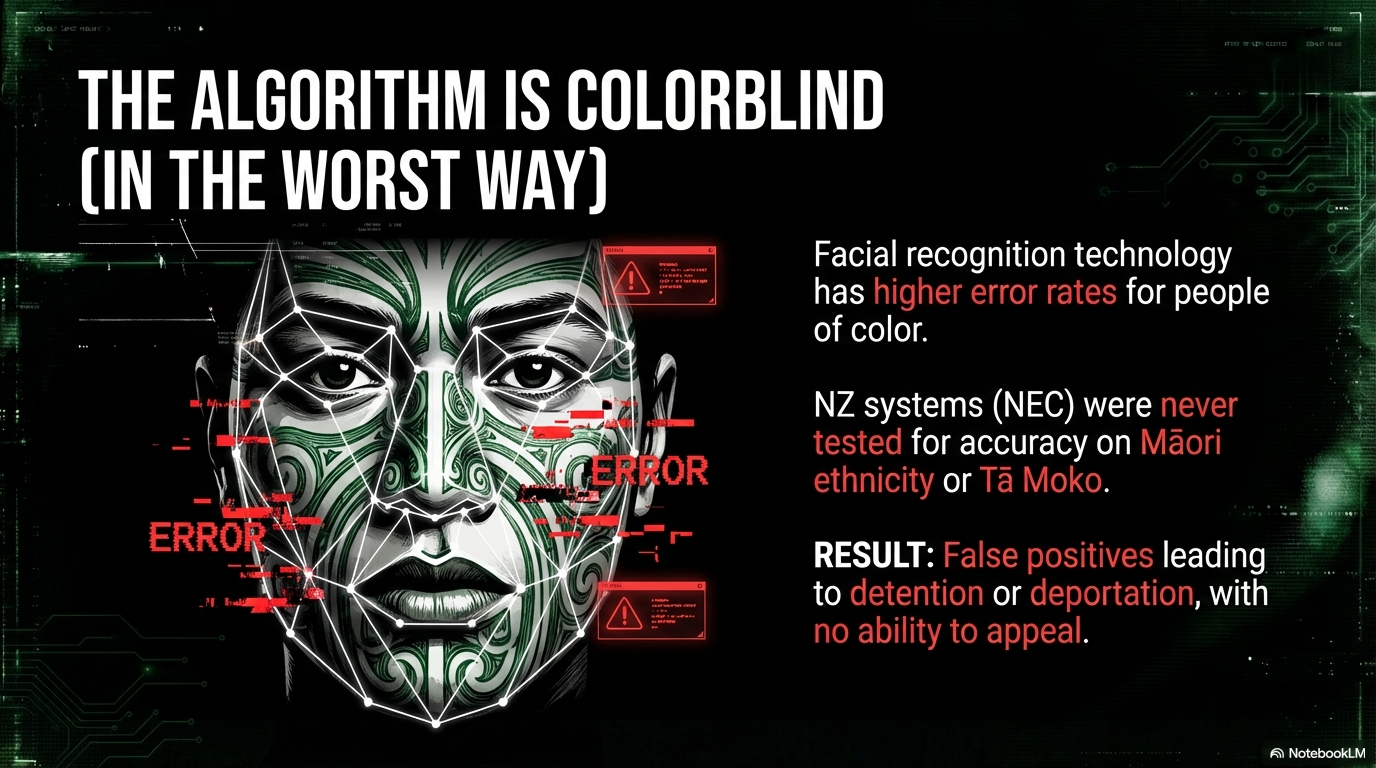
Dr Taiuru warned RNZ: "We've already seen a history of Māori being fingerprinted and photographed at such high proportions and the police didn't actually have a right to take that data in the first place." He raised particular concerns about tā moko: "How will they differentiate the different patterns, Māori patterns? I suspect we could see some false positives — people being falsely accused of being a person that they're not."
The EBSP Danger: Under an EBSP with automated biometric sharing, a Māori individual flagged by a facial recognition false positive in New Zealand's system could be automatically flagged in the US system. Given that ICE treats a positive face verification as conclusive evidence, as Vanderbilt Law School's analysis documented, a misidentification originating in New Zealand could lead to detention, interrogation, or deportation proceedings against the wrong person — in a country where the detained person has no access to New Zealand's Privacy Commissioner, no right to correct the data, and no mechanism to challenge the original error.
In the United States, a Philadelphia immigration judge found "a strong argument that ICE officers had 'egregiously violated' the Constitution" through racial profiling — but deportation proceedings continued anyway because ICE found the person's details in a separate database, as ProPublica documented.
Quantified Harm: The Biometric Processing Privacy Code, which came into force in November 2025, requires agencies to assess the impact on Māori when introducing biometric technology, as RNZ reported. Privacy Commissioner Michael Webster acknowledged: "We know from research done before that there are concerns around bias and misidentification with the use of some biometric technologies, facial recognition technologies." Yet once data leaves New Zealand, this Code is meaningless — as the Privacy Commission itself acknowledged to RNZ, "other legislation could take precedence."
The Tikanga Impact — Explained for the Western Mind: In tikanga, mana is not reputation in the Western sense — it is the spiritual authority and dignity inherent in every person by virtue of their whakapapa. When a surveillance system misidentifies a Māori person — particularly through a technology that was never even tested for accuracy on Māori faces — it does not merely create an administrative error. It strips mana tangata — the inherent dignity of the individual. Being wrongfully detained, interrogated, or deported because a machine cannot tell brown faces apart is the technological expression of the same colonial logic that said all Māori look alike. In the Western context, imagine being imprisoned because a computer confused you with someone else, and the only appeal mechanism is in a foreign country that refuses to acknowledge the error. That is what biometric data sharing without safeguards produces.
Solution: A mandatory moratorium on sharing any facial recognition data until NZ Police and DIA conduct ethnicity-specific accuracy testing and publish the results. No biometric data generated by systems with demonstrated racial bias should be eligible for international sharing. An independent Māori data ombudsman — funded by the Crown, accountable to tangata whenua — must be established with the authority to audit, halt, and remedy cross-border biometric data transfers.
The Māori Green Lantern has previously documented the use of sacred whenua for surveillance purposes in "The Colosseum of Kingsland: How a White Supremacist Government Built a Gladiator Arena on Sacred Whenua", exposing the pattern of this coalition overriding indigenous voice, community consent, and environmental protection to serve corporate and institutional interests.
The FBI in Wellington: The Architecture Is Already Being Built
In September 2025, FBI Director Kash Patel travelled to Wellington and opened a permanent FBI office at the US Embassy, as 1News reported. He met with Defence Minister Judith Collins, Police Minister Mark Mitchell, and Foreign Minister Winston Peters.
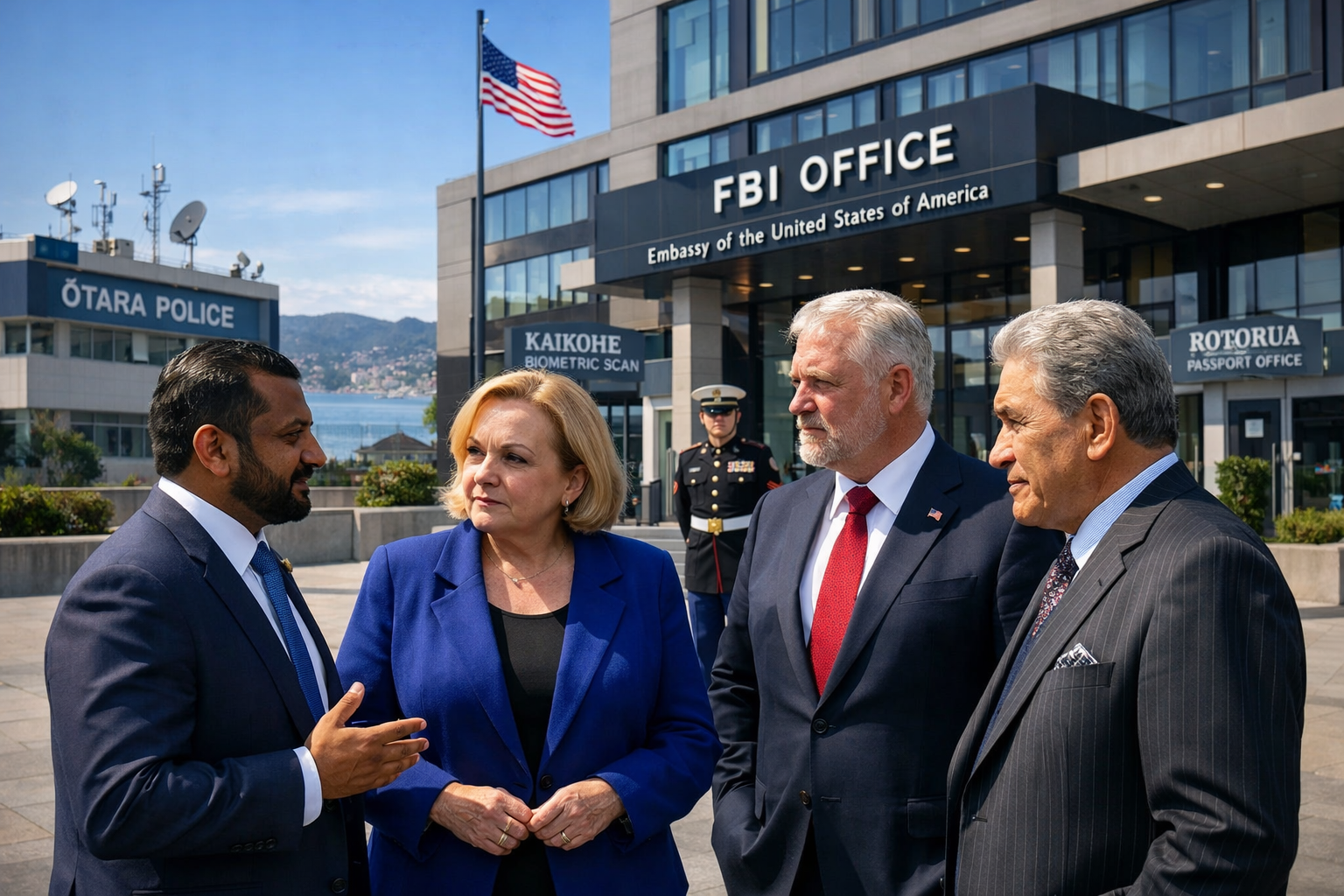
The FBI said the office would "work to investigate and disrupt a wide range of threats and criminal activities including terrorism, cybercrime and fraud, organised crime and money laundering, child exploitation, and foreign intelligence threats." Its jurisdiction covers New Zealand, Antarctica, Samoa, Niue, Cook Islands, and Tonga, as 1News confirmed.
Collins and Mitchell said the upgrade
"demonstrates the strength of the Five Eyes partnership," as 1News reported.
Meanwhile, the Trump administration is loosening restrictions on sharing law enforcement information with the CIA and other intelligence agencies — overriding controls that have been in place since the Watergate reforms to protect American citizens' privacy. Government officials said the changes could give intelligence agencies access to hundreds of millions of documents — from FBI case files to banking records to criminal investigations. The process has been marked by almost no public acknowledgement, with "scant high-level discussion and little debate among government lawyers," as ProPublica revealed.
The architecture is clear:
- FBI office in Wellington — permanent intelligence infrastructure on Aotearoa soil
- Migration 5 — already sharing biometric data between Five Eyes nations
- EBSP — proposed full automated access to national databases
- Palantir — already holding contracts with NZDF, GCSB, and SIS
- DOGE master database — integrating data across US federal agencies
- CIA/law enforcement fusion — collapsing privacy walls between intelligence and policing
The data pipeline does not begin at the US border. It begins in a police station in Ōtara, in a biometric scanner in Kaikohe, in a passport office in Rotorua. And it terminates in a Palantir-generated targeting list in a DHS office in Washington.
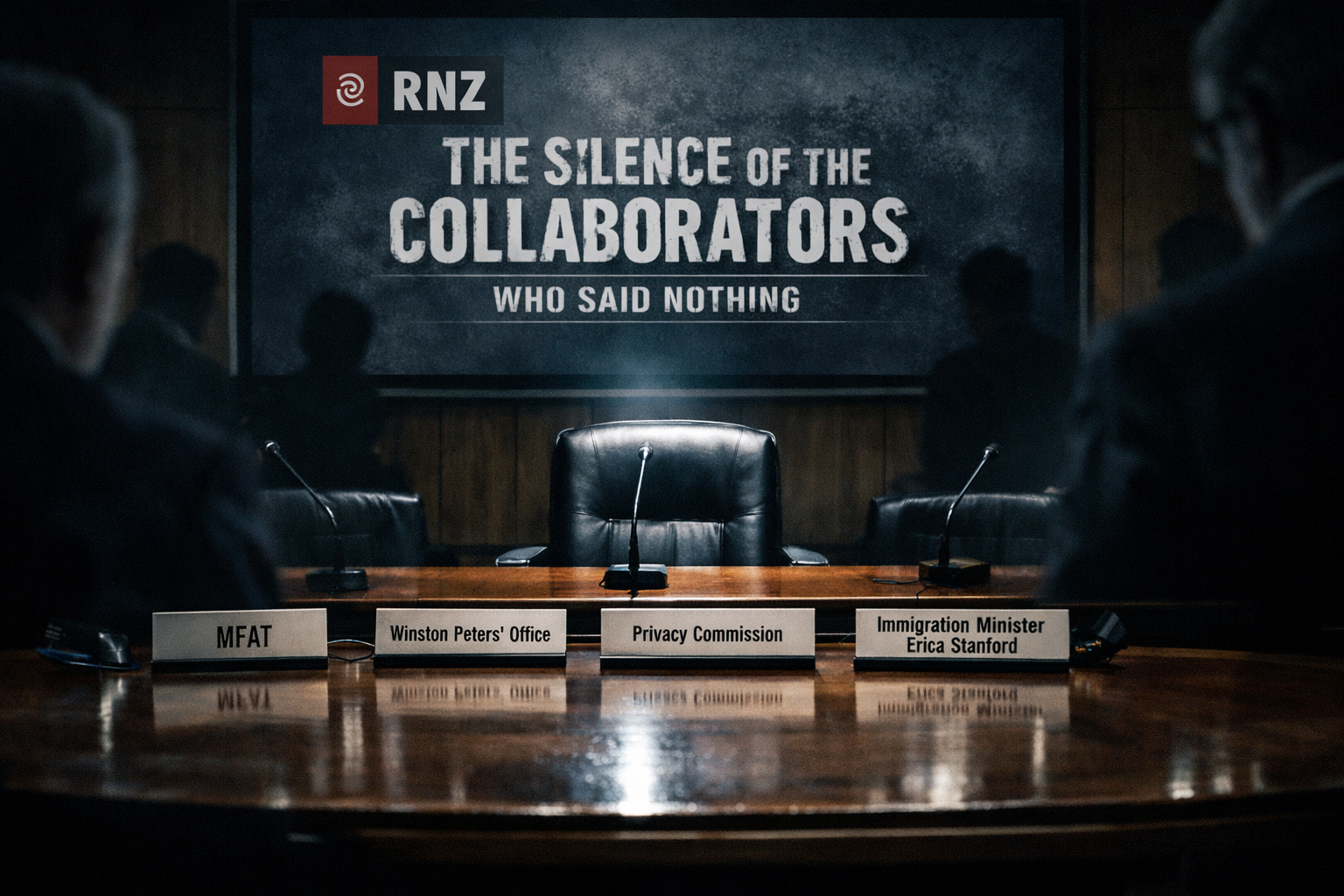
The Silence of the Collaborators: Who Said Nothing
| Who | What They Were Asked | What They Said |
|---|---|---|
| MFAT | When negotiations began, what safeguards, what privacy assessments | One-line statement. Refused all follow-ups. |
| Winston Peters' office | Same questions | Declined to respond. |
| Privacy Commission | Whether consulted, what safeguards should be in place | Declined to answer. |
| Immigration Minister Erica Stanford | Migration 5 oversight concerns | Called it "operational" and said there was "no particular secrecy." |
All confirmed by RNZ's investigation and RNZ's Migration 5 report.
Green Party spokesperson Teanau Tuiono told RNZ:
"We are seeing that alarm right across the world with the direction the US is going under the Trump administration. This is not a time for us to be seeking closer engagement and relationships with the US."
Council of Civil Liberties chair Thomas Beagle told RNZ the line that should be etched into every negotiating document:
"We wouldn't give other countries like China or Russia full access into our police and biometrics databases, would we?"
Te Mauri — The Life Force Assessment
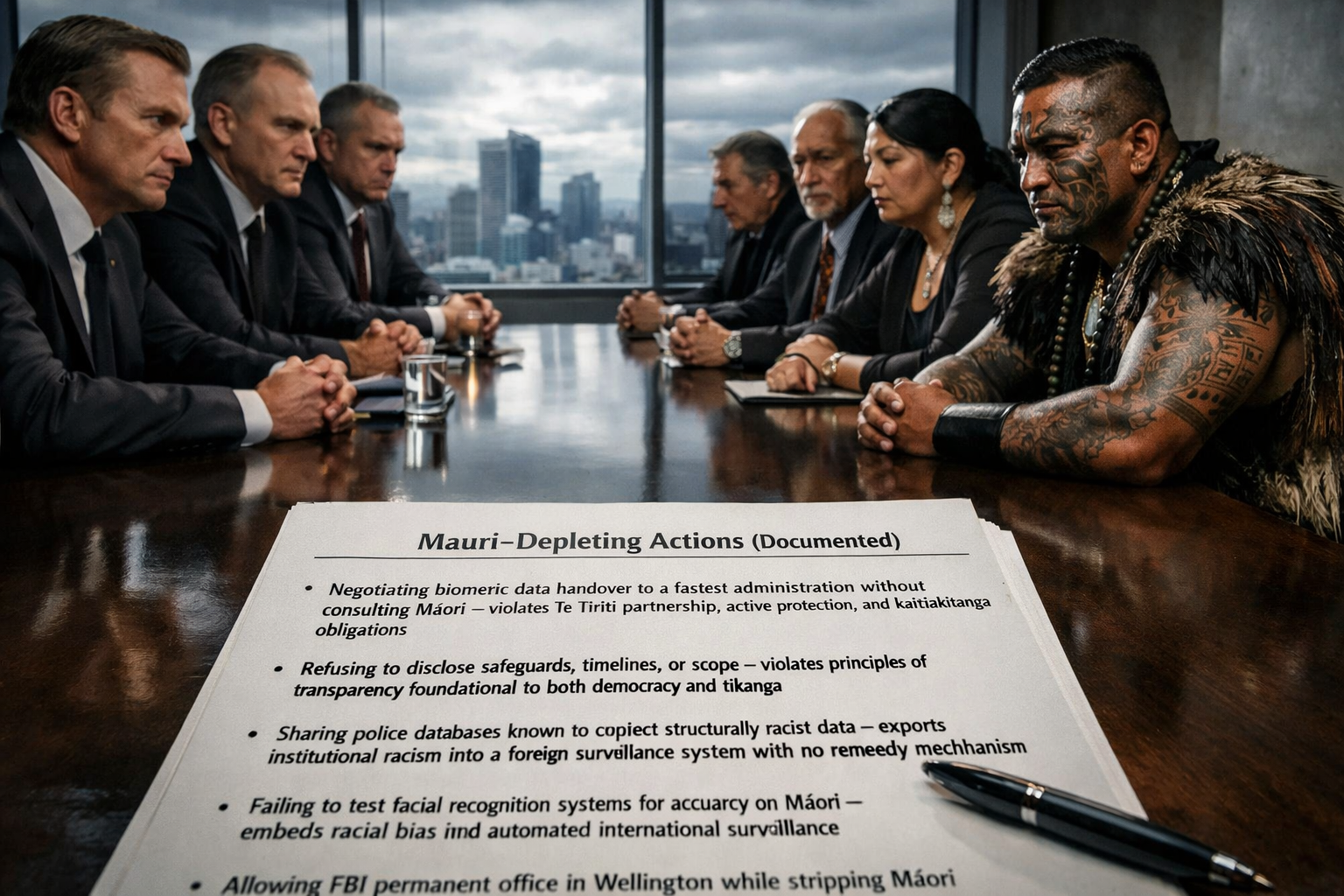
Mauri-Depleting Actions (Documented)
- Negotiating biometric data handover to a fascist administration without consulting Māori — violates Te Tiriti partnership, active protection, and kaitiakitanga obligations
- Refusing to disclose safeguards, timelines, or scope — violates principles of transparency foundational to both democracy and tikanga
- Sharing police databases known to contain structurally racist data — exports institutional racism into a foreign surveillance system with no remedy mechanism
- Failing to test facial recognition systems for accuracy on Māori — embeds racial bias into automated international surveillance
- Allowing FBI permanent office in Wellington while stripping Māori rights domestically — prioritises foreign intelligence interests over tangata whenua sovereignty
Mauri-Enhancing Actions (Required)
- Full Māori participation — as Treaty partners, not consultees — in all biometric data-sharing negotiations
- Independent Māori data ombudsman with audit and halt authority
- Public disclosure of all EBSP terms before signing
- Parliamentary oversight and select committee inquiry
- Ethnicity-specific testing of all biometric systems before international sharing
- Enforceable data deletion protocols and New Zealand-controlled audit mechanisms
The Hidden Connections
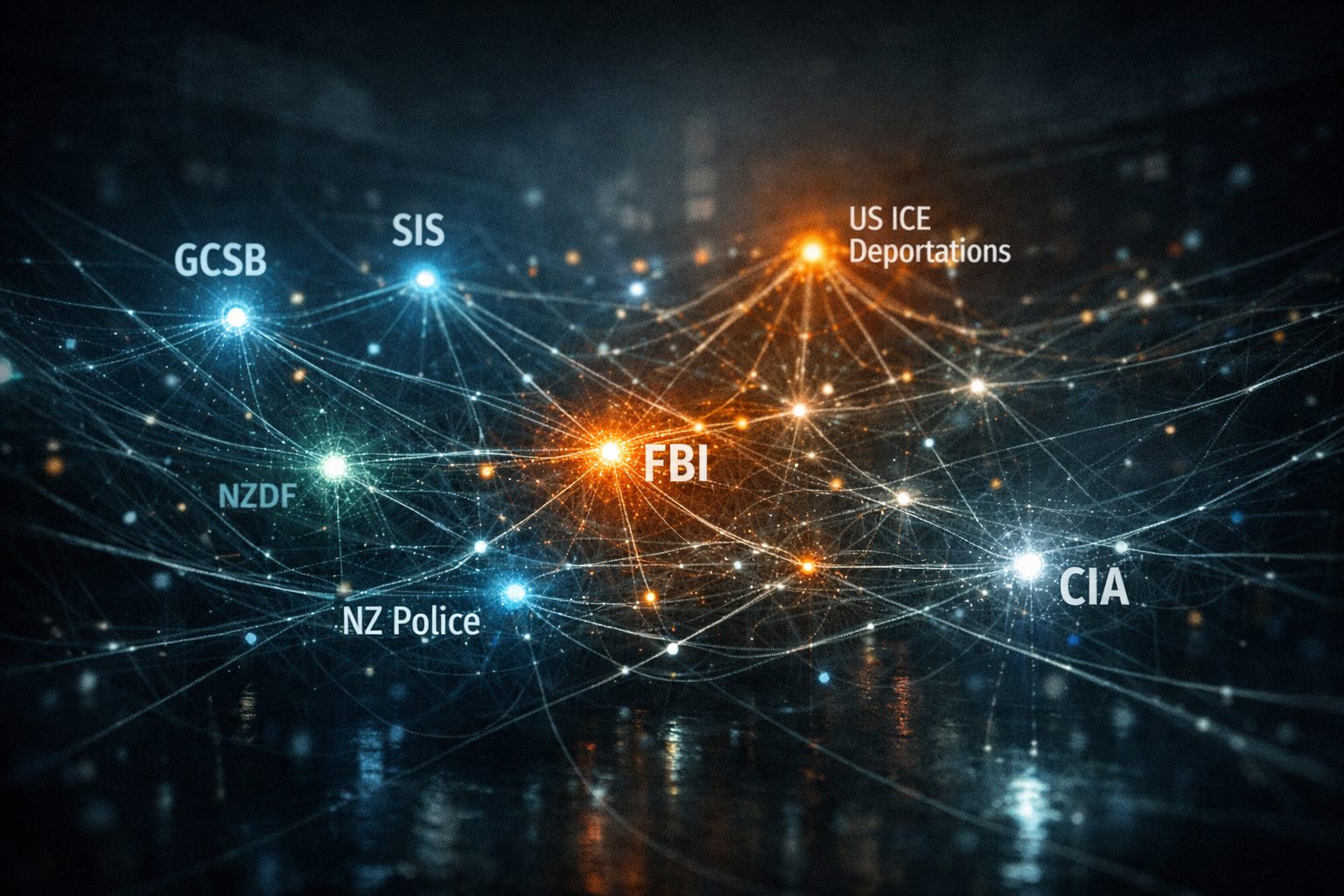
- Palantir holds contracts with both NZ intelligence agencies (GCSB, SIS, NZDF) and US ICE deportation operations — the same company that builds targeting lists for ICE raids also processes New Zealand intelligence data, as The Māori Green Lantern documented in "The Honey Trap Whakapapa" and the Migration Policy Institute confirmed.
- The FBI now has a permanent office in Wellington while the government negotiates to share biometric data with the agency's parent department (DHS) — creating a dual-track intelligence pipeline: physical presence plus digital access, as 1News reported.
- NZ Police biometric systems have documented racial bias against Māori, and those databases are candidates for international sharing — exporting institutional racism as automated data, as the Understanding Policing Delivery report confirmed and RNZ detailed.
- The Trump administration is simultaneously loosening CIA/law enforcement data-sharing walls and demanding EBSP access to foreign databases — data shared with DHS could end up with CIA under the new information-sharing regime, as ProPublica revealed.
- Justice Minister Paul Goldsmith is actively working to expand facial recognition use domestically while the government negotiates to share that data internationally — Goldsmith quietly ordered a review of the Privacy Act to remove barriers to facial recognition, meeting with Auckland tech firm Auror that wanted "pragmatic policy interventions," as RNZ reported.
- The government that cannot consult Māori about biometric data is the same government that suspended Te Pāti Māori co-leaders for 21 days — the longest suspension in parliamentary history — for performing a haka against the Treaty Principles Bill, as RNZ reported. The message is clear: speak up and be silenced; be silent and be surveilled.
The Māori Green Lantern has previously documented the legislative assault in "Back to Basics, Back to Brutality: How a 'Hodgepodge' of Bills Became the Most Coordinated Assault on Māori Rights, Workers, and Democracy in a Generation".
The Metaphor Made Flesh
Let us be plain about what this is.
In the old days, the Crown sent surveyors to map Māori land before it stole it. The surveyor's chain measured the whenua. The Native Land Court converted collective ownership into individual title. The Crown purchased from individuals what belonged to hapū. By the time Māori understood the mechanism, the land was gone.
The EBSP is the digital survey chain.
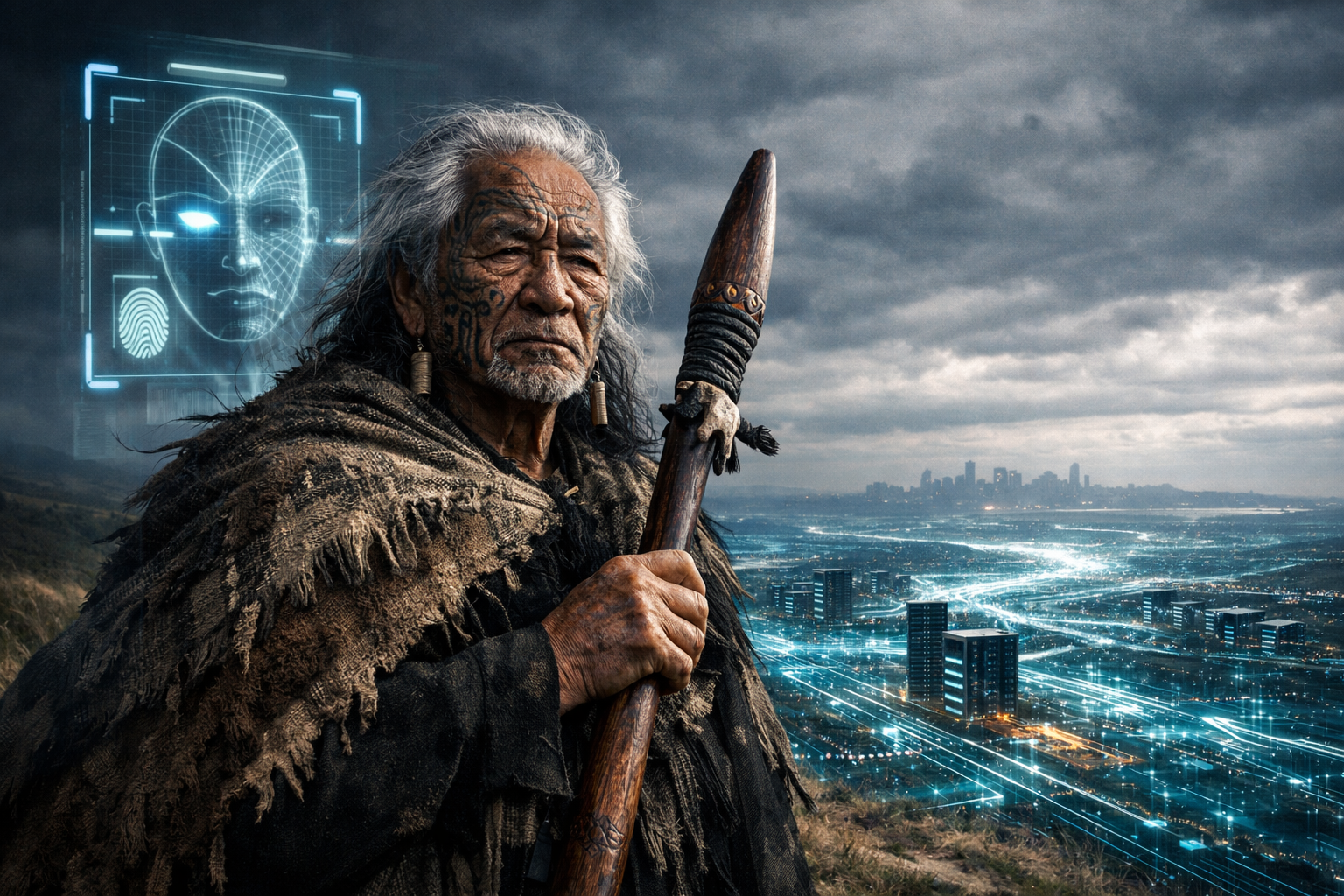
The biometric scanner measures the tinana. The database converts whakapapa into individual data points. The algorithm processes collective identity into isolated profiles. The foreign power acquires access to what belongs to the people. By the time whānau understand the mechanism, the data is gone — replicated on servers in Virginia, queried by Palantir, accessible to ICE agents with smartphone apps, retained for decades, beyond the reach of any New Zealand law.
The land was never returned. The data will never be deleted.
In 1840, the Crown promised tino rangatiratanga — full authority over taonga.
In 2026, the Crown is negotiating to give those taonga to a foreign surveillance state.
The taiaha is the same. The theft is the same. Only the medium has changed: from surveyor's chain to biometric scanner. From Native Land Court to algorithm. From Crown grant to automated database access.
This government does not represent the people of Aotearoa. It represents the interests of a dying imperial order that needs to catalogue, control, and surveil every body that moves across its borders. And it will trade your whakapapa for the convenience of visa-free travel — a convenience that benefits primarily wealthy Pākehā travellers, while Māori bear the surveillance burden of a structurally racist database system they never consented to.
The Call to Rangatiratanga
This must be stopped. Not reviewed. Not "consulted on." Stopped.
No biometric data-sharing agreement with the United States should be signed until:
- Full public disclosure of all proposed terms, including scope, safeguards, deletion protocols, and audit mechanisms
- Select committee inquiry with public hearings and expert testimony
- Māori as Treaty partners at the negotiating table — not as afterthought advisors but as sovereign participants with veto authority over provisions affecting taonga
- Independent Privacy Impact Assessment published in full before any agreement is signed
- Ethnicity-specific accuracy testing of all biometric systems whose data would be shared
- Enforceable prohibition on network mapping, familial data extraction, and automated querying beyond individual travellers
- Legally binding data deletion protocols with New Zealand-controlled audit access
- Establishment of a Māori Data Ombudsman with authority to halt data transfers
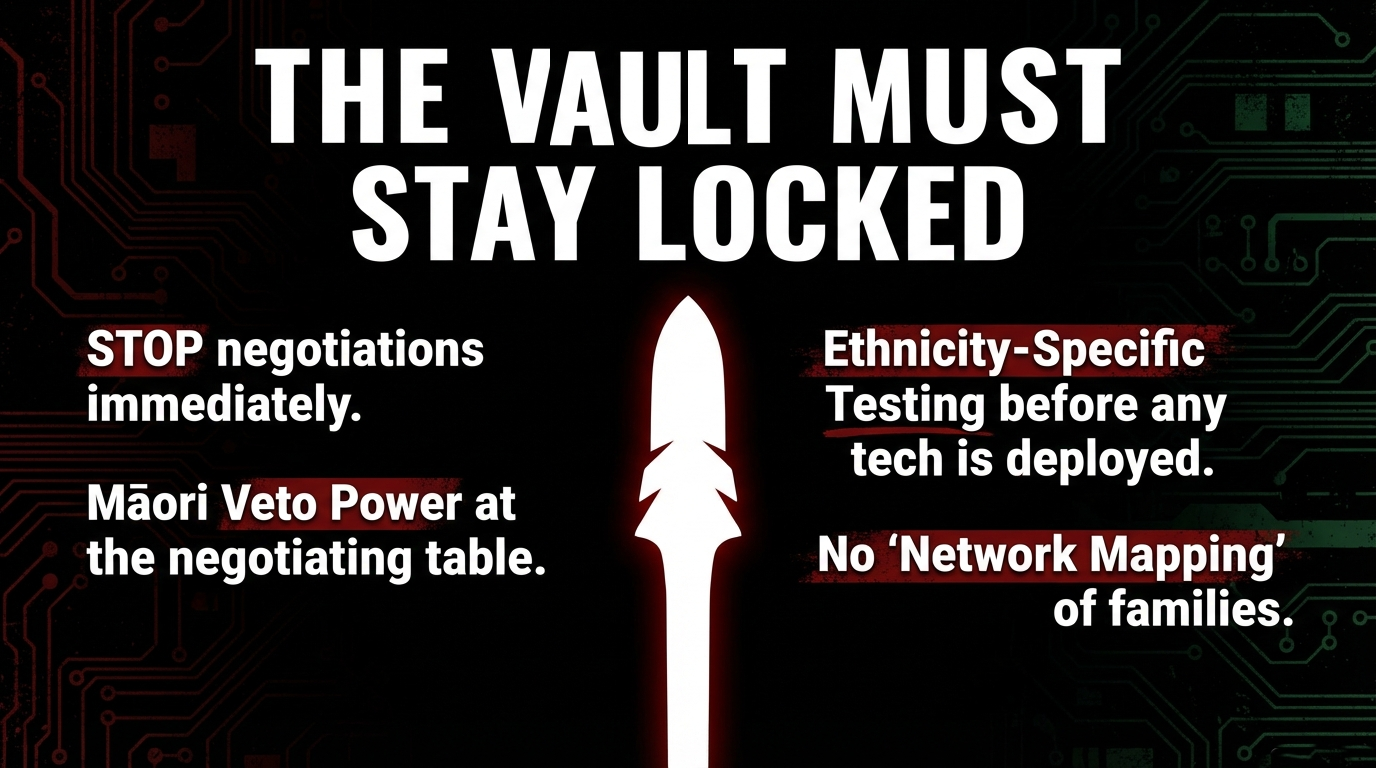
The vault must stay locked. The key must stay in Aotearoa. And the people whose whakapapa is encoded in that data must have the final word on who opens the door.
Kia mau ki te whakapapa. Kia kaha. Kia manawanui.
Hold fast to the whakapapa. Be strong. Be resolute.
Koha Consideration
Every koha signals that whānau are ready to fund the watchdog this government refuses to build. When the Crown negotiates to hand your DNA to a foreign surveillance state in secret — and tells you nothing — it is your voice, your koha, your refusal to be silent that holds the vault door shut.
It signals that rangatiratanga includes the power to fund our own sentinels — because when the government opens the vault in the dark, whānau must fund the light.
Kia kaha, whānau. Stay vigilant. Stay connected. And if you are able, consider a koha to ensure this voice — the one tracing the data pipelines they hope you never see — continues.
If you are unable to koha, no worries! Subscribe or Follow The Māori Green Lantern, kōrero and share with your whānau and friends — that is koha in itself. Every share is another pair of eyes on the vault door.
Three pathways exist:
For those who wish to support this mahi directly with a koha (voluntary contribution):
Koha — Support: https://app.koha.kiwi/events/the-maori-green-lantern-fighting-misinformation-and-disinformation-ivor-jones
For those who wish to receive essays directly and support through subscription:
Subscribe to the Māori Green Lantern: https://www.themaorigreenlantern.maori.nz/#/portal/support
For those who prefer direct bank transfer:
Account details: HTDM, account number 03-1546-0415173-000.

Ivor Jones The Māori Green Lantern Fighting Misinformation And Disinformation From The Far Right
Research conducted 26 February 2026 using search tools, URL verification, and primary source analysis. Sources consulted include: RNZ, 1News, ProPublica, Electronic Frontier Foundation, Waitangi Tribunal reports, Privacy Commissioner publications, Migration Policy Institute, Wired, Vanderbilt Law School, Te Ara, Dr Karaitiana Taiuru's published work, and The Māori Green Lantern archive. All URLs verified at time of research.