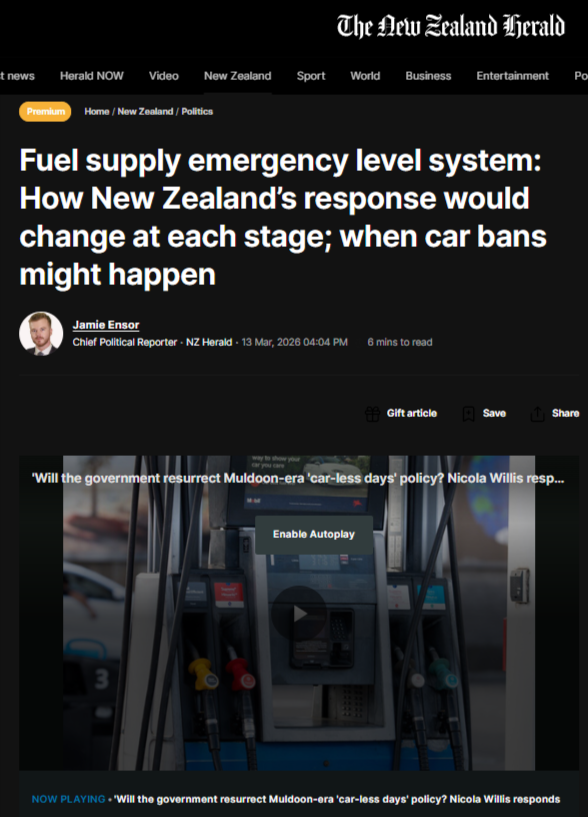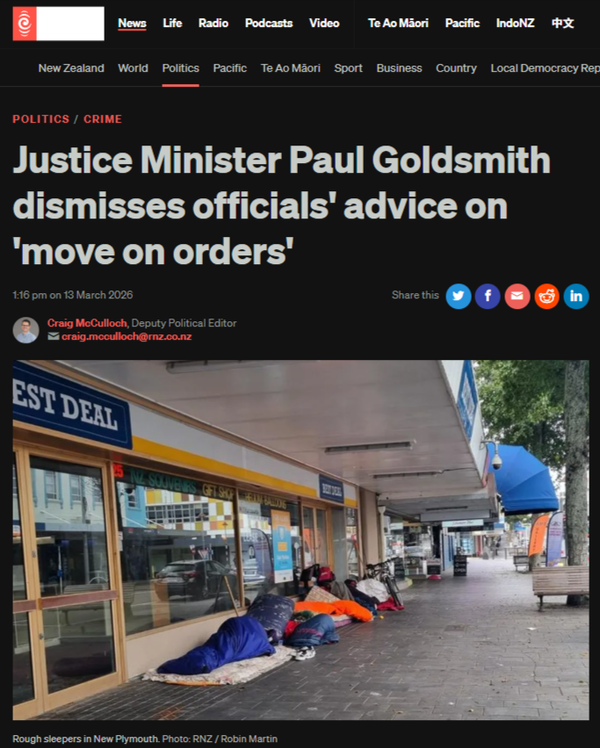
"They Don't Want to Fix Homelessness. They Want to Hide It from View." - 8 March 2026
The Crown's Move-On Orders Are Not Law Enforcement — They Are Aesthetic Enforcement. The Bulldozer Has Always Followed the Invisible Māori.

Mōrena Aotearoa,
He Kupu Whakataki — The Stench They Cannot Smell
There is a very old Pākehā trick. When the problem becomes too visible — when the consequences of your own cruelty walk the streets and sleep in your doorways
— you do not fix the problem. You move it around the corner, out of the sightline of the cameras, away from the café tables where the donors eat their smashed avocado.
You give the police a clipboard and tell them it's justice.
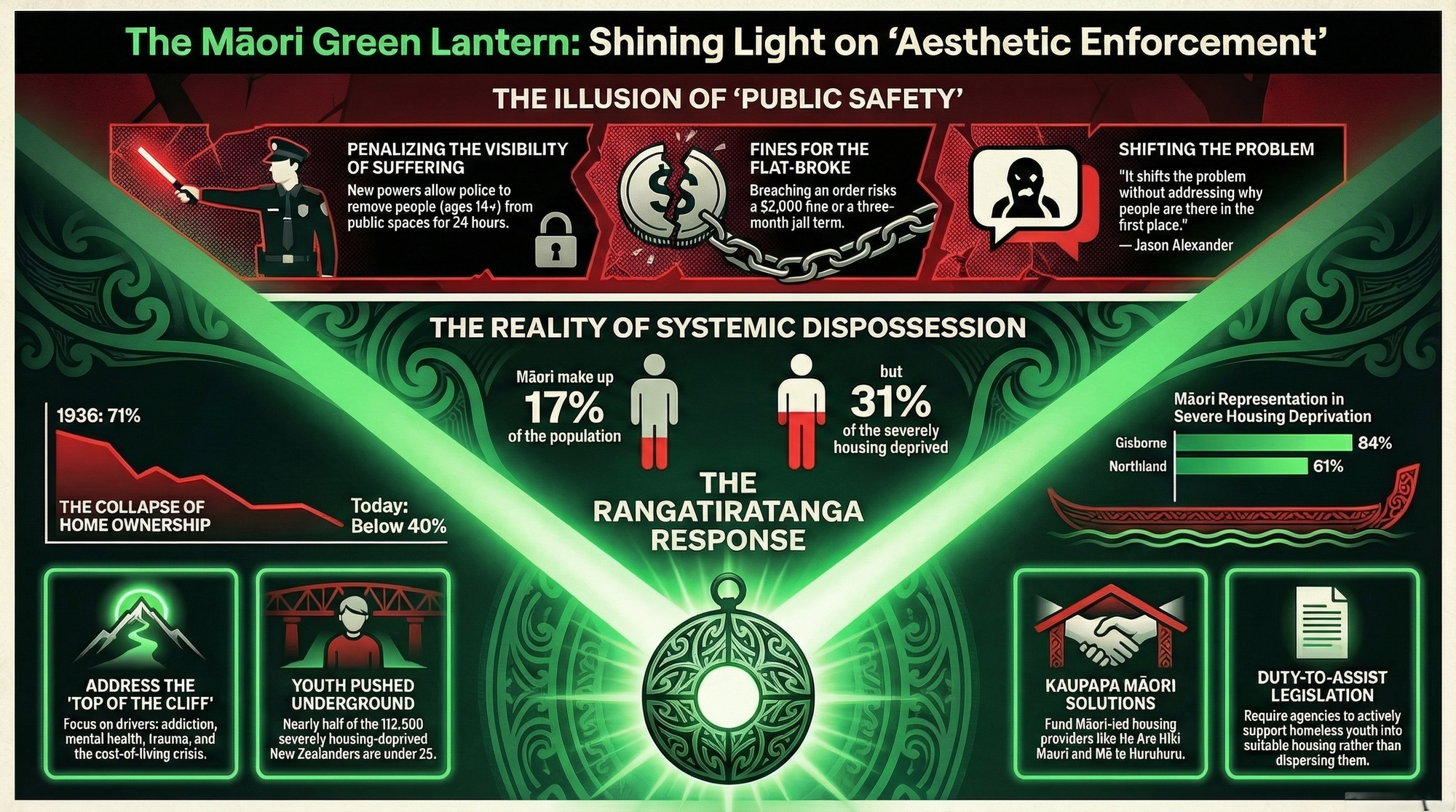
That is exactly what the Luxon-Goldsmith government has done with its proposed move-on orders — a cowardly, mean-spirited, aesthetically-motivated piece of legislation that criminalises the visibility of suffering rather than the suffering itself. It is not law enforcement. It is interior decorating for the ruling class.
And because this government has never met a harm it couldn't disproportionately deliver to Māori, the people who will be moved on — shuffled, shunted, discarded — are overwhelmingly our whānau. Our tamariki. Our rangatahi.
This is not metaphor. This is data. And the Ring is charged.
Te Heke o Mua — The Ancestors Walked. The State Made Sure of It.
To understand what these move-on orders truly are, you must understand what moving on has always meant for Māori.
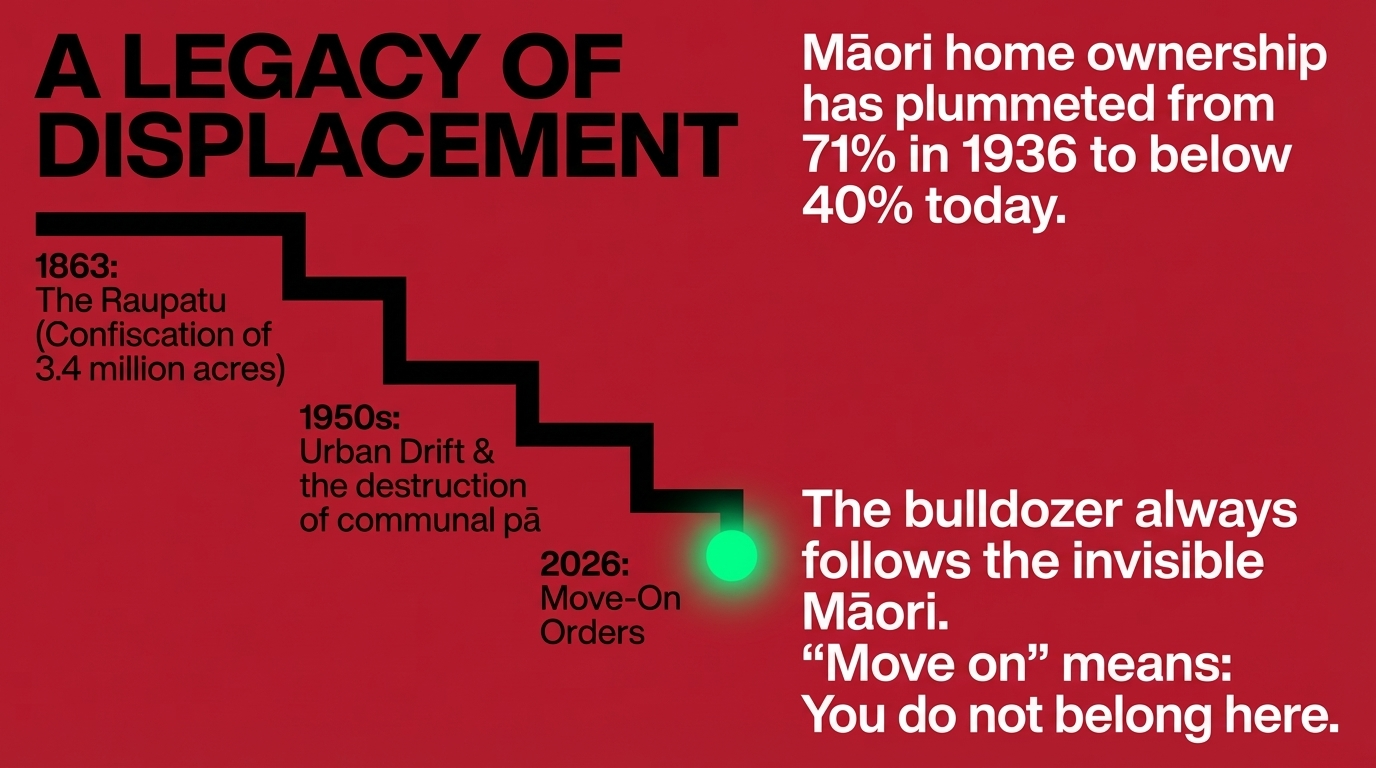
It began with the confiscations — Raupatu — where the Crown took over 3.4 million acres of Māori land under the New Zealand Settlements Act 1863. Then came the Native Land Court, engineered to atomise communal title and force Māori into individual ownership that could be sold, mortgaged, and lost. Then the urban drift of the 1950s, as Pākehā planners demolished pā, broke up communities, scattered whānau to state houses in suburbs not their own, away from kin, away from marae, away from the very networks of reciprocity — manaakitanga, whanaungatanga — that constitute survival.
In 1936, 71% of Māori lived in dwellings their whānau owned. By 1991 it had fallen to 56%. By 2013, 43%. Today, likely below 40% — while Pākehā ownership sits near 70%. If the trend continues, Māori will be almost entirely renters by 2061. Homeless and landless in two generations — that is the title of the paper. That is the trajectory the Crown set and refuses to reverse.
Every move-on order is this history made fresh. Move on. You don't belong here. This space is not for you.

Māori have heard this before. It sounded like muskets then. Today it sounds like Paul Goldsmith.
Te Māramatanga — The Metaphor the Western Mind Needs to Grasp
For whānau who carry mātauranga, the metaphor is obvious. But for the Western mind — conditioned by centuries of individualism, private property worship, and the gospel of meritocracy — let us spell it out in three languages:
story, data, and consequence.
Kōrero Tahi — The Burning Whare
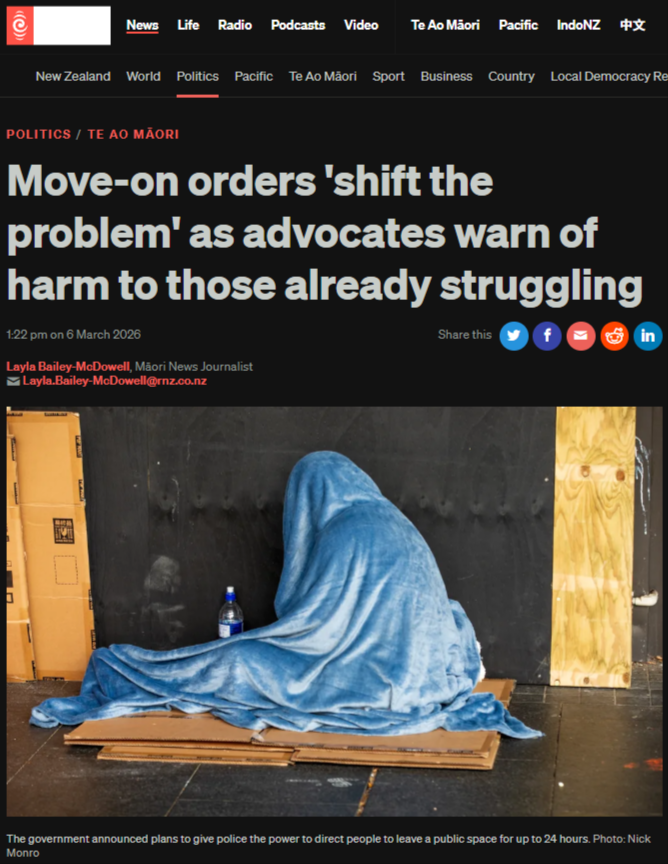
Imagine a whānau whose house is on fire. The smoke billows from the windows. Children are visible at the door, choking. The fire department arrives — not with a hose, but with a clipboard and a fine.
"You cannot stand here and cough in this manner. It is disturbing to the neighbours. Move along. If you are seen coughing here again, you will be fined $2,000 or imprisoned for three months."
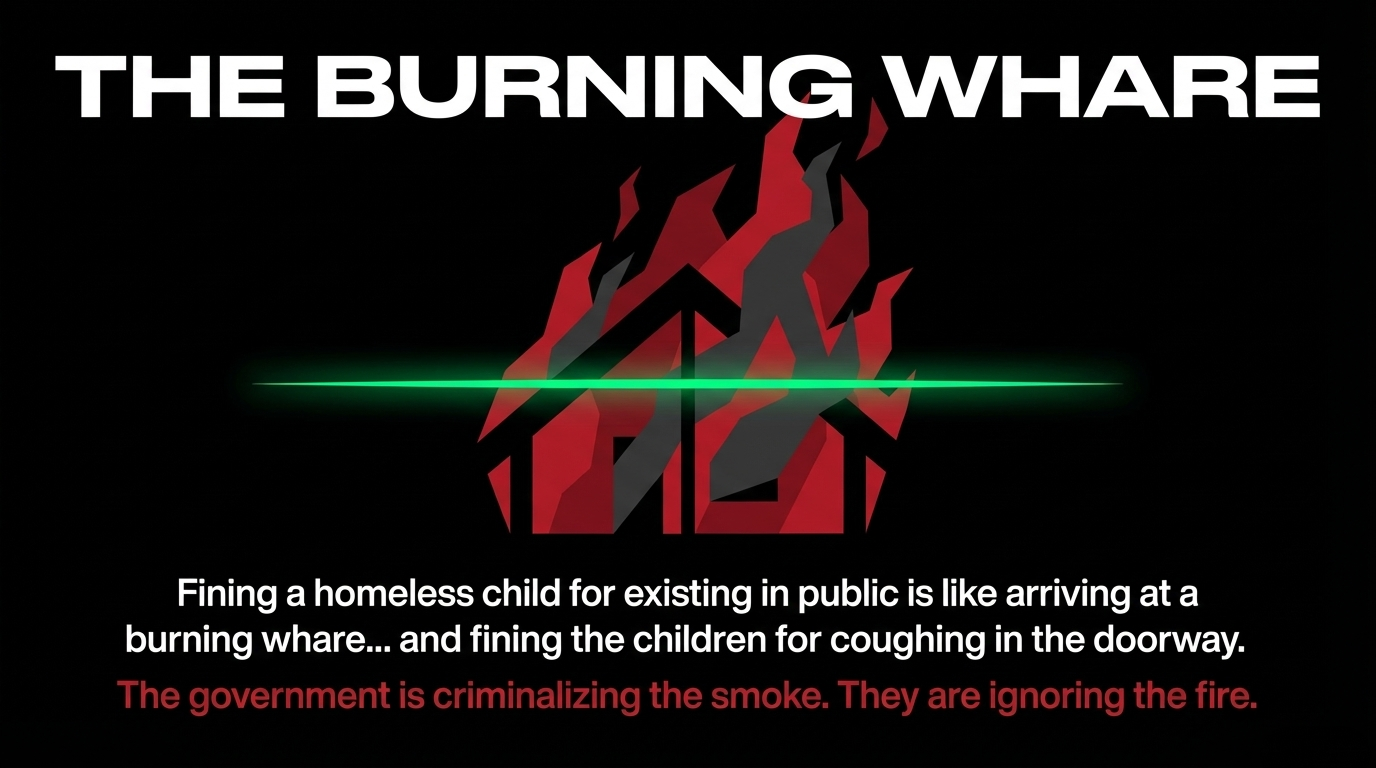
This is not satire. This is the Summary Offences Act Amendment that Justice Minister Paul Goldsmith announced in February 2026. The house is still burning. The children are still in the doorway. The government just made it illegal to be seen in the smoke.
As Hāpai Te Hauora Chief Operating Officer Jason Alexander (Ngāpuhi) said plainly:
"Using move-on orders may reduce what is seen in parts of the CBD, but it does not reduce homelessness. It shifts the problem without addressing why people are there in the first place."
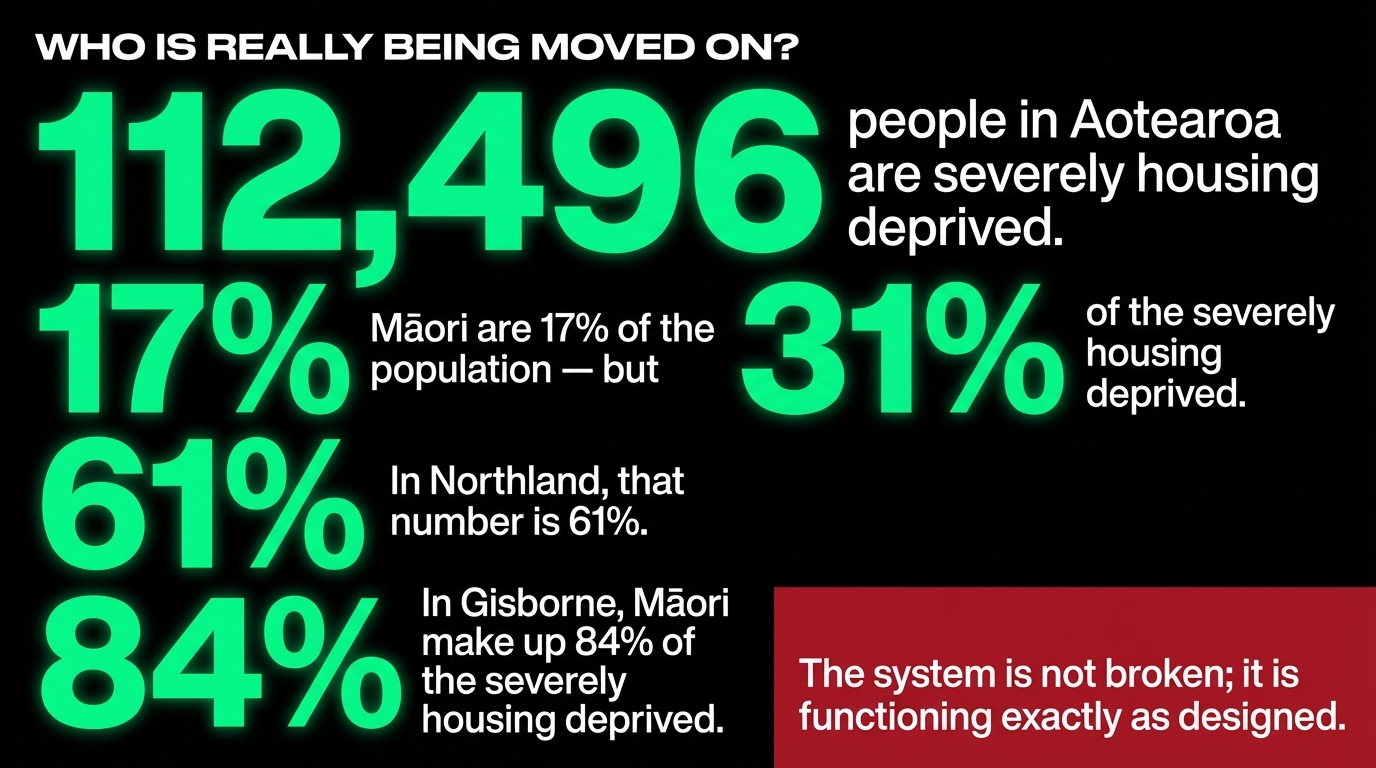
The harm, quantified: At the 2023 Census, 112,496 people — 2.3% of the New Zealand population — were estimated to be severely housing deprived. Of those, Māori were 31% of the severely housing deprived while comprising 17% of the population. In Gisborne, Māori make up 84% of the severely housing deprived. In Northland, 61%. Te Pāti Māori co-leader Rawiri Waititi has stated:
"100,000 people are homeless. 60,000 of those are Māori."
The solution: Fund He Ara Hiki Mauri — the kaupapa Māori approach to homelessness — not slash it. Deliver the National Youth Homelessness Strategy that Manaaki Rangatahi has demanded, fully funded. Build houses, not prisons.
Kōrero Rua — The 14-Year-Old on the Corner
For the Western mind that still thinks this is abstract, consider this specific, named, legal reality:
under these proposed amendments, a 14-year-old Māori child — who has fled domestic violence, whose whānau home is overcrowded, who has nowhere else to go — can be issued a formal police order to leave a public space for 24 hours. If they return — because they have nowhere else to go, because they are 14 and it is raining — they face a $2,000 fine or three months imprisonment.
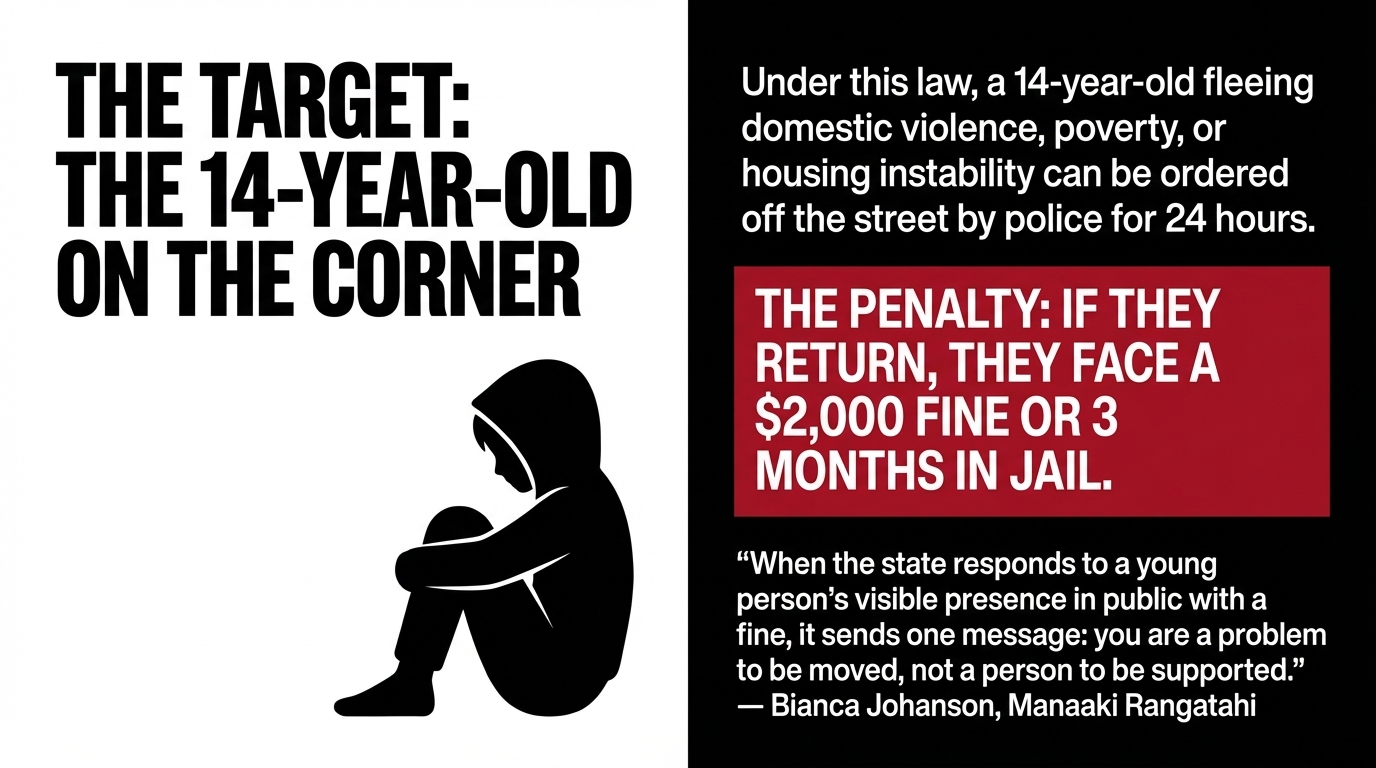
A child. Fourteen years old. Fined or jailed for existing in public while homeless.
"A 14-year-old usually isn't out on the street through their own choice. They're being impacted by family violence, housing instability, poverty, breakdowns at home. If you're 14, you should be enjoying your childhood, not worrying about day-to-day survival on the streets."
Manaaki Rangatahi Pou Ārahi Bianca Johanson was more direct:
"Move-on orders do not move youth on to safety. They move them further underground, further from help, and further from any real chance at stability. When the state responds to a young person's visible presence in public with a fine, it sends one message: you are a problem to be moved, not a person to be supported."
The harm, quantified: At least 112,500 people in Aotearoa were severely housing deprived. Nearly half are under 25. In Tauranga — right here, the city where this essay is written — homelessness-related complaints to council increased by 156.73% between 2021 and 2025, hitting 706 in 2024/25. 85% of Tauranga residents identified homelessness as a significant issue. The government's response? Move-on orders.
The solution: A duty-to-assist legislative framework requiring Oranga Tamariki and housing agencies to actively support homeless youth into suitable accommodation — not disperse them into invisibility.
Kōrero Toru — The Cliff and the Ambulance
Public health professionals have a metaphor that even Goldsmith's office should be able to comprehend: the sign at the top of the cliff versus the ambulance at the bottom.
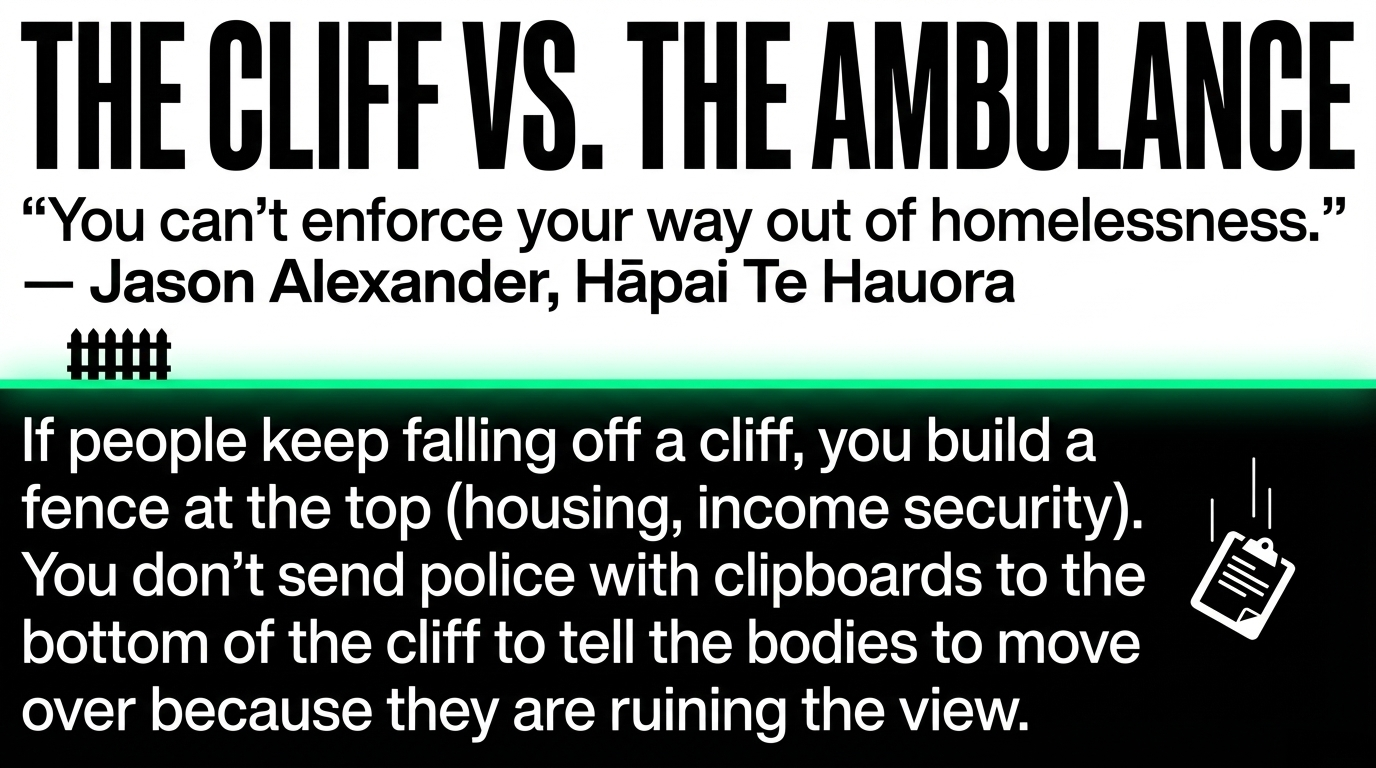
If people keep falling off a cliff, you put a sign — a barrier, a fence — at the top. You don't just keep dispatching ambulances to pick up bodies at the bottom. As Jason Alexander explained to RNZ: "With this policy, it's sort of like they've already fallen off the cliff — that's them being homeless — and now the police are coming along and asking them to move over a bit because we don't want to see it."
This government has not only failed to build the fence. It has cut the fence-building budget, fired the fence workers, privatised the land the fence would stand on, and is now issuing move-on orders to the bodies at the bottom of the cliff for lying in an inconvenient location.
The harm, quantified: Treasury forecasts project child poverty on an after-housing-costs measure will reach 18.4% by 2029 — nearly double the Government's own 10% target for 2028. Not one child poverty target was met in 2025. The Government chose landlords.
The solution: Invest in kaupapa Māori-led Housing First programmes, which the evidence shows deliver superior outcomes for Māori clients in addressing chronic homelessness — not criminality, not paperwork, not aesthetics.
Te Āhua Tikanga — What This Destroys That You Cannot Put a Dollar Value On
For the Western mind that requires tikanga explained in translatable terms, hear this carefully.
In te ao Māori, kāinga is not just a house. It is the physical, spiritual, relational and ancestral centre of a person's identity. Kāinga is where you are from. It is where your dead are buried. It is where your living know to find you. It is where manaakitanga — the ethic of hospitality, care, and generosity toward others — is practiced and transmitted to the next generation.
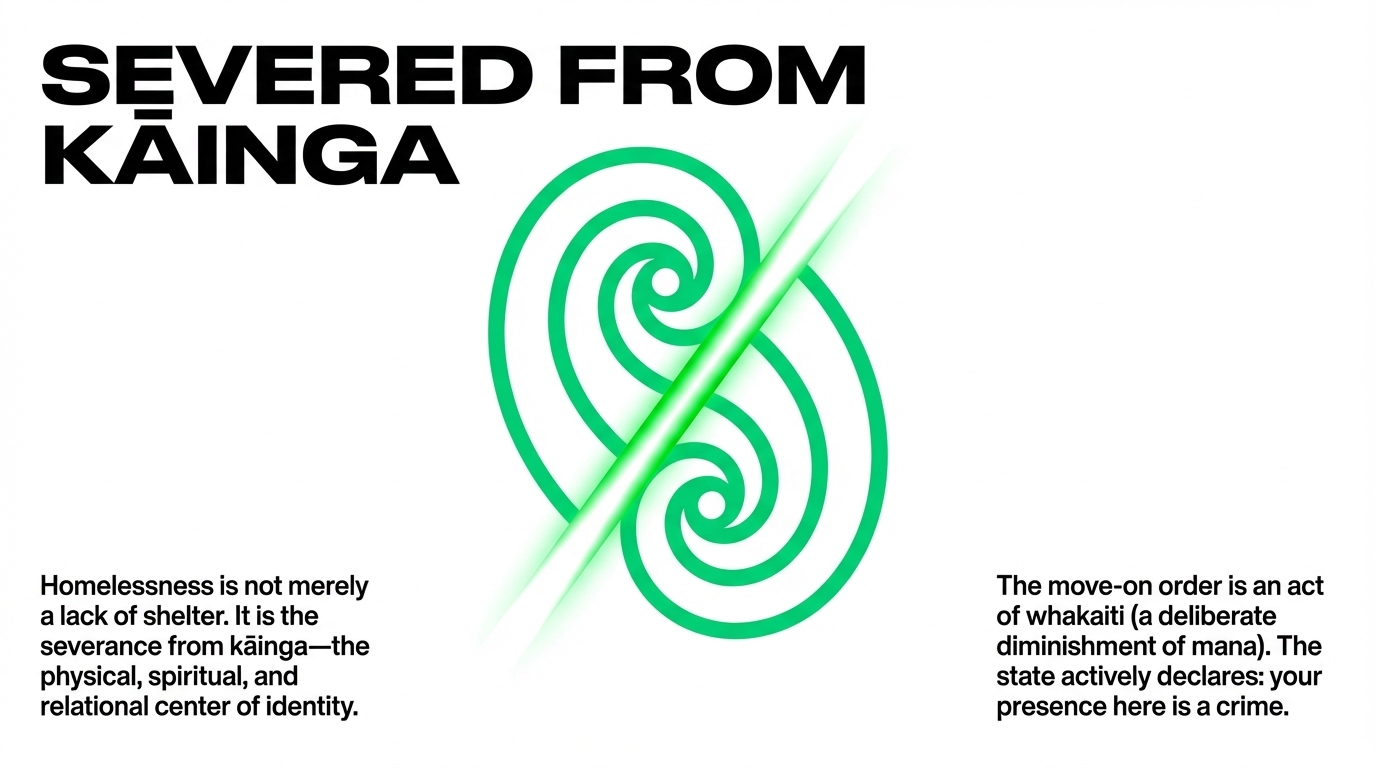
When a child is made homeless, they are not merely without shelter. They are severed from kāinga. They are cut from the whakapapa chain that tells them who they are, where they belong, and what obligations they carry to others. They lose access to the tikanga that would otherwise transmit values, skills, language, and belonging. The child becomes ngaro — lost. Not metaphorically. Existentially.
When the state then issues a move-on order to that child, it does not merely fail to help.
It actively declares: this child's presence is a crime. The state thus becomes a second instrument of severance — after the housing crisis severs the child from kāinga, the police order severs them from public belonging itself. There is nowhere left to exist.
Research by Māhera Maihi, CEO of Mā te Huruhuru Charitable Trust, which runs kaupapa Māori youth housing, illuminates the alternative:
"Young people who come in, they are in the space of tapu — tapu meaning that they've got restrictions on them, restrictions because they are our taonga... it is to keep them safe and keep the whare safe."
This is what the state refuses to fund at scale. It prefers a clipboard.
The move-on order is, in tikanga terms, an act of whakaiti — a deliberate diminishment of mana. It is the state telling our rangatahi: you have no mana here. You have no right to exist here. Move. And it is delivered by a government that simultaneously gutted the Māori Housing kaupapa funding model, restructured Kāinga Ora into a liability-management operation, and delivered a budget in which not one child poverty target was met.
This is not incompetence. This is the policy. The dispossession is the plan.
He Hononga Huna — The Hidden Connections
The Ring does not miss coincidences. It traces whakapapa.
Connection One: The move-on orders were announced in February 2026 — the same period in which homelessness-related calls to Wellington, Auckland and Tauranga councils reached multi-year highs. The government did not respond to the data with housing investment. It responded with police powers. Aesthetics over outcomes.
Connection Two: Māori home ownership has fallen from 71% in 1936 to likely below 40% today. The acceleration of this collapse correlates directly with the 1991 "Mother of All Budgets" — Ruth Richardson's neoliberal demolition of the welfare state. The same ideological lineage that produced that budget now sits in the Beehive, wearing Luxon's suit.
Connection Three: Justice Minister Goldsmith — the minister responsible for these orders — is the same minister whose office deliberately dodged Parliamentary rules to insert provisions into the Crimes Amendment Bill that had been ruled out of scope. This is a man who uses legislative process as a weapon. His move-on orders are consistent with a pattern of using law to harm the most vulnerable while protecting the most powerful.
Connection Four: The Salvation Army's December 2025 homelessness briefing warned of worsening homelessness trends nationwide. The government's answer — announced two months later — was not housing. It was a clipboard and a fine.
Connection Five: The rental discrimination research cited by Hāpai Te Hauora reveals that applicants with Māori-identifying names receive fewer responses from landlords. Structural racism in the rental market drives disproportionate Māori housing deprivation. The government does not address rental discrimination. It targets the people the rental market already rejected.
Ngā Tuhinga o Mua — Previous Essays by The Māori Green Lantern
This is not the first time the Ring has been wielded against the machinery grinding our whānau into the dirt. Previous essays from The Māori Green Lantern on adjacent kaupapa include:
- "The NZ Neoliberal Pantomime: Why Every Major NZ Party Serves the Same Masters — and the Wealth Tax That Would End the Charade" (5 March 2026) — which traces the ideological architecture behind policies exactly like this one, demonstrating that the move-on order is not an anomaly but a product of a system designed to protect capital and manage the visible poor. Available at themaorigreenlantern.maori.nz.
He Ara Whakamua — The Rangatiratanga Response
This government will not fix this. That is not a pessimistic forecast. It is an empirical observation. The ideological DNA of this administration — the same neoliberal whakapapa that gave us the Mother of All Budgets, Kāinga Ora's gutting, benefit cuts, and now move-on orders — does not contain the instructions for housing the poor. It contains the instructions for hiding them.
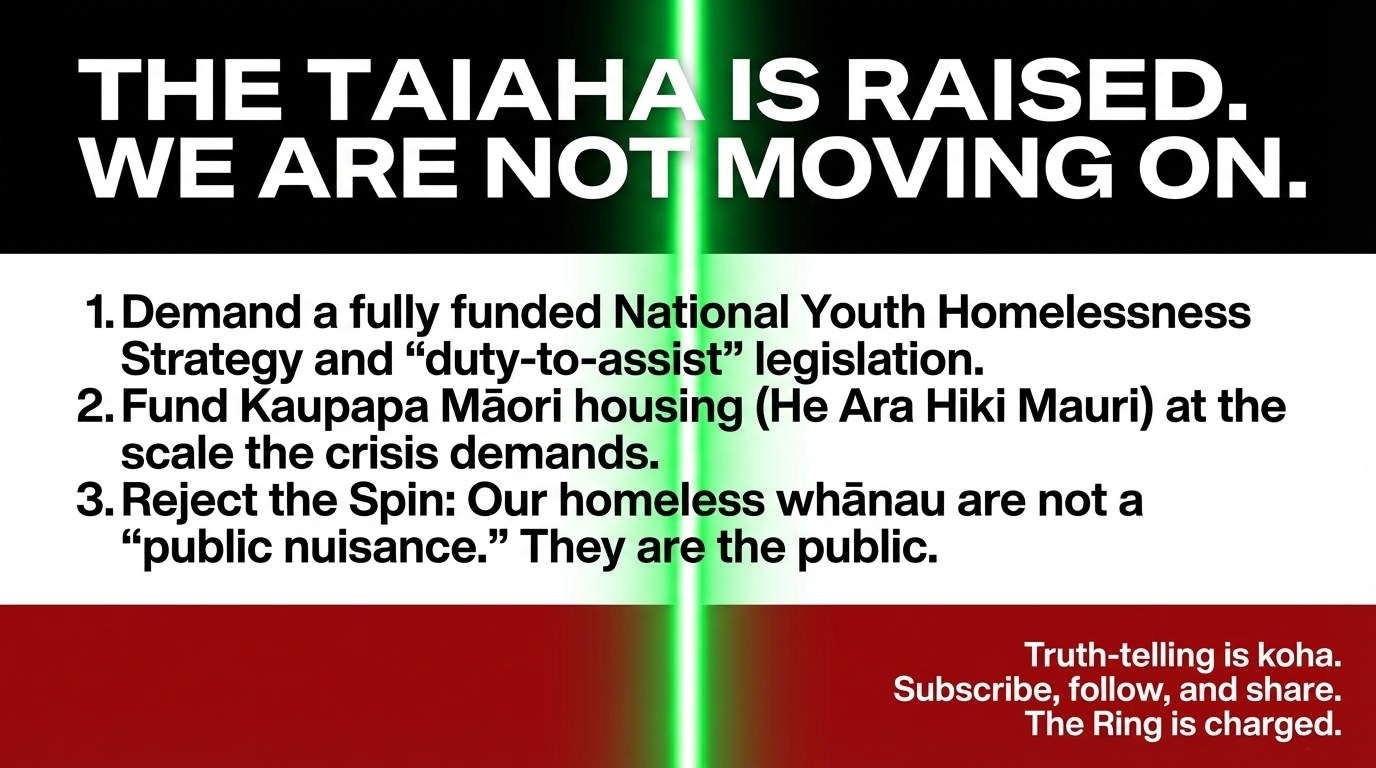
So here is what rangatiratanga demands instead:
- Demand the National Youth Homelessness Strategy, fully funded, with duty-to-assist legislation as Manaaki Rangatahi calls for
- Fund and scale kaupapa Māori housing providers — He Pā Piringa, Mā te Huruhuru, He Ara Hiki Mauri — at the level the crisis demands, not at the level that is politically convenient
- Oppose the Summary Offences Act amendment at select committee — submit, organise, and name every politician who votes to criminalise a 14-year-old for sleeping rough
- Reject the framing that our homeless whānau are a public nuisance. They are the public. As Jason Alexander said: "They're part of us as much as anyone else is."
The cliff is the housing market. The fence is public housing, income security, and rental regulation. The sign at the top is investment in whānau before crisis strikes. And this government — this mean-spirited, aesthetically-obsessed, whānau-harming government — refuses to build the fence. It just keeps issuing orders to the bodies at the bottom.
He Koha — For Those Who Know the Value of Truth-Telling
While this government moves our homeless whānau on from public view, it will not move the truth from these pages. Every move-on order issued to a cold 14-year-old on a Tauranga footpath is a data point this mahi will record. Every Māori whānau shuffled out of sight so Goldsmith's donors can eat undisturbed is a harm this Ring will name.
That work costs time, aroha, and resources the Crown will never provide — because the Crown is the subject of the investigation.
Every koha signals that whānau are ready to fund the accountability the Crown refuses to deliver. It signals that our truth-tellers will not be moved on. If you believe the 60,000 Māori who are homeless deserve a voice louder than a police clipboard, here is how you stand with this mahi:
Support this mahi directly with a koha:
Koha — The Māori Green Lantern
Subscribe and receive essays directly:
Subscribe to The Māori Green Lantern
Direct bank transfer:
HTDM | 03-1546-0415173-000
If koha is not possible — no worries, no shame, no conditions. Subscribe. Follow. Share with your whānau and friends. Forward this essay to every person who still believes Goldsmith when he says he's not criminalising homelessness. Sharing is koha. Kōrero is koha. Waking people up is koha.
Kia kaha, whānau. The Ring is charged. The taiaha is raised. And we are not moving on.

Ivor Jones The Māori Green Lantern Fightng Misinformation And Disinformation From The Far Right
Research conducted 8 March 2026. All URLs verified at time of publication. Sources: RNZ | 1News | Stats NZ | HUD Homelessness Insights | BuildingBetter NZ | Beehive | Salvation Army | Centrist NZ